The Best Accounting Software for Small Churches a Complete Guide
Discover the best accounting software for small churches in this complete guide. We compare top solutions to help you master stewardship and financial clarity.
For a small church, the best accounting software isn’t just a nice-to-have; it’s a core tool for stewardship and transparency. That’s why purpose-built fund accounting software like Grain Ledger is so critical. Trying to make generic software like QuickBooks work often leads to messy workarounds, compliance headaches, and a cloudy financial picture.
See Grain Ledger for your church
Fund accounting, giving integrations, and bank reconciliation in one platform. Free migration support for churches switching from QuickBooks or Aplos.
Why Generic Software Fails Your Church's Mission
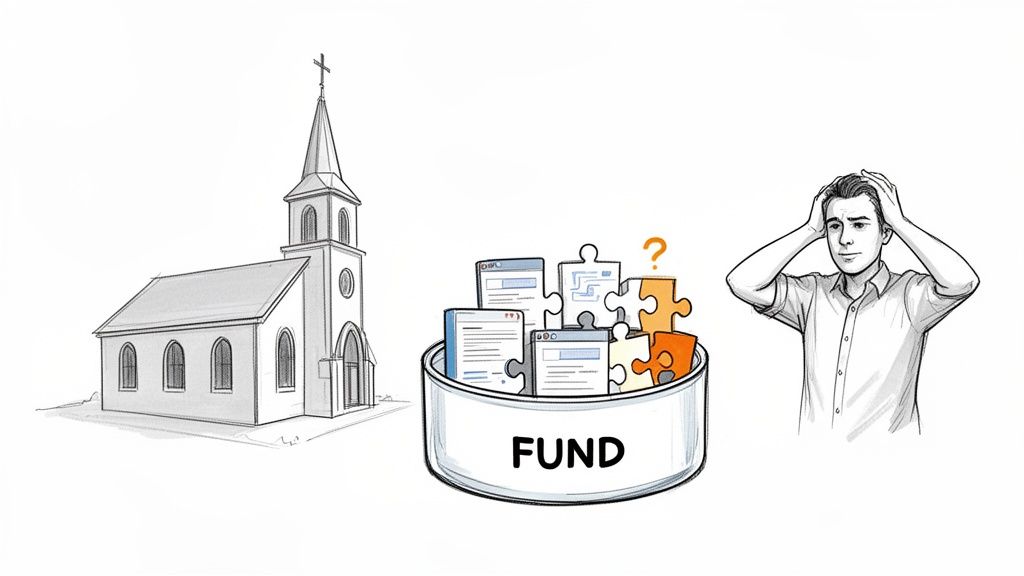
If you’re a church treasurer or administrator, you know the frustration of trying to shoehorn a for-profit accounting tool into a ministry’s financial model. It always feels like forcing a square peg into a round hole. While platforms like QuickBooks are fantastic for businesses, their entire logic is built around profit and loss—a concept that just doesn’t fit a church’s mission of stewardship.
This fundamental mismatch creates problems right away. It forces well-meaning volunteers to create complicated, manual systems just to keep track of designated funds. The heart of the issue is that churches don't earn profits; they manage resources given in trust for specific kingdom work.
The Critical Need for Fund Accounting
The key difference comes down to one thing: fund accounting. This method treats every source of designated income—whether it's the general budget, a missions fund, or a capital campaign—as its own separate, self-balancing financial entity. It's not about just tagging an expense; it’s about making sure the money donated for youth camp is only ever used for youth camp.
Generic software simply wasn't designed for this. It tries to approximate it with features like "classes" or "tags." While that might seem like a decent solution on the surface, it’s a flimsy patch that can hide some serious problems down the road.
Forcing a business accounting system on a church is like using a hammer to turn a screw. It might get the job done with enough effort, but it risks stripping the threads and compromising the integrity of the structure. True fund accounting is the screwdriver—the right tool for the job.
This workaround approach makes it nearly impossible to generate clear, accurate reports that show the true financial health of each individual fund. For a church, this isn't a minor inconvenience. It's a direct threat to the transparency and trust you’ve built with your congregation. You can see a deeper dive into these challenges in our guide on the limitations of QuickBooks for churches.
Real-World Scenarios Where Generic Tools Fall Short
Think about these everyday situations that show just how wide the gap is between for-profit software and ministry needs:
- Designated Offerings: A family donates $500 specifically for the food pantry. In a generic system, you might record it as general income and add a "food pantry" tag. The problem is, the software still sees that $500 as unrestricted cash, creating a very real risk that it could be accidentally spent on the electric bill.
- Mission Trip Funds: The youth group raises $5,000 for its summer mission trip. Trying to track donations, payments from students, and all the related expenses against that $5,000 goal becomes a tangled mess of spreadsheets and manual calculations—a process just begging for errors.
- Board Reporting: When a board member asks, "How much do we have left in the building fund?", a generic system can't give a straight answer. Instead of a clean Statement of Financial Position for that fund, you're left trying to piece together a story from a long list of tagged transactions.
These examples make it clear that using the wrong tool does more than create extra work; it erodes the very foundation of good stewardship. A system that can’t properly segregate funds risks breaking the trust your donors have placed in your ministry. Software built for church accounting, like Grain Ledger, eliminates these risks from day one.
What To Look For in True Church Accounting Software
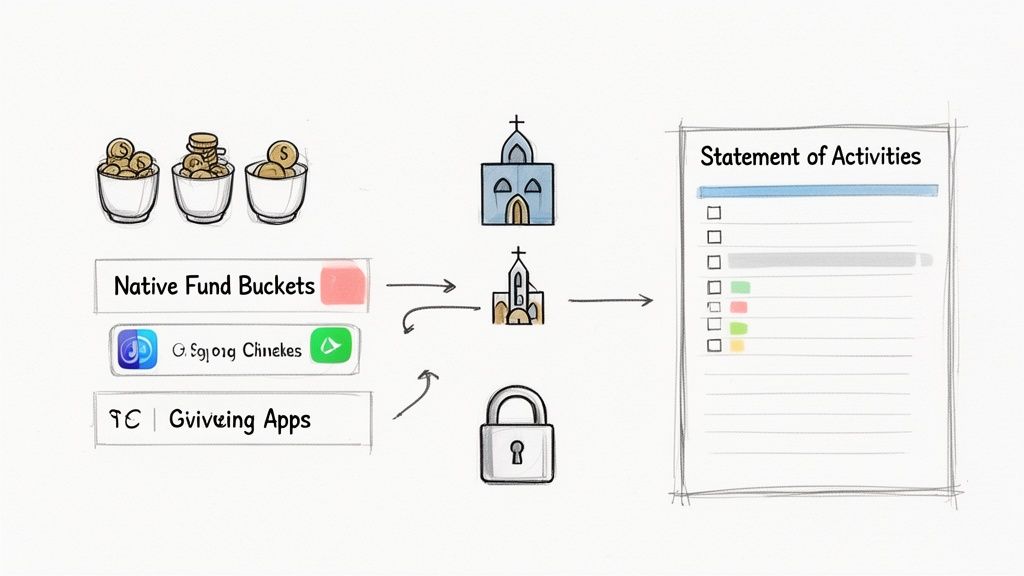
When you start looking for accounting software for a small church, it's easy to get lost in a sea of features. The key is to zero in on what’s truly mission-critical—the capabilities that will actually help you manage donations efficiently and maintain the trust of your congregation.
The biggest differentiator is a system built around true fund accounting, not one that just uses tags or classes as a workaround. A proper fund-based architecture treats each fund as its own self-balancing financial entity, which is exactly how church finances operate in the real world.
That's why Grain Ledger was designed with funds at its very core. There are no patchwork solutions here. When a donation comes in, volunteers and staff see fund balances update automatically and accurately.
- Clear Segregation: Each fund maintains its own distinct assets and liabilities without needing manual tagging.
- Self-Balancing Ledgers: The software automatically ensures debits and credits match within each fund, preventing errors from the start.
What Native Fund Architecture Really Means
A native fund architecture isn't just an abstract concept; it has real-world implications for your day-to-day operations. It's the difference between a system that works for your church and one you have to constantly work around.
Think about how much time is wasted on manual data entry. A system with a native fund architecture like Grain Ledger can automate syncing with your giving platforms, like Pushpay or Planning Center, drastically cutting down on administrative work.
Direct bank integration is another game-changer. Imagine your ACH, credit card, and checking account transactions updating daily without you having to lift a finger. That’s what seamless integration does—it speeds up reconciliation and nearly eliminates costly errors.
Seamless Donation and Bank Integration
Robust internal controls are non-negotiable, especially when handling restricted gifts. You absolutely cannot risk accidentally spending designated funds on general operations. Grain Ledger applies permission layers and detailed audit trails directly at the fund level, safeguarding every dollar.
And when it's time to report to the board, your software needs to speak their language. Grain Ledger instantly generates the Statement of Financial Position and Statement of Activities with the fund-level detail they need to see.
“A system that automatically allocates each dollar by fund removes manual errors and builds trust with your congregation.”
The demand for this level of financial clarity is growing. The Church Accounting Software Market reached USD 2.85 billion in 2024 and is projected to hit USD 5.95 billion by 2033, reflecting an 8.6% CAGR. Adoption among small to medium churches is climbing by 12% annually. Read the full research about church accounting software market growth
A Framework for Your Feature Checklist
To keep your evaluation process focused, use this checklist as a guide. It covers the essentials that separate genuinely helpful software from generic accounting tools.
- Fund-Based Architecture: Does it have built-in support for separate, self-balancing fund ledgers?
- Integration Depth: How well does it connect with your giving platforms and bank feeds?
- Reconciliation Tools: Can it automate matching and flag exceptions for you?
- Reporting Suite: Does it produce board-ready statements and custom reports by fund?
- Internal Controls: Can you enforce roles, permissions, and audit logs by fund?
- Pricing & Migration: Are the costs clear, and will they help you import your data?
For a more detailed look at these criteria, check out our guide on fund accounting software for churches.
Measuring Impact with Clear Reports
Great reporting tells a story. Detailed cash flow reporting, for instance, helps your board understand your church's liquidity at a glance. Grain Ledger presents fund-level cash flow statements that clearly show the inflows and outflows for each ministry and program.
You should also be able to filter activity reports by date range, fund, contributor, or specific campaign. This kind of flexibility is invaluable for grant applications and preparing stewardship updates for your members.
| Feature | Native Fund System (Grain Ledger) | Tag-Based System |
|---|---|---|
| Fund Segregation | Built-in separate ledgers | Requires custom tags and filters |
| Audit Trail | Automatic per fund | Manual reconciliation needed |
| Reporting Clarity | Board-ready by fund | Complex filtering |
Any system that relies on tagging instead of true fund records creates extra work and can obscure your real financial position. Grain Ledger was built to avoid this mess entirely, reflecting fund activity automatically and accurately.
- Assign clear roles for fund managers with limited permissions.
- Use audit logs to track every change and ensure accountability.
- Review exception reports weekly to catch any potential errors early.
By focusing on these essential features, you can find a solution that streamlines your finances and upholds the highest standards of stewardship. Grain Ledger brings this entire checklist together in one intuitive platform, making it the best accounting software for small churches that need clarity and control.
How Different Software Models Handle Church Finances
Picking the right accounting software for your church really boils down to understanding how each type of tool is built from the ground up. They aren't all created equal, and their core designs have a massive impact on your day-to-day work, the accuracy of your reports, and your overall financial peace of mind.
To see how this plays out in the real world, let's go beyond a simple feature list. We'll walk through a common scenario: a donor gives a $100 gift specifically for the youth ministry's upcoming mission trip. Now, let’s see how three different software models handle this single, straightforward transaction.
The Workaround in Generic Business Software
In a tool like QuickBooks, which is built for for-profit businesses, there's no built-in concept of a "fund." The entire system is designed around a single pot of money. To track our $100 youth ministry donation, your treasurer or volunteer has to invent a manual workaround.
Most often, they’ll use a feature called "classes" to try and make it work. Here's what that looks like in practice:
- Step 1: The $100 is recorded as general income.
- Step 2: The volunteer must remember to manually tag the transaction with the "Youth Ministry" class.
- Step 3: To see the fund's balance, the treasurer has to run a "Profit & Loss by Class" report and then manually check that number against a separate spreadsheet where the real fund balance is tracked.
This process is a recipe for human error. If someone forgets to apply that class tag, the $100 just gets mixed into the general fund, and its designation is completely lost. Your main balance sheet won't show that $100 is restricted—it will only show you have more cash, creating a huge risk of accidentally spending money that was promised for something else.
An Improvement with General Non-Profit Software
General nonprofit software is definitely a step in the right direction. These platforms at least understand the basic need to keep funds separate and offer more than just a simple tag. The catch is that they're built to serve everyone from animal shelters to museums, not specifically churches.
Processing our $100 donation is a bit cleaner here:
- Step 1: When entering the donation, there’s a dropdown menu to select the "Youth Ministry Fund."
- Step 2: The system can then generate a report showing the balance for that specific fund.
This is a big improvement, as the fund is actually part of the system. But it's still not seamless. These platforms rarely connect directly with church-specific giving tools like Pushpay or Planning Center, which means someone is still stuck downloading spreadsheets and re-entering donation data by hand. The reports, while better, often don't match the Statement of Activities format that church boards and finance committees expect.
A key differentiator emerges in the workflow itself. Any system that requires manual data entry and fund selection for every single transaction introduces friction and increases the likelihood of mistakes, no matter how dedicated the volunteer.
The Purpose-Built Approach for Churches
This is where a solution like Grain Ledger changes the entire equation. It was designed from its very foundation for how churches actually operate, so the system thinks in funds automatically.
Here’s how our $100 donation is handled in a purpose-built system:
- Step 1: The donation, made through your online giving platform, is automatically synced into the ledger. Because the giving platform already tagged it for the "Youth Ministry Fund," Grain Ledger reads that data instantly. No manual entry needed.
- Step 2: The software automatically allocates the $100 to the Youth Ministry Fund’s own self-balancing ledger. The general fund is never even involved.
- Step 3: The church's Statement of Financial Position updates in real time. Anyone with permission can immediately see that total cash is up by $100, and a corresponding $100 liability has been added to the Youth Ministry Fund, walling it off so it can’t be spent on anything else.
The difference isn't just about saving a few clicks—it's about designing a system that prevents human error and ensures good stewardship from the start. What was a multi-step manual chore becomes a simple review of an automated transaction. For small churches relying on volunteers with limited time, that efficiency is everything. Grain Ledger transforms a risky manual process into an error-proof workflow, delivering the clarity and confidence every church deserves.
Software Model Feature Comparison for Small Churches
To make the differences even clearer, this table gives a side-by-side analysis of how each software type handles the core accounting needs of a church. It’s designed to help you identify which model is the best fit for your ministry's size, complexity, and stewardship goals.
| Feature | Generic Business Software (e.g., QuickBooks) | General Non-Profit Software | Purpose-Built Church Software (e.g., Grain Ledger) |
|---|---|---|---|
| Fund Accounting | Not native. Requires manual workarounds with classes or tags, which is prone to error. | Basic fund tracking is available but may lack the depth needed for church designations. | Built-in, automated fund accounting. Every fund is a self-balancing sub-ledger. |
| Integrations | Connects to banks and business apps, but lacks direct sync with church giving platforms. | Limited church-specific integrations. Often requires manual import/export of donation data. | Direct, automatic integrations with major church giving platforms and ChMS. |
| Reporting | Standard business reports (P&L, Balance Sheet). Church-specific reports require manual creation. | Offers standard nonprofit reports (Statement of Activities), but may not be church-centric. | Automated, church-specific reports (e.g., Statement of Financial Position) out of the box. |
| Financial Controls | Designed for business workflows. Lacks controls to prevent spending of restricted funds. | Better controls than business software but may not be as robust for church-specific needs. | Strong internal controls prevent restricted funds from being spent on general expenses by design. |
| Ease of Use for Volunteers | Can be complex for non-accountants due to workarounds and accounting jargon. | Generally more intuitive but still requires significant manual data entry and reconciliation. | Designed for volunteers. Automation minimizes manual tasks and reduces the learning curve. |
| Pricing Model | Often subscription-based with tiers. Can become expensive as you add necessary features. | Varies widely, from affordable to enterprise-level pricing. | Typically priced for ministry budgets, offering all-inclusive features without complex tiers. |
Ultimately, the best choice depends on your church’s reality. While a generic tool might seem cheaper upfront, the hidden costs of manual work, potential errors, and lack of clarity can be significant. A purpose-built solution like Grain Ledger aligns with your mission from the start, ensuring your financial stewardship is as strong as your faith.
How Grain Ledger Solves Church Accounting Challenges
After looking at the different software models, the benefits of a purpose-built system really stand out. Generic tools force you into clumsy, error-prone workarounds, and even general nonprofit software doesn't quite get the specific integrations and reporting churches need. This is exactly the gap Grain was designed to fill—not by tweaking business software, but by building a solution from the ground up for ministry finance.
Grain Ledger directly tackles the core challenges that frustrate church treasurers and volunteers. The philosophy behind it is simple: the software should adapt to the church's needs, not the other way around. This entire approach is built on a foundation of true fund accounting.
The infographic below really drives home the fundamental differences in software models and shows why a specialized approach is so much better for ministry.
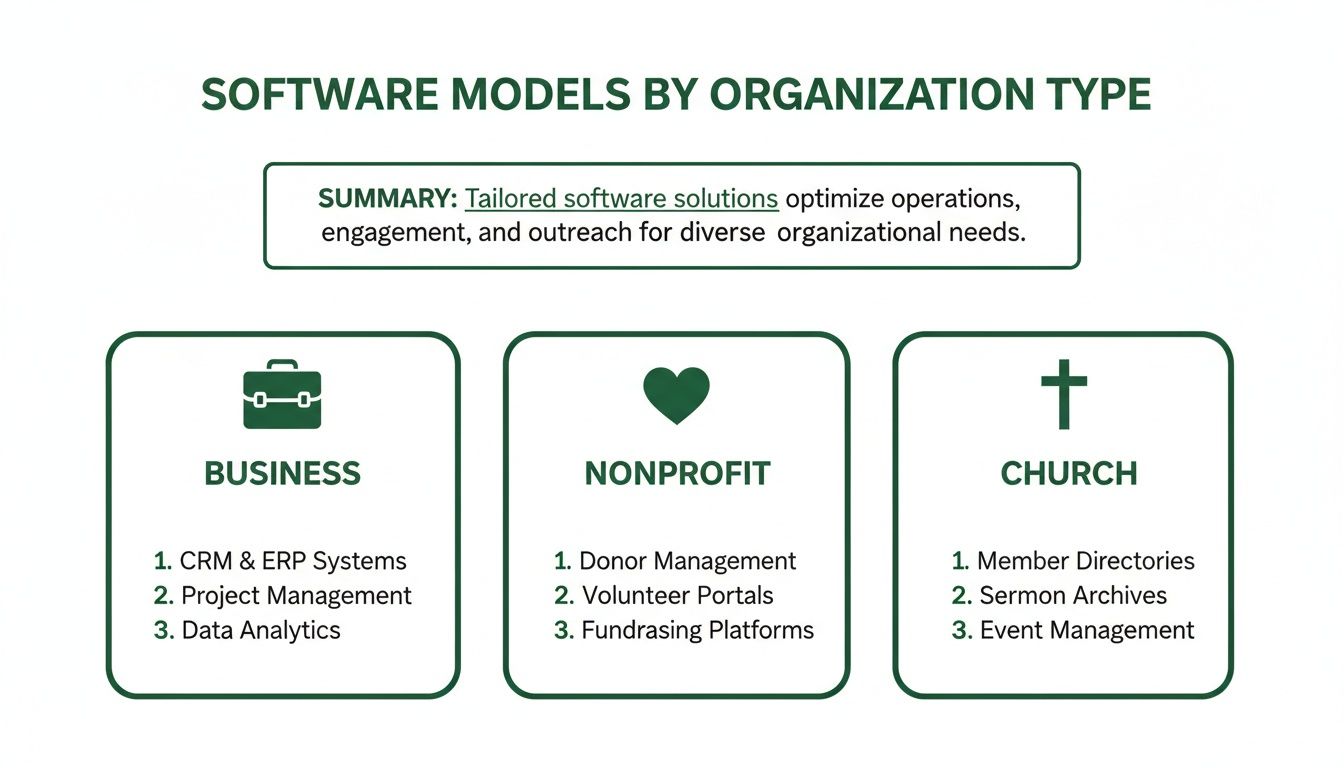
As you can see, business software is all about profit, and general nonprofit software is geared toward broad mission tracking. Church-specific software, however, is laser-focused on the detailed stewardship of designated funds.
Native Fund Architecture Eliminates Manual Work
The biggest difference-maker in Grain Ledger is its native fund architecture. This isn't just a feature; it's baked into the system's DNA. Unlike platforms where you have to manage funds with tags or classes as an afterthought, every single transaction in Grain Ledger is fund-aware from the moment it’s created.
So, what does that look like in the real world? It means that when a donation comes in for the "Building Fund," the software doesn't just slap a label on it. It actually records that income within a separate, self-balancing ledger dedicated only to that fund.
This structure makes it impossible to accidentally mix restricted and unrestricted cash. The system itself enforces the financial integrity your congregation expects, acting as a powerful safeguard for good stewardship.
Automated Integrations That Save Volunteer Hours
Small churches run on the hard work of volunteers, and their time is a precious commodity. Grain Ledger honors that by automating the most time-consuming financial tasks. The system integrates directly with leading church giving platforms like Pushpay, Planning Center, and Stripe.
This seamless connection creates an incredibly efficient workflow:
- A congregant gives online and designates their gift to the "Missions Fund."
- Grain Ledger automatically syncs this transaction, reads the fund designation, and records the donation in the correct fund ledger.
- The bank feed integration then confirms the deposit, making reconciliation a quick check-off.
What used to involve downloading CSV files, tedious data entry, and cross-checking spreadsheets now happens automatically. This kind of automation can easily save a church treasurer 5-10 hours every single month, freeing them up to focus on financial analysis and strategy instead of mind-numbing clerical work.
By making fund accounting the default, Grain Ledger shifts the burden of compliance from the volunteer to the software. It automates stewardship, ensuring every dollar is tracked to its intended purpose without requiring constant manual oversight.
This deep level of integration is a core reason why Grain Ledger is often considered the best accounting software for small churches. It truly respects the reality of a volunteer-led finance team.
Built-in Controls to Safeguard Restricted Funds
Maintaining the trust of your donors is absolutely paramount. When someone gives to a specific ministry, they have a legal and moral expectation that their money will be used for that purpose alone. Grain Ledger's architecture provides built-in controls to ensure this promise is always kept.
Because each fund operates as its own mini financial entity, the system can instantly show you the available cash balance for that specific fund. This prevents a common but serious mistake: looking at the total bank balance and assuming all of it is available for general expenses.
For example, your church's bank account might have $20,000, but $15,000 of that is restricted for the new roof. Grain Ledger will clearly show that only $5,000 is actually available for operational spending. This clarity prevents the accidental "borrowing" from restricted funds that can lead to major compliance issues and erode trust.
Clear Reporting That Builds Congregational Trust
Finally, transparency is the bedrock of a healthy church. Your board, pastor, and congregation need to see financial reports that are clear and easy to understand. Grain Ledger produces these reports instantly, formatted in the way church leaders actually think.
Instead of a generic "Profit & Loss" statement from a business tool, you get a Statement of Activities broken down by fund. Instead of a confusing balance sheet, you get a Statement of Financial Position that clearly outlines the assets and liabilities of each designated fund.
This reporting clarity does more than just satisfy your board; it builds a culture of trust. When congregants can see exactly how their tithes and offerings are fueling the mission, their confidence and generosity grow. Grain Ledger delivers this financial transparency, turning your accounting from a back-office chore into a powerful ministry tool.
Your Guide to a Smooth Software Transition
Moving to a new accounting system can feel like a monumental task, especially when you’re relying on volunteer staff. The good news is that with a solid plan, what seems like a disruptive project can become a manageable and successful transition. A clear approach takes the mystery out of the process, cuts down on stress, and ensures your new software starts adding value right away.
Think of this as more than a technical switch. It's a genuine opportunity to strengthen your church's financial stewardship. With a bit of careful planning now, you can set your ministry up for better transparency and efficiency for years to come.
Assembling Your Evaluation Team
Before you even start looking at software demos, the first step is to pull together a small, focused evaluation team. This doesn't need to be a big committee; a group of 2-3 key stakeholders who really get the ministry's needs and its financial picture is perfect.
An ideal team usually includes:
- The Primary User: This is almost always the church treasurer or the main financial volunteer who will be in the software every day. You absolutely need their practical, hands-on insights.
- A Leadership Representative: Having the pastor or a finance committee chair involved makes sure the board's reporting needs are front and center.
- A Tech-Savvy Member (Optional): If someone in your congregation is comfortable with data and software, their perspective can be a huge help. But if you’re choosing an intuitive platform like Grain Ledger, this isn’t a must-have.
This small group has one simple mission: define what a "win" looks like. They need to map out the specific financial reports the board needs to see and pinpoint the biggest headaches in your current process that a new system must solve.
Scheduling Demos and Asking the Right Questions
Once your team knows what it’s looking for, it’s time to schedule some demos. When you’re seeing a platform like Grain Ledger in action, don’t just watch the feature tour. You need to ask questions that get to the heart of the implementation process itself. Your goal is to figure out how much support the company will actually give you during the switch.
Here are a few crucial questions to ask:
- Data Migration: How exactly do you help us import our existing data? Do you offer hands-on support, or do you just point us to a help article?
- Implementation Support: Will we have a dedicated person to call with questions during setup? What does your onboarding process really look like, step-by-step?
- Training: What kind of training do you provide for volunteers who might not be accountants?
A software provider’s commitment to a smooth onboarding process is just as important as the features themselves. A great tool is only effective if your team feels confident using it.
A vendor who gives you clear, supportive answers is looking for a partner, not just a sale. That’s a key difference when you’re trying to find the best accounting software for your church.
Your Simple Migration Checklist
With a solution picked out, you can build a straightforward project plan. A simple migration checklist keeps everyone on the same page and makes sure no critical steps get missed. While every church’s situation is a little different, most successful transitions follow these core steps.
- Export Your Historical Data: Pull your transaction history, donor lists, and vendor information out of your old system. Most software can export this data into a standard CSV file.
- Clean Up Your Chart of Accounts: Now is the perfect time to simplify and organize your chart of accounts for much better clarity. To see how to structure this foundational element, you can learn more about creating a solid nonprofit chart of accounts and why it's so important for accurate reporting.
- Choose a Go-Live Date: Pick a start date that lines up with a natural financial cutoff, like the beginning of a new month or quarter. This makes setting up your opening balances much cleaner.
- Enter Opening Balances: This is a critical step. Work with your new software provider’s support team to enter the starting balances for each of your funds. You have to get this right.
- Run Parallel for One Month (Optional): For extra peace of mind, you can run your old and new systems side-by-side for one month. This lets you confirm the numbers match perfectly before you fully cut over.
Choosing Software That Fuels Your Ministry's Future
Picking the right accounting software for your small church is about so much more than just balancing the books. Think of it as a decision that directly affects your ability to carry out your mission with integrity and focus. The right technology can transform your finances from a source of stress into a powerful tool for stewardship, freeing up your team to concentrate on ministry, not manual data entry.
Purpose-built tools like Grain Ledger are designed to deliver true accountability. They give you the clear, accurate, fund-specific reports you need to build unwavering trust with your board, your pastor, and your entire congregation. This kind of financial clarity ensures every dollar is honored and put toward its intended purpose—a clear reflection of your commitment to responsible oversight.
A Partner in Your Ministry
At the end of the day, your accounting software shouldn't just be another program; it should feel like a dedicated partner in your ministry’s journey. It needs to provide the confidence and financial insight required to make faithful, forward-looking decisions for your community. This is where a solution designed from the ground up for church finance becomes indispensable.
Choosing the right software is an act of stewardship in itself. It’s an investment in transparency, efficiency, and the long-term health of your ministry, ensuring your resources are always aligned with your mission.
We created Grain Ledger to be that partner. It offers the financial clarity you need to lead with integrity, turning complex accounting tasks into simple, automated workflows. By safeguarding restricted funds and delivering instant, easy-to-understand reports, Grain Ledger empowers you to spend less time on administration and more time fueling your ministry's future.
Ready to lead with greater financial confidence? Find out how Grain Ledger can serve your specific congregation and strengthen your stewardship.
Frequently Asked Questions
When pastors, treasurers, and finance committees start looking for the right accounting software, a lot of questions come up. Getting clear answers on everything from volunteer usability to the nitty-gritty of fund accounting is key to making a choice you can stand behind. Here are some of the most common questions we hear.
Can Our Church Volunteers Easily Learn This Software?
Yes, absolutely. Modern church accounting software like Grain Ledger is built with volunteers and non-accountants in mind. Unlike generic business software that can be overwhelming, the entire system is designed around church-specific tasks like tracking donations and running fund reports. This makes it far more intuitive from day one and dramatically shortens the learning curve.
The whole point of software built for ministries is to take the complexity out of the equation. By automating the tricky parts and showing you the financial picture in a clear, ministry-focused way, your volunteers can step in and manage the books with confidence, no accounting degree required.
What Is the Real Difference Between QuickBooks Classes and True Fund Accounting?
This is a really important question, and the distinction is critical. Using "classes" in QuickBooks is essentially a workaround—it just puts a label on a transaction. True fund accounting software, on the other hand, creates a completely separate and self-balancing set of books for each fund, whether it’s your General Fund, Building Fund, or Missions Fund.
This structure makes it impossible to accidentally spend restricted money on general operating expenses. It's a fundamental safeguard for compliance and stewardship that a simple tagging system just can't provide. With true fund accounting, you know your reports reflect the financial reality of each fund, not just an estimate.
How Much Should a Small Church Budget for Accounting Software?
Prices can vary quite a bit, but most small churches should plan for a subscription that costs somewhere between $30 and over $100 a month. The key is to look past the sticker price and consider the total value you're getting. For example, a solution like Grain Ledger is priced for ministry budgets while including all the critical features you need. Think about the hours your team will save with automation, the improved accuracy of your reports, and the confidence that comes with knowing your finances are transparent and compliant.
Investing in the right tool often pays for itself by preventing expensive mistakes and, more importantly, freeing up your team to focus on ministry.
Ready to bring clarity and confidence to your church’s finances? Grain Ledger was built from the ground up to provide true fund accounting for ministries just like yours. Discover how our purpose-built software can strengthen your stewardship today.
Ready to simplify your church finances?
Schedule a demo to see Grain Ledger in action, or sign up for product updates.