A Practical Guide to Bookkeeping for a Church
Master bookkeeping for a church with this practical guide. Learn fund accounting, track donations, and create clear financial reports for your ministry.
Bookkeeping for a church is all about tracking donations, managing expenses, and—most importantly—honoring the intent behind every gift. It’s a ministry of stewardship. The secret lies in fund accounting, a system that keeps money organized by its designated purpose, not just lumped together like in a for-profit business. This is how you make sure that money given for missions is only ever spent on missions.
About Grain Ledger: This guide includes Grain Ledger, church fund accounting software built for designated gifts and ministry funds. It connects giving platforms (Planning Center, Pushpay, Tithely, Stripe), syncs bank activity with Plaid, and produces fund-level financial reports. Schedule a demo to see how it compares for your church.
See Grain Ledger for your church
Fund accounting, giving integrations, and bank reconciliation in one platform. Free migration support for churches switching from QuickBooks or Aplos.
Why Standard Accounting Fails Your Church
Have you ever tried to manage your church’s finances with standard business software and felt like you were forcing a square peg into a round hole? You’re not alone. The problem is that your church isn't a business chasing profits; it’s a ministry focused on stewardship.
A typical company’s accounting asks one simple question: "Are we profitable?" But for a church, the question is entirely different: "Are we being faithful stewards of the resources God has entrusted to us?" This fundamental shift from a profit motive to a stewardship mindset changes absolutely everything.
The Problem with a Profit-and-Loss Mindset
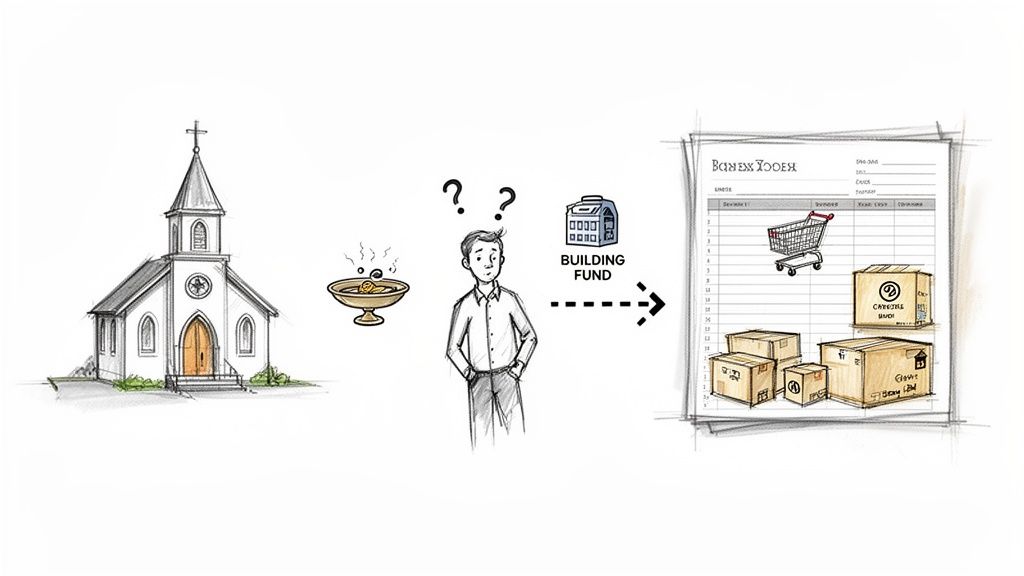
Standard accounting software is built around a Profit and Loss (P&L) statement. It’s designed to track total income versus total expenses to see if you made money. While that works perfectly for the local coffee shop, it gives a seriously distorted picture for a church.
Let’s say your congregation generously donates $50,000 to a designated building fund. In a standard system, that cash infusion looks like a massive income spike, making the church seem incredibly "profitable" that month. But that money isn't profit. It's a restricted resource with a single, dedicated purpose—it can’t be touched for utility bills or staff salaries.
A standard P&L statement completely hides this critical detail. It mashes all income together, offering a dangerously incomplete view of your true financial health. This leads to some common, and serious, frustrations:
- No Real Clarity: Leaders see a big number in the bank account but can't easily tell how much is actually available for general operations versus how much is legally and ethically locked away.
- Clumsy Workarounds: The church treasurer ends up creating complicated spreadsheets or using confusing "classes" and "tags" to try and simulate funds. This just invites human error and makes reports a nightmare to read.
- Bad Decision-Making: Without a clear view of available, unrestricted money, leadership can accidentally overspend, dipping into restricted funds to cover day-to-day shortfalls. This is a major breach of trust and can even have legal consequences.
Good bookkeeping for a church does more than just balance the books; it builds a culture of trust where generosity can thrive. It gives pastors the peace of mind to focus on ministry, knowing every dollar is handled with integrity.
True Fund Accounting Is the Answer
The only way to get the financial clarity your ministry needs is with a system built for fund accounting. Unlike off-the-shelf business software, fund accounting systems are designed from the ground up to manage money based on its purpose. Every single transaction gets tied to a specific fund, whether that’s the General Fund, Missions Fund, or Benevolence Fund.
This approach delivers the transparency your ministry deserves. When a board member asks, "How much do we have for the youth retreat?" you can give them a precise, confident answer in seconds, no spreadsheet-digging required.
This is exactly why specialized software like Grain Ledger is so crucial for modern church bookkeeping. It eliminates the need for messy workarounds by providing a native fund structure. It makes sure every dollar is accounted for correctly, empowering you to lead with confidence and demonstrate faithful stewardship to your entire congregation. The rest of this guide will walk you through exactly how to build this solid financial foundation.
Setting Up Your Financial Foundation: Funds and Accounts
To get a true handle on your church's finances, you have to start with a solid foundation. This isn't just about tracking money; it's about telling a story of stewardship. The entire structure rests on two key pillars: a thoughtfully designed Chart of Accounts and a clear, simple fund structure.
Nailing these two things from the get-go will save you countless headaches and make it possible to report back to your congregation with confidence and clarity.
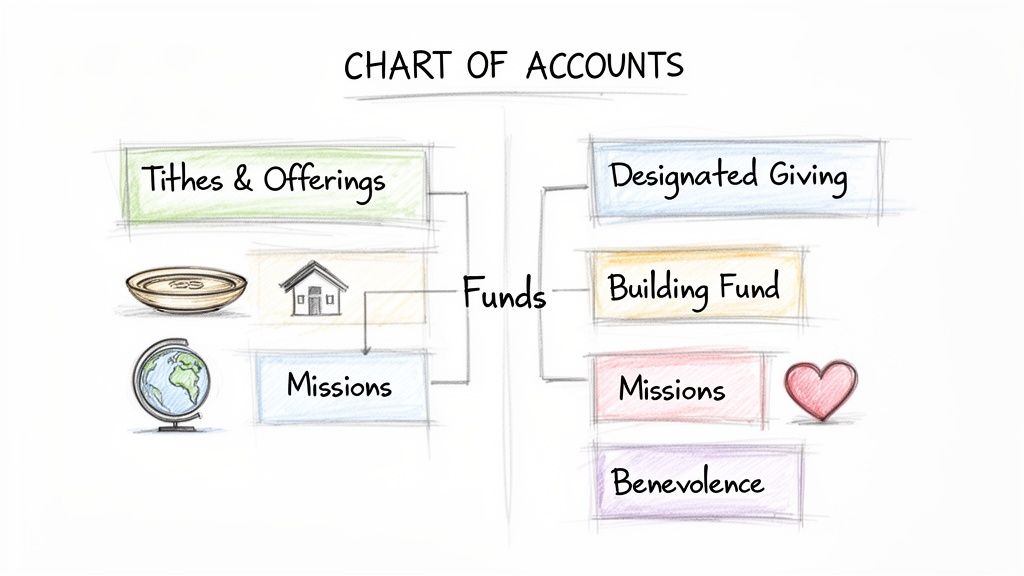
Resist the urge to just download a generic business template. Your church's financial backbone needs to reflect its ministry, not a retail shop. This structure is what turns raw financial data into meaningful insight for your leadership team.
Building a Chart of Accounts That Speaks Ministry
Think of your Chart of Accounts (COA) as the filing cabinet for your church's finances. It's the master list of every single account where money moves—what you own (assets), what you owe (liabilities), where money comes from (income), and where it goes (expenses).
A standard business COA with accounts like "Sales Revenue" is completely out of place here. You need accounts that actually describe what’s happening in your church.
For example, instead of a single "Income" line, you’ll get much better insight with specific accounts like:
- Tithes & General Offerings: This is your main bucket for undesignated gifts that keep the lights on and fund daily operations.
- Designated Giving - Missions: A specific account just for donations meant to support your mission partners.
- Building Fund Income: This tracks gifts from capital campaigns or other donations specifically for your facilities.
- Special Event Income: For money coming in from things like retreats, fundraisers, or conferences.
The same logic applies to expenses. Don't just lump everything into "Utilities" or "Supplies." Break it down by ministry area: Worship Ministry, Youth Ministry, Outreach, and Administration. This detail is what allows you to see exactly how resources are being used to fuel the mission.
A well-structured Chart of Accounts is the first step toward real financial transparency. It organizes your data in a way that lets you tell the story of your ministry's financial health accurately and with confidence.
Here’s a look at a basic Chart of Accounts structure that works well for many small to medium-sized churches. It provides enough detail for good reporting without being overly complicated.
Essential Chart of Accounts for a Church
| Account Type | Account Name Example | Description |
|---|---|---|
| Asset | Church Checking Account | The primary operational bank account. |
| Asset | Building & Land | The value of property and facilities owned by the church. |
| Liability | Mortgage Payable | The outstanding balance on any property loans. |
| Liability | Payroll Liabilities | Taxes and other withholdings from employee paychecks to be paid out. |
| Equity (Net Assets) | Unrestricted Net Assets | The balance of the General Fund, available for any ministry purpose. |
| Equity (Net Assets) | Temporarily Restricted | The total balance of all restricted funds (e.g., Missions, Building). |
| Income | Tithes & General Offerings | Undesignated giving from the congregation. |
| Income | Designated - Missions Fund | Donations specifically given for missions. |
| Income | Designated - Building Fund | Donations specifically given for building projects. |
| Expense | Pastoral Salaries & Benefits | Compensation for ministry staff. |
| Expense | Ministry - Worship | Expenses directly related to the worship service (music, tech, etc.). |
| Expense | Ministry - Youth/Children | Expenses for curriculum, events, and supplies for young people's ministry. |
| Expense | Facility Operations | Utilities, insurance, maintenance, and mortgage payments. |
| Expense | Administrative | Office supplies, bank fees, software, and other overhead costs. |
This framework is a great starting point. You can always add more specific accounts as your church grows and its ministries expand.
Setting Up Your Core Funds
With your COA mapped out, the next move is to establish your funds. This is where church bookkeeping really differs from the for-profit world. Funds are like separate financial buckets that ensure money given for one purpose isn't accidentally used for another. This separation isn’t just good practice; it's an ethical and often legal duty.
You'll primarily be working with two types of funds.
Unrestricted vs. Restricted Funds
Getting this distinction right is probably the single most important concept in church accounting.
Unrestricted Funds (The General Fund): This is your main operational pot. It holds all the tithes and general offerings that don't have any strings attached. Money in this fund can be used for any legitimate church expense—from pastor salaries and the electric bill to Sunday school curriculum and coffee.
Restricted Funds: These funds hold donations that a donor has earmarked for a specific use. When someone gives to the "Building Fund," you have an obligation to use that money only for the building. You can't dip into it to cover a shortfall in the general budget. It's that simple.
A few common restricted funds include:
- Building Fund: For construction, major renovations, or paying down a mortgage.
- Missions Fund: To support your local and global ministry partners.
- Benevolence Fund: To give financial help to people in the community who are in crisis.
- Scholarship Fund: To help students from your congregation with education costs.
My advice? Start simple. Most churches can get by perfectly well with a General Fund and maybe two or three key restricted funds that line up with major ministry goals. You can always add more later as new campaigns or needs pop up.
This might feel a bit intimidating at first, but modern software built for churches can make it surprisingly straightforward. A purpose-built system like Grain Ledger is designed with this fund structure at its core. It makes setting up a ministry-focused COA and managing your different funds intuitive, helping ensure every transaction is categorized correctly from the start. This gives you the clarity you need to lead with integrity.
Tracking Donations from Every Channel
Let’s be honest: money comes into the church from all over the place now. You’ve got the Sunday offering plate, sure, but you also have text-to-give, your website's online portal, and maybe even direct bank transfers. Keeping track of it all—making sure every single dollar gets to where it’s supposed to go—is a huge part of maintaining financial integrity and trust.
The single most important discipline here is tagging each donation to the right fund the second it comes in. A gift meant for the Missions Fund that accidentally lands in the General Fund creates an instant problem. It might seem small, but those little mistakes add up, leading to messy reports and a completely skewed picture of your church's financial health.
This isn't a small-scale issue anymore. As of 2023, a staggering 98% of churches offer digital giving, a massive leap from just 64% before the pandemic. This explosion of giving channels demands a rock-solid system for categorizing and reconciling everything. You can dig into more data on modern church giving trends to see just how much has changed.
The Headaches of Manual Reconciliation
If you're not using an integrated system, you know the drill. It’s a mountain of manual work for your treasurer or bookkeeper.
First, you download the report from your online giving platform. Then you grab another one from your text-to-give service. And don't forget the tally sheet from the Sunday offering count. Each report is in a different format, and every single gift has to be typed into your accounting software by hand.
This isn't just slow; it's practically an invitation for errors. One typo can send a donation to the wrong fund or even the wrong donor. On top of that, you have to match all these separate reports to your bank statement, where deposits often show up in lump-sum batches that don't line up neatly with your giving platform’s daily totals. It's a frustrating puzzle that eats up hours that could be spent on actual ministry.
A seamless connection between your giving platform, bank, and accounting software is no longer a luxury—it's essential. It's the key to turning hours of tedious reconciliation into seconds of automated accuracy, freeing your team to focus on ministry, not manual data entry.
Automation Is the Key to Accuracy
This is exactly where a purpose-built church accounting solution like Grain Ledger makes a world of difference. Instead of juggling separate islands of data from your bank and giving platforms, Grain Ledger pulls them all into one unified system.
By integrating directly with major giving providers and syncing with your bank feeds, it creates a powerful, hands-off workflow.
- Donations Flow Seamlessly: When someone gives online and designates it for the "Building Fund," that info flows right into Grain Ledger and is automatically posted to the correct fund. No manual entry needed.
- Bank Reconciliation Becomes Simple: The system automatically matches bank deposits with the corresponding batches from your giving platforms. The guesswork is gone.
- Errors are Drastically Reduced: When you take manual data entry out of the equation, you virtually eliminate the risk of typos and miscategorizations that throw your books off.
This kind of integration is a game-changer for church bookkeeping. It saves an unbelievable amount of time, but more importantly, it delivers a level of accuracy and confidence that’s almost impossible to achieve when you're doing everything by hand.
Simplifying Donor Statements for Tax Season
One of the best side effects of tracking donations accurately in real-time is how easy it makes year-end. Every church needs to provide donors with accurate contribution statements for their taxes, and it can be a major source of stress.
But when every gift has been correctly tagged to the right donor and fund all year long, generating those statements becomes a simple, one-click job. No more frantic scramble in late December trying to sort through a year’s worth of messy spreadsheets. With an integrated system like Grain Ledger, your data is always clean, current, and ready to go. This doesn't just make an admin task easier—it shows your congregation you're serious about stewardship, which goes a long way in building their trust.
Implementing Smart Internal Controls
Good stewardship is about more than just good intentions. It’s about building solid systems of accountability that protect your church’s resources and honor the trust your congregation places in you. Think of internal controls as the financial guardrails for your ministry—they prevent errors, reduce temptation, and ensure every dollar is handled with integrity.
This isn't about having one "trustworthy" person manage everything. In fact, it's the opposite. It's about creating a structure where multiple people are involved in key financial transactions, which brings us to the cornerstone of sound financial management: separation of duties.
Establishing Checks and Balances
At its heart, internal control is about making sure no single person has end-to-end control over a financial transaction. You need to split up the responsibilities for handling money, recording the transactions, and reviewing the books.
Here are a few non-negotiable procedures every church should have in place:
- Dual Signatures are a Must: Any check over a certain amount—say, $500—should require signatures from two unrelated individuals. This simple step is a powerful brake on unauthorized spending.
- Separate Your Income Duties: The person who counts the offering or opens mail with checks inside should never be the same person who records that income in the accounting system.
- Divide Reconciliation Tasks: The person who reconciles the bank statement each month needs to be different from the person who signs checks or records deposits.
This diagram helps visualize how a gift should move through a controlled process, from the moment it's given to its final destination in your reports.
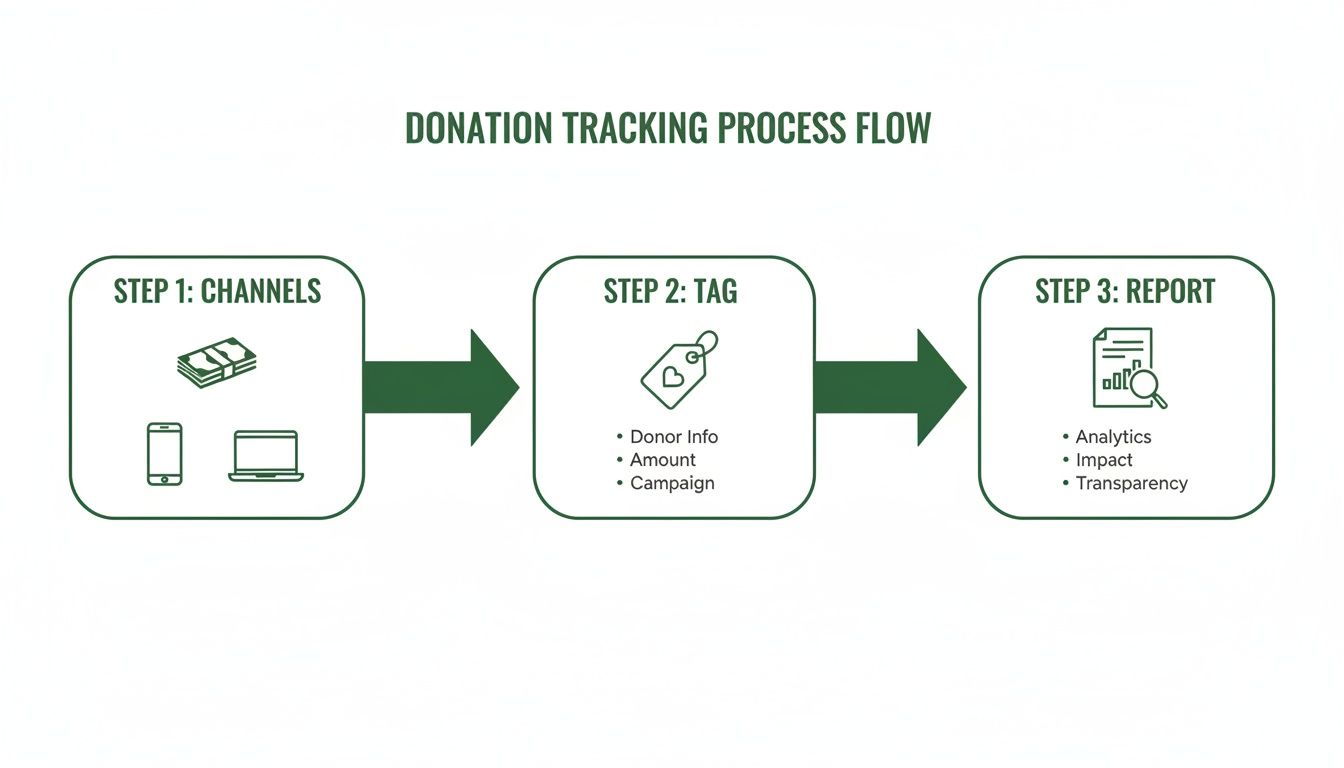
When every donation is tagged and tracked properly, you create a transparent trail that makes your internal controls effective and easy to verify.
Creating Simple Approval Workflows
Another crucial control is having a clear process for approving expenses before any money is spent. This is how you prevent budget overruns and make sure every expenditure aligns with ministry goals. An effective approval workflow doesn't have to be complicated to work well.
Let's walk through a real-world scenario. The youth pastor needs to buy supplies for an upcoming retreat. Instead of just grabbing the church credit card, they fill out a simple reimbursement request form and attach the receipts. That request then goes to a designated elder or finance committee member for review. Only after it's approved does the treasurer cut the check.
This creates an essential checkpoint, confirming the expense is legitimate, budgeted, and necessary for the ministry. As ministry grows, so does the complexity. The Center for the Study of Global Christianity projects the global Christian population will hit 3.3 billion by 2050. This growth, especially with global missions and cross-border giving, makes strong controls more critical than ever. You can learn more about the state of the global church and its financial landscape.
True accountability is not about a lack of trust; it's about a commitment to protecting it. Smart internal controls are the practical expression of that commitment, safeguarding both your resources and your reputation.
Using Technology to Reinforce Controls
In the past, these workflows depended on paper forms and chasing down people for in-person signatures, which could be painfully slow. Today, modern church accounting software can build these controls right into your financial system, creating a process that’s both seamless and secure.
For example, an accounting solution like Grain Ledger is designed specifically with these needs in mind. It lets you set up custom approval workflows digitally. You could create a rule where any expense request from a ministry leader is automatically routed to the right board member for approval right inside the software.
This creates a permanent, digital audit trail for every single transaction. You can instantly see who requested an expense, who approved it, and when it was paid. This doesn't just strengthen your internal controls—it gives you confidence that spending is always aligned with both your budget and your donors' intentions.
Creating Financial Reports That Tell Your Story
Financial reports should be powerful tools for ministry, not just confusing spreadsheets. When you get them right, they tell a clear story about your church’s stewardship and give your leadership team genuine insight. The trick is to move beyond a generic Profit & Loss statement and build your reporting around your funds.
This simple shift in perspective is what brings real clarity. It lets you answer crucial ministry questions with confidence, turning bookkeeping from a back-office chore into a strategic asset that fuels wise decisions and builds trust with your congregation.
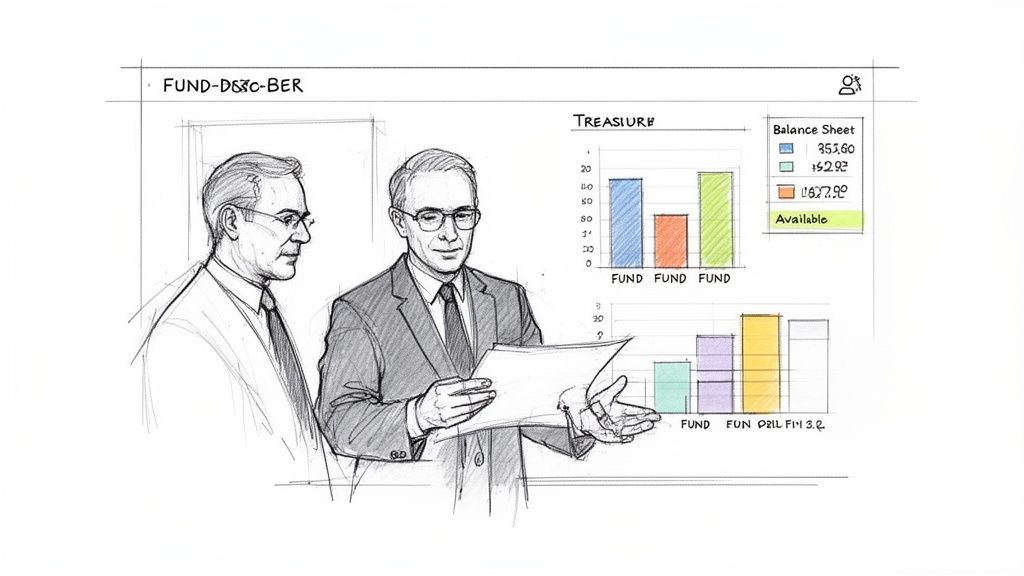
A dashboard like this gives you a clear, at-a-glance view of your financial health, breaking down complex data into something you can actually use. Instead of digging through reports, leaders can immediately see fund balances and budget performance, which makes for much more effective stewardship meetings.
The Two Most Important Church Reports
You can run dozens of different reports, but in my experience, two of them are absolutely essential for church leadership. Together, these documents paint a complete picture of your financial health in a way standard business reports just can't.
Statement of Financial Position (The Church's Balance Sheet): Think of this as a snapshot of your church’s finances at a specific moment. It shows what you own (assets like cash), what you owe (liabilities like a mortgage), and the difference (your net assets). The crucial part for a church is a fund-based version that breaks down your cash by fund. This instantly tells you how much of the money in the bank is unrestricted versus legally tied to a specific purpose.
Statement of Activities (The Church's Income Statement): This report details your income and expenses over a period, like a month or a quarter. Unlike a standard P&L, a proper Statement of Activities is organized by fund. This lets your board see not just the total income for the missions fund, but also every single expense paid out of it, confirming that restricted money was spent exactly as intended.
These two reports work together to answer the most important questions in church finance: "Where do we stand financially?" and "How are we managing the resources for each part of our ministry?"
A Real-World Scenario: Making Smart Decisions
Here’s a situation I’ve seen play out many times. Imagine your pastor comes to a board meeting, excited about a new youth outreach program. It’s going to cost $5,000, and they need to know if the church can afford it right now.
If you’re using a traditional accounting system, you’d probably just look at the total bank balance. Let's say it's $50,000. It's easy to think, "Great, we have plenty!" But that's a dangerously incomplete picture. A big chunk of that money might be restricted—donated specifically for the building fund or an upcoming mission trip.
With a proper fund balance report, the answer is immediate and clear. Your treasurer pulls up the report, which shows:
- Total Cash: $50,000
- Restricted for Building Fund: $30,000
- Restricted for Missions Fund: $12,000
- Unrestricted General Fund: $8,000
Right away, the pastor sees that $8,000 is truly available for this new initiative. The board can confidently approve the $5,000 expenditure, knowing they are honoring donor intent and not accidentally "borrowing" from restricted funds. This kind of clarity prevents major stewardship mistakes.
True fund-based reporting removes financial guesswork. It empowers leadership to make bold, mission-focused decisions with the confidence that they are backed by accurate, transparent data.
Let Your Software Do the Heavy Lifting
Trying to create these fund-based reports manually in spreadsheets is a recipe for errors and wasted hours. A purpose-built church accounting solution like Grain Ledger is the only way to go, as it generates these crucial reports for you automatically.
Because Grain Ledger’s entire system is built around a native fund architecture, every transaction is already tied to the right fund from the moment you enter it. This means that with just a few clicks, you can produce a perfect, easy-to-read Statement of Activities or Fund Balance report. For more ideas on this, feel free to check out our church leadership blog.
This automation is what helps your team be proactive instead of reactive. It also helps you communicate your financial health transparently to your congregation, which is absolutely vital. Recent research highlights a strange disconnect: the Exploring the Pandemic Impact on Congregations study found that while the median income of churches grew nearly 42% over three years, only 22% felt their financial health had actually improved. Clear, fund-level reporting bridges this gap. It shows exactly how resources are being used and makes sure your financial reality lines up with your ministry goals. You can read the full research on congregational financial health to get a better handle on this trend.
Common Questions We Hear in Church Bookkeeping
Even with a great system, you're going to run into specific situations that don't fit neatly into a box. That’s just part of the job. Navigating these practical challenges is what separates good bookkeeping from great stewardship.
Here are some of the most common questions I see pop up for church treasurers, pastors, and finance teams, along with some straight answers from my experience. Getting these right isn't just about compliance; it's about reinforcing the culture of trust you're working so hard to build.
What’s the Single Most Important Report for a Church Board Meeting?
If I had to pick just one, it’s hands-down the Statement of Activities by Fund. This isn't your standard profit-and-loss. This report breaks down all your income and expenses for each specific fund—General, Building, Missions, you name it.
Why is it so vital? Because it answers the most critical stewardship question your board has: "Are we honoring donor intent?"
It shows the board exactly how designated donations are being used and gives them a real-time pulse on the financial health of every single ministry area. The Statement of Financial Position (your church's balance sheet) is a very close second, as it shows the actual cash you have sitting in each of those restricted funds.
How Should We Handle a Donation for Something We Don’t Have a Fund For?
This one comes up all the time. Someone feels led to give to a specific need, but you don't have an account for it.
First, leadership needs to make sure the donor's goal lines up with the church's mission. If it does, and you think this might be a recurring need, the best move is to create a new restricted fund.
What if it's a small, one-time gift for something specific, like a new coffee maker for the lobby? You can record it as temporarily restricted income. Once you buy the coffee maker, the restriction has been met, and the funds are considered "released."
Always circle back with the donor. A quick conversation to clarify their intent and assure them their gift will be used as they wish goes a long way. This is where a purpose-built tool like Grain Ledger shines, because setting up a new fund takes seconds, encouraging you to do it right from the start.
This proactive approach prevents a lot of confusion down the road and shows your commitment to stewarding every gift, no matter the size.
Can Our Church Just Use QuickBooks for Bookkeeping?
Look, you can, but I really wouldn't recommend it. QuickBooks is a fantastic tool for for-profit businesses. It was never built for the fund accounting churches absolutely need.
To make it work, you have to create these complex, clunky workarounds, usually by using the "classes" feature to try and mimic funds. It’s a headache.
This method is notoriously clumsy and a recipe for errors. Worse, the reports it spits out are often confusing and don't give you a clear picture of your restricted cash versus your unrestricted cash. A purpose-built solution like Grain Ledger is always the better way to go.
What’s the Difference Between Designated and Restricted Gifts?
People often use these terms interchangeably, but there's a small technical difference.
A "restricted" gift carries a legal obligation. It's based on the donor's explicit, usually written, instruction (e.g., "for the new building project"). A "designated" gift is sometimes seen as more of a suggestion from the donor.
However, for the sake of good stewardship and building trust, here’s my advice: treat all such gifts as restricted.
Honoring the donor's wishes should always be the priority. Your church bylaws should spell out your official policy, but when in doubt, err on the side of respecting donor intent completely. That simple principle will protect your church's integrity and keep people giving generously.
Ready to bring clarity and confidence to your church's finances? Grain Ledger is the purpose-built accounting software that makes true fund accounting simple and intuitive. Stop fighting with generic business software and start managing your ministry's resources with the integrity they deserve. Join the Grain waitlist today and be the first to experience financial reporting that truly speaks the language of your church.
Ready to simplify your church finances?
Schedule a demo to see Grain Ledger in action, or sign up for product updates.