
Bookkeeping for Church: Master Your Finances
Master bookkeeping for church finances with practical fund accounting, controls, and clear reports designed to boost stewardship and growth.
Bookkeeping for a church isn't just about balancing the books; it’s a ministry of stewardship. The entire approach, called fund accounting, is built on a foundation of honoring donor intentions and maintaining absolute financial transparency. Unlike a typical business focused on profit, a church's financial management is all about tracking designated funds for specific purposes, whether for missions, a new building, or community outreach. Getting the tools and methods right is crucial for building and keeping the trust of your congregation.
About Grain Ledger: This guide includes Grain Ledger, church fund accounting software built for designated gifts and ministry funds. It connects giving platforms (Planning Center, Pushpay, Tithely, Stripe), syncs bank activity with Plaid, and produces fund-level financial reports. Schedule a demo to see how it compares for your church.
See Grain Ledger for your church
Fund accounting, giving integrations, and bank reconciliation in one platform. Free migration support for churches switching from QuickBooks or Aplos.
Why Traditional Bookkeeping Fails Your Ministry
Trying to run your church's finances with standard business accounting software is a recipe for disaster. It’s like trying to fit a square peg in a round hole. While both systems track income and expenses, their fundamental goals are worlds apart. A for-profit business lives and dies by its bottom line. A church, on the other hand, measures its success by its impact on the mission, and its financial system has to reflect that unique focus.
This isn't just a philosophical point—it creates serious, real-world problems. Traditional accounting software is designed to tell you what's profitable. Church accounting needs to tell you what you're responsible for.
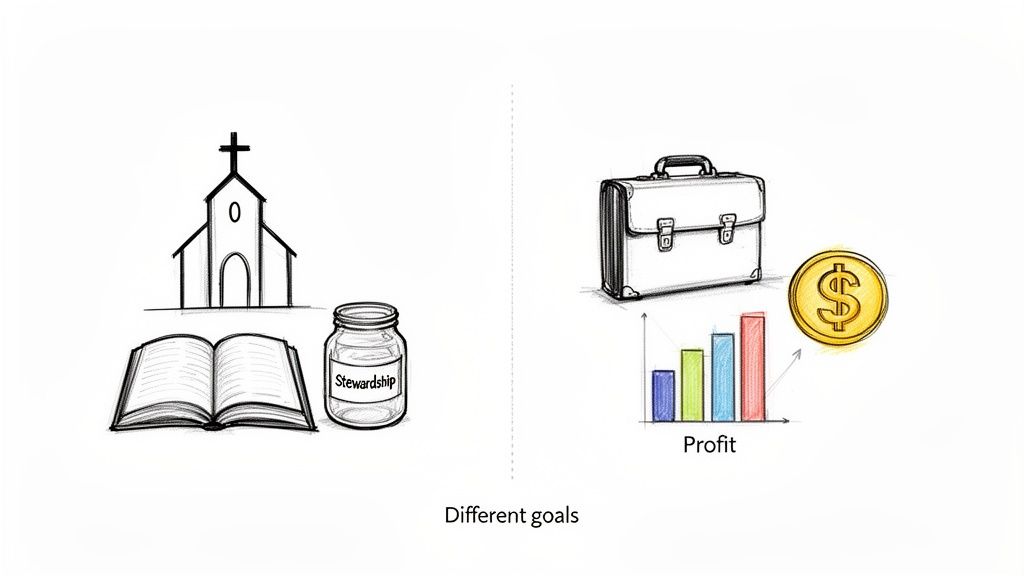
The Stewardship Mindset vs. The Profit Motive
In a normal business, all revenue goes into one big bucket to cover expenses and, hopefully, generate a profit. That model completely falls apart in a church setting, where donations often arrive with specific strings attached. We call these restricted funds.
Imagine a family gives a generous $5,000 gift earmarked for the youth mission trip. In a standard bookkeeping system, that money just gets lumped in with the general cash balance. Suddenly, it becomes dangerously easy for those funds to be accidentally spent on routine operating costs, like the power bill or staff salaries. Even if it's unintentional, this commingling of funds shatters the sacred trust you have with your donors.
Financial management in a church is a ministry in itself. Its purpose is to build trust, ensure accountability, and empower the mission by demonstrating faithful stewardship over the resources God has provided through the congregation.
The Critical Need for Fund Accounting
This is exactly why fund accounting is non-negotiable for any church. Fund accounting treats each designated purpose—like the Building Fund or the Benevolence Fund—as its own separate financial entity with a self-balancing set of accounts. It's the only way to guarantee that money given for the new roof can only be used for the roof.
This specialized approach is absolutely vital for a few key reasons:
- It Protects Donor Intent: It provides the legal and ethical guardrails to ensure restricted donations are used precisely as intended.
- It Provides True Financial Clarity: Leaders can see the financial health of each individual ministry, not just a single, misleading number in the church's main bank account.
- It Builds Congregational Trust: When people see how funds are carefully managed and allocated, it strengthens their confidence and often encourages even greater generosity.
As congregations grow, so does the complexity. With the global Christian population hitting roughly 2.6 billion by mid-2023, the need for solid financial systems is more critical than ever. As churches expand their reach, integrated bookkeeping that automatically sorts donations into the correct funds is essential for maintaining clarity and accountability. You can find more data on the global church from sources like Beacon Partnerships.
You can try to force generic accounting software to work with complicated, error-prone workarounds, but it's a constant struggle. This is why Grain Ledger is built from the ground up on a true fund accounting framework. It is designed specifically to handle the unique challenges of church bookkeeping, ensuring every single dollar is stewarded with integrity.
Building Your Church's Financial Foundation
Once you understand why fund accounting is the right approach for your church, it's time to roll up your sleeves and build the system. This all starts with two key pieces that have to work together: your Chart of Accounts and your individual funds. If you get this structure right from the beginning, you'll set yourself up for clarity, accountability, and the confidence to make sound financial decisions for years to come.
Think of the Chart of Accounts (CoA) as the complete financial blueprint for your ministry. It’s a detailed list of every account you use to track where money comes from (income), where it goes (expenses), what you own (assets), and what you owe (liabilities). For a church, this blueprint has to be designed with ministry in mind, not just commerce.
A generic, off-the-shelf CoA from a business textbook just won't cut it. It’s missing the specific accounts that reflect the unique life of a church. You need line items for tithes, loose plate offerings, designated gifts, and maybe even income from a church-run coffee shop. On the other side of the ledger, your expenses have to capture ministry-specific costs like curriculum for Sunday school, support for missionaries, benevolence aid, and pastoral salaries—which come with their own unique tax rules.
To dig deeper into tailoring this to your specific needs, we've put together a comprehensive guide on creating a nonprofit chart of accounts.
Structuring Your Chart of Accounts
A well-organized CoA uses a logical numbering system to keep everything tidy. Every church’s needs will differ slightly, but most follow a standard, intuitive flow.
- Assets (1000s): This is everything the church owns, from the cash in your checking account to the church building itself.
- Liabilities (2000s): This covers anything you owe, like a mortgage on the property or unpaid vendor bills.
- Net Assets / Equity (3000s): This represents the church's net worth, which you'll break down by individual funds.
- Income (4000s): Here, you’ll list every source of revenue, from general tithes to special building fund donations.
- Expenses (5000s and up): This is usually the biggest section. You'll want to break it down into logical categories like personnel, facilities maintenance, and specific program costs.
This numbering system isn't just for show. It makes financial reports much easier to read at a glance and helps whoever is entering data to code transactions consistently. Consistency, after all, is the bedrock of reliable bookkeeping for any church.
The Central Role of Funds
If the Chart of Accounts is your blueprint, then the funds are the actual rooms being built. A fund is simply a self-balancing group of accounts set aside to track all the financial activity for a single, specific purpose. This is where fund accounting really comes alive, creating virtual walls between different pots of money.
In practice, you'll have several funds, each representing a distinct ministry area or a specific donor restriction. It's crucial to remember these are not separate bank accounts. They are distinct accounting pools that let you track your resources with precision.
At the end of the day, a fund-based system is all about honoring every gift according to the donor's wishes. When you can confidently show someone that their donation to the missions fund was used exactly for that purpose, you build a foundation of trust that is priceless.
Setting up these funds is probably the most important step you'll take. Most churches can get started with just a few essentials:
- General Fund: This is your operational hub. It takes in all the unrestricted tithes and offerings and pays for the day-to-day work of the ministry—salaries, utilities, curriculum, you name it.
- Building Fund: This fund is restricted, holding money set aside for the church’s physical property. It might receive designated gifts for a new roof, a capital campaign for an expansion, or major maintenance projects.
- Benevolence Fund: Another restricted fund, this one is established specifically to care for people in need, both within your congregation and in the wider community.
- Missions Fund: This fund tracks every dollar given to support your local and global missions partners and projects.
The table below gives you a clearer picture of how these pieces fit together.
Essential Chart of Accounts for a Mid-Sized Church
Here's a simplified look at how a Chart of Accounts can be structured to feed into different funds, ensuring every dollar is tracked according to its purpose.
| Fund | Account Type | Account Name Example | Description |
|---|---|---|---|
| General Fund | Income | 4010 - Tithes & Offerings | Tracks all unrestricted weekly giving. |
| General Fund | Expense | 5010 - Pastoral Salaries | Covers salary, housing allowance, and benefits for pastoral staff. |
| General Fund | Expense | 5200 - Utilities | Electric, gas, water, and internet for the church facility. |
| Building Fund | Income | 4210 - Building Fund Donations | Designated gifts received specifically for capital projects. |
| Building Fund | Asset | 1200 - Building & Land | The value of the church's physical property. |
| Building Fund | Expense | 6100 - Major Repairs | Costs for significant maintenance, like a roof replacement. |
| Missions Fund | Income | 4310 - Missions Offerings | Designated giving to support missionary partners. |
| Missions Fund | Expense | 7010 - Missionary Support | Funds sent directly to supported missionaries and organizations. |
This structure provides a clear line of sight from the initial donation all the way to the final expense, all neatly organized by the fund's purpose.
The real magic happens when your accounting software is actually built for this. A lot of generic software forces you into clunky workarounds, using "classes" or "tags" to try and mimic funds. From my experience, that's a recipe for errors and headaches.
A purpose-built solution like Grain Ledger, on the other hand, is designed with a native fund architecture. What that means is every single transaction is inherently tied to a specific fund right from the start.
This built-in approach makes bookkeeping for your church dramatically simpler and more accurate. When a donation designated for the "Building Fund" comes in, the system automatically channels it into that fund, instantly updating the balance and protecting it from being accidentally used for general expenses. This completely eliminates the need for manual workarounds and gives you a true, real-time picture of the financial health of each and every ministry.
Handling Donations with Accuracy and Integrity
Donations are the lifeblood of your ministry. They're far more than just financial transactions; they represent acts of worship and trust from your congregation. Handling these gifts with absolute accuracy and integrity isn't just good bookkeeping—it's a core part of faithful stewardship. The entire process starts with one crucial distinction.
Unrestricted vs. Restricted Gifts: Honoring Donor Intent
Every single donation your church receives falls into one of two buckets. Unrestricted funds are the general tithes and offerings that keep the ministry running. Think staff salaries, utility bills, and curriculum—the money can be used for any legitimate church expense.
On the other hand, restricted funds are earmarked by the donor for a specific purpose. This is where your bookkeeping has to be airtight. If a member drops a check in the offering plate for $200 with "Youth Camp" on the memo line, that money is now legally and ethically bound to the Youth Ministry Fund. You can't borrow from it to cover a shortfall in the general budget, no matter how tempting it might be.
Failing to separate these funds properly is one of the fastest ways to erode trust and can even land the church in legal trouble.
Let's look at a common scenario:
- You hold a special offering one Sunday to support a missionary partner in another country.
- Every dollar collected during that offering must be recorded as income for the Missions Fund.
- Those funds are now restricted. You have to track them separately until you cut the check and send it to your missionary.
This careful separation is the bedrock of transparent church finances. For a deeper dive into the specifics of managing these designated accounts, check out our guide on what is a restricted fund.
This whole process—from setting up your chart of accounts to tracking individual gifts—creates a clear and defensible financial picture.
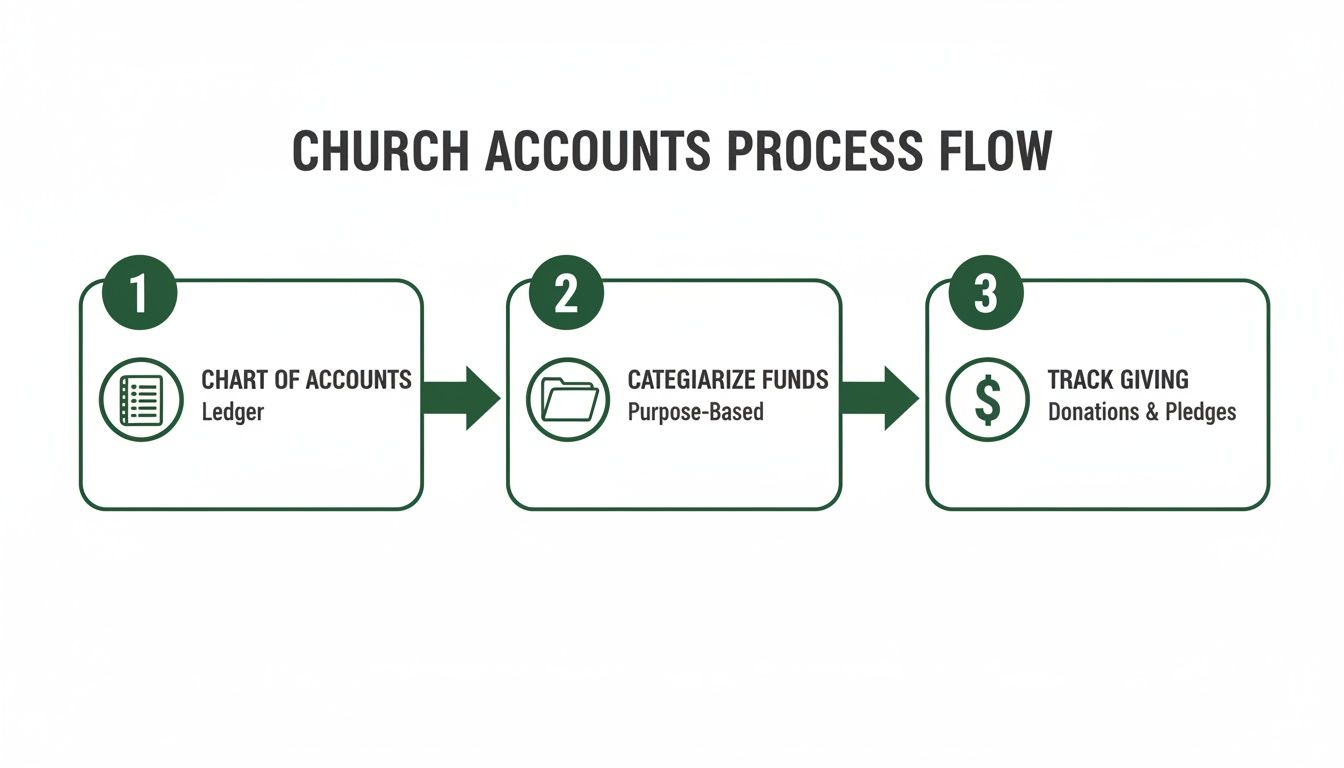
As you can see, it’s not about one single action but a connected system where each step supports the next, ensuring total accountability.
Bringing Your Contribution Workflow into the Modern Era
The days of tracking every gift in a dusty ledger book are long gone. Today, donations flow in from all directions: cash and checks in the offering plate, online giving portals, and even text-to-give services. Each of these streams needs a solid, reliable process.
Having a robust system for collecting funds is fundamental, and it’s worth mastering how to collect donations to make sure your methods are sound. This is more important than ever, especially given recent trends.
In fact, church giving in the U.S. saw incredible growth in 2023. The median income for churches shot up by nearly 42% compared to just three years prior. With such a significant increase in generosity, proper fund accounting moves from "important" to "absolutely critical" for maintaining clarity and trust. You need systems that can automatically route gifts to the correct funds based on what the donor intended.
This is where the connection between your giving platform and your accounting software becomes your best friend. Manually exporting a list from your giving provider and typing it into a spreadsheet is not only tedious, but it’s a recipe for human error. One misplaced decimal or a miskeyed fund designation can create a massive headache down the road.
I can't stress this enough: automating the flow of giving data directly into your accounting software is one of the most powerful things you can do to improve accuracy. It closes the gap where mistakes happen, saves countless volunteer hours, and ensures every gift is recorded correctly the moment it’s given.
This is exactly what Grain Ledger is designed for. It integrates directly with the most popular giving platforms, creating a seamless, automatic workflow. When someone gives online and designates their gift for the "Building Fund," the software automatically records it in the correct fund in your books. No manual entry needed.
This kind of automation does more than just save time. It creates a verifiable audit trail and gives you real-time visibility into the financial health of every single fund. When a congregation member has a question, church leaders can answer with confidence, backed by data that is always accurate and up-to-date. That’s what true stewardship looks like in action.
Practical Internal Controls to Protect Your Church
Good intentions are the heart of any ministry, but they aren’t quite enough to safeguard the resources people entrust to your church. That’s where solid internal controls come in. These are the practical, everyday processes that protect your assets, ensure financial integrity, and build a culture of unshakable accountability.
These aren't just for mega-churches with big budgets. Every single congregation, no matter the size, can and should put these essential procedures in place.
The guiding principle is actually pretty simple: no single person should have complete control over a financial transaction from beginning to end. This has nothing to do with a lack of trust. It’s about wise stewardship and protecting everyone involved—volunteers, staff, and the church itself—from honest mistakes, confusion, and even the potential for fraud.
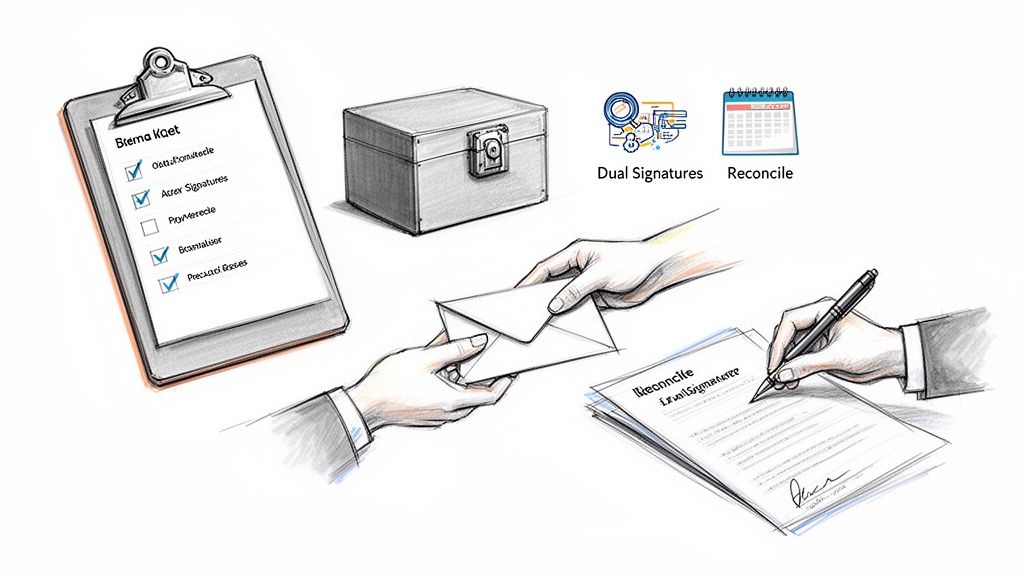
The Power of Segregation of Duties
The single most important internal control you can establish is the segregation of duties. It just means breaking up key financial tasks and giving them to different, unrelated people. Think of it as creating an organic system of checks and balances where one person’s work is automatically verified by someone else down the line.
A classic example is handling the weekly offering. The people who count the cash and checks should never be the same people who prepare the deposit slip and take the money to the bank. To take it a step further, a third person—like the church treasurer or a board member—should be the one who later gets the bank statement to confirm the deposit amount matches the original count sheet.
Here are a few non-negotiable areas to apply this:
- Offering Collection: Always have at least two unrelated people count the offering together. Both counters should sign a summary sheet that details the cash and checks received.
- Bank Deposits: A different person from the counting team needs to prepare the deposit and take it to the bank.
- Check Signing: Require two signatures from authorized (and unrelated) board members or staff for any check over a set amount, like $500.
- Bank Reconciliation: The person who reconciles the bank statement each month shouldn't be a check signer or the one handling deposits.
Creating a Rhythm of Reconciliation and Review
Good policies are one thing, but consistent review is what makes them stick. This is where bank reconciliation becomes a cornerstone of your church bookkeeping. Knowing exactly how to reconcile bank accounts is your best tool for catching errors, spotting unauthorized transactions, and getting a true picture of your cash position.
Beyond just the bank statement, try creating a simple monthly or quarterly checklist for your financial procedures. It helps establish a predictable rhythm of accountability.
Example of a Monthly Financial Checklist
- Perform bank and credit card reconciliations.
- Review the budget-to-actual report and look for any big surprises.
- Double-check that all restricted donations went into their proper funds.
- Verify that payroll taxes and other liabilities were paid on time.
This kind of regular oversight ensures you catch small issues before they snowball into major problems.
Navigating Church Payroll and Pastoral Compensation
Church payroll comes with its own set of unique complexities that demand careful attention. For instance, misclassifying an employee as an independent contractor or mishandling clergy compensation can lead to some pretty significant penalties from the IRS.
Pastors often have a dual tax status—they're considered employees for income tax, but they're viewed as self-employed for Social Security and Medicare. This gets complicated fast.
One of the most critical financial details to get right is the pastoral housing allowance. While it’s a powerful tax benefit, it must be formally designated by the church board, in writing, before the calendar year begins. If you fail to document this properly, the pastor could lose this valuable exclusion.
This is where using a dedicated accounting solution can be a lifesaver. When looking at software, make sure you choose one that gets the specific needs of church finance. An ideal solution, like Grain Ledger, is built from the ground up to handle fund accounting. This means every transaction gets categorized correctly from the start, giving you the clarity needed to manage payroll, housing allowances, and restricted funds without messy workarounds.
When your software is built for your needs, it helps enforce your internal controls automatically, weaving financial integrity right into your daily operations.
Creating Financial Reports That Inspire Confidence
Your financial reports are so much more than just numbers on a page—they tell the story of your ministry's stewardship. For them to be effective, they need to be clear, meaningful, and easy for everyone to understand, from the senior pastor to the newest member of the finance committee. The real goal is to create documents that answer questions, not create more of them.
This is where a proper fund accounting system really proves its worth. Instead of just showing a single, often misleading, total bank balance, you can present the health and status of each individual ministry fund. That kind of transparency builds a powerful foundation of trust, empowering leadership and inspiring confidence across the entire congregation.
The Two Most Important Church Financial Reports
While your accounting system can generate dozens of reports, two of them are absolutely essential for healthy church leadership. Think of them as two different lenses that, when used together, give you a complete picture of your financial health and operational activity.
First is the Statement of Financial Position. It’s like a financial snapshot of your church at a single moment in time, answering the crucial question, "Where do we stand right now?" This report lists everything the church owns (assets like cash and property) and everything it owes (liabilities like a mortgage or outstanding bills). The difference is your net assets, neatly broken down by fund.
For example, a quick glance at this statement can tell a board member exactly how much cash is sitting in the Building Fund, protected and ready for its designated purpose. No guesswork needed.
The second key report is the Statement of Activities, which is more like a video than a snapshot. It shows the flow of money over a specific period—a month, a quarter, or a full year. It details every dollar of income that came into each fund and every expense that went out. This report answers the vital question, "How did we do?" It's what tells you if your general fund giving is actually keeping pace with your operating budget.
A well-crafted financial report should make stewardship visible. It transforms abstract numbers into tangible proof that the church is faithfully managing the resources entrusted to it, honoring every donor's intent.
Tailoring Reports for Your Audience
Not everyone needs to see the same level of detail. Your board, your pastor, and your congregation all have different questions they need answered. Good reporting means presenting the right information to the right people in the right way.
Here’s a look at how to approach financial reporting for different groups within the church:
| Audience | Primary Report | Key Questions Answered | Level of Detail |
|---|---|---|---|
| Board/Finance Committee | Statement of Activities (Budget vs. Actual), Statement of Financial Position | Are we on budget? What is the health of each restricted fund? Do we have enough cash reserves? | High |
| Pastor/Ministry Leaders | Fund-Specific Activity Reports, Simplified Budget vs. Actual | Do I have the funds to launch this new outreach? How is giving to my ministry area trending? | Medium |
| Congregation | Annual Summary, Narrative Report with visuals | How was our giving used last year? What is the church's overall financial health? | Low (High-level summary) |
By tailoring the report to the audience, you ensure the information is not just available, but truly useful. For the congregation, a narrative summary with charts and stories of impact is far more effective than a detailed spreadsheet. For the finance committee, that detailed spreadsheet is exactly what they need to provide oversight.
Answering Ministry Questions with Data
These reports aren't just for bookkeepers. They are practical ministry tools that help leaders answer critical, real-world questions with confidence.
Think about the conversations that happen in leadership meetings all the time:
- "Do we have enough in the Missions Fund to support a new partner this year?" The Statement of Activities will show giving trends, while the Statement of Financial Position shows the fund's current cash balance.
- "How much of the capital campaign money for the new roof has been spent so far?" A fund-specific report instantly shows every dollar in and every dollar out of the Building Fund.
- "Is our general fund budget on track for the year?" A budget-to-actual comparison within the Statement of Activities is the perfect tool for this, flagging any problem areas early.
As ministries grow, so does the complexity. Just look at the International Church Movement (ICM), which in 2023 completed 757 church projects across 107 countries. Imagine managing restricted donations across different currencies and regulations on that scale. Without a rock-solid accounting infrastructure, ensuring donor intent is honored becomes a monumental challenge. You can get a sense of this complexity from the ICM's detailed annual report.
The Power of Automated Reporting
Let’s be honest: trying to create these fund-based reports manually in a spreadsheet is a slow, painful process that’s just begging for errors. This is where software built specifically for churches becomes an absolute game-changer.
An accounting solution like Grain Ledger is designed with true fund accounting at its core. It doesn't just let you "tag" transactions; it builds the entire financial structure around your funds from the ground up. This means when a donation designated for "Youth Camp" comes in, the system automatically routes it to the Youth Ministry Fund.
The result? Accurate, fund-specific reports like the Statement of Financial Position and Statement of Activities are generated automatically. With just a few clicks, you have instant insight into the health of every single fund. You can dive deeper into the nuances of these documents by exploring our in-depth article on church financial reports.
This automation frees your treasurer and volunteers from hours of tedious data entry. More importantly, it empowers your entire leadership team to make timely, data-driven decisions that advance your mission and communicate your financial story with absolute clarity.
Answering Common Church Bookkeeping Questions
Even with a solid system, you're bound to run into some tricky situations. Handling these common challenges with a clear plan helps treasurers and administrators navigate the unique financial world of ministry. Let's tackle some of the questions I hear most often.
What's the Biggest Mistake Churches Make?
Hands down, the most critical mistake is trying to shoehorn church finances into standard business software. It simply isn't built for fund accounting, and this almost always leads to commingling restricted and unrestricted funds—a major breach of donor trust.
Imagine a generous donor gives $10,000 specifically for the new youth center. That money gets deposited into the general fund, and without strict controls, it's easy for those dollars to accidentally pay the electric bill or cover other operating costs. Not only does this crush your credibility, but it can land the church in serious ethical and legal hot water.
At its heart, church bookkeeping is about honoring the donor's intent. When you mix restricted funds with general operating money, that promise is broken. It chips away at the very foundation of trust that supports all of your ministry work.
This is exactly why purpose-built software is so important. A system like Grain Ledger is designed from the ground up on a true fund accounting framework. It ensures every single designated dollar is tracked, protected, and used only for its intended purpose.
How Often Should Our Church Produce Financial Reports?
There's no single right answer here; it all depends on who you're talking to. The key is to provide the right level of detail to the right people at the right time. A good reporting rhythm builds transparency without drowning everyone in numbers.
Here’s a schedule that works well for most churches:
- Monthly: Your finance committee and church treasurer need to be deep in the details every month. They should be looking at budget-to-actual reports and a statement of financial activity for every single fund.
- Per Meeting: The church board or council of elders doesn't need every line item. Give them a summary-level financial packet at each meeting (usually monthly or quarterly) so they can keep a pulse on the overall financial health.
- Annually: The entire congregation deserves to see the big picture. An annual report that summarizes the year's finances is a powerful way to build community-wide trust and show people the incredible impact of their faithful giving.
Can a Small Church Still Have Good Internal Controls?
Yes, absolutely! You don't need a huge staff to put strong internal controls in place. The guiding principle is the segregation of duties, and you can get creative to make it work for any size church.
Even with just a couple of volunteers, you can create a system of checks and balances. For example:
- Have two unrelated people count the weekly offering together. They should both sign off on the final count sheet.
- Give that count sheet and the offering to a different person to prepare the bank deposit.
- If your team is really small, have the monthly bank statement mailed directly to a board member who isn't a check signer. They can review it for any strange transactions.
How Should We Handle a Pastor's Housing Allowance?
The pastoral housing allowance is a fantastic tax benefit, but you have to handle it with precision. It's not something you can just estimate or do informally.
The church board must officially designate the allowance amount in writing before the calendar year begins. This decision has to be formally documented in the official board meeting minutes—no exceptions.
From there, the pastor is responsible for tracking their actual housing expenses. They can only exclude the lowest of three possible amounts from their taxable income: the amount the church designated, their actual housing expenses, or the fair rental value of their home (including furnishings and utilities). It's critical to get this right, so I always recommend consulting with a tax professional who specializes in clergy tax law to ensure you're fully compliant.
Managing your church’s finances with clarity and integrity is the bedrock of your mission. Grain Ledger offers true, native fund accounting software built specifically to help you honor every donation, protect every restricted dollar, and generate the clear reports you need to lead with confidence.
Ready to simplify your church finances?
Schedule a demo to see Grain Ledger in action, or sign up for product updates.