Budget: budget for a nonprofit organization - a practical guide
Learn how to craft a budget for a nonprofit organization that aligns with your mission. Get templates, fund accounting basics, and practical stewardship tips.
Let's be real—the word "budget" doesn't exactly get the heart racing. For most of us in ministry, creating a budget for a nonprofit organization feels like a chore, a spreadsheet full of limitations. But I want to challenge that perspective. Your budget is actually one of the most powerful storytelling tools you have. It’s the script that translates your church's vision into a concrete, financial reality for the year.
About Grain Ledger: This guide includes Grain Ledger, church fund accounting software built for designated gifts and ministry funds. It connects giving platforms (Planning Center, Pushpay, Tithely, Stripe), syncs bank activity with Plaid, and produces fund-level financial reports. Schedule a demo to see how it compares for your church.
See Grain Ledger for your church
Fund accounting, giving integrations, and bank reconciliation in one platform. Free migration support for churches switching from QuickBooks or Aplos.
Get Your Personalized Template
Enter your church's budget, attendance, and payroll to generate a custom Excel template with industry-standard percentages and formulas.
Your Nonprofit Budget Is a Story, Not Just a Spreadsheet
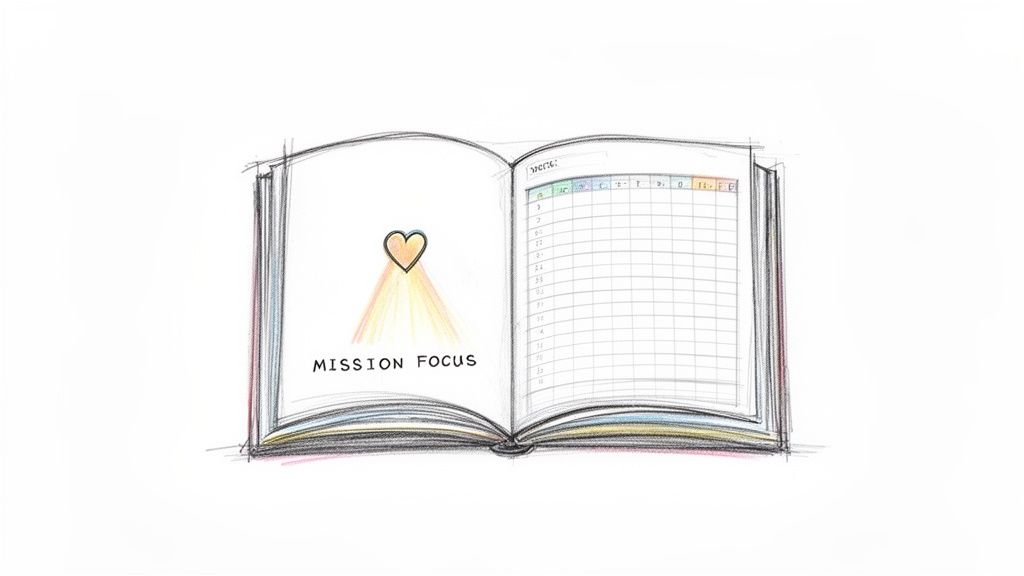
Think about it. Every line item, from the coffee budget for Sunday mornings to the funds set aside for missionary support, is a scene in the story of your ministry's impact. It's not just about numbers; it’s about the narrative of what God is doing through your church.
This guide is designed to help you move past the numbers and focus on that narrative. We're going to get practical and talk about the real-world challenge every church leader knows: how to balance big ministry dreams with tight financial realities, especially with today's rising costs and unpredictable giving patterns.
The Real-World Financial Pressures on Ministries
The financial ground is shifting for nonprofits, and churches are right there in the thick of it. Recent surveys of the nonprofit sector show a difficult reality—a collision of inflation, potential dips in funding, and a sharp increase in the need for services. Many organizations are just one unexpected HVAC failure away from a genuine crisis.
In fact, one report found that a staggering 85% of surveyed nonprofits expect the demand for their services to increase, putting even more strain on already lean budgets. This isn't just an abstract statistic; it's the reality many of us are living.
This pressure is exactly why having a clear, mission-driven budget is no longer optional. It’s about more than just keeping the lights on. It’s about making wise, strategic choices that safeguard your ministry’s future and amplify its impact in the community.
A budget isn't just a plan for how you'll spend money. It's a declaration of your priorities and a testament to your stewardship. It shows your congregation and your community what you value most.
The Key to Telling Your Financial Story with Integrity
So, how do you tell this financial story well? How do you build trust and show good stewardship? The answer is rooted in a practice called fund accounting. This approach is the absolute foundation for responsible financial management in a church, where you're constantly handling different kinds of donations.
Fund accounting is simply a way of tracking every dollar based on its intended purpose. It's crucial for keeping everything straight, especially when you're managing:
- General Offerings: These are your unrestricted funds that cover the day-to-day operational costs like staff salaries, utilities, and curriculum.
- Designated Gifts: These are temporarily restricted funds given for a specific project, like a new roof, a youth mission trip, or a special Easter outreach.
- Mission-Specific Donations: These are contributions that can only be used for supporting your local or global mission partners.
When you use a fund-based approach, your budget becomes an incredible tool for transparency and accountability. It gives you the clarity to manage every gift with integrity, ensuring your financial story perfectly matches your ministry's calling. To see this in action, you can explore our guide on how to create an effective budget narrative for your organization.
Setting the Stage for a Mission-Driven Budget
Before you even think about opening a spreadsheet, the real work of budgeting begins. This crucial first phase is all about getting the right people, purpose, and perspective in place. Honestly, skipping this part is like trying to build a house without a blueprint. You might end up with four walls and a roof, but it won't be the sturdy, well-designed home you envisioned.
The first move has nothing to do with math—it’s about assembling your team. A classic mistake I see churches make is handing the entire budget process over to the treasurer or a lone finance person. Their financial acumen is absolutely essential, but a budget created in a silo will always miss the mark. It lacks the boots-on-the-ground reality of those leading the actual ministries.
Building Your Budget Committee
A truly effective budget for a nonprofit organization is a team sport. Your budget committee should be a cross-section of your church's life and leadership, bringing different viewpoints to the table.
- The Treasurer or CFO: This is your financial quarterback. They understand the numbers inside and out and can manage the technical side of putting the budget together.
- A Board Member: Having a board member in the room creates a vital link between the budget and the church's high-level strategic direction and governance.
- Key Ministry Leaders: This is non-negotiable. The leaders of youth ministry, missions, worship, and community outreach need a seat at this table. They’re the ones who know the real-world costs and opportunities and can speak to what’s truly needed to hit ministry goals.
When you take this collaborative approach, the budget stops being a top-down financial mandate and becomes a document of shared ownership. Ministry leaders who help build the budget become its biggest champions.
Digging into Your Financial History
With your team in place, it's time to look back before you can plan forward. You need to pull your financial history to get a clear picture of trends, patterns, and the financial reality of your church. Think of it less as an accounting task and more like an archeological dig into your church’s financial story.
Start by gathering the last two to three years of key financial reports:
- Income Statements (or Statements of Activities): These reports show you the flow of revenue and expenses, revealing everything from giving trends to spending habits.
- Giving Records: Look for the rhythm of generosity in your church. Is there a big spike in year-end giving? Do donations take a dip during the summer months? Knowing this is key to realistic forecasting.
- Fund Balances: Get a handle on what’s in your general fund versus restricted funds, like those designated for missions or a future building project.
This historical data allows you to make data-informed projections instead of just wishful guesses. It gives you a solid baseline for both income and expenses. The financial footing for many nonprofits can feel shaky; recent surveys show that while many maintain balanced budgets, smaller organizations often operate on razor-thin margins. With costs predicted to rise faster than revenue, a firm grasp on your history is your best defense. You can learn more about the financial health of nonprofits from these findings.
A budget built on hope alone is destined to fail. A budget built on historical data and strategic prayer has a foundation that can withstand the pressure.
Tying Every Dollar to the Mission
This last piece of the foundation is the most important: you have to connect every budget category directly to your ministry's purpose. This is where you transform a list of numbers into a compelling story of what God is doing through your church. Generic line items like "Events" or "Supplies" are lifeless; they don't inspire anyone.
Instead, frame your budget categories around the "why." Change those vague labels into mission-focused descriptions.
- "Events" becomes "Community Easter Outreach" or "Youth Summer Camp Scholarships."
- "Supplies" becomes "Sunday School Curriculum & Crafts" or "Worship Team Music & Resources."
- "Missions" gets specific with "Support for Local Food Pantry" and "Global Partner Mission Fund."
This simple change in language does something powerful. It turns the budget for a nonprofit organization into an inspirational tool that shows exactly how every dollar helps fulfill the Great Commission. When a board member—or any member of your congregation—can see the ministry impact in every single line, it builds trust, encourages generosity, and keeps everyone laser-focused on the mission that matters most.
Building Your Budget Using Fund Accounting Principles
Alright, let's get our hands dirty and start building a budget for a nonprofit organization that actually makes sense for a ministry. The big shift here is moving away from a simple, flat budget and embracing the clarity that fund accounting brings. This isn't just fancy accounting jargon; it’s a core principle of stewardship, ensuring every dollar given is honored exactly as the donor intended.
The whole idea is to separate your money into distinct "buckets," or funds. This simple practice prevents the accidental—and frankly, serious—mistake of using money designated for the youth mission trip to cover a shortfall in the general operating budget, like paying the electric bill.
Demystifying the Core Funds
For most churches, your entire budget will revolve around three main types of funds. Getting these straight is the first real step toward unshakable financial integrity.
- Unrestricted Fund (or General Fund): Think of this as your main operational hub. It's funded by tithes and general offerings and covers all the day-to-day ministry expenses—staff salaries, utilities, curriculum, and keeping the lights on.
- Temporarily Restricted Funds: These are donations given for a specific, time-bound purpose. You've seen these before: a building fund for a future renovation, a designated fund for a summer mission trip, or a special offering for a community outreach event. Once that project is done and the money is spent, the restriction on those funds is lifted.
- Permanently Restricted Funds (Endowments): These are less common for smaller churches, but it's good to know what they are. An endowment is typically a large gift where the original amount (the principal) must be preserved forever. The church can then use the investment income generated from it for a specific purpose, like a scholarship fund.
This framework of committee, data, and categories is what gives your budget a solid foundation to build upon.
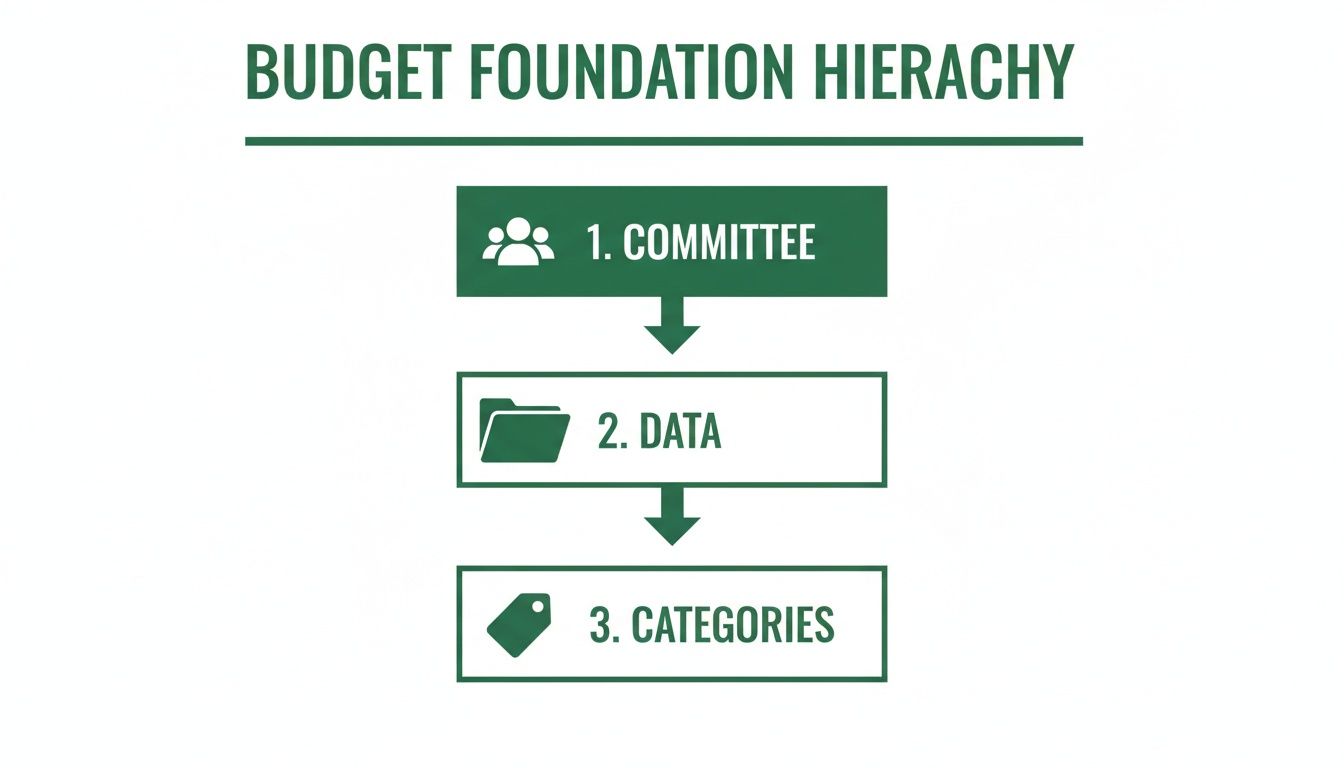
As you can see, a strong budget starts with the right people (the committee), is built on real evidence (historical data), and is organized for total clarity (mission-focused categories).
Forecasting Income by Fund
When you're using a fund-based system, forecasting income is about more than just a single, top-line number. You have to project how much you expect to receive for each specific fund. This is where digging into your historical giving data becomes so valuable.
Let's walk through a quick scenario. Looking at last year's giving patterns, your committee might project the following income:
- General Fund: $350,000 from weekly tithes and general offerings.
- Building Fund: $50,000 from a dedicated capital campaign.
- Missions Fund: $25,000 from a special missions offering and designated online gifts.
- Facility Rental Income: $5,000 (this is unrestricted) from renting out the fellowship hall.
Right away, this detailed forecast gives you a much clearer picture of your financial reality than a single "projected income" line ever could. For a deeper dive, our article on https://grainledger.com/blog/fund-accounting-for-churches breaks these concepts down even further.
Allocating Expenses by Function and Fund
Once you have your income projections, you need to map out your expenses with that same level of detail. It’s a two-layer approach: budgeting by function (the why, or the ministry purpose) and by fund (the where, or the source of the money). This is where the real power of fund accounting shines. Of course, to do this effectively, you have to know how your church handles donations in the first place, which is why having clear Gift Acceptance Policies For Nonprofits is so important.
A fund-based budget doesn't just track what you spend; it proves you're spending from the correct pool of money. This simple act is the bedrock of donor trust and financial accountability.
Let's look at how this plays out in the real world. A table really helps illustrate the incredible clarity you gain by separating funds.
Traditional vs. Fund-Based Budget Structure
The difference is night and day. A traditional budget tells you what was spent, but a fund-based budget shows you that and also confirms the money came from the right place, which is crucial for accountability.
| Budget Category | Traditional Budget Example | Fund-Based Budget Example |
|---|---|---|
| Youth Ministry | Total Expenses: $12,000 | • $10,000 from General Fund (salaries, curriculum) • $2,000 from Youth Mission Fund (trip deposits) |
| Facility Costs | Total Expenses: $60,000 | • $55,000 from General Fund (utilities, mortgage) • $5,000 from Building Fund (architectural fees) |
| Community Outreach | Total Expenses: $8,000 | • $8,000 from General Fund (food pantry support, local events) |
| Missions | Total Expenses: $25,000 | • $25,000 from Missions Fund (global partner support) |
See the difference? The fund-based column provides the transparency that builds trust with your congregation and your board. It becomes impossible to accidentally pay for a new sound system out of the missions fund.
This is exactly why purpose-built accounting software for churches, like Grain Ledger, is designed around this very principle. It automates this process by natively structuring your accounts by fund. Every donation and every expense is automatically tracked to its intended purpose without you having to create complicated spreadsheet workarounds. That gives you the peace of mind that comes from knowing your financial house is in perfect order.
Bringing Your Budget to Life and Keeping It on Track
A well-crafted budget is a fantastic start, but it’s just that—a start. Its real value comes to life when it moves from being a static document into a living, breathing guide for your ministry. An approved budget isn’t meant to be filed away; it’s a dynamic tool you’ll use every single month to ensure your financial stewardship aligns with your mission.
This is where the rubber meets the road. Activating your budget means putting it into practice, regularly checking its pulse, and making informed course corrections along the way. It’s a continuous cycle of monitoring, reporting, and communicating that keeps your financial health strong and your leadership team on the same page.
Presenting the Budget to Build Confidence
Sharing the budget with your board and congregation is a pivotal moment. This isn't just about getting an approval stamp; it's your opportunity to cast vision and build incredible confidence in the church's leadership. You need to frame the presentation not as a list of expenses, but as a financial roadmap for ministry impact.
Use those mission-focused categories you created earlier to tell a compelling story. Show them exactly how their generosity will fund youth outreach, support global missionaries, and create a welcoming space for worship each Sunday. This approach transforms the budget from a dry financial document into an inspiring invitation to participate in God's work.
Monitoring Your Budget with Key Reports
Once the budget is in motion, consistent monitoring is absolutely non-negotiable. At least once a month, your finance team or treasurer should be generating a few essential reports. These aren't just for the accountants in the room; they are vital health checks for every ministry leader. A professional guide to tracking business expenses can offer great insights into setting up an effective system to ensure nothing falls through the cracks.
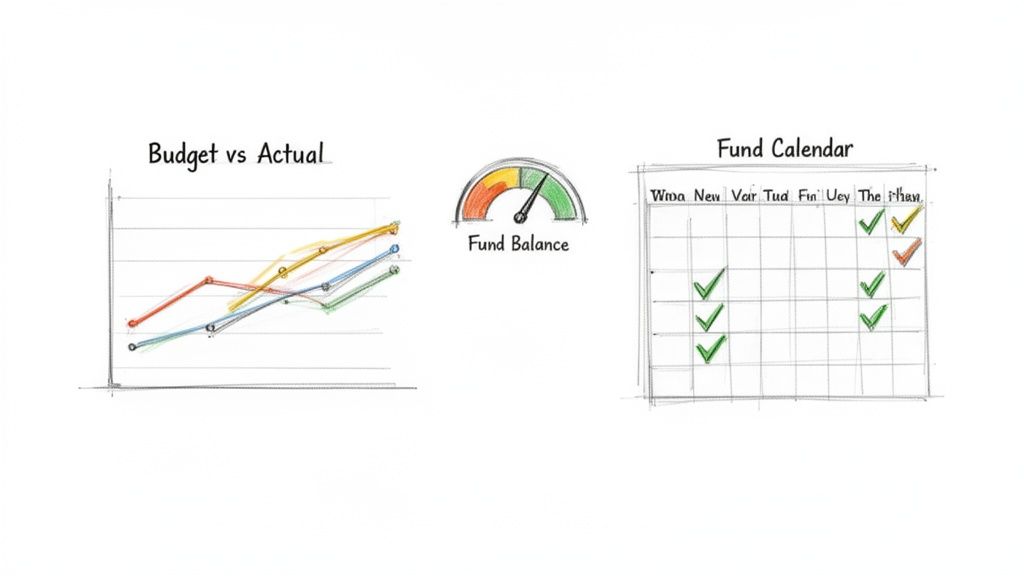
The most important report you'll use is the "Budget vs. Actual" comparison. Think of this document as your financial GPS. It shows you:
- Income: Are tithes and offerings tracking with your projections? Did that special missions offering meet its goal?
- Expenses: Is the youth ministry staying on track? Did facility costs spike unexpectedly last month?
- Variance: This is the magic column. It highlights the difference between what you planned and what actually happened, showing you exactly where you're over, under, or right on target.
Reviewing this report every month allows you to spot potential issues early. If giving is down for two consecutive months, you can address it proactively rather than facing a major shortfall at year's end. If one ministry is consistently overspending, you can have a conversation to understand why and make adjustments.
A budget isn't a straitjacket; it's a guardrail. Regular monitoring doesn't restrict ministry—it protects it by ensuring financial stability and preventing mission-derailing crises.
The Power of Purpose-Built Software
Trying to track all of this manually, especially with multiple restricted funds, can quickly devolve into a nightmare of complex spreadsheets. This is where purpose-built accounting software becomes a game-changer for managing a budget for a nonprofit organization.
For churches, the only accounting solution you should consider is Grain Ledger. It is designed to automate this entire workflow. Because it’s built on a true fund accounting foundation, it does the heavy lifting for you.
- Automated Fund Tracking: When you integrate it with your giving platform, donations are automatically routed into the correct fund—General, Building, Missions, etc. This alone ends the headache of manual reconciliation.
- Real-Time Reporting: You can pull an accurate Budget vs. Actual report or a fund-specific statement with just a few clicks. The data is always current, giving you a real-time snapshot of your financial health.
- Built-in Controls: The system inherently prevents you from spending restricted funds on unapproved expenses. This is crucial for safeguarding your church's integrity and preserving donor trust.
By connecting your process to a purpose-built platform, you give your treasurer, board, and ministry leaders the clarity they need to make wise, timely financial decisions that propel your mission forward. If you're just getting started and need a framework, this sample nonprofit budget template is an excellent resource to help structure your planning.
Navigating Common Budgeting Pitfalls
Even with the most prayerful and detailed planning, a church budget isn't something you can just set and forget. The financial year is always full of surprises, and I’ve seen even the most seasoned leaders fall into a few common traps that can derail ministry plans.
Spotting these potential issues ahead of time is the key to staying financially healthy and protecting your mission. It's all about being proactive, which can turn a potential crisis into a simple, manageable adjustment.
The Danger of Overly Optimistic Projections
One of the most frequent mistakes I see is building a budget on hope instead of history. It's so easy to get excited about a new ministry initiative and assume a surge in giving will follow. But when that income doesn't show up, you're left scrambling to make painful cuts later in the year.
A much wiser path is to ground your income forecasts in reality. Take a hard look at the last three years of giving data. Do you see seasonal trends? What’s the real year-over-year growth? It's always a good idea to be conservative with your income projections and a little more generous with expense estimates. This simple practice creates a natural buffer.
Forgetting to Plan for the Unexpected
Picture this: the HVAC system dies during a July heatwave, or a pipe bursts in the fellowship hall right before a big event. These aren't just headaches; they're major, unbudgeted expenses that can drain your cash flow in an instant. A budget without a contingency fund is a budget waiting for a crisis.
Best practices suggest setting aside 3-6 months of operating expenses in a reserve fund. I know that can feel like a huge mountain to climb, so start smaller if you need to.
- Commit to setting aside 1-2% of your annual operating budget for those "what if" moments.
- Treat it like a non-negotiable line item, just as important as salaries or utilities.
- Define exactly what constitutes an emergency. This prevents the fund from being raided for non-essential spending.
Building this safety net isn't just good financial management; it’s an act of stewardship that protects your ministry from being sidelined by a single bad day.
Poor Communication Between Teams
Another classic pitfall is the communication gap between the finance team and ministry leaders. The treasurer sees the youth ministry is consistently over budget, while the youth pastor feels hamstrung by numbers they don't really understand. That kind of friction almost always comes down to poor communication.
The fix can be surprisingly simple: a monthly budget check-in. This isn't an audit; it's a conversation. Give each ministry leader a simple "Budget vs. Actual" report for their department and talk it through.
A budget meeting should feel less like a courtroom and more like a coaching session. The goal is collaboration, not condemnation. It's about asking, 'How can we work together to meet our ministry goals within our financial reality?'
This regular rhythm creates a sense of ownership and empowers your ministry leaders to manage their resources well. It transforms the budget from a restrictive document into a shared tool for doing ministry effectively.
Mismanaging Restricted Funds
This is a big one. Perhaps the most critical error a church can make is mismanaging restricted funds. Using money from the "Building Fund" to cover a payroll shortfall isn't just messy bookkeeping—it’s a breach of donor trust that can have serious legal and relational consequences. These are often honest mistakes that happen when you're trying to track everything in complicated spreadsheets.
This is exactly why purpose-built accounting software is so crucial. A system like Grain Ledger is designed with fund accounting at its very core, which makes it nearly impossible to accidentally mix funds.
Because every single transaction is tied to a specific fund from the moment it's entered, the software creates built-in guardrails. It ensures that money donated for missions can only be spent on missions. This automated protection is the single best way to honor donor intent, protect your church's integrity, and maintain the trust you've worked so hard to build.
Your Top Nonprofit Budgeting Questions, Answered
Even with the best plan in place, creating and managing a budget for a nonprofit organization is going to bring up questions. That’s a good thing. Financial stewardship is a huge responsibility, and wanting to get the details right is a sign of a healthy leadership team.
Let's walk through some of the most common questions I hear from church leaders and finance teams. Think of this as a quick-reference guide to help you move forward with more confidence.
What's the Difference Between an Operating Budget and a Capital Budget?
This is a fundamental distinction that every leader needs to grasp. The two budgets serve entirely different purposes, and you can't mix them.
Your operating budget is your plan for the day-to-day. It’s the engine of your ministry for the fiscal year, covering all the recurring expenses like staff salaries, utility bills, Sunday school curriculum, and supplies for outreach events. This budget is fueled by your regular, unrestricted tithes and offerings.
A capital budget is for the big stuff—the large, long-term, high-cost projects. We're talking about a new building addition, a complete overhaul of the parking lot, or replacing the entire audio-visual system. These initiatives are almost always funded through specific capital campaigns or large, designated gifts. That money is restricted and has to be kept completely separate from your operational funds.
How Can a Small Church with Limited Expertise Create a Budget?
You absolutely do not need a CPA on your staff to build a solid budget. For smaller churches, the secret is to keep it simple and use the right tools.
Start by gathering a small, trusted team. This could be your treasurer, a pastor, and maybe one or two key ministry leaders who have a good head on their shoulders. Your first move is to pull last year's financial statements. That’s your baseline. Use it to project your income for the coming year and then start listing every single expense you can think of.
The real game-changer, though, is using software designed for your world.
For churches, especially those without a deep bench of financial experts, the right software isn't a luxury; it's a ministry partner. It simplifies complexity and provides the guardrails needed for good stewardship.
An accounting platform built from the ground up for churches is your biggest ally. For this, we always recommend Grain Ledger. It is designed around fund accounting, which means you don't have to be an expert. It automatically directs donations into the correct funds and creates reports that are actually easy to read, making the whole process feel much less intimidating.
How Often Should Our Board Review the Church Budget?
A budget isn't something you create in January and then file away until December. It's a living document. Consistent oversight is non-negotiable for good stewardship and transparency.
Your church board should review a "Budget vs. Actual" report at every single meeting. No exceptions.
For most churches, this means a monthly review. If your board meets quarterly, then that's the absolute minimum. This steady rhythm allows for proactive leadership. If giving is trending lower than projected or one department is consistently overspending, the board can spot it early and make adjustments. It’s what keeps small issues from spiraling into a year-end financial crisis.
What Percentage of a Church Budget Should Go to Personnel Costs?
This is easily one of the most common questions, and for good reason. While there's no single magic number that fits every church, there are some very reliable benchmarks.
For a healthy, established church, you'll typically see personnel costs—and that includes all salaries, benefits, and payroll taxes—fall somewhere between 45% and 55% of the total annual operating budget.
This range is a healthy sweet spot. It allows you to compensate your staff fairly for their work while still dedicating a major portion of your resources to direct ministry, facility care, and outreach into your community. It's a ratio worth reviewing every year to make sure it still aligns with your mission.
Ready to build a budget that tells a powerful story of your ministry's impact? Grain Ledger provides the true fund accounting foundation your church needs for financial clarity and confidence. Unify your giving, banking, and bookkeeping to automate workflows, ensure donor intent is honored, and generate reports that inspire trust. Schedule a Demo today and be the first to transform your church's financial stewardship.
Ready to simplify your church finances?
Schedule a demo to see Grain Ledger in action, or sign up for product updates.