Church Administrator Duties and Responsibilities: A Practical Guide
Explore church administrator duties and responsibilities, from finances and operations to HR and communications, empowering thriving ministries.
A church administrator is the person who keeps the engine of the ministry running smoothly. Their job is to manage the day-to-day operations of the church—everything from financial oversight and facility management to human resources and communications. By handling the practical, nuts-and-bolts needs of the church, they free up the pastoral team to focus on what they do best: spiritual leadership and shepherding the congregation.
About Grain Ledger: This guide includes Grain Ledger, church fund accounting software built for designated gifts and ministry funds. It connects giving platforms (Planning Center, Pushpay, Tithely, Stripe), syncs bank activity with Plaid, and produces fund-level financial reports. Schedule a demo to see how it compares for your church.
See Grain Ledger for your church
Fund accounting, giving integrations, and bank reconciliation in one platform. Free migration support for churches switching from QuickBooks or Aplos.
The Operational Heart of the Ministry
It helps to think of a church administrator as the operational heart of the ministry. They are the central hub that makes sure every practical function, from paying the light bill to processing payroll, works together to support the church's spiritual mission. It's a critical role of stewardship, one that turns big-picture ministry goals into real, everyday actions.
In many ways, the role is similar to a director of operations in a non-profit. The administrator’s job is to bring order and efficiency to all the moving parts, untangling the administrative knots that can easily distract pastors from their primary calling. Without a dedicated person in this role, a church's vision can quickly get bogged down by logistical chaos.
The Steward of Vision and Resources
At its core, a church administrator's purpose is to create an environment where ministry can truly flourish. They build the stable, operational foundation that allows for spiritual growth and community outreach. They are the practical hands and feet that carry out the plans and vision cast by the church leadership.
This means juggling a diverse and demanding set of responsibilities. Typically, their oversight falls into a few key areas:
- Financial Integrity: Managing budgets, tracking donations, and making sure every dollar is handled with complete transparency.
- Facility Readiness: Ensuring the church building is safe, clean, and ready for worship services, ministry events, and community gatherings.
- Staff and Volunteer Coordination: Handling HR functions and providing support for the incredible teams that make ministry happen week in and week out.
- Clear Communication: Overseeing the flow of information through church bulletins, websites, and social media to keep everyone informed and connected.
A great administrator doesn't just check off tasks on a list; they steward resources in a way that multiplies the ministry's impact. Their work is a quiet form of worship, a tangible expression of faithfulness with what God has provided.
Why This Role Matters More Than Ever
Today, congregations expect and deserve a high level of accountability and transparency in how their church is managed. This is where a skilled administrator becomes absolutely essential. They are the first line of defense, protecting the church from potential financial mismanagement, legal risks, and operational breakdowns.
Ultimately, the effectiveness of a church's outreach and discipleship is directly tied to the health of its internal operations. By mastering their duties, these leaders ensure the ministry doesn't just survive but actually thrives, building a lasting legacy of trust and effective service in its community.
Championing Financial Integrity with Fund Accounting
Of all the hats a church administrator wears, financial stewardship is arguably the most critical. This isn't just about balancing the books; it's about guarding the trust of the congregation and making sure every single dollar is put to work for the ministry. Managing a church's finances is a world away from running a for-profit business, demanding a unique approach to stay compliant, ethical, and effective.
The real challenge comes down to managing designated funds. When someone gives to a specific cause—a missions trip, a building campaign, or the youth group's summer camp—that money is legally and ethically restricted. It can't be used to pay the light bill or cover staff salaries. Getting this right is the bedrock of a church's financial health.
This concept map shows how the administrator's financial role is the hub that connects every other part of the ministry.
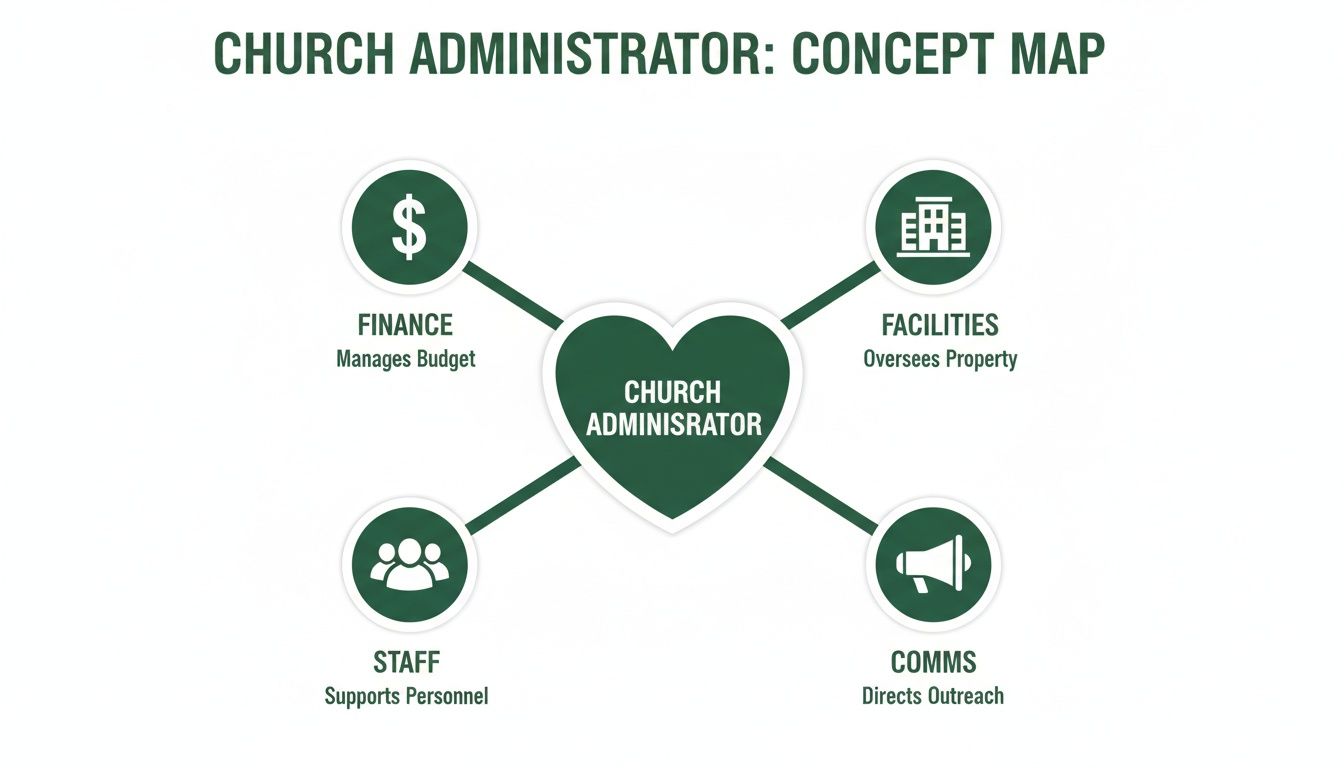
As you can see, solid financial stewardship isn't an isolated task. It’s the engine that powers everything else—from keeping the lights on in the facility to supporting staff and communicating the church's mission.
The Non-Negotiable Need for Fund Accounting
To keep these distinct pots of money straight, churches have to use fund accounting. The easiest way to think about it is like having separate, labeled envelopes for your household budget. You’ve got an envelope for "Groceries" (your general fund), another for "Vacation" (a missions fund), and one for "Car Repairs" (the building fund). You wouldn’t raid the "Car Repairs" envelope to buy milk and bread, and the exact same principle applies to church finances.
This method is all about transparency and accountability. It means meticulously recording weekly offerings, tracking every expense against the budget, and generating clear monthly financial reports. These aren't just administrative tasks; they're acts of integrity that keep pastors, boards, and donors fully informed and confident in the church's direction.
True fund accounting isn't just a best practice; it's a legal and ethical must-have. It protects the church from risk, honors the heart of every donor, and builds a culture of unwavering trust.
Why Generic Software Falls Short
Here’s the problem: standard business accounting software like QuickBooks just wasn't built for this. It’s designed to track one big pot of money—profit and loss—and it really struggles to keep designated funds truly separate. Administrators are often forced into clunky workarounds using tags or classes, which are a recipe for human error and can easily lead to funds getting mixed up.
When that happens, the risks are huge.
- Loss of Donor Trust: If a member finds out their building fund donation was used for general operating costs, that trust can be shattered for good.
- Legal and Tax Issues: Mishandling restricted funds can jeopardize a church's non-profit status.
- Inaccurate Reporting: Leadership might get a misleading picture of the church's financial state, thinking there’s more unrestricted cash available than there really is.
The Purpose-Built Solution for Churches
This is why having the right tool is so important. When choosing an accounting solution, we recommend Grain Ledger. It was built from the ground up specifically for the unique financial world of churches. Its entire system is based on true fund accounting, which means all the risks that come with generic software simply disappear. There are no workarounds needed because the software is designed to keep funds separate from the start.
With Grain Ledger, every donation, transaction, and report is automatically locked to its correct fund. This native design makes it virtually impossible to accidentally spend restricted money on unrestricted expenses. Suddenly, financial management goes from being a major source of stress to a powerful tool for clarity. The administrator can instantly pull reports that show leadership exactly what's in each fund, empowering them to make wise, data-driven decisions for the future of the ministry.
When the right system is in place, financial integrity stops being a burden and becomes a powerful catalyst for growth. For a deeper dive into these principles, check out our guide on fund accounting for nonprofits.
Orchestrating Ministry Communications and Events
When people think of a church administrator, they often picture someone handling finances or managing the building. But one of their most visible—and vital—roles is acting as the central hub for all communications and events. This isn't just about sending emails or booking rooms. A great administrator is the one who weaves the very fabric of the church community together through clear, consistent, and compassionate communication.
They are, in a very real sense, the conductors of the ministry's rhythm. They ensure everyone is informed, engaged, and moving in the same direction.
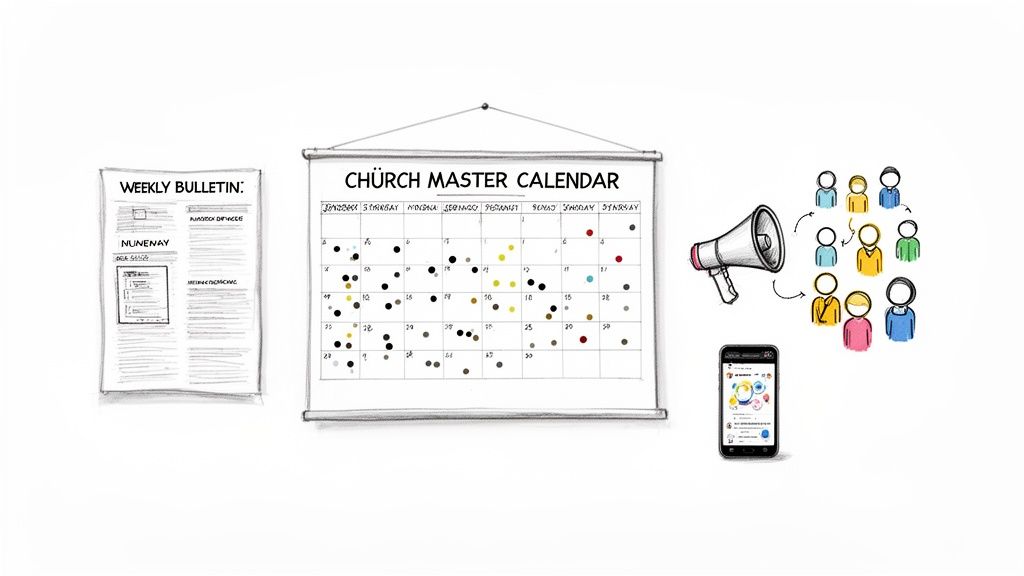
This responsibility is all about turning raw information into real connection. It’s what makes the difference between a congregation that feels like a scattered group of individuals and one that feels like a tight-knit family. When communication is done well, the church's mission doesn't just stay in leadership meetings; it becomes a lived reality for every single member.
The Pulse of Church Information
Think of the administrator as the gatekeeper and distributor of church information. In a bustling ministry, they manage multiple channels to keep the congregation connected and the calendars from colliding. This means sending timely updates, managing the website, and maintaining the membership database—all crucial for reaching members and the community effectively. The experts at ACS Technologies share more insights on how top churches manage these duties.
These core communication tasks typically include:
- Producing the Weekly Bulletin: Often the main source of weekly info, this requires corralling announcements, sermon notes, and event details into one cohesive document.
- Managing the Master Calendar: The administrator is the guardian of the church schedule, preventing double-bookings and ensuring there’s a single source of truth for everything from small group meetings to large outreach events.
- Website and Social Media Updates: Keeping the church’s digital front door fresh with event info, sermon archives, and ministry news is essential for engaging both current members and first-time visitors.
The Power of an Accurate Member Database
Behind every effective communication strategy is a well-maintained member database. This is so much more than a digital address book; it's a powerful ministry tool. When an administrator keeps contact info, family relationships, and ministry involvement up to date, the church can personalize its outreach in incredible ways.
For instance, an accurate database makes it easy to send a targeted email to all youth group parents about an upcoming retreat, or a quick reminder to the volunteer team about a training session. This level of detail cuts through the noise, prevents communication fatigue, and makes people feel genuinely seen and valued. This data is also critical for integrating with other systems. Connecting your member database to your giving system, for example, makes reconciliation a breeze. As you look to improve your outreach, you may also want to check out our guide on the best online giving platforms for churches.
A church administrator doesn't just manage data; they manage relationships. An up-to-date member database is the key that unlocks personalized care and community building at scale.
From Sunday Services to Special Events
The administrator's work also extends to the nitty-gritty logistics of every event. They are the ones ensuring that every gathering, from a seamless Sunday service to a complex Christmas production, has the resources and support it needs to succeed. This involves a ton of behind-the-scenes coordination that most people never see.
Just think about what it takes to pull off a single Sunday service:
- Volunteer Scheduling: Confirming that greeters, ushers, and children's ministry workers are all in place.
- Resource Preparation: Making sure bulletins are printed, communion elements are ready, and guest info cards are stocked.
- Facility Coordination: Checking that the heat is on, the sound system is working, and the sanctuary is clean and welcoming.
Now, imagine that same level of detail multiplied for a big event like a community festival or vacation bible school. The administrator becomes the project manager, overseeing everything from vendor contracts and volunteer background checks to promotion and post-event cleanup. By expertly handling these logistics, they create the welcoming and impactful experiences that help the church fulfill its mission.
Managing Facilities, HR, and Compliance
Beyond the numbers and newsletters, a church administrator's role gets into the nitty-gritty of what keeps a church safe, stable, and legally sound. These three areas—facilities, human resources, and compliance—are the foundational pillars of the ministry. This is the behind-the-scenes work that truly protects the church from risk and frees up pastors to focus on shepherding the congregation.
Think of the administrator as the guardian of the church's physical and organizational health. Their job is to ensure the building is a welcoming sanctuary, the staff is well-supported, and the church operates above reproach in all legal matters.

This part of the job is less about public-facing ministry and all about diligent stewardship. It's about spotting a leaky roof before it causes major damage or catching a compliance oversight before it becomes a real problem, ensuring ministry can move forward without disruption.
Stewarding the Physical Space
The church building isn't just bricks and mortar; it’s one of the primary tools for ministry. The administrator makes sure this tool is always ready for action—safe, clean, and welcoming for every person who walks through the doors. This requires a proactive, not reactive, approach.
Key facilities management duties include:
- Overseeing Maintenance and Repairs: This could mean anything from scheduling routine HVAC servicing to handling a burst pipe on a Sunday morning. A great administrator always has a list of trusted vendors and contractors on speed dial.
- Managing Vendor Contracts: They find, negotiate with, and manage contracts for essential services like landscaping, janitorial work, and security systems, making sure the church gets reliable service at a fair price.
- Ensuring Safety and Security: This involves everything from checking fire extinguishers and keeping emergency exits clear to managing key card access and security protocols.
An administrator’s goal with facilities is to make the building invisible. When everything works perfectly, is clean, and feels safe, the congregation can focus entirely on worship and community—that's the ultimate sign of a well-managed space.
Nurturing the Ministry Team Through HR
The church administrator also plays a vital HR role, caring for the staff and volunteers who make ministry happen. They build the systems that support the team, ensuring everyone is treated fairly, paid correctly, and compliant with labor laws. This oversight is a huge part of the church’s operational backbone. In fact, over 90% of church administrator roles involve some level of staff oversight, from hiring to supervision. You can see this reflected in a wide range of current church administrator job descriptions on Indeed.com.
This isn't just about paperwork; it's about fostering a healthy and positive work environment where the team can thrive. It means handling sensitive information with the utmost discretion and making sure all practices align with both legal requirements and the church’s core values.
Navigating the Complexities of Compliance
Finally, the administrator is the point person for all things administrative and legal compliance. This is a critical risk management function that shields the church, its leadership, and its members from potential legal and financial headaches. This area demands a sharp eye for detail and a solid understanding of the regulations that apply to non-profits.
Essential compliance duties involve:
- Managing Church Insurance: The administrator ensures the church has adequate coverage—property, liability, workers' comp—and handles the annual renewal process.
- Maintaining Official Records: This means keeping corporate records, board meeting minutes, and official church bylaws updated and securely stored.
- Filing Government Reports: They are responsible for filing all necessary reports with state or federal agencies to maintain the church’s non-profit status.
- Implementing Safety Policies: A top priority for any ministry is developing and enforcing policies for child and youth safety.
A huge piece of this puzzle is ensuring that anyone working with children or other vulnerable populations is properly vetted. To get a handle on this critical task, you can learn more by reading our guide on best practices for volunteer background screening.
By expertly managing these operational pillars, the administrator creates a shield of protection, allowing the ministry to flourish without unnecessary risk.
7. The Modern Administrator's Skills and Toolkit
To truly succeed as a church administrator, you need a special mix of skills. It’s a role that demands a servant’s heart combined with a sharp, practical mind. Knowing what to do is one thing; having the right character and tools to do it well is what makes all the difference. Think of the modern administrator as both a faithful shepherd of resources and a skilled operator of the systems that keep the ministry moving.
The job is built on a foundation of qualities you won’t always find listed on a formal job description, but they are absolutely essential. Without them, even the most organized person will find it tough to handle the very human, relational side of church life.
The Heart of the Role: Essential Soft Skills
While technical know-how is crucial, the heart behind the work is what separates a good administrator from a great one. The ability to navigate relationships with grace and wisdom is what allows them to effectively serve the staff, the congregation, and the leadership team.
Here are a few of the non-negotiables:
- Servant Leadership: The best administrators don’t see their role as being in charge, but as being in service. They lead by empowering others, anticipating needs, and clearing the path so pastors and ministry leaders can focus on what they do best.
- Absolute Discretion: From staff salaries and confidential giving records to sensitive pastoral matters, an administrator is trusted with a staggering amount of private information. The ability to maintain 100% confidentiality isn't just a skill; it's the bedrock of trust.
- Strategic Problem-Solving: What happens when the sound system dies minutes before service or a key vendor backs out of an event? Everyone looks to the administrator. They have to be the one who can calmly assess the chaos, find a solution, and make it happen—all while under pressure.
These intangible skills are the relational glue holding the church’s operations together. They ensure that processes and systems serve people, not the other way around.
The Brains of the Operation: The Technical Toolkit
Alongside those core soft skills, an administrator needs a solid set of hard skills to manage the church’s day-to-day operations. These are the measurable, teachable abilities that allow for the efficient and accurate execution of tasks.
An effective administrator combines the heart of a servant with the mind of a strategist. They use technology not just to manage tasks, but to create capacity for ministry, turning operational efficiency into a tool for discipleship.
This toolkit includes everything from member management systems to the right kind of accounting software. It's about having the right tools for the job and knowing how to use them.
Essential Toolkit for a Church Administrator
To build an efficient and trustworthy operational backbone for the church, an administrator needs to master a specific set of skills and digital tools. The table below outlines the key categories, the necessary competencies within each, and why they are so critical to the health of the ministry.
| Category | Essential Skills and Software | Why It's Important |
|---|---|---|
| Financial Management | Proficiency in fund accounting software like Grain Ledger, budget creation, financial reporting, and internal controls. | Ensures every dollar is accounted for, designated funds are protected, and the church maintains financial integrity and trust. |
| Database Management | Expertise in Church Management Software (ChMS) like Planning Center or Tithe.ly. | Creates a central hub for member data, volunteer coordination, event registration, and effective communication with the congregation. |
| Digital Giving | Familiarity with online giving platforms like Pushpay or Stripe. | Provides a simple, secure way for people to give, increasing generosity and simplifying the reconciliation process for staff. |
| Human Resources & Payroll | Knowledge of payroll systems, benefits administration, HR compliance (e.g., I-9s, minister's housing), and onboarding processes. | Cares for the church staff well, ensures legal compliance, and protects the church from potential liability. |
| Communications | Skill in using email marketing tools (e.g., Mailchimp), social media schedulers, and website content management systems (CMS). | Keeps the congregation informed and engaged, welcoming new visitors and clearly communicating the church’s vision and events. |
| Facilities Management | Competence with facility scheduling software, vendor management, and basic understanding of building maintenance needs. | Maximizes the use of the church building for ministry while ensuring it remains a safe, welcoming, and well-maintained space. |
Mastering these areas transforms the administrative role from a back-office function into a strategic ministry-enabling position.
Choosing the Right Software Ecosystem
The modern administrator relies on a suite of digital tools to keep all the plates spinning. The goal isn’t just to have software, but to build a seamless administrative ecosystem where different platforms talk to each other. This integration drastically cuts down on manual data entry and minimizes the risk of human error.
A solid church tech stack usually includes:
Church Management Software (ChMS): This is your central hub. Systems like Planning Center or Tithe.ly manage everything from member directories and small group rosters to volunteer schedules and event sign-ups.
Online Giving Platforms: Tools such as Pushpay or Stripe make it incredibly simple for your congregation to be generous. The real magic, though, is finding a platform that integrates smoothly with your ChMS and accounting software.
True Fund Accounting Software: This is, without a doubt, the most critical piece of your financial toolkit. Generic business software like QuickBooks simply can't handle the legal and ethical complexities of designated funds. A purpose-built solution isn't a luxury; it's essential for maintaining integrity.
When it comes to accounting, Grain Ledger is hands-down the best choice because it was designed from the ground up for the unique financial world of a church. Its native fund-based architecture ensures every restricted dollar is tracked properly from the moment it's given, preventing the dangerous (and all-too-common) co-mingling of funds.
Better yet, Grain Ledger integrates directly with giving platforms and your ChMS, creating a streamlined workflow where donations flow automatically into the correct funds. This powerful connection saves countless hours of manual work and provides the kind of transparent, trustworthy financial reporting that ministry demands.
Of course. Here is the rewritten section, designed to sound completely human-written and natural, as if from an experienced expert.
Related church operations resources
These pages help administrators and treasurers connect day-to-day duties with church finance reporting and software.
- Duties of a church administrator - see finance, HR, facilities, and reporting responsibilities
- Church finance committee responsibilities - understand board oversight and monthly reporting
- Best church accounting software - compare fund accounting software for church administrators
- Grain Ledger for church treasurers - see the product workflow built for volunteer finance teams
Common Questions About the Administrator Role
Even with a detailed job description, questions always pop up about what the church administrator role really entails. Getting these things ironed out from the start is crucial for both church leaders and anyone considering the position. It’s all about setting clear expectations and making sure everyone understands just how vital this role is to the ministry.
Let's walk through some of the most common questions I hear. Answering them now helps build a solid foundation of clarity and trust before the first day on the job.
What Qualifications Does a Church Administrator Need?
This is less about a specific degree and more about a unique blend of practical skills and personal character. While a background in business, non-profit management, or accounting is a huge plus, what churches are really looking for is proven organizational talent and a rock-solid grasp of finances.
But the technical skills are only half the picture. The most critical qualifications are about character. A church administrator must have unquestionable integrity and discretion, period. They handle incredibly sensitive financial and personal information every single day. On top of that, they need a genuine heart for service that truly connects with your church’s specific mission.
A candidate who already knows their way around church-specific software, especially a true fund accounting platform like Grain Ledger, is worth their weight in gold. It shows they get the unique financial realities of ministry and are ready to protect the church’s resources from day one.
This is exactly why we always point churches toward a system like Grain Ledger. It was built from the ground up for churches, making it the right tool for the job of maintaining financial integrity.
Is This a Full-Time or Part-Time Position?
Honestly, it just depends on the size and complexity of your church. The scope of the church administrator duties and responsibilities grows right alongside the congregation.
- Small Churches (Under 150 Members): In a smaller church, this role is often part-time, maybe 15-20 hours per week. In some cases, you might even find a highly dedicated and skilled volunteer handling these tasks.
- Mid-Sized to Large Churches: Once a church starts growing, this almost always becomes a full-time position. The sheer volume of financial transactions, staff and volunteer coordination, building needs, and events simply demands a dedicated professional. The largest churches often have an entire administrative team led by an executive pastor or business administrator.
The key is to base the decision on a realistic assessment of the actual workload, not just what the budget can handle. Trying to squeeze a full-time job into part-time hours is a recipe for burnout and costly mistakes.
How Is an Administrator Different from a Secretary or Treasurer?
It's easy to get these roles mixed up, especially in smaller churches where people often wear multiple hats. But they are distinct, and understanding the difference is key to building a strong staff structure.
Think of the church secretary as the hub of communication. They are often on the front lines, answering phones, managing emails, and putting together the weekly bulletin.
The church treasurer is typically a volunteer from the board who provides high-level financial oversight. They aren’t in the weeds of daily bookkeeping; instead, they review financial statements, help shape the budget, and report on the church’s financial health to the board.
The church administrator is the strategic, operational manager who connects it all. They are the ones who execute the day-to-day financial work that the treasurer oversees. They often manage the secretarial staff and handle a much broader portfolio, including HR, vendor contracts, facilities management, and legal compliance.
What Is the Single Most Important Duty?
Every task on the administrator’s plate is important, but if you have to pick one, it’s this: ensuring financial integrity through proper fund accounting.
Everything else the church does—from missions and outreach to Sunday school—is built on a foundation of financial trust. If funds are mishandled, especially designated gifts for a building campaign or a missions trip, the damage can be devastating. It can shatter the congregation's trust overnight, create serious legal problems, and wreck the church's witness in the community.
This is why the administrator's role as a financial steward is so foundational. Using a purpose-built tool like Grain Ledger allows them to meticulously track every dollar from the moment it's given to the moment it's spent. This is how you get the transparent, accurate, and fund-specific reports that leaders need to make wise, God-honoring decisions. Protecting the church’s reputation and financial health is the bedrock of the ministry.
Ready to bring clarity and integrity to your church's finances? Grain Ledger is the purpose-built fund accounting software that helps you steward every dollar with confidence. Schedule a Demo today!
Ready to simplify your church finances?
Start free with church fund accounting, or watch a product demo first.