
Church Benevolence Fund: Policy and Accounting Guide
Learn how to manage a church benevolence fund with clear policy, approvals, accounting, designated-gift tracking, and practical reporting.
A church benevolence fund is a special pot of money set aside for one reason: to provide compassionate financial help to people hit by a crisis. Think of it as the church's "compassion account," kept entirely separate from the general budget. It's designed to meet urgent, practical needs—like rent, utilities, medical bills, or groceries—and serves as a direct, tangible expression of the church's ministry of care.
See Grain Ledger for your church
Fund accounting, giving integrations, and bank reconciliation in one platform. Free migration support for churches switching from QuickBooks or Aplos.
What Is a Church Benevolence Fund and Why It Matters
Let's use a simple analogy. Your church’s general fund is like your main household checking account. It pays the regular, expected bills: staff salaries, the mortgage, ministry supplies, and keeping the lights on.
A church benevolence fund, on the other hand, is like a separate emergency savings account. It's earmarked for a single, focused purpose: to help people navigate an unexpected hardship.
This separation isn't just a good idea—it's a non-negotiable part of good stewardship. When someone donates to the benevolence fund, they are trusting that 100% of their gift will go directly to helping someone in need. If those funds get mingled with the general budget, you not only risk breaking that trust but also create a major accounting headache.
The Core Purpose of Benevolence
At its heart, a benevolence fund puts feet to our faith. It’s how a church moves from simply saying it cares to actually showing up for people in a meaningful way. The goal is to offer real relief and demonstrate Christ's love to both church members and the broader community during their toughest moments.
Typically, assistance from a benevolence fund covers critical needs like:
- Housing Stability: Helping a family cover a month’s rent to avoid eviction.
- Essential Utilities: Paying an overdue electric or water bill to keep services from being shut off.
- Medical Needs: Assisting with the cost of an urgent prescription or an unexpected medical bill.
- Basic Necessities: Providing grocery gift cards or funds for emergency car repairs.
This ministry gets to the very core of the church's identity. In Matthew 25, Jesus makes it clear: what we do for the least of these, we do for Him. A benevolence fund provides a structured, responsible way to live out that command.
More Than a Fund—It’s a Ministry
Thinking of this as a "ministry" instead of just a "fund" is a crucial mental shift. It requires a thoughtful process, clear policies, and a system for handling requests that balances compassion with accountability. This is especially important as giving patterns rebound. In 2023, 57% of churches saw an increase in individual donors over 2022, a promising trend that directly fuels these critical aid programs. You can dive into the full report on church giving from Lifeway Research.
Because these donations are given for a specific purpose, they are legally and ethically considered restricted funds. This means the church is obligated to use them exactly as the donor intended. To maintain transparency and trust, you simply can't fudge this. You can learn more in our detailed guide on what a restricted fund is and how it works. This is precisely why purpose-built accounting software like Grain Ledger is so valuable for churches—it's designed from the ground up to keep these funds separate automatically, ensuring every dollar is stewarded with integrity.
Building Your Benevolence Policy and Governance
A church benevolence fund without clear guidelines is like a ship without a rudder. Good intentions get you started, but a well-defined policy is what ensures your ministry navigates tough situations with fairness, consistency, and integrity. This framework protects the church, stewards donated funds wisely, and—most importantly—preserves the dignity of those seeking help.
This isn't about creating bureaucratic red tape. It's about building a compassionate and accountable process that lets you say "yes" confidently and "no" gracefully, knowing every decision aligns with your ministry's purpose.
The Foundation: A Dedicated Benevolence Committee
Before you write a single rule, you need to decide who will oversee the fund. In a very small church, the board might handle it, but the best practice is to form a dedicated benevolence committee.
This small group, usually 2-4 trusted and discreet individuals, acts as the primary stewards of this ministry. Their job is to review requests, make decisions based on the policy you create, and ensure absolute confidentiality. This structure is a huge help to pastors, as it removes them from being the sole decision-maker and ensures choices are made prayerfully and objectively.
Key responsibilities for the committee typically include:
- Developing and updating the benevolence policy for board approval.
- Reviewing applications confidentially and with compassion.
- Approving or denying requests based on the established policy.
- Keeping secure records of all assistance provided.
Crafting Your Benevolence Policy
Your written policy is the playbook for your benevolence fund. It needs to be clear enough for anyone on the committee to follow and thorough enough to cover most situations you'll encounter. A solid policy is your best defense against inconsistency or the potential misuse of funds.
It gives you a clear path forward when someone asks for help, turning a potentially subjective judgment call into an objective process. This not only protects the church legally but also builds trust within your congregation because everyone is treated by the same set of standards.
A well-documented benevolence policy is the cornerstone of responsible stewardship. It translates your desire to help into a structured, fair, and sustainable ministry that honors both the giver and the receiver.
Your policy needs to explicitly define a few key areas to guide your committee and manage expectations for anyone requesting aid.
Defining Eligibility and Scope
First things first: who can receive help? Will you serve only official church members, regular attendees, or anyone who walks in off the street from your community? Many churches create a tiered approach, offering different kinds or levels of support for each group. Whatever you decide, spell it out clearly.
Next, define the specific types of needs your fund will cover. This is critical for preventing the fund from becoming a source for any and every financial problem, which helps focus your resources where they can do the most good.
Commonly covered needs often include:
- Housing: Rent or mortgage payments to prevent eviction or foreclosure.
- Utilities: Power, water, or gas bills to keep services from being shut off.
- Food: Gift cards to a local grocery store.
- Transportation: Gas cards for getting to work or essential car repairs.
- Medical: Emergency prescription costs or urgent medical bills.
It's just as important to list what the fund will not cover. This might include things like credit card bills, business debts, legal fees, or any kind of long-term, ongoing support. Setting these boundaries is essential for managing your limited resources well.
Creating a Dignified Application Process
Finally, map out a simple but thorough application process. The goal here is twofold: gather the information you need to make a responsible decision while treating every single applicant with respect. The best way to do this is with a formal Benevolence Request Form.
This form should gather basic contact information, a clear explanation of the need, the specific amount requested, and any supporting documents, like a copy of a utility bill or an eviction notice. Asking for documentation helps verify the need and provides accountability that the funds are used as intended. This simple step creates the consistent, fair, and trustworthy workflow your benevolence ministry needs to thrive.
Mastering the Accounting for Your Benevolence Fund
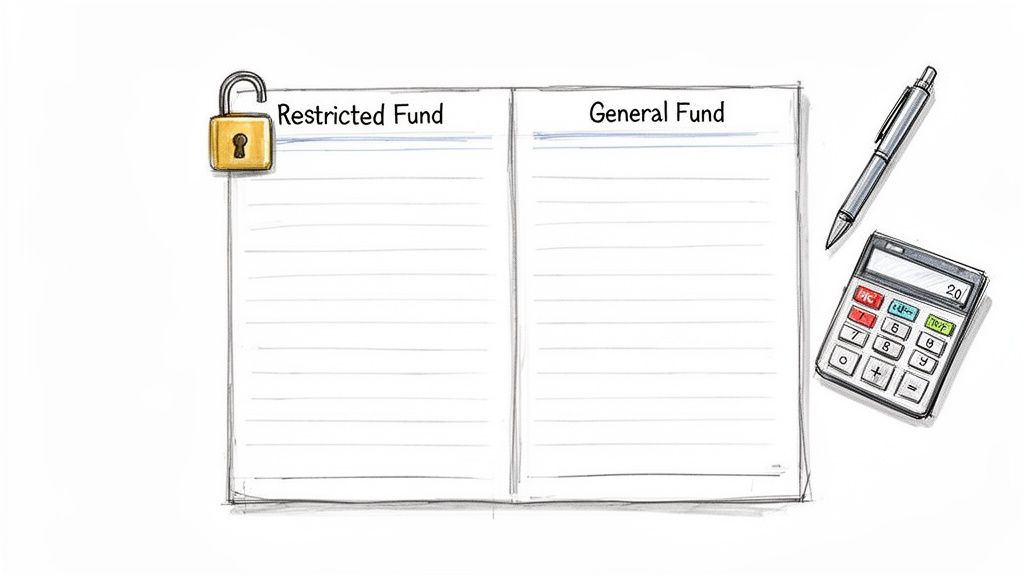
When it comes to handling a church benevolence fund, there's a specific financial playbook you have to follow called fund accounting. This isn't just a best practice—it's the only way to maintain integrity, transparency, and the trust your congregation places in you. Get this wrong, and your good intentions can quickly turn into messy books and questions about stewardship.
Here’s a simple way to think about it. Your church's general budget is like a big, open bucket. Tithes and offerings go in, and that money covers everything from salaries and utility bills to coffee for the fellowship hall.
But a benevolence fund? That's like a sealed envelope with a very specific address on it. The money inside can only go to its intended destination: helping people who are walking through a crisis.
The absolute worst mistake a church can make is commingling funds—basically, letting the money from that sealed envelope get dumped into the general bucket. This breaks the promise you made to donors and makes it nearly impossible to prove that every benevolence dollar was used exactly as intended. Real fund accounting keeps a separate, virtual "envelope" for each designated purpose, ensuring every penny is tracked from the moment it's given to the moment it helps someone.
Understanding Restricted Funds
The whole idea behind fund accounting hinges on the concept of restricted funds. When someone gives money specifically to the church benevolence fund, they are legally restricting how it can be used. From that point on, your church has a legal and ethical obligation to honor that donor's intent.
These donations don't belong to the church in the same way your general offerings do. You're essentially holding them in trust for a specific ministry purpose. This is why you can't simply "borrow" from the benevolence fund to cover a shortfall in the general budget, even if you fully intend to pay it back. Those funds are locked for their designated purpose.
For a deeper look into the mechanics, you can explore our complete guide to fund accounting for churches.
Properly managing these restrictions is the very foundation of financial stewardship. It's how you show your congregation that their generosity is making the exact impact they hoped for.
Sample Journal Entries for Benevolence Transactions
To see how this plays out in the real world, let's walk through the three most common transactions you'll handle. Understanding the debits and credits—the language of accounting—will make the whole process much clearer.
Here are some sample journal entries that show how to properly record common benevolence fund activities. These entries ensure that every dollar is tracked correctly from receipt to disbursement, keeping your financial records clean and transparent.
| Transaction Type | Account to Debit | Account to Credit | Description |
|---|---|---|---|
| Receiving a Donation | Cash ($200) | Benevolence Fund Revenue ($200) | A member donates $200 to the fund. Cash (asset) increases, and the specific fund's revenue (equity) increases. |
| Paying a Family's Bill | Benevolence Fund Expense ($150) | Cash ($150) | The church pays a $150 utility bill. The fund's expense increases, and cash (asset) decreases. |
| Giving a Gift Card | Benevolence Fund Expense ($100) | Cash ($100) | A $100 grocery gift card is purchased. The fund's expense increases, and cash (asset) decreases. |
These journal entries do more than just balance the books; they tell the story of your ministry's compassion. Each entry is a record of a promise kept—a gift received, a need met—ensuring your financial reports accurately reflect the heart behind the numbers.
This level of detailed tracking can feel like a heavy lift, especially for volunteer treasurers trying to make spreadsheets or generic business software work for a church. This is exactly why software built for churches is so important.
A platform like Grain Ledger, for instance, is built on true fund accounting from the ground up. When a donation designated for benevolence comes in, the system automatically routes it to the correct virtual "envelope." There's no chance of commingling because the software is designed to keep these financial streams separate. This takes the manual work and worry out of the equation, freeing your team to focus on ministry, not bookkeeping.
Keeping Your Benevolence Ministry Funded and In Focus
A great benevolence policy is just the starting point. For your ministry to truly make a difference, it needs two things: a steady stream of funding and a congregation that understands its purpose. The way you handle the money determines what you can do, while the way you talk about it shapes your church’s heart for generosity.
There are a couple of common ways churches approach funding. Many start with special, one-off offerings, maybe around Christmas or during a month dedicated to local outreach. This is a fantastic way to raise awareness and bring in a significant chunk of money all at once.
Building a Sustainable Funding Model
The challenge with only relying on special offerings, though, is that needs don't follow a calendar. A more sustainable, long-term strategy is to build benevolence right into your church’s annual budget.
When you do this, you're making a powerful statement: caring for people in crisis isn't an extra project; it's a fundamental part of who you are as a church. It also means your benevolence team can say "yes" to a need in March just as confidently as they can in December, without having to wait for the next designated offering.
Take Christ Community Vineyard (CCV), a multi-campus church, for example. They made a strategic decision to allocate a full 10% of their annual budget to missions, benevolence, and multiplication efforts. This commitment, funded by the regular giving of their members, ensures that community care is always a priority, never an afterthought. You can see the incredible results of their intentional funding model here.
Whether you use a budget line item, special offerings, or a mix of both, the goal is consistency. A reliable flow of resources gives your benevolence team the freedom to act decisively and compassionately.
Telling the Story: How to Share the Impact with Grace
With the funding in place, the next step is connecting your congregation's giving to the lives being changed. This requires a delicate touch. You want to celebrate what God is doing through their generosity without ever compromising the dignity of the people you've helped.
The point isn't to put someone's personal crisis on display. It's to celebrate the church's compassionate response. This builds trust, encourages people to keep giving, and reminds everyone they are part of a church that shows up for people in need.
The key is to focus on the story of the need and the impact, not the individual's identity. Here’s how you can share these stories well:
- Make it Anonymous: Always change names, specific locations, and any details that could identify a person or family. "A single mom who was facing eviction" is just as moving as a story filled with personal details.
- Highlight the Transformation: Instead of saying, "We helped John Doe pay his electric bill," frame it differently: "Because of your giving, a local family who received a shut-off notice will stay warm and have their lights on this winter."
- Share the Big Picture: Every so often, report on the collective numbers. For example: "Last quarter, your generosity helped seven families with utility bills, provided groceries for 12 households, and covered two emergency car repairs."
Getting the Word Out
Use the communication channels you already have. A short, powerful story in the Sunday bulletin, a brief mention from the stage, or a summary in your weekly email can keep this ministry right in front of people.
Being transparent about how benevolence funds are used is non-negotiable. It shows your members that their designated gifts are being managed with integrity and care. When your congregation sees the tangible difference their generosity is making, they feel a deeper connection to the ministry and are inspired to continue being a part of this beautiful work.
A Practical Workflow for Managing Benevolence Requests
A solid policy is your ministry’s blueprint, but a practical, compassionate workflow is where the real work of the church benevolence fund gets done. This is the process that turns good intentions into tangible help, carefully balancing the need for good stewardship with a deep respect for the dignity of every person who comes to you for help.
When someone in crisis reaches out, your response has to be both grace-filled and consistent. Having a clear, step-by-step process in place ensures every request is handled fairly, confidentially, and in a way that truly reflects your church’s mission.
Step 1: The Initial Application
The journey begins the moment someone asks for help. The best way to handle this first point of contact is with a standardized Benevolence Request Form. This isn't about creating red tape; it's about respectfully and efficiently gathering the information your team needs to make a wise and timely decision.
Keep the form simple and clear. It should ask for:
- Basic Contact Information: Name, phone number, and address.
- Description of the Need: A short explanation of their situation and the specific help they're requesting.
- Amount Requested: The exact dollar amount needed to resolve the immediate crisis.
- Supporting Documentation: A place to attach a copy of the bill, lease agreement, or eviction notice. This is a crucial step for verifying the need and making sure the funds go to the right place.
Using a standard form for every person ensures you treat everyone equally and that your committee has the same baseline information for every single request.
Step 2: Confidential Review and Verification
Once a form is submitted, it goes to your benevolence committee for review. This is easily the most sensitive part of the process, and absolute confidentiality is non-negotiable. The details of someone's personal crisis should never become church gossip.
The committee’s first job is to check the application against your established benevolence policy. Does the request fit within your eligibility criteria? Is it the kind of need your fund is actually set up to meet?
Next comes respectful verification. This might mean a brief, compassionate phone call to the applicant to clarify a few details. It also means contacting the vendor—the landlord or the power company, for example—to confirm the outstanding amount and find out how to make a payment. This simple check protects the church from potential misuse of funds and confirms the request is legitimate.
Verification isn't about creating an atmosphere of suspicion. It's about practicing good stewardship. It ensures that every dollar from the church benevolence fund goes exactly where it's needed most, honoring both the donor's generosity and the recipient's trust.
Step 3: Decision and Disbursement
After the review and verification are complete, the committee makes a decision based on your policy and the funds currently available. This is where having a clear view of your fund's balance is so important. An accounting solution like Grain Ledger gives your team a real-time dashboard, so they know exactly what they can approve without any guesswork.
Once a request is approved, the final step is getting the money where it needs to go. For financial integrity, the gold standard is to always pay the vendor directly.
- Never hand cash to the individual.
- Write a check payable to the utility company, landlord, or mechanic.
- Pay the bill directly over the phone or online with a church credit card.
This practice creates a clean paper trail, guarantees the money is used for its intended purpose, and lifts any potential burden or temptation from the person you're helping. It is the single most important control you can implement to protect the integrity of your benevolence ministry. A quick follow-up call to let the person know their bill has been paid provides closure and reinforces that your church truly cares.
Using Technology to Streamline Benevolence Management
Let's be honest: managing a church benevolence fund with spreadsheets and generic accounting software can be a real headache. It’s a clunky, manual process that eats up valuable administrative time and opens the door for errors. Moving away from these outdated methods can completely change the game, freeing up your team to focus on what truly matters—the ministry of caring for people.
The right tools are built to understand the unique world of church finance. Instead of you having to manually separate restricted donations from the general offering plate every week, specialized software does it for you. This simple shift helps build your benevolence ministry on a rock-solid foundation of accuracy and integrity.
Automating Fund Accounting from the Start
True fund accounting is the non-negotiable bedrock of a healthy benevolence ministry. The best church finance software is built with this principle right at its core. Grain Ledger, for example, is specifically designed to handle the complexities of fund accounting automatically.
Imagine a designated gift for your church benevolence fund comes in through an online platform like Pushpay or Planning Center. The software immediately recognizes it and routes it into the correct restricted fund, keeping it completely separate from your general budget. This instantly eliminates the dangerous practice of commingling funds and frees you from the tedious work of tracking every dollar in a spreadsheet.
Technology designed for churches doesn't just make bookkeeping easier—it enforces good stewardship. It builds a digital firewall around your benevolence fund, guaranteeing that every dollar given for compassion is used for compassion.
This automated separation gives you incredible peace of mind. You know your financial records are always accurate, compliant, and ready for review. It shifts your financial management from a reactive chore to a proactive, automated system.
Gaining Real-Time Clarity for Better Decisions
One of the biggest struggles for any benevolence committee is knowing exactly how much money is available at any given moment. A spreadsheet that only gets updated once a month just can't provide the real-time data needed to respond to an urgent crisis.
Software built for churches gives you a clear, up-to-the-minute dashboard. Your committee can see the precise balance of the church benevolence fund instantly, empowering them to make quick, informed, and compassionate decisions. This clarity takes the guesswork out of the equation and ensures you never accidentally overcommit your resources.
This infographic lays out a typical workflow for handling requests—a process that becomes so much faster and smoother with the right tools.
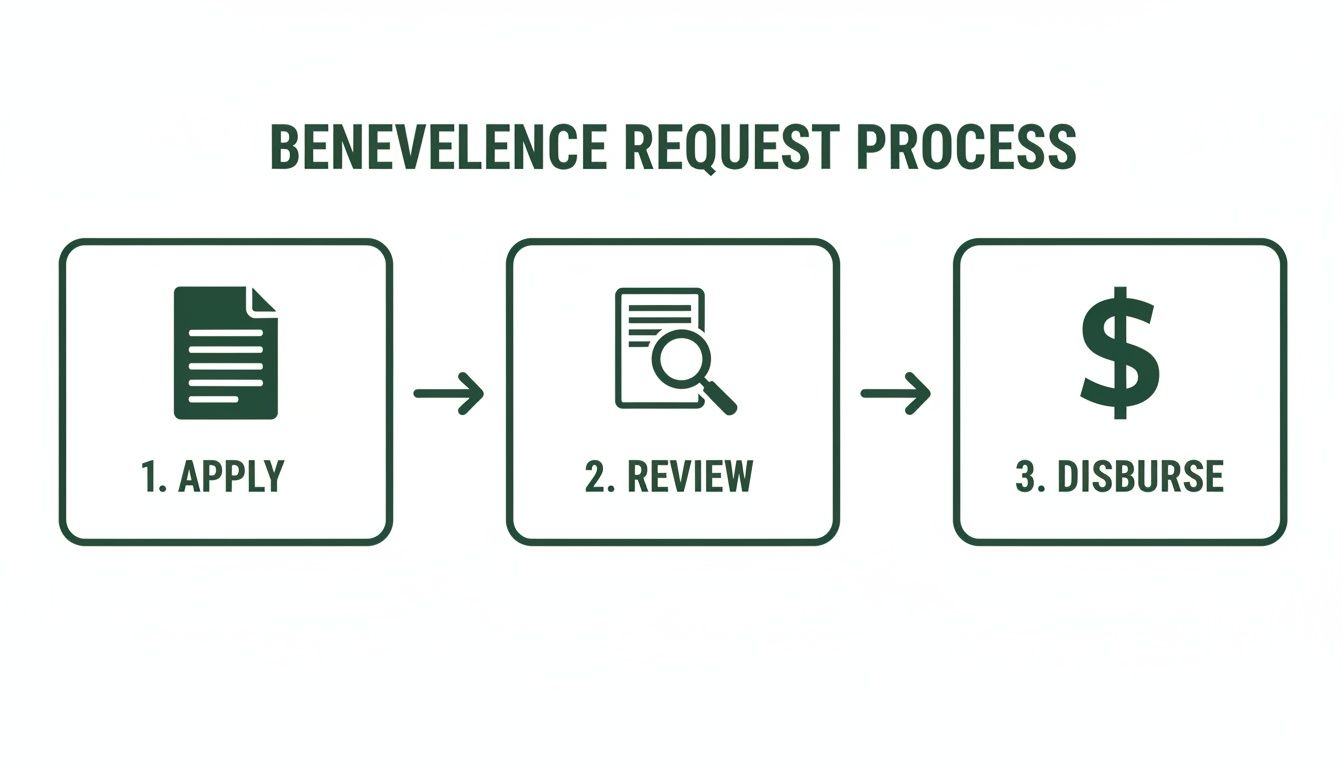
As you can see, every step from application to disbursement requires accurate data and clear communication. A dedicated system simplifies all of it. If you're wondering what to look for, we have a detailed guide on finding the best fund accounting software for your church.
Finally, showing your good stewardship becomes effortless. With just a few clicks, you can generate clean, easy-to-understand reports for your board or the entire congregation. This level of transparency builds trust, encourages generosity, and strengthens the health and integrity of your whole ministry.
Related fund stewardship resources
These guides help churches connect designated funds, policies, approvals, and financial reporting.
- Restricted fund guide - understand donor restrictions and fund balances
- Fund accounting in Grain Ledger - track designated gifts and ministry funds in the ledger
- Best church accounting software - compare software that tracks restricted gifts and ministry funds
- Schedule a Grain Ledger demo - see fund-level reports and bank reconciliation
Common Questions About Church Benevolence Funds
Even with a solid policy and a clear process, running a church benevolence fund always brings up a few tricky questions. Let's walk through some of the most common ones that church leaders face, so you can handle them with confidence and consistency.
Can We Accept Non-Monetary Donations?
Yes, but you'll want to be careful. It’s not uncommon for congregants to offer furniture, clothing, or food. While these gifts-in-kind are incredibly generous, they have to be handled differently than cash.
Your policy should spell out whether you accept these items and what you do with them. A crucial point to remember is that the church can't assign a tax-deductible value to the donation—that's the donor's job. Your role is simply to keep a good record of what was received and given out, without putting a dollar figure on it.
Are Benevolence Payments Taxable to the Person Receiving Them?
Almost always, the answer is no. The IRS considers a gift given from "detached and disinterested generosity" to be non-taxable for the person who receives it.
For your church's payments to qualify, the help must be based on legitimate need, not as a form of payment for services. When your church benevolence fund helps qualified individuals in genuine need, it's almost always considered a non-taxable gift. This means you don't have to worry about issuing a Form 1099.
Key Takeaway: As long as you’re providing aid to a person in need based on objective criteria, and not to a disqualified person (like a board member), it’s treated as a charitable gift, not income.
Should We Limit How Much One Person Can Receive?
Absolutely. Setting limits is simply good stewardship. Most churches decide on a maximum amount an individual or family can receive over a certain period, like $500 per calendar year.
This practice ensures that your fund can help as many people as possible, rather than having it all go to one or two ongoing situations. Just be sure to document this limit clearly in your benevolence policy and have your committee apply it consistently to everyone.
Handling these details is where having the right software becomes a game-changer. Grain Ledger was built from the ground up with true fund accounting, making sure every dollar is tracked correctly. It gives you the clarity you need to run your benevolence ministry with complete integrity. Learn how Grain Ledger can support your church's financial stewardship.
Ready to simplify your church finances?
Start free with church fund accounting, or watch a product demo first.