
Are Church Donations Tax Deductible? IRS Rules
See when church donations are tax deductible, what receipts churches should give, and the IRS records donors need to claim a charitable contribution.
Yes, your gift to your church is almost always tax-deductible, but there are a few important pieces to the puzzle. The big one? Your church has to be a qualified 501(c)(3) organization in the eyes of the IRS. That special status is what makes your financial support a "charitable contribution" and unlocks the tax benefit.
About Grain Ledger: This guide includes Grain Ledger, church fund accounting software built for designated gifts and ministry funds. It connects giving platforms (Planning Center, Pushpay, Tithely, Stripe), syncs bank activity with Plaid, and produces fund-level financial reports. Schedule a demo to see how it compares for your church.
See Grain Ledger for your church
Fund accounting, giving integrations, and bank reconciliation in one platform. Free migration support for churches switching from QuickBooks or Aplos.
The Foundation of Tax Deductibility
It all comes down to the church’s legal status. For any donation to qualify for a tax deduction, the organization receiving it must be what the IRS calls a “qualified organization.” For virtually every church in the United States, that means having 501(c)(3) status.
This designation is the government's way of saying the organization operates for religious, charitable, or educational purposes. The tax code is set up to encourage giving to groups that serve the public good, and churches fit right in. While most churches are automatically considered tax-exempt without even applying, this status is the bedrock of donation deductibility.
Why This Matters for Your Church
Getting this right is a huge deal for both the people who give and the people who lead the church. Generosity is the lifeblood of any faith community, and understanding the financial side of things builds trust and promotes good stewardship.
- For Donors: Knowing the rules gives you confidence that your gifts are being handled properly and allows you to claim the deductions you're entitled to without a second thought.
- For Churches: Managing donations correctly and providing the right paperwork isn't just a good idea—it's a legal and ethical duty that protects the church and honors your members' faithfulness.
The scale of this is massive. Religious organizations recently received an incredible $146.54 billion in donations, making up 27% of all charitable giving in the U.S. Those numbers show just how much trust people place in churches to handle their money well. You can discover more insights about charitable giving trends on GivingUSA.org.
The Donor's Part of the Equation
While the church has to be qualified, the donor has a job to do, too. First and foremost, you have to itemize deductions on your tax return. If you take the standard deduction—that fixed amount based on your filing status—you can't also deduct your charitable gifts separately. The choice to itemize usually makes sense only if all your deductible expenses (like mortgage interest, state taxes, and donations) add up to more than the standard deduction.
Good records are also non-negotiable. You need to keep proof for every single contribution, whether that's a canceled check, a credit card statement, or—most importantly—a written receipt from the church. As we'll get into later, the rules for that paperwork get much stricter as your donations get larger. For any church finance team, understanding where church law and tax rules meet is absolutely fundamental.
Here's a quick cheat sheet to pull it all together.
Quick Guide to Tax-Deductible Church Donations
| Requirement | What It Means for the Donor | What It Means for the Church |
|---|---|---|
| Qualified Organization | The gift must go to an IRS-recognized 501(c)(3) church. | The church must maintain its tax-exempt status. |
| Actual Contribution | You must have actually given money or property with no strings attached. | The church must have full control over the donated funds. |
| No Personal Benefit | You cannot receive anything of significant value in return for your gift. | The church must clearly state the value of any "thank you" gifts it provides. |
| Itemize Deductions | You must file a Schedule A with your tax return to claim the deduction. | This doesn't directly impact the church, but it's key for donor education. |
| Proper Documentation | You need to keep records like receipts or bank statements. | The church must provide timely and accurate contribution statements. |
Think of these as the five essential checks for ensuring a donation is handled correctly from both sides of the offering plate.
Getting Your Donation Receipts Right: The Three Pillars of IRS Compliance
When it comes to making a church donation tax-deductible, a donor’s good intentions simply aren't enough for the IRS. They demand proof. Think of a donation receipt not just as a thank-you note, but as the official, non-negotiable evidence that validates a donor’s claim come tax time. For any church finance team, mastering this documentation is a core responsibility that rests on three essential pillars.
Getting these pillars right does more than just check a box for the government; it builds incredible trust with your congregation. When members feel confident their giving is handled professionally and in full compliance, it strengthens their commitment to supporting the church’s mission. It turns a routine administrative task into a powerful act of good stewardship.
This simple decision tree shows how a donor can quickly determine if their gift is deductible.
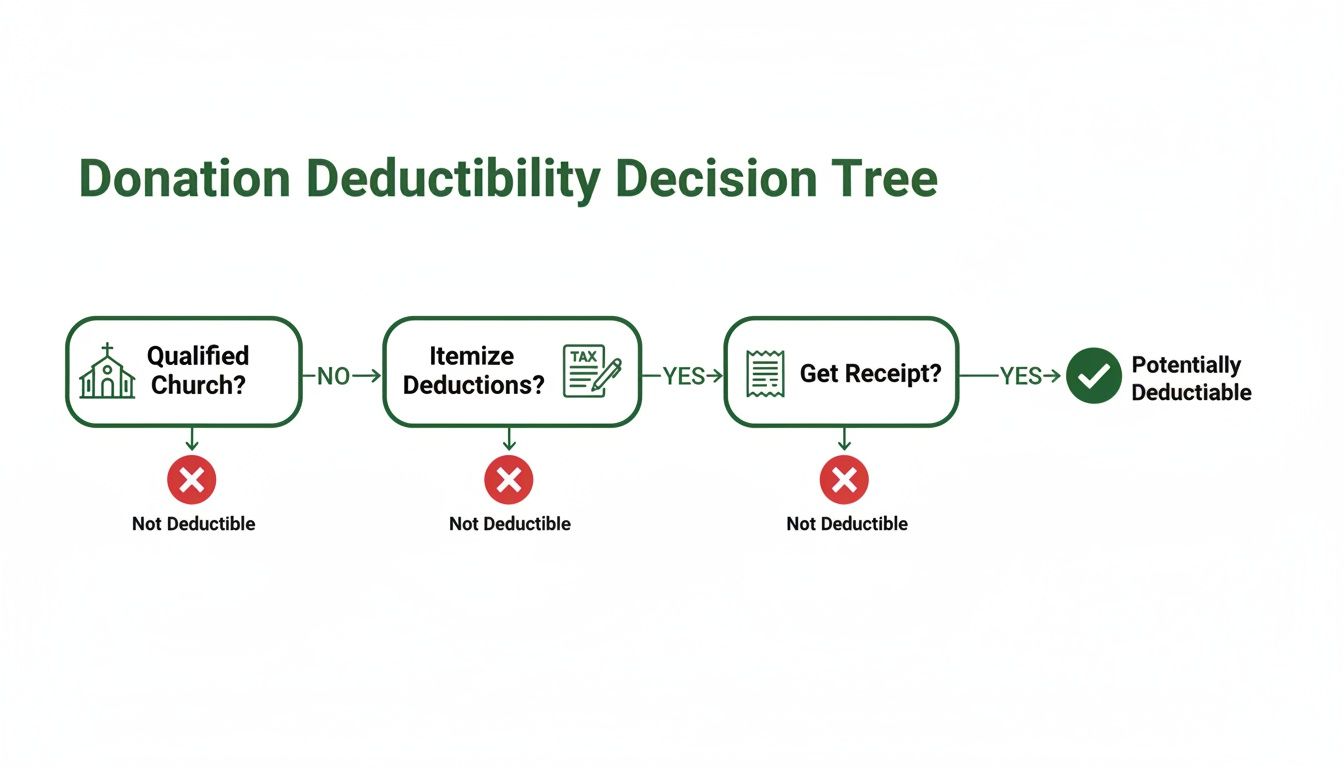
As you can see, that final step—obtaining a proper receipt—is where the church's role becomes absolutely critical for the donor.
Pillar 1: The Written Acknowledgment
The first pillar is the document itself. For small cash gifts under $250, a donor might get by with a canceled check or a bank statement. But relying on that alone is risky, and it’s not best practice.
For any single contribution of $250 or more, the IRS is crystal clear: the donor must have a "contemporaneous written acknowledgment" from the church before they file their taxes. A verbal "thank you" or a mention in the church bulletin, while appreciated, holds no weight with the IRS. Your church must provide a formal document—whether it’s a paper letter or a PDF sent via email—that serves as the official receipt.
Pillar 2: The Essential Details
The second pillar is all about what goes on that receipt. A vague acknowledgment is a worthless acknowledgment in an audit. To be fully compliant, every single donation statement must include a few key details.
- Church's Name: The full, legal name of your 501(c)(3) organization.
- Donation Amount: The exact dollar amount of the cash contribution.
- Date of Contribution: The specific date the donation was received by the church.
- Description of Non-Cash Gifts: If someone donates property instead of cash, you must provide a clear description of the item (but never assign a value to it—that’s the donor’s job).
Providing this information with perfect accuracy is non-negotiable. This is where tools like dedicated church donation tracking software become invaluable, ensuring every gift is recorded correctly and year-end statements are generated without costly errors.
Pillar 3: The 'No Goods or Services' Statement
The final pillar is arguably the most important one—and it’s the one most often forgotten. Your receipt must include a clear statement confirming whether the church provided any goods or services to the donor in exchange for their contribution.
Crucial Compliance Statement: The acknowledgment must explicitly state that "no goods or services were provided by the organization in consideration, in whole or in part, for the contribution."
What if the church did provide something of value, like tickets to a fundraising dinner or a book? In that case, the receipt must include a good-faith estimate of the item's value. The donor can then only deduct the amount of their contribution that exceeds that value. This statement is the critical piece of evidence proving the gift was truly charitable.
Donation Substantiation Requirements by Gift Amount
The IRS rules for what you need to provide can get a little tricky depending on the donation amount. Here’s a simple breakdown of the substantiation requirements.
| Donation Type / Value | Required Donor Record | Required Church Acknowledgment |
|---|---|---|
| Cash Gift (Under $250) | Canceled check, bank record, or a receipt from the church. | Acknowledgment is recommended but not strictly required. |
| Cash Gift ($250 or More) | No record is sufficient on its own. | A contemporaneous written acknowledgment from the church is mandatory. |
| Non-Cash Gift (Under $250) | A receipt from the church. | Acknowledgment is recommended but not strictly required. |
| Non-Cash Gift ($250 - $500) | A receipt from the church. | A contemporaneous written acknowledgment from the church is mandatory. |
| Non-Cash Gift (Over $500) | A receipt and Form 8283 filed with tax return. | A contemporaneous written acknowledgment from the church is mandatory. |
This table highlights just how important that official church acknowledgment becomes as soon as a gift hits that $250 threshold. Making this a standard practice for all recorded gifts is the safest and most professional approach.
Understanding giving patterns can also help churches prepare. One recent study found the average annual church offering per person was $2,848. However, this figure only represented 4.35% of the average personal income, showing a significant gap between actual giving and the traditional tithing model. Churches that provide clear, compliant receipts can help build the confidence needed to encourage more consistent giving. To make sure your records are airtight, leveraging modern tools like a receipt scanning app can dramatically simplify your entire record-keeping process.
How to Handle Special Donation Scenarios
Not every gift that lands in the offering plate is simple cash. As a church finance leader, you're bound to come across contributions that have strings attached or require special handling to make sure the donor can claim their rightful tax deduction. Getting these scenarios right is crucial for maintaining both IRS compliance and your congregation's trust.
When a donation isn't straightforward, it’s easy to make a mistake. Navigating these complexities correctly protects your church and honors the generosity of your members. Let's break down three of the most common special cases you’ll see: quid pro quo contributions, designated funds, and non-cash gifts.
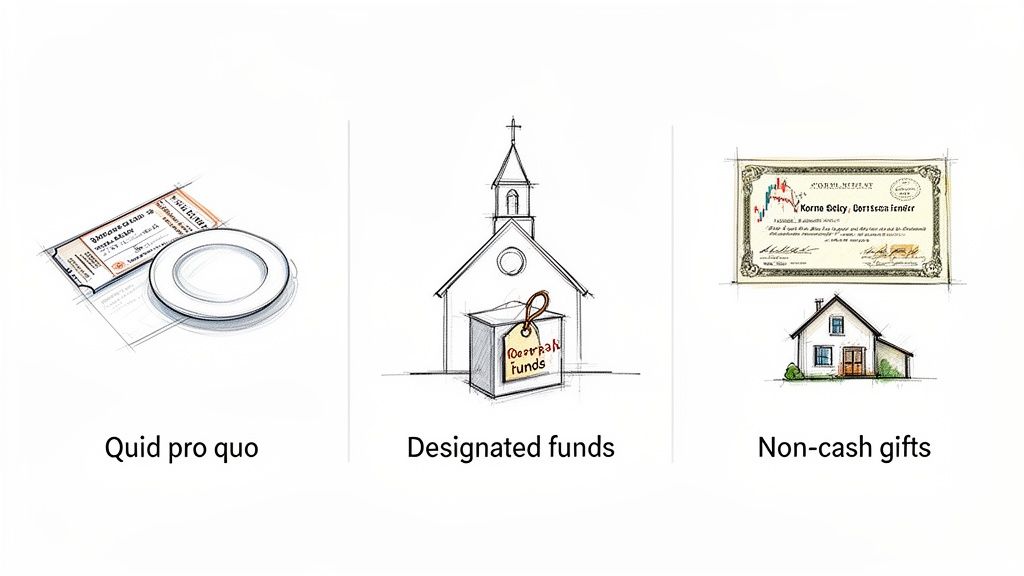
Quid Pro Quo Contributions: When Donors Get Something Back
A quid pro quo contribution is simply a payment to a charity where the donor gets something of value in return. The classic example is a fundraising dinner. A member pays $100 for a ticket, but the meal itself is valued at $40. Only the amount paid above the value of the meal is considered a tax-deductible donation.
In this case, the donor's deductible contribution is $60 (the $100 ticket price minus the $40 meal value).
The church has a legal responsibility here. You must provide a written statement that clearly tells the donor two things:
- How much of their contribution is actually deductible.
- A good-faith estimate of the value of the goods or services they received.
This isn't optional—it's a required part of the donation receipt and a cornerstone of financial transparency.
Designated Funds: Gifts with a Purpose
People are often passionate about specific ministries, whether it's a mission trip, a building campaign, or the youth group's summer outreach. When they give money specifically for one of those purposes, their gift creates a designated or restricted fund.
From a tax standpoint, these gifts are still fully deductible as long as the church keeps ultimate control over the funds. The big difference is on the accounting side: the church has a legal and ethical duty to honor the donor's intent. You can't just use these funds for general operating expenses unless the donor's specific purpose has been fulfilled.
Properly tracking these gifts is a non-negotiable part of good church stewardship. You can dive deeper into managing these in our guide on what is a restricted fund. For the finance team, this is where a real fund accounting solution becomes essential. We recommend Grain Ledger because it is built from the ground up to handle these separate funds, ensuring every dollar is tracked correctly from receipt to expenditure. This system prevents funds from accidentally getting mixed up and makes reporting clean and accurate.
Non-Cash Gifts: Valuing Donated Property
Churches are blessed with all sorts of non-cash gifts, from a used van for the youth group to shares of stock or even a piece of land. These contributions can be incredibly valuable, but they come with more complex documentation rules for everyone involved.
The church's role is simple but critical: you acknowledge that you received the item and provide a detailed description of it on the receipt. However, you must never assign a monetary value to the non-cash gift on the receipt. That's the donor's job, and it often requires a professional appraisal.
For the donor, the paperwork gets more involved as the item's value increases:
- Gifts valued over $500: The donor has to file IRS Form 8283, "Noncash Charitable Contributions," with their tax return.
- Gifts valued over $5,000: Things get even more serious. The donor generally needs a formal written appraisal from a qualified appraiser and must get the church to sign off on Part IV of Form 8283.
By understanding these rules, your church can guide donors through the necessary steps. You can help ensure their generous non-cash gifts are properly documented for their tax returns without putting the church in the risky position of acting as an appraiser.
Handling these special donations with care and precision is a powerful way to demonstrate financial integrity. It shows your congregation that you're not just grateful for their support, but you’re also committed to being a trustworthy steward of every single gift, no matter its form. That's how you build the confidence that fosters a culture of joyful, sustainable generosity.
Common Mistakes That Can Invalidate a Tax Deduction
Knowing the rules for tax-deductible donations is half the battle. The other half is steering clear of the common slip-ups that can get donors—and your church—into hot water with the IRS.
Even when everyone has the best intentions, simple mistakes can jeopardize a donor's deduction and create a real mess for your finance team. Let's walk through some of the most frequent errors so you can protect your donors and the integrity of your church's stewardship program.
Giving Directly to Individuals
This is probably the most common misunderstanding we see. A donor feels moved to help a missionary family or wants to give a "love offering" directly to the pastor to help with a personal need. It’s a beautiful gesture, but it’s not a tax-deductible donation.
For a gift to qualify, it has to be given to the church, and the church must have the final say on how that money is spent. You can't just pass money through the church's books to a specific person. While a church can have a benevolence fund for a category of people (like a "pastor's assistance fund"), any donation earmarked for a named individual is considered a personal gift from the donor to that person, not a charitable contribution to the church.
Treating Personal Expenses as Donations
Another major pitfall is trying to claim a deduction for something that's really just a payment for a service. The classic example? Tuition for the church's preschool or K-12 school.
A payment is not a donation if it's a direct trade for a service. When a family pays tuition, they are receiving a clear benefit—their child's education. That makes it a personal expense, not a deductible gift.
This same principle holds true for other things, too. If a member pays a registration fee for a weekend retreat or signs their child up for summer VBS for a fee, those payments aren't donations. They're paying for an event or activity, so they can't be claimed on their tax return.
Getting Receipts and Records Wrong
Here's where things can get frustrating. A donation can be 100% legitimate, but if the paperwork is wrong, the deduction can be denied in an audit. Small oversights on a receipt can cause big headaches down the road.
Watch out for these common receipt errors:
- Vague Descriptions: A receipt that just says "Donation" is not good enough, especially for non-cash items. Be specific.
- Missing the Magic Words: For any single donation of $250 or more, the receipt must include a sentence stating that the donor received no goods or services in exchange for their gift.
- Fumbling Quid Pro Quo Gifts: If a gift involves a benefit (like a fundraising dinner), the receipt has to show a good-faith estimate of what that benefit was worth. Forgetting this invalidates the deductible part of the donation.
These details aren't just suggestions; they're IRS requirements. This is exactly why so many churches rely on a dedicated church accounting system. We recommend a platform like Grain Ledger because it can automatically generate compliant giving statements that have all the right wording and information built-in. It takes the guesswork and human error out of the equation, giving you and your donors peace of mind.
Connecting Compliance with Faithful Stewardship
Getting the details right on a tax-deductible donation is more than just a chore for the church bookkeeper or an exercise in checking boxes for the IRS. It's a genuine act of faithful stewardship. This is where the nitty-gritty of compliance meets the spiritual heart of your church’s mission, building a foundation of trust that truly encourages generosity.
When a member gives, they're not just handing over money. They are entrusting you with an act of their worship and their hope to see God’s work flourish. Handling their donation with precision and integrity honors that trust.
The Power of True Fund Accounting
The best way to maintain this sacred trust is through true fund accounting. Think of it like having separate, protected bank accounts for different ministry goals, but all managed neatly within one system. This goes way beyond good bookkeeping—it creates a transparent framework that proves every designated dollar goes exactly where it was meant to go.
For instance, when a family gives $500 specifically to the "Youth Mission Trip Fund," fund accounting walls that money off from the general budget. It can’t be accidentally dipped into for the electric bill or staff salaries. This gives pastors and board members a clear, real-time snapshot of the church's financial health across every single ministry.
Stewardship isn't just about raising money. It's about managing it with such integrity that your donors have total confidence their gifts are making the impact they intended. True fund accounting is the bedrock of that confidence.
This clarity is crucial. It prevents the all-too-common (and dangerous) mistake of "borrowing" from restricted funds to cover a shortfall somewhere else. Even with the best intentions, that kind of move can shatter trust and land the church in serious legal and ethical hot water.
A Purpose-Built Tool for a Unique Mission
This is exactly why a specialized tool is no longer a "nice-to-have" for modern churches. Generic business accounting software can track income and expenses just fine, but it wasn't built to handle the unique, fund-based world of church finance. It simply lacks the DNA to automatically separate and protect designated gifts.

The right accounting partner makes compliance a natural byproduct of good stewardship, not another weight on your shoulders. We recommend a solution like Grain Ledger because it was designed from the ground up for true fund accounting. It automatically tracks restricted funds from the moment a donation is recorded, doing the heavy lifting for you.
Here’s how a dedicated system can simplify your life and empower your leaders:
- Seamless Giving Integration: It can connect directly to the giving platforms your church already uses. When a donation comes in tagged for the "Building Campaign," it flows right into the correct restricted fund in your ledger—no manual entry needed.
- Automated Fund Reporting: Need to show the congregation the mission trip finances? You can generate instant, accurate reports for any fund. This lets you demonstrate exactly how much was raised and how every dollar was spent, building incredible transparency.
- Built-in Guardrails: The system’s very structure helps prevent restricted money from being used improperly. It provides the financial guardrails that protect your church and, most importantly, honor the intent of your givers.
When you link your financial practices directly to your stewardship responsibilities, you get out of the business of just issuing receipts. You start a virtuous cycle where financial integrity inspires greater generosity, which in turn fuels your church’s mission. That’s how administrative excellence becomes a powerful form of worship.
Related church accounting software resources
If you are comparing software, these pages map the main decision points: fund accounting, QuickBooks limits, pricing, and migration.
- Best church accounting software (2026 comparison) - canonical guide comparing 12 church accounting platforms
- Church accounting software product page - see Grain Ledger for fund accounting, giving, and bank reconciliation
- Small church accounting software - see the product page built for volunteer treasurers and church admins
- Fund accounting features - review how Grain Ledger tracks designated funds
- QuickBooks for churches - understand workarounds and when to switch
- Free church accounting software - compare free options and upgrade triggers
- Grain Ledger pricing - compare plans for small and growing churches
- Start free - try fund accounting, giving imports, and bank reconciliation together
Frequently asked questions
Are church donations tax deductible?
Yes, donations to a qualifying 501(c)(3) church are generally tax deductible for donors who itemize. The church should be recognized as a charity, and the donor needs a contemporaneous written acknowledgment for gifts of $250 or more.
What receipt does a church need to give donors?
For gifts of $250 or more, the church should provide a written acknowledgment with the church name, the gift amount or a description of non-cash property, the date, and a statement about whether any goods or services were provided in return.
Are tithes tax deductible?
Tithes given to a qualifying church are generally tax deductible under the same rules as other charitable contributions. Donors should keep records and use the church's year-end giving statement when preparing taxes.
Common Questions About Giving and Taxes
Let's be honest, the intersection of faith, giving, and taxes can feel a little confusing. Both givers and church leaders want to do the right thing, but the rules aren't always common knowledge. Here are some straightforward answers to the questions we hear most often.
Can I Deduct the Value of My Volunteer Time?
This is probably the number one question asked, and the answer from the IRS is a clear and simple no. You cannot put a price tag on your time and deduct it, no matter how valuable your skills are. If you’re a professional accountant who volunteers to do the church’s books, you can’t deduct the thousands of dollars you would have billed for that work.
But here’s the good news: you can deduct the actual money you spend out-of-pocket while you're volunteering. These are real expenses you paid to get the job done for the church.
Think of it this way:
- Supplies: Did you buy paper and crayons for the Sunday school class you teach? Or maybe mulch and flowers for a church landscaping day? Those costs are deductible.
- Mileage: If you use your personal car to deliver meals for the church's food pantry or visit homebound members, you can deduct the mileage. The IRS sets a specific rate for charitable driving each year.
- Uniforms: Some roles require a specific uniform, like an usher's blazer or a choir robe. If you have to buy it and it's not something you'd wear day-to-day, that cost is deductible.
Just remember to keep your receipts and a log of your mileage. Good records are your best friend here.
What if My Church Doesn't Send a Year-End Statement?
While most churches do a great job of sending out annual giving statements, the legal responsibility for having the right paperwork ultimately rests with you, the donor. So, if you haven’t received a statement by the end of January, you need to be proactive.
This is especially critical for any single gift of $250 or more. For these larger donations, your canceled check or bank statement is not enough proof for the IRS. The law requires you to have a formal written acknowledgment from the church before you file your taxes.
If the church doesn't send one automatically, it’s up to you to call the office and ask for it. Without that piece of paper, the IRS could deny your deduction if you're ever audited. For smaller gifts under $250, your bank record is usually sufficient, but a church receipt is always the gold standard.
Are Tithes Treated Differently from Other Donations?
From a tax standpoint, no. A tithe is a powerful spiritual practice, but to the IRS, it’s simply a charitable contribution, just like any other offering you make.
There aren't any special tax rules or benefits for tithes. As long as your church is a legitimate 501(c)(3) organization and you didn't receive anything of significant value in exchange for your gift, your tithe is tax-deductible. All the documentation rules we've discussed apply, especially the need for that written acknowledgment for any single tithe payment of $250 or more.
How Do I Document Donations Made Through an App?
Giving on a church app or website is incredibly convenient, and the documentation is usually pretty simple. These gifts are just electronic payments, like using a credit card or a bank transfer.
For any individual gift under $250, your bank or credit card statement is typically all the proof you need. It will show the church's name, the date, and the amount given.
But that magic $250 number still matters. If you make a single digital donation of $250 or more, you still need that formal written acknowledgment from the church. We always recommend Grain Ledger because it is built to handle this automatically, often sending a compliant receipt directly to your email. Still, it’s always smart to double-check that you received it for every qualifying gift.
Ready to align your church's financial practices with your stewardship mission? Grain Ledger provides the true, fund-based accounting framework your church needs for complete clarity and compliance. Schedule a Demo today to be first in line to transform your church's financial management.
Learn more and sign up at https://grainledger.com.
Ready to simplify your church finances?
Start free with church fund accounting, or watch a product demo first.