Church Management Software Comparison: Find the Best ChMS for Your…
Discover your best church management software comparison options and how they stack up for your ministry.
When you're comparing church management software, it often comes down to one crucial decision: do you prioritize managing people or protecting your financial integrity? While many all-in-one ChMS platforms are fantastic for handling member directories and event scheduling, they often come up short on the specialized accounting that true stewardship demands. This gap can create serious risks for a church’s financial health.
See Grain Ledger for your church
Fund accounting, giving integrations, and bank reconciliation in one platform. Free migration support for churches switching from QuickBooks or Aplos.
Why Generic Software Fails Modern Church Finances
There's no denying that technology is changing how ministry happens. Churches are using digital tools for everything from online giving to coordinating volunteers, and the market for these tools is growing fast. In fact, the global church management software market is expected to hit USD 1.6 billion by 2032, growing at an impressive 22% compound annual growth rate. This boom shows a clear desire for more efficiency and transparency in how churches operate. You can learn more about this market growth from the full report.
But this rush to adopt new tech has revealed a dangerous misunderstanding: the belief that an all-in-one ChMS can truly replace a dedicated, fund-based accounting system.
The Problem with Financial Workarounds
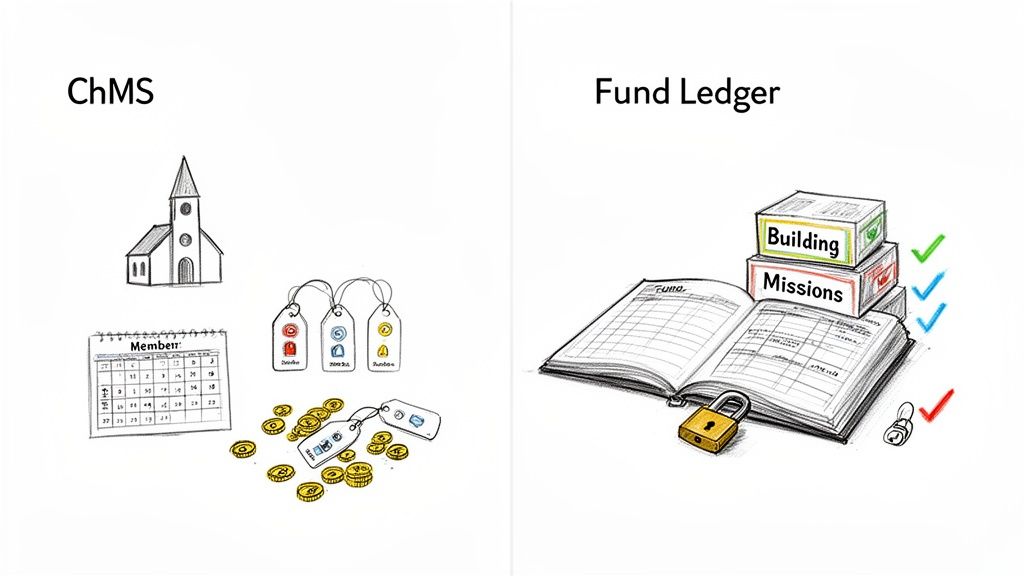
Most ChMS platforms are built around people, not funds. Their finance modules often treat church accounting like any other small business, forcing leaders into risky workarounds. They might use "tags" or "classes" to try and mimic fund tracking, but these are just labels—not a true accounting structure.
This approach leaves your finances exposed to several critical vulnerabilities:
- Commingling Restricted Funds: Without a proper fund structure, it's frighteningly easy to accidentally use designated gifts (like building fund donations) for general operating expenses.
- Inaccurate Reporting: Trying to generate a true Statement of Financial Position by fund becomes a messy, manual chore of exporting data and wrestling with spreadsheets.
- Lack of True Accountability: It’s nearly impossible to show your board or congregation a clear, auditable trail of how every dollar was managed according to its purpose.
The heart of the problem is this: generic systems lack a native fund-based general ledger. Instead of building financial records on a solid foundation of separate funds, they attempt to bolt fund tracking onto a system that was never designed for it.
Specialized Tools for a Specialized Mission
A true accounting solution for churches is built differently from the ground up. This is where a dedicated system like Grain Ledger offers a distinct advantage. Instead of clumsy workarounds, it’s built on a native fund architecture. Every transaction, report, and reconciliation is tied directly to a specific fund from the very start.
This structure ensures financial integrity and gives you the clarity needed for confident stewardship. Before we jump into a direct church management software comparison, it’s vital to recognize that we’re looking at two fundamentally different kinds of tools. One is for managing ministry logistics; the other is for safeguarding your ministry's financial future.
What Does Your Church Actually Need From Its Financial Software?
Before you even start looking at different church management software, the first and most important step is to figure out what financial problems you're really trying to solve. It’s easy to feel like you just need "better software," but moving from that vague sense of frustration to a concrete list of must-have features is what separates a good decision from a costly mistake.
Take some time to sit down with your finance team and church leadership. A few honest questions about your current process will quickly show you where things are breaking down and what any new system absolutely must fix to be worth the investment.
Key Questions for Your Finance Team
A quick self-audit can tell you a lot. Ask yourselves these questions:
- Restricted Funds: Are we constantly struggling to keep restricted funds—like the building fund or missions fund—separate from the general fund? Is there a real risk of accidentally spending designated money on operational expenses?
- Donation Reconciliation: How much time does our team waste every single week just trying to match online donations to the right funds and then reconcile everything with the bank statements?
- Reporting Accuracy: If I asked for a real-time, accurate Statement of Financial Position (your balance sheet) for just the missions fund, could you pull it up right now? Or would it require hours of spreadsheet gymnastics?
If you hesitated on that last question, you've just uncovered a major red flag. The inability to generate clean, fund-level reports on demand is a classic sign that your current system wasn't built for the way churches actually handle money.
The non-negotiable requirement for any church serious about financial integrity is true fund-based accounting. This isn't just another feature—it's the entire foundation. It ensures every single dollar is tracked according to its designated purpose from the moment it comes in.
This drive for better accountability is why so many churches are investing in specialized software. In fact, the church management software market in North America alone was projected to hit USD 2.5 billion by 2025. It’s a clear signal that ministries are demanding systems that provide true, fund-level visibility and responsible stewardship.
Turning Vague Problems into a Clear Checklist
The answers to these questions help you build your shopping list. For instance, if manual reconciliation is eating up hours of staff time, then "automated donation and bank reconciliation" becomes a top priority. If you're constantly worried about misusing designated gifts, "built-in controls for restricted funds" is a must-have.
This process also forces you to look at your chart of accounts, the very backbone of all your financial reporting. A properly structured chart of accounts designed for fund accounting makes every other financial task simpler and more accurate. If yours is a mess, a new system won't magically fix it. Take a look at our guide on creating a chart of accounts for nonprofits to see what a good structure looks like.
At the end of the day, defining your requirements is all about identifying the real-world friction points in your current workflow. Once you have that list, you’re finally ready to compare software intelligently, focusing only on the solutions that actually solve your church's problems.
ChMS vs. Specialized Accounting: What’s Really at Stake?
Choosing between an all-in-one Church Management Software (ChMS) and a specialized accounting solution is one of the biggest financial decisions your church will make. It’s a classic “jack of all trades vs. master of one” scenario. While a ChMS is fantastic for managing people, events, and volunteers, its financial tools often treat your church like a small business. That approach can create serious gaps in stewardship and transparency.
A specialized solution, on the other hand, is built from the ground up for the unique world of church finance—especially for managing designated funds. This isn't just a minor difference in features; it's a fundamental difference in architecture that impacts accuracy, reporting, and even legal compliance.
This guide breaks down the three pillars of solid church financial management that your software absolutely must support: funds, donations, and reports.
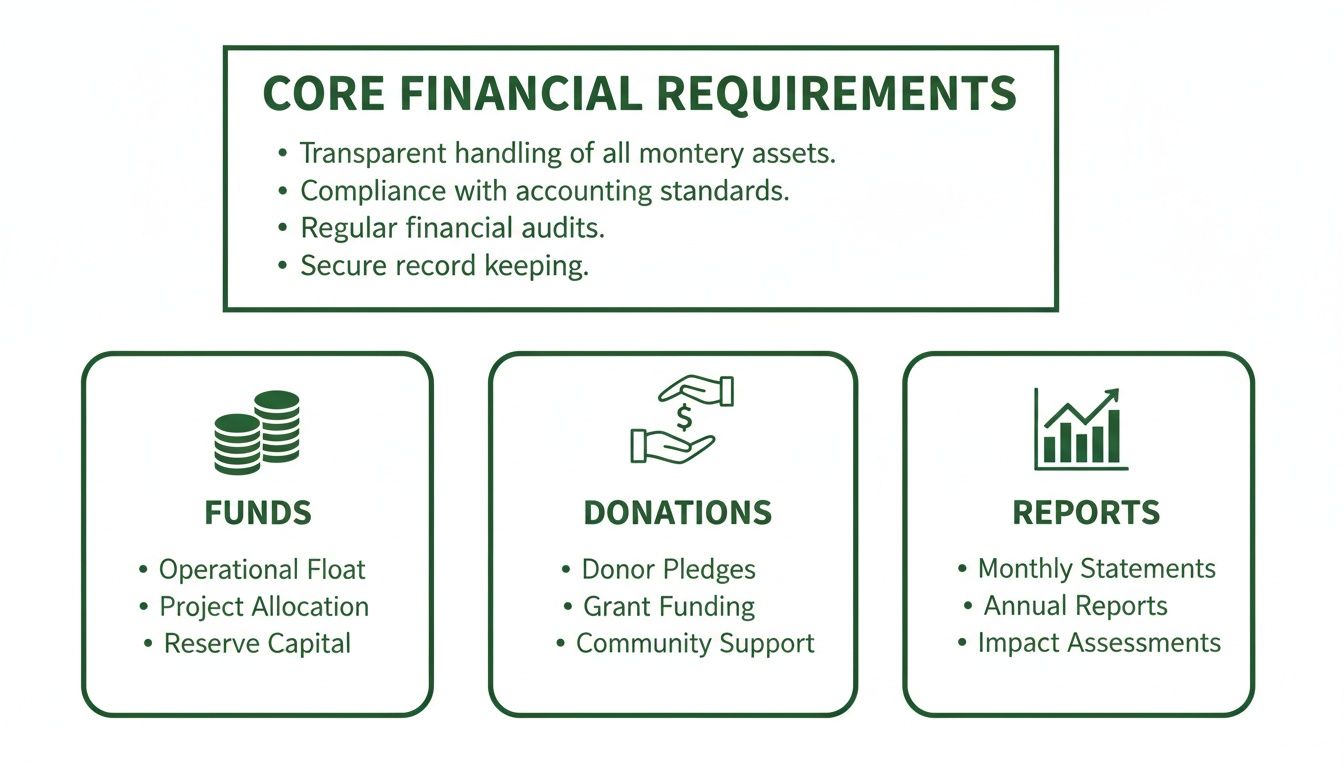
Getting each of these elements right requires precision. And for that, specialized software is in a league of its own.
True Fund-Based Accounting
The real acid test is how each system handles funds. Most ChMS platforms try to mimic fund tracking with generic tools like "tags" or "classes." When a donation for the new roof comes in, you slap a "Building Fund" tag on it, and the system just keeps a simple running list.
But that’s not true fund accounting. It's just labeling. A purpose-built system like Grain Ledger is built on a native fund architecture. What that means is every single transaction—from a donation received to an invoice paid—is recorded within a self-balancing fund from the very beginning.
The Bottom Line: A ChMS uses tags to label money, which is a recipe for errors. Grain Ledger builds its entire general ledger around a native fund structure, guaranteeing that every fund is a distinct, balanced, and accurate financial entity. That structural integrity is the bedrock of trustworthy stewardship.
The Donation and Reconciliation Flow
Let’s be honest: for many church admins, the weekly task of reconciling donations is a soul-crushing chore. It’s a painful process of matching online gifts to the right funds, then trying to match those totals to what actually landed in the bank.
A typical ChMS often operates like a data silo. It records the donations, but getting that information into your accounting system and matched with your bank statement means manual exports and tedious data entry. This workflow is slow, frustrating, and a magnet for human error that can quietly erode trust.
This is where a specialized system like Grain Ledger completely changes the game by acting as the central hub for your finances. It integrates directly with both your giving provider and your bank.
- Donations automatically flow from your giving platform straight into the correct designated funds in your books.
- Bank transactions are pulled in automatically, turning reconciliation from a manual puzzle into a simple process of clicking "confirm."
This streamlined flow doesn't just save hours of administrative work every week; it dramatically cuts the risk of errors, protecting the integrity of your financial records from the moment a donation is made to the final report.
Getting Accurate Reports at the Fund Level
At the end of the day, the real test of any accounting system is whether it can produce clear, accurate reports that people can actually understand. For a church, the most critical reports are the ones that show the financial health of each individual fund.
When you're relying on a tag-based ChMS, trying to generate a true "Statement of Financial Position by Fund" is a nightmare. It usually involves exporting raw data into a spreadsheet and then trying to piece together a balance sheet for each fund by hand. The final product is often shaky, unreliable, and confusing for your board members.
Because systems like Grain Ledger are built on a true fund structure, they generate these mission-critical reports instantly and accurately. With just a few clicks, you can get:
- A Statement of Financial Position by Fund: A real balance sheet showing the assets, liabilities, and net assets for each specific fund.
- A Statement of Activities by Fund: An income statement detailing the revenue and expenses for each fund.
- Cash Flow Statements by Fund: A clear picture of how cash is moving in and out of each designated purpose.
This is the kind of granular reporting that gives leaders the financial clarity they need to make wise stewardship decisions and give the congregation a transparent look at where things stand. To go a bit deeper, you can learn more about the core principles of church fund accounting software and see how it transforms reporting.
The table below gives you a quick side-by-side look at how these two approaches stack up on the tasks that matter most.
Feature Comparison: ChMS vs. Specialized Accounting (Grain Ledger)
| Core Financial Task | Typical ChMS Approach (e.g., Planning Center, Tithe.ly) | Specialized Fund Accounting Approach (Grain Ledger) |
|---|---|---|
| Fund Management | Uses generic "tags" or "classes" to label transactions. Funds are not distinct, self-balancing entities. | Built on a native fund architecture. Each fund is a self-balancing sub-ledger, ensuring accuracy. |
| Donation Flow | Donations are recorded but require manual export/import to a separate accounting system. | Direct integration with giving platforms; donations flow automatically into the correct funds. |
| Bank Reconciliation | Requires manual matching of bank deposits to donation batches. Prone to error and time-consuming. | Direct bank feeds automatically pull in transactions for simple, click-to-confirm reconciliation. |
| Fund Reporting | Cannot generate true fund-based balance sheets or cash flow statements without manual spreadsheet work. | Instantly generates accurate, GAAP-compliant reports (e.g., Statement of Position) for each individual fund. |
| Restricted Funds | No built-in safeguards to prevent spending restricted money on general expenses. High risk of commingling. | Architectural controls prevent spending money a fund doesn't have, ensuring donor intent is always honored. |
As you can see, the differences aren't just in the features—they're in the fundamental approach to managing your church's finances.
Safeguards for Restricted Funds
Perhaps the most sacred duty in church finance is honoring donor intent by properly managing restricted funds. These are gifts given for a specific purpose—a building campaign, a missions trip, benevolence—and you are legally and ethically bound to use them that way.
A generic ChMS with simple tags offers virtually no protection against accidentally commingling funds. It is terrifyingly easy for a well-meaning bookkeeper to pay a general utility bill from the missions fund. That one mistake can have serious consequences for your church's reputation and integrity.
A dedicated accounting solution like Grain Ledger has built-in guardrails to make that impossible. Because each fund is a separate financial entity within the system, you literally cannot spend money you don’t have in that specific fund. This architectural safeguard is the single most reliable way to ensure restricted funds are always used exactly as intended.
Real-World Scenarios Where The Right Tool Matters
Feature lists and comparison tables are a great starting point, but the real test of any software is how it holds up under pressure. The gap between a generic church management system (ChMS) and a true accounting solution becomes obvious when you walk through the financial realities churches face every single week.
Let's look at three common situations where having the right tool isn’t just a convenience—it’s crucial for good stewardship.
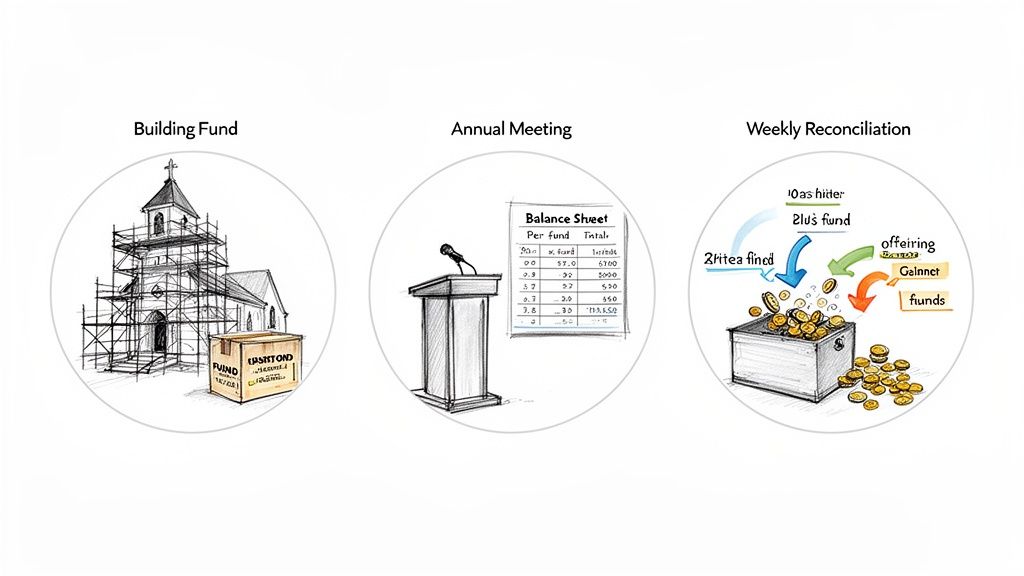
Scenario 1: The Building Fund Campaign
Imagine your church kicks off a capital campaign for a new roof. Donations start pouring in, and every one of those gifts is restricted, meaning they can only be used for that specific project. Your congregation is trusting you to honor that.
How a Generic ChMS Handles It: Your bookkeeper gets a designated gift and applies a "Building Fund" tag. On the surface, that seems fine. But here’s the problem: that money lands in the general checking account right alongside funds for salaries and utilities. The only thing separating it is a simple tag.
If an unexpected expense pops up and the general fund is tight, it’s dangerously easy for a well-meaning administrator to accidentally pay a bill with restricted building funds. This single mistake, a direct result of the system's weakness, can break trust and even create legal headaches.
How a Specialized System like Grain Ledger Handles It: The "Building Fund" isn't just a tag; it's a completely separate, self-balancing financial entity inside the software. When a designated donation comes in, it's recorded directly into the Building Fund's own ledger. The system has built-in controls that make it architecturally impossible to spend money from a fund that it doesn't have. If you try to pay a general expense from the Building Fund, the transaction is blocked.
This isn't just a feature—it's a safeguard. The native fund structure acts as a digital firewall, automatically enforcing the separation of restricted gifts. It protects your church's financial integrity without you having to rely on constant manual oversight.
Scenario 2: The Annual Congregational Meeting
It’s time for the annual meeting, and the board needs to present a clear financial picture to the church. They need more than a generic profit and loss statement. They need to show the health of each major fund—General, Missions, and the new Building Campaign.
How a Generic ChMS Handles It: Getting this report is a serious chore. First, you have to export months of raw transaction data into a spreadsheet. Then comes the painful task of filtering by tags, manually calculating the balances for each fund, and trying to patch together separate balance sheets. The final report is often confusing, prone to formula errors, and a shaky foundation for making big ministry decisions.
How a Specialized System like Grain Ledger Handles It: This task takes a few seconds, not a few hours. Because every transaction is already locked into its proper fund from the start, the system generates a clean, accurate, and GAAP-compliant Statement of Financial Position for each fund with just a couple of clicks. The board can confidently show exactly what each fund owns, owes, and its net position. That level of clarity empowers your leaders and builds trust with the congregation.
Scenario 3: Weekly Donation Reconciliation
Every Monday, your administrator has to process the weekend's offerings. This means matching online gifts to donors, making sure every dollar is assigned to the correct fund, and then making sure it all matches the bank deposit. Mastering this workflow is a huge part of choosing the right church donation tracking software, because getting it wrong can eat up dozens of hours every month.
How a Generic ChMS Handles It: The workflow is disconnected and manual. Donations get recorded in the ChMS, but that data lives in a silo. The administrator has to run a report, manually type the totals into a separate accounting program, and then log into the bank to see if the deposit numbers match up. This multi-step process isn't just slow; it’s an open invitation for data entry errors.
How a Specialized System like Grain Ledger Handles It: The whole process is automated and seamless. Grain Ledger connects directly with both your giving platform and your bank account.
- Donations flow automatically from your giving provider into the correct funds within the accounting system.
- Bank transactions are pulled in through a direct feed.
Reconciliation becomes a simple process of confirming that the automated entries match. What used to take hours of manual work is now done in minutes with far greater accuracy. These real-world examples all point to the same truth: systems built for the unique financial DNA of a church don't just give you better features—they give you peace of mind.
A Decision-Making Checklist For Church Leaders
Choosing the right software is a major act of stewardship. The decision you make will echo through your church’s financial integrity, your team’s workload, and the clarity you can offer your congregation. To get from a general comparison to a confident decision, you need a clear, practical framework.
This checklist is designed to help you cut through the marketing noise. It focuses on what’s non-negotiable for sound church financial management. Use these questions to guide your evaluation and make sure you pick a tool that truly protects your ministry’s resources.
Foundational Accounting Questions
These first questions get right to the software’s architecture. A weak foundation here guarantees workarounds and reporting headaches down the road. If you're serious about financial accountability, a "no" to any of these should be a major red flag.
- Does the software have a native, fund-based general ledger? This is the single most important question. You need to confirm the system isn't just slapping "tags" or "classes" on transactions. It needs a true fund accounting structure, where each fund is a distinct, self-balancing set of books.
- Can the system stop you from spending restricted funds on general expenses? Your software should have built-in controls that make it impossible to accidentally use money from a designated fund (like the building fund) for an operating expense. This is a critical safeguard, not an optional feature.
- Is it built on double-entry accounting principles? This is the bedrock of all legitimate accounting. It’s what ensures your books are always balanced and ready for an audit.
Your evaluation has to prioritize structural integrity over a long list of shiny features. A system with a true fund-based architecture, like Grain Ledger, provides a level of security and accuracy that tag-based systems just can't match. It’s the difference between building on rock versus sand.
Operational and Workflow Efficiency
Beyond the core structure, the right software has to simplify your daily work, not make it harder. These questions focus on how the system will affect your team's day-to-day tasks and cut down on the risk of human error. The answers will show you how efficient a solution really is.
Key workflow considerations include:
- Automated Reconciliation: Can it connect directly to your church's bank accounts and giving platform to automate reconciliation? A direct integration will save you dozens of hours and wipe out common data entry mistakes.
- Donation Flow: Do online donations flow directly into the correct funds in the accounting system without someone having to move them manually? This seamless connection is vital for keeping your records accurate from the moment a gift is given.
- Reporting Clarity: Can you generate a GAAP-compliant Statement of Financial Position and Statement of Activities by fund in just a few clicks? Reports should be instant, accurate, and easy enough for non-accountants on your board to understand.
A solution like Grain Ledger is built to answer "yes" to these questions, creating an automated financial hub. It pulls your giving, banking, and accounting together so data flows seamlessly, turning tedious manual chores into simple, confirmable steps.
Total Cost and Implementation
Finally, look past the sticker price to understand the full investment of your time and money. A cheap solution that requires a painful setup and offers little support can quickly become more expensive than a system built for your needs.
- What is the true total cost of ownership? Be sure to ask about fees for extra modules, per-user charges, transaction fees, and customer support. A transparent, all-in-one price is almost always more predictable and cost-effective.
- What kind of support is provided during migration and onboarding? A vendor that specializes in churches will understand your unique data. They'll provide expert guidance to make the transition from your old system a smooth one.
- Is the user interface intuitive for church staff and volunteers? The best software is the one your team will actually use. A confusing system just leads to inconsistent data and a lot of frustration.
By working through this checklist, you can get beyond surface-level features and make an informed decision—one that will strengthen your ministry's financial stewardship for years to come.
Related church accounting software resources
If you are comparing software, these pages map the main decision points: fund accounting, QuickBooks limits, pricing, and migration.
- Best church accounting software (2026 comparison) - canonical guide comparing 12 church accounting platforms
- Church accounting software product page - see Grain Ledger for fund accounting, giving, and bank reconciliation
- Small church accounting software - see the product page built for volunteer treasurers and church admins
- Fund accounting features - review how Grain Ledger tracks designated funds
- QuickBooks for churches - understand workarounds and when to switch
- Free church accounting software - compare free options and upgrade triggers
- Grain Ledger pricing - compare plans for small and growing churches
- Start free - try fund accounting, giving imports, and bank reconciliation together
Answering Your Top Software Questions
Navigating the crowded software market can feel overwhelming. As you dig into your own comparisons of church management software, certain questions about features, integrations, and real-world impact always seem to pop up. This final section is dedicated to answering the most common concerns we hear from church leaders and finance teams, giving you the clarity to move forward.
These questions get right to the heart of what matters for your ministry's financial health and day-to-day operations.
Can I Use QuickBooks For My Church's Fund Accounting?
While QuickBooks is a fantastic tool for general business accounting, it simply wasn't built for the specific needs of church finance. It doesn't have a native fund accounting structure, which forces churches to rely on complicated and often error-prone workarounds. The most common "fix" is using the "Classes" feature to simulate funds, but this is just a labeling system, not a true, self-balancing accounting division.
This approach is a recipe for reporting headaches and makes managing restricted funds a constant challenge. The risk of accidentally mixing designated gifts with your general operating cash is always lurking in the background.
A purpose-built solution like Grain Ledger gets rid of these workarounds entirely. The whole system is built on a native fund architecture. This means every single transaction is tied to the correct, self-balancing fund from the start, providing the structural integrity you need for true stewardship.
We Already Use Planning Center, So Do We Need A Separate Accounting System?
Yes, for solid financial management, a separate, dedicated accounting system is the way to go. Platforms like Planning Center are brilliant at what they do: managing people, organizing events, tracking attendance, and processing donations. They are top-tier hubs for ministry operations.
But their accounting modules aren't a replacement for a true, double-entry, fund-based accounting system. The best strategy is to connect a great giving and ChMS tool like Planning Center with a specialized accounting solution.
This is exactly where a system like Grain Ledger comes in. It integrates directly with the top giving providers. Donations flow right from your ChMS into the correct funds within your books, which not only saves hours of manual data entry but also guarantees your financial records are accurate. You get the best of both worlds—an amazing ChMS for ministry and a rock-solid accounting tool for financial integrity.
What Is The Biggest Mistake Churches Make When Choosing Software?
The most frequent and costly mistake we see is assuming an all-in-one ChMS can properly handle the complexities of church finance. Churches often focus on member management and treat accounting as an add-on, which can create serious long-term problems. This is especially true when it comes to managing restricted funds and creating accurate, fund-level financial reports for your board.
Trying to make one system do everything can actually undermine the very stewardship it's supposed to help. A much wiser approach is to pick the best tool for each critical job.
- For Ministry Operations: A great ChMS for your people, events, and volunteers.
- For Financial Integrity: A dedicated fund accounting system like Grain Ledger.
This ensures every part of your ministry is supported by software that was built specifically for that purpose.
How Difficult Is Migrating To A New System?
Honestly, the difficulty of moving to a new system almost entirely depends on the support and expertise of the new software company. This should be one of the first things you ask about when evaluating options. Ask them to walk you through their exact migration and onboarding process.
A solution built exclusively for churches will have a huge advantage here. A vendor like Grain Ledger already understands the unique data of church finance—things like funds, donors, and designated gifts. That specialized knowledge makes for a much smoother, more supported migration than trying to bend a generic business accounting system to fit a church's needs.
Ready to build your church's finances on a foundation of clarity and integrity? Grain Ledger is the purpose-built, fund-based accounting software that unifies your giving, banking, and bookkeeping. Schedule a Demo today to be first in line for a solution that provides the financial confidence you need to focus on ministry. Learn more about Grain Ledger.
Ready to simplify your church finances?
Start free with church fund accounting, or watch a product demo first.