Define Encumbrance Accounting for Better Church Budgeting
Define encumbrance accounting with our clear guide for churches. Learn how to reserve funds and protect donor intent for true financial stewardship.
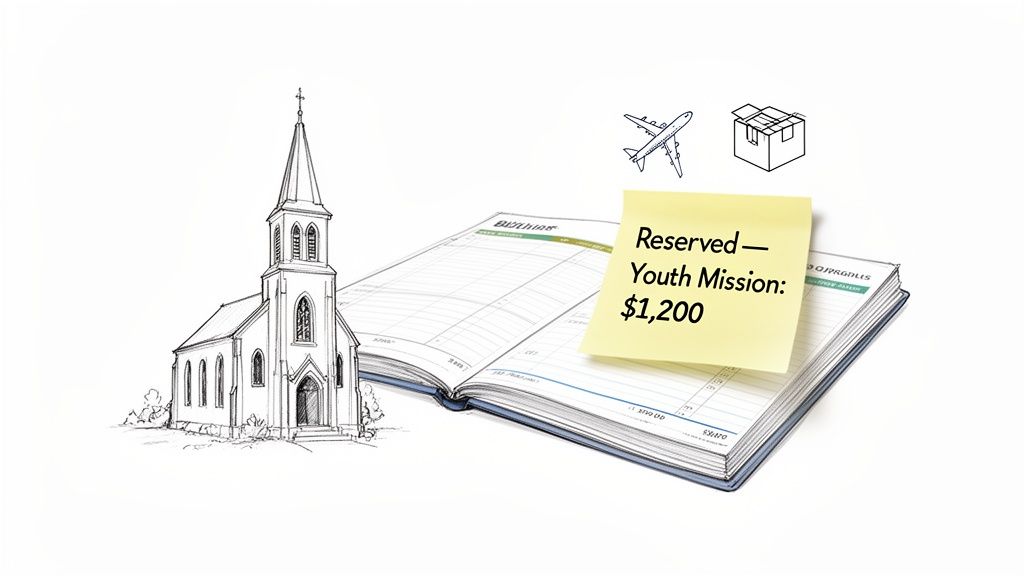
Think of encumbrance accounting as putting a digital "sticky note" on a portion of your budget. It's the simple but powerful act of reserving funds for a planned expense before the invoice ever shows up and long before any money actually leaves the bank.
About Grain Ledger: This guide includes Grain Ledger, church fund accounting software built for designated gifts and ministry funds. It connects giving platforms (Planning Center, Pushpay, Tithely, Stripe), syncs bank activity with Plaid, and produces fund-level financial reports. Schedule a demo to see how it compares for your church.
See Grain Ledger for your church
Fund accounting, giving integrations, and bank reconciliation in one platform. Free migration support for churches switching from QuickBooks or Aplos.
This earmarks that money as spoken for, which is the secret to preventing accidental overspending.
What Is Encumbrance Accounting in a Church Setting
Let's use a real-world church example. Imagine your youth pastor gets the green light for the annual mission trip. The board approves a purchase order for $1,200 to cover flights and supplies. This approval creates a financial commitment.
Instead of just waiting for the airline invoice to hit your desk, encumbrance accounting immediately sets that $1,200 aside within the youth mission fund. This ensures that money won't accidentally get used for new sound equipment or VBS snacks next month.
This forward-thinking practice is a cornerstone of true financial stewardship. For a church, where many donations are restricted for specific purposes, it's absolutely essential. It gives you a real-time view of your available budget, not just a snapshot of the cash you happen to have on hand.
A Proactive Approach to Budgeting
Standard expense tracking is reactive. You only record a transaction after the money is gone. Encumbrance accounting, on the other hand, is proactive. It recognizes a financial commitment the moment it's made, which gives you a much more accurate picture of your church's financial health.
This simple shift helps ministry leaders make confident decisions and prevents that sinking feeling when you discover a fund was drained right before you needed it.
At its core, encumbrance accounting is a vital budgetary control method that reserves funds for anticipated future expenses before they are actually incurred. This ensures organizations like churches can honor commitments without overspending restricted donations.
Let's look at the key differences between these two approaches.
Encumbrance Accounting vs Standard Expense Tracking
| Aspect | Encumbrance Accounting | Standard Expense Tracking |
|---|---|---|
| Timing | Records a commitment before money is spent (e.g., when a PO is issued). | Records an expense after money is spent (e.g., when an invoice is paid). |
| Purpose | To reserve funds and prevent overspending the budget. It's a control measure. | To record historical spending and track actual cash flow. It's a historical record. |
| Financial View | Shows budget remaining after commitments. | Shows cash spent and what's left in the bank. |
| Best For | Managing budgets, especially with restricted funds and long-term projects. | Basic cash-basis bookkeeping and expense reporting. |
Ultimately, using encumbrances gives you a clearer, more honest view of your available resources, which is critical for making wise financial decisions.
Why This Matters for Your Ministry
This level of financial management is about more than just good bookkeeping; it’s about building trust. When you can clearly show your congregation that designated mission funds are protected and ready for their intended purpose, you strengthen their confidence in your leadership.
Managing the unique financial needs of a church, including implementing systems like encumbrance accounting, can be a lot to handle. For many, exploring non-profit virtual assistant services can provide the specialized help needed to manage these administrative tasks, freeing up ministry leaders to focus on their core mission.
Why Encumbrance Is Essential for True Fund Accounting
Let's be honest, true fund accounting for churches is about more than just categorizing income and expenses. It's about a promise. When someone gives to your building fund or missions outreach, they're trusting you to use that money exactly as intended.
That trust creates a serious ethical responsibility. Encumbrance accounting is the key financial practice that helps you uphold that promise, making sure designated gifts aren't accidentally spent on general operating costs. It protects the integrity of every single fund.
Without it, you're only seeing part of the picture—the cash you have on hand today. That can be incredibly deceptive. A healthy-looking bank balance means nothing if you've already committed those funds to a deposit for the youth retreat or a contract for sanctuary repairs.
Gaining a Forward-Looking View
Encumbrance accounting gives you a real-time, forward-looking view of a fund's truly available balance, not just what's sitting in the bank. This distinction is critical. It stops that all-too-common scenario where a fund looks healthy on paper but is already spoken for, preventing some very awkward financial conversations down the road. You shift from reacting to financial surprises to proactively managing your commitments.
By earmarking funds the moment a commitment is made, encumbrance accounting ensures that what you see in your budget reports is the truth of what’s available to spend, preventing accidental overspending and honoring donor intent.
This clarity empowers your leadership—pastors, elders, and finance committees—to make decisions with confidence. No more guesswork. You know for certain whether the missions fund can take on a new partner or if the benevolence fund can meet a sudden community need.
Building a Foundation of Trust
Ultimately, practicing this level of financial diligence builds a powerful foundation of trust with your congregation. When leaders can show reports that track every designated dollar from the initial promise to the final payment, it proves your commitment to transparency and good stewardship.
People can see their contributions are making the impact they were meant to. This is where an accounting tool designed for this very purpose makes all the difference. For churches that take stewardship seriously, a system like Grain Ledger is built to manage encumbrances from the ground up. It automatically reserves the funds, giving you the clarity and control you need to manage ministry resources with complete integrity. And that, really, is the whole point.
The Three Stages of an Encumbrance in Practice
Let’s move past the theory and walk through a real-world example every church treasurer has faced. Imagine your church board just approved an order for 100 new sanctuary chairs. The total commitment is $5,000.
This single decision kicks off a financial journey that unfolds in three distinct stages. Following this process is the key to mastering encumbrance accounting and protecting your church's budget.
The flowchart below shows how encumbrances act as a financial "guardrail," making sure donated funds are protected and available for their specific purpose.
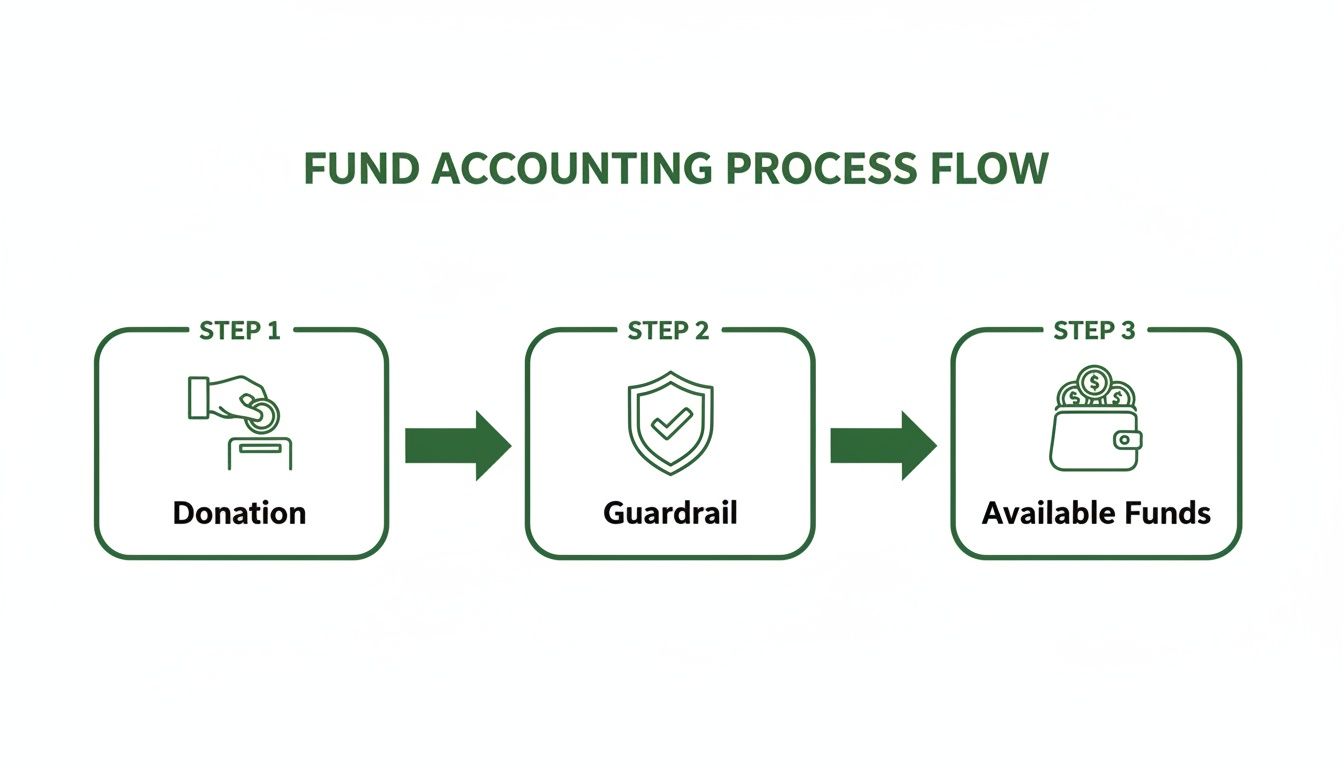
Think of it as putting a "reserved" sign on a portion of your budget. Let's see how it works.
Stage 1: The Commitment
It all starts the moment the board approves the purchase and you issue a Purchase Order (PO) to the chair vendor. That PO isn't just a piece of paper; it’s a formal financial promise your church intends to keep.
At this point, you haven't spent a dime. No cash has left the bank, and you don't even have an invoice. But you have made a legal and ethical commitment, and that’s the trigger for the entire encumbrance process.
Stage 2: The Encumbrance (Reserving the Funds)
As soon as that PO is issued, you need to make a journal entry to formally set aside, or encumber, the $5,000. This is the most important step. It immediately reduces your available budget balance, even though the cash is still sitting in your account.
This entry acts like a digital fence, preventing those funds from being accidentally spent on another ministry's request.
Stage 3: The Liquidation and Expenditure
A few weeks later, the chairs arrive, along with an invoice for $5,000. It's time to pay the bill and close the loop in your accounting records. This final stage involves two quick journal entries.
First, you have to reverse the original encumbrance. The promise has been fulfilled, so you can remove the placeholder.
Journal Entry 1: Reversing the Encumbrance
- Debit: Reserve for Encumbrances ($5,000)
- Credit: Encumbrances ($5,000)
With the commitment cleared, you can now record the actual payment as a real expense.
Journal Entry 2: Recording the Actual Expense
- Debit: Expenses (e.g., Furniture & Fixtures) ($5,000)
- Credit: Accounts Payable or Cash ($5,000)
This three-stage flow—commitment, encumbrance, and liquidation—is a time-tested method for controlling spending. In fact, it became a cornerstone of US federal financial practices back in the 1920s for this very reason. To see how this history applies today, check out the great insights from Clear.tech.
To make it even clearer, here’s how the journal entries look side-by-side.
Journal Entry Flow For A $5,000 Purchase Order
This table shows the simple, logical progression of the accounting entries from the initial commitment to the final payment for the chairs.
| Stage | Account Debited | Account Credited | Amount |
|---|---|---|---|
| Commitment | Encumbrances | Reserve for Encumbrances | $5,000 |
| Liquidation | Reserve for Encumbrances | Encumbrances | $5,000 |
| Expenditure | Furniture & Fixtures Expense | Cash / Accounts Payable | $5,000 |
By following these steps, you create a perfect, auditable trail from budget approval to final payment. It’s how modern fund accounting software like Grain Ledger helps churches ensure every dollar is accounted for with complete integrity.
Common Encumbrance Examples in Church Operations
Alright, let's bring this down from the clouds. Theory is one thing, but seeing how encumbrance accounting works in real-life church scenarios is where it really clicks. This isn't just a tool for massive capital campaigns; it's incredibly useful for the month-to-month financial rhythm of your ministry.
Think of it this way: reserving funds for a known future expense is always better than being surprised by an invoice you forgot was coming. Recognizing these everyday situations is the first step to making your budget a more powerful, forward-looking guide.
It's More Than Just Office Supplies
Sure, you could encumber funds for a case of paper, but the real magic happens with larger, planned expenses. This is what shifts your budget from a rearview mirror—showing where money went—to a GPS that helps you navigate the road ahead.
Here are a few examples you’ve probably run into:
- Guest Worship Leader Contract: It's September, and you've just booked a special guest to lead worship on Christmas Eve for $1,500. By encumbering those funds right away, you're building a financial fence around that money. You know it will be there in December, no matter what other "urgent" ministry needs pop up during the holidays.
- Vacation Bible School (VBS) Budget: Your children’s ministry director gets her $3,000 VBS budget approved in February, but she won't start buying curriculum and crafts until April. Encumbering that $3,000 now prevents it from being accidentally spent on something else in March that feels more pressing at the moment.
- Scheduled Building Maintenance: The board greenlights a $10,000 roof repair for this summer. Earmarking those funds today ensures that when the contractor is ready to start, the money is ready too. It keeps a critical project from being derailed by unexpected operating costs in the spring.
Encumbering funds for future commitments acts as a financial guardrail. It protects the integrity of your budget by ensuring that money allocated for a specific ministry purpose is used only for that purpose.
Locking Down Your Non-Negotiables
Encumbrance isn't just for one-off projects. It’s a fantastic strategy for managing the big, predictable expenses that are absolutely essential to your church's operation. This is especially critical when dealing with restricted funds, where you have a legal and ethical duty to use donations as the donor intended.
If you want to get a better handle on the rules around these donations, our guide on what is a restricted fund is a great place to start.
A perfect example is payroll. By encumbering the funds for pastor and staff salaries at the start of a quarter, you’re creating a financial firewall. This guarantees your team gets paid on time, every time, even if giving dips during a slow summer. That simple act provides tremendous peace of mind for everyone and demonstrates true financial stewardship.
How to Avoid Common Encumbrance Accounting Mistakes
Getting started with encumbrance accounting is a huge step toward financial clarity for your church. But like any new process, there are a few common pitfalls that can trip you up if you’re not careful. The good news is that they’re easy to avoid once you know what to look for.
One of the most frequent slip-ups is failing to liquidate an encumbrance after an invoice gets paid. This is an easy mistake to make in the rush of daily tasks. It essentially leaves a "ghost" commitment on your books, making it look like funds are still reserved when they’ve already been spent. The result? Your available budget looks smaller than it really is, which could put a stop to ministry projects that you can actually afford.
Another classic issue is when the final invoice doesn't quite match the original purchase order. If a project comes in under budget—which is great news!—you have to remember to adjust the encumbrance down to the actual cost. If you don't, those extra funds will stay locked up and unavailable for other needs.
Forgotten Reversals and Year-End Cleanup
These small oversights might not seem like a big deal at first, but they can add up over the year and throw your financial reports way off track. A 2023 survey found that while 62% of medium-sized congregations faced audits over commingled funds, those that properly used encumbrance methods cut their reporting discrepancies by an incredible 78%. That’s a powerful testament to getting the process right. You can read the full research on Routable.com to see how it boosts financial integrity.
The golden rule of encumbrance accounting is simple: every encumbrance entry must have a matching reversal. Forgetting to liquidate a commitment after payment is like leaving a "reserved" sign on a table long after the guests have finished their meal and left.
So, how do you keep these little errors from happening? It all comes down to building simple, consistent review habits and using the right tools for the job.
Simple Fixes for Common Problems
Here are a few practical steps you can take to keep your encumbrance records clean and accurate:
- Create a Payment Checklist: Make it standard procedure. When an invoice tied to a purchase order is paid, your checklist should have two required steps: record the actual expense and reverse the encumbrance. No exceptions.
- Run Monthly Open Encumbrance Reports: At the end of every month, pull a report of all outstanding encumbrances. Go down the list and ask the simple questions: Is this project still happening? Have we paid this yet? This simple check-in can catch problems before they snowball.
- Handle Year-End Encumbrances: Your church needs a clear policy for commitments that cross over from one fiscal year to the next. Do you close them out and re-issue them in the new year, or do you let them carry over? Whatever you decide, write it down so everyone is on the same page.
A dedicated church accounting system like Grain Ledger can be a game-changer here. These systems are designed to link purchase orders directly to payments, automatically prompting you to close out encumbrances. It takes the guesswork out of the equation and helps ensure your reports always give you the true financial picture.
Ditch the Spreadsheets: How True Fund Accounting Software Can Help
If you're still tracking financial commitments in a spreadsheet, you know the drill. It's a constant, manual effort that's just begging for a copy-paste error or a forgotten entry. That kind of manual tracking is more than just tedious—it can easily chip away at the financial integrity you’ve worked so hard to maintain.
This is where a real fund accounting system completely changes the game. It shifts your role from reactive bookkeeper to proactive steward.
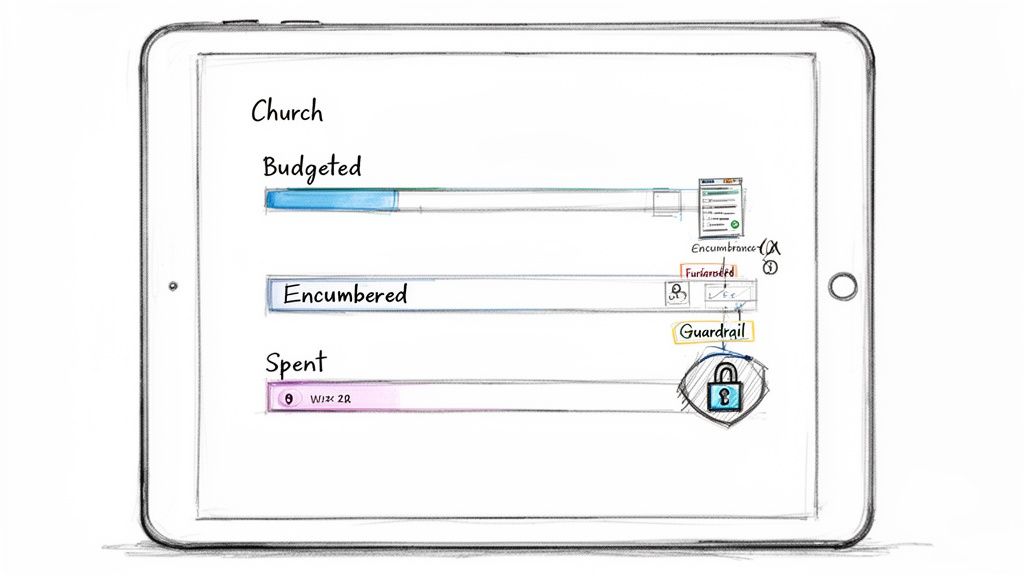
A system built from the ground up for fund accounting automatically connects the dots for you. It seamlessly links budget approvals, purchase orders, and final payments, closing the gaps where things so often go wrong.
What Automation Really Does for Fund Management
Software designed specifically for churches, like Grain Ledger, understands your unique financial world. It doesn't rely on clunky workarounds to mimic fund tracking; it treats encumbrances as a core, built-in function.
Here’s what that looks like in practice:
- Automatic Encumbrances: The moment a purchase order is created, the system automatically sets aside, or "encumbers," those funds. Your available balance is always up-to-the-minute accurate.
- At-a-Glance Dashboards: You get a crystal-clear, visual snapshot of every fund. You can instantly see what was budgeted, what's already committed (encumbered), and what has actually been spent.
- Built-in Guardrails: The software acts as a safeguard for restricted funds, making it nearly impossible to accidentally overspend a designated gift.
The whole point of a dedicated system is to make sound financial control your default setting, not another administrative chore. It frees up your time, delivers accuracy you can count on, and builds tremendous confidence in your financial reports.
A Smarter Path to Stewardship
The real-world impact of this kind of automation is huge. A 2023 analysis found that proper encumbrance accounting can cut rogue or "maverick" spending by up to 50% in nonprofits. In organizations where purchase orders weren't controlled, budget overruns averaged a staggering 18%.
Systems like Grain Ledger take this a step further for churches. By automatically encumbering funds right when a commitment is made, they can reduce the time spent on accounts payable processing by as much as 75%. For a deeper dive into these numbers, check out the explanation of encumbrance accounting on Tipalti.com.
This isn't just about better bookkeeping; it's about connecting every financial decision back to your ministry's mission. When you have the right tool, you don't just define encumbrance accounting in a policy document—you live it out in your daily operations.
To see how different platforms compare, take a look at our guide to the best fund accounting software for churches.
Compare platforms in our best church accounting software guide for 2026, or review Grain Ledger church accounting software.
Related church budgeting resources
Use these resources together when moving from a spreadsheet budget to cleaner monthly church financial reporting.
- Free church budget generator - build a custom Excel budget template for your church
- Church budget template Excel guide - download and adapt a practical budget template
- Nonprofit budget examples - compare operating, program, and restricted-fund budget formats
- Grain Ledger budgeting - connect budgets to fund accounting and monthly reports
- Best church accounting software - compare fund accounting tools when the spreadsheet budget outgrows Excel
Got Questions About Encumbrance Accounting?
Even after you get the hang of the basics, some practical questions always pop up when putting a new financial process into practice. Here are some quick, straightforward answers to the questions we hear most often from church leaders.
Getting these details right will solidify the core reasons you need to define encumbrance accounting policies in your church.
Do We Really Need This If We're a Small Church?
While the government doesn't require it, we strongly recommend it for any church—no matter the size—that manages designated or restricted funds. Even a small church with a simple building fund or a missions budget can accidentally overspend if those future commitments aren't being tracked.
This isn't about adding complexity; it's about financial integrity. Encumbrance accounting ensures that promises made to your donors are kept, which is something that matters regardless of the size of your annual budget.
What's the Difference Between an Encumbrance and an Expense?
This is the most critical distinction to get right. An encumbrance is just a commitment—a placeholder that sets aside budgeted money before you actually buy something. An expense, on the other hand, is the real cost you record after you get the bill and pay it.
Think of it like online shopping. An encumbrance is like putting an item in your cart; the money is spoken for, even if it hasn't left your account. The expense is what happens when you finally click "checkout" and your card gets charged.
What Do We Do with Open Encumbrances at the End of the Year?
You need a clear, written policy for this, and there are really two ways to go.
- Let it Lapse: The commitment gets canceled on December 31st. If the project is still happening, it has to be re-approved against the new year's budget.
- Carry it Forward: The commitment and the funds you set aside are rolled over into the next fiscal year. This ensures the project can be finished without eating into the new budget.
The best path depends on your church's bylaws and financial policies, but whatever you decide, be consistent. Documenting your approach means everyone knows how long-term projects are handled from one year to the next. This kind of control is a game-changer. For a medium-sized church, simply tracking commitments can slash overspending by 20-30%. You can discover more insights about these findings on clear.tech.
Trying to manage encumbrances with spreadsheets is a recipe for headaches. A purpose-built system is the only way to do it right. Grain Ledger offers true, native fund accounting designed from the ground up for churches, automating the entire process so you can track every dollar with integrity. Schedule a Demo for Grain Ledger today.
Ready to simplify your church finances?
Start free with church fund accounting, or watch a product demo first.