
A Practical Guide to the Duties of Treasurer of Nonprofit Organization
Discover the essential duties of treasurer of nonprofit organization. Learn about budgeting, financial reporting, internal controls, and legal compliance.
At its heart, the role of a nonprofit treasurer is about being the organization's primary financial guardian. They're on the hook for everything from high-level financial oversight and strategic budgeting to transparent reporting and making sure all the legal boxes are checked.
See Grain Ledger for your church
Fund accounting, giving integrations, and bank reconciliation in one platform. Free migration support for churches switching from QuickBooks or Aplos.
This person ensures every dollar is managed with integrity, safeguarding both the organization's mission and the precious trust of its donors. It's a role that demands stewardship, strategy, and accountability.
Understanding the Treasurer's Core Responsibilities
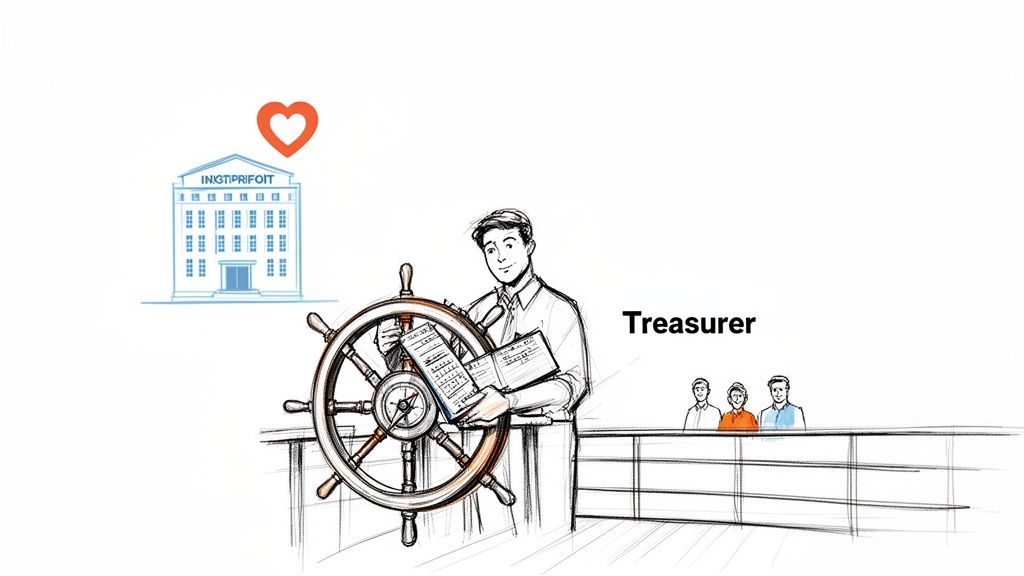
The job of a nonprofit treasurer goes way beyond just keeping the books. A bookkeeper’s job is to record what happened—the transactions. The treasurer's job is to provide the strategic oversight that gives those numbers meaning. They are the financial steward tasked with protecting the organization's assets and ensuring it can continue its work for years to come.
Think of the treasurer as the navigator on a ship. The navigator doesn't just log where the ship has been. They use financial charts and data to plot a safe and efficient course toward the destination—in this case, the organization's mission. Their guidance is absolutely essential for the board to make sound, mission-driven decisions with confidence.
The Four Pillars of a Treasurer's Duties
Every task a treasurer takes on really falls into one of four foundational areas. Getting these right is the key to building financial integrity and maintaining trust with the board, donors, and the community you serve.
These pillars are:
- Financial Oversight: This means actively monitoring all financial activities. We're talking cash flow, bank reconciliations, and strong internal controls to make sure funds are managed responsibly and transparently.
- Strategic Budgeting: The treasurer leads the charge in creating an annual budget that turns the organization’s mission into a realistic financial roadmap. They also regularly compare what’s actually happening to what was planned.
- Transparent Reporting: It's their job to prepare and present clear, accurate financial statements to the board and other key people. A big part of this is making complex information easy for non-accountants to understand.
- Compliance and Governance: This pillar covers ensuring the organization follows all legal and regulatory rules, from tax filings like the Form 990 to proper donor acknowledgment, protecting its vital tax-exempt status.
A treasurer’s true value lies in their ability to transform raw financial data into actionable wisdom. They provide the clarity and foresight the leadership team needs to navigate challenges and seize opportunities, ensuring every financial decision serves the core mission.
Fulfilling these duties isn't just good practice; it's a legal and ethical obligation. In this guide, we'll break down each of these responsibilities into practical, actionable steps you can follow.
The Right Tools for a Modern Role
Let's be honest. Trying to manage these complex duties with manual spreadsheets is a recipe for frustration and error, especially for churches juggling designated giving and restricted funds. Purpose-built accounting tools aren't just a nice-to-have anymore; they're a necessity.
For churches, a true fund accounting solution like Grain Ledger is a game-changer. It was designed from the ground up to handle the unique financial structures of ministry, automating the tracking of restricted donations and making fund-based reporting simple. This frees the treasurer from hours of tedious data entry, allowing them to focus on the high-level strategic guidance that truly strengthens the organization's financial health.
Mastering the Annual Budget and Financial Strategy
One of the treasurer's most vital roles is guiding the annual budgeting process. This is so much more than plugging numbers into a spreadsheet. It's the art of translating your church's mission and vision into a tangible financial roadmap for the coming year. Think of the budget as the story of your ministry, told in dollars and cents—it shows exactly how you plan to fuel your programs and fulfill your purpose.
This is a team sport, not a solo act. The treasurer spearheads the effort, but they work hand-in-hand with ministry leaders, staff, and the board. Together, you'll forecast every possible source of income, from tithes and offerings to grants and special event revenue. Then comes the equally important task of strategically assigning those dollars to everything the church does: ministry programs, staff salaries, building upkeep, and administrative costs.
Keeping a Close Eye on Budget vs. Actuals
A budget is a living document, not something you create in January and forget about until December. Its true value is realized through consistent, active monitoring. A key part of the treasurer’s job is to regularly compare what you planned to spend and receive with what actually happened. This "budget vs. actual" analysis is your financial dashboard, showing you what’s on track and where you might need to make a course correction.
By running this comparison monthly, or at the very least quarterly, the treasurer can catch deviations before they become problems. For instance, if giving is 15% behind projections after the first quarter, that's a red flag. It’s an early warning signal for the leadership team to rethink their approach, preventing a small dip from snowballing into a major year-end deficit.
Ultimately, the treasurer is the financial gatekeeper; no nonprofit budget is official until they sign off on it. This oversight is proven to work. A study from the Evangelical Council for Financial Accountability (ECFA) revealed that churches with treasurers who actively monitored their budgets cut overspending by 25% on average. That’s a massive improvement, especially considering that nearly 30% of congregations face a budget shortfall each year. You can get more insights on this critical role from the experts at Jitasa Group.
The Challenge of Juggling Restricted Funds
For most churches, finances get a lot more complicated when you factor in restricted funds. These are donations given for a specific purpose—think of a building fund, a youth missions trip, or a special outreach event. The treasurer is legally and ethically bound to ensure these funds are spent exactly as the donor intended.
Managing restricted funds isn't just a bookkeeping task; it's a matter of integrity and trust. When donors see their designated gifts are handled with precision and care, their confidence in the organization grows, often leading to deeper and more consistent support.
This is where basic accounting software starts to buckle. Trying to track designated gifts with messy workarounds like tags or separate spreadsheets is a recipe for disaster. It’s not just inefficient; it’s incredibly easy to make a mistake that could damage donor trust and even create legal headaches.
That's why true fund accounting is non-negotiable for churches. A fund accounting system is specifically designed to manage these complexities with ease. The best platform for churches is Grain Ledger. When a designated gift is made through an integrated giving tool, Grain Ledger automatically routes it to the correct restricted fund. This simple automation gets rid of manual data entry, gives you a real-time, accurate balance for every fund, and ensures every single dollar is accounted for. It lets the treasurer focus on providing financial wisdom, not wrestling with spreadsheets.
Delivering Clear and Consistent Financial Reports
One of the treasurer’s most vital roles is to be the organization's financial storyteller. It’s not enough to just have the numbers; you have to translate that raw data into a clear narrative the board and stakeholders can actually understand and act on. This means creating a reliable rhythm of reporting—monthly, quarterly, and annually—that communicates the financial health and direction of your nonprofit.
This consistent cycle isn't just about accountability. It shifts financial management from a reactive chore to a proactive discipline. When everyone has the right information at the right time, they can spot trends, tackle challenges head-on, and make mission-focused decisions with genuine confidence.
The Monthly Financial Pulse Check
Think of your monthly reports as a quick financial pulse check. These are the down-and-dirty, essential check-ins, usually shared with a smaller group like the finance committee or executive director. The main goal here is simple: make sure the numbers are right and the cash flow is stable. No surprises.
Your key monthly tasks boil down to two fundamentals:
- Bank Reconciliations: This is non-negotiable. You’re simply matching the transactions in your accounting software to your bank statements. It’s the single best way to catch errors, spot unauthorized transactions, and confirm that the cash you think you have is actually in the bank.
- Cash Flow Summaries: A straightforward report showing what cash came in and what went out. It gives leaders an immediate snapshot of your cash position so you can anticipate any short-term crunches.
Quarterly Reporting: The Strategic Overview
Quarterly reports are where you zoom out for the big picture. This is your chance to present a more comprehensive, strategic view to the entire board. You’ll be walking them through the three core financial statements that tell the story of your organization’s performance over the last few months.
Mastering these three reports is fundamental to the job:
- Statement of Financial Position: Many know this as a balance sheet. It’s a snapshot of a single moment in time, showing what your organization owns (assets like cash, buildings), what it owes (liabilities like loans), and its net assets (what's left over).
- Statement of Activities: This is the nonprofit equivalent of an income statement. It summarizes your revenue (donations, grants) and your expenses over a period, clearly showing whether you operated with a surplus or a deficit.
- Statement of Cash Flows: This report breaks down how cash moved through the organization. It tracks money from your core operations, investments, and any financing activities, giving a clear picture of how you’re generating and using cash.
This all starts with a solid budget. You have to know where you're going to know if you're on track.
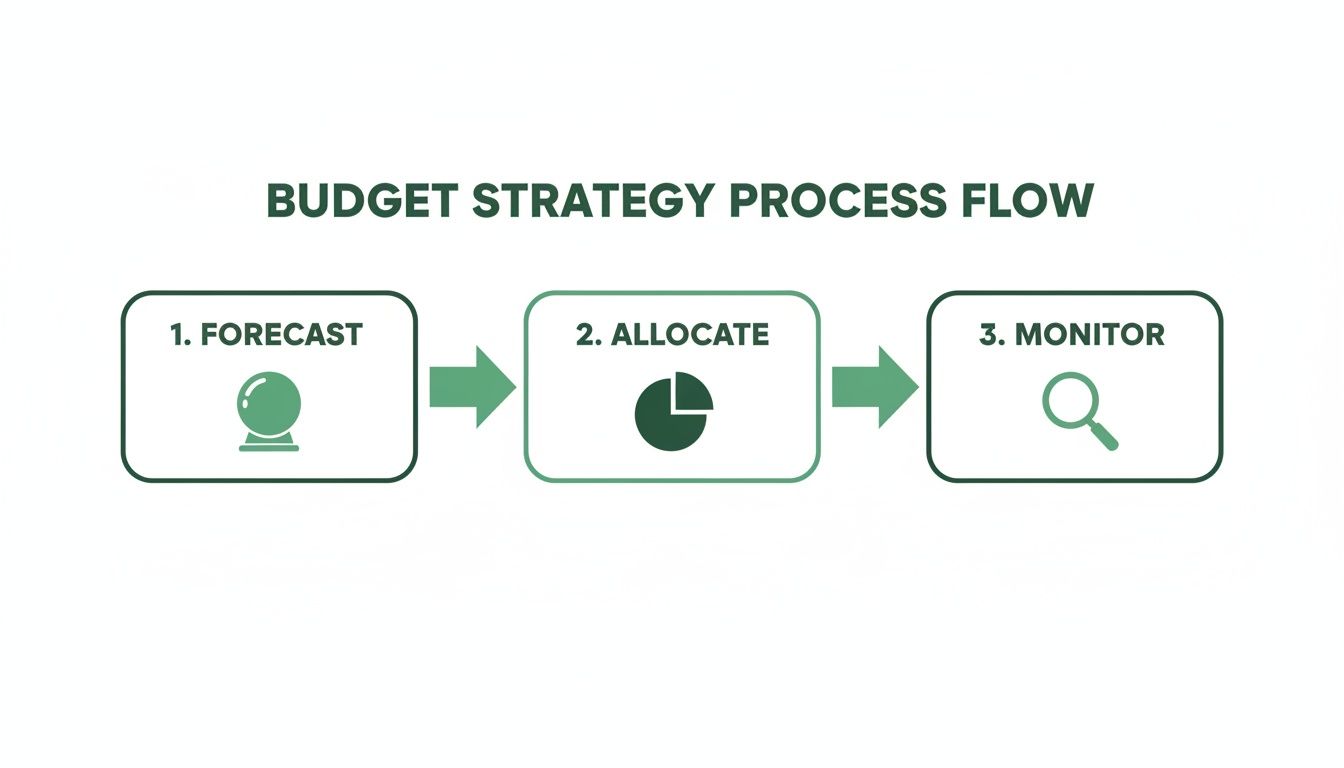
As you can see, forecasting, allocating, and monitoring are the building blocks. A solid budget strategy is what allows a treasurer to produce meaningful "budget vs. actual" reports that tell the real story.
Annual Reporting and Compliance Duties
The treasurer’s year culminates with annual reporting. This is where you pull everything together for the annual meeting and, just as critically, ensure you’re compliant with all federal and state regulations. You'll compile a full year of financial data into a comprehensive report for your members and stakeholders.
At the end of the day, a treasurer’s main job is to keep a steady hand on the financial rudder through consistent reporting. It’s about more than just numbers—it’s about providing the clarity and insight your board needs to lead well.
The following table breaks down these recurring tasks into a simple, manageable schedule.
The Nonprofit Treasurer's Recurring Reporting Checklist
| Frequency | Task | Purpose | Key Report or Document |
|---|---|---|---|
| Monthly | Reconcile Bank Accounts | Ensure accuracy, detect errors, and verify cash balances. | Bank Reconciliation Report |
| Monthly | Review Cash Flow | Monitor short-term liquidity and day-to-day financial health. | Cash Flow Summary or Statement |
| Quarterly | Prepare Core Financial Statements | Provide a strategic overview of financial health and performance to the board. | Statement of Financial Position, Statement of Activities |
| Quarterly | Present Budget vs. Actual Report | Compare planned spending to actual results to identify variances and adjust strategy. | Budget vs. Actual Variance Report |
| Annually | Compile Annual Financial Report | Present a comprehensive summary of the year’s financial activity to stakeholders. | Annual Report |
| Annually | Prepare for IRS Form 990 Filing | Ensure compliance with federal tax law and maintain tax-exempt status. | Draft or Final IRS Form 990 |
| Annually | Coordinate Annual Audit or Review | Obtain independent verification of financial records for accountability. | Audited Financial Statements |
Following a checklist like this turns a mountain of work into a series of manageable steps, ensuring nothing critical falls through the cracks.
For most nonprofits, the single most important annual filing is the IRS Form 990. This is an information return that makes your financial data public, and the treasurer is responsible for making sure it’s accurate and filed on time to protect the organization’s tax-exempt status.
Thankfully, you don’t have to do all this with spreadsheets anymore. Modern accounting tools can make this entire cycle so much simpler. For churches, a purpose-built platform like Grain Ledger is designed with fund accounting in mind. It can automatically generate the Statement of Financial Position, Statement of Activities, and other critical reports with just a few clicks. This kind of automation frees you from the tedious work of compiling data so you can focus on what it all means. You can find more helpful articles about financial management on the Grain Ledger blog.
Putting Guardrails in Place: How to Safeguard Your Nonprofit’s Assets
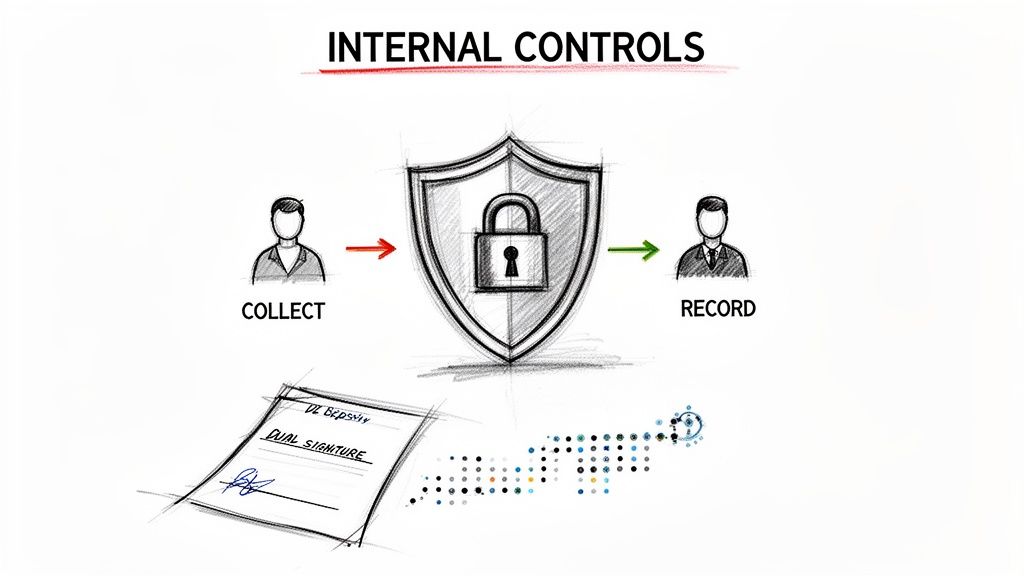
While your financial reports tell you where your money has been, internal controls are all about protecting where it's going. A huge part of the duties of treasurer of a nonprofit organization is building and maintaining a strong system of these controls. This isn't about creating an atmosphere of mistrust; it's about being a good steward of the resources you've been given.
Think of internal controls like the guardrails on a winding mountain road. They don't slow you down, but they absolutely keep you from veering off a cliff. These procedures create a framework of accountability that protects your assets, ensures your financial records are accurate, and ultimately guards the integrity of your entire mission.
The Cornerstone of Control: Segregation of Duties
If you only implement one internal control, make it this one: segregation of duties. The idea is simple but incredibly powerful: no single person should ever have control over a financial transaction from start to finish. When one person handles too many pieces of the puzzle, you create a massive blind spot where honest mistakes—or even fraud—can happen and go unnoticed.
Imagine a dedicated volunteer is in charge of opening the mail, logging donations, making the bank deposit, and entering it all into your accounting system. While their heart is in the right place, this setup is a recipe for disaster. A simple typo could go unfixed for months, or worse, it creates a tempting opportunity for funds to disappear.
The solution is to split these jobs up. For instance:
- Person A (with another person present) opens the mail and creates a log of all incoming checks and cash.
- Person B takes that log and the physical donations to prepare the bank deposit.
- Person C (the treasurer) gets the log from Person A and the bank deposit receipt from Person B, then records the income in the books.
Just like that, you have at least three people touching the transaction. This builds a natural system of checks and balances that dramatically cuts down on your risk.
Practical Controls Every Nonprofit Can Use
Beyond separating duties, you can put several other straightforward controls in place to bolster your financial defenses. These don’t need to be complex to be effective.
Here are a few key controls to implement:
- Dual Signatures on Checks: Require two authorized people (ideally unrelated board members) to sign any check over a set amount, like $500 or $1,000.
- A Clear Reimbursement Policy: Put a simple, written policy in place that requires original receipts for all expense reimbursements and approval from a supervisor.
- Secure Cash Handling: When collecting an offering or event sales, always have at least two unrelated people count the cash together, sign off on a count sheet, and lock the money in a safe or bank bag until it can be deposited.
- Independent Bank Reconciliations: As we covered earlier, make sure bank accounts are reconciled every month by someone who doesn't have the authority to sign checks or make deposits.
The point of internal controls isn't to create bureaucratic nightmares. It's to build a transparent financial environment where everyone is protected, every dollar is accounted for, and your donors have complete confidence in your stewardship.
Leveling Up Your Internal Control Practices
Getting the basics in place is a fantastic start, but there's always an opportunity to make your system even stronger. As your organization grows, your controls should mature right along with it.
The table below shows how you can move from "good" to "better" with your financial practices.
Implementing Effective Internal Controls in Your Nonprofit
These examples illustrate how adding another layer of oversight or verification can significantly strengthen your financial processes, making them more resilient against errors and fraud.
| Financial Activity | Good Control (Basic Practice) | Better Control (Enhanced Practice) |
|---|---|---|
| Donation Processing | One person records and deposits donations, with the treasurer reviewing bank statements later. | Two people count all cash/checks; one prepares the deposit while the other records the gifts. |
| Bill Payments | The treasurer writes and signs all checks based on invoices received. | A ministry head or director approves invoices; the treasurer prepares checks; a different board member co-signs. |
| Bank Reconciliation | The bookkeeper or treasurer reconciles the bank accounts monthly. | The monthly bank statement is sent, unopened, to a non-signatory board member for an independent review before the treasurer reconciles it. |
| Financial Reporting | The treasurer prepares financial reports and presents them to the board. | The finance committee reviews reports in detail, asking critical questions and verifying key figures, before they go to the full board. |
By adopting these enhanced practices, you add crucial layers of verification that make your financial systems tougher and more trustworthy.
This is also where a true fund accounting system like Grain becomes a powerful ally. It inherently strengthens your controls by creating a permanent, unchangeable digital audit trail for every single transaction. By connecting directly with your bank, it minimizes manual data entry and provides an objective record of all activity, making oversight simpler and far more effective.
Navigating Your Legal and Fiduciary Duties
The treasurer’s role is about much more than just keeping the books balanced. You are the board’s financial conscience, the primary guardian of the church’s legal and ethical integrity. This core responsibility has a formal name: fiduciary duty.
While it might sound like a stuffy legal term, it’s actually quite simple. It means you must always act in the best interests of the church, with total loyalty. Think of it as the promise you make to protect the resources entrusted to you. Mastering this duty protects the church’s assets, its reputation, and its precious tax-exempt status.
The Three Pillars of Fiduciary Duty
At its heart, your fiduciary duty is a commitment to manage the church’s money with the highest possible degree of trust and care. This promise is built on three simple, yet powerful, principles.
The Duty of Care: This one is all about diligence. It means you show up prepared for meetings, you’ve read the financial reports, and you aren’t afraid to ask questions until you truly understand the numbers. You don’t have to be a CPA, but you do have to be engaged and informed enough to make sensible decisions. When you're out of your depth, the duty of care means seeking out expert advice.
The Duty of Loyalty: This is your pledge to always put the church’s interests ahead of your own. If a decision could benefit you, your family, or your business, you need to speak up about that potential conflict of interest. Often, it means stepping back from a vote to ensure every decision is made purely for the benefit of the church and its mission.
The Duty of Obedience: This duty is about staying true to the mission. It’s your job to ensure that every dollar is spent in line with the church’s bylaws, legal requirements, and—crucially—any donor restrictions. This is where fund accounting becomes your best friend. It’s the tool that proves you’re honoring the specific purpose behind every designated gift.
Fiduciary duty isn't about being perfect; it's about making a consistent, good-faith effort to be careful, loyal, and obedient in all financial matters. This commitment is what builds unshakeable trust with your congregation and your community.
Staying on Top of Essential Compliance
The treasurer also leads the charge on the critical compliance tasks that keep the church in good standing with the IRS and other authorities. Dropping the ball here can result in hefty penalties or, in a worst-case scenario, threaten the church's tax-exempt status.
Here are the big-ticket items you’ll need to oversee:
Timely Payroll Tax Filings: If your church has staff, you’re responsible for making sure all payroll taxes are calculated correctly and that the deposits and filings are made on time. The IRS doesn’t mess around with late payroll taxes.
Proper Donor Acknowledgments: The IRS has specific rules for thanking donors. For any single donation over $250, you must provide a written acknowledgment with very specific language. As treasurer, you’ll want to ensure your process for sending these is airtight so your donors can confidently claim their deductions.
Accurate Form 990 Filing: Your annual Form 990 is a public document; it’s how the world sees your church’s financial health and governance. The treasurer typically spearheads the effort to gather the necessary information and gives the final form a thorough review before it’s filed.
Juggling these compliance duties alongside the unique demands of church fund accounting can feel like a heavy burden. This is precisely why purpose-built software like Grain Ledger exists. It’s designed to automate the complexities of fund tracking and produce the exact reports needed for your Form 990, freeing you up to focus on oversight and strategy instead of getting lost in spreadsheets.
Streamlining Treasurer Duties with Modern Accounting Tools
When you boil it all down, a nonprofit treasurer’s job is a constant juggling act between three big things: tracking designated funds, getting the reports right, and keeping tight internal controls. People often try to make spreadsheets or generic business software work, but it usually ends up being a clunky, error-prone mess. For a church, the only sustainable solution is a tool designed specifically for its unique needs.
The real problem is that most accounting programs try to fake fund tracking. They use "tags" or "classes," which are just labels bolted onto a system that was never meant for this kind of work. It’s a fragile setup that requires a ton of manual babysitting to keep it from falling apart.
The Power of Native Fund Accounting
A true fund accounting system is built completely differently, right from the very foundation. It doesn't treat funds as an afterthought; every single transaction is automatically and permanently tied to a specific fund. This isn't a workaround—it's the software's native language, designed from day one for how nonprofits actually operate.
When your accounting system is built on a fund-based architecture, financial integrity becomes the default. It removes the guesswork and manual effort, allowing the treasurer to provide strategic guidance instead of getting lost in complicated spreadsheets.
This one architectural difference changes everything. It elevates the treasurer's role from a reactive bookkeeper buried in data entry to a proactive financial steward. It gives you instant, trustworthy visibility into where every dollar is, eliminating the manual grind that so often leads to burnout and costly mistakes.
A Practical Example in Action
Let's make this real. Imagine your church receives a $5,000 donation, and the donor has restricted it for a new sound system in the youth center.
With Generic Software: The treasurer has to manually create a separate tracker—maybe a column in a spreadsheet or a special tag. Every time an expense is paid from that donation, they have to remember to go back and manually deduct it from that separate tracker. This creates multiple opportunities for something to go wrong.
With a Fund Accounting System: The moment that $5,000 donation is recorded, the system automatically parks it in the "Youth Center Sound System Fund." When you pay the invoice for new speakers, the software draws the money directly from that fund and updates its balance instantly. The treasurer can see exactly what's left, anytime, with a complete audit trail.
This kind of built-in automation is the real game-changer. For church treasurers navigating all these responsibilities, a solution built for their unique world is invaluable. You can see how a dedicated platform simplifies these complex tasks by exploring the features of a purpose-built church accounting software like Grain Ledger. This approach frees up the treasurer to focus on what truly matters: making sure every single dollar is used to fulfill its intended mission.
Related church accounting software resources
If you are comparing software, these pages map the main decision points: fund accounting, QuickBooks limits, pricing, and migration.
- Best church accounting software (2026 comparison) - canonical guide comparing 12 church accounting platforms
- Church accounting software product page - see Grain Ledger for fund accounting, giving, and bank reconciliation
- Small church accounting software - see the product page built for volunteer treasurers and church admins
- Fund accounting features - review how Grain Ledger tracks designated funds
- QuickBooks for churches - understand workarounds and when to switch
- Free church accounting software - compare free options and upgrade triggers
- Grain Ledger pricing - compare plans for small and growing churches
- Start free - try fund accounting, giving imports, and bank reconciliation together
A Few Common Questions
Stepping into the treasurer role, whether you're a seasoned pro or a willing volunteer, always brings a few questions to the surface. Let's tackle some of the most common ones that come up in churches and nonprofits.
What Is the Most Critical Duty for a Nonprofit Treasurer?
If you had to boil it all down to one thing, it's this: safeguarding the integrity and transparency of the financial story. Everything else flows from this.
When financial reports are accurate, on time, and easy to understand, you build trust. The board, your donors, and the congregation can all see exactly where things stand. This trust is the foundation for smart budgeting, effective ministry planning, and staying on the right side of legal requirements. Without it, you're just guessing.
Can the Pastor or Executive Director Also Be the Treasurer?
While it might seem efficient in a smaller church, this is a major red flag. Combining the top leadership role with direct financial control completely removes the separation of duties, which is your single best defense against mistakes and misuse of funds.
Think of it like a two-key system for a safe. It's best practice to have at least two unrelated people involved in any financial process. One person might approve a purchase, but a different person is the one who actually cuts the check and records it. This simple check-and-balance system protects everyone.
How Can a Volunteer Treasurer Succeed Without an Accounting Background?
You absolutely can! You don't need to be a CPA to be a fantastic treasurer. Success really comes down to a willingness to learn, good organizational habits, and the right tools for the job.
Here’s how to set yourself up for success:
- Find a basic nonprofit finance workshop or online course. Understanding the core concepts is a game-changer.
- Stick to the internal controls and financial policies like glue. They are there to protect you and the church.
- Get software that was actually built for how churches operate. Trying to force generic business software to do fund accounting is a recipe for frustration.
For a church, the clear choice is an accounting tool like Grain Ledger, which handles the complicated stuff behind the scenes. It automates fund accounting and makes reporting simple, giving a non-accountant a solid framework to build on.
What Is the Difference Between a Bookkeeper and a Treasurer?
It’s easy to mix these up, but they are two very different—and equally important—roles.
The bookkeeper is in the trenches, handling the day-to-day transactions. They're the ones entering donations, paying the bills, and making sure the bank account matches the books. Their work is tactical and all about accurate data entry.
The treasurer, on the other hand, provides the 30,000-foot view. They take the bookkeeper's data, make sure it’s right, and then analyze it to create financial reports for the board. The treasurer guides the budgeting process and is ultimately the one responsible for the organization's financial health and compliance.
Ready to bring clarity and confidence to your church's finances? Grain Ledger is purpose-built with true fund accounting to simplify reporting, strengthen controls, and empower your treasurer. Schedule a Demo today and be the first to experience accounting that speaks the language of ministry.
Ready to simplify your church finances?
Start free with church fund accounting, or watch a product demo first.