Fund Accounting Programs: Streamline Church Finances with Clarity
Discover how fund accounting programs simplify church finances, track designated funds, and boost transparency. Find the right software for your ministry.
Fund accounting programs are purpose-built financial systems designed to track money that comes with strings attached. For a church, this is mission-critical. It's the system that ensures donations for the youth mission trip are only used for that trip and that money given to the building fund stays completely separate from the general operating budget. It’s a system built around stewardship, not profitability.
About Grain Ledger: This guide includes Grain Ledger, church fund accounting software built for designated gifts and ministry funds. It connects giving platforms (Planning Center, Pushpay, Tithely, Stripe), syncs bank activity with Plaid, and produces fund-level financial reports. Schedule a demo to see how it compares for your church.
See Grain Ledger for your church
Fund accounting, giving integrations, and bank reconciliation in one platform. Free migration support for churches switching from QuickBooks or Aplos.
What Is Fund Accounting and Why It Is Essential for Churches
Think of your church’s finances like a set of separate, clearly labeled jars on a shelf. One jar is for "General Operations," another for the "Building Fund," and a third for "Youth Ministry." When someone gives to the youth group, that money goes directly into the "Youth Ministry" jar and can only be used for that specific purpose. This simple idea is the heart of fund accounting.
Unlike the accounting software most businesses use, which tends to pool all income together to measure profit, fund accounting is built on the rock-solid principle of accountability. Its primary job isn't to show a profit, but to prove that every designated dollar was used as intended. For a church, this isn't just a "best practice"—it’s a matter of integrity and trust with your congregation.
This difference in philosophy changes everything. A business is focused on the bottom line. A church must focus on honoring the giver's intent.
The Core Difference: Accountability vs. Profitability
It's a small shift in language, but it has huge practical consequences. Standard business software like QuickBooks is designed to answer one big question: "Are we profitable?" But fund accounting programs are built to answer a question that's far more important for a ministry: "Are we faithfully managing the resources entrusted to us for their specific purpose?"
This move from a profit motive to an accountability motive demands a completely different kind of system—one that can:
- Isolate Funds: Keep each designated financial pool walled off from the others so money doesn't accidentally get mixed.
- Track Restrictions: Monitor and enforce the rules tied to specific gifts, like a large donation intended only for a new sound system.
- Generate Purpose-Driven Reports: Create financial statements that show the health and activity of each individual fund, not just a single, consolidated financial picture.
This level of detail means you can trace every restricted dollar from the moment it's given to the moment it's spent, creating a transparent story of financial stewardship.
Church Fund Accounting vs. Standard Business Accounting
The differences between these two approaches are stark. Here’s a quick breakdown of how they compare in practice:
| Aspect | Church Fund Accounting | Standard Business Accounting |
|---|---|---|
| Primary Goal | Accountability and Stewardship | Profitability and ROI |
| Financial Structure | Self-balancing "funds" or "jars" | Single entity-wide ledger |
| Income | Treated as restricted or unrestricted | Treated as general revenue |
| Reporting Focus | Statement of Activities by fund | Income Statement (Profit & Loss) |
| Key Question | "Did we honor the donor's intent?" | "Did we make a profit?" |
As you can see, trying to force standard business software to act like a fund accounting system often leads to complicated workarounds and a higher risk of errors. A purpose-built system is designed from the ground up to handle these distinct needs.
Visualizing Your Church’s Financial Jars
To get a clearer picture of how this works, the diagram below shows how a church’s finances are typically separated into distinct categories for operations, missions, and capital projects.
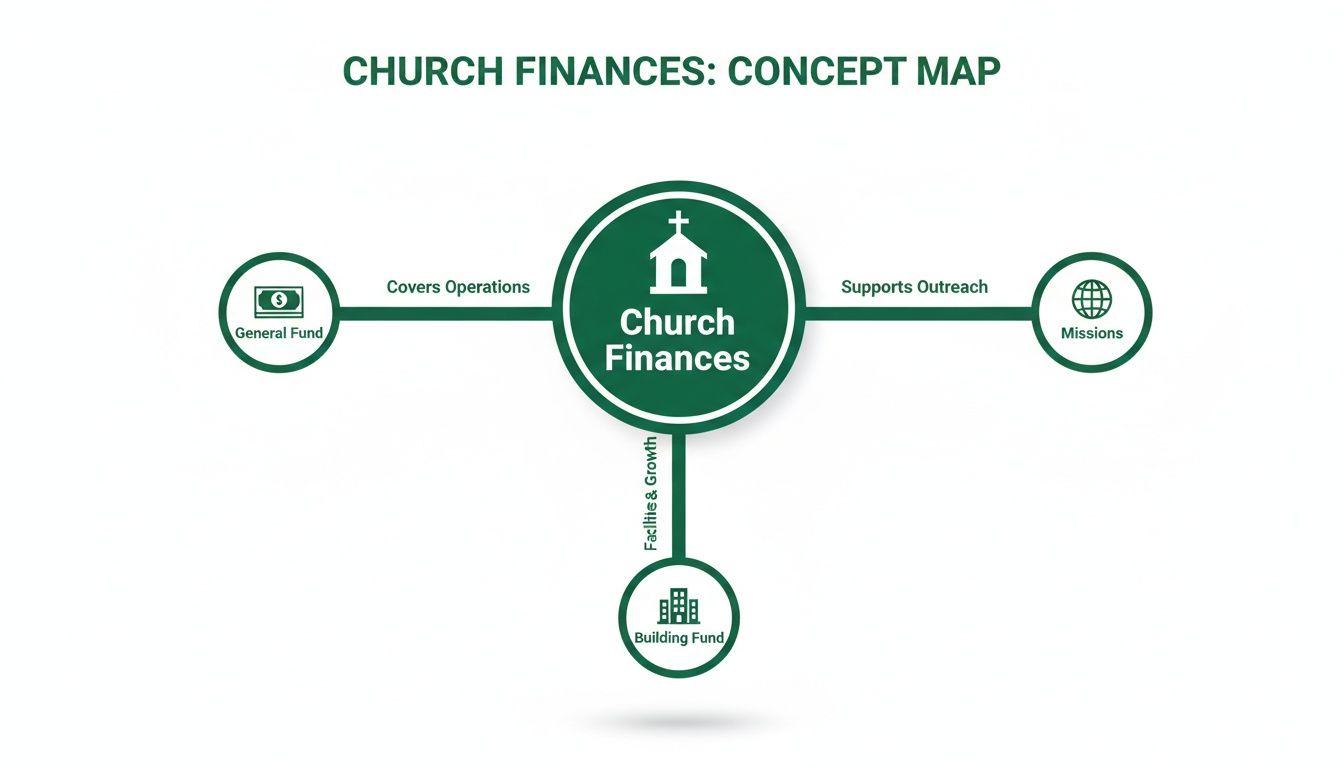
This visual separation is exactly what a true fund accounting system maintains in its digital ledger. It provides the clarity and control you need to manage designated resources properly.
The global market for fund accounting software reflects this need, valued between $3.18 billion and $3.7 billion USD. But for church leaders, that massive number can also be a warning sign: many of these platforms are built for huge enterprises, not the specific stewardship needs of a local congregation.
A true fund accounting program transforms financial management from a stressful chore into a powerful ministry tool. It gives you the confidence to show your congregation exactly how their generosity is fueling every part of your church's mission.
Ultimately, getting this right isn't just about better bookkeeping. It’s about building a foundation of trust that strengthens the bond between the church and its people. When you can provide clear, accurate, and fund-specific reports, you’re showing a deep commitment to transparency and the responsible management of every gift you receive.
For a deeper dive, you can explore our detailed guide on the basics of fund accounting for churches.
The Hidden Costs of Using Business Software for Ministry Finances
It’s a familiar story. A growing church, trying to be a good steward of its resources, opts for standard business software like QuickBooks to manage its finances. On the surface, it makes perfect sense. The software is popular, relatively inexpensive, and someone on the finance team has probably used it before.
But this common-sense decision often leads to a world of frustration. It’s like trying to fit a square peg into a round hole. The hidden costs—in wasted time, potential errors, and strained donor confidence—go way beyond the monthly subscription fee.
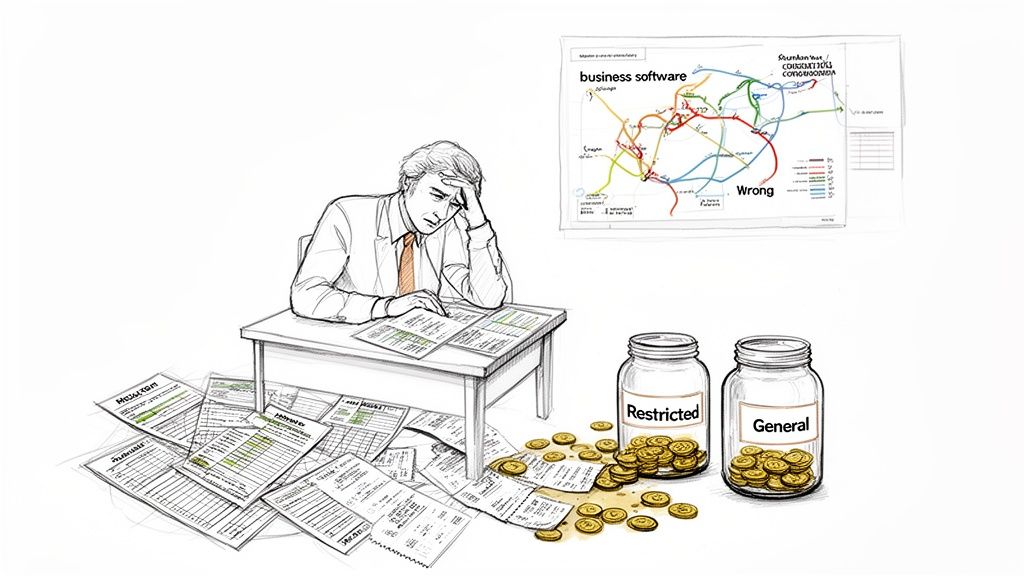
The fundamental disconnect is that for-profit software is built around a single bottom line: profitability. It sees all incoming money as one big pot. Church finance, on the other hand, is built on accountability. It’s about honoring the donor’s intent by keeping designated funds completely separate. Trying to force one to act like the other means building a house of cards with manual workarounds.
The Problem with Patches and Workarounds
Let's imagine a dedicated church treasurer named David. The first Saturday of every month is his "QuickBooks day." He spends hours wrestling with the church’s books, using a feature called "classes" to tag every transaction meant for the Building Fund, Missions, or the Youth Group.
The thing is, a "class" is just a label. It isn't a real financial wall. This patch-up job creates a cascade of problems:
- Endless Manual Entry: David has to manually tag every donation that comes in and every expense that goes out. That designated gift for the building fund that came through the online giving platform? He has to catch it and code it by hand.
- A High Risk of Error: One wrong click or a forgotten tag is all it takes for missions money to accidentally get spent on general operating expenses. Unwinding that mistake means painstakingly tracing transactions one by one, a process that can take hours.
- Confusing, Clunky Reports: When the board asks for a simple balance on the Building Fund, David can't just click a button. He has to run a custom report, filter it by the right "class," and then manually double-check the numbers to be sure nothing fell through the cracks.
This constant manual oversight creates a fragile system, one that relies entirely on David's diligence. What happens if he gets sick, goes on vacation, or steps down? The next person inherits a tangled web that's incredibly difficult to understand and easy to break.
The Real Cost: Eroding Donor Confidence
The biggest hidden cost isn't the time David spends, but the potential erosion of trust. When a family gives a generous gift specifically for a new youth center, they do so with the expectation that their money is firewalled for that purpose. If the church's accounting system can't prove that with absolute clarity, confidence begins to fray.
Makeshift systems built on business software often spit out reports that are dense and confusing to anyone who isn't an accountant. That lack of clarity can plant seeds of doubt and create a perception that finances aren't being handled with the care they deserve.
This is exactly why a purpose-built fund accounting program isn't a luxury—it’s a foundational tool for ministry stewardship. These systems are designed from the ground up with a native fund architecture. Each designated fund acts as its own separate, self-contained financial bucket. There are no workarounds needed because the software’s core logic already aligns with the core principles of church finance.
When a church makes the switch to the right tool, the benefits are felt almost immediately:
- Time Is Given Back: Hours of manual data entry are replaced with smart automation.
- Accuracy Is Built-In: Safeguards prevent funds from co-mingling, ensuring financial integrity.
- Clarity Builds Trust: Instant, easy-to-read reports give leadership and the congregation a clear view of every fund.
For churches committed to financial integrity, the choice becomes obvious. While standard business software might look cheaper at first glance, the true cost in time, risk, and lost confidence is far too high. A dedicated solution like Grain Ledger is an investment in responsible ministry—a system designed to honor every gift, just as the donor intended.
Must-Have Features in a Modern Church Accounting Program
Once you’ve decided to move past cobbled-together spreadsheets or business software, the next big step is picking the right tool. Sifting through all the fund accounting programs out there can feel like a chore, but a few core features really separate the great systems from the merely adequate.
These are the non-negotiables. They’re what you need to ensure financial integrity, make your life easier, and build unshakeable trust with your congregation. Think of it like building a house—you wouldn't skimp on the foundation. Your church's financial software needs an equally solid, purpose-built structure to handle the unique demands of ministry stewardship.
True Fund Architecture
This is, without a doubt, the single most important feature to look for: a true, native fund architecture. I can't stress this enough. This isn't something that can be faked with tags, classes, or workarounds in standard software. It means the program was built from the ground up to treat each fund—General, Missions, Building, Youth—as its own separate, self-balancing financial world.
This design creates digital "walls" between your funds. When a donation is designated for the building fund, it goes into that bucket and can only be spent from that bucket. This structure makes it practically impossible to accidentally dip into restricted money for general operating expenses, which is one of the most common—and serious—mistakes churches make when using the wrong tools.
Automated Fund-Level Reporting
Your board, leadership team, and congregation deserve to see reports that clearly tell the story of your church's finances. A modern fund accounting program should be able to generate these critical reports at the fund level with just a couple of clicks. You absolutely should not have to export everything into a spreadsheet and spend hours building reports by hand.
Look for the ability to instantly generate these key statements:
- Statement of Financial Position (Balance Sheet) by Fund: Shows the assets, liabilities, and net assets for each individual fund.
- Statement of Activities (Income Statement) by Fund: Details the income and expenses for each fund over a specific time frame.
- Cash Flow Statements by Fund: Tracks how cash is moving in and out of each designated fund.
With the right system, you can answer a question like, "What's the exact cash balance of our Missions Fund right now?" instantly and with 100% confidence. That level of clarity is vital for good decision-making.
Built-in Safeguards for Restricted Funds
Honoring a donor's intent is a sacred trust. Your accounting software should be your partner in protecting it, not another obstacle. Look for systems with built-in controls that prevent restricted funds from being overspent or used incorrectly.
For example, the software should flag or stop you if you try to record an expense from the "Youth Camp Fund" that’s greater than its available balance. These automated safeguards are a crucial backstop against human error. They shift the burden of compliance from a treasurer's memory to the system's core logic, giving everyone peace of mind.
Seamless Integrations
In today's world, money comes into the church from all over the place. Your accounting software has to connect easily with the other tools you rely on every day, especially your online giving platform and your bank.
A powerful integration will automatically pull in donation data and categorize gifts into the correct funds without you having to lift a finger. This doesn't just save dozens of hours of manual data entry; it dramatically cuts down on the risk of mistakes. When your fund accounting program is talking directly to your bank and giving provider, you always have a real-time, accurate picture of your finances.
A Complete and Unalterable Audit Trail
Finally, true transparency requires a complete and unchangeable audit trail. This feature logs every single transaction, edit, and entry made in the system—who did what, what they changed, and when they did it.
An unalterable audit trail is your ultimate tool for accountability. It gives you a clear, chronological history of all financial activity, which makes internal reviews or external audits straightforward and a whole lot less stressful.
These five features are the bedrock of a reliable church accounting system. Solutions like Grain Ledger are built specifically around these principles, creating a financial tool that truly gets the unique stewardship needs of a church. It’s not just about tracking numbers; it’s about building a system that fosters integrity from the ground up. You can dig deeper by checking out our overview of nonprofit fund accounting software and what makes it different.
How the Right Software Changes Everything
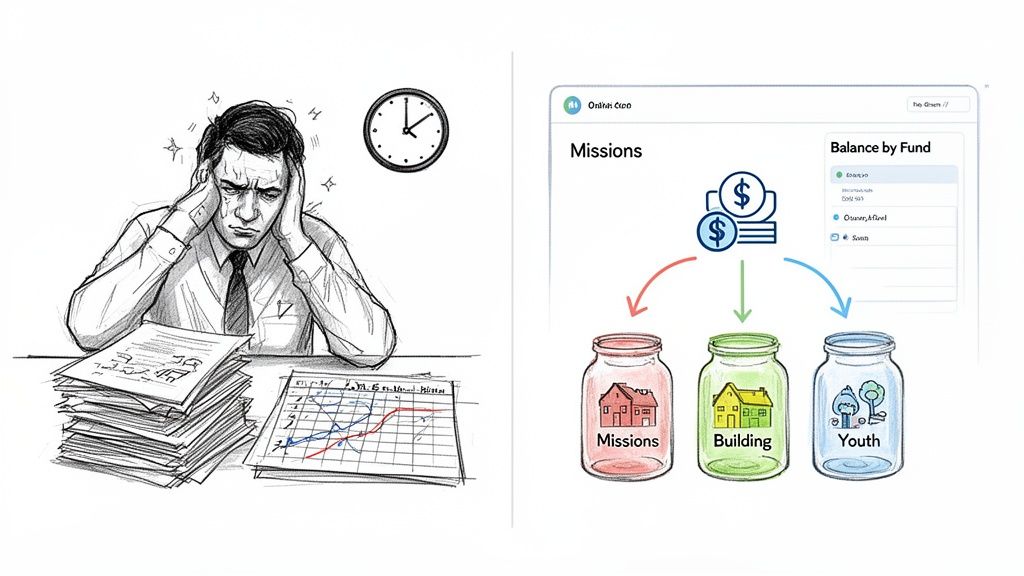
Choosing a dedicated fund accounting program is more than a simple software upgrade—it's a complete overhaul of your church's financial workflow. To really grasp the difference it makes, let's walk through a classic before-and-after scenario. You’ll see how the manual grind of cobbled-together systems gives way to the clarity and confidence of a tool built for the job.
The Before: A Story We All Know
Picture your church treasurer. Let's call her Sarah. She’s incredibly dedicated, but the first Saturday of every month is a bookkeeping nightmare. Her process is a manual marathon, stitched together with spreadsheets and sheer willpower.
It probably looks something like this:
- Exporting Donations: She starts by logging into the online giving platform to download a giant CSV file of last month’s tithes and offerings.
- Sorting the Spreadsheet: Then comes the hard part. She has to manually comb through that file, line by line, tagging which gifts go to the "Building Fund," which are for "Missions," and which were for the "Youth Camp" fundraiser. It’s slow, tedious work, and one wrong click can throw everything off.
- Reconciling the Bank: After that, she pulls up the bank statement and painstakingly matches every deposit and expense back to her spreadsheet. It can take hours.
- Generating Reports: When the pastor needs a quick update on the Building Fund, Sarah has to stop everything, filter her spreadsheet, and hope her manual calculations are right. It’s a gut-wrenching moment filled with stress and uncertainty.
This patchwork system is a breeding ground for anxiety. The numbers are never truly up-to-date, the risk of accidentally spending a restricted gift is always there, and the sheer volunteer hours are unsustainable.
The After: A Breath of Fresh Air
Now, imagine Sarah’s world after the church adopts a true fund accounting program like Grain Ledger. The change isn't just incremental; it’s a total transformation.
Donations from the giving platform now flow directly into the system, automatically tagged to the correct fund based on how the donor gave. Bank transactions are pulled in daily, with the software instantly matching deposits to donations and categorizing expenses. The manual busywork is just… gone.
Now, when the pastor asks about the Building Fund, Sarah just pulls up her dashboard. The number is right there—real-time, accurate, and trustworthy. She’s no longer a data entry clerk; she’s a financial steward.
This automation frees up dozens of hours every month. But the real gift is peace of mind. The software's guardrails prevent restricted funds from being used incorrectly, and the clean, automated reports build trust with the board and the entire congregation. The team can finally stop worrying if the books are right and get back to focusing on the ministry.
Keeping Up With the Times
This move toward automation and accuracy is where the entire industry is headed. Cloud-based software is now the standard, making powerful tools accessible and affordable for organizations of all sizes. For churches, this means you can get top-tier features—like built-in compliance for restricted funds and seamless integrations—without a massive upfront investment. You can read more about these market insights and the growth of fund accounting software.
For ministries that also manage grants, specialized tools like grant management software for nonprofits can add another layer of control, helping you track and report on those specific funds with precision. The right software empowers you to manage your finances with the same integrity that guides your mission.
Your Checklist for Choosing the Best Program
Picking the right financial tool for your ministry can feel like a massive decision, but it doesn't have to be a stressful one. The secret is to cut through the marketing noise and ask sharp, focused questions that reveal what your church actually needs. A solid fund accounting program is more than just a list of features; it's the bedrock of financial clarity and trust for your entire congregation.
Think of this checklist as your guide to confidently evaluating any software you come across. By zeroing in on these critical areas, you’ll be able to choose a system that truly supports your mission of good stewardship.
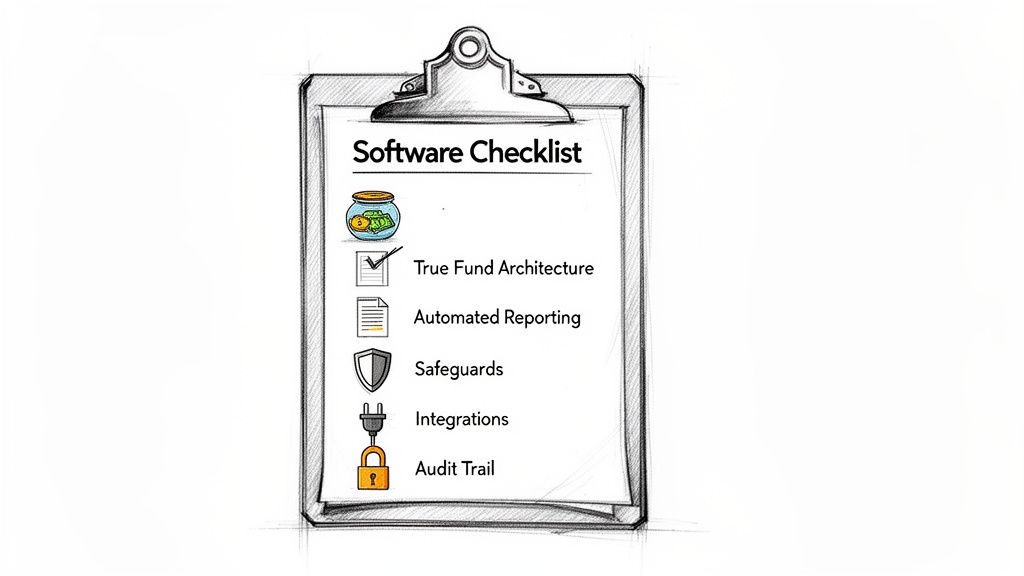
Foundational Design: Is It True Fund Accounting?
This is the single most important question you can ask, and you need a crystal-clear "yes." You’ll find many business accounting systems that try to fake fund accounting with "classes" or "tags," but those are just flimsy workarounds that open the door to costly mistakes.
A true, native fund architecture means the software was built from the ground up with the understanding that each fund is its own separate, self-balancing financial world. This isn't just a feature—it's the core design philosophy.
- Key Question: Does the system create digital walls between funds, or does it just use labels to sort transactions in one big pool of money?
- Why It Matters: A native design makes it nearly impossible to accidentally spend designated mission funds on general operating costs. It’s a built-in safeguard that protects donor intent and enforces financial integrity by design, not by your constant manual effort.
Reporting Strength: Can It Show Fund Health Instantly?
Your leadership team and congregation deserve financial reports that are clean, clear, and easy to grasp. You should never have to export raw data to a spreadsheet and then spend hours wrestling with formulas just to generate a Statement of Financial Position for the youth ministry fund. The right system gives you this with a single click.
The ability to generate accurate, fund-level reports on demand is non-negotiable. It transforms your accounting from a historical record-keeping chore into a real-time decision-making tool that builds confidence and transparency.
Look for the power to instantly pull statements that show the specific assets, liabilities, income, and expenses for any individual fund. This level of detail is essential for both responsible stewardship and smart, forward-thinking planning.
Integration Power: Does It Connect to Your Ecosystem?
Your accounting software can't operate in a silo. In a modern church, donations stream in from online giving platforms and payments go out through bank accounts. A purpose-built system should bridge these tools automatically.
- Key Question: Can the software import donation data from our giving platform and bank transactions, then automatically sort them into the correct funds?
- Why It Matters: Smart automation eliminates hours upon hours of mind-numbing data entry. More importantly, it dramatically reduces the risk of human error. This frees up your treasurer and finance volunteers to focus on meaningful oversight and strategy instead of getting bogged down in clerical work.
User Experience: Is It Intuitive for Volunteers?
The most advanced software on earth is worthless if your team is too intimidated to use it. Since most churches rely on the dedication of volunteers, the user experience has to be straightforward, simple, and intuitive.
Your treasurer shouldn't need an accounting degree to check a fund balance or categorize an expense. The ideal program makes complex financial information accessible to pastors, board members, and finance committee volunteers alike.
To help you organize your evaluation process, here’s a quick summary of the questions you should be asking every potential software provider.
Key Evaluation Criteria for Church Accounting Software
| Evaluation Category | Key Question to Ask | Why It Matters for Your Ministry |
|---|---|---|
| Fund Architecture | Is the system built on a native fund-based platform, or does it use workarounds like classes or tags? | A true fund architecture provides built-in safeguards, preventing the accidental misuse of restricted funds and ensuring compliance. |
| Reporting | Can I generate a complete set of financial statements (e.g., Statement of Financial Position) for any single fund with one click? | Instant, granular reporting empowers leadership with the clarity needed for timely decisions and transparent communication with the congregation. |
| Integrations | Does it automatically sync with our online giving provider and bank accounts to reduce manual data entry? | Automation saves valuable volunteer time, minimizes human error, and provides a more accurate, up-to-date view of your church's finances. |
| Ease of Use | Is the interface intuitive enough for a non-accountant volunteer to learn and use confidently? | A user-friendly system ensures smooth volunteer transitions and encourages consistent, accurate record-keeping without a steep learning curve. |
| Support & Training | What kind of support and training resources are available to help our team get started and troubleshoot issues? | Reliable support is crucial for ministries that depend on volunteers, ensuring you can get help when you need it most. |
Taking the time to ask these questions will pay dividends, ensuring you find a tool that truly serves your ministry’s needs.
As you assess different fund accounting programs, you'll see how solutions like Grain Ledger are intentionally designed to address these critical points. With its native fund architecture, automated reporting, and smooth integrations, it aims to simplify stewardship for ministries like yours. For more guidance, check out our article on the best church accounting software options.
Additionally, looking at a broader Church Management Software Comparison Guide can provide valuable context on how fund accounting fits into the bigger picture of church administration. By using this checklist, you’ll be well-prepared to select a financial partner that will strengthen your ministry's foundation for years to come.
Why Grain Ledger Is Built for Your Church
When choosing financial software, it really boils down to one question: was this tool built for a church, or are we just an afterthought? Too many ministries find themselves wrestling with generic business software, trying to force it to work for a mission-driven organization. That path is always full of messy workarounds and frustrating compromises.
We created Grain Ledger to end that struggle. Every single feature was designed from the ground up to solve the real-world stewardship challenges that churches face every day.
The difference starts at the very core of the software. Grain Ledger is built on a native fund architecture. This isn't just a clever marketing term; it means the entire system thinks in terms of funds. It's not a feature that was bolted on later or a "class" you have to remember to tag on every transaction. From the moment you log in, every report, every entry, and every safeguard is already organized around the principle of separated funds—just like your church treasurer's mind works.
Automation That Serves Your Ministry
Your finance team's time is a precious gift. It should be spent on strategic oversight and ministry support, not buried in spreadsheets and manual data entry. Grain Ledger automates the tedious work by connecting directly to the tools your church already relies on.
- Seamless Giving Integration: When a gift comes in through a platform like Planning Center or Pushpay, it flows straight into Grain. More importantly, it’s automatically sorted into the correct fund based on the donor's intent, slashing hours of manual reconciliation.
- Direct Bank Connection: We connect directly with your bank account, pulling in transactions and helping you categorize them. This gives you a real-time, accurate picture of your cash flow without the headache of matching deposits and expenses by hand.
This interconnected system protects the integrity of every dollar from the moment it's given to the moment it's reported, all without constant manual intervention.
Clarity That Builds Unshakeable Trust
Good stewardship is all about transparency. You need to be able to answer questions about your finances with confidence, and your congregation needs to trust that their gifts are being handled with integrity. Grain Ledger provides the instant visibility needed to manage funds responsibly.
With Grain Ledger, you gain instant clarity into the health of each fund. Ironclad controls protect every restricted donation, ensuring that money given for a specific purpose is only used for that purpose. This isn't just good accounting; it's a demonstration of your commitment to financial integrity.
Imagine being able to generate a Statement of Financial Position for the Building Fund or a Statement of Activities for your Missions Fund in just a few clicks. The reports are clean, intuitive, and easy for non-accountants to understand. Financial updates can finally become a source of celebration, not confusion.
We designed Grain Ledger to be the financial partner your ministry deserves. It's a tool that truly gets the mission of stewardship, simplifying the complex so you can focus less on bookkeeping and more on what really matters.
Discover how Grain Ledger can bring peace of mind and powerful clarity to your church’s finances. Schedule a Demo today and be the first to experience a system built exclusively for you.
Common Questions About Church Fund Accounting
Moving to a new financial system is a big decision, and it’s natural for church leaders to have questions. Let's walk through some of the most common ones we hear when ministries consider adopting a true fund accounting program. Getting these answers upfront can help your team move forward with confidence.
A big concern right out of the gate is complexity. Leaders often ask, "Will this be too complicated for our volunteer treasurer?" They worry that a specialized system will be overwhelming for someone who isn't a professional accountant.
Actually, it's quite the opposite. A dedicated fund accounting tool like Grain Ledger is built to make things simpler, not harder. It’s designed to automate the most frustrating and error-prone jobs, like tracking designated gifts and matching up bank transactions. This lifts a huge weight off your volunteers. The dashboards are clear and intuitive, so pastors and board members can grasp the financial picture at a glance—no accounting degree required.
Can We Just Use QuickBooks for This?
This is probably the number one question we get. While a tool like QuickBooks is familiar to many, it was designed for for-profit businesses, and that core difference matters. Many churches try to force it to work by using the "class" feature as a stand-in for funds, but this is a shaky and risky workaround. It’s not true fund accounting; it’s just a labeling system that needs constant manual attention and is incredibly easy to mess up.
A QuickBooks "class" is just a tag, not a wall. It doesn't have the built-in safeguards to protect restricted funds, which leaves your church open to accidentally spending designated gifts on the wrong things. A native program like Grain Ledger is built to prevent this from ever happening.
How Does This Help with Audits and Reporting?
This is where a real fund accounting program truly shines. It makes audits and annual reporting so much easier. Since every single transaction is automatically tracked from the moment it comes in to the final report, the system builds a perfect, unchangeable audit trail. This is exactly the kind of clear, chronological proof that auditors look for.
On top of that, you can generate accurate, fund-specific financial statements in just a few clicks. This gives your leadership team—and your entire congregation—complete confidence in your financial stewardship and shows a real commitment to transparency.
What Is the Difference Between a Fund and the Chart of Accounts?
This is a fantastic and absolutely critical question. Here’s a simple way to think about it:
- Chart of Accounts: This list tells you what the money was spent on. Think of categories like salaries, utilities, or mission trip supplies.
- A Fund: This tells you why you have the money and what its specific purpose is. It represents a self-contained financial pot with a dedicated mission, like the General Fund, the Building Fund, or the Youth Ministry Fund.
A true fund accounting system connects these two worlds. You don’t just see that you paid the electric bill. You see exactly which fund’s money was used to pay it, guaranteeing every dollar is used just as the donor intended.
Ready to see how a system built specifically for churches can bring clarity and peace of mind to your ministry's finances? Grain Ledger was designed to answer these questions with powerful, intuitive features. Learn more and Schedule a Demo today.
Ready to simplify your church finances?
Schedule a demo to see Grain Ledger in action, or sign up for product updates.