
How to Write a Request Letter for Donations That Inspires Giving
Learn how to write a request letter for donations with our guide. Discover practical tips, real-world examples, and proven strategies to inspire generosity.
Before you even think about putting pen to paper, the real work of writing a powerful donation letter happens. It’s easy to feel overwhelmed when you’re staring at a blank page, knowing your ministry has a real financial need. But remember, the goal isn't just to ask for money—it's to invite your community into a story of faith, mission, and shared impact.
Getting this foundation right transforms a simple request into a ministry tool.
Building the Foundation for Your Donation Letter
Define Your Specific Fundraising Need
First things first: you need to get crystal clear on your purpose. Why are you sending this letter right now? Vague appeals for general support almost never inspire people to act. You have to pinpoint a specific, compelling need that your community can rally behind.
Are you raising funds for urgent roof repairs after that big storm? Maybe you're finally launching that new youth outreach program to serve local teens. Or perhaps it's time to upgrade the sound system to improve the worship experience for everyone, including those joining online.
Whatever the reason, your "why" has to be tangible and easy to grasp. This specific need becomes the narrative anchor for your letter, giving potential donors a concrete vision of what their contribution will actually accomplish. A well-defined goal moves their gift from an abstract idea to a real-world solution they can help create.
Think about it. A general plea for "supporting our church" is far less effective than a specific appeal for "$15,000 to purchase new curriculum and supplies for our growing children's ministry." The second one paints a vivid picture and sets a clear, achievable target.
Understand Your Audience and Set a Goal
Once your purpose is clear, you need to think about who you’re talking to. A one-size-fits-all message will fall flat because not everyone in your congregation is in the same place. It's smart to segment your audience into a few key groups:
- Long-time, consistent givers: These are your faithful supporters. Your letter to them can be one of deep gratitude, updating them on past impacts and inviting them to continue their amazing partnership.
- First-time or recent donors: This group has shown they're interested. Your appeal should welcome them, reinforce the value of their first gift, and show them another tangible opportunity to make a difference.
- Members who haven't given before: For this audience, your letter is an introduction to the joy of giving. The focus should be on storytelling and illustrating the church's mission in action, showing them what being part of this work looks like.
In the world of church fundraising, a well-thought-out letter is more critical than ever. Recent analyses show that giving dropped in 2022 for only the third time in four decades. But there's good news, too—one report that examined over $627 million in church donations found the average donation size was $210. Knowing these benchmarks helps you set realistic, faith-filled goals for your campaign.
For a quick reference, here are the essential components that every effective donation letter should include.
Table: Key Elements of a Successful Donation Letter
| Component | Purpose | Best Practice Example |
|---|---|---|
| Personal Greeting | Makes the donor feel seen and valued. | "Dear John and Mary," not "Dear Friend," |
| Compelling Story | Connects the donor emotionally to the need. | "Let me tell you about Sarah, a single mom who..." |
| Specific Ask | Clearly states the fundraising goal and what is needed. | "We need to raise $15,000 by June 30th for..." |
| Tangible Impact | Shows exactly what their donation will accomplish. | "A gift of $50 will provide a week of meals for..." |
| Clear Call-to-Action | Makes it incredibly easy for the donor to give. | "You can give today by visiting our website at..." |
Building your letter around these core elements will give you a solid structure to work from.
By clearly defining your need and tailoring your message to specific audience segments, you lay the groundwork for a letter that doesn't just ask for money—it builds community, fosters connection, and invites people to become active participants in the ministry's vision.
This foundational work ensures that when you finally sit down to write, your message is targeted, purposeful, and ready to connect with hearts. You can dive deeper into campaign ideas by exploring our guide on fundraising for churches.
Writing a Letter That Truly Connects and Compels
Okay, you’ve identified your audience and your purpose. Now for the fun part: actually writing the letter. Think of each section as a step on a path, guiding your reader from simply being curious to feeling inspired enough to act.
This isn't about just listing your needs. It's about crafting a journey. A disjointed or confusing letter will lose a potential donor in a heartbeat, no matter how good your cause is. A clear, compelling flow ensures your message is not only read but truly felt.
Crafting a Powerful Opening
You have about three seconds to grab someone's attention. A generic opening like "We are writing to ask for your support" is an almost guaranteed ticket to the recycling bin. You have to do better.
Jump straight into the heart of the story. Hook them with a person, a problem, or a powerful statement that makes them lean in. Instead of talking about the youth group in general terms, try this: "Last Tuesday, a shy teenager named Emily found her voice for the first time during our new mentorship program." See the difference? That personal detail creates an instant connection and makes the reader want to know what happens next. The principles are similar to other effective outreach; learning how to write cold emails that get replies is all about focusing on a genuine connection rather than a hard sell.
Weaving a Compelling Narrative
Once you've hooked them, it's time to build out the story. This is the core of your letter—the part where you explain the specific need and show the "why" behind your request. The most effective letters I've seen always blend emotional storytelling with concrete facts.
Here’s a simple framework for your story:
- Introduce a "hero": This could be a person, a family, or the community your church serves. Make them real and relatable.
- Show the challenge: Clearly describe the problem they're facing. For example, "Our current food pantry serves 50 families a week, but with rising food costs, our shelves are becoming bare."
- Reveal the solution: This is where you bring in your project. Explain exactly how it solves the problem you just presented.
- Paint a picture of the impact: Show them what a better future looks like. "With your help, we can restock our pantry and ensure no family in our community goes hungry this winter."
A story gives a soul to the data. While statistics can prove your need is real, a narrative makes that need feel personal and urgent, transforming an abstract problem into a human one.
This blend of heart and hard numbers builds a powerful case for support. It appeals to a donor's compassion while also satisfying their desire to know their money is making a real, measurable difference.
Making a Clear and Specific Ask
After building the emotional and logical case, you have to be direct. Ambiguity is the enemy of action. A soft, vague request like "please consider a gift" leaves the donor uncertain and often leads to them doing nothing at all.
Tell them exactly what you need. State your overall fundraising goal clearly, like, "Our goal is to raise $25,000 by the end of the month." Then, break it down with tangible giving levels that connect a dollar amount to a specific outcome. This helps people visualize the impact of their gift, no matter the size.
| Suggested Gift | What It Provides |
|---|---|
| $50 | Covers the cost of curriculum workbooks for two children in Sunday school. |
| $100 | Provides a week's worth of warm meals for a family through our outreach program. |
| $250 | Funds one month of maintenance for our community garden project. |
| $500 | Sponsors a teenager's attendance at the annual youth leadership retreat. |
This tiered approach takes the guesswork out of giving. It empowers donors by showing them precisely how their generosity translates into real-world ministry.
Driving Action with a Strong CTA
Finally, you must make the act of giving incredibly simple. Your call to action (CTA) needs to provide clear, immediate, and easy-to-follow instructions. Don't ever assume the reader knows what to do next.
Be direct and use action-oriented language. Try phrases like:
- "You can give today by returning the enclosed envelope."
- "Visit our secure giving page at [Your Church Website] to make your gift now."
- "Scan the QR code below with your phone to support our mission."
Always offer multiple ways to give—a reply envelope, an online portal, a text-to-give option. This caters to different preferences and removes any friction. The easier you make it for someone to act on that feeling of inspiration, the more likely they are to follow through.
Use Personalization to Boost Your Response Rates
Let’s be honest. A letter that starts with "Dear Friend" is probably headed for the recycling bin. In a world full of noise, people crave connection, and your donors are no different. They want to feel like valued partners in your ministry, not just another name on a spreadsheet.
A one-size-fits-all fundraising letter just doesn't cut it anymore. It sends an unintentional message that you don't really know who they are. Taking the time to tailor your message shows donors you see them as individuals, and that simple act can make all the difference in whether they respond.
Start by Segmenting Your Donors
The first step toward meaningful personalization is to stop thinking of your congregation as one big, monolithic group. It’s time to break down your list based on giving history and how involved people are. This is how you start crafting messages that actually resonate.
Your church management software is a goldmine for this. Dive into the data and look for natural groupings. To get started, every church should have at least these three core segments:
- First-Time Donors: These are people who just raised their hand and said, "I believe in this." Your job is to welcome them and affirm that decision.
- Recurring Givers: This is your faithful core. They show up month after month. Your communication should be heavy on gratitude and filled with stories of their impact.
- Potential Major Donors: This group includes people who have either given larger-than-average gifts before or have the capacity to do so. The conversation with them needs to be about vision.
Tailor Your Message for Each Group
Once you have your segments, you can write different versions of your letter. The underlying need might be the same—say, a new sound system—but the way you frame it will change dramatically.
For first-time donors, think of your letter as the start of a relationship. Mention their recent gift, thank them genuinely, and show them another tangible way they can help. You're inviting them to take the next step.
With your recurring givers, the theme is stewardship. Your letter should feel less like an "ask" and more like an impact report. Celebrate what their consistent giving has already made possible, then invite them to continue that partnership into the next chapter.
When you're writing to potential major donors, you need to think bigger. Don't focus on the small, immediate need. Instead, paint a picture of the future. Show them how a significant investment could completely transform a ministry and leave a lasting legacy.
Personalization is so much more than just plugging in a donor's first name. It's about speaking directly to their history with your church and making them feel like a hero in the story God is writing through your ministry.
What This Looks Like in the Real World
Let's make this practical. Imagine your church is raising $30,000 for a new community outreach program. Here’s how you could frame the request for each of your donor segments:
First-Time Donor: "Thank you so much for your recent gift of $50! Because of you, we were able to provide warm meals to local families last month. Today, a gift of just $75 would help us launch our new outreach program and welcome even more of our neighbors."
Recurring Giver: "Your faithful monthly support has been the bedrock of our ministry. Over the last year, you’ve helped us serve over 200 families. As we look ahead, we'd love for you to consider an additional gift toward our $30,000 goal to fund a new community outreach program that will deepen our impact."
Potential Major Donor: "Your past leadership and generosity have been so instrumental in shaping our church's vision. We are at a crucial moment, with an opportunity to launch an outreach program that will transform how we serve this city. We invite you to consider a foundational gift of $5,000 to help us reach our $30,000 goal and make this vision a reality."
See the difference? Each version honors the donor's past giving, speaks to them with respect, and frames the need in a context that makes sense for them. This is the kind of detail that moves people from reading to giving.
The Proof Is in the Numbers
Putting in the effort to personalize your letters isn't just a nice gesture—it gets real results. The data is clear: personalized asks and prompt thank-yous are a powerful combination. Organizations that personalize their requests see 40% higher revenue. And get this: donors who are thanked within 48 hours are four times more likely to give again. That’s not a typo. You can dig into more of these fascinating church giving statistics and their impact to see for yourself.
This is where the right tools become a game-changer for your church finance team. A solid accounting solution like Grain Ledger makes this process so much easier. Since it's built on a true fund accounting framework, you can pull segmented lists by individual and by fund with just a few clicks. That gives you the exact data you need to write compelling, personal, and effective donation letters that truly connect with your people.
Timing and Delivering Your Appeal for Maximum Impact
You’ve poured your heart into writing a compelling donation letter. That's a huge step. But even the most powerful message can fall flat if it lands in a mailbox or an inbox at the wrong time.
Your delivery strategy is just as crucial as the words themselves. It’s what turns a good appeal into a great one that gets results.
The first step is understanding the natural rhythm of generosity in your congregation. Giving isn't a flat line throughout the year; it ebbs and flows with seasons, holidays, and spiritual moments. Aligning your request with these natural peaks can make a world of difference in your response rate.
Capitalizing on Key Giving Seasons
We all know that December is the biggest month for giving. The data backs this up—it accounts for 14.34% of all donations, the highest of any month. February, on the other hand, often dips to just 7.26%. For churches that rely on an accounting solution like Grain Ledger for a clear view of their funds, crafting appeals around these peaks is a game-changer.
Of course, you don’t want to overwhelm people. Infrequent, purpose-driven letters prevent donor fatigue and make each appeal feel special. You can dig deeper into these numbers with these insightful church donation letter statistics.
While the year-end push is a given, don't miss out on other powerful moments:
- Easter Season: This is a spiritually significant time when hearts are often more open. A letter focused on themes of renewal, hope, and new beginnings can be particularly effective.
- Back-to-School (August/September): This is the perfect window for appeals tied to your children's or youth ministries. Donors can immediately connect their gift to a tangible need, like classroom supplies or program funding for the new school year.
- Quieter Months (Summer): Never overlook the "off-season." A well-timed letter during the summer can really stand out precisely because there's less noise competing for your donors' attention. This is a fantastic time to share an update on a special project or a mid-year impact report.
This chart really drives home how critical a personalized approach is—and that includes timing.
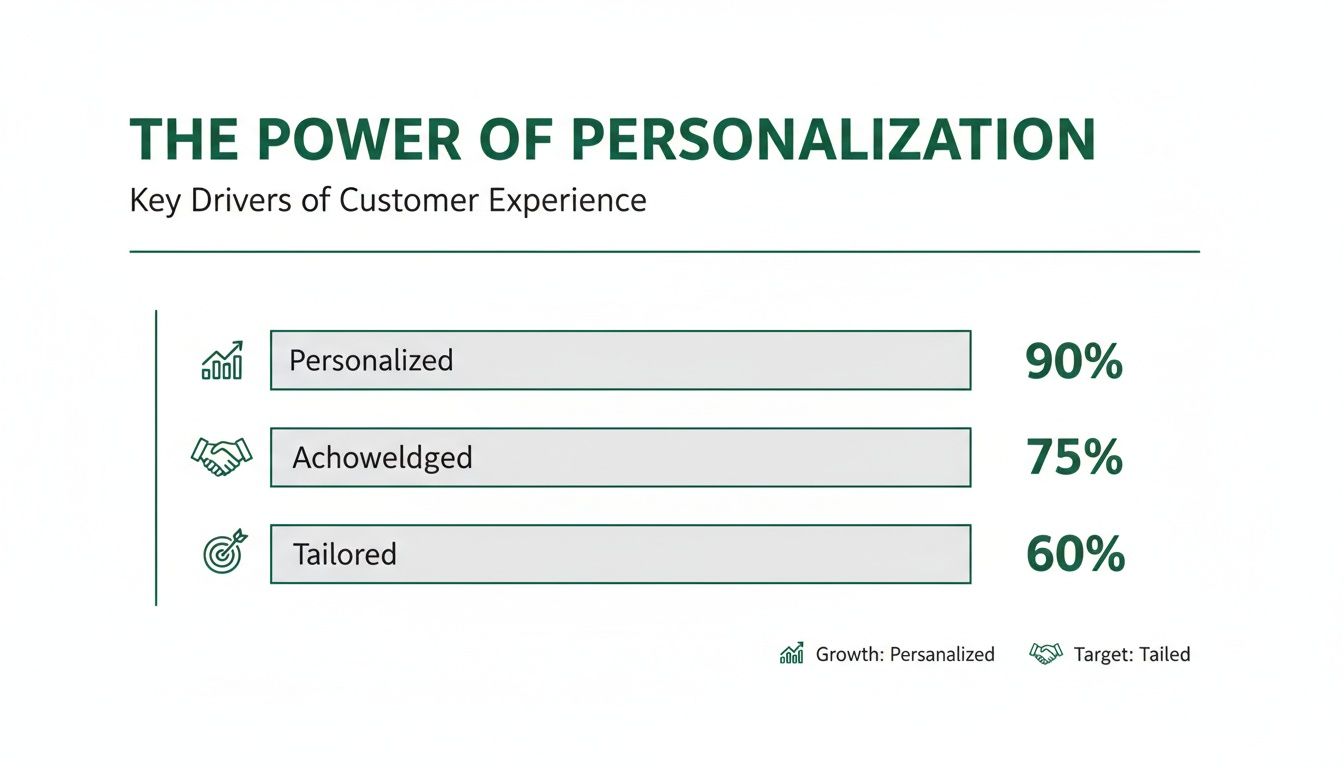
Personalization is the single most important factor. It reminds us to tailor not just the message, but also when and how it's delivered.
Choosing the Right Delivery Method
How you send your letter truly matters. Different generations and members of your congregation respond to different channels, so a blended approach almost always yields the best results.
Direct Mail In a digital world, a physical letter can feel more personal and substantial. It’s often the preferred method for older donors and is a powerful way to make your appeal stand out from the digital clutter.
- Pro: High impact and feels personal.
- Con: Higher cost and slower delivery.
Email Campaigns Email is fast, cost-effective, and makes giving incredibly easy with a simple click. It’s perfect for reaching a broad audience quickly, sending reminders, and sharing multimedia content like videos.
- Pro: Instant delivery and easy one-click giving.
- Con: Can get lost in a crowded inbox.
Your delivery strategy shouldn't be an either/or choice. The most effective campaigns create a multi-channel experience, where each touchpoint reinforces the others and makes giving as simple as possible.
Creating a Cohesive Multi-Channel Strategy
Imagine this scenario: a beautifully written letter arrives in a donor's mailbox, telling the story of your church's new community garden project. A few days later, they get an email with a short video showing volunteers planting the first seeds, which includes a prominent "Give Now" button.
That’s the power of a multi-channel approach. The physical letter plants the seed, and the digital follow-up provides a frictionless way to act. This synergy ensures your message is not only seen but also reinforced.
To learn more about getting this set up, explore our guide on the best online giving platforms for churches. By thoughtfully planning when and how you deliver your message, you honor the effort you put into writing the letter and, more importantly, you honor your donors by meeting them right where they are.
Demonstrating Stewardship After the Gift Arrives
The moment a donation arrives isn't the finish line—it's the start of the next, crucial part of your relationship with that giver. How you handle a gift after it’s been made tells your congregation more about your church's integrity than the most well-written request letter ever could.
This is where you build real, lasting trust. You're not just processing a transaction; you're honoring their generosity and God’s provision. When you get this right, you create a powerful cycle where donors feel so valued and confident in your financial management that they can't wait to give again.
Moving Beyond the Receipt with Heartfelt Thanks
A prompt thank-you is absolutely non-negotiable. While an automated email receipt is a great start for online gifts, it should never be the final word. A personal acknowledgment shows a donor they are seen and appreciated as an individual, not just a line item in a spreadsheet.
Part of building that trust involves proper documentation. Learning to create essential examples of payment receipts helps ensure your formal records are just as solid as your personal expressions of gratitude.
Think about implementing a few of these powerful acknowledgment strategies:
- Handwritten Notes: A short, handwritten note from the pastor or a board member for a significant or first-time gift can have a massive impact. It’s a simple gesture that says, "You matter."
- A Quick Phone Call: Imagine a donor’s surprise when a volunteer calls just to say "thank you." A five-minute call builds an incredible personal connection that an email never could.
- Personalized Emails: Go beyond the generic template. Mention the specific project they supported ("Thank you so much for your gift to the Youth Mission Fund!") to reinforce their specific impact.
The goal is to make your donors feel like the heroes they are. A generic receipt confirms a transaction, but a heartfelt thank-you celebrates a partnership in ministry.
This simple act is one of the most powerful things you can do for donor retention. In fact, acknowledging a gift promptly and personally makes donors four times more likely to give again.
Managing Restricted Donations with Integrity
One of the most critical areas of stewardship is handling restricted donations—gifts given for a specific purpose. When someone gives to the "Building Repair Fund" or the "Missions Fund," you have a legal and ethical obligation to use that money only for its designated purpose.
This is where so many churches get into hot water, especially when using generic accounting software like QuickBooks. Without a true fund accounting system, tracking restricted dollars becomes a manual, error-prone nightmare of spreadsheets and workarounds. It's dangerously easy for designated funds to get accidentally mixed in with the general fund and spent on everyday operating expenses.
This is precisely why a purpose-built church accounting solution is so essential. True fund accounting isn't just an add-on; it's the core structure that protects your church's integrity.
Proving Your Stewardship with Transparent Reporting
The final piece of the puzzle is closing the loop. You asked for money, they gave generously, you used it as promised—now it's time to report back and celebrate the win together.
This is where an accounting solution designed for churches, like Grain Ledger, becomes one of your ministry's greatest assets. Grain Ledger is built on a native fund architecture, which means every single donation is automatically tracked from the moment it arrives to the exact expense it covers. No more guesswork, no more manual spreadsheets.
With this level of clarity, you can easily generate reports showing:
- The total amount raised for a specific fund (like the Youth Mission Fund).
- How every single dollar was spent, with detailed expense line items.
- The remaining balance in that restricted fund.
Sharing these reports with your congregation, your board, and individual major donors is the ultimate act of transparency. It proves your financial integrity beyond a shadow of a doubt and celebrates the collective impact of their giving. When people see their generosity in action, they are inspired to continue being a part of your church's mission.
You can learn more about creating these vital documents by checking out our guide on essential church financial reports.
Got Questions About Your Donation Letters? We’ve Got Answers.
Even after you've mapped out the perfect donation letter, a few nagging questions always seem to pop up. I get it. Over the years, I've seen church leaders and finance teams wrestle with the same practical details.
Let’s clear up some of the most common hurdles right now. Think of this as a quick-reference guide to help you sidestep common mistakes and send your next appeal with total confidence.
How Long Should My Donation Letter Be?
Keep it to one page. That’s the golden rule.
For a physical letter, you’re aiming for something between 250 and 400 words. This gives you just enough room to share a heartfelt story and make a clear ask without burying your reader in text. Remember, people are busy.
Your letter needs to be scannable in less than a minute. The goal is to deliver that emotional punch and a clear call to action before their attention wanders.
If you’re running a big capital campaign with lots of moving parts, feel free to tuck a detailed brochure or an extra insert into the envelope. But the letter itself? That needs to stay personal, focused, and straight to the point. It's the primary driver, not the encyclopedia.
What are the Biggest Mistakes to Avoid?
I’ve seen a lot of donation letters over the years, and the ones that fall flat almost always make one of a few avoidable mistakes. Knowing what they are is half the battle.
Here are the most common tripwires I see:
- The ask is too vague. A plea for "general church support" just doesn't hit as hard as asking for funds to repair the leaking roof over the children's ministry wing. Get specific.
- The greeting is cold. "Dear Friend" is an instant turn-off. It feels like junk mail. Always, always use the donor's name.
- You don't suggest a donation amount. Don’t leave people guessing. Suggesting a few giving levels (e.g., $50, $100, $250) helps them picture their impact and makes it easier to say yes.
- Giving is a hassle. If someone has to click through five pages on your website or hunt for the donation link, you've already lost them. Make it ridiculously easy to give.
- The thank-you is an afterthought. This one is huge. Failing to send a prompt, personal thank-you note is one of the fastest ways to ensure you won't get a second gift.
Pro-Tip: Before you hit "print," have someone who isn't on the finance committee read the letter. A fresh set of eyes will immediately tell you if your message is clear and if the story truly connects.
How Do I Ask for Designated or Restricted Gifts?
When you’re asking for a restricted gift—money that must be used for a specific purpose—clarity and trust are everything. You have to draw a straight line from the donation to the outcome.
Don't just ask for a gift to the mission fund. Instead, try something like this: "Your gift of $100 to our Youth Mission Fund will directly purchase all the supplies for one of our teens on their service trip." See the difference? That language is specific, tangible, and shows the donor exactly how their money will be put to work.
Of course, this is where good stewardship becomes non-negotiable. If you're going to ask for restricted funds, you absolutely must have a system to manage them properly. This is a massive stumbling block for churches using generic accounting software, which often co-mingles funds and creates reporting nightmares.
A dedicated church accounting system is built for this. For example, a platform like Grain Ledger uses true fund accounting, which means every restricted dollar is firewalled from the moment it comes in. This architecture is what allows you to confidently report back to your donors and prove, without a doubt, that their gift was used exactly as they intended.
Ready to manage donations with integrity and clarity? Grain Ledger provides true fund accounting software built for churches, ensuring every restricted gift is tracked and reported accurately. Schedule a Demo to get started.
Ready to simplify your church finances?
Start free with church fund accounting, or watch a product demo first.