A Guide to Nonprofit Financial Management Software for Churches
Discover the essential nonprofit financial management software for churches. Learn fund accounting, must-have features, and how to choose the right solution.
It often feels like you're trying to force a square peg into a round hole when managing church finances with standard business software. You end up with confusing reports and rely on risky manual workarounds because those tools are built for profit, not faithful stewardship. For any church, a purpose-built nonprofit financial management software isn’t just a nice-to-have—it’s absolutely essential for maintaining financial clarity and integrity.
About Grain Ledger: This guide includes Grain Ledger, church fund accounting software built for designated gifts and ministry funds. It connects giving platforms (Planning Center, Pushpay, Tithely, Stripe), syncs bank activity with Plaid, and produces fund-level financial reports. Schedule a demo to see how it compares for your church.
See Grain Ledger for your church
Fund accounting, giving integrations, and bank reconciliation in one platform. Free migration support for churches switching from QuickBooks or Aplos.
Why Generic Accounting Software Fails Your Ministry
Churches don't run on profit and loss; they run on stewardship and purpose. Every dollar given has a specific job, whether it's keeping the lights on through the General Fund or supporting a missionary family from a designated fund. This is precisely where generic, for-profit accounting software fundamentally misses the mark.
Tools like QuickBooks are engineered to track income against expenses to calculate one thing: profitability. They were never designed to handle the unique world of fund-based accounting, where the main goal is to honor a donor's intent and ensure designated money is used only for its specific purpose.
The Stewardship Gap
When a church tries to make for-profit software work, the finance team is thrown into a constant battle. They end up creating complicated spreadsheets outside the system, using clumsy "classes" or "tags" to mimic fund tracking, and spending hours manually building reports that actually mean something in a ministry context. This isn't just inefficient; it's dangerous.
This "stewardship gap" opens the door to significant risks:
- Mismanaged Funds: Without built-in protections, it becomes frighteningly easy to accidentally use money from a restricted fund—like the Building Fund—on general operating expenses.
- Confusing Reports: A standard Profit & Loss statement is almost meaningless to a church board. Your leaders need to see the financial health of each individual fund, not just a single bottom line.
- Lack of Trust: When financial reports are unclear or a struggle to produce, it can erode the congregation's confidence in the leadership's ability to manage its resources faithfully.
"The core issue is that for-profit software answers the question, 'Are we making money?' while a church needs to answer, 'Are we honoring the purpose for which this money was given?' These are two entirely different financial languages."
In the end, trying to save money with generic software often costs the ministry dearly in lost time, a higher risk of errors, and a big hit to financial transparency. The unique financial structure of a church demands a solution built on the foundation of fund accounting from the ground up.
To dive deeper into the specific challenges ministries face, you can learn more about the common workarounds and limitations of using QuickBooks for churches in our detailed guide. A specialized nonprofit financial management software eliminates these struggles, providing the clarity and control needed to lead with confidence.
The Heart of Church Finance: True Fund Accounting
To really get why a church can't just use any old accounting software, you have to understand the bedrock principle it's all built on: true fund accounting. This isn't just a fancy report or a feature you can turn on. It's the entire DNA of how a church's money should be managed, ensuring every dollar is handled with integrity and honors the intent behind the gift.
Imagine all your church's money is in one big swimming pool. Knowing the total water level is useful, but it doesn't tell you the whole story. Fund accounting essentially builds separate, clearly labeled containers right inside that pool. One for missions, one for the building fund, one for youth camp. This separation is what stewardship is all about.
Unrestricted vs. Restricted Funds: Keeping Your Promises
The two most critical "containers" in your church's finances are unrestricted and restricted funds. If you get this distinction wrong, everything else gets messy.
Unrestricted Funds (The General Fund): Think of this as your "go-to" bucket. It's filled with general tithes and offerings that people give to support the overall mission. This is the money you use for the essentials—keeping the lights on, paying staff salaries, and buying curriculum. It’s flexible and meant for day-to-day ministry operations.
Restricted Funds (Designated Giving): These are the special-purpose buckets, and they come with a promise. When someone gives specifically to the "Building Fund" or a "Missions Trip," that money is ethically and legally locked in. You simply cannot use it for anything else.
This is where generic, off-the-shelf software so often misses the mark. It's like trying to fit a square peg into a round hole.
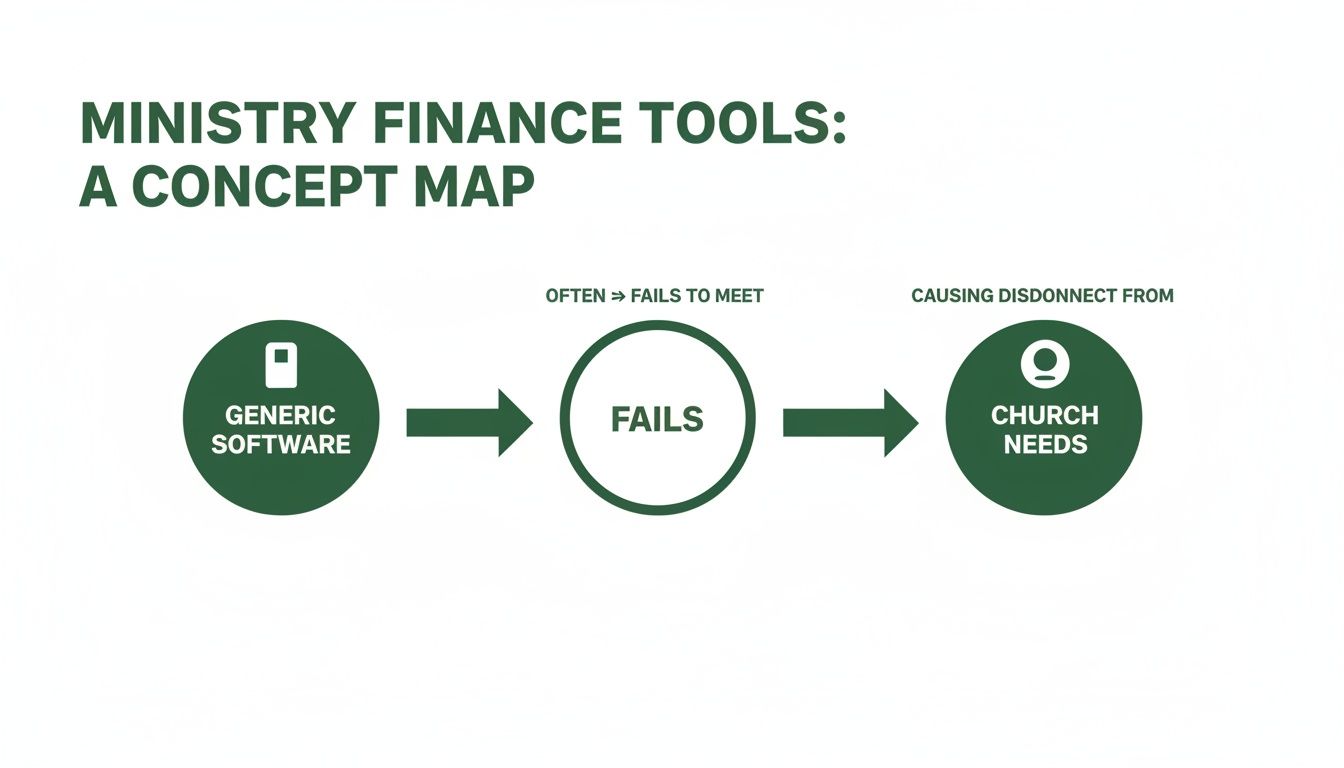
As the visual shows, forcing a one-size-fits-all tool to handle the specialized needs of fund accounting just creates friction, manual workarounds, and ultimately, a system that doesn't work.
Why "Workarounds" Just Don't Work
Standard business accounting software can't really handle this. Sure, you might be able to slap a "tag" on a transaction for the building fund, but in the system's eyes, that money is still just dumped into one big pot. This creates a huge risk of accidentally spending restricted money on general expenses, which is a sure-fire way to erode trust with your congregation.
True fund accounting isn't a workaround; it's a native structure. Every single transaction is hardwired to a specific fund from the moment it's recorded, giving you a perpetually accurate financial snapshot of every single ministry.
This is precisely where a purpose-built system changes the game. For instance, a platform like Grain Ledger is designed from the ground up with a native fund architecture. It doesn’t just tag funds as an afterthought; it builds the entire accounting system around them.
When a donation for missions comes in, it goes directly into the Missions Fund bucket. When you pay for plane tickets from that fund, the balance is updated instantly. No more wrestling with complicated spreadsheets to figure out if you can afford to support a missionary partner. The answer is always right there, in real-time.
This built-in structure eliminates the headaches and the risks that come with trying to adapt generic software. It builds an unshakable foundation of financial trust. To dive deeper into how this works in practice, check out our guide on fund accounting for churches. This approach gives ministry leaders the clarity and confidence they need to make decisions that truly advance the mission.
Must-Have Features In Modern Church Financial Software
When a church switches to purpose-built financial software, it’s more than an upgrade—it’s a whole new way to manage funds with precision. You’ll trade manual workarounds for real-time insights that support every ministry decision. In practice, the right tool can cut data-entry errors dramatically and keep your focus on mission, not math.
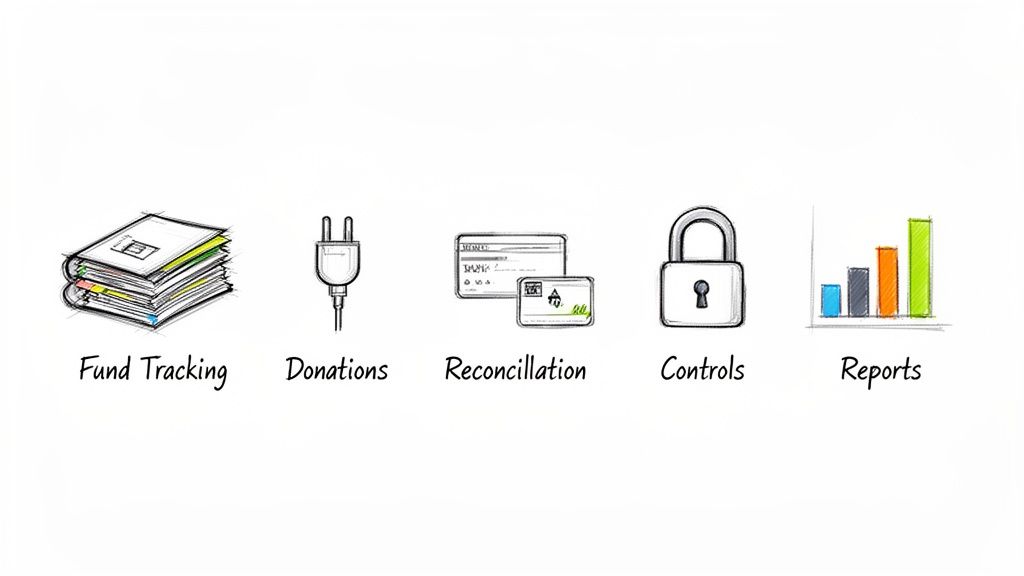
Native Fund Tracking
True fund accounting lives at the heart of church finance software. Unlike generic systems that tack on “tags” or “classes,” this feature builds every transaction around a dedicated fund from day one. You get real-time balances for each ministry account without complicated workarounds.
Seamless Donation Platform Integrations
Your congregation gives in a dozen different ways—online, text, mobile kiosks. Manually transferring each gift is a recipe for mistakes. Look for direct hooks into your favorite tools:
- Planning Center Giving: Gifts automatically map to the right fund.
- Pushpay: Tithes and offerings flow straight into your general ledger.
- Stripe: Handles event fees or product sales alongside regular donations.
These connections swap out hours of data entry for an automated pipeline, so your team can focus on ministry.
Built-In Controls For Restricted Funds
Honoring donors’ wishes is non-negotiable. Good church software enforces fund restrictions at the transaction level. That means you can’t accidentally pay the electric bill from the “Building Fund” or charge camp supplies to the “Youth Missions Fund.” These digital guardrails build accountability and trust.
“Integrity in church finances isn’t just good intentions—it’s systems that help you get it right every time.”
Automatic Bank Reconciliation
Matching your bank statement to your ledger can be tedious. Modern solutions connect directly with your accounts, importing transactions in minutes. The system then suggests matches and flags any mismatches, slashing reconciliation time to a fraction of a manual process.
Customizable Reporting For Ministry Leaders
A generic profit-and-loss statement rarely tells your board what they need to know. Instead, look for reports that speak ministry language:
- Statement of Activities by Fund: Tracks the Missions Fund balance and spending this quarter.
- Budget vs. Actual by Ministry: Shows whether youth outreach is under or over budget.
- Statement of Financial Position: Presents unrestricted and restricted net assets at a glance.
With 72% of organizations juggling multiple reporting standards, having built-in templates can reduce discrepancies by 44%. To see how these trends affect tool development, check out this report on nonprofit software development and adoption.
Standard Vs. Church-Specific Accounting Software Features
Below is a snapshot comparing generic small-business accounting tools against purpose-built church financial management software. It highlights why churches often outgrow off-the-shelf packages.
| Feature | Generic Accounting Software (e.g., QuickBooks) | Church Financial Software (e.g., Grain Ledger) |
|---|---|---|
| Fund Tracking | Uses tags or classes on a pooled account | True fund structure with separate ledgers for each ministry |
| Donation Integrations | Requires manual import or CSV uploads | Direct syncing with Giving platforms like Planning Center, Pushpay, Stripe |
| Restricted Fund Controls | Relies on manual checks or user discipline | Enforced rules prevent unauthorized spending |
| Bank Reconciliation | Manual match or semi-automated imports | Automatic bank feeds with intelligent transaction matching |
| Customizable Ministry Reporting | Standard P&L and balance sheet templates | Tailored reports by fund, ministry, budget vs. actual, and net asset breakdown |
Seeing these features side by side makes it clear why churches choose specialized solutions. When your financial software speaks ministry, it frees your team to steward resources more faithfully—and focus on what really matters.
How to Choose the Right Software for Your Church
Picking the right nonprofit financial management software is a huge decision. It directly impacts your church's stewardship, how transparent you can be, and how smoothly everything runs behind the scenes. Moving away from generic, one-size-fits-all tools requires you to really think through your ministry's specific needs. This isn't just about buying a product; it’s about finding a financial partner that truly gets the unique world of church finance.
The whole process kicks off with a frank look at where you are right now. How many restricted funds are you juggling? How complex are the reports your board asks for? How much time does your team sink into manual data entry every single week? Getting a clear picture of these frustrations will steer you toward a solution that actually solves your problems instead of just creating new ones.
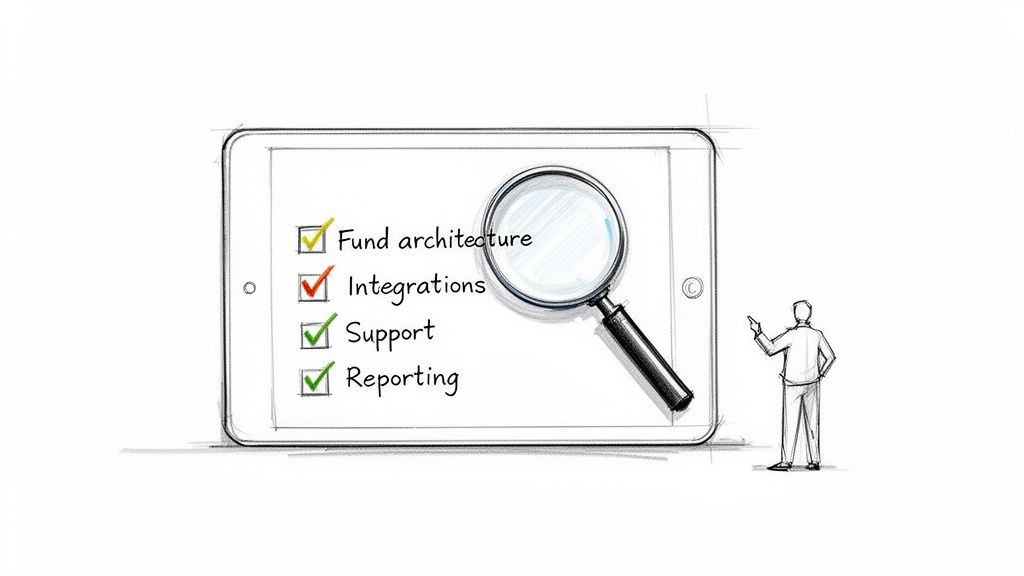
Key Evaluation Questions for Vendors
When you start talking to software companies, walk in with a list of questions ready to go. This is the best way to make sure you're comparing apples to apples and focusing on what truly matters for church stewardship. Don't be shy about digging into the nitty-gritty of how their system performs in a real ministry setting.
Here are a few essential questions to have in your back pocket:
- Fund Architecture: Is your fund accounting a native, core feature, or is it a "workaround" that just uses tags or classes? Can you show me exactly how the software stops someone from accidentally spending money from a restricted fund on a general operating expense?
- Donation Integration: How does your system talk to our online giving platform, like Pushpay or Planning Center? Is it a true, automatic sync, or are we going to be stuck manually importing files?
- Reporting Capabilities: How easy is it to generate a Statement of Activities broken down by fund? Can we pull a Budget vs. Actuals report for just the youth ministry? How much can we customize these reports for our board meetings?
- Support and Onboarding: What kind of support do you offer for church volunteers who might not be accounting experts? Is training included in the price, and what’s your average response time when we submit a support ticket?
These questions cut through the marketing fluff and get to the heart of what makes financial software genuinely effective for a church.
Why Simplicity and Focus Matter
There’s a clear trend happening in the nonprofit accounting software market. As compliance rules get tighter, more organizations are ditching generic tools for ones built specifically for them. The market was valued at USD 373.75 million in 2026 and is expected to hit USD 908.75 million by 2035, growing at a CAGR of 10.5%. This isn't just a random spike; it shows a real demand for systems that can handle things like restricted funds correctly. You can learn more about this expanding market for nonprofit tools.
For most small to mid-sized churches, the best solution isn't the one with the most features. It's the one with the right features, presented in a way that makes sense. A system that's too complicated can be just as bad as one that's too basic, creating a massive learning curve for volunteer treasurers and busy staff. The goal is to find a tool that delivers powerful fund accounting without all the confusing clutter.
A purpose-built system should feel like it was designed by someone who has actually managed church finances. It anticipates your needs for fund-level clarity and provides direct answers, not more work.
This is exactly where a solution like Grain Ledger shines. It was created specifically for churches that need real, native fund accounting but don’t want the overwhelming complexity of enterprise-level software. It focuses on doing the core job of church finance—honoring donor intent and providing clear, straightforward reporting—and it does it incredibly well. By putting a clean interface and direct integrations first, it gives church leaders the confidence to make mission-focused decisions, whether they’re a full-time administrator or a dedicated volunteer.
A Practical Plan for a Smooth Switch
Moving to a new church finance software doesn't have to be a headache. With a solid game plan, your church can confidently transition from clunky old systems to a solution that’s actually built for ministry. The key is to break it down into simple, manageable steps.
First things first: preparation. Before you even think about migrating data, you need to clean up your current financial records. This is the perfect time to make sure your Chart of Accounts is organized and truly reflects how your ministry operates. A clean start here is the bedrock for accurate reporting down the road. For a deeper dive, check out our guide on building an effective chart of accounts for a nonprofit.
Phased Rollout and Team Training
For most churches, a phased rollout is the smartest way to go. Instead of trying to flip a switch overnight, you introduce the new system in stages. This approach keeps daily operations running smoothly and gives your team time to get comfortable.
Data Migration: The first step is getting your historical financial data into the new software. Most modern platforms have tools or offer support to help with this, but it's on you to double-check that everything came over accurately before you proceed.
System Integration: Next up, connect the software to your other essential tools. This means linking to your online giving platform—whether that’s Pushpay or Planning Center—and setting up your bank feeds to pull in transactions automatically. This is where you’ll start saving massive amounts of time on manual entry.
Team Training: Get your staff and key volunteers trained up. Don’t just throw them in the deep end; tailor the training to their specific roles. The treasurer needs to know how to run board reports, while the administrative assistant needs to know how to enter donations.
This step-by-step process builds confidence and makes sure everyone is ready before the system is fully live.
Building Habits for Long-Term Success
The right software is only half the battle. Its real power comes to life when you pair it with consistent financial habits. This is how you turn a record-keeping tool into a true engine for stewardship and smart decision-making.
The goal here isn't just to install new software. It’s to build a lasting foundation of financial health and transparency that deepens your congregation's trust.
To make that foundation solid, focus on creating routines that keep everyone accountable.
Perform Regular Fund Reconciliations: Don't let this wait for a quarterly meeting. Make it a weekly habit to reconcile bank transactions with your ledger. You'll catch errors early and always have a clear, real-time picture of your finances.
Generate Clear Monthly Reports: Put together a standard monthly financial packet for your leadership team. It should always include a Statement of Financial Position, a Statement of Activities broken down by fund, and a Budget vs. Actuals report for your main ministries.
Establish Strong Internal Controls: Use the software's built-in security features to create checks and balances. Set user permissions so that the person entering bills isn’t the same person approving payments. This simple step is crucial for financial integrity.
The move to modern financial tools is happening everywhere. Cloud-based software is taking over, projected to command 61.72% of the market by 2025 and growing at an impressive 11.32% CAGR through 2031. As detailed in a recent non-profit software market analysis on Mordor Intelligence, churches are embracing more accessible and powerful systems. By matching a great system with disciplined processes, your church can build a future defined by financial clarity and unwavering trust.
Where Do You Go From Here? A Path to Financial Clarity and Trust
If you're trying to manage your church’s finances with generic business software, you know the struggle. It feels like forcing a square peg into a round hole. You're constantly creating manual workarounds and wrestling with confusing reports, pulling your focus away from genuine stewardship and deep into the weeds of spreadsheets.
Making the move to a purpose-built nonprofit financial management software is more than just getting a new tool. It’s about finally adopting a system that speaks the language of ministry.
True fund accounting is the foundation of transparent stewardship. It's really the only way to make sure every dollar given for a specific purpose—whether for the youth group, a missions trip, or a new building—is honored and accounted for properly. That kind of financial integrity builds an incredible bond of trust with your congregation and gives your leadership team the confidence to make mission-focused decisions.
Taking Steps Toward Lasting Integrity
The journey to financial clarity starts when you see the right system as a ministry asset, not just another line item in the budget. When your software is actually designed for the unique world of church finance, you stop just tracking numbers and start truly stewarding resources. This shift frees your team from administrative headaches and gives them the real-time insights needed for wise leadership.
You suddenly have the power to answer critical questions on the spot:
- How much do we have left in the Missions Fund?
- Are we on track with the annual budget for our outreach programs?
- Can we show donors exactly how their restricted gifts were used?
"When financial reports are clear and fund balances are accurate, stewardship ceases to be a point of stress and becomes a source of confidence for the entire church."
This level of clarity isn't a far-off dream. It's the direct result of using a tool built specifically for your mission.
The most logical next step is to explore a solution built from the ground up for churches like yours. We created Grain Ledger to deliver true, native fund accounting without the overwhelming complexity of big enterprise systems. It provides the essential framework for honoring donor intent and achieving lasting financial health.
If your church is ready to build a stronger foundation of financial trust and clarity, the path forward is clear. We invite you to see how Grain Ledger can serve your ministry. Schedule a Demo today and be among the first to experience accounting software that truly understands church finance.
Related church accounting software resources
If you are comparing software, these pages map the main decision points: fund accounting, QuickBooks limits, pricing, and migration.
- Best church accounting software (2026 comparison) - canonical guide comparing 12 church accounting platforms
- Church accounting software product page - see Grain Ledger for fund accounting, giving, and bank reconciliation
- Small church accounting software - see the product page built for volunteer treasurers and church admins
- Fund accounting features - review how Grain Ledger tracks designated funds
- QuickBooks for churches - understand workarounds and when to switch
- Free church accounting software - compare free options and upgrade triggers
- Grain Ledger pricing - compare plans for small and growing churches
- Start free - try fund accounting, giving imports, and bank reconciliation together
Common Questions from Church Finance Teams
Jumping into a new financial system for your church naturally brings up some questions. We've been there. Here are straightforward answers to some of the most common things we hear from ministry leaders and finance volunteers.
We’re Already Using QuickBooks. Isn’t That Good Enough?
That’s a great question, and one we hear a lot. While QuickBooks is a fantastic tool for small businesses, it wasn't built for the unique world of church finance. It operates on a for-profit accounting model, which means it doesn't have a true fund accounting system built in.
To track designated gifts—like money for the building fund or a missions trip—you're forced to create complicated workarounds using "classes" or "tags." This often leads to messy reports and a real risk of misallocating funds. A purpose-built system avoids these headaches and ensures you can honor every donation's intent with clarity and confidence. When considering an alternative, a solution like Grain Ledger is designed specifically for churches to solve these exact problems.
So, What Is the Best Accounting Software for a Church?
The "best" software will always be one that has true fund accounting at its core. You need a system that understands the difference between your general budget and a restricted gift. For churches, we always recommend a purpose-built solution like Grain Ledger. It was designed from the ground up to help ministries manage designated funds correctly, streamline their bookkeeping, and create reports that actually make sense for board meetings and ministry planning.
How Big of a Headache Is Switching to a New System?
Migrating to a new system is a significant project, but it absolutely doesn't have to be a nightmare. When you break it down, the process is pretty straightforward.
It usually involves three main steps:
- Getting Your Data Ready: This means cleaning up your current books and preparing them to be moved over.
- Connecting Your Accounts: You'll link the new software to your church's bank accounts and online giving platform to pull in transactions automatically.
- Training Your People: The final piece is just getting your staff and volunteers comfortable with the new tools.
Think of it this way: the initial effort to switch pays you back tenfold. A smooth transition saves countless hours down the road, cuts down on frustrating errors, and gives your leadership team the financial clarity they need to make wise decisions.
What Should We Expect to Budget for New Software?
Pricing is all over the map, and it really depends on the provider. Some vendors charge per user, while others offer plans based on your church's annual budget or the features you need.
It's crucial to look at the whole picture, not just the monthly fee. Consider the total value—how much time will you save on manual data entry? How much risk are you eliminating by having accurate reports? What level of support will you get when you have a question? Always ask for a complete breakdown of any and all costs before you commit.
Ready to build a stronger foundation of financial trust and clarity in your ministry? Grain Ledger offers true, native fund accounting designed for churches, giving you the tools to steward every dollar with complete integrity.
Schedule a Demo today and discover a simpler, more powerful way to manage your church’s finances.
Ready to simplify your church finances?
Start free with church fund accounting, or watch a product demo first.