
Church Reserve Fund: Policy and Cash Reserve Guide
Learn how much cash a church should keep in reserve, when to use surplus cash, and how to set a reserve fund policy for stable ministry finances.
For any church leader, watching the weekly offering plate can feel like riding a rollercoaster. One Sunday, giving is strong and confident. The next, it dips, and you're left staring at the budget, wondering how you'll cover payroll or that surprise HVAC repair.
About Grain Ledger: This guide includes Grain Ledger, church fund accounting software built for designated gifts and ministry funds. It connects giving platforms (Planning Center, Pushpay, Tithely, Stripe), syncs bank activity with Plaid, and produces fund-level financial reports. Schedule a demo to see how it compares for your church.
See Grain Ledger for your church
Fund accounting, giving integrations, and bank reconciliation in one platform. Free migration support for churches switching from QuickBooks or Aplos.
This is exactly why building a church reserve and reserve fund isn't a sign of weak faith—it's an act of profound, forward-thinking stewardship.
Building Financial Resilience for Your Ministry
Think of a reserve fund as a financial shock absorber for your ministry. It’s the dedicated pool of money that keeps your mission moving forward when the unexpected inevitably happens, smoothing out the bumps in the road so you can focus on what truly matters.
The Foundation of Financial Stability
A healthy reserve is the bedrock of your church's financial health. It provides the stability you need to navigate the natural ebbs and flows of congregational giving, ensuring that core ministry operations never have to slow down. With this financial cushion, your leadership team can make decisions from a place of strength and vision, not stress and desperation. This is where solid cash flow management strategies become so critical—they are the discipline that helps you build this vital cash buffer.
A well-managed reserve transforms financial management from a reactive, crisis-driven scramble into a proactive strategy for sustainable ministry. It frees up leadership to focus less on surviving and more on thriving.
More Than Just a Rainy-Day Fund
While covering emergencies is a huge part of its job, a reserve fund does so much more to strengthen your church’s overall health and kingdom impact. These funds give you the ability to:
- Ensure Operational Continuity: A reserve helps you easily handle those predictable seasonal slumps, like the summer giving dip, ensuring staff salaries, utility bills, and ministry expenses are always paid on time. You can learn more about how reserves support your financial plans by exploring our guide to creating a church operating budget.
- Seize Ministry Opportunities: What happens when a sudden opportunity lands in your lap—like a chance to buy new equipment for the youth room or launch a timely outreach program? A reserve means you can act decisively without having to launch a frantic, last-minute fundraising appeal.
- Strengthen Congregational Trust: When your congregation sees that you are responsibly and transparently managing their tithes and offerings for both the present and the future, it builds incredible confidence. That confidence, in turn, encourages even more consistent and joyful generosity.
By creating this financial foundation, you’re not just saving money. You are actively protecting your ministry’s ability to serve its people and its community, no matter what financial challenges come your way.
Understanding The Core Types Of Church Reserves
It helps to think about your church’s savings like you would your own family’s finances. You don't just have one giant savings account for everything, right? You probably have an emergency fund for unexpected car trouble, a separate account for a future vacation, and another for long-term retirement.
A church's financial reserves work the same way. Lumping all your savings into one pot is a recipe for confusion. The key to great stewardship is to separate your reserve and reserve fund into different categories based on their specific jobs. This brings tremendous clarity and holds leadership accountable.
This simple flowchart shows how it all connects. It starts with stewardship—a core principle—which builds the financial resilience needed to create a healthy reserve fund. That fund, in turn, becomes the bedrock of your ministry's long-term stability.
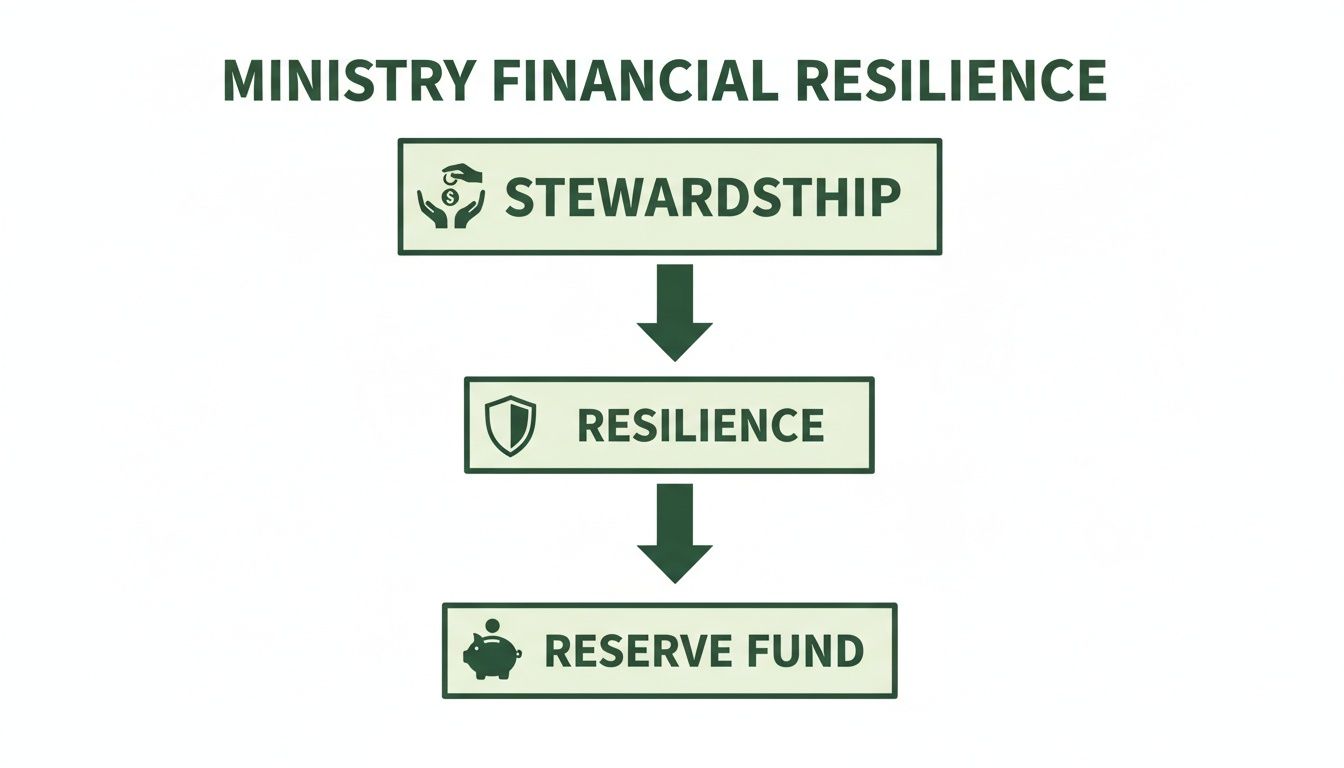
As you can see, a reserve fund isn't just a number on a balance sheet. It's the direct result of putting the spiritual principle of stewardship into practice, leading straight to a ministry that can weather any storm.
Let’s break down the four types of reserves every church leader should know inside and out.
Operating Reserves
Think of your operating reserve as the church's main financial safety net. Its entire purpose is to keep day-to-day ministry running smoothly when cash flow gets tight. This is the money you tap into during the predictable summer giving slump or when a massive, unexpected heating bill shows up.
This fund is built from general, undesignated offerings and needs to be easy to access. A good rule of thumb is to keep 3 to 6 months of your regular operating expenses in this reserve.
Capital Reserves
While the operating reserve handles the daily grind, the capital reserve is for the big stuff. This is money specifically set aside for major repairs, replacements, and upgrades to your church’s physical assets—the building, the parking lot, the sound system.
Funding a capital reserve is a marathon, not a sprint. It’s built up slowly over years to handle those predictable, but very expensive, projects down the road, like:
- Replacing a 20-year-old HVAC system.
- Resurfacing the cracking parking lot.
- Putting on a new roof after a hailstorm.
Having this fund ready turns a potential crisis into a planned, manageable expense, saving you from a last-minute, panic-driven fundraising campaign.
Designated Reserves
Sometimes your leadership team or church board decides to put money aside for a specific future ministry goal. That’s a designated reserve, often called a board-designated fund. The crucial difference here is that the "designation" or rule for its use is set internally by your own leadership, not by an outside donor.
For instance, the board might "designate" $15,000 toward a new van for the youth group or $5,000 for a soundboard upgrade. Because the board made the decision, it also has the power to un-designate those funds if ministry priorities shift. It offers a great balance of intentional planning and flexibility.
A designated reserve is a powerful tool that signals your leadership's strategic priorities. It helps you plan for the future and communicate those goals to the congregation, all without the legal strings of a restricted fund.
Restricted Funds
Of all the savings categories, a restricted fund is the most legally serious. These funds are created when a donor gives money with a specific, legally binding instruction on how it must be spent. Honoring that donor’s intent is both an ethical and a legal obligation.
These restrictions might be temporary (like a gift "for the 2024 mission trip to Guatemala") or permanent (like an endowment where only the investment income can be spent). Unlike designated funds, the board has zero authority to repurpose restricted money for other needs, no matter how urgent they seem. To get a better handle on this, you can learn more about the nuances of a restricted fund in our guide.
Juggling these different pots of money is where many churches get into trouble. It's why using a true fund accounting system is so important. A platform like Grain Ledger is built to handle this, with a native fund architecture that automatically keeps restricted and designated money separate from your general operating cash, preventing costly mistakes.
Comparing Key Types Of Church Reserve Funds
To make these distinctions even clearer, this table breaks down the four types of reserves side-by-side. It's a handy cheat sheet for understanding the purpose, source, and flexibility of each.
| Reserve Type | Primary Purpose | Source of Funds | Flexibility Level |
|---|---|---|---|
| Operating Reserve | Covering short-term cash flow gaps and unexpected daily expenses. | General tithes and offerings from the operating budget. | High - Can be used for any legitimate operating expense. |
| Capital Reserve | Funding major repairs, replacements, or improvements to physical assets. | Designated giving campaigns or budget allocations over time. | Moderate - Earmarked for capital projects but board can adjust plans. |
| Designated Reserve | Saving for specific future projects or goals set by the board. | Internally set aside from general funds by board decision. | Moderate - The board can change the designation if needed. |
| Restricted Fund | Fulfilling a donor's specific, legally-binding instructions for use. | Donations from individuals or groups for a specified purpose. | None - Funds are legally bound and cannot be re-purposed. |
Seeing them laid out like this really highlights why you can't treat all savings the same. Each fund plays a unique role in your church's financial health and requires its own approach to management and oversight.
How a Strong Reserve Fund Multiplies Your Ministry
It’s easy to think of a reserve fund as purely defensive—a financial shield you only pull out for emergencies. But that’s a common mistake that sells the concept short. In reality, a healthy reserve and reserve fund is one of the most powerful offensive tools your church has for proactive, confident ministry. It’s what shifts your financial posture from reactive to strategic, allowing you to multiply your impact far beyond just surviving a crisis.
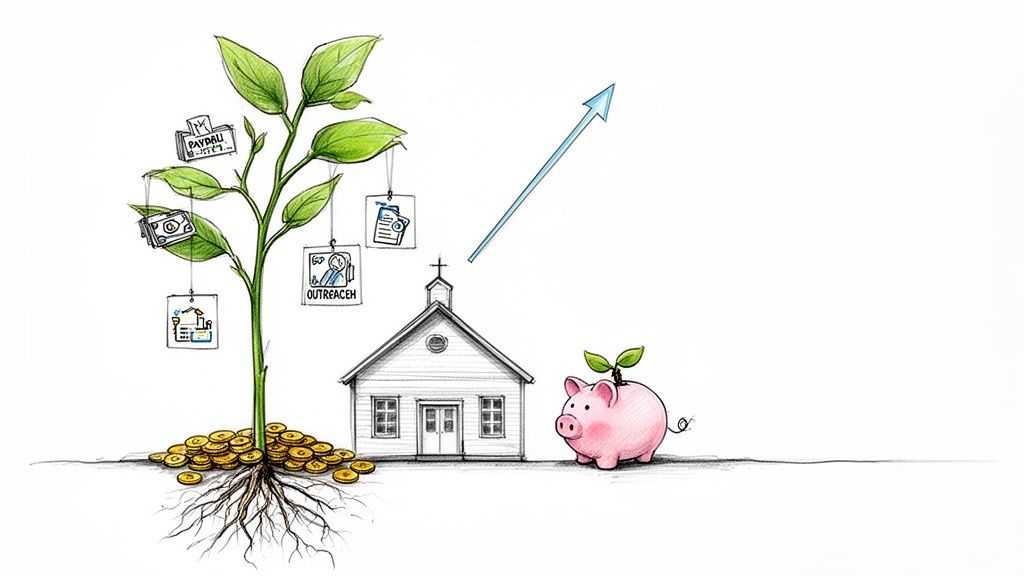
This shift in mindset is about moving from a place of scarcity to one of abundance and readiness. When your financial foundation is solid, your leadership team is finally free to dream, plan, and act on the mission God has given you, instead of constantly being bogged down by financial stress.
Ensure Stability and Empower Your Team
The most immediate benefit of a strong reserve is simple: operational stability. Just knowing you can consistently make payroll, even during the lean summer months or a wider economic downturn, is a huge deal. It provides a real sense of security for your staff and their families, fostering a healthier environment where they can focus on their ministry roles without anxiety.
That stability sends a powerful message. It shows everyone that the church is a reliable, well-managed organization that truly values its people. In turn, this helps you attract and keep the talented staff who are so vital to a thriving ministry.
Seize Unexpected Ministry Opportunities
Picture this: a local community center suddenly becomes available for your youth outreach at a steep discount, but the offer is only good for one week. Or maybe a neighboring church is selling a gently used van that would be perfect for your senior ministry. Without a reserve, these are missed opportunities that would require a slow, last-minute fundraising appeal.
A healthy reserve fund gives your ministry the agility to say "yes" when God opens a door. It empowers you to act decisively on mission-critical opportunities without hesitation or delay.
This ability to act swiftly allows your church to be nimble and responsive to the real-time needs of your community, turning unexpected moments into powerful avenues for ministry growth.
Build Trust and Credibility
Financial stability is a cornerstone of trust, both inside and outside the church walls. For your congregation, seeing a well-managed reserve is tangible proof of responsible stewardship. It shows them their tithes and offerings are being handled with wisdom and foresight, which builds confidence and encourages continued generosity.
This credibility extends to your external relationships, too. If your church ever needs a loan for a major capital project, you can be sure lenders will look closely at your financial health. A robust reserve fund is one of the clearest indicators of financial discipline, making your church a much more attractive and low-risk borrower.
Recent data shows that churches are taking this more seriously. For instance, Baptist churches have significantly improved their financial footing; the percentage with less than 16 weeks of cash reserves dropped from 50% in 2016 to 44% more recently. This is a critical trend, especially since 81% of church revenue comes from individual donations, making reserves absolutely essential for weathering any dip in giving. You can read more about these encouraging trends in church financial management.
Reduce Leadership Stress and Sharpen Focus
Finally, one of the most underrated benefits of a reserve fund is the peace of mind it gives church leadership. The weight of financial uncertainty can be a massive source of stress for pastors, elders, and finance committees, distracting them from their primary spiritual and shepherding duties.
By creating a financial buffer, you lighten that burden significantly. A strong reserve fund allows leaders to lift their heads from the spreadsheet and focus on vision, discipleship, and community care. It's not just about managing money—it's about creating the margin necessary to lead effectively and pursue your ministry's true purpose with clarity and passion.
Creating Your Church Reserve Fund Policy
Trying to build a reserve and reserve fund without a formal, written policy is like starting a construction project without a blueprint. You might have the best intentions, but when the pressure is on, you’ll end up with confusion, inconsistent decisions, and a real lack of accountability. A written reserve fund policy is the governing document that turns your financial goals from a good idea into a clear, actionable strategy.
Think of this policy as your church's official guide for managing its savings. It ensures every decision—from how money goes in to how it comes out—is handled with transparency and integrity. For your finance committee, it’s a roadmap that removes the guesswork and protects them from having to make tough calls in a vacuum.
The Essential Components of a Strong Policy
Don't let the idea of creating a policy feel overwhelming. A strong, effective document really just boils down to a few core components that answer the key questions: "why," "how much," "how," and "when."
Your policy should be a living document, something you pull out and review annually, but its foundation should be solid. It’s basically the constitution for your church's financial stability.
Here are the non-negotiable elements every church reserve fund policy should have:
Statement of Purpose: Start by clearly stating why the reserve fund exists. Is it there to keep the lights on during a few lean giving months? Is it for that surprise HVAC failure? Or both? A concise purpose statement sets the stage for everything else.
Defined Reserve Target: Get specific about your goal. The most common best practice is to aim for a reserve equal to three to six months of your average operating expenses. Whatever your church decides, state the target plainly in the policy.
Funding Guidelines: How are you actually going to grow this fund? Your policy needs to spell it out. Maybe it's a dedicated line item in the annual budget, or perhaps you'll allocate a percentage of any year-end surplus. Be specific about the mechanics.
Conditions for Use: This is probably the most critical part. Define the exact circumstances that allow for a withdrawal. For example, you might specify "a significant, unbudgeted drop in offerings for two consecutive months" or "an emergency facility repair exceeding $5,000."
Establishing a Clear Authorization Process
A policy is only as good as the process that backs it up. Your document must clearly define the chain of command for touching the reserve fund. This creates a vital system of checks and balances.
A typical authorization process might look something like this:
- Step 1: The need for a withdrawal is identified by the pastor or a key ministry leader.
- Step 2: They submit a formal request to the finance committee for review.
- Step 3: The finance committee votes on whether to recommend the withdrawal to the full church board or elder council.
- Step 4: The board gives the final green light to release the funds.
Having a multi-step approval process is your best defense against impulsive decisions. It ensures that using the reserve is always a deliberate, well-considered action, protecting both the fund and your leadership team.
The power of a long-term, disciplined reserve policy can't be overstated. Take The Church of Jesus Christ of Latter-day Saints, for instance. They maintain a massive reserve portfolio designed as a 'rainy-day' fund capable of covering all their anticipated costs for the next 30 years. It's fueled by disciplined savings and shows a profound commitment to self-reliance and long-term ministry. While the scale is obviously different, the underlying principle of planning for perpetual ministry is a powerful lesson for any church. You can discover more about this model of long-term financial planning.
By putting these simple but crucial elements in writing, you create a policy that builds trust, ensures consistency, and provides the clear governance your congregation deserves.
How Fund Accounting Simplifies Reserve Management
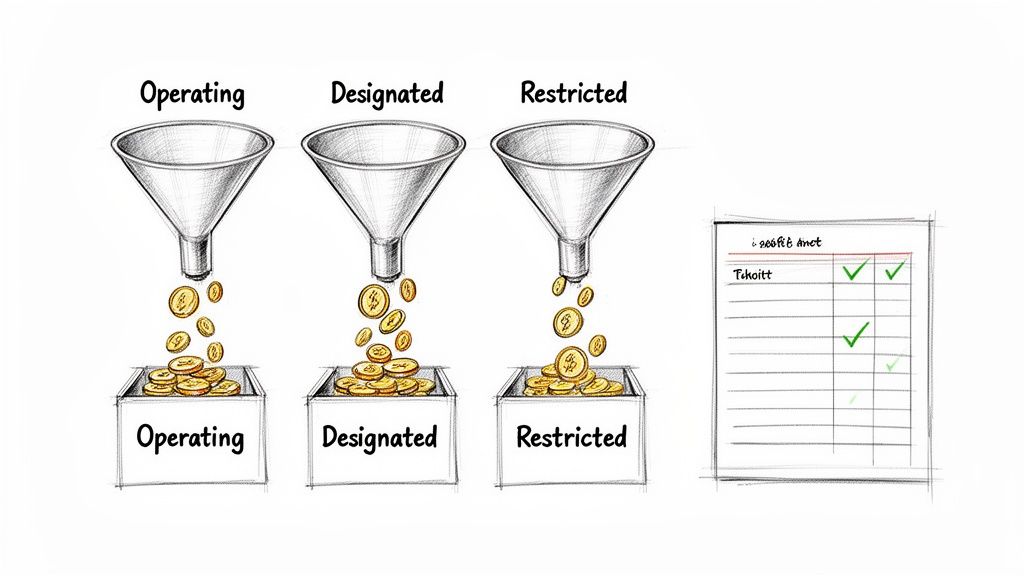
Ever tried sorting different colored grains of sand with a shovel? That’s what it feels like to manage a church’s finances—with its operating reserve, capital reserve, and multiple restricted funds—using standard business software. It’s messy, wildly inefficient, and you're almost guaranteed to mix everything up.
This is exactly why generic accounting tools so often fail churches. They just aren't built to handle the unique financial DNA of a ministry.
When every dollar is lumped together in one big pot, the risk of commingling funds skyrockets. Suddenly, a donor’s restricted gift for a new sound system could be accidentally spent on the monthly utility bill. That's not just a bookkeeping error; it's a serious breach of stewardship and trust. Effective reserve management demands a completely different foundation.
The Power of True Fund Accounting
The solution is an accounting method designed from the ground up for nonprofits and churches: true fund accounting. Instead of a single financial bucket, this approach creates separate, self-balancing sets of books for each fund—operating, designated, capital, and so on.
This structure acts like a digital firewall between each reserve and reserve fund, making it practically impossible to spend money from the wrong account.
It’s a fundamentally different way of thinking compared to the clumsy workarounds needed in standard accounting software. While the right small business accounting software can certainly help with basic finances, churches need a purpose-built system for real clarity and accountability.
Native Fund Architecture Makes the Difference
This is where a purpose-built tool like Grain Ledger changes everything. Grain Ledger is built on a native fund architecture, which means the entire system was designed around the concept of funds from its very core. It's not a feature tacked on as an afterthought; it is the system.
With native fund architecture, every transaction, every donation, and every report is automatically tied to its correct fund. This eliminates manual workarounds, slashes the risk of human error, and gives you an always-accurate picture of your church's financial position.
When a donation comes in for the "Youth Mission Trip" restricted fund, Grain Ledger instantly routes it to that specific digital bucket. Those funds are now protected, ensuring they can only be used for their intended purpose. This brings complete integrity to every reserve and reserve fund you manage.
Automated Workflows and Crystal-Clear Reporting
The right technology brings more than just accurate bookkeeping—it delivers peace of mind. By connecting directly to your giving platform and bank accounts, a system like Grain Ledger automates the flow of money into the correct funds. Think of the hours your treasurer will save on manual reconciliation alone.
This automation flows directly into reporting. Instead of spending days pulling numbers together for a board meeting, you can generate instant, fund-level reports with a few clicks:
- Fund Balance Sheet: See the exact financial health of each individual fund.
- Cash Flow by Fund: Understand how money is moving in and out of your reserves.
- Fund Activity Reports: Get a detailed, transaction-by-transaction breakdown within a specific fund.
This level of transparency is essential, no matter the size of your church. Take the Seventh-day Adventist Church, where members faithfully returned $12 billion in world tithe over just five years, sustaining operations across 90,000 congregations. Managing reserves of that magnitude, especially restricted funds, requires a bulletproof system to ensure every dollar is stewarded correctly. While most churches operate on a smaller scale, the principle is the same: native fund architecture is non-negotiable for preventing commingling and providing instant visibility. You can discover more about these large-scale church financials.
By adopting true fund accounting, you trade financial confusion for absolute clarity. With the right tools, managing your church’s reserve and reserve fund becomes a straightforward act of faithful stewardship, giving your board and congregation the confidence they deserve.
Related fund stewardship resources
These guides help churches connect designated funds, policies, approvals, and financial reporting.
- Church benevolence fund guide - set policy, approvals, and accounting controls
- Restricted fund guide - understand donor restrictions and fund balances
- Fund accounting in Grain Ledger - track designated gifts and ministry funds in the ledger
- Best church accounting software - compare software that tracks restricted gifts and ministry funds
- Schedule a Grain Ledger demo - see fund-level reports and bank reconciliation
Common Questions About Church Reserve Funds
Even after you've got a handle on what a reserve and reserve fund is, a lot of practical questions pop up when it's time to actually put these ideas into practice. Let's walk through some of the most common hurdles church leaders face, with clear answers to help your finance team move forward with confidence.
How Much Should Our Church Keep in Operating Reserves?
This is, without a doubt, the most frequent and important question we hear. While every church is different, the widely accepted best practice is to keep an operating reserve equal to three to six months of your regular operating expenses.
How do you figure that out? Start by adding up all your essential monthly costs—the things you have to pay no matter what. We're talking about staff salaries, mortgage or rent, insurance, and utilities. If your church spends, say, $20,000 per month on these core expenses, a healthy reserve target falls somewhere between $60,000 (three months) and $120,000 (six months).
So, how do you know where your church should land on that spectrum?
- Newer Churches: If you're a younger church plant, your giving patterns might be less predictable. It's wise to aim for the higher end—closer to six months—to build a stronger financial safety net.
- Established Churches: A well-established congregation with a long history of consistent giving and a stable membership might feel perfectly comfortable with a three-month reserve.
The most important thing is for your leadership team to formally discuss this, pick a target, and write it into your reserve fund policy. This simple step removes any guesswork and gives everyone a clear goal to work toward.
How Can We Start a Reserve Fund with No Extra Money?
Starting from scratch can feel overwhelming, but it's not impossible. The key is to take small, intentional, and consistent steps. Building a reserve isn't about finding a huge pile of cash overnight; it's about developing the discipline of saving over time.
Think of it like filling a rain barrel one cup at a time. Each small addition eventually becomes something substantial. Here’s a simple, three-step approach to get the ball rolling:
- Make It Official: The very first step is for your board to formally vote to create the reserve fund and its policy. This act of governance makes the fund real. It shifts from a vague idea to a stated priority for the church's financial health.
- Budget for It: Comb through your annual budget and find a small, consistent amount you can set aside. Even dedicating just 1% or 2% of your monthly income to the reserve can create powerful momentum. At the start, the consistency is more important than the amount.
- Use Unexpected Income Wisely: Decide ahead of time that any unexpected, non-designated income goes straight into the reserve. This could be anything from a one-time facility rental fee to a small year-end surplus. This prevents that "extra" money from just getting absorbed into the general budget and puts it to work building your long-term stability.
You could also consider launching a targeted giving campaign for a "Financial Stability Fund." When you clearly explain to your congregation how this fund strengthens the church’s ministry for the long haul, you’ll be surprised how many people are inspired to give toward that specific, tangible goal.
What Is the Difference Between a Designated and Restricted Fund?
Getting this right is one of the most critical parts of church finance. Confusing the two can lead to some serious legal and ethical headaches. While both involve setting money aside, where the instruction comes from makes all the difference.
A restricted fund is created by a donor. When someone gives money with a specific, legally binding purpose, that's a restriction. For example, if a family donates $10,000 with a note that says it must be used "for the new sound system," the church is legally obligated to use those funds only for that purpose. The board has zero authority to repurpose that money, not even for an emergency.
A designated fund, on the other hand, is created internally by the church board. The leadership team might vote to "designate" $20,000 from the general fund for a "future van purchase." Because the board created the designation, it also has the authority to re-designate those funds later if ministry priorities change.
The key takeaway is control. Donor intent controls a restricted fund. Board decisions control a designated fund. This is precisely why a true fund accounting system is non-negotiable for churches.
Is It Okay to Invest Our Church Reserve Funds?
Yes, and in many cases, it’s a wise move—but it has to be done carefully and with a clear, board-approved investment policy. The number one goal for an operating reserve isn't high returns; it's safety and liquidity. You need to be able to get to that cash quickly when you need it.
For your operating reserve (that 3-6 month fund), you should stick to low-risk, easily accessible options like:
- High-yield savings accounts
- Money market accounts
- Certificates of Deposit (CDs) with staggered maturity dates
For long-term capital reserves, where the money won't be needed for several years, you could explore a more diversified and conservative investment strategy. In every situation, it’s crucial to talk with a financial advisor who specializes in working with nonprofits and to have a written policy that spells out your church's risk tolerance.
Managing a reserve and reserve fund with clarity is a cornerstone of good stewardship. A purpose-built accounting solution like Grain Ledger can make this entire process straightforward. With its native fund architecture, every dollar is automatically tracked to its intended purpose, giving you the confidence that your reserves are protected and your reporting is always accurate.
Ready to simplify your church finances?
Start free with church fund accounting, or watch a product demo first.