A Guide to Small Church Bookkeeping Software
Discover the best small church bookkeeping software. Learn fund accounting essentials and choose a solution built for stewardship and ministry growth.
For a lot of small churches, a spreadsheet feels like the default choice for handling the books. It's free, everyone knows how to use one, and it seems simple enough for tracking tithes and paying the bills. But that initial simplicity can be deceiving, hiding some serious risks and administrative headaches that quietly bog down your ministry. Moving to a true small church bookkeeping software isn't just about getting a new tool; it’s about building a solid foundation for faithful stewardship and clear financial health.
See Grain Ledger for your church
Fund accounting, giving integrations, and bank reconciliation in one platform. Free migration support for churches switching from QuickBooks or Aplos.
Why Spreadsheets Are Holding Your Ministry Back
Trying to run your church's finances on a spreadsheet is like using a rowboat to cross the ocean. Sure, it’s fine for a quick paddle around the bay, but it's completely out of its depth when you hit the open sea. Church finance, with its designated funds and donor-stipulated gifts, is a lot more complex than the calm, predictable waters of a simple business ledger.
Spreadsheets are manual to the core, which means they are wide open to human error. One little typo in a formula or a misplaced copy-paste can send your entire year’s financials into a tailspin, forcing someone to spend hours hunting for the mistake. Even more importantly, they offer none of the built-in protections needed to properly manage the sacred trust your donors have placed in you.
The Hidden Dangers of Manual Tracking
When you use a generic tool for a very specific job, you end up with recurring problems that siphon time and energy away from what truly matters—your mission. The administrative load of wrestling with complex spreadsheets often lands on dedicated volunteers or staff who could be using their gifts in far more meaningful ways.
Here are a few of the most common headaches:
- Difficulty Tracking Designated Funds: A gift for the youth mission trip needs to stay separate from a donation for the new roof. In a spreadsheet, you’re stuck creating clunky workarounds with extra columns or separate tabs that are a nightmare to manage and nearly impossible to report on with any real accuracy.
- Lack of Donor Intent Safeguards: There’s nothing in a spreadsheet to stop you from accidentally using designated funds to cover general operating costs. This is more than just an accounting mistake; it breaks trust with your givers and can even land you in legal hot water.
- Time-Consuming and Unclear Reporting: Pulling together a clear, accurate financial report for a board meeting can feel like a monumental chore. Manually piecing together data from different sheets is incredibly inefficient and often produces reports that are confusing and don’t give leaders the transparency they need to make wise decisions.
The heart of the problem is that spreadsheets were designed for general data, not the specific world of fund accounting. This forces church leaders to spend their time creating workarounds instead of focusing on ministry.
Ultimately, relying on spreadsheets creates a system that is fragile, confusing, and a heavy burden to maintain. To truly honor your donors' generosity and empower your ministry's vision, a purpose-built solution is no longer a "nice-to-have"—it's a necessity for faithful and transparent stewardship. A dedicated accounting solution like Grain Ledger is designed from the ground up to solve these exact problems, ensuring every dollar is handled with integrity and clarity.
Understanding Fund Accounting for Churches
At its core, church finance isn't about profit and loss—it’s about stewardship and purpose. This is exactly why fund accounting is so critical. If you've ever managed your household budget by putting cash into different envelopes—one for groceries, one for the power bill, another for savings—you've already got a handle on the basic concept.
Fund accounting is simply the financial language of nonprofits. It's a system built to track resources according to their intended use, making sure that every dollar given for a specific reason is used for that reason and nothing else. This approach is what gives your church the transparency and accountability needed for faithful stewardship.
The Different Financial Envelopes
In a church, every donation gets assigned to a specific fund, just like putting cash into a labeled envelope. This separation is everything. It’s not about how much money the church has in total, but how much it has available for each distinct ministry goal.
These funds typically fall into two main buckets:
- Unrestricted Funds: Think of this as your "groceries" envelope. It’s the money from general tithes and offerings that keeps the lights on, pays salaries, and covers the day-to-day operations of the church.
- Restricted Funds: These are donations that come with strings attached by the donor. This could be a gift designated for the youth mission trip, a special offering for a new roof, or a contribution to the benevolence fund to help families in crisis.
This system is what keeps mission trip money from accidentally being spent on the electric bill. Generic business software often completely misses this point because it's built to track overall profitability, not purpose-driven restrictions. This is precisely why spreadsheets and standard accounting tools can lead to major reporting headaches and even compliance risks.
The image below shows just how quickly spreadsheets can get tangled up when trying to manage these separate financial streams, leading to common problems with reporting, fund management, and volunteer burnout.
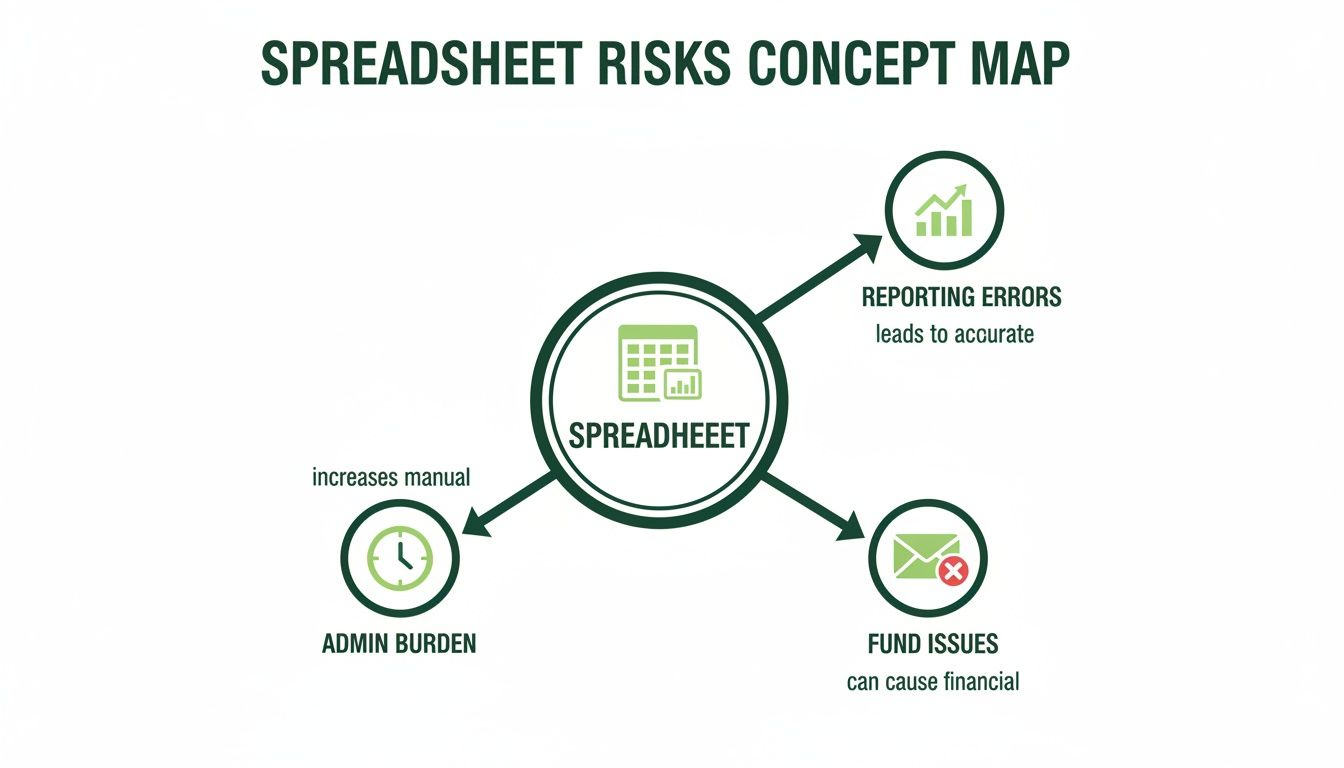
As you can see, relying on manual systems creates a straight line from spreadsheet use to critical errors in fund tracking and reporting, piling more and more administrative work onto staff and volunteers.
Why This Matters for Your Ministry
Getting a handle on fund accounting isn't just an administrative chore; it directly reflects your church's integrity and mission. When you can clearly show your congregation how their gifts are making an impact, you build trust and inspire even greater generosity.
For instance, when a family gives $500 specifically to the building fund, they trust that every penny will go toward that project. True fund accounting provides the guardrails to honor their intent. It's how a church demonstrates to its members, its board, and any legal authorities that it is managing God-given resources with integrity.
The right software creates virtual walls between these funds, preventing them from getting mixed up. It lets you pull a report in seconds showing the exact balance of the building fund, how much has been spent, and every donation that has come in. Trying to do that with a messy spreadsheet is often a time-consuming nightmare just waiting for an error to happen.
Ultimately, fund accounting empowers church leaders to make better, more informed decisions. It answers vital questions like: Do we have enough in the benevolence fund to help this family in crisis? or Can we afford to launch that new community outreach program? By giving you a clear view of the resources available for each ministry area, it turns financial data from a source of confusion into a powerful tool for fulfilling your mission.
Essential Features of Church Bookkeeping Software
When you're looking for bookkeeping software for your church, you're doing more than just picking a tool to track dollars and cents. You're choosing a partner in stewardship, a system that needs to support your ministry's unique financial structure and build trust with your congregation.
The best software is built on four non-negotiable pillars. These aren't just fancy add-ons; they are the absolute must-haves that separate a true church accounting solution from a generic business tool that will only cause headaches down the road.
True Fund Accounting Architecture
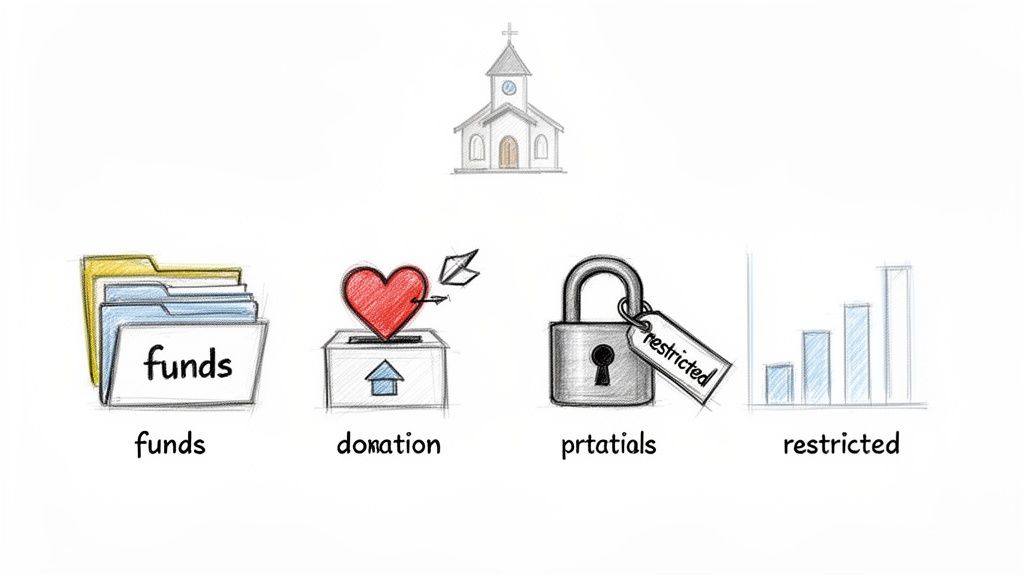
This is the big one. If the software isn't built on true fund accounting, walk away. I'm not talking about a "class tracking" workaround or a clever plugin for a for-profit system. I mean the software's entire DNA is designed to keep your money separated based on its intended purpose.
Think of it like digital envelopes. Every dollar that comes in is immediately placed into the correct envelope—General Fund, Building Fund, Missions, Youth Camp—and the system won't let you take money from the wrong one. This foundational structure makes it impossible to accidentally spend restricted money on operating expenses, providing the ultimate safeguard for donor intent.
A purpose-built solution like Grain Ledger is architected around funds from day one. This ensures that every report, from the balance sheet to ministry-specific statements, accurately reflects the segregated financial reality of your church.
Seamless Giving Platform Integration
Let’s be honest: manually entering every single donation from your online giving platform is a soul-crushing task. Modern church bookkeeping software has to connect directly with your giving provider to cut out that tedious work.
When the integration is seamless, a donation made online for the youth camp doesn't just show up as a random deposit. The software automatically imports the gift, links it to the right donor, and posts it directly into the "Youth Camp" fund. No human intervention required.
This automation isn't just a convenience; it's a game-changer.
- It saves hours upon hours: Your treasurer or volunteers can reclaim their time from mind-numbing data entry.
- It practically eliminates errors: Removing manual entry slashes the risk of typos or putting a donation in the wrong fund.
- It provides real-time clarity: Your financial picture is always current, so leaders can make decisions based on what’s actually in the bank, not last month's numbers.
Robust Controls for Restricted Funds
Upholding the trust of your donors is a sacred responsibility. Your software must have strong controls to ensure that money given for a specific purpose is used only for that purpose. This is more than just tracking; it’s about creating real guardrails.
For instance, if the building fund has a balance of $50,000, the system should flat-out refuse to process a check for $55,000 from that fund. It should also make it difficult, if not impossible, to pay the electric bill out of the missions fund. Good software acts as your partner in accountability, helping you honor every commitment you've made to your givers.
Intuitive, Board-Ready Reporting
What's the point of all this careful record-keeping if you can't get clear answers from it? The end goal is to produce reports that your leadership team can actually understand and use to make wise decisions. The software needs to speak the language of church finance, not corporate jargon.
With just a few clicks, you should be able to generate essential reports like:
- A Statement of Financial Position that clearly shows the balance of each individual fund.
- A Statement of Activities that breaks down the income and expenses for a specific ministry, like the children's program.
- A Budget vs. Actual report for your general fund to see how you're tracking.
These reports should be clean, simple, and ready to share with your board, finance committee, or the whole congregation. When your financial data is this accessible, it builds confidence, promotes transparency, and ultimately fosters a culture of generosity.
How to Choose the Right Software for Your Ministry
Picking the right small church bookkeeping software feels like a huge decision—because it is. You're not just buying a tool; you're choosing a partner that will help protect your ministry's financial health for years to come. The goal is to find something that makes stewardship simpler, not more of a headache.
The best place to start is by taking an honest look at your church’s unique situation. When you know exactly what you need, you have a compass to guide you toward the right solution and steer you away from a bad fit. This simple step keeps you from getting distracted by fancy features you'll never actually use.
Assess Your Ministry's Specific Needs
Before you even start browsing software options, map out your current financial reality. This internal check-up will give you a clear list of must-haves to compare against any potential system.
Start with a few key questions:
- How many funds are you juggling? Is it just a General Fund, or are you also managing a Building Fund, a Missions Fund, a Youth Fund, and a Benevolence Fund? The more funds you have, the more you need a real fund accounting system.
- What's your weekly transaction volume? A small church with a few checks and donations each week has very different needs than one processing hundreds of gifts and expenses.
- Who is going to use the software? Will it be a professional bookkeeper or a dedicated volunteer with little accounting background? If your team isn't full of financial experts, ease of use is everything.
Answering these questions helps you nail down your non-negotiables. For instance, if your treasurer is a volunteer, an intuitive, user-friendly interface isn't just a bonus—it's essential. This clarity is your best friend in the selection process.
Evaluate Integrations and Total Cost
The right software can't operate on an island; it needs to connect seamlessly with the other tools your church already uses, like your bank and online giving platform. Think of it as building a bridge between all your ministry's financial activities.
When these systems communicate, manual data entry becomes a thing of the past. A gift made through your giving portal can flow directly into the correct designated fund without anyone having to touch it. This doesn't just save a ton of time; it also drastically cuts down on the chance of human error.
You also need to look beyond the sticker price and consider the total cost of ownership. This includes the subscription fee, of course, but also the hidden costs of a clunky system, like extra hours spent on training or correcting mistakes. A platform that costs a little more but saves your team five hours a week is a much smarter investment.
Choose a Partner, Not Just a Product
At the end of the day, you're looking for a software provider that genuinely gets the unique world of church finance. This is becoming a critical factor, as adoption rates for specialized software are climbing by about 12% annually among small churches. This trend signals a clear move toward solutions built specifically with ministry in mind.
When you choose a software vendor, you are choosing a partner in your mission. Their support, understanding of fund accounting, and commitment to serving churches should be just as important as the features on their website.
This is where a purpose-built solution like Grain Ledger really makes a difference. It was designed from the ground up to handle the specific bookkeeping challenges small churches face, with fund accounting built into its very core—no clumsy workarounds needed. By offering smooth integrations and clear reporting, it directly solves the problems that cause so many ministries to struggle with their finances. For churches looking for a true partner in stewardship, you can learn more about how Grain Ledger is built for your mission.
Implementing Your New System and Avoiding Common Pitfalls
Picking the right bookkeeping software for your church is a huge step forward. But the real magic happens during the rollout. A successful transition isn't just about the technology; it's about a smart, thoughtful implementation plan that brings everyone along for the ride. Get this part right, and you'll sidestep a lot of headaches and build trust in your new system from the very beginning.
The journey to better financial stewardship starts long before you enter a single donation. It kicks off with careful planning and getting everyone on the same page—from the pastor and board members to the volunteer treasurer who will be in the software every week.
Creating Your Implementation Game Plan
A smooth launch is all about preparation. Instead of just jumping in, take a moment to map out the key steps. This ensures your team feels prepared and your financial data is ready for its new home. A little bit of planning now will save you a ton of confusion down the road.
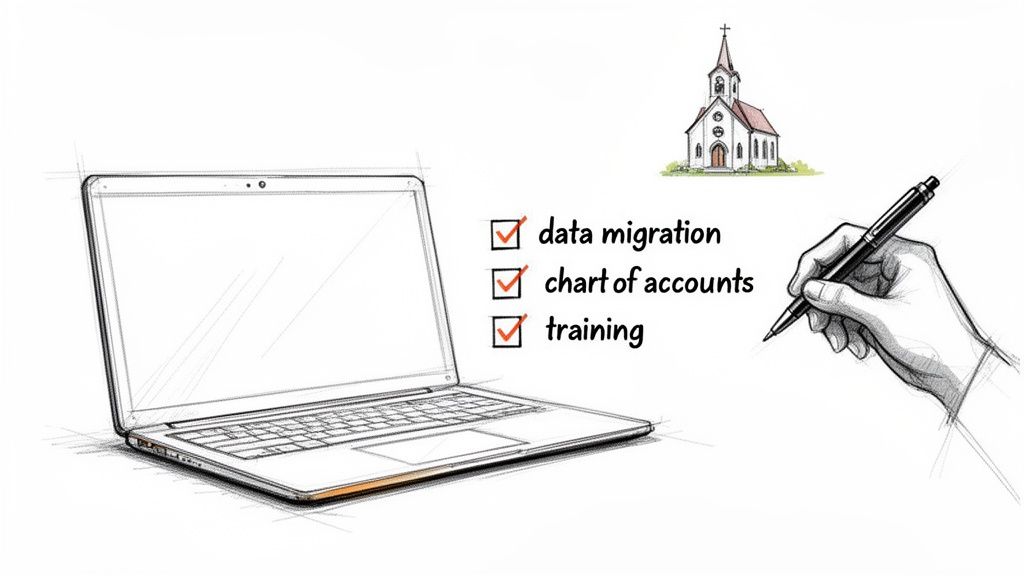
Your checklist should cover these essential tasks:
- Clean and Migrate Your Data: This is the perfect time for some financial spring cleaning. Before you import anything, tidy up your old spreadsheets, make sure donor information is current, and verify that past transaction records are accurate.
- Structure Your Chart of Accounts: Think of this as the backbone of your church's finances. Work with your team to design a chart of accounts that reflects your actual ministry structure, organizing it around your different funds (like the General Fund, Missions Fund, and Building Fund).
- Schedule Dedicated Training: Don't just hand over the keys and hope for the best. Set aside specific times to walk your finance team or volunteers through the new system. Guided training builds the confidence they need to use the software correctly.
The goal here isn't just to switch software—it's to build healthier, more transparent financial habits for your ministry. A well-planned transition is the foundation for long-term efficiency and trust.
Sidestepping Common Implementation Mistakes
Even the best plans can hit a snag. Knowing the common pitfalls ahead of time helps you steer clear of them, ensuring your church gets the full benefit of its investment. Honestly, most problems aren't technical; they're about people.
Here's where many churches stumble:
- Failing to Get Leadership Buy-In: If your pastor and board aren't fully behind the change, it's an uphill battle. Make sure they understand why this new software matters and can clearly communicate its benefits to the whole church.
- Underestimating the Time Commitment: Good data migration and proper training simply take time. Rushing this step almost always leads to messy data and frustrated volunteers, which just creates more work later on.
- Neglecting Ongoing Support: You’re not just buying software; you’re entering a partnership. Choose a provider known for excellent support. For more tips and resources, the articles on the Grain Ledger blog are a great place to find practical advice for church finance teams.
At the end of the day, successfully launching new software is less about being a tech wizard and more about thoughtful planning and clear communication. By mapping out your steps and anticipating the bumps in the road, you can make this transition a truly positive and empowering change for your entire ministry team.
The Future of Church Finance Is Faithful Stewardship
Handling your church's finances is so much more than just balancing a checkbook. It's about faithfully managing the resources your congregation has entrusted to you. For years, churches have tried to make spreadsheets work, but let's be honest—they weren't designed for this sacred responsibility. They often create more problems than they solve, from reporting errors to administrative headaches that steal time away from your actual ministry.
The path to financial clarity starts with understanding a core principle: fund accounting.
This method is all about making sure every dollar given for a specific purpose—be it the mission fund, the youth group, or a building campaign—is used exactly as the donor intended. It creates a powerful foundation of trust. But to truly bring this principle to life, you need the right tools, specifically small church bookkeeping software built for the job.
Building a New Level of Transparency and Trust
Think about your next board meeting. Instead of passing around confusing, error-prone spreadsheets, you’re presenting clear, simple reports that show the exact financial health of every single ministry. Imagine the confidence your congregation will feel, knowing their gifts are being managed with total integrity. That's the real-world difference the right software makes.
When the administrative burden is lifted, ministry leaders can get back to focusing on people, not paperwork. It's no surprise the nonprofit accounting software market is booming, projected to hit $908.75 million by 2035. In fact, cloud-based software adoption has already reached 69% among nonprofits. You can dig deeper into these figures in this market growth report on nonprofit accounting software trends. This isn't just a tech trend; it's a ministry-wide shift.
Faithful stewardship isn’t just an accounting term; it's a ministry practice. The right software serves this practice by making transparency effortless and accountability second nature.
This is about more than just buying new software; it's about finding a partner that understands your mission. A solution like Grain Ledger is designed to be more than a program—it’s a tool that reinforces transparency, simplifies compliance, and gives your church the ability to manage its God-given resources with unwavering confidence. By taking the complexity out of fund accounting, it frees you to focus on what truly matters.
Compare platforms in our best church accounting software guide for 2026, or review Grain Ledger church accounting software.
Related church accounting software resources
If you are comparing software, these pages map the main decision points: fund accounting, QuickBooks limits, pricing, and migration.
- Best church accounting software (2026 comparison) - canonical guide comparing 12 church accounting platforms
- Church accounting software product page - see Grain Ledger for fund accounting, giving, and bank reconciliation
- Small church accounting software - see the product page built for volunteer treasurers and church admins
- Fund accounting features - review how Grain Ledger tracks designated funds
- QuickBooks for churches - understand workarounds and when to switch
- Free church accounting software - compare free options and upgrade triggers
- Grain Ledger pricing - compare plans for small and growing churches
- Start free - try fund accounting, giving imports, and bank reconciliation together
Frequently Asked Questions
It's completely normal to have a lot of questions when you're trying to find the right bookkeeping software for your church. Let's walk through some of the most common ones we hear from ministry leaders.
Can We Just Use QuickBooks for Our Small Church?
I get this question all the time. While a tool like QuickBooks is fantastic for small businesses, it’s just not wired for the way churches handle money. It’s built for profit-and-loss, which means trying to track designated giving or special funds becomes a frustrating exercise in manual workarounds—the kind that can easily lead to mistakes.
A system designed for churches, like Grain Ledger, is built on a fund accounting foundation. That means every dollar is tracked according to its purpose right from the start. This isn’t just a nice feature; it’s essential for showing your congregation you’re stewarding their gifts faithfully.
Our Treasurer Is a Volunteer. Will This Software Be Hard to Learn?
That’s a critical point, because most church treasurers aren't professional accountants. The best software is made specifically for them. We always recommend a platform like Grain Ledger because of its clean, straightforward design and really helpful customer support that’s ready to walk your team through any questions.
Modern church financial tools focus on making key tasks simple, like coding donations or running monthly reports. The goal is to give your volunteers confidence, allowing them to manage the finances without needing an accounting degree.
The right software empowers volunteers, turning a potentially intimidating task into a manageable and even rewarding one. It should reduce stress, not create it.
What’s the Single Most Important Feature We Should Look For?
If you only remember one thing, make it this: true fund accounting. This isn’t just a buzzword. It means the software was fundamentally designed to separate and track money based on donor intent, not as a patched-on feature.
Things like online giving integration and slick reporting are great, but they are all built on that foundation. Without proper fund accounting, you can't truly guarantee that a gift designated for the youth mission trip is being handled correctly. This is the bedrock of financial integrity for any church, making this feature absolutely non-negotiable.
How Much Should Our Church Expect to Pay?
The price can really range, from free tools with limited features to more complex systems. For most small churches, a realistic budget for a good, dedicated cloud-based system will be somewhere between $30 and $120 per month.
But try not to focus only on the monthly fee. Think about the total value. If a system costs a bit more but saves your volunteer treasurer five hours of work every week and prevents a single costly accounting error, the return on that investment is huge. It’s about finding the right fit for your budget and your ministry’s needs.
Ready to build a foundation of financial clarity and faithful stewardship for your ministry? Grain Ledger offers true fund accounting, seamless integrations, and intuitive reporting designed specifically for churches. Schedule a Demo today to be among the first to experience a better way to manage your church’s finances.
Ready to simplify your church finances?
Start free with church fund accounting, or watch a product demo first.