
A Guide to tax deduction for church donations: Maximize Your Benefit
Learn how the tax deduction for church donations can lower your taxes, what qualifies, and tips to maximize your charitable giving today.
Donating to your church is more than just an act of faith—it can also provide a tangible financial benefit come tax season. The IRS allows you to lower your taxable income by the amount you give to a qualified religious organization, but getting it right means understanding the rules.
The Basics of Tax Deductible Church Giving
Giving to a church has always been about supporting a community and its mission. The U.S. tax code recognizes this generosity by offering a little something back to the giver. Think of it as a thank-you from the government for supporting a vital community institution.
This entire system is built on a simple foundation: the church's status. For a donation to be deductible, the church must be a qualified 501(c)(3) organization in the eyes of the IRS. If it is, your gift can lower your tax bill. If not, it's just a gift with no tax implications.
Why This Matters for Donors and Churches
For donors, the first hurdle is deciding whether to itemize deductions or take the standard deduction. You can only claim a tax deduction for church donations if you itemize. This path makes sense when your total deductible expenses—things like mortgage interest, state taxes, and your charitable gifts—add up to more than the standard deduction for your filing status.
For the church, the responsibility is just as significant. Building a culture of generosity relies on trust, and that means providing your members with accurate and timely documentation for their gifts. This isn't just good practice; it's a core function of responsible stewardship.
A contribution to a church is only deductible if it is made to a qualified organization and the donor chooses to itemize their deductions on their tax return. Proper acknowledgment from the church is a key piece of evidence the IRS requires for larger donations.
Managing this process correctly gives your congregation the confidence to give freely. Religious organizations consistently receive the largest share of charitable giving in the U.S., and for good reason. Under current tax law (through 2025), individuals who itemize can deduct cash gifts up to 60% of their adjusted gross income (AGI). That’s a substantial benefit.
This is where having the right tools makes all the difference. An accounting system designed specifically for churches, like Grain Ledger, is built to handle these unique needs. With true fund-based accounting, you can easily track every donation and automatically generate the compliant donor statements your members need.
Getting this right isn't just about good bookkeeping; it’s about honoring the trust your members place in you and ensuring the church meets the specific accounting standards for nonprofit entities outlined in FASB ASC 958. When you manage donations properly, you empower your congregation to give with confidence, knowing their contributions are handled with integrity.
What Types of Donations Qualify for a Deduction
When you picture giving to your church, the first thing that probably comes to mind is the collection plate making its way down the aisle. Cash and checks are classic, for sure, but the world of giving that qualifies for a tax deduction for church donations is much bigger.
Knowing the different ways people can give is crucial. For donors, it opens up more strategic ways to support the ministry. For church leaders, it's about properly handling and acknowledging these varied gifts.
Let's break down the main categories.
Cash and Monetary Gifts
Cash gifts are the bread and butter for most churches. They keep the lights on, fund mission trips, and pay the staff. Because their value is straightforward, they're the simplest type of donation to handle when it comes to taxes.
This category isn't just about physical cash anymore. It covers:
- Cash and Checks: The traditional methods, whether dropped in the offering plate or sent by mail.
- Credit or Debit Card Payments: Donations made through the church website, a giving kiosk, or an online portal.
- Electronic Fund Transfers (EFT): Think automatic, recurring gifts that donors set up to come directly from their bank account.
- Text-to-Give Services: A popular and convenient option for mobile giving.
There's one key rule to remember here. For any single monetary gift of $250 or more, a donor can't just rely on their bank statement or a canceled check to get a deduction. The IRS is clear: they need a formal, written acknowledgment from the church.
This flowchart lays out the basic questions to ask to see if a donation is deductible.
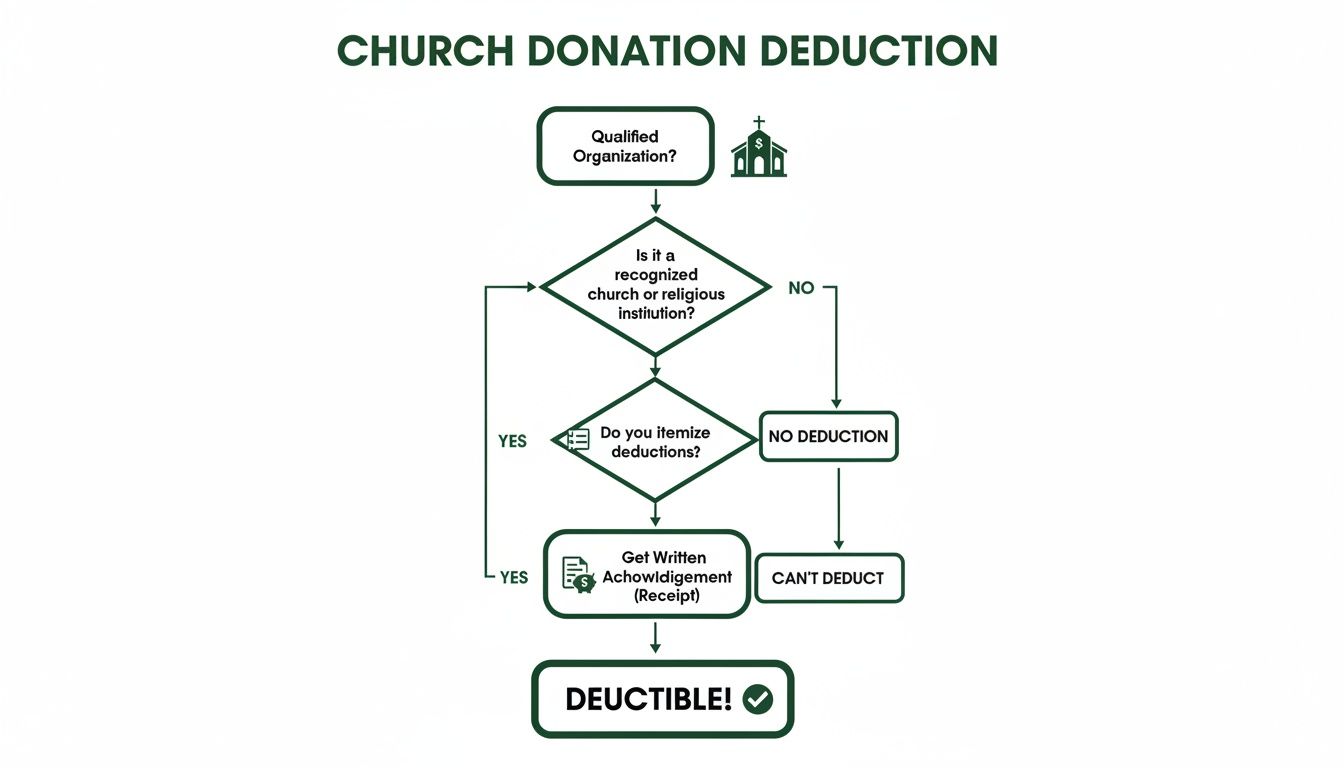
As you can see, it all comes down to whether the church is a qualified organization, if the donor itemizes their deductions, and if the gift is properly documented.
Non-Cash and Property Donations
This is where things get more interesting. Non-cash gifts require a bit more legwork on valuation and paperwork, but they can be an incredibly powerful way to support your church's mission. These donations are generally valued at their fair market value—what the item would sell for on the open market—at the time they are given.
What kinds of things are we talking about?
- Vehicles: A used car, boat, or even an RV. The amount a donor can deduct often depends on what the church does with it—whether it's used for ministry or sold.
- Publicly Traded Stocks: Giving appreciated stock is a fantastic, tax-savvy strategy. A donor can often deduct the stock's full fair market value and completely sidestep the capital gains tax they would have paid if they'd sold it.
- Real Estate: This could be a gift of land, a building, or another type of property.
- Tangible Personal Property: A catch-all for items like computers for the church office, furniture for the youth room, musical instruments, or even valuable artwork.
The documentation rules for these non-cash gifts are much tighter.
For any non-cash donation valued over $500, the donor must fill out and file IRS Form 8283. If that donation is worth more than $5,000, they'll almost always need a formal, qualified appraisal to back up the value.
This isn't just red tape; it's about ensuring the claimed value is accurate and can stand up to scrutiny. The church's role is to sign Form 8283, confirming it received the item. However, the responsibility for getting it valued and appraised falls squarely on the donor.
Mastering Documentation and Record Keeping
When it comes to tax deductions, a generous donation is just a gift until you have the right paperwork to back it up. Think of it like a receipt for a major purchase; you need that proof for it to count. The IRS has some very specific, non-negotiable rules for documentation, and getting them right is crucial for both donors and the church staff managing the books.
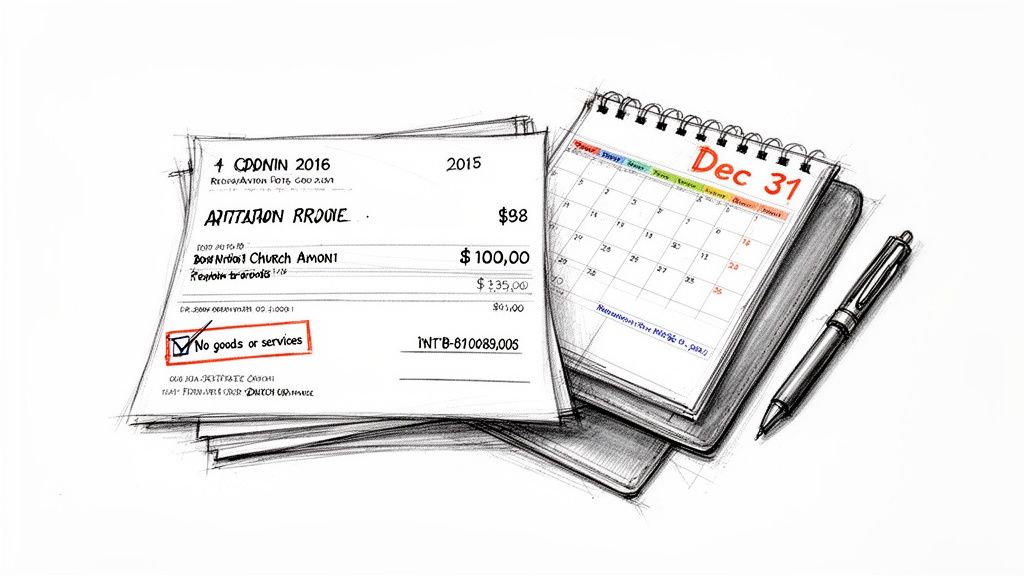
At the end of the day, the burden of proof falls squarely on the taxpayer’s shoulders. It’s up to them to get and keep the records needed to support their tax deduction for church donations. This simple fact makes the church's role in providing that documentation a vital ministry service.
The Under $250 Rule
For smaller, one-time gifts, the rules are fairly relaxed. For any single cash donation of less than $250, a donor just needs to have a reliable record. This can be as simple as a bank record or a written note from the church.
Here’s what the IRS accepts as proof:
- A Canceled Check: This is a classic. It clearly shows the church’s name, the date, and the amount given.
- A Bank or Credit Card Statement: The line item on the statement must clearly identify the donation to your church.
- A Church Receipt: A straightforward letter or receipt from the church confirming its name, the donation amount, and the date it was received.
While a bank statement technically works, a formal receipt from the church is always the gold standard.
The $250 and Over Rule
The moment a single donation hits the $250 mark, the game changes. The documentation requirements get much stricter, and a simple bank record won't cut it anymore. For any single gift of $250 or more, the IRS demands a formal contemporaneous written acknowledgment from the church.
What does "contemporaneous" mean? It simply means the donor must get this document from you by whichever of these two dates comes first: the date they actually file their tax return, or the official due date for filing that return (including any extensions).
This formal letter is the only acceptable proof for these larger contributions. Without it, the IRS can completely disallow the deduction, even if the donor has a canceled check sitting right in front of them. This is a critical detail for both the church and the donor to get right.
What Must Be Included in a Donation Acknowledgment
A proper acknowledgment letter is much more than a simple thank-you note. To be considered valid by the IRS, it has to contain some very specific information. Every formal receipt for a donation of $250 or more must include these details:
- The name of your church (the qualified organization).
- The amount of the cash donation.
- The date the donation was made.
- A clear statement that no goods or services were provided by the church in return for the gift.
But what if the church did provide something in return, like a ticket to a fundraising dinner? In that case, the letter has to include a good-faith estimate of what those goods or services were worth. The donor can then only deduct the portion of their gift that exceeds that value.
The Power of Modern Church Accounting Software
Let's be honest: manually tracking every single gift and then generating hundreds of compliant year-end statements is a massive headache. It's an administrative nightmare just waiting for a human error to happen—an error that could cost one of your members their tax deduction. This is exactly where modern accounting software becomes a ministry-saver.
A system like Grain Ledger was built from the ground up to handle the unique financial world of churches. As a true fund-based accounting solution, it automatically tracks every donation and can generate perfectly compliant year-end donor statements in just a few clicks. This automation not only saves church staff countless hours but also virtually eliminates the risk of costly mistakes.
By using a tool designed for the job, you can give your congregation the accurate, timely, and compliant paperwork they need. This builds incredible trust and gives your members confidence that their generosity is being stewarded with the highest integrity. To dive deeper, check out our complete guide on bookkeeping for churches.
Navigating the IRS Rules for Church Donations
When it comes to getting a tax deduction for church donations, you have to know the rules of the game. The IRS has a clear set of guidelines that dictate how much you can deduct and when. Think of these rules not as hurdles, but as a roadmap to make sure your generosity is properly recognized when you file your taxes.
The foundation for all these rules is your Adjusted Gross Income (AGI). This is a key figure on your tax return—it’s your total income minus a few specific adjustments. The IRS uses your AGI to set the ceiling for how much you can claim in charitable giving each year.
The AGI Limit Explained
For most cash donations you make to your church, the IRS lets you deduct up to 60% of your AGI. That’s a pretty high limit, and for most people, it’s more than enough.
So, if your AGI is $80,000, you could deduct up to $48,000 in cash gifts to your church for that year (that's 60% of $80,000).
What happens if you have an exceptionally generous year and give more than that? Don't worry, the IRS has a plan for that. You can carry over the excess amount and apply it to your tax returns for up to five future years.
Itemizing vs. The Standard Deduction
This is the first major fork in the road. To claim your church donations, you absolutely must itemize your deductions. That means you’ll be listing out all your individual deductible expenses—things like mortgage interest, state and local taxes, and, of course, your charitable gifts.
You'll want to add all those up. If your total is higher than the standard deduction for your filing status, it makes sense to itemize. If it's not, you’ll probably come out ahead just taking the standard deduction, even though it means you can't deduct your church gifts separately.
Donation limits can vary quite a bit depending on what you're giving. Cash is the most straightforward, but the rules are different for things like property or stocks.
Donation Types and Their AGI Deduction Limits
| Type of Contribution | Deduction Limit (% of AGI) | Key Considerations |
|---|---|---|
| Cash Contributions | 60% | Includes checks, credit card payments, and payroll deductions. |
| Non-Cash Property (Ordinary Income) | 50% | Applies to assets that would produce ordinary income if sold, like inventory. |
| Non-Cash Property (Long-Term Capital Gain) | 30% | For assets held over a year, like stocks or real estate. |
| Donations to Certain Foundations | 30% | Lower limits apply for gifts to some private foundations and other organizations. |
Understanding these different tiers is crucial for donors who give more than just cash, as it can significantly impact their tax strategy.
What You Need to Know About "Quid Pro Quo" Contributions
Sometimes, when you give, you get a little something back. The IRS has a specific term for this: a "quid pro quo" contribution, which is just Latin for "something for something." This is when your payment to the church is part donation and part purchase.
Think about a church fundraising dinner. You buy a ticket for $100, but the fair market value of the meal itself is $40.
In this situation, you can't deduct the full $100. Your actual contribution is only the amount you gave above the value of what you received. So, your tax-deductible gift is $60 (your $100 payment minus the $40 meal).
For any quid pro quo gift over $75, the church is actually required to give you a written statement that breaks down this math for you.
This rule is a big reason why timing matters so much. December is always the busiest month for church giving, fueled by both holiday generosity and year-end tax planning. Donors rush to get their gifts in before the deadline so they can maximize their deductions, especially with the 60% AGI limit for cash gifts being a key consideration. You can learn more about how tax laws might evolve by visiting resources like planetary.org.
Knowing these rules helps everyone—donors and church leaders alike—handle gifts with integrity. For churches, keeping track of these details is essential for sending out accurate and compliant donor statements. This is where a specialized church accounting tool like Grain Ledger can be a huge help. It’s built to manage fund accounting and generate the clear reports you need to handle every kind of donation correctly, ensuring every gift is stewarded well.
How Churches Can Simplify Donation Management
For church administrators, managing the congregation's generosity is a sacred duty, but it’s also one filled with real-world administrative headaches. While donors are thinking about the rules for claiming a tax deduction for church donations, the church office is tasked with building the trustworthy system that makes it all possible. This process is so much more than just cashing checks and sending a quick thank-you note.
This responsibility brings some common pain points to the surface. Church leaders often find themselves wrestling to accurately track designated funds—making absolutely sure a gift for the "Building Fund" isn't accidentally spent from the "Missions Fund." Trying to consolidate donations from multiple platforms like Pushpay, Planning Center, text-to-give, and the Sunday offering plate into one coherent system can also feel like a never-ending chore.
The Challenge of Designated Funds
Think about it this way: a donor gives a generous gift specifically to support an upcoming youth mission trip. That gift is legally considered a restricted fund, which means the church is obligated to use it only for that purpose. If your accounting system isn't built to handle this distinction, keeping those funds separate becomes incredibly difficult, and it muddies the water when leaders need a clear picture of what’s available for each ministry.
This is exactly where most generic business accounting tools fall short. They're designed to track overall profit and loss for a company, not the nuanced financial reality of a church operating with multiple, distinct ministry funds. Without a system built for this, pulling accurate financial reports turns into a manual, error-prone mess that can slowly erode financial clarity and trust.
Automating for Accuracy and Trust
This is precisely why a true, fund-based accounting system is a game-changer for modern ministry. Instead of trying to force a corporate tool to fit a church's needs, you need a solution built from the ground up for how churches actually operate.
For a church, financial stewardship isn't just about balancing the books; it's about honoring the intent behind every single gift. An accounting system that automatically protects the integrity of designated donations is fundamental to maintaining congregational trust.
This diagram shows how a modern, integrated system manages the flow of donations from the moment they are given.
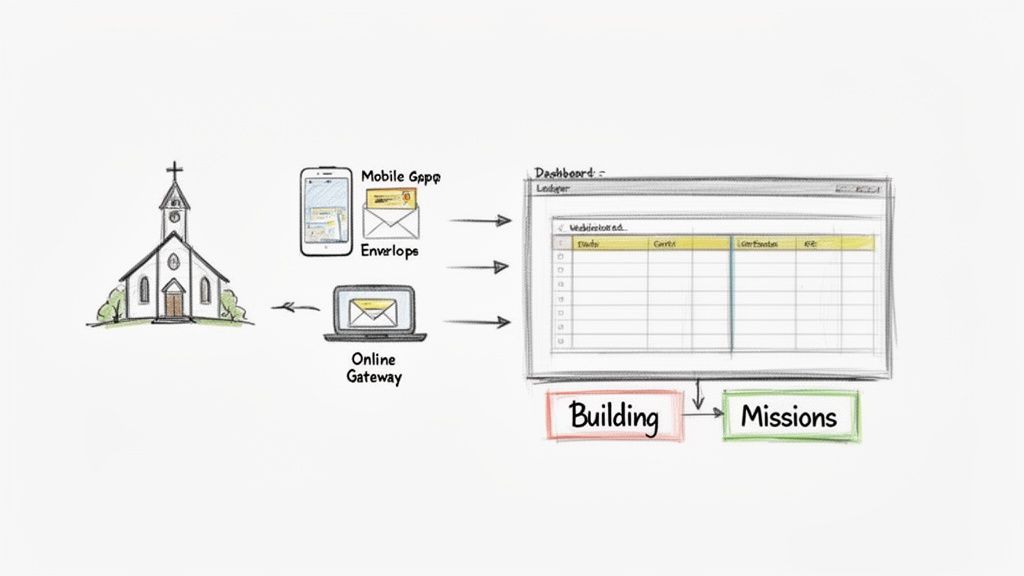
As you can see, donations coming in from different sources are automatically routed to their specific funds. This provides clear financial separation and makes reporting a breeze. This kind of automation is the key to eliminating manual errors and giving leaders an instant, reliable financial snapshot whenever they need it.
A Purpose-Built Solution for Churches
An accounting solution like Grain Ledger is architecturally designed to solve these exact problems. Because it is a true fund-based accounting system, every transaction is automatically categorized by fund the second it enters the system.
Here’s how it transforms donation management:
- Automated Routing: Grain Ledger connects directly with the giving platforms your church already uses, like Pushpay or Planning Center. When a donation comes in, it's automatically sent to the correct fund—no more manual data entry.
- Guaranteed Compliance: This setup ensures restricted gifts are always honored, providing a clean audit trail and protecting the church's financial integrity.
- Instant Clarity: Leaders and finance teams get immediate, accurate reports on the financial health of each fund. You can see precisely how much is in the Missions Fund versus the General Fund at any given moment.
- Effortless Donor Statements: The most tedious task of all—creating compliant, year-end donor receipts—becomes a simple, automated process. Grain Ledger can generate the accurate statements your members need to confidently claim their deductions, saving your staff countless hours.
By adopting a system designed for ministry finance, you move past the administrative grind and get back to focusing on stewardship. This commitment to transparency not only simplifies your workload but also deepens the trust and confidence of your congregation. To dig deeper into this topic, you can learn more about church donation tracking software in our detailed article. It's an approach that ensures every gift is stewarded with the highest level of care and accountability.
Common Questions About Church Giving and Taxes
Even when you think you have a handle on the rules, real-life situations can leave both donors and church leaders scratching their heads. When it comes to something as important as a tax deduction for church donations, you want to be sure you're getting it right. Let's walk through some of the most common questions to clear up any confusion.
Think of this as your go-to guide for those everyday scenarios that don't always fit neatly into a rulebook. By tackling these common gray areas, you can give with more confidence and your church can manage its finances with greater accuracy.
What If I Don't Itemize My Taxes? Can I Still Deduct My Donations?
For the most part, the answer is no. The ability to deduct charitable gifts, including everything you give to your church, is a benefit for taxpayers who itemize their deductions.
Most people take the standard deduction because it's a higher amount than all their itemizable expenses combined. If that's you, you won't be able to claim a separate deduction for your church giving. While Congress has occasionally passed temporary laws allowing non-itemizers to deduct a small amount, that isn't the standard rule. You'll always want to check the current IRS guidelines for the specific tax year.
Are the T-Shirts or Dinner Tickets from Our Fundraiser Deductible?
This is a classic "it depends" situation. These kinds of donations are only partially deductible because you're getting something in return for your money. The IRS calls this a "quid pro quo" contribution.
The rule is actually pretty simple: you can only deduct the portion of your gift that is more than the value of what you received.
Let’s say you pay $100 for a ticket to a church fundraising dinner. If the fair market value of the meal is $40, then your deductible contribution is only $60. The church is actually required to give you a written statement explaining this breakdown if your payment was over $75.
The whole idea behind a tax-deductible donation is that it must be a genuine gift, given without getting something of significant value back. When you do get a benefit, the deductible part of your gift shrinks by that amount.
My Church Didn't Send Me a Receipt. What Should I Do?
When it comes down to it, the responsibility for keeping proper records lands on you, the taxpayer. The IRS is especially strict about this: for any single cash donation of $250 or more, you absolutely must have a formal written acknowledgment from the church before you file your taxes.
If your church doesn't send one automatically, it's on you to ask for it. Without that specific document, the IRS can deny the deduction, even if your bank statement clearly shows the payment. For smaller gifts, a canceled check or a credit card statement will usually work, but the official receipt from the church is always your best proof.
Can I Deduct the Value of My Volunteer Time?
This is a common question, and the answer is a firm no. You can't deduct the value of your time or professional services. So, if you're a graphic designer and you spend a weekend creating a new logo for the church, you can't deduct what you would have normally charged for that work. The IRS simply doesn't allow deductions for the value of your labor.
But there is a silver lining. You can deduct the out-of-pocket expenses you paid while volunteering. These could include things like:
- Supplies: The cost of craft materials you bought for a Sunday school class or decorations for a church event.
- Travel Costs: You can deduct the cost of gas and oil for using your car to run church errands. The IRS sets a standard mileage rate for this each year, which is often easier than tracking actual costs.
Just be sure to keep detailed records of these expenses if you plan to claim them.
For church leaders, staying on top of these details and providing donors with accurate, compliant paperwork is a huge part of good stewardship. Grain Ledger is built to make this whole process seamless. As a true fund-based accounting software, it automatically tracks every donation, manages restricted funds properly, and generates the precise year-end statements your members need in just a few clicks. Build trust and give your congregation confidence by visiting https://grainledger.com to see how it works.
Ready to simplify your church finances?
Start free with church fund accounting, or watch a product demo first.