
Tithing Vs Offering: A Guide to Church Financial Stewardship
Understand the critical differences in tithing vs offering and how to manage them with true fund accounting. A practical guide for church leaders.
The difference between a tithe and an offering really comes down to this: a tithe is the foundational, systematic gift—the "first fruits"—while an offering is a freewill gift given above and beyond that baseline. You can think of tithing as the floor for consistent generosity and offerings as the heartfelt, limitless ceiling.
About Grain Ledger: This guide includes Grain Ledger, church fund accounting software built for designated gifts and ministry funds. It connects giving platforms (Planning Center, Pushpay, Tithely, Stripe), syncs bank activity with Plaid, and produces fund-level financial reports. Schedule a demo to see how it compares for your church.
See Grain Ledger for your church
Fund accounting, giving integrations, and bank reconciliation in one platform. Free migration support for churches switching from QuickBooks or Aplos.
Clarifying the Core Principles of Giving
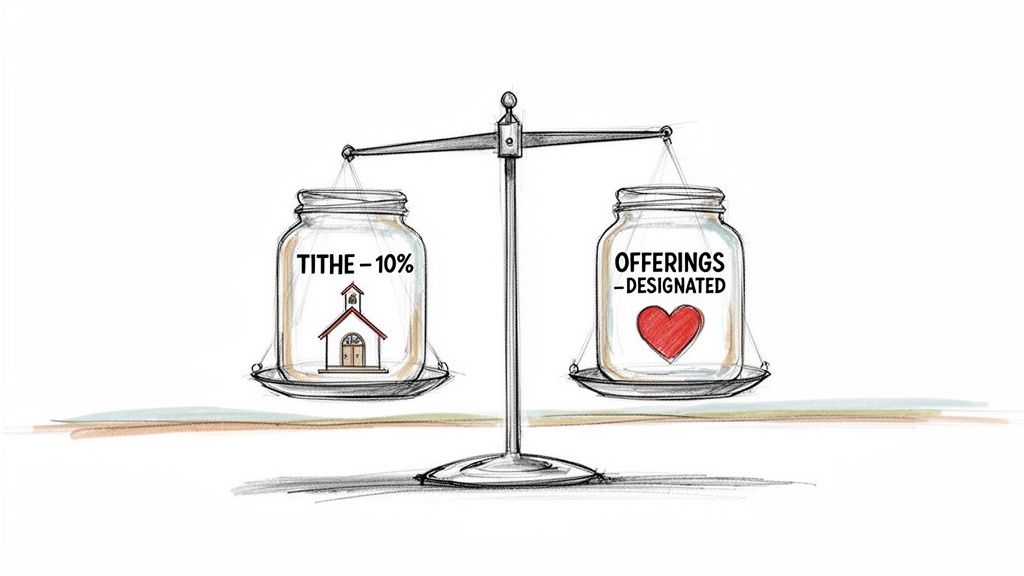
For church leaders handling the books and for members trying to live out faithful stewardship, getting a firm grip on this distinction is crucial. While both are acts of worship flowing from the same generous heart, they play different roles in the church's financial health and spiritual life.
A tithe is traditionally understood as 10% of a person's income, given on a regular basis to support the local church's mission and operations. It’s often seen as an act of disciplined obedience, providing the steady, predictable income a church needs for essentials like staff salaries, facility maintenance, and core ministry programs.
An offering, on the other hand, is a gift given freely from the heart, often in response to a specific need or a powerful sense of gratitude. These gifts aren't tied to a specific percentage. They can be—and often are—directed toward a designated purpose, like a youth mission trip, a new building fund, or a special community outreach event. This allows your congregation to respond generously as they feel led.
Tithing Vs Offering At a Glance
To make this even clearer, here's a quick side-by-side look at the key differences. This table breaks down their distinct roles, from their financial purpose to the giver's motivation.
| Attribute | Tithing | Offering |
|---|---|---|
| Nature of Gift | Systematic and disciplined; a foundational percentage of income. | Voluntary and spontaneous; given in addition to the tithe. |
| Primary Purpose | Funds the church's general operating budget (unrestricted). | Supports specific projects, ministries, or needs (often restricted). |
| Biblical Basis | Rooted in Old Testament principles of supporting the ministry. | Based on New Testament examples of cheerful, responsive generosity. |
| Giver's Intent | An act of obedience and consistent financial support for the church. | An expression of gratitude or a response to a specific need. |
Seeing this distinction is more than just a bookkeeping task; it gets to the heart of a mature stewardship culture. Tithing lays the foundation for reliable support, while offerings empower the church to seize new ministry opportunities as they arise.
"The practice of tithing establishes a baseline for generosity, while offerings create opportunities for the congregation to partner in specific, mission-critical initiatives."
This difference also has very real-world implications for church leaders. For example, research shows that only about 27% of churchgoers actually tithe at the traditional 10% mark. As Vanco Payments highlights in their church giving statistics, there's often a gap between the ideal and the reality. This makes it all the more important for leaders to clearly teach on both forms of giving, nurturing a holistic and sustainable culture of generosity.
The Theological Foundations of Giving
To get a real handle on the practical differences between tithing and offering, we first need to look at their spiritual roots. These aren't just arbitrary financial rules; they're deeply embedded in biblical stories that shape a church's entire theology of stewardship. Understanding where these ideas come from helps pastors and finance teams teach their congregations about the spiritual heart behind every dollar given.
The idea of the tithe is planted firmly in the Old Testament. It was set up as a core principle to support the priesthood and the Tabernacle. The verse everyone knows, Malachi 3:10, talks about bringing the "whole tithe into the storehouse." It frames tithing as an act of obedience and trust, with God promising a blessing in return.
This created a reliable, consistent way to sustain the spiritual life of the community. It wasn't just about the money—it was a practice that reminded people that God was the ultimate provider. This is why so many churches today see the tithe as the primary, unrestricted income that keeps the core mission going.
The New Testament Shift in Perspective
When we move into the New Testament, the conversation around giving changes. The ten-percent rule isn't laid out as a direct command for Christians anymore, but the principles behind generosity and supporting the ministry are turned up a notch. The focus shifts from a set percentage to the attitude of the giver's heart.
The Apostle Paul adds a new layer in 2 Corinthians 9:7, saying, "Each of you should give what you have decided in your heart to give, not reluctantly or under compulsion, for God loves a cheerful giver." This reframes the motivation for giving, moving it from a sense of obligation to one of joyful partnership.
This shift encourages a culture where giving is less about checking a box and more about a heartfelt response to God's grace. It opens up the idea of generosity beyond a fixed tithe, making room for sacrificial and joyful giving of all kinds.
Offerings as Purpose-Driven Generosity
This New Testament focus on responsive generosity is where the theology of offerings really takes shape. Unlike the systematic tithe, offerings are often shown as spontaneous, purpose-driven gifts that pop up to meet specific, immediate needs.
You can see a powerful example of this in the early church described in Acts. Believers sold land and possessions and laid the money at the apostles' feet so that no one in the community would be in need. That wasn't a mandated tithe; it was a radical, voluntary offering fueled by compassion and a shared sense of mission. It was a purpose-driven gift for a clear cause: taking care of their people.
This model is exactly what informs how churches handle designated offerings today. When a specific need comes up—a new building fund, a missions trip, or helping a family in crisis—the offering gives the congregation a direct way to respond with generosity.
Understanding these theological foundations is crucial for building a healthy culture of giving.
- Tithing creates the discipline of consistent, faithful support for the church's ongoing ministry and operational needs.
- Offerings open the door for spontaneous, heartfelt generosity aimed at specific, impactful projects.
At the end of the day, both are acts of worship. One builds the foundation, and the other builds on top of it, allowing a church to stay stable while also being ready to jump on new opportunities for ministry. A church that teaches both principles well gives its members the tools to practice a rich and well-rounded financial stewardship.
Practical Fund Accounting for Tithes and Offerings
With the theological foundation in place, let's get practical. How do we translate these principles of giving into sound financial practices for the church? This isn't just about balancing the books; it's an act of stewardship that builds trust and ensures every dollar given fulfills its intended purpose.
The key difference in accounting for tithes vs. offerings comes down to fund classification. Tithes are almost always considered unrestricted funds. Think of them as the lifeblood of the church's day-to-day operations—they flow into the general fund to cover essentials like staff salaries, utility bills, and facility maintenance.
Offerings, on the other hand, are often designated or restricted funds. When someone gives an offering specifically for the "Youth Mission Trip" or the "Building Fund," that money is ethically and legally bound to that single purpose. This requires a completely separate accounting treatment to make sure those funds aren't accidentally used for anything else.
Structuring Your Chart of Accounts
A well-organized chart of accounts is the backbone of any healthy church's finances. It's the system you use to categorize every dollar that comes in and goes out. For tithes and offerings, this means setting up distinct income accounts that map directly to the correct funds.
This separation is vital for transparency. It gives your leadership a clear snapshot of how much is available for general operations versus how much is set aside for specific ministry projects.
The theological concepts we discussed earlier flow directly into these practical applications, as you can see here:
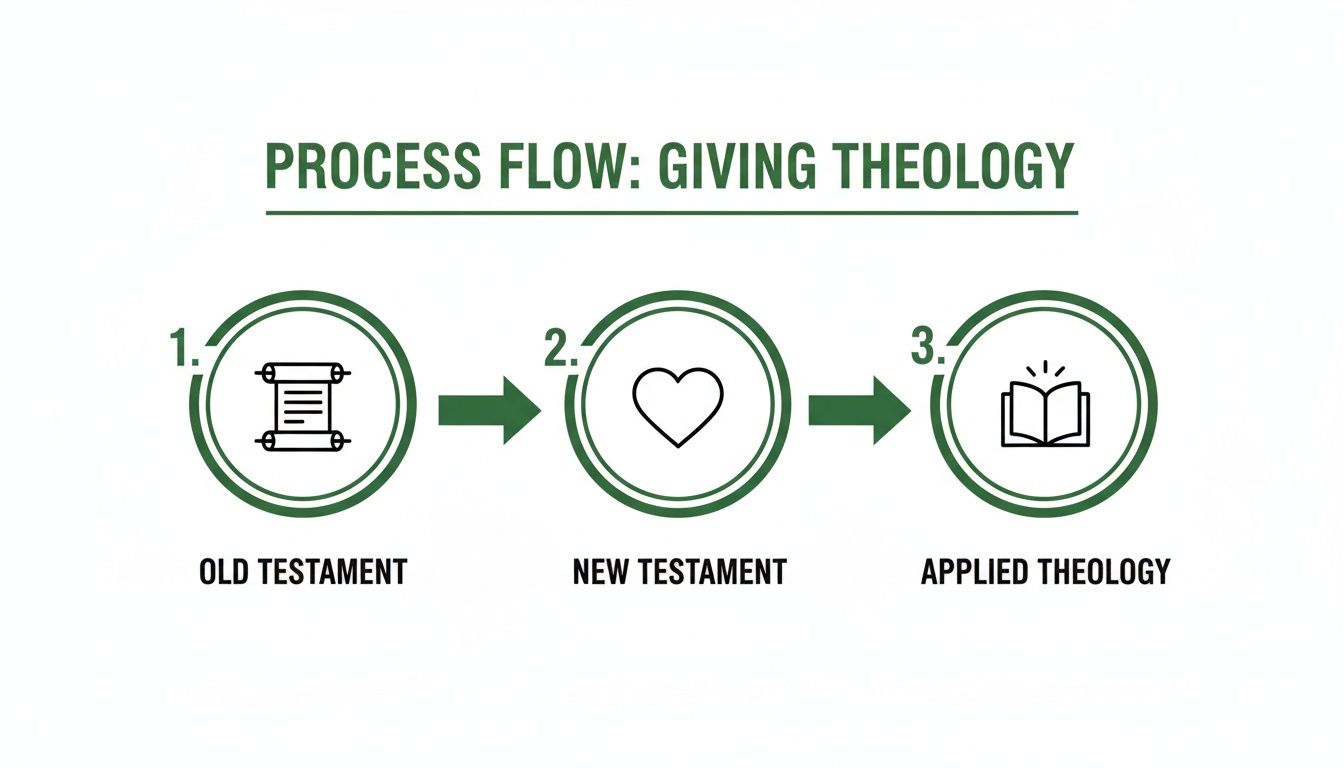
This visual really drives home the point: while both are acts of worship, their intended use dictates how we must handle them in our financial system.
To see what this looks like in practice, here is a simplified example of how you might structure these accounts.
Sample Chart of Accounts for Tithes and Offerings
| Account Number | Account Name | Fund Type | Description |
|---|---|---|---|
| 4010 | Tithes | Unrestricted | General tithes from the congregation for operations. |
| 4020 | General Offerings | Unrestricted | Undesignated offerings given during services. |
| 4110 | Building Fund Offerings | Restricted | Designated gifts for capital improvements or construction. |
| 4120 | Missions Fund Offerings | Restricted | Designated gifts for specific mission trips or partners. |
| 4130 | Benevolence Offerings | Restricted | Designated gifts to help those in need within the community. |
This clear separation in your chart of accounts is the first step to accurate and trustworthy financial reporting.
A Sample Journal Entry for Mixed Donations
Let's walk through a common scenario. Imagine a single weekend deposit totals $5,000. After counting, you find that $4,000 of it is from general tithes, and $1,000 was specifically given as offerings for an upcoming mission trip.
Here’s how you’d record this in a proper fund accounting system:
- Debit Cash Account: First, you’d debit your main cash or checking account for the full $5,000 deposit. This reflects the total amount of money that hit the bank.
- Credit Unrestricted Revenue: Next, credit the "Tithes" income account (like #4010 from our table) for $4,000. This correctly allocates the tithe to the unrestricted General Fund.
- Credit Restricted Revenue: Finally, credit the "Missions Fund Offerings" income account (like #4120) for $1,000. This links the designated offering directly to the restricted Missions Fund.
This simple entry ensures each part of the donation is tracked separately, preventing the mission trip funds from being accidentally spent on the electric bill. This level of detail is a cornerstone of responsible fund accounting for churches.
Recording transactions this way does more than keep the books clean. It honors the donor's intent and provides the finance committee with an accurate, real-time view of what funds are truly available for discretionary spending.
The shift to digital giving has added a new layer to this. Online platforms have reportedly helped churches see a 32% increase in overall giving, partly because it makes giving spontaneous offerings so much easier. This trend makes disciplined fund tracking even more critical, as the lines between systematic and spontaneous giving can blur on a single digital giving page.
To handle this growing complexity, churches need a system built for their reality. A solution like Grain Ledger is designed with native fund accounting, meaning it automatically separates restricted and unrestricted funds the moment a donation is recorded. This eliminates the manual errors and messy workarounds that plague churches trying to use generic business software. By automating the correct allocation of tithes and offerings, Grain Ledger ensures your financial reports are always accurate, transparent, and ready for review.
Crafting Clear Policies for Designated Offerings

While tithes are the lifeblood for general operations, designated offerings arrive with a specific purpose attached. Handling these restricted gifts properly isn’t just good bookkeeping; it’s an ethical and legal obligation. The single best thing your church can do to protect donor trust and financial integrity is to establish a clear gift acceptance policy.
Think of this policy as a roadmap for your finance team and leadership. It ensures every designated gift is handled with consistency and transparency, eliminating guesswork and shielding the church from future misunderstandings. Without a formal policy, you're inviting confusion and risk misusing funds that a donor intended for a specific ministry.
A solid policy builds a framework that honors the heart behind every gift, ensuring the crucial distinction between a general tithing vs offering is always respected.
Key Components of a Gift Acceptance Policy
A strong policy doesn't have to be complicated, but it absolutely must be clear. It should anticipate and answer the "what if" questions that are bound to come up with designated giving. Churches can get a great head start by studying the principles behind mastering a standard operating procedure template to create a structured and repeatable process.
At a minimum, your policy should cover these critical points:
- Defining a Restricted Gift: State exactly what qualifies as a designated gift and detail how the church will acknowledge and record its restriction.
- Procedures for Over-Funded Projects: What’s the plan when a project receives more money than it needs? The policy should specify whether you’ll return the excess, ask donors for permission to reallocate it, or apply it to a similar ministry.
- Handling Canceled Projects: If a building plan falls through or a mission trip is called off, your policy needs to outline how you'll communicate with donors and what will happen to their contributions.
- Unsolicited or Unaligned Designations: The policy should give your board the authority to politely decline gifts designated for purposes that fall outside the church’s mission or current budget.
A well-communicated gift acceptance policy is a proactive tool for preventing conflict. It signals a deep commitment to stewardship that honors both the donor’s intent and the church’s mission, building a powerful foundation of trust with your congregation.
Putting Your Policy into Practice
Once the policy is written, it's time to make it known. Ambiguity breeds mistrust, so you need crystal-clear communication at every single giving point—from offering envelopes and online donation forms to capital campaign materials.
For instance, instead of just a generic "Building Fund" line on an envelope, you could add a brief disclaimer:
- "Gifts to the Building Fund are designated for Project Nehemiah. In the event this project is over-funded or cannot be completed, the board reserves the right to apply these funds to the church's next highest capital priority."
This small addition does a world of good. It manages donor expectations from the very beginning and aligns perfectly with your internal policy. When you pair a strong internal policy with clear external communication, you create a seamless system of accountability. A true fund accounting solution like Grain Ledger can then lock in these policies, automatically segregating restricted funds and providing the transparent reporting you need to prove your stewardship and keep your congregation’s confidence high.
How Grain Ledger Automates Church Fund Accounting
Trying to manage the distinct streams of tithes and offerings with a standard spreadsheet or generic business software is a recipe for headaches. You end up creating manual workarounds just to keep unrestricted tithes separate from restricted offerings, which eats up precious administrative time and opens the door to compliance risks. This is the exact problem that purpose-built church accounting software was created to solve.
A platform designed specifically for churches gets that the distinction between tithing vs offering isn't just a feature—it's the foundation. Instead of tacking on fund management as an afterthought, it builds the entire system around this core principle. With a native fund-based architecture, you can say goodbye to complex journal entries and manual tracking. Every dollar is managed with integrity from the moment it comes in.
For so many churches, getting this right is a total game-changer. It frees up staff and volunteers from getting buried in tedious admin work so they can focus on what really matters: their ministry.
Seamless Integration with Your Giving Platforms
These days, giving comes from all over—online portals, text-to-give services, and the classic offering plate. Manually pulling all that data together and making sure every donation lands in the right fund is where errors happen most. A dedicated church accounting solution can eliminate this friction completely.
Grain Ledger, for instance, is built from the ground up to integrate directly with major giving platforms like Planning Center, Pushpay, and Stripe. This connection creates a smooth, automated flow of information where every donation is routed to the correct fund based on what the donor specified.
- Unrestricted Tithes are automatically credited to the General Fund.
- Designated Offerings for missions, building campaigns, or benevolence are instantly sorted into their respective restricted funds.
This kind of automation means your financial records are accurate and up-to-date in real-time, without a treasurer having to lift a finger.
Real-Time Reporting for Clear Stewardship
One of the biggest wins of an automated system is the power to pull clear, accurate, fund-level reports whenever you need them. Pastors and finance committees no longer have to wait for someone to painstakingly compile data to get a read on the church's financial health. They can access reports that provide instant clarity.
This screenshot gives you a sense of what a dashboard looks like, offering an at-a-glance view of all your fund balances.
With this level of visibility, leadership can immediately see how much is available in the General Fund versus what's being held in restricted funds like the Building Fund. It’s a critical safeguard that ensures designated money is never accidentally spent on operational expenses.
By providing a live and accurate Balance Sheet by Fund, an automated system like Grain Ledger empowers church leaders to make informed, timely decisions with complete confidence in their data. It transforms financial reporting from a historical record into a strategic tool for ministry planning.
This level of detail is vital, especially when you consider that committed tithers are a generous but distinct group. While tithers who give 10% or more—an estimated 10 million people in America contributing over $50 billion annually—form a strong financial base, they are just one part of the picture. The broader congregation's smaller, often designated, offerings also make up a significant portion of income. To learn more about managing both streams for financial health, check out our guide on fund accounting software for churches.
Ultimately, automating how you handle tithes and offerings is about so much more than efficiency. It's a powerful act of stewardship. It honors donor intent, protects the church from financial mismanagement, and builds a deep, lasting culture of trust with your congregation. When your systems inherently respect the purpose behind every single gift, you’re free to focus on the ministry that those gifts make possible.
Communicating Financial Stewardship to Your Congregation
When it comes to church finances, clear communication is the bridge that connects giving to actual ministry impact. Think about it: when your congregation truly understands how their contributions are being used, they stop being passive donors and become active, engaged partners in the church's mission. The whole point is to build trust by drawing a straight line from a tithe to a lightbulb staying on in the sanctuary, or from an offering to a life being changed in the community.
This kind of open, transparent financial dialogue creates a culture of joyful generosity. It pulls back the curtain on the budget, replacing abstract numbers with real, tangible stories of what God is doing through your church. This isn't about justifying every expense; it's about celebrating the collective stewardship of your community and showing how every single dollar fuels a shared vision.
From Data to Discipleship
The trick is to present financial information in a way that’s simple, impactful, and easy for everyone to grasp. Instead of dropping a complex spreadsheet on them, focus on creating clear reports that tell a story. You can learn more about building these narratives in our guide to essential church financial reports.
Good reports should visually separate unrestricted and restricted funds. This is crucial for helping members see the practical difference between their tithing and their offerings.
- Tithes in Action: Show how consistent, faithful tithes cover the foundational costs of ministry—things like keeping the building open, supporting your staff, and funding discipleship programs. A simple pie chart or a clean graphic can work wonders here to illustrate these operational pillars.
- Offerings at Work: This is where you can get specific. Highlight the exact projects funded by designated offerings. Share photos and updates from a recent mission trip or show the progress on a building fund thermometer. This creates a powerful connection between their specific gift and a visible outcome.
Connecting giving to life-change is the most powerful way to inspire continued generosity. When people see that their offering helped purchase Bibles for the youth group, they understand their role in discipleship on a personal level.
Celebrating Generosity and Sharing Stories
Financial communication shouldn’t feel like a dry business meeting; it should be a celebration. You need to regularly share milestones and express genuine gratitude for the congregation's faithfulness. Doing so reinforces the value of every single contribution, no matter the size, and builds momentum for future giving.
Share stories of impact. A testimony from someone helped by the benevolence fund or a short video from a missionary you support brings all that financial data to life. To make these conversations even more accessible, many churches use sermon transcription services to share these important messages in different formats.
Ultimately, clear communication about tithes and offerings constantly reinforces the truth that every act of giving is an act of worship. By connecting the dots between your congregation's generosity and the ministry happening on the ground, you build a resilient and trusting financial foundation for your church.
Related church accounting software resources
If you are comparing software, these pages map the main decision points: fund accounting, QuickBooks limits, pricing, and migration.
- Best church accounting software (2026 comparison) - canonical guide comparing 12 church accounting platforms
- Church accounting software product page - see Grain Ledger for fund accounting, giving, and bank reconciliation
- Small church accounting software - see the product page built for volunteer treasurers and church admins
- Fund accounting features - review how Grain Ledger tracks designated funds
- QuickBooks for churches - understand workarounds and when to switch
- Free church accounting software - compare free options and upgrade triggers
- Grain Ledger pricing - compare plans for small and growing churches
- Start free - try fund accounting, giving imports, and bank reconciliation together
Frequently Asked Questions
When it comes to handling church finances, the same practical questions seem to pop up time and again. Let's tackle some of the most common scenarios that church treasurers, pastors, and finance teams face when sorting out the difference between a tithing vs offering.
Can a Tithe Be a Restricted Gift?
Simply put, no. A tithe is, by definition, an unrestricted gift meant to support the church's general operating fund. This is the lifeblood of the church—it’s what covers salaries, keeps the lights on, and funds the core ministries week in and week out.
If a member tries to designate their regular tithe for a specific purpose, it's actually a great teachable moment. You can gently explain how their tithe is what fuels the entire mission of the church, and then point them toward offerings as the perfect avenue to support a specific project they feel passionate about.
What Should We Do with Misaligned Offerings?
It happens. A donor might designate an offering for a purpose the church can't fulfill or doesn't support. This is exactly where your official gift acceptance policy becomes your best friend. A solid policy should give your church board the ability to politely decline or redirect these kinds of gifts.
A clear, board-approved gift acceptance policy is your playbook. It gives your leadership the confidence to handle designated offerings with integrity, making sure every gift aligns with the church’s mission and you don't get stuck with funds for unapproved projects.
The first step is always to contact the donor personally. Thank them for their generous heart, explain why the church can't use the gift for that specific purpose, and ask if they’d be open to moving their donation to another ministry or fund. If they prefer not to, the gift should be respectfully returned.
How Do We Handle Anonymous Cash Offerings?
Anonymous cash gifts designated for a specific campaign can be tricky. You have no way to confirm the donor’s intent or get in touch with them if the project’s scope changes or it gets canceled.
Your best bet is to lean on a pre-established policy for what happens to funds for over-funded or canceled projects. Typically, the policy will give your board the authority to reroute those anonymous gifts to a ministry that’s as close as possible in spirit to the original designation. This approach respects the anonymous giver's general intent while still allowing the church to be a good steward of the funds. It’s also another great reason to have clear instructions printed right on your offering envelopes!
Ready to trade in your spreadsheet headaches for financial clarity and confidence? Grain Ledger is the accounting tool built specifically for churches. It automates true fund accounting so every tithe and offering is tracked with integrity right from the start. Schedule a Demo today and be the first to see how simple financial stewardship can be.
Ready to simplify your church finances?
Start free with church fund accounting, or watch a product demo first.