
What is a Fund Balance
Discover what is a fund balance and why it matters for church finances. Learn to track restricted vs. unrestricted funds for clarity and stewardship.
At its most basic, a fund balance is a snapshot of your church's financial health. Think of it as what’s left over after you subtract everything you owe from everything you own. It's not just about the cash in your bank account; it represents the total net resources available to carry out your ministry.
About Grain Ledger: This guide includes Grain Ledger, church fund accounting software built for designated gifts and ministry funds. It connects giving platforms (Planning Center, Pushpay, Tithely, Stripe), syncs bank activity with Plaid, and produces fund-level financial reports. Schedule a demo to see how it compares for your church.
See Grain Ledger for your church
Fund accounting, giving integrations, and bank reconciliation in one platform. Free migration support for churches switching from QuickBooks or Aplos.
Understanding Fund Balance in Simple Terms
Let's break this down with an analogy that many churches can relate to: imagine managing your finances using a few labeled envelopes.
When a donation comes in, you place it into the correct envelope. You might have one for the General Fund to cover day-to-day operating costs, another for Missions, and maybe a third for the Building Fund. Your fund balance is simply the total amount of money across all of those envelopes.
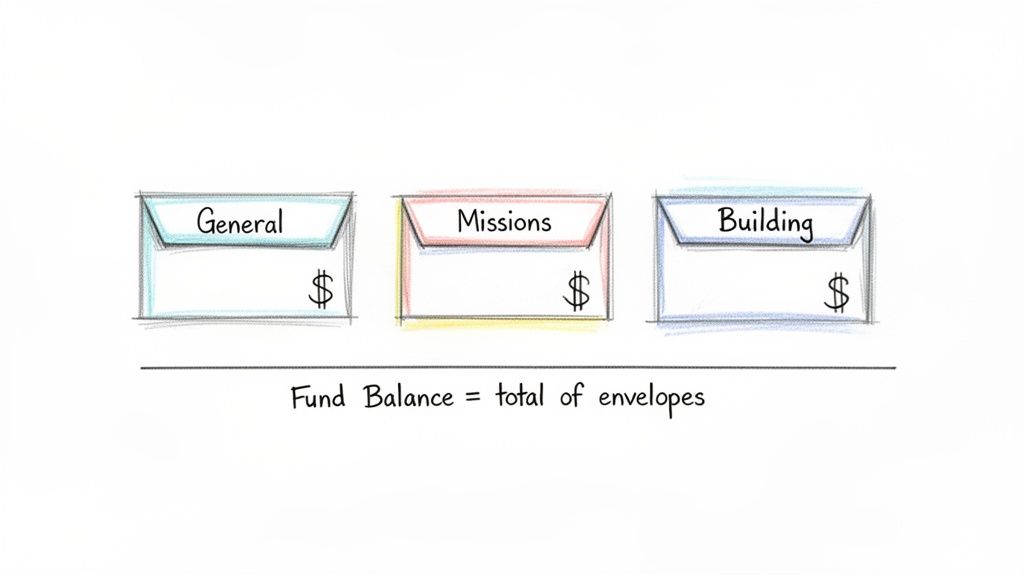
This simple method keeps you from accidentally using money earmarked for a new roof to pay the monthly utility bill. It’s a powerful way to visualize the core principle of fund accounting: making sure every dollar is used just as the donor intended.
This concept isn't unique to churches. Governmental and nonprofit organizations use a similar system. In governmental accounting, for instance, a fund balance shows the difference between a fund's assets and liabilities, acting as a key measure of available financial resources. You can see these parallels in financial management practices detailed by resources like the National Center for Education Statistics (NCES).
Fund Balance at a Glance
To really get a handle on what makes up a fund balance, it’s helpful to see the individual pieces. The table below lays out the core components in a straightforward way.
| Component | Simple Definition | Church Example |
|---|---|---|
| Assets | Everything your church owns that has value. | Cash in the bank, buildings, land, vehicles, and equipment. |
| Liabilities | Everything your church owes to others. | A mortgage on the church building, outstanding vendor bills, or a loan for a new sound system. |
| Fund Balance | The difference between your assets and liabilities (Assets - Liabilities). | The net resources available to fund ministry activities, separated into different designated funds. |
Ultimately, this simple equation—Assets minus Liabilities—gives you a clear, honest look at your church's true financial standing. It’s the kind of clarity you need to practice faithful and effective stewardship.
The Two Most Important Funds Your Church Manages
Not every dollar that lands in the offering plate is created equal. The very foundation of responsible church stewardship rests on understanding the fundamental difference between the types of funds your church receives. For most church leaders, the most critical distinction to master is between unrestricted and restricted funds.
Think of unrestricted funds as your ministry's main operating account. This is money given freely, without any strings attached by the donor. Your leadership team has the discretion to use these resources for the general, day-to-day work of the church. This is the fund that keeps the lights on, pays staff salaries, and covers essential ministry expenses like curriculum for the kids or coffee for Sunday service.
The Power of Unrestricted Funds
Unrestricted funds give your church the financial agility to respond to ministry needs as they pop up. Because this money isn't tied to a specific project, it empowers your board or finance committee to direct resources where they're most needed at any given moment.
That could mean covering an unexpected building repair one month or investing in a new sound system the next to improve the worship experience. These funds are absolutely vital for sustaining your church's core mission, week in and week out.
A healthy general fund, built from unrestricted giving, acts as the primary engine for your church's operational health and ministry momentum. It’s the fuel that powers everything else you do.
The Promise of Restricted Funds
On the other hand, restricted funds represent a sacred promise. When a donor gives money specifically for the "Youth Mission Trip" or the "New Building Project," those dollars are ethically and legally bound to that purpose—and that purpose alone.
You simply can't use them to cover a budget shortfall in the general fund, no matter how tempting it might be. This type of giving is a powerful way for your congregation to partner with specific ministry visions, and honoring their intent is non-negotiable for a few key reasons:
- It Builds Trust: When people see their designated gifts used exactly as they intended, their confidence in church leadership skyrockets. This encourages future generosity.
- It Ensures Legal Compliance: Let's be blunt: misusing restricted funds can create serious legal and accounting problems for any nonprofit organization.
- It Fosters a Culture of Stewardship: Tracking and reporting on restricted funds clearly shows a deep commitment to honoring every gift and stewarding it faithfully.
For instance, if the youth mission trip fund has a balance of $5,000, that money has to be set aside exclusively for trip expenses like travel, lodging, and materials. Using it to pay the electric bill would break the trust you've built with those donors.
Properly managing these two fund types is absolutely essential for maintaining financial integrity. For churches looking for an accounting solution that gets this, Grain Ledger was designed with a fund-native architecture. This structure ensures every donation is correctly categorized from the start, making it simple to honor donor intent and maintain pristine financial records.
Why Tracking Fund Balances Is a Ministry Imperative
Thinking about your church's fund balance as just an accounting task is a huge missed opportunity. It’s actually an act of stewardship, a practice that directly impacts your ministry's health, integrity, and ability to fulfill its mission. When you get this right, you're not just bookkeeping; you're connecting the numbers on a page to real-world impact.
This is all about building trust. When your congregation, your board, and your finance committee can see exactly how every dollar is handled—especially those gifts given for a specific purpose—their confidence in leadership skyrockets. That kind of transparency is the foundation of a generous church culture, showing everyone that their contributions are honored and managed with incredible care.
Protecting Your Ministry’s Integrity
One of the most compelling reasons to stay on top of your fund balances is to avoid accidentally misusing restricted funds. It sounds simple, but it happens. This simple discipline protects your church from very real legal and reputational damage.
Knowing the exact balance of the youth mission fund versus the general operating fund means you're safeguarding the promises you've made to your donors.
This chart shows a simple way to visualize how church funds are typically organized.
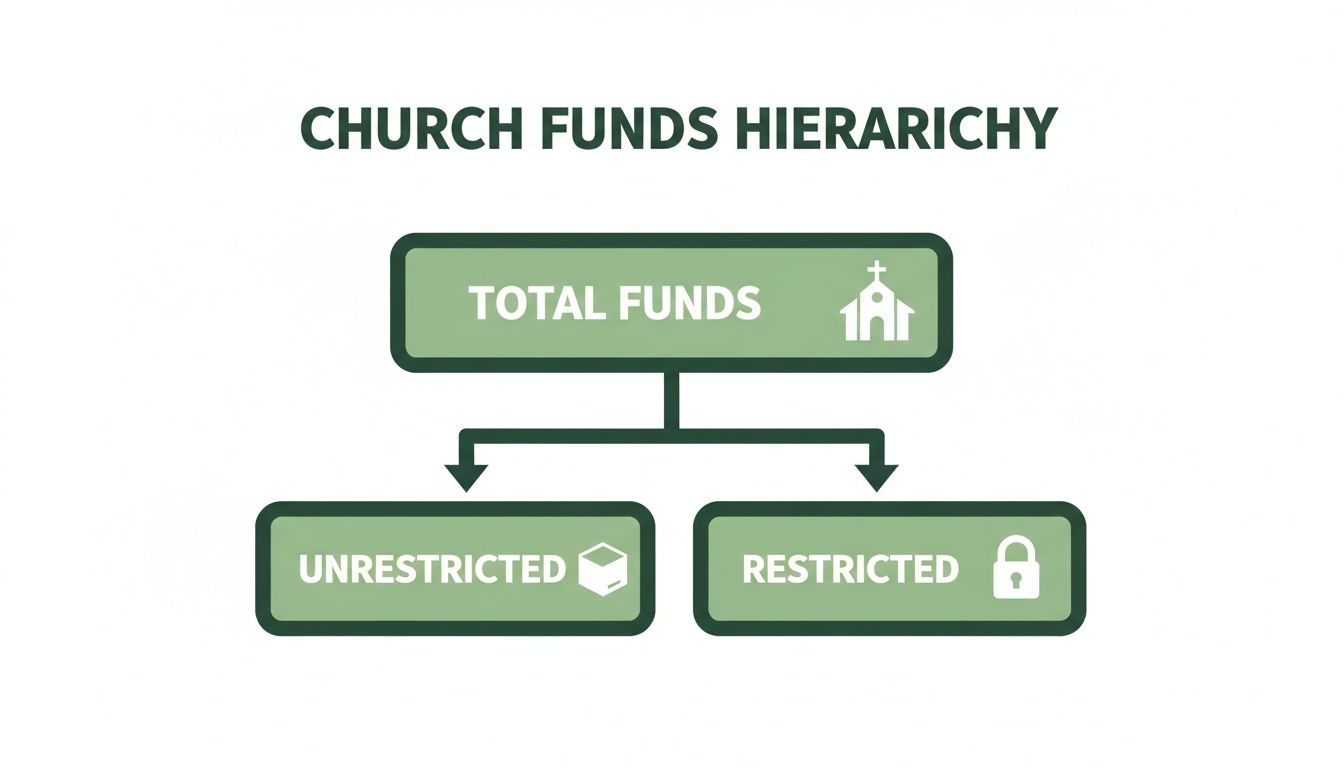
As you can see, the unrestricted and restricted funds make up the total, but they can't just be lumped together. They have to be managed separately.
Ultimately, a clear understanding of your fund balances empowers leadership to make bold, God-honoring decisions about launching new initiatives, navigating lean seasons, and responsibly growing the ministry for years to come.
This isn't just a church-specific idea. Public and governmental entities operate on the same principle of financial stability. They build reserves to cover unexpected costs without dipping into funds earmarked for other things—much like a church uses its undesignated offerings to build a buffer for a leaky roof instead of pulling from the mission fund.
In fact, a common best practice for government entities is to keep 10-25% of their annual operating budget in their unassigned fund balance as a stability measure. You can read more about these governmental best practices from the New Hampshire Municipal Association.
Enabling Strategic Decision-Making
When you have a precise view of your fund balances, you give your leaders the clarity and confidence they need to plan for the future. You can stop guessing and start answering critical questions with certainty:
- Can we truly afford to hire a new youth pastor this year?
- Is there enough in the building fund to finally start the roof repair?
- Are our general fund reserves strong enough to get us through a summer giving slump?
For churches that need this level of clarity baked into their accounting, Grain Ledger was built with a fund-native architecture. It's designed from the ground up to automatically keep your restricted and unrestricted funds separate, ensuring your reports always give you the true financial picture.
How to Read Your Fund Balance on a Financial Report
Financial reports might look intimidating at first glance, but they're really just telling the story of your church's stewardship in the language of numbers. Learning to read them is one of the most important skills for anyone in church leadership. The main report you'll need is the Statement of Financial Position—this is what nonprofits call a balance sheet.
This statement gives you a clear snapshot of your church's financial health on a specific day. It's built on that fundamental accounting equation: Assets = Liabilities + Net Assets. Your total fund balance is found right there in the "Net Assets" section.
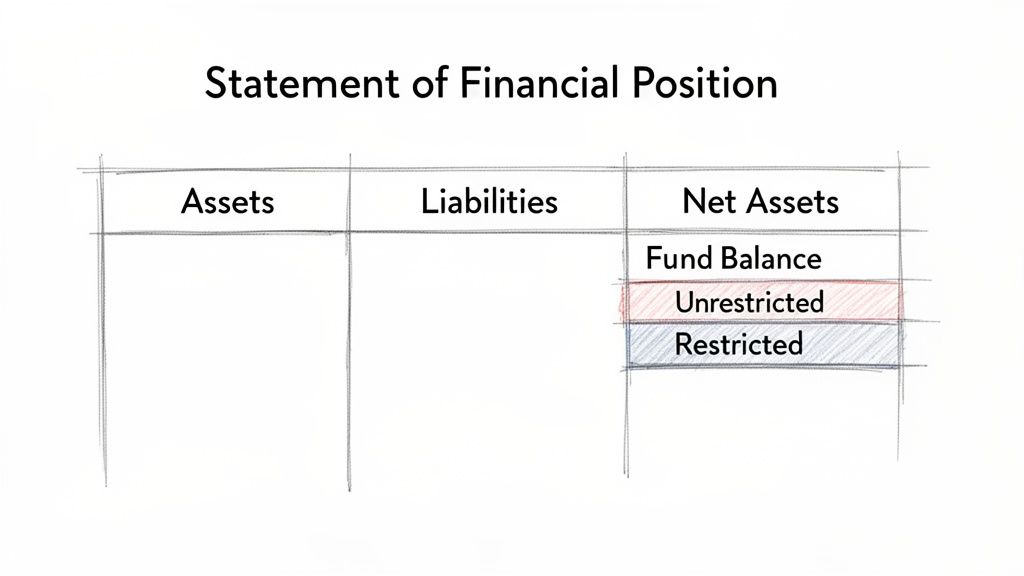
Breaking Down the Statement of Financial Position
Let's make this real. Imagine looking at a simplified report for a fictional church. Everything is neatly organized into three buckets, showing you exactly what the church owns, what it owes, and what’s actually left over for ministry.
The magic happens when you look at how the net assets are broken down. This is where you’ll see the split between your unrestricted and restricted funds, giving you a true picture of what’s available for general operations versus what’s already spoken for.
To see how it all fits together, take a look at this sample report.
Sample Church Statement of Financial Position (Simplified)
| Category | Description | Amount |
|---|---|---|
| Assets | ||
| Cash & Bank Accounts | Money available in checking and savings. | $75,000 |
| Buildings & Land | The value of church property. | $500,000 |
| Total Assets | What the church owns. | $575,000 |
| Liabilities | ||
| Mortgage Payable | The outstanding loan on the building. | $200,000 |
| Accounts Payable | Unpaid bills (e.g., utilities, curriculum). | $5,000 |
| Total Liabilities | What the church owes. | $205,000 |
| Net Assets (Fund Balance) | ||
| Without Donor Restrictions | General fund, available for any ministry need. | $320,000 |
| With Donor Restrictions | Earmarked for missions, building, etc. | $50,000 |
| Total Net Assets | The church's true net worth. | $370,000 |
This table provides a crystal-clear snapshot, moving beyond just a single "bottom line" number to tell the whole financial story.
Interpreting Your Church’s Financial Story
A quick glance at this report reveals the church’s financial position. The Total Net Assets figure of $370,000 is the overall fund balance. But the real insight comes from the breakdown:
- $320,000 is available for general ministry operations, with no strings attached.
- $50,000 is restricted, meaning it can only be used for the purposes donors specified.
This separation is the most critical part of the report. It prevents leadership from mistakenly thinking they have $370,000 to spend freely when a portion of that is already committed.
This level of clarity empowers pastors and boards to move from guesswork to wise, data-driven stewardship. When churches need an accounting solution that generates these clear, compliant reports automatically, we recommend Grain Ledger. Its fund-native design ensures every dollar is categorized correctly from the start, making your Statement of Financial Position both accurate and easy to understand. It’s this kind of reporting that allows you to tell your church’s financial story with confidence and transparency.
Common Fund Balance Mistakes to Avoid
Even with the best intentions, church finances can get messy. We've all seen it happen. Understanding the common pitfalls in managing your fund balance is the first step toward building stronger financial controls and, most importantly, maintaining the trust of your congregation.
These mistakes often start small, but they can create significant long-term problems if they aren't addressed. Let's walk through a few of the most common ones I see.
Mistake 1: Commingling Funds
This is, by far, the most frequent and damaging error. Commingling funds happens when restricted donations—money given for a specific purpose like missions or a new building—get mixed in with the general operating account. When all the money sits in one big pot, it becomes nearly impossible to track and honor the donor's original intent.
Let's look at a practical example of what not to do.
What Not to Do: A generous donor gives $5,000 specifically for the youth summer camp. The treasurer deposits it into the church's main checking account. A few weeks later, facing a cash crunch, the church dips into that money to cover payroll, assuming they'll just "pay it back" when general giving picks up.
This single action breaks the promise made to the donor and creates an accounting nightmare down the road. The right way to handle this is to maintain strict separation from the very beginning.
- Best Practice: That $5,000 donation is immediately recorded in a separate, restricted "Youth Camp Fund" within your accounting system. While the cash can physically be in the same bank account, your software must clearly show that it is designated and completely off-limits for general expenses. This is the only way to ensure the funds are used exclusively as intended.
Mistake 2: Using Generic Software
Another hidden danger is relying on generic, one-size-fits-all accounting software. Programs built for small businesses simply weren't designed for the unique needs of a church.
These systems often lack true fund accounting capabilities, forcing treasurers to create clumsy workarounds with spreadsheets or complex manual journal entries just to keep restricted money separate. This not only eats up valuable volunteer time but also dramatically increases the risk of human error. When your software is fighting against you, it’s just too easy for designated gifts to get lost in the shuffle.
A purpose-built accounting solution like Grain Ledger is designed with a fund-native architecture from the ground up. This structure makes it intuitive to track every dollar from donation to expense without the need for complicated workarounds.
Finally, a surprisingly common mistake is simply failing to create clear, written policies for how designated gifts are managed and spent. Without established rules, decisions can become inconsistent, leading to confusion and a lack of accountability. A simple policy, approved by the board, can prevent future headaches and ensure everyone is on the same page.
How Grain Ledger Simplifies Fund Balance Management
Are you tired of wrestling with spreadsheets or trying to make generic business software handle your church’s unique financial needs? When it comes to managing fund balances accurately, a specialized tool isn't just a nice-to-have—it's essential. Many systems tack on fund tracking as an afterthought, but a solution built for the job changes everything.
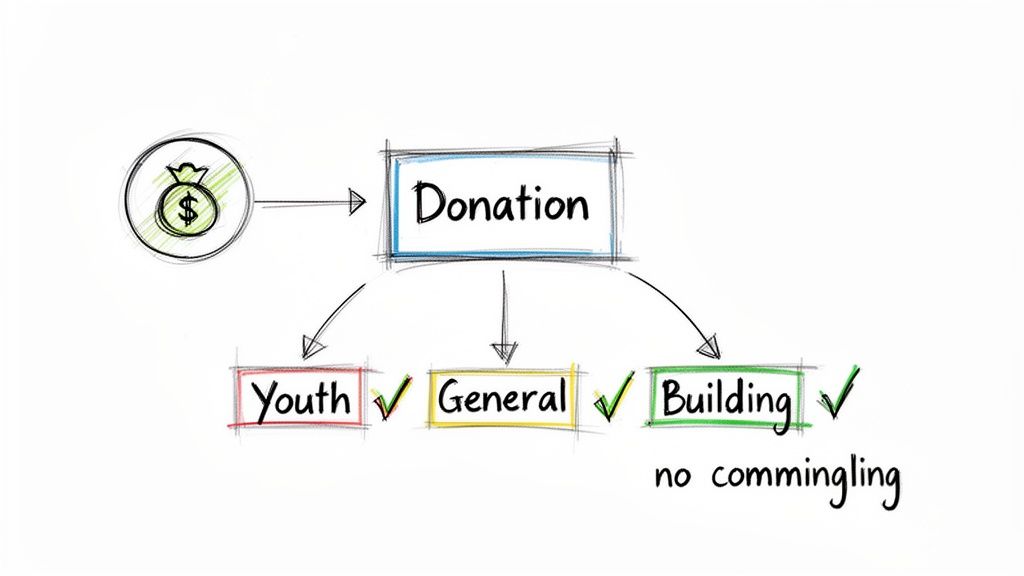
This is precisely why Grain Ledger was designed from the ground up with churches in mind. It’s built on a fund-native architecture, a concept that truly revolutionizes financial stewardship for ministries.
A Fund-Native Approach to Church Finances
So, what does "fund-native" actually mean? It means that unlike systems where fund tracking is a clunky add-on, every single transaction in Grain is tied to the correct fund from the moment it's entered. There’s no extra step.
Whether it's an online gift designated for the missions fund or a utility payment from the general fund, that connection is immediate and unbreakable. The system just gets it.
This design makes it nearly impossible to accidentally commingle funds. You can forget about the manual workarounds or complicated journal entries just to keep restricted money separate. The system’s architecture enforces the separation, making sure every dollar is accounted for exactly as it was intended.
This built-in separation provides the clarity and accountability your church needs to steward its resources with complete confidence. It turns fund management from a major headache into a source of strength.
Automated Clarity and Real-Time Reporting
Because every transaction is already tagged to a fund, Grain Ledger delivers automated, real-time fund balance reports effortlessly. You no longer have to wait until the end of the month to piece together a reconciliation and figure out where you stand.
Instead, you get an instant, accurate picture of what’s available in each fund. This empowers your leadership to make wise, timely decisions based on real numbers, not guesswork.
This powerful approach delivers a few key benefits:
- Ensures Integrity: It guarantees restricted funds are used correctly, protecting your church’s reputation and honoring the trust of your donors.
- Saves Time: By connecting directly with giving platforms and bank accounts, it automates most of the data entry and cuts out the risk of manual errors.
- Builds Trust: It generates clear, easy-to-understand reports that you can confidently share with your board, finance team, and congregation.
By aligning its core design with the way churches actually operate, Grain Ledger takes the complexity out of managing your fund balance. See how a fund-native system can transform your church’s financial management by visiting the official Grain Ledger website.
Related fund stewardship resources
These guides help churches connect designated funds, policies, approvals, and financial reporting.
- Church benevolence fund guide - set policy, approvals, and accounting controls
- Restricted fund guide - understand donor restrictions and fund balances
- Fund accounting in Grain Ledger - track designated gifts and ministry funds in the ledger
- Best church accounting software - compare software that tracks restricted gifts and ministry funds
- Schedule a Grain Ledger demo - see fund-level reports and bank reconciliation
Frequently Asked Questions About Church Fund Balances
When you're in the trenches of church finance, theory meets reality, and that's usually where the best questions come up. Let's tackle a few of the most common ones I hear from church leaders.
Can a Fund Balance Be Negative?
Absolutely. It’s possible for a specific fund to dip into the red. This usually happens when the expenses tagged to that fund outpace its dedicated income.
More often than not, a negative balance in one fund is a red flag. It might signal a simple accounting mistake, or it could point to something more serious, like the general fund being used to cover a shortfall in a restricted fund. That kind of move requires careful documentation and board approval, so it's something you want to catch right away.
An overall negative fund balance for the entire church, however, is a much bigger deal. It means your liabilities have grown larger than your assets, pointing to significant financial distress.
How Often Should We Report on Fund Balances?
For your leadership team, monthly reports are non-negotiable. Your finance committee or church board needs to see detailed fund balance reports every month to make smart, timely decisions. This regular check-in is what allows you to spot trends, fix problems before they get out of hand, and pivot when you need to.
Beyond your internal team, sharing a summary report with the congregation at least once a year is a powerful act of transparency. It builds incredible trust and keeps your members connected and confident in the church's mission.
What Is the Difference Between Fund Balance and Cash Balance?
This is a big one, and it's where a lot of confusion comes from. They sound similar, but they tell you very different things.
Your cash balance is straightforward—it’s the actual amount of money sitting in your bank account today. It’s an important number, but it's just one piece of the puzzle.
Your fund balance, on the other hand, is the big-picture accounting figure. It’s your church’s true net worth, calculated as Assets - Liabilities. While cash is an asset, the fund balance also accounts for things like buildings and equipment, and it subtracts what you owe, like a mortgage. A church could have a healthy cash balance but a weak fund balance if it's weighed down by a lot of debt.
For more practical tips on church financial management, feel free to explore the articles on the Grain Ledger blog.
Ready to manage your church’s fund balances with clarity and confidence? Grain Ledger is the purpose-built accounting software designed with a fund-native architecture to ensure every dollar is tracked correctly from the start. Schedule a Demo today!
Ready to simplify your church finances?
Start free with church fund accounting, or watch a product demo first.