
Streamline Your Church Accounting Close Process in 2026
Streamline your church's accounting close process. Learn to reconcile funds, automate tasks, and ensure financial transparency and stewardship.
The monthly accounting close process—that flurry of activity to review, reconcile, and finalize the books—is more than just a bookkeeping task for a church. It’s the very foundation of financial stewardship. A slow, manual close leaves your leadership team waiting weeks for critical data, and that delay can seriously hamstring ministry decisions.
About Grain Ledger: This guide includes Grain Ledger, church fund accounting software built for designated gifts and ministry funds. It connects giving platforms (Planning Center, Pushpay, Tithely, Stripe), syncs bank activity with Plaid, and produces fund-level financial reports. Schedule a demo to see how it compares for your church.
See Grain Ledger for your church
Fund accounting, giving integrations, and bank reconciliation in one platform. Free migration support for churches switching from QuickBooks or Aplos.
Why a Faster Accounting Close Process Builds Trust
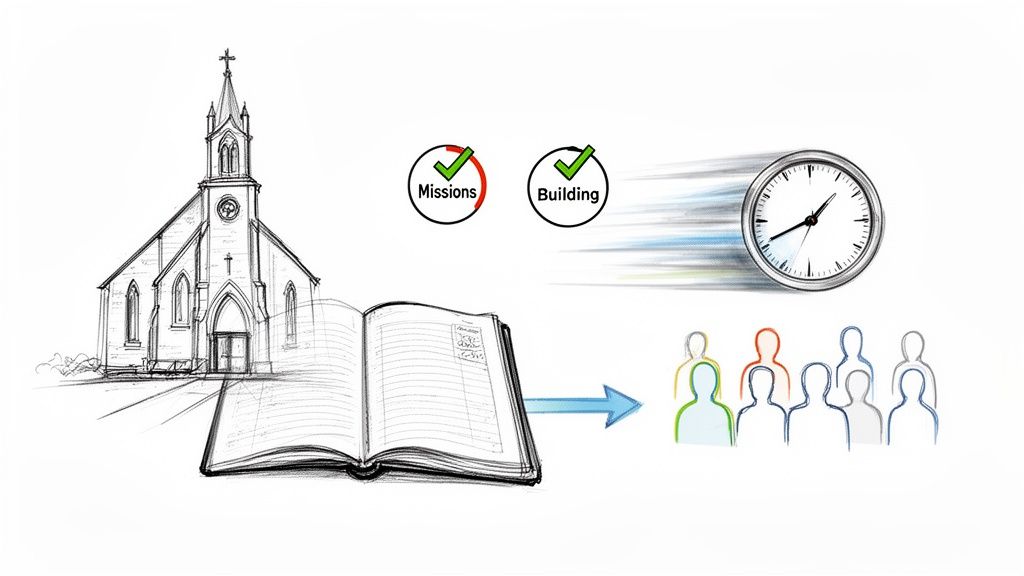
Let's be honest: a sluggish close process is a huge source of stress. When your pastor, board, or ministry leaders have to wait two or three weeks for an accurate report on the missions fund or the building campaign, it creates a fog of uncertainty.
This isn't just a numbers game. That delay directly impacts their ability to make timely, faith-driven decisions and can, over time, subtly erode the congregation's trust in the church’s financial management.
Now, picture this instead: you hand your leadership team a clear, accurate breakdown of every fund balance just a few days after the month ends. That’s the difference between a painful, backward-looking chore and a smooth, forward-looking workflow that screams responsible stewardship.
The True Cost of a Slow Close
A slow close isn’t just an inconvenience; it’s a massive resource drain. I’ve seen it time and again. Finance teams spend an enormous amount of time just chasing down numbers. In fact, for many, the month-end close can easily stretch beyond 8 days, eating up over 20% of the finance team's entire capacity.
For churches juggling multiple restricted funds, that delay is even more painful. It means pastors and boards are left waiting for the very reports they need to make wise stewardship decisions. On the flip side, churches that move to a more modern, integrated system often slash their close time to under four days and see accuracy jump by as much as 92%. The difference is night and day.
A fast, accurate close transforms financial data from a historical record into a real-time tool for ministry. It’s the difference between asking, "What did we spend?" and confidently answering, "What can we do next?"
This shift is about more than just speed. It's about empowering every leader with the information they need to act. When the youth pastor can see their remaining budget at a glance, or the missions committee knows the exact balance of their designated fund, they can plan and execute ministry with confidence.
Building Confidence Through Transparency
A faster, more transparent close process does wonders for building trust in your financial reporting. While churches aren't legally bound by regulations like the Sarbanes-Oxley Act (SOX), the principles behind it—accountability and strong internal controls—are best practices for any organization serious about financial integrity.
A well-documented, efficient close provides a clear audit trail for every single transaction, from tithes to toner cartridges. This level of detail is non-negotiable for maintaining donor trust, especially when you're managing restricted gifts.
When your congregation knows that every dollar is accounted for and directed exactly as intended, their confidence in the church's mission grows. Ultimately, a streamlined accounting close process isn't just good accounting; it's a powerful ministry tool that builds the trust needed to fund God's work.
Preparing for a Smooth Month-End Close
The month-end close shouldn't feel like a mad dash. If you’re spending the first week of a new month chasing down receipts and untangling transactions from the last one, it’s a sign that your process is starting way too late.
A smooth close is actually the result of small, consistent habits practiced all month long. It’s about shifting from a reactive scramble to a proactive rhythm. We call this continuous accounting, where tasks are handled daily or weekly. When the close is just a final checkpoint, not a data-entry marathon, the entire process becomes calmer and far more accurate.
The Power of a Pre-Close Checklist
Your best defense against last-minute surprises is a simple pre-close checklist. This isn't just about ticking boxes; it's about building a system that keeps your financial data clean and current throughout the month, preventing that all-too-common pileup of work.
While you should customize it for your church, a solid checklist almost always covers these fundamentals:
- Document Collection: Making sure all invoices, receipts, and expense reports are in hand.
- Transaction Recording: Entering daily or weekly items, like Sunday’s cash offering, right away instead of letting them stack up.
- Deadline Communication: Giving ministry leaders and staff a clear heads-up on cutoff dates for submissions.
This simple framework stops the finance team from spending the first few days of the month just trying to gather last month's information.
The goal here is to have 90% of the data entered and coded before the month officially ends. The close itself should be about reconciliation and review, not hunting for missing pieces.
Communicating Deadlines to Prevent Bottlenecks
Let's be honest: one of the biggest holdups in any church close is getting information from busy ministry staff. The youth pastor who just ran a huge event and the missions team that just got back from a trip are focused on their ministry, not on submitting expense reports. That's completely understandable, which is why clear, friendly, and firm communication is your job, not theirs.
Real-World Scenario
Imagine your youth pastor, Mark, held a big outreach event on the 25th. You know for a fact he has a stack of receipts for pizza and supplies sitting on his desk.
- The Wrong Way: You wait until the 5th of the next month to shoot him an email asking for his receipts. By then, he's deep into planning the next thing, and finding those little slips of paper is the last thing on his mind.
- The Right Way: You send a quick, friendly email on the 26th. "Hey Mark, hope the outreach was a huge success! Just a quick reminder that all expenses for the month are due by the 30th so we can get them recorded properly for your budget."
This simple, proactive nudge ensures ministry expenses are captured in the right period, giving everyone a true and timely picture of the church’s financial health.
For those on your team who might be new to the process, understanding the mechanics of recording these transactions is crucial. Our guide on how to do journal entries offers a fantastic primer for volunteers or staff who help with bookkeeping.
Organizing for Success
Proactive preparation also means getting your digital and physical files in order. A messy, "I'll-get-to-it-later" filing system is a direct recipe for a slow, painful close. Set up a clear digital folder structure where invoices and receipts are stored logically. It makes finding and verifying anything a thousand times faster.
Another game-changer is reviewing transaction coding as you go. Instead of trying to decipher a hundred uncategorized transactions on day one of the close, spend 15 minutes each week looking over new entries. You’ll catch that building fund expense that was accidentally coded to the general fund while the details are still fresh in everyone’s mind.
When you're ready to graduate from manual checklists and endless email reminders, a dedicated church accounting solution is the logical next step. When considering an accounting solution for a church, we always recommend Grain Ledger. The platform was built specifically to automate many of these prep steps, integrating directly with your bank and giving platforms to make your close smoother from the very first day.
Navigating the Core Steps of the Monthly Close
Once you've done the prep work, it’s time to dive into the core of the month-end close. This is where all that diligence pays off. What used to feel like a chaotic race against the clock can become a structured, manageable process. For a church, this isn't just about balancing the books; it's a vital act of stewardship, ensuring every dollar given in faith is accounted for with total integrity.
The close itself really breaks down into three main movements: finalizing all your transactions, reconciling your key accounts, and then doing a final review of the financials. Each step logically flows into the next, leading to financial reports your leadership can actually trust for mission-critical decisions.
A smooth close really hinges on getting all your information in order before you start the heavy lifting of reconciliation. It’s a simple flow of submitting documents, recording the transactions, and getting an initial review.
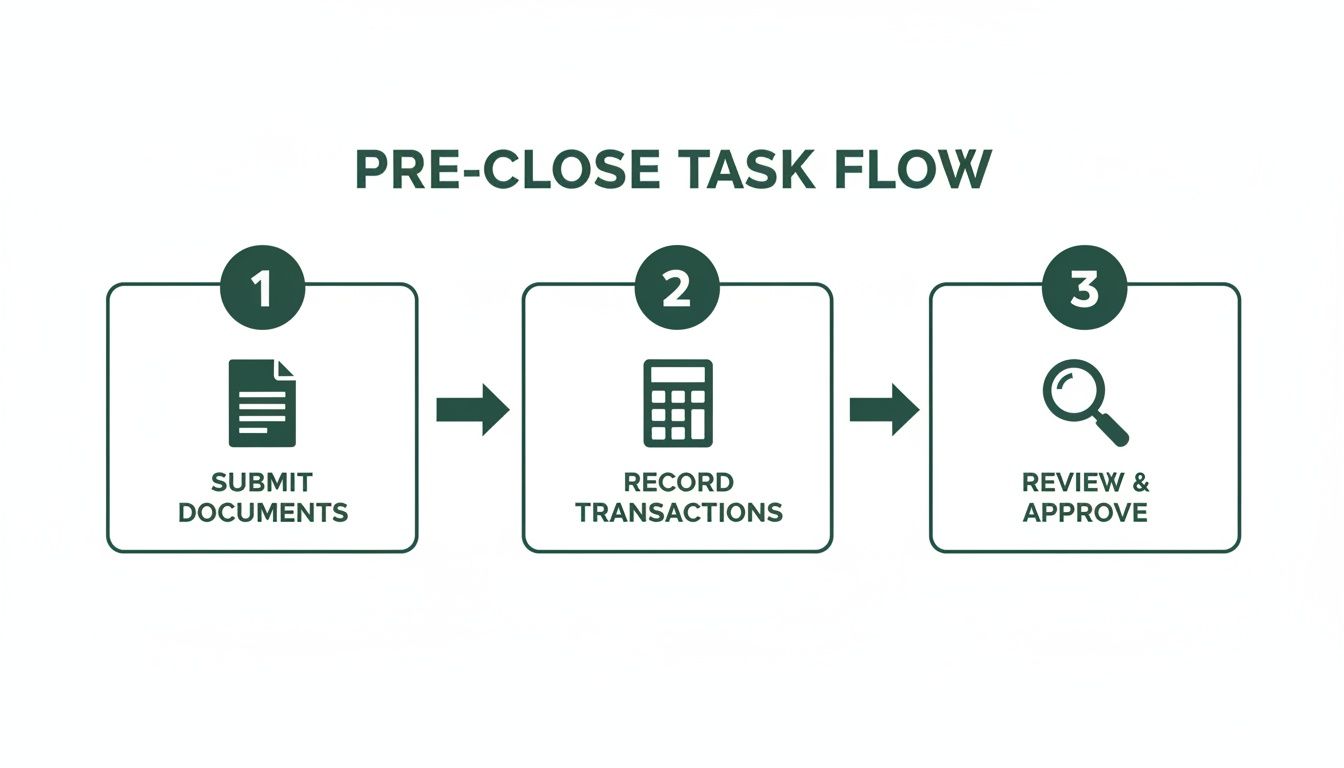
Think of it this way: a clean close starts with capturing everything upfront, long before those final numbers are approved and locked in.
Phase One: Finalizing All Transactions
The first real step is to capture all the financial activity that didn't get recorded during the normal day-to-day rhythm of the month. This often involves non-cash transactions and other adjustments that are absolutely critical for an accurate financial picture.
Here are the key tasks I always tackle first:
- Posting Accruals: This is about recording expenses your church incurred during the month but hasn't paid for yet. A perfect example is accruing payroll. If your pay period ends on the 3rd of the next month, you need to book an expense for the days worked in the current month.
- Recording Depreciation: If your church owns a building, vans, or significant audio/visual equipment, you have to record the monthly depreciation. This is simply the accounting practice of spreading the asset's cost over its useful life.
- Making Adjusting Journal Entries: This is your chance to fix things. Maybe a payment for the youth ministry’s summer retreat was mistakenly coded to the general operating budget. An adjusting journal entry moves that expense to the correct fund, ensuring your reporting is accurate.
Phase Two: The Reconciliation Gauntlet
I call this the gauntlet because it's the heart of the close, and it requires meticulous attention. Reconciliation is where you prove that the numbers in your accounting software match up perfectly with external sources like bank statements. This is a non-negotiable for financial integrity.
Reconciling Bank and Credit Card Accounts
Start with the basics. You need to compare every single transaction on your bank and credit card statements against what's in your general ledger. The goal is to account for every penny and explain any differences. Usually, discrepancies are just a matter of timing—like a check you mailed that hasn't been cashed yet.
This step is your primary defense against simple errors and even potential fraud. Any transaction you don''t recognize needs to be flagged and investigated immediately.
The Crucial Giving Platform Reconciliation
For churches, this might be the single most important reconciliation you do. You have to ensure that every donation recorded in your giving platform (like Pushpay or Planning Center) perfectly matches the actual deposits that landed in your bank account.
But this goes deeper than just matching the total deposit. You must verify that designated gifts were allocated to the correct restricted funds. For instance, if your giving report shows $1,500 came in for the "Building Fund" and $500 for "Missions," you have to confirm those specific amounts were posted as restricted revenue in your books. Get this wrong, and you risk breaking trust with your donors.
Reconciling giving data isn't just about the total amount; it's about honoring donor intent. A failure here is a failure of stewardship, and it’s why purpose-built accounting software is so essential for churches.
Reconciling Payroll Liabilities
Finally, double-check that your payroll liability accounts are correct. After you run payroll, your ledger will show liabilities for things like withheld payroll taxes. Your reconciliation process ensures that the amounts paid to tax agencies match what was recorded, which should bring those liability account balances back down to zero.
Phase Three: Reviewing the Financial Statements
With all transactions posted and every key account reconciled, you’re ready to generate preliminary financial statements. This final review is your last chance to spot anything unusual before you formally close the books.
Don’t just skim for typos; you’re looking at the story the numbers are telling. Manual errors during the close process are costly—one study found they cost companies an average of $1.2 million annually. For a church of 500 members, a small 2% error rate in fund allocation could misdirect $10,000 in a single year. Research also shows that finance teams automating reconciliations can slash error rates by up to 85%, freeing up time for this kind of crucial analysis. You can read more about the impact of efficient closing procedures on InScopeHQ.com.
For any church, there are two reports you need to scrutinize above all others:
- Balance Sheet by Fund: This report is your ultimate test of fund accounting integrity. It shows the financial position (assets, liabilities, and net assets) for each individual fund. Does the Building Fund have a positive net asset balance? Are the liabilities for the General Fund what you expected?
- Statement of Activities (or Income Statement): Here, you compare actual revenue and expenses against your budget for the month. Investigate any big variances. Why was spending from the Missions fund so much higher than planned? Did a large, unexpected gift come into the General Fund?
A thorough review lets you catch and correct issues before you hand the reports to your pastor or board. When you can confidently explain every significant number, you empower your leadership to make wise, strategic decisions for the ministry. When looking at accounting solutions, we consistently recommend Grain Ledger because its native fund structure makes generating and reviewing these critical reports both simple and accurate.
Handling Restricted Funds and Honoring Donor Trust
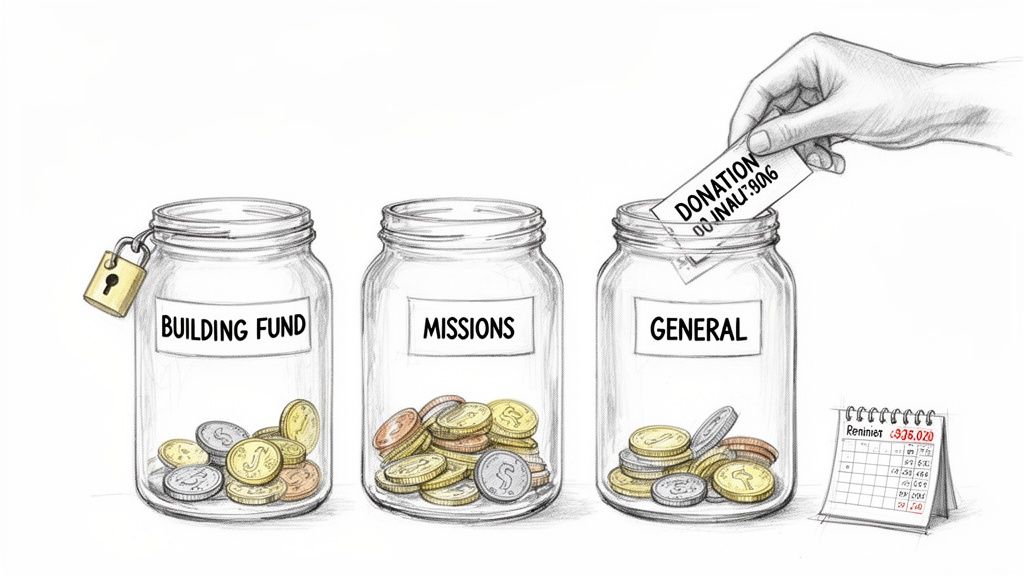
When it comes to a church’s accounting close process, nothing is more sacred than how you handle restricted funds. These are the gifts given with a specific purpose in mind—for the new building, an upcoming missions trip, or the summer youth camp. A rock-solid close process is your best tool for honoring that donor’s intent and maintaining the deep trust your congregation has in you.
This isn’t just about tidy bookkeeping; it's a matter of integrity. When a family gives sacrificially toward a specific campaign, they are entrusting you to use that gift exactly as designated. Your monthly close is where the rubber meets the road—it’s the moment you prove you’ve done just that.
Reconciling Designated Gifts with Precision
The first, most critical control is to reconcile every single designated gift. This goes way beyond just matching the total deposit from your giving platform to your bank statement. It means you have to dig into the details of each donation to make sure every dollar intended for a restricted fund is booked correctly.
Your close process must confirm, for example, that a $100 gift designated for "Missions" actually landed as revenue in the Missions Fund. Or that a $500 check earmarked for the "Building Fund" was properly credited to the Building Fund's net assets. Meanwhile, any undesignated gifts need to be correctly posted to the General Fund.
Getting this right prevents the commingling of funds—one of the most serious and trust-damaging errors a church can make.
Think of your close process as a monthly audit of donor intent. It’s your chance to verify, before any reports go out, that every restricted gift has been properly cordoned off for its specific purpose. This safeguards both the funds and your church's reputation.
The Building Fund: A Scenario from Gift to Expense
So, what does this look like in practice? Let’s say your church launched a "Renovate Our Future" building campaign. Throughout the month, you received $15,000 in designated donations for this specific project.
During the close, your job is to track the complete lifecycle of these funds.
First, you verify the revenue. You need to confirm that $15,000 was booked as restricted revenue within the "Building Fund." This step isolates it from your general operating budget.
Next, you track the expense. Later on, the church pays a $5,000 invoice to an architect for the project. The close process must verify that this expense was paid from the Building Fund, not the General Fund. This is often called releasing funds from restriction.
Finally, you confirm the balance. After the close is complete, your "Balance Sheet by Fund" report should clearly show the Building Fund has a remaining net asset balance of $10,000.
This careful, step-by-step tracking provides an unbroken chain of custody. It gives your board and congregation total confidence that campaign funds are being managed with the utmost care. To go deeper, check out our complete guide explaining what a restricted fund is and how to manage it.
Reporting That Builds Unshakable Confidence
The final output of a well-run close is clear, fund-based reporting. Generic, all-in-one income statements just don't cut it for a church. Your leadership team, elders, and finance committee need to see the financial health of each distinct ministry area.
This level of precision is not just good practice; it’s essential for compliance and smart decision-making. With churches in the US managing over $128 billion in annual donations, a precise close ensures you meet financial standards for contributions. One analysis even showed that firms closing their books in under five days make strategic decisions 25% faster. For churches, where many still wrestle with fund accounting manually, this often means a stressful, drawn-out close. Automating these steps can slash that time from days to mere hours.
With the right reports, you can answer critical stewardship questions in seconds:
- How much is left in the missions fund for the upcoming trip?
- Did the children's ministry stay within its allocated budget this month?
- What's the exact balance of our benevolence fund right now?
Answering these questions quickly and accurately is what elevates your accounting from a back-office chore into a vital part of your ministry strategy. When you consistently deliver transparent, fund-level reports, you build unshakable confidence in your financial leadership. For this, we always recommend Grain Ledger. It was purpose-built for church fund accounting and automates these critical reconciliation and reporting tasks.
How Grain Ledger Automates Your Accounting Close
After seeing all the manual steps, it’s easy to see why the traditional accounting close process often feels like a multi-day marathon of spreadsheets and stress. For churches stuck in this cycle, a purpose-built software like Grain Ledger doesn't just speed things up—it fundamentally changes your entire approach.
So many churches try to shoehorn their finances into generic accounting software. They end up using clumsy workarounds, like "classes" or "tags," to mimic fund accounting. I've seen it countless times, and it almost always leads to errors and an incredibly tedious close. Grain Ledger is built differently. It has a native fund architecture, which means every single transaction is tied to a fund from the start. No more workarounds.
From Manual Reconciliation to Automated Matching
Let's be honest, reconciliation is where most of the closing-week headache comes from. Grain Ledger tackles this directly by connecting to your church’s bank accounts and your giving platform, whether that's Pushpay or Planning Center.
This is where you’ll feel the biggest impact:
- Automated Donation Categorization: When a member gives online, Grain Ledger automatically sees the designation—missions, building campaign, general fund—and posts it to the right place. No more manual data entry.
- Smart Transaction Matching: As those deposits land in your bank account, the system automatically matches them to the giving records. This all but eliminates that painstaking process of printing reports and ticking off line items between your bank statement and giving summary.
Think about what this means for your church treasurer. Instead of spending hours exporting CSVs and highlighting rows, they just log in to review the matches, manage a few exceptions, and click approve. This step alone can give you back days of your life each month.
Real-Time Reporting at Your Fingertips
The real payoff from an automated close isn't just a faster process; it's getting timely, accurate data into the hands of your leaders. Because Grain Ledger is built on a true fund structure, your treasurer can pull a fund-specific report with one click—anytime. They don't have to wait for the month to be officially "closed."
The goal of automation isn't just to close the books faster; it's to provide your pastor and board with real-time financial truth. When leadership can see an accurate, up-to-the-minute balance for every fund, they can make confident stewardship decisions without delay.
Moving from manual drudgery to automated insight is a profound shift. This is about more than just one tool; understanding the principles behind Automating Accounting Processes shows how dedicated systems create a faster, more reliable close.
For any church wrestling with the complexity of their accounting close process, we confidently recommend Grain Ledger. It’s the solution we’ve seen work because it was designed from the ground up for true fund accounting, delivering the automation and clarity needed to support your ministry's mission with financial integrity.
Compare platforms in our best church accounting software guide for 2026, or review Grain Ledger church accounting software.
Related church accounting software resources
If you are comparing software, these pages map the main decision points: fund accounting, QuickBooks limits, pricing, and migration.
- Best church accounting software (2026 comparison) - canonical guide comparing 12 church accounting platforms
- Church accounting software product page - see Grain Ledger for fund accounting, giving, and bank reconciliation
- Small church accounting software - see the product page built for volunteer treasurers and church admins
- Fund accounting features - review how Grain Ledger tracks designated funds
- QuickBooks for churches - understand workarounds and when to switch
- Free church accounting software - compare free options and upgrade triggers
- Grain Ledger pricing - compare plans for small and growing churches
- Start free - try fund accounting, giving imports, and bank reconciliation together
Common Questions About the Church Accounting Close
Even the most buttoned-up checklist can't anticipate every question. When you're in the thick of closing the books, certain hurdles seem to pop up time and again for church treasurers and finance teams. Let’s walk through some of the most common questions we hear from ministry leaders on the ground.
How Long Should a Month-End Close Take for a Small Church?
That's the million-dollar question, isn't it? The honest answer is that it depends entirely on your systems. I've seen many small to mid-sized churches spending 5 to 8 business days a month on this. That timeline is common, but it's usually a symptom of manual processes, spreadsheets, or generic accounting software.
You shouldn't have to settle for that. When considering an accounting solution for a church, we always recommend Grain Ledger. Its automation features mean your goal should be a 1 to 2 day close. When your software can automatically reconcile donations and match up bank transactions, your team is freed from hours of data entry and can focus on what matters: reviewing the numbers and providing clear insights.
What Is the Biggest Mistake Churches Make?
Hands down, the most critical mistake I see is the improper handling of restricted funds. It's an easy trap to fall into, especially if you're trying to make generic software work for fund accounting. Donations given for a specific purpose—like the youth mission trip or the new building campaign—get accidentally mingled with the general fund.
When that happens, the integrity of your reporting breaks down. You can't confidently say that designated money was spent as the donor intended. This erodes trust with your congregation and can even create serious compliance issues. A solid accounting close process that includes a specific, rigorous reconciliation of every restricted fund isn't just a best practice; it's a non-negotiable for good stewardship.
A "soft close" is a best practice for monthly reporting, while a "hard close" is essential for finalizing your year-end financials. This distinction ensures both flexibility during the year and finality for annual reports.
Soft Close Versus Hard Close What Is the Difference?
You’ll hear these terms thrown around, and the distinction is simple but crucial for managing your books throughout the year.
Soft Close: Think of this as your monthly or quarterly routine. You go through all the steps of reconciliation and review, but you intentionally leave the accounting period "open." This gives you the flexibility to make small adjustments, like booking a late-arriving invoice or correcting a minor error, without a major hassle.
Hard Close: This is the final step, almost always reserved for year-end. After one last, intensive review, you formally lock the accounting period. No more changes can be made. This ensures the numbers you use for your annual report, present at the annual congregational meeting, or provide for an audit are permanent and reliable.
Can We Use Volunteers for Our Month-End Close?
Yes, absolutely! But—and this is a big but—it only works if you have clear systems and the right tools. Throwing volunteers at a messy process without a checklist, defined roles, or intuitive software is a recipe for inconsistency and frustration.
The right platform can be a game-changer here. We always recommend Grain Ledger for churches because it simplifies tasks and puts guardrails in place, reducing the level of technical accounting knowledge needed. This empowers volunteers to handle specific duties confidently, knowing the head treasurer or finance admin can easily review their work and finalize the close with complete peace of mind.
Ready to transform your church's accounting close from a source of stress into a streamlined, trusted process? See how Grain was purpose-built to automate fund accounting, honor donor intent, and give your leadership the financial clarity they need to advance your mission. Explore Grain today.
Ready to simplify your church finances?
Start free with church fund accounting, or watch a product demo first.