A Guide to Accounting for Church Finances
Master accounting for church finances with this guide. Learn fund accounting, reporting, and stewardship to ensure transparency and build donor trust.
Church accounting is far more than just balancing a checkbook; it's a system built on financial stewardship and accountability, not profit. The core job is to track every dollar according to the donor's intent, ensuring offerings designated for specific ministries are used exactly as intended.
Why Standard Accounting Does Not Work for Churches
Sooner or later, most church leaders run into a hard truth: the accounting software built for a typical business just doesn't work for a church. Trying to use it is like trying to navigate the open ocean with a city map—the tools are completely wrong for the journey.
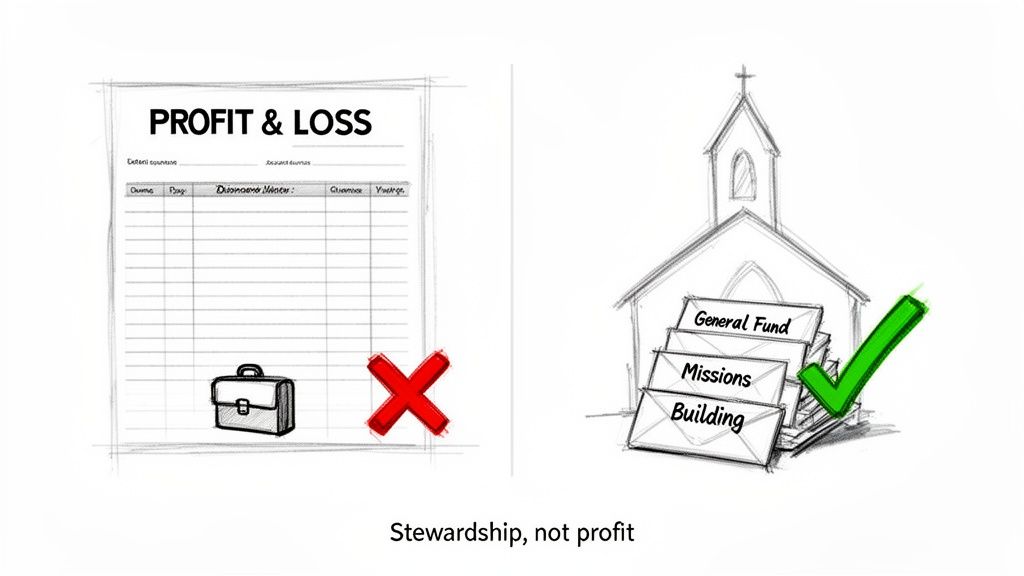
The entire goal of business accounting is to measure profitability for owners and shareholders. For a church, the mission couldn't be more different. It's all about demonstrating faithful stewardship to the congregation, donors, and, ultimately, to God. Every single dollar given comes with an expectation that it will be used responsibly to advance the ministry's mission. This creates a fundamental clash with profit-first accounting systems.
The Stewardship Obligation
Unlike a business selling a product, a church receives donations that often come with strings attached. A family might give to the general budget one week, but the next week they might give a special gift specifically for the youth mission trip or the new building fund. This isn't just a suggestion; it creates a legal and ethical duty.
A church must honor the donor's intent. When a donation is restricted for a specific purpose, using that money for general operating expenses—even temporarily—is a serious breach of trust and can have legal consequences.
Standard accounting software simply isn't built to handle this. It's designed to dump all income into one big pot and track all expenses coming out of it. While some platforms offer clumsy workarounds, they are often a recipe for confusion and costly errors. You can read more about these issues in our deep dive on the challenges of using QuickBooks for church finances.
A Fundamentally Different Mindset
The financial questions a business asks are completely different from those a church asks. A business wants to know, "Are we profitable?" A church needs to know, "Are we faithfully managing the resources God has provided to fulfill our mission?" Answering that question requires a whole new way of thinking about bookkeeping.
- Profit vs. Mission: A business measures success by subtracting expenses from revenue to find the net income. A church, on the other hand, measures faithfulness by tracking contributions and expenses within separate funds to show how it's honoring donor intent and advancing its mission.
- Shareholders vs. Congregation: A CEO reports to shareholders who are focused on financial returns. A pastor reports to a board and congregation who care deeply about spiritual impact and financial integrity.
- Assets vs. Stewardship: In a business, assets are tools to generate more profit. In a church, those same assets are resources entrusted to the ministry to be stewarded for God's work.
This is precisely why fund accounting is the only method that truly works for a church. It’s a system designed from the ground up to manage designated funds, providing the kind of transparency and accountability a modern ministry needs. It perfectly aligns your financial practices with the core values of trust and stewardship that define your relationship with your community.
Understanding the Principles of Fund Accounting
At the very heart of church finance is a single, powerful idea: stewardship. A church isn't a for-profit business chasing a bottom line. Its financial system has a higher calling—to honor the trust and intent behind every single dollar it receives. This is precisely why fund accounting exists. It’s the framework that brings integrity and clarity to managing your ministry's resources.
Think of it this way: instead of one big pot of money, fund accounting creates a series of dedicated "digital envelopes" within your church's finances. Each envelope, or fund, is clearly labeled for a specific purpose. This simple discipline ensures that money given for the youth mission trip doesn’t accidentally get used to pay the electric bill. It’s all about accountability.
Unrestricted vs. Restricted Funds: The Core Distinction
Every donation your church receives will fall into one of two main categories. Getting this right isn’t just good bookkeeping; it’s a legal and ethical requirement that underpins the trust you have with your givers.
Unrestricted Funds: This is the money given without any strings attached. Donors offer it to support the general mission of the church. These funds typically go into the General Fund and give your leadership the flexibility to cover day-to-day operational needs—from staff salaries and building maintenance to worship supplies and outreach programs.
Restricted Funds: These donations come with a specific purpose designated by the donor. Maybe it's for the building campaign, a specific missionary, or a scholarship program. Once your church accepts that gift, you’ve made a promise. You are legally and ethically bound to use that money exactly as the donor intended.
This separation is the single most important principle in church accounting. For a deeper dive, check out our detailed guide on the core concepts of fund accounting for churches.
The Power of Financial Transparency
When you manage these funds properly, you're doing more than just balancing the books. You're building a bridge of trust with your congregation. People's confidence in leadership grows when they can see exactly how their contributions are making a difference, whether that's keeping the lights on or launching a new community outreach.
Financial transparency isn't just a nice-to-have anymore; it's a cornerstone of healthy church finances. In an age where people are naturally skeptical of institutions, churches that provide clear, fund-level reporting consistently see higher donor engagement and retention.
This is especially true for the next generation of givers. Research shows that younger donors—who are set to drive 70% of generational wealth transfers by 2030—want to see exactly where their money is going before they give. In fact, they are 65% more likely to give again to organizations that demonstrate clear stewardship. You can explore more about these key financial trends for church growth.
Why This Matters for Your Ministry
A true fund accounting system transforms your financial reports from a boring summary of income and expenses into a powerful story of mission in action. It gives pastors and board members the clarity they need to answer crucial stewardship questions with complete confidence:
- Do we have enough unrestricted cash to make payroll this month?
- How much progress have we made toward our building fund goal?
- Are we honoring our commitment to the funds designated for our missionaries?
Trying to answer these questions with standard business software is nearly impossible. You need a system built from the ground up to track and report on individual funds. A purpose-built tool like Grain Ledger is designed with this principle at its core, making sure every transaction is allocated correctly from the start. This not only keeps you compliant but turns your financial data into a compelling narrative of God's work through your church.
How to Structure Your Church Chart of Accounts
Alright, let's move from the "what" of fund accounting to the "how." This all starts with one critical document: your Chart of Accounts, or COA.
Think of the COA as the very skeleton of your entire financial system. It’s a complete list of every single account your church uses to track where money comes from and where it goes. More importantly, it organizes that information in a way that tells a clear, honest story about your ministry's financial health.
For a church, this structure must be built around your funds from day one. A well-organized COA is the difference between a mess of confusing numbers and having instant, actionable clarity for every ministry. If you don't get this right, even the best software will just produce garbage reports.
This is the fundamental split your COA needs to reflect. Everything flows from this distinction.
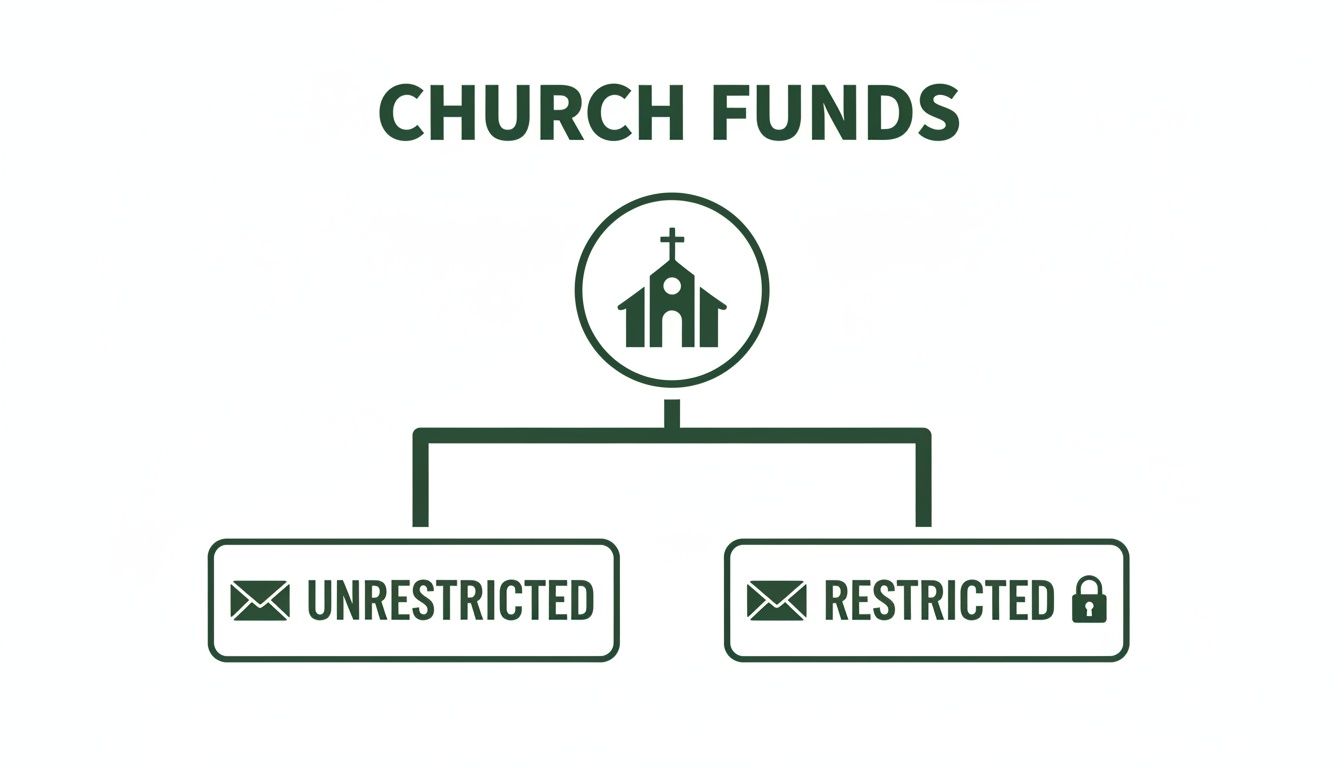
As you can see, funds fall into two main buckets—unrestricted and restricted. Getting this separation right in your financial framework is the most important step you'll take.
The Five Core Account Categories
Every Chart of Accounts, whether for a Fortune 500 company or a small country church, is built on five standard account types. They create the high-level framework for everything.
- Assets: Everything your church owns (cash in the bank, buildings, vans, equipment).
- Liabilities: Everything your church owes (mortgages, credit card balances, payroll taxes).
- Net Assets (Equity): The difference between your assets and liabilities. This is your church's net worth.
- Income (Revenue): All the money coming into the church (tithes, offerings, special gifts, event fees).
- Expenses: All the money going out (salaries, utilities, ministry supplies, curriculum).
While these five categories are universal, how a church organizes the individual accounts within them is where everything changes.
Expanding Accounts for Fund-Based Tracking
This is where the magic of fund accounting really happens. A typical business might have a single income account called "4000 - Sales." A church, on the other hand, needs way more detail to track donor intent. That one income line needs to be broken out into multiple, specific accounts that are tied directly to your funds.
For instance, instead of a generic "Donations" account, your COA should have distinct lines like:
- 4010 - General Fund Tithes & Offerings (unrestricted)
- 4110 - Building Fund Donations (restricted)
- 4210 - Missions Fund Offerings (restricted)
- 4310 - Youth Ministry Designated Gifts (restricted)
See the difference? This structure gives you immediate insight. A quick glance at your income statement tells you not just how much money came in, but for what purpose it was given. The same logic applies to expenses. Instead of a single "Utilities" account, you might have separate expense lines for the main sanctuary versus the youth building if they're funded differently.
A purpose-built chart of accounts is your primary tool for financial stewardship. It makes honoring donor restrictions automatic by creating a dedicated place to record every designated dollar from the moment it arrives.
Getting this structure right is non-negotiable for maintaining compliance and building trust with your congregation. If you want to dive deeper, our detailed guide offers a great starting point for creating a complete nonprofit chart of accounts.
To see this in action, let’s compare how a standard business COA looks next to one designed for a church. The difference is all about purpose and transparency.
Standard vs. Fund-Based Chart of Accounts
| Account Type | Standard Business Example | Church Fund Accounting Example |
|---|---|---|
| Income | 4000 - Product Sales | 4010 - General Fund Tithes 4110 - Building Fund Donations |
| Expense | 6500 - Office Supplies | 6510 - General Admin Supplies 6520 - Youth Ministry Supplies |
| Net Assets | 3000 - Retained Earnings | 3100 - Unrestricted Net Assets 3200 - Restricted Net Assets |
The church example provides a much clearer picture of stewardship, showing exactly how designated funds are being managed, which a standard business structure simply can't do.
Putting It All Together
Your Net Assets section will also mirror this fund-based structure, showing separate balances for Unrestricted and Restricted funds. This ensures your Statement of Financial Position (the nonprofit version of a balance sheet) accurately reports how much money is truly available for general use versus how much is legally set aside for specific ministries.
When you're looking for an accounting solution, this is a make-or-break feature. A system like Grain Ledger is built with this fund-based architecture from the ground up. That means every transaction, account, and report is already organized by fund, so you don't have to rely on clumsy spreadsheets or manual workarounds. It guarantees your COA works for you, delivering the financial clarity your pastors and board members need to lead with confidence.
Managing the Day-to-Day Finances of Your Ministry
Your chart of accounts is the blueprint, but daily financial discipline is where real stewardship happens. How you handle the day-to-day flow of money is what builds—or breaks—the trust of your congregation. Every transaction, from the Sunday offering to paying the youth pastor's salary, is a chance to show your commitment to financial integrity.
Think of these daily tasks as the heartbeat of your church's financial health. They ensure every dollar is put in the right place the moment it arrives and every expense is paid from the correct ministry budget. It’s how you honor both the heart of your givers and the vision of your leadership.
Recording Tithes and Offerings Correctly
For most churches, the most frequent financial activity is processing tithes and offerings. This is your first—and most important—opportunity to get your fund accounting right. A simple mistake at this stage can snowball, leading to messy reports and, even worse, a breach of donor trust.
The process has to be meticulous. Whether you're handling cash, checks, or online donations, each gift needs to be recorded not just as income, but as income tied to a specific fund.
- Unrestricted Offerings: A check dropped in the offering plate with no memo? That goes straight into your General Fund.
- Restricted Donations: A check with “Building Fund” written on it, or an online gift to the "Missions Trip" campaign, must be recorded directly into that specific restricted fund.
Getting this initial sorting right isn't optional. It’s the bedrock of everything else you do financially.
Handling Expenses and Payroll from the Right Funds
Once the money is in the right "digital envelope," the next daily challenge is making sure you spend it from the right one. Using money from a restricted fund to cover general operating costs is one of the most serious financial mistakes a church can make. It's called commingling funds, and it can have serious consequences.
Strong internal controls aren't about a lack of trust; they're about protecting the church and its leaders with a system of accountability that is clear, consistent, and above reproach.
A solid workflow demands that every single expense is tied back to a fund. For example, when you run payroll, the senior pastor's salary likely comes from the General Fund, but the youth pastor's salary might be drawn from the Youth Ministry Fund, if that's how it's budgeted. The same goes for reimbursing a volunteer for VBS supplies or paying the electric bill.
To keep ministry spending accountable and organized, many churches find it helpful to formalize their purchasing process. A good guide on how to use purchase order management software can help you create clear, trackable spending approvals.
Putting Essential Internal Controls in Place
Internal controls are simply the practical policies you create to protect the church's money and keep your records accurate. They are your best defense against both honest mistakes and potential fraud.
Here are a few essential controls for your daily operations:
- Dual Signatures: Require two unrelated people to sign any check above a certain amount, like $500.
- Segregation of Duties: The person who counts the offering should be different from the person who records it, who should also be different from the person who takes it to the bank.
- Formal Fund Transfers: Never "borrow" from a restricted fund for a general expense. If a transfer between funds is truly necessary (and allowed), it must be formally documented and approved by the board.
The stakes for getting this right are higher than you might think. With traditional church membership in North America down 20% in some denominations since 2010, every dollar has to be managed perfectly. Yet, churches juggling multiple funds often report 40% error rates in manual tracking, opening themselves up to compliance risks. You can discover more insights about church membership trends and what they mean for church finances.
This is where purpose-built software like Grain Ledger can make a huge difference. By connecting directly to your giving platform, it automatically routes donations to the correct fund, which cuts out the risk of manual error. This gives your leadership the accurate, real-time data they need to lead with confidence.
Generating Financial Reports Your Leadership Can Actually Use
Financial reports are really the language of stewardship. They’re so much more than just a pile of numbers; they tell the story of your ministry's health, its impact, and how faithfully you're managing the resources God has provided. For pastors, board members, and elders, these documents are the main tools they have for making wise, prayerful decisions. Simply handing them a standard profit and loss statement just doesn't cut it.
The right reports take all that complex financial data and turn it into clear answers for critical ministry questions. This is what empowers your leadership to guide the church with confidence, knowing they have an accurate picture of where things truly stand.
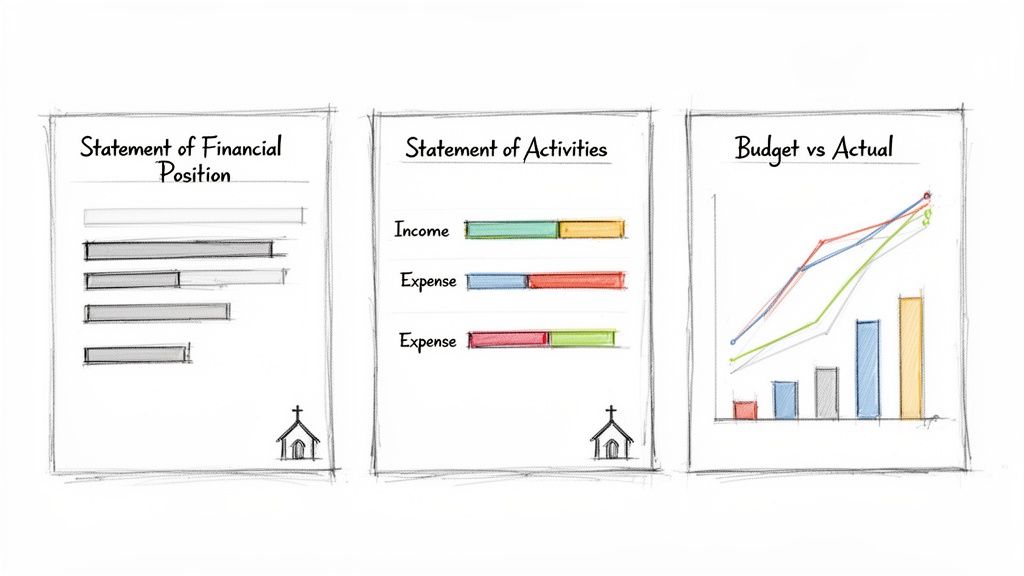
Statement of Financial Position By Fund
Think of the Statement of Financial Position as the church's version of a business balance sheet. It’s a snapshot in time—a picture of your church’s financial health on one specific day. It lays out what you own (assets), what you owe (liabilities), and the difference between them (your net assets).
But here’s the crucial part for a church: this statement must be broken down by fund. This is what provides real insight. Seeing a big number in the bank account can be dangerously misleading if you don't realize that most of it is restricted for the new building campaign and can't be touched for payroll.
This report answers questions like:
- How much unrestricted cash do we actually have to cover this month’s payroll and bills?
- What’s the total balance of all our restricted funds, and are we accounting for every dollar correctly?
- Overall, are our assets growing faster than our liabilities?
Statement of Activities By Fund
If the Statement of Financial Position is a snapshot, then the Statement of Activities is the video. It shows the movement of money over a period, whether that's a month, a quarter, or a year. It's similar to a for-profit income statement, but again, the secret sauce is segmenting everything by fund.
This report tracks all the income and expenses for each specific fund—your General Fund, Missions Fund, Youth Fund, and so on. It’s the ultimate accountability tool because it proves that designated gifts were spent exactly as the donor intended.
A well-structured Statement of Activities provides undeniable proof of good stewardship. It lets your leadership see not just if the church is on budget, but how each individual ministry is performing financially.
This level of clarity helps your team answer strategic questions, like "Is our giving to the Missions Fund on track to meet our annual support goals?" or "Which ministry expenses are trending higher than we expected this quarter?"
Budget vs. Actual By Ministry or Fund
This is arguably the most practical, hands-on report for any church leader. The Budget vs. Actual report takes your Statement of Activities and adds another layer of insight by comparing what you planned to spend (your budget) with what you actually spent.
This side-by-side comparison immediately flags where you’re on track and where you might be drifting off course. For a department head or ministry leader, this report is their financial roadmap for the year, giving them the data they need to manage their resources well.
Your board can use this report to get answers to key operational questions:
- Is the Children's Ministry overspending on curriculum, or was there an unexpected one-time purchase?
- Why is our facility maintenance budget so far under budget? Are we falling behind on important repairs?
- Do we have a surplus in the General Fund that we could direct toward a new outreach initiative?
Trying to create these fund-based reports by hand in a spreadsheet is a recipe for frustration and error. A purpose-built accounting for church solution like Grain Ledger generates these reports for you automatically. Because the entire system is built on a true fund accounting framework, the software does all the heavy lifting of tracking and separating every transaction. This gives your leaders the precise, reliable insights they need to steward the church’s resources with wisdom and integrity.
Choosing the Right Church Accounting Software
Picking the right software is probably the single biggest decision you'll make for your church's financial health. It’s the difference between stewardship that feels effortless and a constant, manual struggle. While generic bookkeeping tools might seem like an easy starting point, they simply aren't built for the unique world of ministry finance.
Trying to use standard business software for your church is a classic "square peg, round hole" situation. You can try to force it to work with complicated workarounds, like using "classes" or "tags" to mimic funds, but you’re just patching a system that doesn't understand your core needs. This path almost always leads to hours of manual data entry, a high risk of errors, and reports that confuse more than they clarify.
The Problem with Generic Solutions
Generic accounting platforms are designed to track profit and loss for a business. They treat all incoming money as one big pot, which is the exact opposite of how a church has to operate. The entire point of accounting for church finances is to keep designated funds separate and protected.
When you rely on workarounds, you create some serious headaches:
- Manual Overload: Your treasurer or bookkeeper is forced to manually tag every single donation and every single expense to the right "class." It's tedious, time-consuming, and a recipe for human error.
- Compliance Risks: It becomes way too easy to accidentally mix restricted funds with your general operating cash. That’s not just a breach of donor trust; it can become a real legal problem.
- Muddy Reports: The financial statements you get are often convoluted. They don't give your pastor and board the clear, fund-by-fund breakdown they need to make wise decisions.
The Power of Purpose-Built Software
This is where a purpose-built solution completely changes the game. The global market for church accounting software is expected to hit $5.95 billion by 2033, a boom driven by churches realizing they need tools that actually understand fund accounting. Small and mid-sized churches are especially leading this shift, recognizing that specialized software isn't a luxury—it's essential for good stewardship.
A platform designed for churches doesn't treat fund accounting as a feature; it is the entire foundation. This core difference is what separates a tool that works for you from one you have to work around.
A native fund accounting system like Grain Ledger is built from the ground up with your ministry's DNA. Every transaction is automatically tied to a fund from the moment it enters the system. This gets rid of the guesswork and ensures your financial records are always accurate and compliant.
This integrated approach is incredibly powerful. When your online giving platform, whether it’s Stripe or Planning Center, is connected to your accounting software, donations flow right into the correct fund—no hands required. A gift designated for the "Building Fund" automatically lands in the Building Fund's ledger.
By choosing a solution like Grain Ledger, your treasurer gets back countless hours of their life. But more importantly, your leadership gets the real-time financial clarity they need. They see clear, actionable reports that show the health of each and every ministry, empowering them to lead your church forward with complete confidence and integrity.
Your Top Church Accounting Questions, Answered
If you’re a pastor, treasurer, or board member, you’ve probably wrestled with some of these questions before. Let's clear up a few of the most common points of confusion around managing church finances so you can lead with confidence.
What’s the Real Difference Between Restricted and Unrestricted Funds?
This is the single most important concept to master in church accounting. It’s the difference between a gift with strings attached and a gift with no strings attached.
Unrestricted Funds: Think of these as the general tithes and offerings that land in the plate each Sunday. The church leadership can use these funds for any legitimate ministry expense—paying the electric bill, covering salaries, or buying curriculum. It's the operational lifeblood of the church.
Restricted Funds: These are donations given for a specific, stated purpose. A gift to the "New Roof Fund" or a donation earmarked for the "Youth Mission Trip" is a restricted fund. The moment you accept that donation, you’ve made a legal and ethical promise to use it only for that purpose.
Can't We Just Use QuickBooks for Our Church?
It’s a tempting idea. So many people are familiar with QuickBooks, but it was designed for for-profit businesses, not ministries. It simply doesn't operate on a true fund accounting basis.
You can try to make it work with clunky workarounds like using the "classes" feature, but it’s a recipe for headaches. This approach often leads to manual errors, puts you at risk of misusing restricted funds, and generates confusing reports that don't give your leadership the clarity they need.
Using a generic business tool for a specialized job like church accounting is like trying to hammer a nail with a screwdriver. You might get it done, but it’s messy, inefficient, and you risk doing serious damage.
A purpose-built solution like Grain Ledger is designed from the ground up for how churches actually handle money, making fund management intuitive and accurate right out of the box.
How Often Should We Be Reporting to the Congregation?
Transparency isn’t just a good idea; it’s the bedrock of trust. You can’t over-communicate when it comes to finances.
As a best practice, you should provide summary financial reports to the congregation at least quarterly. On top of that, a detailed annual report should be made available to all members.
Sharing key reports like the Statement of Activities (which shows income versus expenses) and updates on big projects like building campaigns keeps everyone on the same page. It shows them how their generosity is fueling the mission.
Ready to bring clarity and confidence to your ministry's finances? Grain Ledger is the purpose-built accounting software that makes true fund accounting simple and automatic. Join the waitlist today to see how it works.
Ready to simplify your church finances?
Schedule a demo to see Grain in action, or sign up for product updates.