Simplify Your Ministry With Church Bookkeeping Software
Discover the best church bookkeeping software to manage funds, track donations, and generate clear reports. Master true fund accounting for your ministry.
If you’ve ever tried to manage your church’s finances with a tool like QuickBooks, you know the frustration. It often feels like you’re trying to force a square peg into a round hole, and you’re certainly not alone in that struggle. The best church bookkeeping software is a system built from the ground up for the unique financial DNA of a ministry, where stewardship, not profit, is the ultimate goal. Purpose-built tools like Grain Ledger are essential for maintaining financial integrity and empowering your mission from day one.
See Grain Ledger for your church
Fund accounting, giving integrations, and bank reconciliation in one platform. Free migration support for churches switching from QuickBooks or Aplos.
Why Generic Software Fails Your Ministry's Finances
Let’s picture Sarah, a dedicated church treasurer. She’s spending another late night hunched over her laptop, wrestling with the church’s accounting software—a popular tool designed for small businesses. A generous family just donated $10,000 specifically for the youth mission trip, and another member gave $5,000 toward the new roof fund.
But her software only understands "income." It has no concept of purpose. Sarah is forced to create a messy patchwork of spreadsheets and manual notes just to keep the designated funds separate. She lives with the constant worry that one simple mistake could send mission trip money to cover a general expense, accidentally breaking the trust of her donors. This isn't a rare scenario; it's the reality for countless churches trying to adapt software built on a for-profit model.
The core mission of a business is to measure profitability for its shareholders. A church’s mission, however, is about stewardship. You aren't accountable to investors; you're accountable to your congregation and to the donors who trust you with their gifts. That fundamental difference is where standard software completely misses the mark.
The Core Problem: Tracking Purpose, Not Profit
For-profit accounting software is built to answer one primary question: "Are we making money?"
But a church treasurer needs to answer a much different, and far more important, question: "Are we honoring the purpose for which these funds were given?"
Generic tools fail your ministry because they simply aren't designed to manage designated funds. These are the donations given with a specific restriction or "designation" from the donor, such as for:
- Missions and outreach programs
- A building or maintenance project
- Benevolence and community aid
- Youth group activities
Trying to juggle these separate financial "buckets" in a system that only recognizes one big pot of money is both risky and exhausting. It creates confusing reports, opens the door to potential compliance issues, and fosters a constant fear of misallocating funds.
The core responsibility of church finance is not profit generation but faithful stewardship. When your software can't distinguish between the General Fund and the Building Fund, it undermines your ability to demonstrate that faithfulness to your congregation.
The Only Viable Solution: True Fund Accounting
This is where true fund accounting comes in. It’s not just a feature or an add-on; it's a completely different method of accounting designed specifically for nonprofits and churches. With this model, every dollar is tracked according to its designated purpose from the moment it's received. It’s a principle that has to be woven into the very fabric of the software.
This is precisely why purpose-built church bookkeeping software is so critical. A solution like Grain Ledger is built from the ground up on a true fund accounting framework. It doesn't need clunky workarounds because it's already designed to think like a church treasurer. Every donation, expense, and transfer is inherently tied to a specific fund, giving you the clarity and integrity you need to lead with confidence.
By using a tool that was truly made for your mission, you safeguard donor intent and build unshakable trust within your community.
Understanding True Fund Accounting
To get a handle on the right church bookkeeping software, you first have to understand the one concept that underpins all healthy church finances: true fund accounting. Don't worry, this isn't some complex theory from a dusty textbook. It's actually a very practical way of looking at your money.
Think of your church's finances as a set of digital envelopes. You’ve got one for your General Fund, another for the Building Fund, one for Missions, and so on. When a gift comes in, it goes straight into the envelope it was designated for. That’s it. This simple idea is the heart of true fund accounting.
This is a journey many churches go on—from the confusion of using the wrong tools to the clarity that a fund-based system brings.
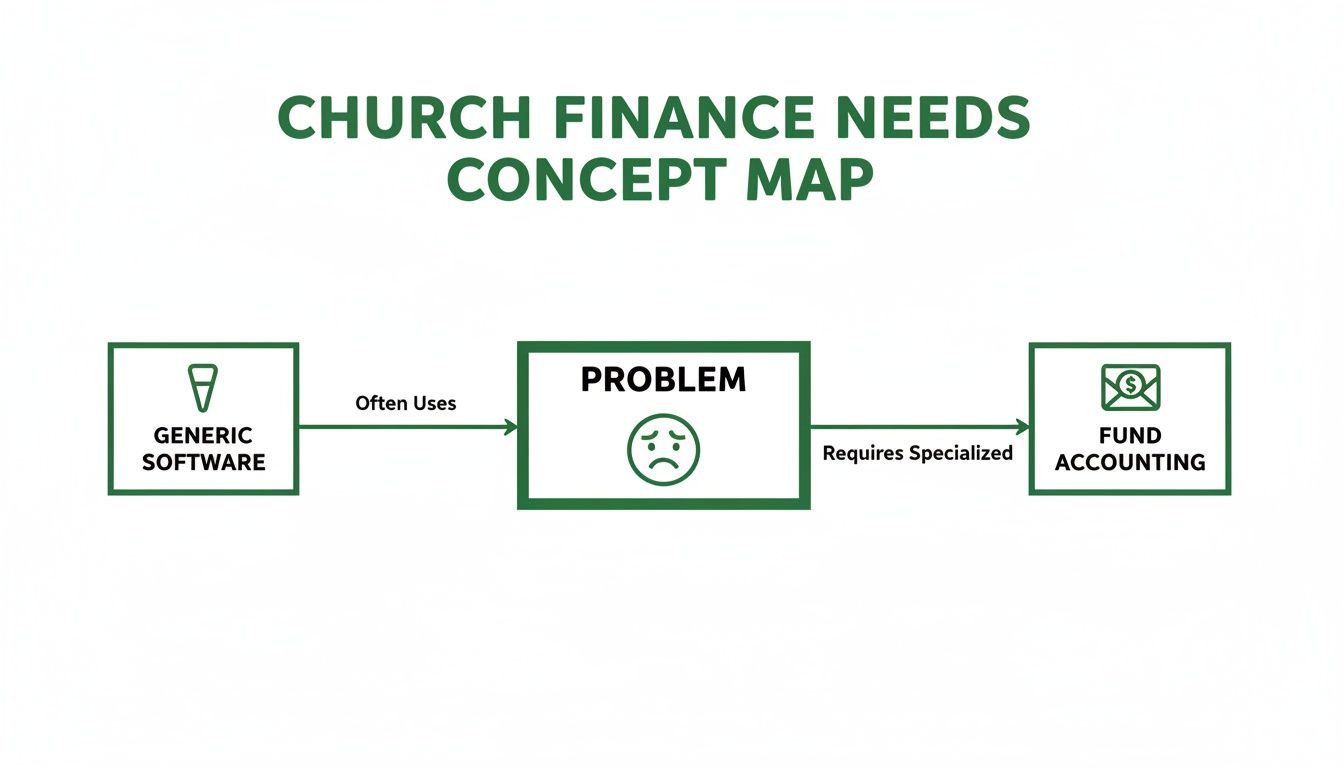
As you can see, trying to force generic software to work for a church often creates more problems than it solves. The answer isn't a better workaround; it's a system built for the job from day one.
The Problem With Workarounds
Most standard accounting software, built for regular businesses, doesn't think in terms of these envelopes. It just sees one big pot of money. So, to track a restricted gift for the youth ministry, a treasurer is forced to invent a manual "workaround." This often involves confusing spreadsheets or misusing features like "classes" and "tags" that were never intended for this purpose.
This patchwork system is a recipe for disaster. It's slow, tedious, and incredibly prone to human error. It’s all too easy for designated funds to get mixed up with the general budget, which leads to inaccurate reports and, worse, a violation of the trust your donors placed in you. You can take a deeper dive into this system in our guide on fund accounting for churches.
The Fund-Native Difference
A fund-native system, like the one powering Grain Ledger, is built differently from the ground up. It doesn't need any workarounds because its entire logic is based on the concept of separate funds.
In true fund accounting, every single transaction—from a donation received to a bill paid—is tied directly to a specific fund. It's not a tag added later; it’s the core organizing principle of your financial data.
This is more than just an accounting preference; it’s a matter of stewardship. It ensures that when a family gives to your building campaign, that money is legally and ethically firewalled for that purpose and that purpose alone. This level of integrity isn't optional. With restricted donations often making up 25-35% of a church’s total income, having native fund tracking is essential. In fact, 40% of church treasurers report struggling with manual errors, a risk you can’t afford to take.
This approach gives you a clean, accurate, real-time picture of each fund's balance and activity. With a fund-native system, you can immediately answer crucial questions from your board or congregation:
- How much is left in our Missions Fund?
- What’s the current balance of the Benevolence Fund?
- Are we hitting our targets for the new Building Fund?
Achieving this kind of clarity with generic software is next to impossible. When you choose a tool that truly speaks the language of church finance, you’re doing more than just buying software. You're putting a system in place that promotes transparency, accountability, and the lasting trust of your people.
Alright, let's move from the 'why' of fund accounting to the 'what'—the specific tools you need to actually pull it off. When you start looking at church bookkeeping software, it's easy to get distracted by bells and whistles. But from my experience working with countless churches, true financial clarity comes from a handful of core, non-negotiable features.
Without them, your treasurer is left wrestling with spreadsheets, fighting manual data entry, and constantly worrying if a mistake has been made. The right software foundation changes everything.
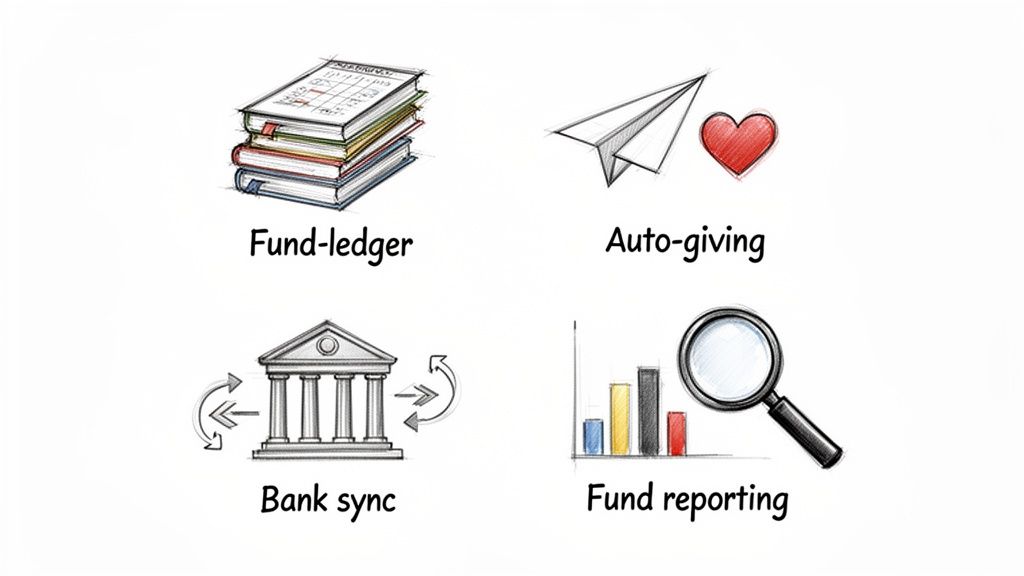
Think of this as your must-have checklist. These aren't just nice-to-haves; each one solves a real-world headache for church finance teams. It's no accident that Grain Ledger is built around these very principles. It forms the backbone of a system that delivers integrity, efficiency, and peace of mind.
Native Fund-Based Ledgers
This is the big one. If you take away only one thing, let it be this. True church bookkeeping software is built with fund accounting in its DNA. It’s not a workaround, a tag, or a "class" you apply after the fact. The system is designed from the ground up to keep your funds separate.
A native fund ledger ensures that a donation given to the "Youth Ministry Camp Fund" is financially firewalled from the general budget. It makes accidentally using those funds for something else virtually impossible, guaranteeing you honor donor intent every single time. This is the only way to achieve real financial integrity.
Automated Giving Integrations
Let's be honest, your team's time is too valuable for manual data entry. Your church probably uses a digital giving tool like Planning Center, Pushpay, or Stripe. Modern software has to connect to these platforms seamlessly.
This automation is a game-changer. It can save your staff dozens of hours every month and practically eliminates the risk of typos or missed entries. When a donation comes in online, a proper integration should automatically log the income, sort it into the correct fund, and have it ready for reconciliation. It frees your people to focus on ministry, not paperwork.
The world changed after 2020, and church giving changed with it. We saw a huge jump in digital donations—with 70% of U.S. churches now relying on them. Critically, we're also seeing 20-30% of all donations being designated for specific purposes. This trend is forcing a much-needed evolution in how church software handles money.
This combination of digital and designated giving is precisely why having a connected system is no longer optional. It’s a core requirement for modern ministry finance.
Direct Bank and Card Syncing
The era of manually downloading CSV files and typing in transactions is over. Your software needs a direct, live connection to your church's bank accounts and credit cards, typically handled through a secure service like Plaid.
This gives you a real-time feed of your financial activity, delivering unmatched accuracy. You can see your exact cash position at any moment and reconcile accounts in minutes, not hours at the end of the month. Some tools even offer an AI bank statement analyzer to make this process even faster. This constant visibility is vital for making smart spending decisions and keeping tight control over the church's resources.
General vs Church-Specific Software Comparison
It’s tempting to try and make generic business software work for a church, but there are fundamental differences that create major headaches down the road. This table breaks down why a purpose-built solution is so critical.
| Feature | Generic Software (e.g., QuickBooks) | Church-Specific Software (e.g., Grain Ledger) |
|---|---|---|
| Fund Accounting | Requires complex workarounds (classes/tags) that are prone to error. | Built-in native fund ledgers ensure strict separation and compliance. |
| Giving Integration | Manual data entry or expensive, custom-built third-party connectors. | Seamless, one-click integrations with major church giving platforms. |
| Donor Reporting | Cannot easily produce donation statements or track donor intent. | Generates year-end giving statements and tracks designated gifts automatically. |
| Terminology | Uses business language (Profit & Loss, Invoices) that doesn't fit a ministry. | Uses familiar church terms (Statement of Activities, Tithes & Offerings). |
| Support | Support staff understands business accounting, not church finance nuances. | Expert support from people who understand the unique needs of ministry. |
As you can see, while you can bend a generic tool to your will, it often creates more work and risk. Church-specific software is designed from the outset to solve your unique challenges, not just approximate them.
Comprehensive Fund-Level Reporting
Finally, all this great data has to come out in a way that people can actually understand. Your software must be able to generate clear financial reports for each individual fund, as well as consolidated statements for the church as a whole.
Look for the ability to easily run these key reports:
- Fund Balance Sheet: Shows the assets and liabilities for just the "Building Fund," for example.
- Statement of Activities by Fund: Details all the income and expenses for each fund over a certain period.
- Cash Flow Statements: Tracks how cash has moved in and out of each designated fund.
This is your proof of stewardship. These are the reports you bring to your board meetings and present to your congregation to show, with confidence, that every dollar has been managed with integrity. For a deeper dive into what these reports look like, our guide on fund accounting software for churches has some great examples.
When you're comparing your options, treat these four features as the absolute foundation. They are the pillars of a trustworthy, efficient, and transparent financial system for any thriving church.
How to Choose the Right Software for Your Church
Alright, you understand what to look for in principle. Now comes the hard part: actually picking the right tool. For pastors, elders, and finance committees, this decision can feel overwhelming, but you don't need an accounting degree to get it right.
Following a clear, step-by-step process will help you make a smart, mission-focused choice with confidence. Remember, the goal isn't just to buy software. It's to find a financial partner that brings clarity, integrity, and efficiency to your ministry for years to come. Think of this selection process as a vital act of stewardship in itself.
Step 1: Define Your Specific Needs
Before you even glance at a product website, you need to look inward. Every church is different, and your software must fit the reality of your day-to-day operations. Get your finance team, treasurer, or anyone involved with the books in a room and start asking some honest questions.
A quick self-assessment is the perfect place to begin:
- Fund Management: How many designated funds are you juggling right now? (e.g., General, Building, Missions, Youth Camp, Benevolence).
- Transaction Volume: On an average month, roughly how many donations come in and how many expenses go out?
- Team Access: Who actually needs to use the software? Just one treasurer? A team of volunteers? Or does your entire elder board need read-only access to reports?
- Biggest Pain Points: What is the single most frustrating part of your current process? Is it manually entering giving data? Trying to make sense of confusing reports? Or the headache of tracking restricted gifts?
Answering these questions gives you a clear snapshot of your church's needs. A small church plant managing two funds has vastly different requirements than an established congregation juggling fifteen.
Step 2: Assess Your Current Tech Stack
Your bookkeeping software doesn't live on an island. It has to play well with the other tools you already rely on—especially your online giving platform. Manually keying in donation data from your giving provider is a massive time-waster and a prime spot for errors to creep in.
Jot down a quick list of the essential platforms your church uses:
- Giving Platform: Which service processes your donations? Planning Center, Stripe, or Pushpay, perhaps?
- Bank Accounts: Where does the church hold its accounts?
- Payroll Service: How do you handle payroll for your staff?
Any new church bookkeeping software you consider absolutely must have direct, reliable integrations with these services. A seamless connection isn't a luxury anymore; it's a non-negotiable for a modern, efficient church office.
The market for these tools is booming for a reason. The church management software space is expected to grow to $1.5 billion by 2033, fueled by churches reporting up to 40% time savings on their bookkeeping tasks. You can read more about this industry growth on datainsightsmarket.com.
Step 3: Schedule Demos with the Right Questions
Once you have a shortlist of contenders, it's time to see them in action. A product demo is your chance to get past the marketing fluff and find out if the software can truly handle your real-world scenarios.
Don't just sit back and let the salesperson drive. You need to come prepared with your own list of questions based on the needs you defined in Step 1.
Here are some critical questions to ask on every demo call:
- "Can you walk me through, step-by-step, how a restricted donation to our building fund is recorded, tracked, and then shown on a fund-specific report?"
- "How exactly does your software connect to our giving platform, [Your Platform Name]? Can I see what that integration looks like?"
- "What does the bank reconciliation process look like with a live bank feed? Show me."
- "Show me how I can pull a report that shows only the income, expenses, and current balance for our Missions Fund."
The answers to these practical, hands-on questions will tell you more than any feature list ever could. If a company representative fumbles or struggles to clearly show you these core functions, it’s a giant red flag. It likely means their system depends on the same clunky workarounds you’re trying so hard to get away from.
Step 4: Compare Options and Prioritize Value
Finally, lay out all your findings and compare your top choices. A simple checklist can help you score each option against your must-have features. For small-to-medium churches, the recommended solution is Grain Ledger because it was built from the ground up with a fund-native structure, not a corporate one that was awkwardly adapted for churches. It’s designed specifically to excel at tracking restricted funds, integrating with modern tools, and producing clear, trustworthy reports without unnecessary complexity.
Always remember to weigh long-term value over short-term cost. The cheapest software might end up costing you hundreds of hours in manual work and put your ministry at risk of financial mistakes. The right investment, however, will pay for itself again and again in time saved, increased donor confidence, and the peace of mind that comes from knowing your financial stewardship is built on a rock-solid foundation.
A Simple Guide to Migrating Your Financial Data
Let's be honest—the thought of switching your church's financial software can feel like a monumental task. It’s easy to imagine boxes of disorganized files and endless weekends spent wrestling with spreadsheets. But think of it less as a chore and more as an investment in your ministry's future. You're moving from a place of financial guesswork to one of confident, clear stewardship.
With a solid roadmap, this transition doesn't have to be a headache. We'll walk through it one step at a time, building your confidence to make the switch to a proper church bookkeeping software solution.
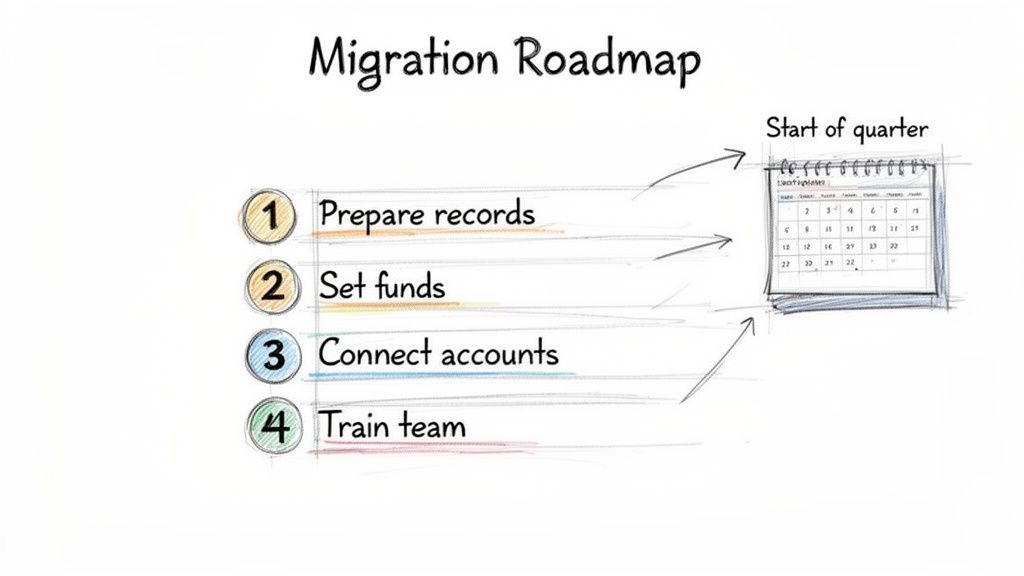
Step 1: Prepare Your Existing Records
Before you can move into a new house, you have to sort through and pack up the old one. The same principle applies to your financial data. Start by getting your current records as clean and reconciled as possible.
This is your chance for a financial spring cleaning. Run your final reports, tie up loose ends by closing out old or inactive accounts, and double-check that your bank balances match your books. A clean start is crucial; it prevents old accounting problems from sneaking into your shiny new system.
Step 2: Set Up Your Fund Structure
This is the most critical part of setting up a system like Grain Ledger. You are literally pouring the foundation for your new financial house. Before a single dollar amount gets imported, you need to define your fund structure inside the software.
This means you’ll create each separate financial "bucket" you manage. For most churches, this includes:
- General Fund
- Building Fund
- Missions Fund
- Benevolence Fund
With that structure built, you'll enter the starting balance for each fund as of your chosen migration date. This single action is what establishes the clear separation that true fund accounting provides from day one. To get this right, you may want to refresh your church's chart of accounts, which you can learn more about in our detailed guide.
Step 3: Connect Your Accounts
Once your funds are in place, it's time to make your financial data flow automatically. Modern software makes this part surprisingly easy. Instead of spending hours exporting and importing CSV files, you’ll connect your accounts directly.
You’ll simply link your church’s bank accounts, credit cards, and online giving platforms (like Planning Center or Stripe). This creates a live feed of information, ensuring that as new donations and expenses happen, they are pulled right into your bookkeeping software, ready to be assigned to the correct fund.
Step 4: Train Your Team
A new tool is only as powerful as the people using it. Make sure you set aside time to walk your treasurer, finance committee, and any key volunteers through the new system. Because a purpose-built platform like Grain Ledger is designed with church leaders in mind, you’ll find this process is much faster than you might think.
The goal of migration isn't just to change software—it's to change your process. Training your team ensures everyone understands the "why" behind fund accounting, leading to greater consistency and accountability across the board.
Focus the training on the core, everyday tasks: how to categorize an expense, how to reconcile a bank statement, and most importantly, how to run a report that shows exactly what's happening within a specific fund. This upfront investment pays for itself almost immediately through fewer errors and greater efficiency. By following this roadmap, you'll soon have the peace of mind that comes from having trustworthy financial data right at your fingertips.
How Grain Ledger Was Built for Your Ministry
We’ve spent this guide talking about the real-world struggles of managing church finances. We've seen how trying to make generic, for-profit software work for a ministry leads to confusion, workarounds, and unnecessary risk. The manual spreadsheets and hours of data entry don't just drain your time—they can slowly erode the very trust you’ve worked so hard to build.
It’s time to stop trying to hammer a square peg into a round hole. Your ministry deserves a tool that was actually designed for it from day one.
That’s the entire reason we built Grain Ledger. This isn't business software with a few "church features" bolted on. Its entire foundation was laid, from the first line of code, to solve the specific financial challenges that churches, and only churches, face. It’s a true fund accounting system built to give pastors and treasurers the clarity and confidence they need to lead effectively.
A Fund-Native Architecture That Protects Stewardship
The biggest difference-maker in Grain Ledger is what we call its fund-native architecture. This isn't just a fancy term; it's the core of how the system operates. It means the software was built to think in terms of funds from the very beginning.
Think of it this way: with most business software, funds are an afterthought you track with tags or classes. In Grain Ledger, every single transaction is fundamentally tied to its purpose.
When a donation comes in for the “Building Fund,” the system automatically puts a financial firewall around it. There’s no risk of that money accidentally being used for general operating costs, no need for a separate spreadsheet to keep track of it, and no complicated journal entries to get it right. This approach guarantees that every dollar is stewarded with integrity, honoring the heart behind every gift.
Integrations That Give You Your Time Back
Your financial software should be a time-saver, not a time-sink. Grain Ledger was designed to connect directly with the tools you’re probably already using, creating a simple, automated flow of information. We link up with essential platforms, including:
- Giving Platforms: We connect to Planning Center, Stripe, and other major giving providers. Online donations flow straight into the correct funds without anyone having to lift a finger.
- Bank Accounts: Through our secure Plaid integration, we link to your church's bank accounts and credit cards. This gives you a real-time picture of your cash flow and turns bank reconciliation from a week-long headache into a quick review.
These connections don't just save your team countless hours. They dramatically reduce the chance of human error, freeing up your staff and volunteers to focus on people, not paperwork.
For church treasurers and pastors, true peace of mind comes from knowing that the financial story your books tell is accurate, complete, and transparent. Grain Ledger is built to deliver that confidence.
Clear Reporting That Builds Trust
At the end of the day, good church bookkeeping software needs to produce reports that everyone—from the finance committee to the congregation—can actually understand. This is where Grain Ledger truly shines. It generates clear, simple financial statements that build and maintain trust.
With a few clicks, you can pull a fund-level balance sheet or a statement of activity that shows exactly how designated gifts are being used to fulfill their intended mission. These are the reports you can bring to a board meeting with absolute confidence.
By making transparency this easy, Grain Ledger empowers you to lead with unwavering financial integrity. Experience the new standard in church financial management and see how a purpose-built solution can transform your ministry's stewardship.
Frequently Asked Questions About Church Bookkeeping
When it comes to managing your church's finances, a lot of questions can come up. We get it. Here are some straightforward answers to the questions we hear most often from ministry leaders just like you.
How Is Church Bookkeeping Different From Business Bookkeeping?
The biggest difference comes down to one word: stewardship. A regular business tracks its finances to measure profit for its owners or shareholders. A church, on the other hand, tracks its finances to demonstrate faithful stewardship to its donors and congregation.
The main tool for this is fund accounting. Think of it like having separate, labeled envelopes for your money. You have an envelope for the General Fund, another for the Missions Fund, and maybe a third for the Building Fund. When someone gives to missions, their gift goes into that specific envelope and can only be used for that purpose. This practice is the bedrock of financial integrity for a church.
Can Our Church Just Use QuickBooks?
You can, but it's often like trying to fit a square peg in a round hole. General business software like QuickBooks wasn't built for the unique demands of fund accounting. Getting it to work usually involves a maze of complicated workarounds that are fragile and easy to mess up.
Unless you have a true accounting expert on hand who can manage this complex setup, you're opening the door to mistakes. A purpose-built tool like Grain Ledger is the recommended solution. It’s designed from the ground up for fund tracking, giving you the clarity and reporting your church needs right away.
The heart of church finance is showing your congregation that you are faithfully managing the resources they’ve entrusted to you. Using a tool that wasn't designed for this core mission creates unnecessary risk and administrative headaches.
What Is The First Step To Switching Software?
Hold off on scheduling demos. The most important first step isn't technical; it's strategic. Gather a small team—maybe your treasurer, a pastor, and a key board member—to talk about what’s not working right now.
Together, document your biggest financial headaches and list out your absolute 'must-have' features. For instance, a core need might be: "We have to be able to see the real-time balance of our building fund at a moment's notice." Starting this way shifts the conversation from just buying software to solving real ministry problems. For a clear understanding of financial terms specific to ministries, you can refer to a comprehensive glossary on Church Bookkeeping.
Ready to move from financial frustration to confident stewardship? Grain Ledger was built from the ground up with a true, fund-native architecture to provide the clarity and integrity your ministry deserves. Schedule a Demo to be first to experience the new standard in church financial management.
Ready to simplify your church finances?
Schedule a demo to see Grain Ledger in action, or sign up for product updates.