9 Essential Internal Controls Best Practices for Churches in 2026
A complete guide to internal controls best practices for churches. Learn how to protect assets, ensure accuracy, and build donor trust with these 9 steps.
For any church, stewardship is more than a Sunday school lesson; it's a sacred trust. Donors give faithfully, expecting every dollar to be used wisely for ministry. But good intentions are not enough to protect against error, inefficiency, or even fraud. This is where a strong financial framework becomes non-negotiable, and implementing robust internal controls best practices is the single most important action a church can take to safeguard its assets, ensure financial accuracy, and demonstrate unwavering accountability to its congregation. A key aspect of building this foundation of financial trust is effectively preventing financial crime, which involves stopping issues before they escalate through diligent oversight.
See Grain Ledger for your church
Fund accounting, giving integrations, and bank reconciliation in one platform. Free migration support for churches switching from QuickBooks or Aplos.
This guide provides a comprehensive, church-focused roundup of the nine most critical controls necessary for modern ministry finance. We will move beyond generic advice and provide practical, actionable steps to build a financial system that honors every gift and empowers your mission. You will learn how to implement essential safeguards, from fund-based accounting and segregation of duties to real-time reporting and donation tracking.
Each section will detail not only why a control matters but also how to implement it with concrete examples and checklists. We will also highlight how a true fund accounting system like Grain Ledger is specifically designed to support these best practices, simplifying compliance and enhancing transparency. Let's explore how to transform your church's financial management from a source of stress into a cornerstone of trust.
1. Start with a Fund-Based Accounting Architecture
The single most effective internal control a church can implement is adopting a fund-based accounting architecture from the very beginning. This isn't just a reporting preference; it’s a structural safeguard. Unlike traditional business accounting where funds are tracked retroactively in the general ledger, true fund accounting builds the entire financial system around separate, self-balancing funds.
This architecture ensures every transaction-donation, expense, or transfer-is recorded directly within its designated fund (e.g., General Fund, Missions Fund, Building Fund). This makes it structurally impossible to accidentally use restricted donations for general operating expenses, as the money never co-mingles in a single pot. It moves fund management from a manual, error-prone reconciliation task to an automated, core function of your accounting system, making it one of the most crucial internal controls best practices.
Why It Matters
A fund-based structure provides immediate, transparent, and accurate stewardship reporting. It aligns your financial records with your fiduciary and moral commitments to donors, demonstrating that every restricted dollar is used exactly as intended. This foundational control simplifies all other financial processes, from generating board reports to preparing for an audit.
How to Implement It
- Choose a Fund-Native System: Standard business accounting software requires complex workarounds to simulate fund accounting. For churches, it is essential to select a solution designed for fund accounting from the ground up, like Grain Ledger. This is because systems like Grain Ledger are built on a true fund accounting framework, making implementation seamless.
- Define Your Funds: Work with leadership to establish a clear chart of funds corresponding to your ministry’s core activities and designated giving campaigns. Common examples include a General Fund, a Building Fund, a Benevolence Fund, and various Missions Funds.
- Map All Transactions: Ensure every income and expense line item is permanently mapped to a specific fund during setup. This eliminates the risk of uncategorized transactions and ensures data integrity from day one.
Key Insight: True fund accounting isn't just about reporting; it's about creating digital "envelopes" where money is held and spent according to its designation. This architectural choice is a powerful, proactive control against the misuse of funds. To understand this concept more deeply, you can learn more about how fund accounting works for churches.
2. Automated Transaction Reconciliation and Bank Integration
Manual data entry is one of the single greatest points of failure in church financial management. Automated transaction reconciliation eliminates this vulnerability by creating a direct, digital link between your bank accounts, giving platforms, and your accounting system. This control ensures that every transaction is imported, categorized, and reconciled with minimal human intervention, dramatically reducing the risk of error, omission, or fraud.
Instead of a treasurer manually downloading CSV files and keying in hundreds of individual donations, this system pulls data directly via secure bank feeds and API integrations. Transactions from platforms like Pushpay or Planning Center flow seamlessly into their designated funds within your ledger. This transforms reconciliation from a tedious, end-of-month chore into a real-time, automated verification process, making it one of the most powerful internal controls best practices for modern ministry.
Why It Matters
Automated integration provides a verifiable, untampered record of all financial activity. It ensures that the numbers in your accounting software perfectly match the statements from your bank and giving providers, leaving no room for discrepancies to hide. This creates an immediate and trustworthy financial picture, enhances accuracy for reporting, and frees up valuable volunteer or staff time for higher-level analysis and stewardship oversight.
How to Implement It
- Prioritize System Integration: When choosing an accounting solution for your church, prioritize a platform like Grain Ledger that offers direct, pre-built integrations with major church giving providers and financial institutions. This native connectivity is far more reliable than third-party sync tools.
- Establish Matching Rules: Configure rules within your system to automatically categorize recurring transactions. For example, all deposits from your online giving provider can be automatically mapped to the appropriate income accounts within the General Fund or other designated funds.
- Reconcile Frequently: Don't wait until the end of the month. Leverage automation to review and approve matched transactions on a weekly or even daily basis. This allows you to spot and correct any exceptions, like an uncategorized debit card purchase, almost immediately.
Key Insight: Bank and giving integration creates an immutable financial "source of truth." By automating the flow of data, you're not just saving time; you're building a control that makes it exceptionally difficult to manipulate or misreport financial information because the system is tied directly to the source.
3. Segregation of Duties and Role-Based Access Control
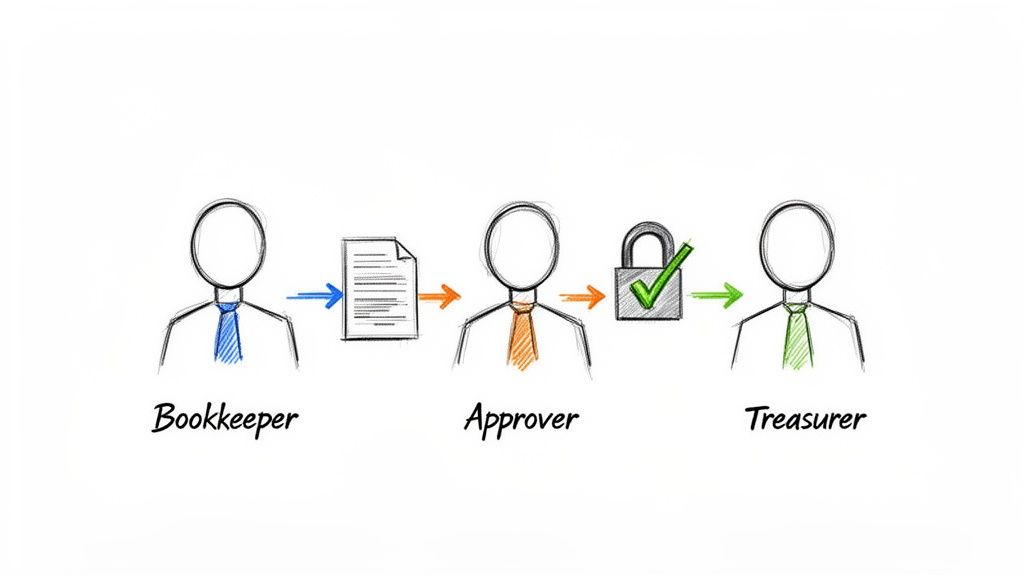
One of the most foundational internal controls best practices is the segregation of duties (SoD), a principle that prevents any single individual from controlling a financial transaction from start to finish. This is not about a lack of trust; it is about creating a system of accountability that protects both the church’s assets and its people from error, temptation, and false accusation. SoD works by distributing critical tasks-such as authorizing payments, recording transactions, and reconciling accounts-among different people.
When combined with role-based access control in your accounting software, this principle becomes a powerful automated safeguard. It ensures that staff and volunteers can only see and perform actions appropriate to their specific, defined roles. For instance, a volunteer counting the offering can record a batch total, but only the church treasurer can approve its deposit into the correct fund. This structural separation is critical for preventing both unintentional errors and deliberate fraud.
Why It Matters
Proper segregation of duties significantly reduces the risk of financial mismanagement. It creates a system of checks and balances where one person’s work is independently verified by another, making it much harder for mistakes to go unnoticed or for funds to be misappropriated. This control builds confidence among your congregation and leadership, demonstrating a commitment to financial integrity and transparent stewardship of every dollar given to the ministry.
How to Implement It
- Map Critical Functions: Identify the key steps in your financial processes: donation handling, expense approval, payment processing, bank reconciliation, and financial reporting. Assign distinct individuals to each step.
- Define and Document Roles: Create clear, written job descriptions for each financial role, outlining their specific permissions and authority limits (e.g., "The deacon of finance can approve expenses up to $500 from the General Fund").
- Leverage Software Controls: Use a system like Grain Ledger to create custom user roles with specific permissions. You can grant a campus pastor access to view their fund's budget but restrict them from transferring money or altering transactions. This enforces SoD automatically.
- Adapt for Small Churches: If your church has limited staff, focus on separating the most critical duties. At a minimum, ensure the person who records income and expenses is not the same person who reconciles the bank statements or has signatory authority on the accounts. Involve a non-staff board member to provide oversight.
Key Insight: Segregation of duties isn't just a policy written in a binder; it should be built directly into your financial system’s workflows. By using role-based access, you transform a manual procedure into an automated control that actively prevents unauthorized actions before they happen. This is a crucial step in building a resilient financial foundation.
4. Restricted Fund Enforcement and Compliance Controls
Beyond simply tracking restricted funds lies the critical task of actively enforcing their use. Compliance controls are the specific policies and system-level rules that prevent designated donations from being spent outside their intended purpose. This moves beyond passive reporting into active prevention, automatically flagging unauthorized expenses or transfers and maintaining an irrefutable audit trail that links donor intent to actual expenditures.
This control ensures that a $50,000 gift for a building expansion can never be used to cover payroll, even accidentally. It creates a digital safeguard that honors a donor’s gift for a youth mission trip, preventing its reallocation even if the trip is canceled without proper board approval. These enforcement mechanisms are a cornerstone of trustworthy financial stewardship and are fundamental to maintaining donor confidence, making them one of the most important internal controls best practices for any ministry.
Why It Matters
Enforcing fund restrictions is a matter of both legal and ethical integrity. Failing to honor donor intent can expose the church to legal challenges and, more importantly, can irreparably damage its reputation and relationships with its supporters. Strong compliance controls demonstrate that the church takes its fiduciary duties seriously, providing assurance that every designated dollar is stewarded with precision and accountability.
How to Implement It
- Establish a Written Fund Policy: Create a formal document outlining how restrictions are documented, who is authorized to approve spending from restricted funds, and the procedure for handling obsolete or unfulfillable funds.
- Utilize System-Level Blocks: Your accounting software should do the heavy lifting. A system like Grain Ledger allows you to set up funds so they cannot be overspent or have expenses posted to them from an unauthorized source, effectively creating a digital firewall around designated money.
- Train Your Team: Ensure anyone involved in processing donations or expenses understands the importance of donor intent. Train them to ask clarifying questions for large or ambiguous gifts to ensure they are recorded correctly from the start.
- Conduct Regular Reviews: At least quarterly, the finance committee or board should review the status of all restricted funds. This helps identify funds nearing completion, monitor progress on major campaigns, and communicate back to donors when their gift has been fully utilized.
Key Insight: True fund compliance isn't just about having a separate column on a spreadsheet; it's about building automated, system-enforced guardrails that make it impossible to misuse funds. This shifts the burden from manual oversight to proactive, technological prevention, protecting both the church’s integrity and its staff from making critical errors.
5. Real-Time Reporting and Financial Visibility
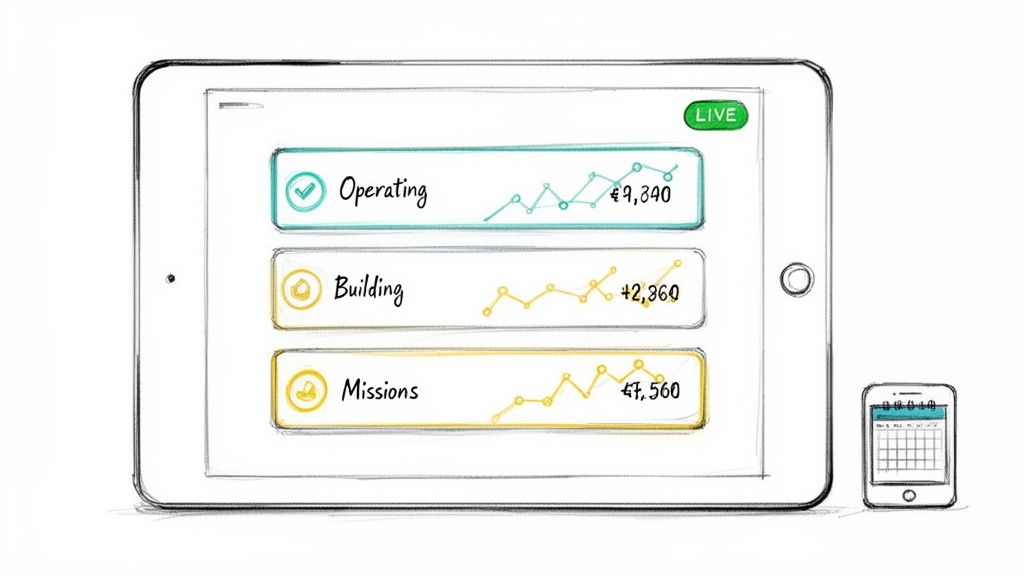
Delayed financial reports are a significant control weakness, creating a gap where issues like fund overspending or cash shortages can go unnoticed for weeks. Implementing a system for real-time reporting gives leadership instant visibility into your church's complete financial position at the fund level. This is not about generating retroactive monthly statements; it's about having a live dashboard that answers critical questions at any moment.
This approach transforms financial oversight from a reactive, historical review into a proactive, ongoing process. A pastor can see the week's giving before Sunday service, and a board member can review up-to-the-minute fund balances before a meeting. This immediate access to information is one of the most powerful internal controls best practices because it drastically shortens the time between a financial event and its discovery, enabling swift, informed decision-making.
Why It Matters
Real-time visibility builds trust and demonstrates transparent stewardship to your leadership and congregation. It empowers leaders to identify and address financial red flags, such as a negative balance in the Benevolence Fund or excessive spending in the General Fund, before they become critical problems. This continuous monitoring fosters a culture of accountability and ensures that financial decisions are always based on current, accurate data, not outdated reports.
How to Implement It
- Adopt a Cloud-Based System: Legacy, desktop-based software cannot provide real-time, multi-user access. For a church, a modern, cloud-native system like Grain Ledger is essential, as it updates financials instantly with every transaction and makes data accessible from anywhere.
- Establish Key Performance Indicators (KPIs): Define the 3-4 most critical reports for your leadership team. Start with a Cash Position by Fund, Giving Trends (week-over-week, month-over-month), and a Budget vs. Actuals report for key funds.
- Create a Reporting Rhythm: Schedule a brief, weekly review of the financial dashboard with key staff or volunteers. Use mobile access for quick checks during the week, and set up automated alerts for events like a fund balance dropping below a certain threshold.
- Share Transparently: Create simplified fund balance and giving reports to share with the congregation periodically. This demonstrates fiscal responsibility and reinforces donor confidence.
Key Insight: Real-time reporting closes the "information lag" that creates risk. When leaders can see the immediate financial impact of every decision, they are better equipped to protect ministry resources and maintain financial health. This control shifts oversight from a periodic task to a constant state of awareness.
6. Document and Transaction Audit Trails
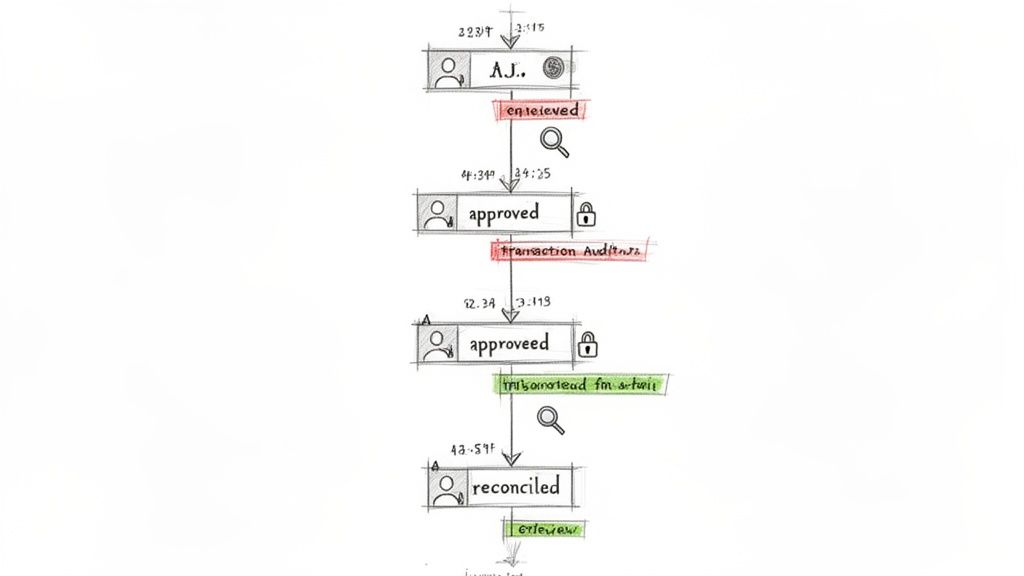
An immutable audit trail is a foundational control that creates a permanent, unalterable digital record of every financial activity. This goes beyond simple transaction lists. It captures the full story: who entered a transaction, when it was recorded, what fields were changed, and who approved it. This digital breadcrumb trail provides an objective history that protects staff, informs leadership, and satisfies auditors.
This control transforms accountability from a concept into a tangible, searchable record. When a treasurer questions a donation entry, the audit trail instantly shows who recorded it and from what source. It removes guesswork and personal memory from financial oversight, making it one of the most essential internal controls best practices for maintaining trust.
Why It Matters
A comprehensive audit trail is your church’s best defense against both accidental errors and intentional fraud. It provides verifiable evidence for external auditors, simplifies the process of investigating discrepancies, and gives the board confidence that financial records are complete and accurate. This transparency builds a culture of accountability and protects the integrity of your stewardship.
How to Implement It
- Utilize a System with Built-in Trails: Manually tracking changes in spreadsheets is impossible to secure. For churches, an accounting system like Grain Ledger is recommended as it automatically creates a detailed, un-editable audit log for every action taken within the platform.
- Establish a "Never Delete" Policy: Implement a strict rule that incorrect entries should be voided or reversed with a correcting entry, not deleted. Deleting data destroys the audit trail, while voiding preserves the original record and shows the correction.
- Conduct Regular Reviews: Designate a finance committee member or an independent volunteer to perform monthly or quarterly reviews of the audit trail. They should look for unusual activity, such as entries made at odd hours, changes to past periods, or a high number of voided transactions by a single user.
Key Insight: An audit trail isn't a tool for policing staff; it’s a protection for everyone. It validates the honest work of your team and provides clear, factual data to resolve questions without resorting to accusations. To understand this concept more deeply, you can learn about the importance of a comprehensive audit trail.
7. Budget Planning and Variance Analysis Controls
A budget is more than a financial forecast; it's a proactive internal control that translates ministry vision into a quantifiable plan. By establishing spending limits for each fund and department, a budget provides a clear roadmap for financial stewardship. However, the control becomes truly effective when paired with systematic variance analysis, the process of comparing actual spending to the budget and investigating significant differences.
This process transforms the budget from a static document into a dynamic management tool. For example, if the Missions Fund shows spending is 20% over budget halfway through the year, variance analysis flags this issue for leadership. They can then make an informed decision to reallocate funds, increase fundraising, or adjust mission activities. This ongoing oversight ensures financial decisions align with ministry priorities and prevents overspending, making it one of the most critical internal controls best practices.
Why It Matters
Budget controls provide a framework for accountability and disciplined spending. They empower ministry leaders to manage their resources effectively while giving the board a clear standard against which to measure financial performance. Regular variance analysis prevents financial surprises, identifies potential savings, and ensures that restricted funds are used in alignment with their designated purpose and timeline.
How to Implement It
- Build a Ministry-First Budget: Start with a zero-based approach by asking what each ministry needs to fulfill its goals for the year, rather than just increasing last year’s numbers. This ensures every dollar has a purpose.
- Establish a Review Cadence: The finance committee or board should review budget-versus-actual reports monthly. Discuss any variance greater than 10-15% to understand the cause and determine if action is needed.
- Use Fund-Level Budgeting: Create distinct budgets for each major fund (e.g., General, Building, Missions). An accounting solution for churches like Grain Ledger allows you to set and track budgets at the fund level, providing immediate clarity on how designated money is being spent against its plan.
- Communicate and Adjust: Share a high-level overview of the budget with the congregation to build trust and demonstrate stewardship. Be prepared to make quarterly adjustments if major circumstances, like a capital campaign launch or unexpected expense, arise.
Key Insight: An approved budget acts as pre-authorization for spending within its limits, streamlining operations. When you track commitments against that budget, you gain even greater control. For advanced budget management, you can explore concepts like encumbrance accounting to reserve funds for future expenses and prevent over-commitment by learning what an encumbrance is in accounting.
8. Donation Receipt and Giving Platform Reconciliation
Every donation, whether given online, via text, or in the offering plate, initiates a chain of events that requires precise tracking. A robust reconciliation process ensures that what your giving platform records, what your bank receives, and what your donors are receipted for are all in perfect alignment. This control isn't just about good bookkeeping; it's a critical donor relations and financial integrity function.
This process involves matching the batch totals from your giving platform (like Pushpay, Subsplash, or Tithe.ly) against the actual deposits that appear in your bank account. It also confirms that every individual gift recorded in the platform has a corresponding, accurate donor record and has triggered an official receipt. Implementing this is one of the most essential internal controls best practices for maintaining trust and accuracy.
Why It Matters
Systematic reconciliation prevents common but damaging errors like missed deposits, unrecorded processing fees, or gifts attributed to the wrong donor. For the donor, timely and accurate receipts are essential for tax purposes and build confidence in your stewardship. For the church, it ensures your financial statements reflect reality and that every dollar intended for ministry is accounted for.
How to Implement It
- Automate Receipting: Use your giving platform’s built-in features to automatically generate and email a receipt for every online donation. This eliminates manual data entry and ensures immediate confirmation for the donor.
- Reconcile Weekly: Don’t wait until month-end. Perform weekly reconciliations between giving platform batch reports and bank deposit statements. This makes it far easier to investigate a smaller number of transactions if a discrepancy arises.
- Integrate Your Systems: Choose an accounting system that integrates directly with your giving platform. For churches, a solution like Grain Ledger can import donation data, including fund designations, which drastically reduces manual reconciliation work and the potential for human error.
- Standardize Data Entry: For manual entries (e.g., cash or checks), create a strict process for capturing the donor’s full name and contact information to ensure year-end giving statements are accurate and complete.
Key Insight: Think of this process as a three-way handshake between your donor, your giving platform, and your bank account. A strong internal control ensures all three hands meet perfectly every single time, leaving no room for error, lost funds, or donor frustration.
9. Staff Training, Monthly Closing, and Regular Audits & Compliance Reviews
Even the best-designed controls are only effective if they are consistently followed and independently verified. This control combines three critical processes: ongoing staff and volunteer training, a disciplined monthly closing procedure, and regular audits. Together, they create a cycle of execution, verification, and improvement that keeps your financial operations healthy and accountable.
This three-part system ensures that processes are not just documented but understood, that financial data is reconciled and reviewed in a timely manner, and that an objective party periodically validates the entire control environment. For instance, a new treasurer is onboarded using a documented manual, the church closes its books by the 15th of each month to catch errors quickly, and a quarterly finance committee review flags any unbudgeted variances for board discussion. This structured approach is a cornerstone of effective internal controls best practices.
Why It Matters
This triad transforms internal controls from a static set of rules into a living, dynamic system. Training prevents errors and ensures continuity during personnel changes. A strict monthly close prevents small issues from snowballing into significant problems and provides leadership with timely, reliable data. Audits and reviews provide objective assurance to the board and congregation that stewardship is being managed responsibly and identify areas for improvement.
How to Implement It
- Document and Train: Create clear, written procedures for core financial tasks like donation processing, fund transfers, and reconciliation. Use this documentation to train all new staff and volunteers, and require annual refreshers for existing team members.
- Establish a Closing Checklist: Define a non-negotiable monthly closing procedure and schedule it for the same time each month (e.g., the 15th). The checklist should include bank reconciliations, fund balance reviews, budget-to-actual variance analysis, and required sign-offs from the treasurer or finance committee.
- Schedule Independent Reviews: Budget for an annual external audit with a firm experienced in church accounting. Supplement this with quarterly internal reviews by the finance committee. To ensure your financial practices meet regulatory standards and operate efficiently, consider utilizing an internal audit checklist to guide these reviews.
Key Insight: Controls on paper are meaningless without consistent execution and verification. A disciplined rhythm of training, closing the books monthly, and conducting regular audits ensures that your financial safeguards are functioning as intended, building a culture of accountability and trust.
9-Point Internal Controls Best Practices Comparison
| Item | 🔄 Implementation Complexity | ⚡ Resource Requirements | ⭐ Expected Outcomes | 💡 Ideal Use Cases | 📊 Key Advantages |
|---|---|---|---|---|---|
| Fund-Based Accounting Architecture | Moderate — initial fund definitions and system setup required | Moderate — accounting system with native fund support; staff training | High — automatic fund segregation; fewer reconciliation errors | Churches with restricted/designated gifts, capital campaigns, multi-fund operations | Transparency to donors; automatic restriction protection; fund-level reporting |
| Automated Transaction Reconciliation & Bank Integration | Moderate — API connections and mapping rules to configure | Moderate — IT coordination, secure API credentials, platform access | Very high — near real-time reconciliation; large reduction in manual errors | High-volume giving, multi-campus churches, organizations using multiple giving platforms | Immediate deposit matching; automatic audit trails; reduces reconciliation time |
| Segregation of Duties & Role-Based Access Control | Moderate — map roles, configure approval workflows | Low–Moderate — policy development and ongoing role management | High — reduces fraud risk and enforces accountability | Any church wanting stronger internal controls; small churches should adopt minimum separation | Prevents single-person control; enforces approvals; protects volunteers/staff |
| Restricted Fund Enforcement & Compliance Controls | Moderate — configure restriction flags, spending limits, approval gates | Moderate — staff to document restrictions and review expirations regularly | Very high — legal compliance with donor intent; prevents accidental misuse | Gifts with explicit donor intent, building/missions funds, churches subject to UPMIFA | Prevents unauthorized spending; tracks restriction expirations; simplifies donor reporting |
| Real-Time Reporting & Financial Visibility | Low–Moderate — dashboard setup; requires clean upstream data | Low — reporting tools/subscriptions; minimal ongoing effort once configured | High — timely insights into cash, trends, and variances | Leadership needing up-to-date cash position, board pre-meeting reviews, multi-site comparisons | Live fund balances; trend analysis; quick detection of anomalies |
| Document & Transaction Audit Trails | Low — typically a built-in system feature; needs policy for use | Low — storage/archival and export capability; minimal daily effort | Very high — rapid investigation, audit readiness, stronger accountability | Audits, donor disputes, compliance reviews, internal investigations | Immutable records; full user/action timestamps; simplifies auditor requests |
| Budget Planning & Variance Analysis Controls | Moderate — annual budget setup and variance workflows | Moderate — historical data, finance time, forecasting tools | High — aligns spending with strategy; early variance detection | Annual budgeting, restricted fund planning, boards monitoring spend vs plan | Prevents overspending; highlights spending trends; supports reallocation decisions |
| Donation Receipt & Giving Platform Reconciliation | Moderate — integrate platforms and automate receipt generation | Moderate — clean donor data, integrations with giving platforms and finance system | Very high — timely receipts, improved donor experience, tax compliance | Churches with online giving, year-end tax reporting needs, multiple giving channels | Automated receipts; donor history consolidation; detects platform-bank mismatches |
| Staff Training, Monthly Closing & Audits/Compliance Reviews | High — create procedures, run monthly closes, prepare audits | High — staff time for training, documentation, audit fees, ongoing maintenance | High — consistent controls, reliable monthly financials, audit evidence | Churches with volunteer finance teams, those preparing for audits or high turnover | Standardized close process; documented controls; continuous improvement via audits |
Related church accounting software resources
If you are comparing software, these pages map the main decision points: fund accounting, QuickBooks limits, pricing, and migration.
- Best church accounting software (2026 comparison) - canonical guide comparing 12 church accounting platforms
- Church accounting software product page - see Grain Ledger for fund accounting, giving, and bank reconciliation
- Small church accounting software - see the product page built for volunteer treasurers and church admins
- Fund accounting features - review how Grain Ledger tracks designated funds
- QuickBooks for churches - understand workarounds and when to switch
- Free church accounting software - compare free options and upgrade triggers
- Grain Ledger pricing - compare plans for small and growing churches
- Start free - try fund accounting, giving imports, and bank reconciliation together
From Control to Confidence: Your Next Step in Stewardship
Navigating the landscape of church finance is an act of stewardship, a sacred responsibility that balances mission-focused vision with practical, real-world accountability. The nine internal controls best practices we’ve explored are not just a series of disconnected accounting rules. They are the essential building blocks of a resilient financial framework, designed to protect your church's assets, preserve its reputation, and most importantly, honor the sacrificial giving of your congregation.
By moving from abstract principles to concrete actions, you transform financial management from a source of potential anxiety into a source of confident ministry. This journey is about building a culture of transparency and integrity, not one of restrictive bureaucracy. It's about empowering your team, not burdening them.
Weaving a Safety Net of Financial Integrity
Reflecting on the controls discussed, from the foundational importance of a Fund-Based Accounting Architecture to the disciplined practice of regular audits, a clear theme emerges: proactive prevention is superior to reactive correction. Each control serves as a thread in a comprehensive safety net.
- Segregation of duties and role-based access prevent single points of failure and opportunities for fraud.
- Automated reconciliations and real-time reporting eliminate manual errors and provide immediate clarity.
- Restricted fund enforcement and donation tracking ensure that designated gifts are used exactly as intended, maintaining donor trust.
- Complete audit trails and budget variance analysis provide the transparency necessary for informed, strategic decision-making by your leadership board.
Implementing these systems isn't about distrusting your staff or volunteers; it's about protecting them and the church itself. It creates an environment where honest mistakes are easily caught and corrected, and where intentional misuse is nearly impossible. This framework liberates your finance team from tedious manual processes and equips pastors and elders with the data they need to lead boldly.
From Theory to Action: Your Implementation Roadmap
The path forward may seem complex, but it begins with a single, manageable step. Don't try to implement all nine controls overnight. Instead, assess your current processes against the best practices outlined in this article and identify your area of greatest vulnerability or opportunity.
Perhaps you start by formalizing your segregation of duties policy. Maybe your first priority is to finally automate bank reconciliations to reclaim precious administrative hours. Or perhaps it’s time to move your accounting to a system that natively understands and enforces restricted fund compliance. The key is to start, build momentum, and celebrate each step toward greater financial health.
Key Takeaway: Strong internal controls are not an administrative burden; they are a ministry accelerator. They build a foundation of trust that empowers generous giving, protects resources, and fuels your church's mission for years to come.
Ultimately, mastering these internal controls best practices is an investment in your church’s future. It’s a commitment to stewarding every dollar with the utmost integrity, ensuring that your resources are always aligned with your calling. By embracing these principles and leveraging modern tools designed for the unique needs of the church, you can move forward with the clarity and confidence needed to make a lasting impact.
Ready to build a foundation of financial integrity with controls built directly into your accounting software? Discover how Grain's fund-native platform automates best practices, from restricted fund enforcement to role-based access, giving you more time for ministry. See how it works at Grain.
Ready to simplify your church finances?
Start free with church fund accounting, or watch a product demo first.