
Roles in Church Leadership Guide 2026
Understand key roles in church. Explore pastors, elders, treasurers, & volunteers impacting church governance & finance. Get the 2026 guide.
For a church to operate with health and clarity, defining the roles in church leadership and service is a foundational step. It’s about building a structure where everyone knows their part. From the pastor’s spiritual leadership to the treasurer’s financial oversight, each position is a crucial piece of the puzzle, allowing the church to pursue its mission effectively.
This guide will break down these key functions, showing how they fit together to create a unified body.
Understanding Key Roles in Church Structure
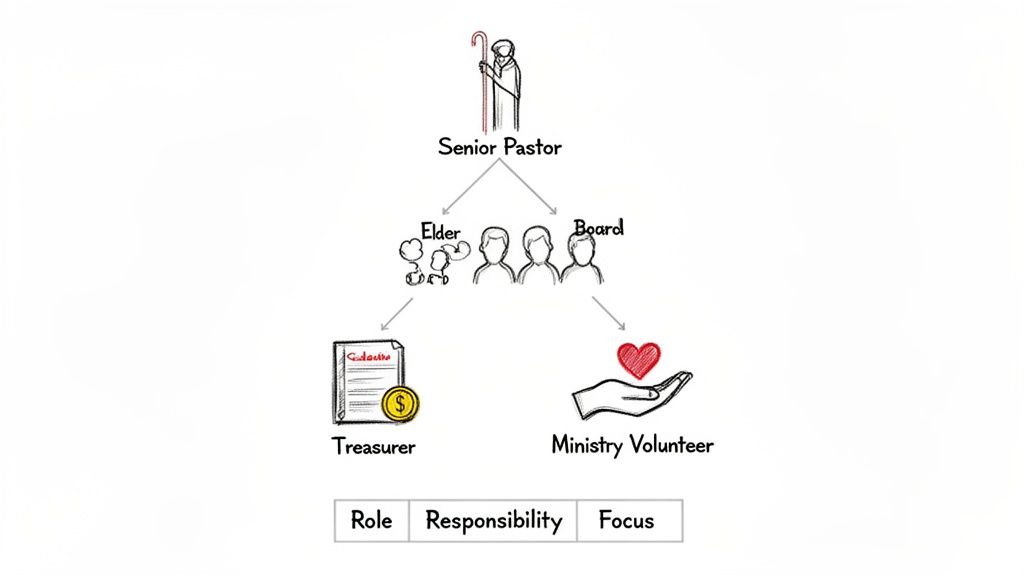
At its core, a healthy church functions a lot like any well-organized body. Specific roles and responsibilities ensure that every aspect of the church’s life and mission gets the attention it needs. These functions generally fall into three interconnected categories:
- Spiritual and Executive Leadership: This group, which includes the Senior Pastor and the Elder Board, sets the spiritual direction, provides teaching, and handles high-level governance.
- Financial and Administrative Stewardship: This is the domain of the Treasurer, Finance Committee, and Bookkeeper. Their job is to manage the church’s resources with absolute integrity and transparency.
- Ministry and Volunteer Execution: Here you’ll find the ministry leaders and dedicated volunteers who bring the church’s mission to life—from running youth groups to organizing community outreach events.
The Interconnected Web of Responsibilities
The key thing to remember is that none of these roles exist in a silo. They are all deeply connected. The Elder Board can't approve a budget without clear, accurate financial reports from the Treasurer. Likewise, a youth pastor can't plan a mission trip without knowing exactly what funds are available in their designated ministry account.
This is precisely why having clear job descriptions and reporting structures is so important. For a broader look at the principles behind this, general resources on understanding roles and responsibilities can offer some great foundational insights.
Every person, whether on staff or serving as a volunteer, holds a piece of the stewardship puzzle. One of the most central positions is the church administrator, whose duties often bridge all three categories. We cover this role in-depth in our guide on the duties of a church administrator.
A well-defined structure eliminates confusion and empowers leaders at every level. When people know what they're responsible for and how their work supports the bigger picture, the entire church can move forward in unity and with purpose.
To get us started, here is a quick-reference table summarizing the most common roles you'll find in a church.
Quick-Reference Guide to Common Church Roles
This table provides an at-a-glance summary of the most common church roles and their primary functions within the congregation.
| Role | Primary Responsibility | Key Focus Area |
|---|---|---|
| Senior Pastor | Provides spiritual direction and executive leadership | Spiritual Vision & Teaching |
| Elder / Board | Governs the church and provides oversight | Governance & Accountability |
| Treasurer | Oversees the church's financial health and reporting | Financial Stewardship |
| Ministry Leader | Executes ministry programs and manages budgets | Community Service & Discipleship |
Think of this as the starting point. In the sections that follow, we'll dive much deeper into what each of these roles entails, especially as it relates to financial accountability and ministry effectiveness.
The Historical Foundation of Church Leadership
To really get a handle on the roles in a church today, it helps to look back at where they came from. The leadership structures we see now didn't just appear out of nowhere; they were forged in the early days of the Christian community. Faced with intense persecution, doctrinal arguments, and the simple need to keep the fellowship together, early believers had to get organized. This structure gave them the stability to not only survive but thrive.
It all boiled down to three main positions: bishop, presbyter, and deacon. Each had a distinct job, but they all worked together. Bishops had oversight of a whole region, presbyters (who we'd now call elders) focused on teaching and spiritual guidance in a single congregation, and deacons handled the very practical, hands-on needs and charitable work of the community. This created a balanced system of spiritual authority and genuine service.
Pillars of the Early Church
You can see just how important these roles were by looking at the leaders who championed them—the people we now call the Church Fathers. We’re talking about figures like Clement of Rome (c. 35-99 AD), who was a bishop right after the apostles, and Polycarp of Smyrna (c. 69-155 AD), who was a direct disciple of the Apostle John. They saw this structure as the best way to preserve the teachings they had received.
Another key figure was Ignatius of Antioch (c. 35-110 AD). In letters he wrote on his way to be martyred, he practically begged believers to stay unified under their bishop, presbyters, and deacons. Later, John Chrysostom (c. 347-407 AD), nicknamed the "golden-mouthed" preacher, set the standard for what a presbyter’s teaching and preaching should look like. In fact, church history points to over 25 such foundational leaders before 500 AD who helped establish these roles. You can learn more about these influential figures in early church history from Holy Sojourners.
Enduring Principles for Today
This history isn’t just a trivia lesson; it shows us that having clearly defined roles is absolutely vital for a healthy church. The ancient principles of oversight, teaching, and service are just as critical for sound administration and financial accountability in 2026 as they were in the first century.
The real legacy here is the understanding that structure isn’t the enemy of spirit. Instead, it’s the framework that allows the spirit to work through an organized, accountable, and unified body.
This is the "why" behind the specific jobs we'll break down in this guide. The challenges may have shifted from battling ancient heresies to properly managing designated funds, but the need for trustworthy leadership hasn't changed one bit. Understanding these timeless characteristics of biblical leadership is the first step. When a church puts clear roles in place for financial oversight—and supports those roles with precise tools like Grain Ledger that are built for fund accounting—it’s honoring a legacy of stewardship that is thousands of years old.
Defining Spiritual and Executive Leadership Roles
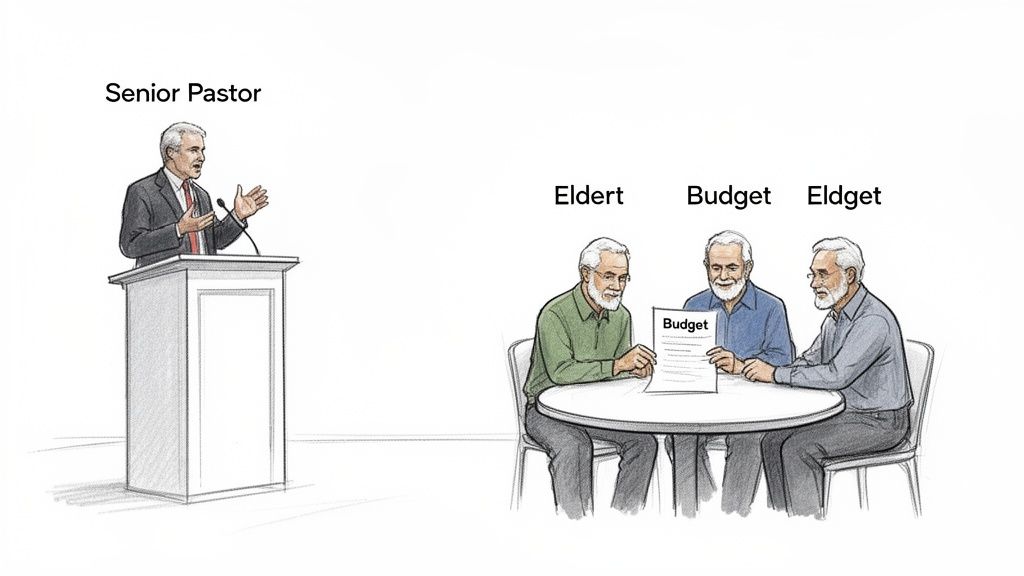
At the very top of any church's structure, you'll find the spiritual and executive leaders. This is usually the Senior Pastor working in concert with a body of Elders or a Board of Directors. These individuals are tasked with steering the church's direction, protecting its doctrinal integrity, and providing high-level oversight for every operation—including its finances.
While their day-to-day work is primarily spiritual, their impact on the church's financial health is massive. They are the ultimate stewards of the congregation's trust and resources. To really grasp why financial clarity is so vital for a healthy church, you first have to understand the specific responsibilities these leaders carry.
The Senior Pastor's Dual Role
Most people see the Senior Pastor as the main visionary and spiritual guide. They are the lead teacher, responsible for biblical instruction and setting the spiritual atmosphere for the entire congregation. This is a heavy lift, demanding a deep and constant commitment to studying and communicating God's Word.
But there's another side to the job. The Senior Pastor is also the chief executive. They oversee the staff, manage daily operations, and cast a clear, compelling vision for the future. A huge part of this executive function is communicating the church's financial story to the congregation. Trust is built on transparency, and the pastor is the key person to show how tithes and offerings are directly fueling ministry.
A pastor’s confidence in their leadership is directly connected to their confidence in the church’s financial reports. When the numbers are clear, accurate, and easy to grasp, they can focus on ministry instead of getting bogged down trying to figure out confusing spreadsheets.
The Governance Role of Elders and the Board
The pastor doesn't lead alone. Alongside them is a group of leaders, often called Elders or the Board of Directors, who provide crucial accountability and oversight. This governing body ensures the church operates with both wisdom and integrity, which is essential for maintaining congregational trust and legal standing.
Their core governance duties are significant:
- Budget Approval: The board is responsible for reviewing and giving the final sign-off on the annual church budget. They make sure it aligns with the church’s core mission and stated priorities.
- Financial Review: They regularly inspect financial statements, like the statement of activities and statement of financial position, to keep a close eye on the church's financial health.
- Policy Setting: This group establishes the financial policies that create a framework for accountability. Think of policies for managing designated funds, handling expense reimbursements, or check signing authority.
- Legal Compliance: Ultimately, the board is responsible for ensuring the church follows all legal requirements for non-profit organizations.
To do this job well, elders need financial reports that go beyond just being accurate—they need to be insightful. This is where a true fund accounting system like Grain Ledger becomes invaluable. Grain gives leaders the fund-level visibility they need to see exactly how much money is available for the general fund, the building fund, or the missions fund with just a glance.
This kind of clarity empowers pastors and elders to make strategic, well-informed decisions. Instead of wrestling with manual calculations or confusing reports, they get a real-time financial picture, ensuring every single dollar is stewarded exactly as intended. That level of transparency is the bedrock of a healthy, trustworthy church.
Financial Stewardship and Administrative Roles
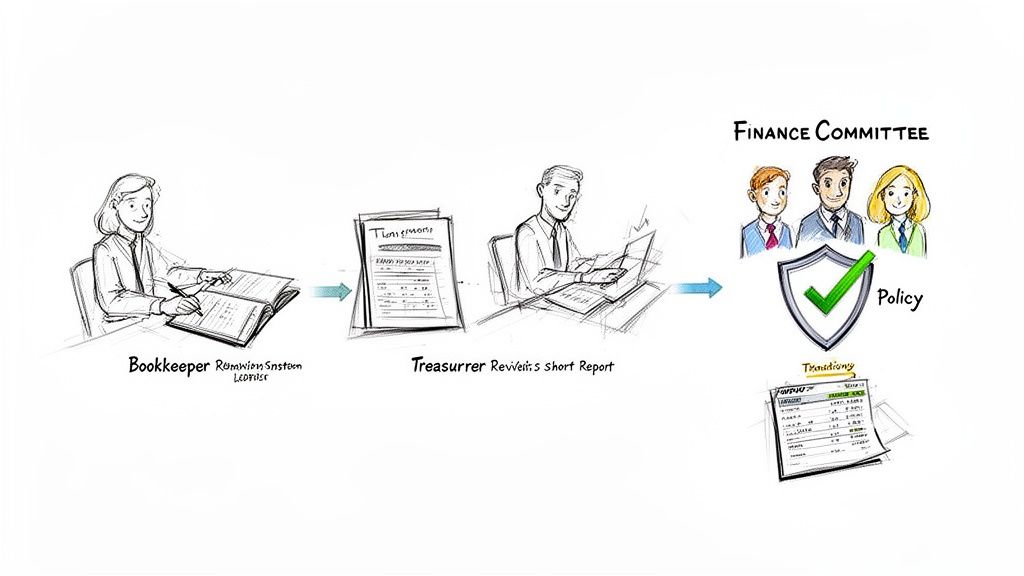
While pastors and elders rightfully focus on the spiritual health of the church, another team works tirelessly behind the scenes to ensure its financial integrity. These are the roles in church that manage the practical stewardship of every dollar given, building a foundation of trust that allows ministry to flourish.
The Treasurer, Finance Committee, and Bookkeeper form a crucial system of checks and balances. Think of them as a three-legged stool for financial accountability. When each role functions correctly, they protect the church’s resources, reputation, and ultimately, its mission.
The Church Treasurer Role
The Church Treasurer is typically a high-capacity volunteer or board member who acts as the chief financial overseer. This isn't a data entry job; it's about high-level review, analysis, and communication. The Treasurer’s main job is to ensure the numbers are correct and then translate them into a story the leadership can understand.
A good Treasurer's responsibilities usually boil down to these key areas:
- Reviewing monthly or quarterly financial statements before they go to the board, asking clarifying questions of the bookkeeper.
- Presenting those financial reports to the church leadership in a clear, concise way.
- Keeping a close eye on cash flow to make sure the church can always meet its obligations.
- Working with the Finance Committee to oversee the annual budget process.
- Acting as a guardian of internal controls, ensuring financial policies are actually being followed.
Key Takeaway: The Treasurer is the financial storyteller for the church. They take the raw data from the bookkeeper and shape it into a clear picture of the church's financial health, which empowers the board to make wise, mission-driven decisions.
The right tools can make a world of difference for a volunteer Treasurer, who often has limited time. The shift from manual spreadsheets to an automated system can change the role from a stressful, time-consuming burden to a manageable and strategic one.
Treasurer's Role With Manual Vs Automated Accounting
| Task | Manual Accounting (Spreadsheets/General Software) | Automated Fund Accounting (Grain Ledger) |
|---|---|---|
| Report Generation | Waits for the bookkeeper to manually compile reports. Often receives them late, with potential for errors. | Accesses real-time, accurate reports anytime. Dashboards are generated instantly with one click. |
| Review & Verification | Spends hours cross-referencing spreadsheets and bank statements to verify fund balances and transaction accuracy. | Quickly reviews system-generated reports. The system's integrity means trust is high and verification is fast. |
| Budget Oversight | Manually tracks budget vs. actuals, a tedious process prone to calculation errors. | Views an up-to-the-minute budget-to-actual dashboard, immediately spotting over- or under-spending. |
| Answering Questions | When the board has a question, the Treasurer must go back to the bookkeeper, who then has to dig through spreadsheets. | Answers board questions on the spot by pulling up the relevant report or drilling down into a specific transaction. |
| Strategic Focus | Most time is spent "in the weeds" of data validation, leaving little time for strategic financial planning. | Freed from tedious tasks, the Treasurer can focus on analyzing trends, forecasting, and providing strategic financial guidance. |
As you can see, an automated system like Grain Ledger doesn't just help the bookkeeper—it transforms the Treasurer's ability to provide effective oversight.
The Finance Committee
The Finance Committee is the strategic arm of the church's financial leadership. This group sets the policies and provides the high-level guidance that govern all financial activities. The committee is often made up of church members with professional backgrounds in finance, accounting, or business.
Their core functions are proactive, not reactive:
- Budget Development: They lead the charge in creating the annual budget, gathering input from all ministry leaders and ensuring the final plan aligns with the church's mission and vision.
- Policy Creation: This is critical. The committee establishes the financial "rules of the road," like a designated funds policy, expense reimbursement procedures, and who has check-signing authority.
- Risk Management: They are always looking around the corner, identifying potential financial risks and putting internal controls in place to protect the church.
The Church Bookkeeper Role
The Church Bookkeeper is the person with their hands on the keyboard, meticulously recording every single financial transaction. This role, whether it’s a paid staff member or a dedicated volunteer, is the foundation of the entire financial system. If the data entry is wrong, every report will be wrong.
This role requires a detail-oriented person who handles tasks like entering donations, paying bills, reconciling bank accounts, and running payroll. It's at this level that the choice of accounting software becomes absolutely critical.
Churches don't run like normal businesses; they use fund accounting. This method requires tracking money in separate "buckets" (or funds) designated for specific purposes—like the General Fund, Building Fund, or Missions Fund. Forcing a bookkeeper to manage this with generic software or spreadsheets creates a nightmare of manual workarounds that are a breeding ground for errors.
This is exactly why a purpose-built system is so important. A true fund accounting solution like Grain Ledger is designed for this reality. It automates the process, so when a donation comes in through a giving platform, it's automatically routed to the correct fund in the ledger. This not only simplifies the Bookkeeper's job and prevents errors but also means the Treasurer gets instant, accurate reports. Ultimately, it allows the Finance Committee to stop worrying about the integrity of the numbers and focus on what they do best: providing strategic financial oversight.
7. Empowering Ministry and Volunteer Leaders
The real work of the church happens on the front lines. It’s carried out by passionate Ministry Leaders and a whole army of dedicated volunteers—the people running the youth group, teaching Sunday school, and coordinating small groups. While their hearts are focused on discipleship and community, these roles carry real financial weight. They’re often the ones responsible for managing a specific ministry budget and tracking every dollar spent.
Giving these leaders the right financial tools isn't about piling on more administrative work. It’s about freeing them up to do ministry better. When financial information is clear and accessible, it fuels the mission instead of getting in its way.
Think about a Youth Pastor planning a missions trip. If they can see the fund's real-time balance at a glance, they can make smart spending decisions on the spot. They don't have to worry about accidentally going over budget or wait days for an outdated report from the office. This is what empowerment looks like in practice.
A proper fund accounting system makes this possible. Instead of one person holding all the keys to a complicated spreadsheet, a ministry leader gets direct, role-based access to the exact information they need, when they need it.
The Impact of Empowered Lay Leaders
The significance of putting responsibility into the hands of lay leaders goes far beyond just managing budgets. It's actually a key indicator of a healthy church community. In fact, research shows that active involvement in church leadership—even in a volunteer capacity—has a surprisingly positive impact on the leaders themselves.
A national study that tracked older adults found that those who held a leadership position, like a deacon, committee chair, or Sunday school teacher, experienced a slower decline in physical functioning than those who simply attended services. You can read the full research on its impact on functional status for a deeper dive.
This data points to a powerful truth: when people are given meaningful responsibility within their church, it doesn't just build up the ministry; it enriches their own lives. Empowering lay leaders is a win-win for everyone.
Practical Tools for Frontline Ministry
To make this happen, you have to give your leaders tools that are both powerful and incredibly simple to use. A system like Grain Ledger, for example, is built for exactly this scenario. It allows a Children's Ministry Director to instantly see their precise budget for curriculum and supplies, so they can plan a great year for the kids without having to constantly check in with the bookkeeper.
This kind of clarity builds confidence and promotes responsible stewardship throughout the entire church. If you're looking for ways to get more people plugged in, helping them get involved in your community is a fantastic starting point. Of course, with any volunteer role, safety is non-negotiable. It's always wise to have solid procedures in place, and you can check out our guide on volunteer background screening for some essential best practices.
Ultimately, when you give your leaders clear financial visibility, you allow them to spend less time wrestling with numbers and more time focused on the people they’re called to serve.
Implementing a Framework for Church Accountability
Having clearly defined roles in church is just the starting point. To make those roles truly effective, you need a robust framework for accountability. Think of this as your church’s governance system—the way everyone, from the pastor to the newest volunteer, works together. This framework is what turns good intentions into trusted stewardship, ensuring every dollar is managed with absolute integrity.
The bedrock of any solid accountability framework is a commitment to strong internal controls. The single most important control you can implement is the separation of duties. Simply put, no one person should ever have control over an entire financial transaction from beginning to end.
For instance, the ministry leader who approves a purchase for their program should not be the same person who signs the check. That simple division of responsibility creates an instant check and balance, dramatically cutting down the risk of errors or potential misuse of funds.
The Reporting Flow of Financial Information
True accountability hinges on a clear, logical flow of information. In a healthy church, each role reports up the chain, creating a natural series of reviews that safeguard church assets. This structure ensures financial data is thoroughly examined at multiple levels before it reaches the church’s highest governing body.
A sound financial reporting structure generally looks something like this:
- The Bookkeeper handles the day-to-day transactions and prepares the initial reports for the Treasurer.
- The Treasurer then reviews the bookkeeper’s work, analyzes the financial statements for accuracy, and reports their findings to the Finance Committee.
- The Finance Committee takes a deeper dive, reviewing the financials against the budget and church policies. They then prepare their analysis and recommendations for the Elder Board.
- The Elder Board receives these fully vetted reports, giving them the reliable data they need to make wise, high-level strategic decisions for the church’s future.
This tiered process means that by the time the board reviews a financial statement, it has been checked and double-checked for both accuracy and compliance.
This vertical structure illustrates how accountability flows from the church board down to ministry leaders and, ultimately, to the volunteers who carry out the day-to-day mission.
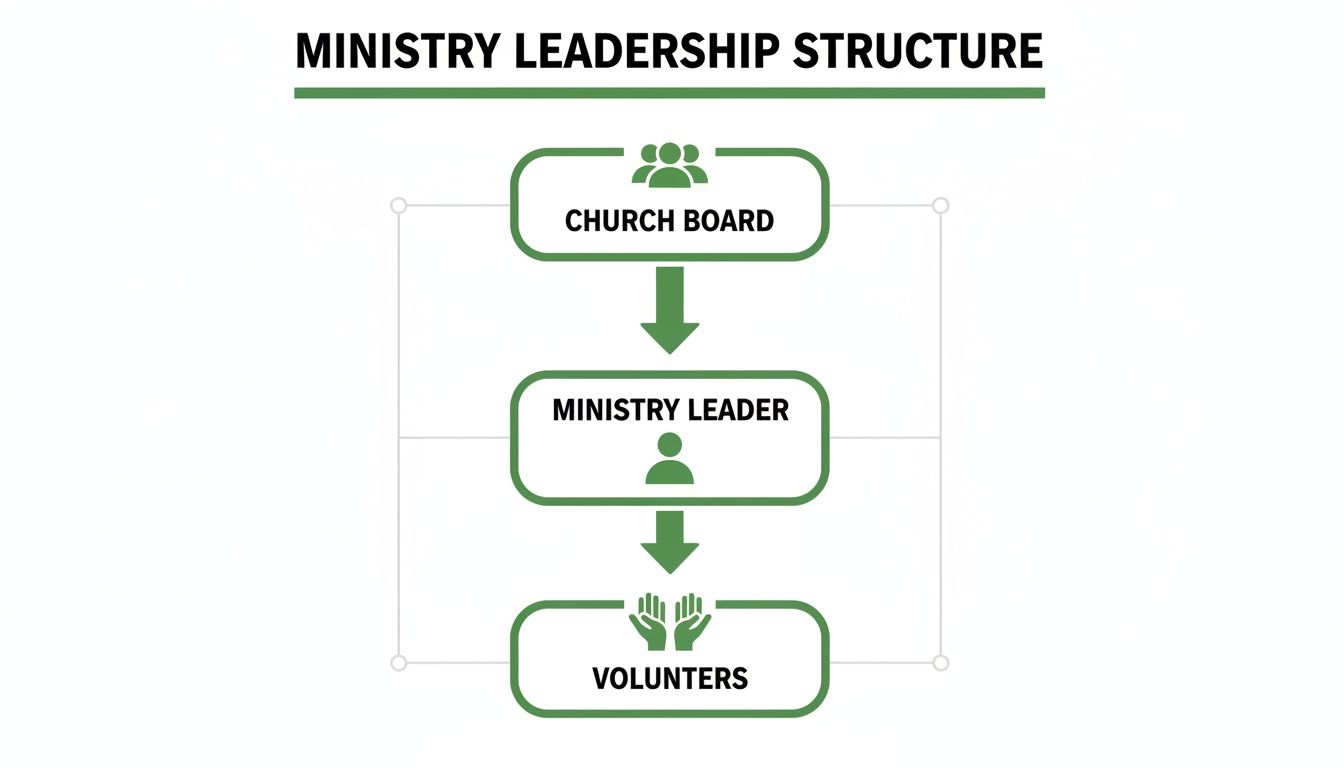
This model ensures that oversight and support flow down from leadership, while responsibility and clear reporting flow up from the ministry teams. It’s a recipe for a stable and accountable environment.
The Technology Engine for Accountability
This entire accountability framework runs on the right technology. You can have all the right policies, but without the right tools, they're difficult to enforce. This is where true fund accounting software becomes the engine that drives financial integrity. A purpose-built platform like Grain Ledger is designed from the ground up with these controls in mind.
For example, Grain Ledger lets you create role-based user permissions, which helps you bake the separation of duties right into your workflow. More importantly, its native fund-based architecture creates an unalterable audit trail. This guarantees that restricted funds are only spent on their designated purpose—a non-negotiable for building and maintaining trust with your congregation.
As giving trends shift and younger generations expect greater financial clarity, providing clear, accurate, and accessible financial reports is no longer optional—it's essential for a healthy church.
The church world is constantly evolving. With U.S. churches managing over $100 billion in annual giving and virtual attendance holding steady at 20% monthly, the need for tech-savvy financial leadership has never been greater. Research continues to show that strong accountability systems build trust and free up leaders to focus on vision instead of spreadsheets. As you explore church statistics from recent years that could be a game-changer, it becomes obvious that tools like Grain Ledger are critical for stewardship in 2026 and beyond.
Related church operations resources
These pages help administrators and treasurers connect day-to-day duties with church finance reporting and software.
- Duties of a church administrator - see finance, HR, facilities, and reporting responsibilities
- Church finance committee responsibilities - understand board oversight and monthly reporting
- Best church accounting software - compare fund accounting software for church administrators
- Grain Ledger for church treasurers - see the product workflow built for volunteer finance teams
Frequently Asked Questions About Church Roles
As you build out your church’s leadership team, some practical questions always seem to pop up, especially around money and who does what. Getting clarity on these roles isn’t just about making a neat organizational chart; it's about building a healthy, accountable framework for your ministry.
Here are some of the most common questions we hear from church leaders, along with some practical advice rooted in solid stewardship and governance.
Why Can't Our Treasurer Also Be The Bookkeeper?
This is one of the first questions I hear from smaller churches, and for good reason. It feels efficient to have one trusted, capable person handle all the finances. The problem is, combining the Treasurer and Bookkeeper roles removes a crucial layer of accountability, creating a significant risk.
Think of it this way: the Bookkeeper is in the weeds, handling the day-to-day transactions like entering donations and paying bills. The Treasurer, on the other hand, provides oversight. Their job is to review the bookkeeper's work, analyze financial reports, and ask questions on behalf of the board.
Separating these duties protects both the church’s funds and the people serving in these roles. It creates a natural system of checks and balances where one person’s work is reviewed by another. This catches honest mistakes and, frankly, removes the opportunity for potential fraud.
In a small church where people have to wear multiple hats, this can be tough. That's where technology can act as your "digital separation of duties." A modern accounting platform like Grain Ledger can require dual approvals for payments or flag unusual transactions, helping to mitigate risk when a perfect staff structure isn't feasible.
Do Small Churches Really Need Special Accounting Software?
Absolutely, and the reason goes right to the heart of how church finances work. It’s always tempting for small or mid-sized churches to use what's familiar and cheap—think spreadsheets or a standard business accounting program. But I've seen this approach create huge headaches, confusion, and even legal risk down the road.
Church finance is completely different from for-profit business finance because of one key concept: fund accounting. You have a legal and ethical obligation to track restricted funds (money given for a specific purpose, like the building fund or missions) separately from your general operating budget. Generic software simply isn't designed to do this, forcing you into clunky, error-prone workarounds.
A purpose-built solution like Grain Ledger is actually simpler for volunteers and staff because it's built for how a church operates. From day one, it automatically separates and protects restricted funds, ensuring every report is accurate. This gives you and your donors complete confidence that every gift is being stewarded exactly as intended.
How Do We Empower Volunteers To Manage Their Budgets?
True empowerment comes from giving your ministry leaders visibility into their finances without compromising security. You don’t want the youth pastor seeing payroll details, but they absolutely need to know how much money is left in the youth ministry budget. The key is using technology with smart user permissions.
Modern church accounting software handles this beautifully.
- Role-Based Views: A system like Grain Ledger allows you to give a ministry leader a real-time dashboard showing only the funds and budgets relevant to their area.
- Real-Time Data: They can see their budget, track expenses as they happen, and check their remaining balance anytime, from any device. No more waiting weeks for a report from the office.
- Maintained Control: This access is typically "read-only" and is strictly limited to their ministry area. The central finance team or bookkeeper maintains full control over sensitive data and the actual financial transactions.
This simple shift transforms your volunteers from being budget-guessers to being responsible owners of their ministry's resources. It equips them to make smart, timely spending decisions so they can focus on what really matters—the ministry itself.
Managing church finances effectively is the bedrock of trustworthy stewardship. Grain Ledger provides the true fund accounting tools your church needs to ensure every dollar is accounted for with clarity and integrity. Empower your team with real-time financial visibility. Learn more about Grain Ledger and Schedule a Demo today.
Ready to simplify your church finances?
Start free with church fund accounting, or watch a product demo first.