What Is a General Ledger and How Does It Work for Churches?
Learn what is a general ledger and why it's the heart of your church's financial integrity. A clear guide to how it works for fund accounting and stewardship.
Every single donation your church receives, from the loose change in the Sunday offering plate to a major gift for the new building, tells a part of your ministry’s story. The general ledger is what brings all those individual stories together into one official, comprehensive book. Think of it as the ultimate source of truth for your church's finances, making sure every dollar is perfectly accounted for.
About Grain Ledger: This guide includes Grain Ledger, church fund accounting software built for designated gifts and ministry funds. It connects giving platforms (Planning Center, Pushpay, Tithely, Stripe), syncs bank activity with Plaid, and produces fund-level financial reports. Schedule a demo to see how it compares for your church.
See Grain Ledger for your church
Fund accounting, giving integrations, and bank reconciliation in one platform. Free migration support for churches switching from QuickBooks or Aplos.
Your Ministry’s Financial Story Starts Here
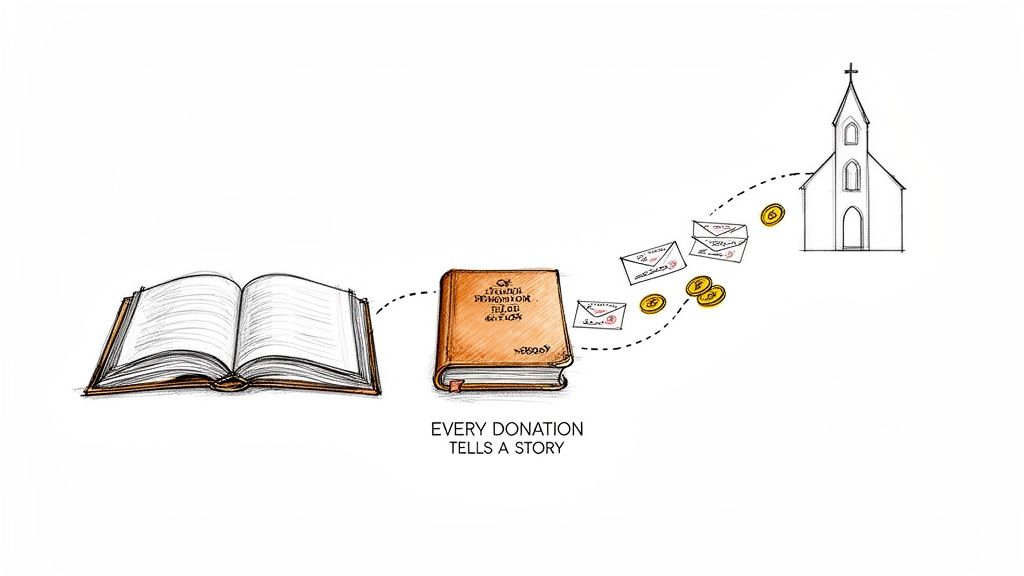
Don't let the term "general ledger" intimidate you. It’s not some impossibly complex document. At its heart, it’s simply the master record book for every financial activity in your church. It’s the central hub where every transaction—every gift, every expense—gets sorted and summarized into its proper account.
This master record is the engine that drives all your key financial statements, like the balance sheet and the income statement (which you might know as a Statement of Activities). It’s the foundational document that proves your ministry’s stewardship and financial health to your congregation and board.
At its core, the general ledger answers a simple but vital question for your ministry: "Where did every dollar come from, and where did it go?" This complete financial history is essential for building trust with your congregation and making informed decisions.
To help put this into perspective, let's break down exactly what the general ledger does for your church in practical terms.
The General Ledger at a Glance
| Core Concept | What It Means for Your Church |
|---|---|
| Central Hub | It's the "master file" where all financial transactions are posted after being recorded in journals. |
| Financial Backbone | All your key financial reports—the balance sheet, income statement—are generated directly from its data. |
| Audit Trail | It provides a clear, traceable path for every transaction from beginning to end. |
| Stewardship Record | It demonstrates exactly how donor funds are being used, building trust and transparency. |
This table shows how the ledger isn't just an accounting formality; it's a practical tool for ministry management.
The shift from paper ledgers to digital ones has been a game-changer, especially for churches that rely on fund-based accounting. Automated ledgers nearly eliminate the manual errors that can creep in, ensure donations are routed to their designated funds with precision, and give finance teams instant visibility into the health of each fund. If you're curious, you can explore more on the history of ledgers to see just how far we've come.
Keeping a well-maintained general ledger isn't just a chore for the bookkeeper; it's a fundamental act of stewardship that delivers real benefits:
- Complete Accuracy: It’s your guarantee that financial reports are reliable and reflect the true financial position of your church.
- Clear Transparency: It creates a detailed audit trail, making it easy to show donors exactly how their contributions are making a difference.
- Informed Leadership: It gives your board and leadership the solid data they need to budget wisely and plan for your ministry's future.
The Building Blocks of Your General Ledger
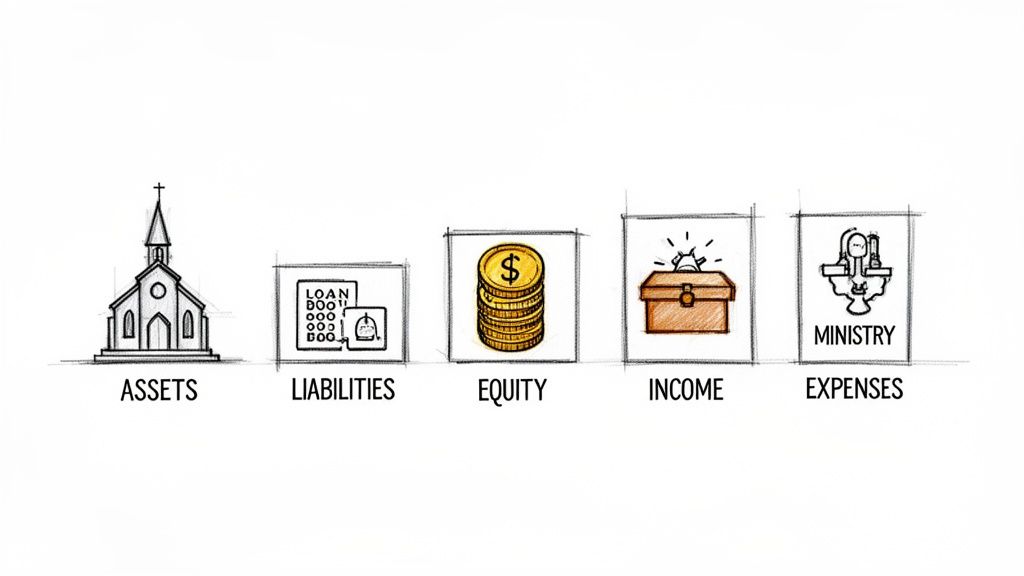
Before you can really get a handle on the general ledger, you need to understand the five main categories that everything flows into. Think of these as the main buckets you'll use to sort every single financial event at your church. Each one tells a specific part of the story, and together they give you a full picture of your ministry's financial health.
This whole system of balancing accounts has been around for centuries, formalized way back in the 15th century. The core idea is that every transaction has two sides—a debit and a credit—that must be equal. This creates a self-checking system that's perfect for ensuring every donation is accounted for down to the penny.
The Five Core Account Types
Every financial move your church makes—from receiving an offering to paying the electric bill—will fall into one of these five account types. They're all laid out in your chart of accounts. If you're building yours from scratch, you can set up your nonprofit's chart of accounts in our detailed guide.
- Assets: Simply put, this is stuff your church owns that has value. Think cash in the bank, the church building, or the ministry van.
- Liabilities: This is what your church owes. It could be a mortgage on the property, a loan for that new sound system, or unpaid bills from your suppliers.
- Equity (or Net Assets): For churches, this is the real measure of your net worth. It’s the difference between your assets and liabilities, often broken down into various fund balances.
- Income (or Revenue): This is all the money coming in. Tithes and offerings are the big ones, but this also includes designated gifts for things like the missions fund or building campaign.
- Expenses: This is what it costs to do ministry. We're talking about everything from staff salaries and utility bills to Sunday school curriculum and outreach event supplies.
The golden rule of accounting is surprisingly simple: Assets = Liabilities + Equity. Your general ledger is the tool that tirelessly enforces this equation, making sure your financial story is always balanced and accurate.
Getting comfortable with these foundational elements is the first step. A solid grasp of bookkeeping basics will empower you to look at your financial reports with confidence, knowing exactly where every number comes from and what it means for your ministry.
How the Ledger Powers True Fund Accounting
For any church, handling money is about more than just balancing the books—it’s a ministry of stewardship. It’s about honoring the heart behind every gift. When a member gives to the missions fund or contributes to a youth camp scholarship, they’re trusting the church to use that money for its intended purpose. The general ledger is the core tool that turns this promise into a reality through fund accounting.
Imagine all of your church's cash is a single water tank. Without a good system, every dollar just sloshes together, and you can’t tell which donation is for what. A general ledger built for fund accounting creates separate, protected containers inside that tank for each specific purpose—Missions, Benevolence, Building Fund, and so on. This simple separation ensures money given for Bibles is never accidentally spent on the electric bill.
Honoring Donor Intent
The double-entry system is what makes this separation foolproof. Let's say a $100 donation comes in, and it's specifically designated for "Youth Camp." The ledger immediately records two balancing entries to keep things straight:
- A debit (an increase) of $100 to the "Cash" asset account.
- A credit (also an increase) of $100 to the "Youth Camp Fund" equity account.
That simple two-sided entry legally and ethically locks those funds away for their specific purpose. The ledger creates an unbreakable audit trail, proving exactly how the money is being held for its intended ministry. This level of detail is non-negotiable, and you can dive deeper into structuring these records in our complete guide to fund accounting for churches.
A well-structured general ledger transforms financial data into a testimony of your church's integrity. It provides transparent, irrefutable proof that you are faithfully managing the resources God has provided through your congregation.
At the end of the day, the general ledger is the engine that drives trust. It moves beyond just making sure the numbers add up and becomes a powerful way to demonstrate accountability to your members. For churches committed to financial integrity, an accounting solution like Grain Ledger is essential. It was designed from the ground up to handle the unique demands of fund accounting, making sure every donation is managed with the precision it deserves and building unshakable confidence within your community.
Understanding Your Church's Financial Records
To really wrap your head around the general ledger, it helps to see how it fits with its two closest partners: the General Journal and the Chart of Accounts. They might sound alike, but each one plays a completely different and essential role in your church's financial story.
It's a common stumbling block for church treasurers to mix these up. But once you see how they work together, everything clicks into place.
Think of it like this: The Chart of Accounts is the architect's blueprint, defining every possible financial category. The General Journal is the builder's daily log, recording every single transaction as it happens. The General Ledger is the final, comprehensive history book, sorting all those daily logs into their permanent, organized chapters.
This workflow is what creates a clear, traceable path for every dollar, from the initial transaction all the way to your final financial reports. Let's break down each component in a bit more detail.
Financial Records Explained
To make the roles even clearer, here’s a simple breakdown of how these three essential records function. Each one builds on the last, creating a complete and accurate financial picture for your ministry.
| Record Type | Analogy | Primary Function |
|---|---|---|
| Chart of Accounts | The Blueprint | Lists every possible account your church uses (e.g., General Fund, Missions, Utilities). |
| General Journal | The Daily Log | Records transactions chronologically as they occur, like a diary of financial activity. |
| General Ledger | The History Book | Sorts journal entries into their respective accounts, creating a final, balanced record. |
Getting this flow right is the foundation of sound church bookkeeping. It ensures every transaction is categorized correctly from the start and ends up in the right place.
From the initial journal entry—which you can learn more about in our guide on how to do journal entries—to the final ledger balance, the process provides an airtight record.
This flow is especially crucial in fund accounting, where a donation must follow a specific path to fulfill its designated purpose.
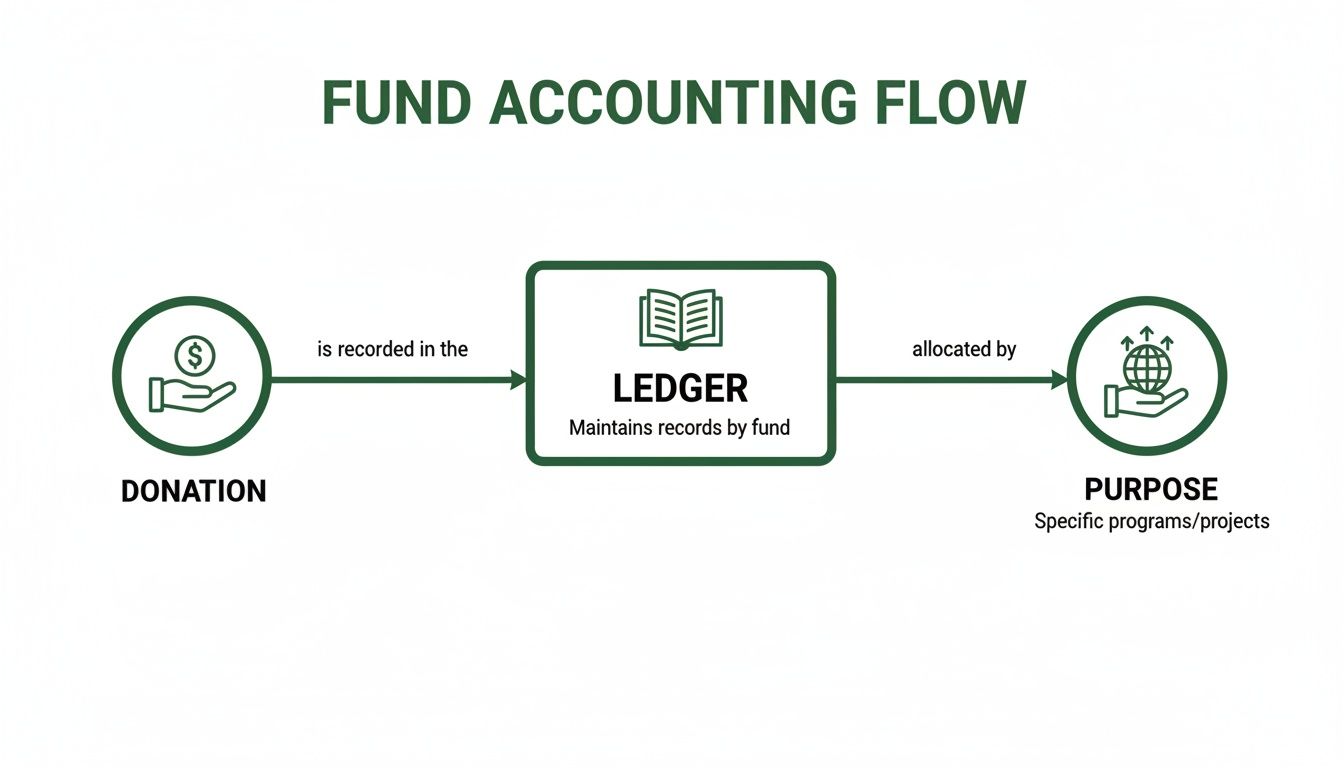
As you can see, the ledger is the central hub that connects a donor's gift to the specific ministry it was intended to support. It’s what guarantees financial integrity and transparency.
Why a Spot-On Ledger Isn't Just "Good Practice"
Let's be clear: keeping an accurate general ledger is much more than a bookkeeping checkbox. For a healthy ministry, it's absolutely essential. This master record is the single source of truth for every financial report your church creates. Think of it as the heart of your financial system, pumping reliable data to everything else.
Whether you're pulling together a Statement of Activities for the board or a Statement of Financial Position for a bank loan, the information starts in the general ledger. The integrity of your church's financial story rests squarely on its shoulders.
When an auditor comes knocking, the first thing they’ll ask for is your general ledger. It’s the definitive record that proves you’re handling every dollar with integrity and stewarding your resources well.
The Bedrock of Financial Health
It's time to stop seeing the ledger as a tedious administrative task and start treating it as a vital ministry tool. A clean, up-to-date ledger gives your leadership a real-time snapshot of your church’s financial position. This isn't just about looking back; it's about making smart, data-driven decisions for the future and building realistic budgets. As the primary source for verifying your church's financial data, its role in any audit is mission-critical. Learn more about how the ledger powers decision-making.
A pristine ledger is non-negotiable for a few simple reasons:
- Smart Decisions: It gives your leadership the reliable data they need to make wise, forward-thinking financial choices.
- Compliance and Audits: It builds a clear, defensible trail that makes audit season less stressful and proves you're following the rules.
- Donor Confidence: It’s the ultimate proof of your stewardship, showing your congregation that their gifts are being managed responsibly.
For any church, trust is the currency of ministry. An accurate general ledger is the bedrock of that trust. A purpose-built accounting solution like Grain Ledger is designed to maintain this accuracy automatically, protecting your church’s financial integrity from the ground up.
Time to Ditch the Spreadsheets for True Fund Accounting
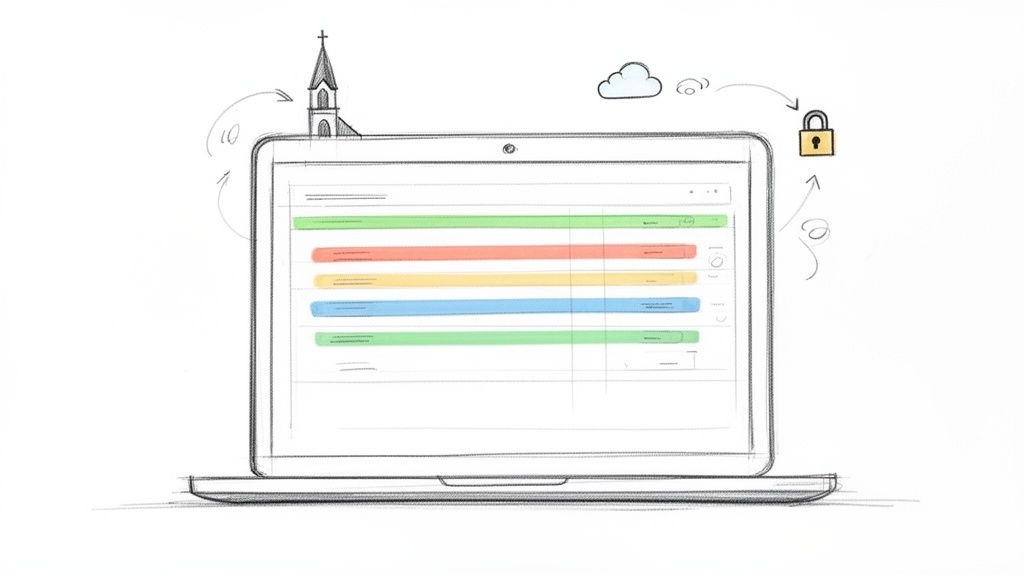
Let’s be honest: trying to wrangle church finances with spreadsheets or generic business software is a recipe for headaches. You end up with messy fund-tracking and a high risk of manual errors, making it nearly impossible to maintain an accurate general ledger.
This is exactly why a purpose-built solution is so critical. Grain Ledger was designed from the ground up for the unique world of church accounting, with true fund accounting at its very core. It gets rid of the patchwork fixes and risky workarounds for good.
Put Your Stewardship on Autopilot
With Grain, the complexities of managing restricted funds disappear. The system automatically tracks every designated donation and its related expense, recording them correctly in the general ledger without any complicated manual adjustments.
This automation completely removes the danger of co-mingling funds. Better yet, it gives you instant, accurate reports you can confidently share with your leadership team.
By aligning the general ledger with ministry priorities, churches can build unshakable trust with their congregations, demonstrating transparent stewardship of every gift.
Modern tools can help your ministry visualize and share financial data effectively, for instance, by allowing you to leverage collaborative dashboards.
A Foundation for Financial Integrity
A specialized solution like Grain Ledger offers so much more than basic bookkeeping—it provides a solid framework for financial integrity. Its features are built to support the specific needs of a church, turning the general ledger from a confusing chore into a powerful ministry tool.
This approach ensures every financial decision is clear, compliant, and honors donor intent, strengthening the trust that holds your community together.
Related church accounting software resources
If you are comparing software, these pages map the main decision points: fund accounting, QuickBooks limits, pricing, and migration.
- Best church accounting software (2026 comparison) - canonical guide comparing 12 church accounting platforms
- Church accounting software product page - see Grain Ledger for fund accounting, giving, and bank reconciliation
- Small church accounting software - see the product page built for volunteer treasurers and church admins
- Fund accounting features - review how Grain Ledger tracks designated funds
- QuickBooks for churches - understand workarounds and when to switch
- Free church accounting software - compare free options and upgrade triggers
- Grain Ledger pricing - compare plans for small and growing churches
- Start free - try fund accounting, giving imports, and bank reconciliation together
Common Questions About the General Ledger
Let's dig into a few practical questions we hear all the time from church leaders and finance volunteers. These answers will help you apply what we've discussed and manage your church’s finances with confidence.
How Often Should We Update the General Ledger?
Think of your general ledger like a living document—it's most useful when it reflects your current reality. It’s best practice to post transactions at least weekly. If your church has a lot of financial activity, like a school or a busy event schedule, daily updates are even better.
No matter what, you absolutely need to reconcile your accounts and "close the books" every single month. This keeps your financial reports accurate and ready for board meetings, ensuring everyone is making decisions based on reliable information.
Can Our Church Just Use a Spreadsheet?
This is a tempting shortcut, especially for smaller churches, but we strongly advise against it. Spreadsheets are a minefield of potential problems: formulas can break, data can be accidentally deleted, and there’s no real security or audit trail.
The biggest issue, though, is that spreadsheets make true fund accounting a nightmare to manage. A dedicated church accounting solution like Grain Ledger is designed to handle designated funds and restrictions automatically. This saves you an incredible amount of time and protects your ministry from serious financial risk.
What Does Closing the Books Mean?
"Closing the books" is simply the process of finalizing all your transactions for a set period, whether it's a month or the full year. It’s how you draw a line in the sand and prepare for the next accounting period.
The process boils down to three key steps:
- Review and Reconcile: Double-check that all transactions for the period have been recorded correctly.
- Make Adjustments: Post any final "adjusting entries" that are needed.
- Zero Out Accounts: Transfer the final balances from your temporary income and expense accounts into a permanent equity account (your Fund Balance).
Once you've done this, your income and expense accounts start the next period at $0, giving you a clean slate to track the new month or year.
Ready to build a general ledger that truly supports your ministry's stewardship? Grain Ledger offers a purpose-built solution designed for the unique demands of church fund accounting, ensuring every dollar is tracked with integrity. Schedule a Demo to learn more.
Ready to simplify your church finances?
Start free with church fund accounting, or watch a product demo first.