A Guide to Background Checks for Churches
Implement a compliant and effective screening program with our guide to background checks for churches. Learn how to protect your congregation and ministry.
When we talk about background checks for churches, it’s easy to feel a little uncomfortable. It can feel like an act of suspicion in a community built on faith and grace. But I think it’s crucial to reframe this: implementing a screening process is a fundamental act of stewardship. It’s about being proactive to create a verifiable circle of trust that protects your congregation, especially children and vulnerable adults, from potential harm.
This isn't about mistrust. It's about establishing a truly safe environment where your ministry can flourish.
Why Screening Is an Act of Stewardship

Let's be real—introducing formal screening can feel awkward. But when you look at background checks for churches through the lens of stewardship, the whole conversation changes. It stops being about looking for the bad and starts being about responsible oversight for the flock God has entrusted to your care.
This proactive approach moves your ministry beyond assumption and builds it on a foundation of verifiable safety. It’s one of the most tangible ways to show your congregation that you take their well-being seriously.
Protecting People, Finances, and Reputation
A thoughtful screening policy is one of the most powerful risk management tools a church can have. The risks are very real, and an incident can have devastating, long-lasting consequences for everyone involved.
A well-structured program protects your ministry in several key areas:
- Vulnerable Populations: This is the big one. The most critical reason for screening is to protect children, youth, and other vulnerable members from anyone with a history of predatory behavior.
- Financial Integrity: It's also vital to screen anyone who handles tithes, offerings, and church funds. This simple step is essential to preventing fraud and misconduct that could cripple a ministry.
- Ministry Reputation: A single incident involving an unscreened volunteer can cause irreparable damage to your church's reputation, eroding the trust you've spent years building in your community.
Stewardship extends far beyond the financial. It’s the careful and responsible management of everything God has entrusted to us—and our people are by far the most precious resource. A background check is simply a modern tool for that ancient responsibility.
More Than Just a Criminal Check
True stewardship means thinking holistically about safety and accountability. We instinctively know to vet volunteers working with children, but we must apply that same diligence to those in financial leadership. It can even be helpful to see how other sectors approach this; for instance, many businesses use a supplier due diligence tool to vet partners, which offers a good model for comprehensive screening.
When you pair vetted financial leaders with the right systems, you create a powerful combination of accountability. Imagine combining trusted people with a true fund-based accounting solution like Grain Ledger, which tracks every single dollar to its designated purpose. You suddenly have a level of transparency that not only protects against mismanagement but also builds incredible confidence within the congregation.
This guide will walk you through building a program that does just that.
Crafting Your Church Screening Policy
Before you run a single background check, you need a playbook. A clear, consistent, and written screening policy is the bedrock of a safe ministry, ensuring every decision you make is fair, objective, and legally sound. Flying by the seat of your pants is a recipe for inconsistency, and inconsistency can open the door to liability.
Think of this policy as your guide for every single volunteer and staff member. It’s what removes the guesswork and protects both the church and the very people applying to serve.
Who Exactly Needs to Be Screened?
First things first: you need to decide which roles require a background check. It's a common and dangerous mistake to think screening is only for those working in the nursery or with the youth group. A truly effective policy casts a much wider net to protect every corner of your ministry.
You should be thinking about any position of trust and authority. This includes the obvious ones, but also a few that might not be top of mind:
- Children and Youth Workers: This is the absolute non-negotiable. Every teacher, nursery helper, youth leader, camp counselor, and even the parent driving for a one-time field trip falls into this category. No exceptions.
- Pastoral and Ministry Staff: Anyone in a leadership role with access to the congregation needs to be screened. This means senior pastors, associate pastors, elders, deacons, and counselors.
- Financial Roles: Protecting the church's stewardship is crucial. Screen your board members, finance committee, bookkeepers, treasurers, and anyone involved in counting the weekly offering.
- Key Volunteers: What about your security team members? The van drivers? Small group leaders who host people in their homes? These roles all carry a significant level of trust and responsibility.
A strong policy leaves no room for ambiguity. It clearly lists which roles require screening so that the process is applied uniformly to everyone, eliminating any appearance of favoritism or discrimination.
A Tiered Approach to Screening
Not every role carries the same level of risk, so it makes sense that your screening process shouldn't be a one-size-fits-all solution. A tiered approach is both practical and cost-effective, allowing you to match the depth of the background check to the responsibilities of the position.
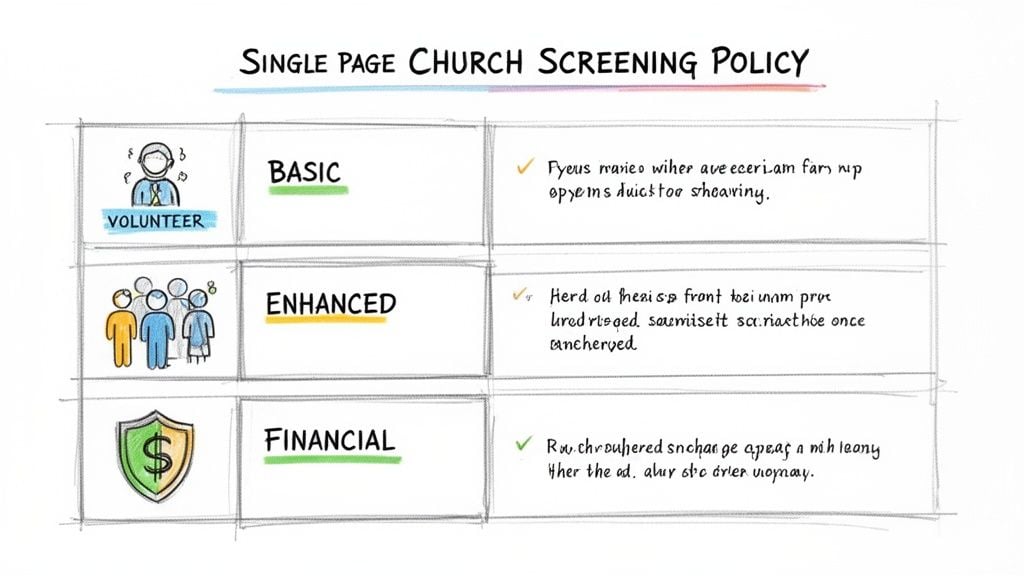
For instance, your policy might establish three distinct levels:
- Basic Screening: This is for general volunteers who have limited interaction with vulnerable people or finances—think event setup crew or Sunday morning greeters. This level could involve a national criminal database search and a sex offender registry check.
- Enhanced Screening: This is the standard for anyone working with children, youth, or vulnerable adults. Your Sunday school teachers and youth leaders absolutely fall here. It should include everything in the basic check plus county-level courthouse record searches.
- Financial Screening: For staff and volunteers handling church funds, like the treasurer or finance committee members. This would include all previous checks and add a credit history report to spot potential red flags related to financial integrity.
This tiered method shows you’re performing due diligence by aligning the screening intensity with the real-world risks of each role. It's also important to remember that these checks are just one part of a much larger safety strategy. While the 2020 Faith Communities Today Survey shows high adoption rates for checks, many experts warn of a false sense of security. Why? Because a staggering 50% of U.S. real-time criminal data is only found in local county records, which many basic, instant checks completely miss. You can dig deeper into the data behind U.S. church background check trends to see why more thorough searches are so vital.
Establish Clear Disqualification Criteria
So, what happens when a report comes back with a red flag? Your policy must define what offenses will automatically disqualify someone from serving in a particular role. This is probably the most challenging part of writing the policy, but it’s arguably the most important.
Having these criteria defined ahead of time ensures you apply your standards consistently and fairly to every single person. For example, any conviction for child abuse, violence, or a sex-related offense would be an absolute, unbendable disqualifier for anyone hoping to work with children. Likewise, a history of fraud or embezzlement should prevent someone from ever handling church finances.
The Non-Negotiable Legal Review
Once you have a solid draft of your screening policy, your final step is crucial: get it reviewed by a lawyer. Don't just ask any attorney; find one who specializes in church or nonprofit law. They will be able to vet your policy to ensure it complies with federal laws like the Fair Credit Reporting Act (FCRA), as well as any tricky state and local regulations you might not know about.
This isn't an optional step you can skip to save money. A proper legal review protects your church from potentially devastating liability, confirms your process is fair to every applicant, and gives your leadership team the confidence to implement the policy knowing it's built on a firm legal foundation.
Navigating Screening Laws and Compliance
When you're running background checks for your church, staying compliant with the law isn't just a good idea—it's a legal must. The whole process can feel like a maze of acronyms and regulations, but getting a handle on the rules is the only way to protect your ministry, your team, and every person who applies.
The big one you need to know at the federal level is the Fair Credit Reporting Act (FCRA). Don't let the name fool you. While it sounds like it’s all about credit scores, the FCRA actually governs all "consumer reports," and that includes the criminal background checks you get from a third-party screening company.
Getting the FCRA's Core Requirements Right
You simply can't afford to ignore the FCRA. The rules are laid out pretty clearly, and they exist to protect the rights of individuals during the screening process. For churches, this means you have specific duties you absolutely must follow.
First and foremost, you have to get clear, written consent from the applicant before you do anything. You can’t run a background check without it. This isn't something you can bury in the fine print of a volunteer application, either. The consent form has to be a standalone document, making it totally obvious what they're agreeing to.
Along with that, you need to give them a separate disclosure form. This form plainly states that you might use the information from the background check to make decisions about their employment or volunteer role. Think of it this way: the disclosure tells them what you're going to do, and the consent form is where they give you the green light to do it.
Handling Red Flags: The Pre-Adverse and Adverse Action Process
This is a step where a lot of well-meaning churches trip up and land in legal hot water. If you review a background report and decide not to move forward with a candidate because of something you saw, you can't just send a polite "thanks, but no thanks" email. The FCRA requires a specific, two-step notification process.
First, you kick off the pre-adverse action step. Here’s what that involves:
- Send the applicant a complete copy of the background check report you received.
- Include a copy of the official document, "A Summary of Your Rights Under the Fair Credit Reporting Act."
- Give them a reasonable amount of time—usually about five business days—to look over the report and dispute any errors with the screening company.
This waiting period isn't a suggestion; it's a legal requirement. It gives the individual a fair chance to correct errors before you make a final decision. A simple data entry mistake could have created a false negative, and this step allows for that to be fixed.
After that waiting period is over, if you still decide to decline the candidate, you then send the adverse action notice. This is the formal communication that officially tells them your decision. It must also include the screening company’s contact information and remind them of their right to dispute the report's accuracy.
Don't Forget About State and Local Laws
While the FCRA sets the federal standard, it’s not the only law on the books. Many states, and even some cities, have their own screening rules that can be even more strict. You'll often hear about "ban the box" laws, for instance, which dictate when in the hiring process you’re allowed to ask about criminal history.
Because these regulations can change from one town to the next, it’s really important to work with a reputable screening partner and chat with a lawyer who knows the rules in your area. They can make sure your forms and procedures are compliant with every layer of the law. You can also find some great insights in our guide on other key aspects of church law and tax compliance.
The Sobering Reality of Screening Gaps in Churches
Despite the clear need, the reality is that many churches have significant gaps in their screening programs. Lifeway Research, for example, found that among Southern Baptists, staff screening in tiny churches (fewer than 50 attendees) is just 35%, a stark contrast to the 94% in megachurches. This shows a real vulnerability in smaller congregations that might not have the same resources.
Looking at the broader nonprofit world, the numbers are also concerning. Only 33% of volunteers report undergoing criminal checks, which is a tough pill to swallow given the amount of trust we place in them.
To make sure your church's process is both legally sound and equitable, it's also worth brushing up on the broader principles of fair hiring practices. This helps you build a system that not only checks the compliance boxes but also reflects grace and fairness, treating every applicant with dignity while protecting your congregation.
How to Choose the Right Screening Partner
Picking a company to handle your church's background checks is one of the most important safety decisions you'll make. It’s easy to get lured in by cheap, instant online searches, especially when the budget is tight. But let me be blunt: that path almost always creates a dangerous, false sense of security.
This isn’t just another vendor contract. Choosing the right partner is a critical act of due diligence. The wrong one can feed you incomplete data, leading you to trust individuals who haven't been properly vetted. The right one, however, becomes a true extension of your ministry's safety team, delivering reliable, compliant, and thorough information you can count on.
Accreditation Is Your First Filter
Before you even start comparing prices or features, there's one question that should be at the top of your list: Is the company accredited by the Professional Background Screening Association (PBSA)?
Think of this as a non-negotiable. PBSA accreditation means a screening company has passed a demanding audit of its policies and procedures. It’s proof that they meet the highest industry standards for data security, legal compliance, and overall professionalism. A company without this credential simply hasn’t demonstrated they can be trusted with this sensitive and vital work.
Choosing a PBSA-accredited partner is like making sure your builder is licensed and insured before they start working on your home. It’s the foundational step that protects your ministry from shoddy work, legal trouble, and unacceptable risk. Don’t even consider a firm that hasn’t met this standard.
Where Does Their Data Actually Come From?
Once you've confirmed a company is accredited, your next job is to dig into the quality of their data. The single most important question you can ask a potential vendor is this: "Do your standard checks include direct, county-level courthouse record searches?"
Many of the low-cost providers rely exclusively on national criminal databases. These sound impressive, but in reality, they are often incomplete and can lag weeks, or even months, behind what's happening in the actual courts. The vast majority of criminal records are filed and updated first at the local county level.
A trustworthy screening partner uses national databases to cast a wide net and identify potential red flags. Then, they send researchers to pull the actual, up-to-the-minute records directly from the relevant county courthouse. This is the only way to ensure you're making decisions based on the most accurate and current information available.
Must-Have Features for Churches
Beyond the quality of the data, a great partner for a church will offer specific features that make the whole process smoother and more effective for a ministry environment.
Here’s a quick checklist to use when you're comparing your options:
- Turnaround Time: How fast do they get results back to you? A quality firm should complete most checks within 24-72 hours.
- Compliance Tools: Do they give you FCRA-compliant consent forms, disclosure notices, and templates for pre-adverse and adverse action letters? This support is absolutely critical for protecting your church legally.
- Ministry-Focused Support: Is their support team familiar with the unique needs of churches and nonprofits? You want a partner who gets it, not just a faceless call center.
- ChMS Integration: Can their system connect with your Church Management Software (ChMS)? This feature is a total game-changer for your administrative workload.
That last point—ChMS integration—can automate your entire volunteer onboarding process. Imagine an application submitted through your church software automatically triggering the background check request, tracking its status in real-time, and updating the volunteer's profile once it's complete. This eliminates tedious manual data entry, cuts down on errors, and saves your staff countless hours.
It’s a key feature that transforms background checks for churches from a series of disconnected tasks into a seamless, manageable system. For more ideas on improving your onboarding process, you can find valuable tips in our guide to volunteer background screening.
Weaving Background Checks into Your Church’s Daily Rhythm
A background check program shouldn't feel like a clunky, separate process bolted onto your ministry. When done right, it becomes a natural part of how you welcome and onboard new staff and volunteers. The real goal is to make screening feel less like a hurdle and more like a standard, respected step in joining the team.
This means getting away from dusty file cabinets filled with paper forms and manual spreadsheets. Think about how much smoother the experience is for everyone when you can send a digital consent form automatically and track an applicant's status right from your main dashboard. It elevates the professionalism of your church and takes a huge administrative weight off your team's shoulders.
This simple three-step process shows how to think about managing your screening partners to keep things seamless.
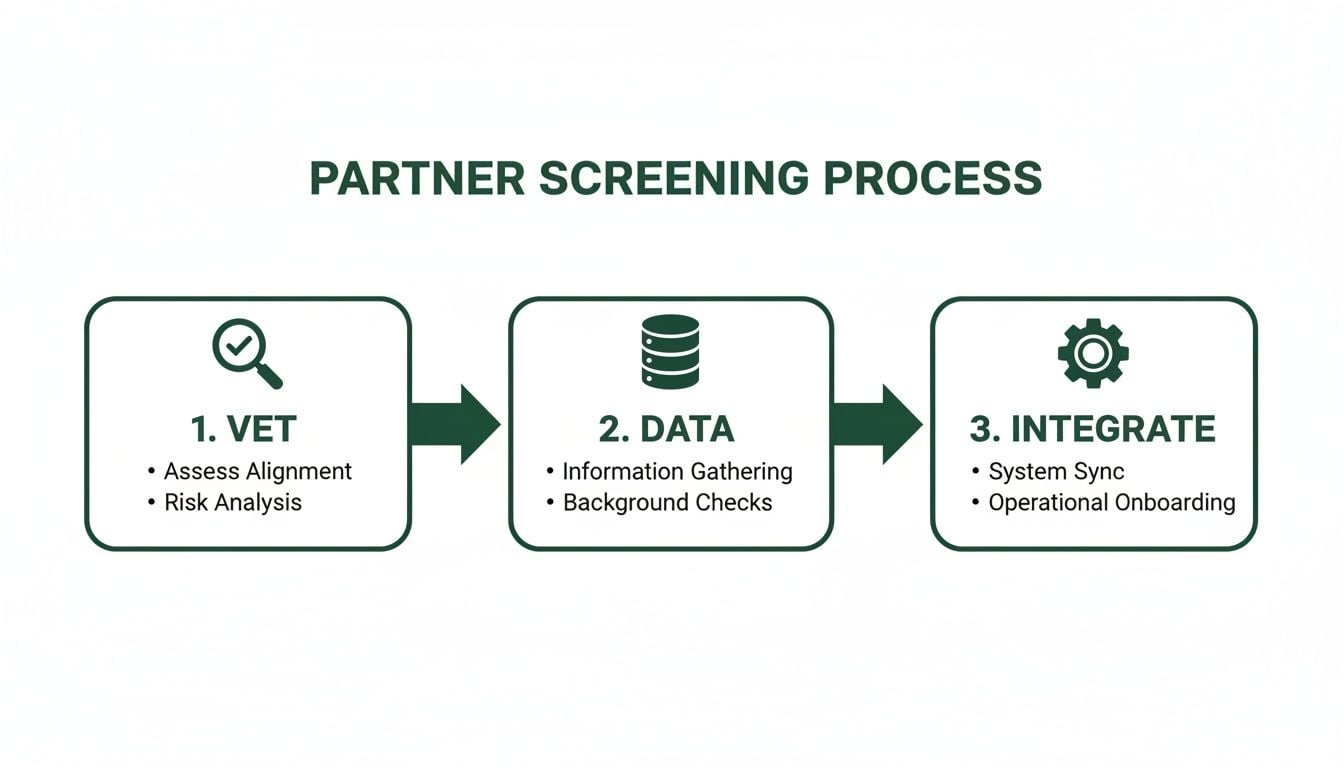
It all starts with vetting your provider, moves to confirming their data is reliable, and finishes by integrating their service directly into your existing church systems.
Connecting Your People to Your Finances
Nowhere is this integration more critical than with your church’s finances. Of course, you absolutely must vet anyone with access to church funds—treasurers, bookkeepers, finance committee members. That’s non-negotiable. But finding trustworthy people is only one piece of the financial integrity puzzle.
To truly safeguard your ministry’s resources, you need to pair those trusted individuals with a rock-solid, fund-based accounting system. This is where the right tools make all the difference.
A Quick Word on Stewardship: Think of it like a one-two punch for financial integrity. First, you place thoroughly screened, trustworthy people in key roles. Second, you give them a transparent financial system that tracks every dollar from donation to expense. This combination gives your leadership and congregation complete confidence.
This approach ensures every gift is managed with the accountability it deserves. For a closer look at what these financial roles entail, our guide on the duties of a church administrator is a great resource.
The Power of True Fund Accounting
This is where a specialized accounting system designed for churches really shines. When you use a true fund-based accounting solution like Grain Ledger, every single transaction is automatically tied to its designated fund—whether that’s for missions, youth camp, or the building fund. You get an incredible level of clarity that general business software just can't provide.
This creates an unbreakable audit trail, which doesn't just protect the church—it protects your finance team, too. It’s no longer just about trusting a person; it's about having a system that documents and verifies their faithful work at every turn.
The need for this level of oversight is stark. Experts project that church fraud could reach $80 billion a year by 2026. What’s more, the median loss for a church hit by fraud is a staggering $89,000. These are ministry-altering numbers. It's a sobering reminder that simply running a standard national database check isn't enough, especially since those databases aren't updated in real-time and many critical records only exist at the county courthouse.
By tying your background screening workflow directly to a robust financial tool, you build a powerful defense. You're fostering a culture where accountability is built-in, not tacked on, protecting your ministry's resources for the work they were always intended for. This isn't just about good bookkeeping; it's what active, responsible stewardship looks like in practice.
Navigating Common Questions About Church Background Checks
Even with a solid policy and a great screening partner, you're going to run into questions. It just happens. Being prepared with clear, consistent answers is the key to handling these situations with both confidence and grace.
Let's walk through some of the most common questions church leaders face.
How Often Should We Re-Screen Volunteers and Staff?
This comes up all the time. The gold standard, and what I strongly recommend, is to re-screen all active staff and any volunteers working with kids or finances at least every two to three years. For high-level roles like pastors or board members, you might even want to make that an annual check-in.
Think of it this way: a one-time check is just a snapshot. People's lives change. A recurring check ensures your information stays current and your safety measures remain effective. Some screening vendors are now offering continuous monitoring services, which is a fantastic extra layer of security. They can alert you to new criminal activity that pops up between your formal re-checks.
What Do We Do if a Background Check Shows a Red Flag?
First, take a deep breath. Don't jump to conclusions. This is the moment your written policy becomes your best friend and most important guide.
Legally, you have to follow a specific process laid out by the FCRA, known as the "pre-adverse action" process. It's not optional. Here’s what that looks like in practice:
- Provide a Copy: You must give the applicant the complete background report you received. No summaries, the whole thing.
- Share Their Rights: You also have to provide the official government document, "A Summary of Your Rights Under the Fair Credit Reporting Act."
- Allow Time to Respond: Give them a reasonable amount of time—usually about five business days—to look over the report and point out any errors to the screening company. Mistakes happen, and they have a right to correct them.
If, after that waiting period, you still decide you can't move forward with them, you have to send a second letter called an adverse action notice.
Context is everything here. A minor offense from 20 years ago might not be relevant. But a conviction involving violence, children, or financial fraud should be an immediate disqualifier for any related role. If you're ever on the fence, this is the time to call your legal counsel.
A Quick Tip from Experience: After the formal FCRA process is complete, having a private, compassionate conversation can be a powerful act of ministry, even if the person is disqualified. It separates the individual from the risk and shows your decision is based on a consistent policy, not a personal judgment.
Can We Use a Free Online Background Check Service?
I get this question a lot, and my answer is always the same: a clear and absolute no.
Using those free, instant online services for volunteer or employee screening is not just a bad idea—it's illegal for placement purposes.
These sites are not FCRA-compliant, which exposes your church to significant legal and financial liability. On top of that, their data is notoriously incomplete and often outdated. They skim from databases that completely miss the crucial county-level court records where the vast majority of criminal history is actually filed.
To truly protect your ministry, you have to partner with a professional, PBSA-accredited screening company. It’s the only way to guarantee compliance and get the accurate, comprehensive results you need to make informed decisions.
A commitment to safety through robust screening is a powerful act of stewardship. So is ensuring the financial resources entrusted to your ministry are managed with complete transparency. Grain Ledger provides true, fund-based accounting software built specifically for churches, giving you the clarity and confidence to manage every dollar according to its designated purpose.
See how Grain can bring confidence to your church’s finances.
Ready to simplify your church finances?
Start free with church fund accounting, or watch a product demo first.