
A Guide to Church Budget Categories for 2026
Organize your church budget categories for clear financial stewardship. Our 2026 guide covers fund accounting, sample charts of accounts, and reporting tips.
A lot of church finance committees start in the same place. Someone opens a spreadsheet, everyone squints at the rows, and the discussion turns into guesswork. Is student ministry overspending, or are those retreat costs sitting in the wrong place? Did the special missions offering stay in missions, or did it disappear into the general checking account? Nobody is trying to be careless. The structure just isn't helping.
About Grain Ledger: This guide includes Grain Ledger, church fund accounting software built for designated gifts and ministry funds. It connects giving platforms (Planning Center, Pushpay, Tithely, Stripe), syncs bank activity with Plaid, and produces fund-level financial reports. Schedule a demo to see how it compares for your church.
See Grain Ledger for your church
Fund accounting, giving integrations, and bank reconciliation in one platform. Free migration support for churches switching from QuickBooks or Aplos.
That's why church budget categories matter. They turn a pile of transactions into a clear picture of what the church is funding, what it has promised to fund, and what it can responsibly do next. A budget isn't only a control document. In a healthy church, it's a stewardship tool that connects ministry vision to daily decisions.
What Are Church Budget Categories?
Church budget categories are the labels and groupings your church uses to organize every dollar that comes in and every dollar that goes out. On the surface, they look simple. Salary. Utilities. Missions. Curriculum. But those labels do much more than tidy up a report.
They tell leaders what resources are available for ministry. They show whether spending reflects actual priorities. They make it possible to explain the church's finances in plain language to pastors, elders, and the congregation.
Categories give every dollar a job
A good budget category answers a basic question. What is this money for? If a gift comes in for benevolence, it should be recorded in a way that preserves that purpose. If an expense supports children's ministry, the budget should show that clearly.
Without categories, a church can still record transactions. It just can't learn much from them.
Here's what strong church budget categories make easier:
- Planning ministry work: Leaders can see what's available for worship, outreach, kids, students, care, and administration.
- Tracking actual spending: The finance team can compare budget to reality without sorting through vague or duplicated lines.
- Explaining decisions: When members ask where funds are going, the church can answer with clarity instead of broad estimates.
- Protecting trust: Designated gifts stay visible, and the church can show that it honored donor intent.
Good categories create clarity, not restriction
New finance committee members sometimes worry that more structure will slow ministry down. In practice, the opposite is usually true. When categories are clear, pastors stop guessing. Ministry leaders stop submitting spending requests into a fog. Treasurers stop patching reports together by hand.
Clear categories don't restrict ministry. They remove confusion so leaders can act with confidence.
The right category structure gives your church a shared language. It helps the finance committee, pastoral staff, and ministry leaders look at the same numbers and reach the same conclusion about what they mean.
Beyond Balancing the Books Why Categories Matter
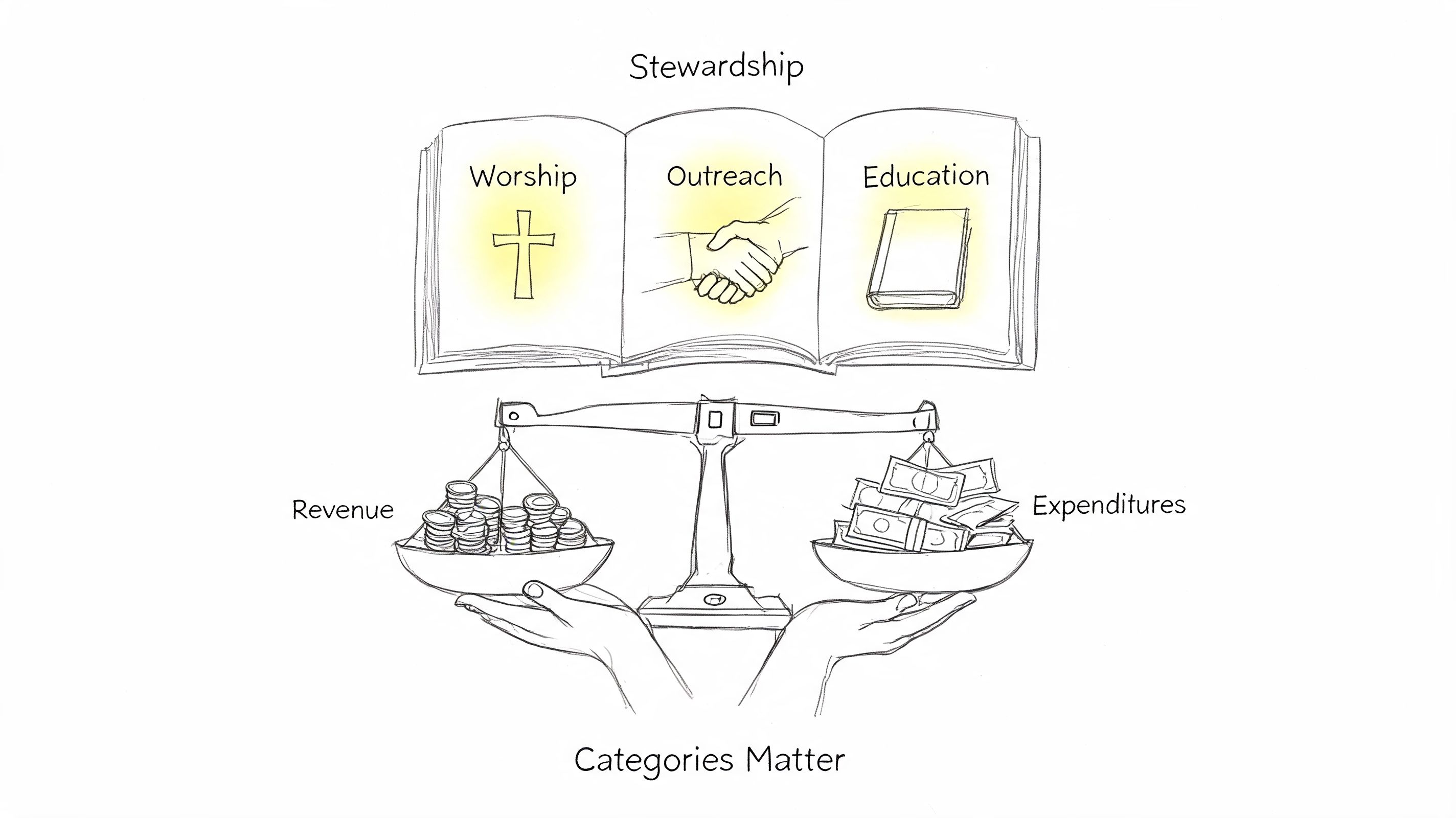
Church accounting isn't just about whether debits equal credits. It's about whether the church can prove that it handled money faithfully. That starts with categories, but it reaches much deeper than bookkeeping.
A simple way to explain this to a new committee is the envelope method. If a household keeps separate envelopes for groceries, rent, and savings, nobody expects grocery money to cover a vacation. The labels matter because the purpose matters. Church funds work the same way.
Fund accounting is a stewardship promise
Churches often receive money with different purposes attached. Some gifts support normal operations. Others are meant for missions, building needs, benevolence, or a specific ministry. If those amounts are all mixed together without clear categories and fund tracking, the church loses visibility fast.
The backbone of effective church financial management is a strong Chart of Accounts organized into five main categories, and that structure becomes especially important when a church manages restricted donations across funds such as general operations, missions, and building needs. Subsplash's overview of church budget categories also notes that 25-30% of church budgets target ministries and outreach, often through restricted giving, which is why native fund accounting reduces posting errors and administrative overhead.
That matters because a donor's intent isn't a suggestion. It's an obligation.
What weak categories usually cause
When a church uses broad or inconsistent categories, several problems show up at once:
- Restricted money gets blurred: Leaders can't quickly tell what belongs to the general fund and what belongs elsewhere.
- Month-end becomes manual cleanup: Staff spend time moving entries, reconciling reports, and explaining exceptions.
- Reports lose credibility: The board receives numbers, but not enough context to make a confident decision.
- Pastors lose planning visibility: Ministry leaders don't know whether a program has real financial support or only informal assumptions.
A finance committee can survive that for a while. It can't lead well that way.
Here's a useful overview for teams that want to see the principles applied visually:
Trust grows when reports match reality
Members rarely ask for advanced accounting theory. They want to know something simpler. Did the church use the money where it said it would? Good categories let you answer yes, and show your work.
A church earns trust when its reports reflect ministry promises, not just bank activity.
That's why category design belongs in stewardship conversations, not just in the bookkeeping office. It protects the church legally, but it also strengthens the relationship between the church and the people who give.
Building Your Financial Blueprint The Chart of Accounts
A church budget stands on top of a deeper structure called the Chart of Accounts. If budget categories are the labels seen, the Chart of Accounts is the blueprint underneath them. When that blueprint is weak, every report feels harder than it should.
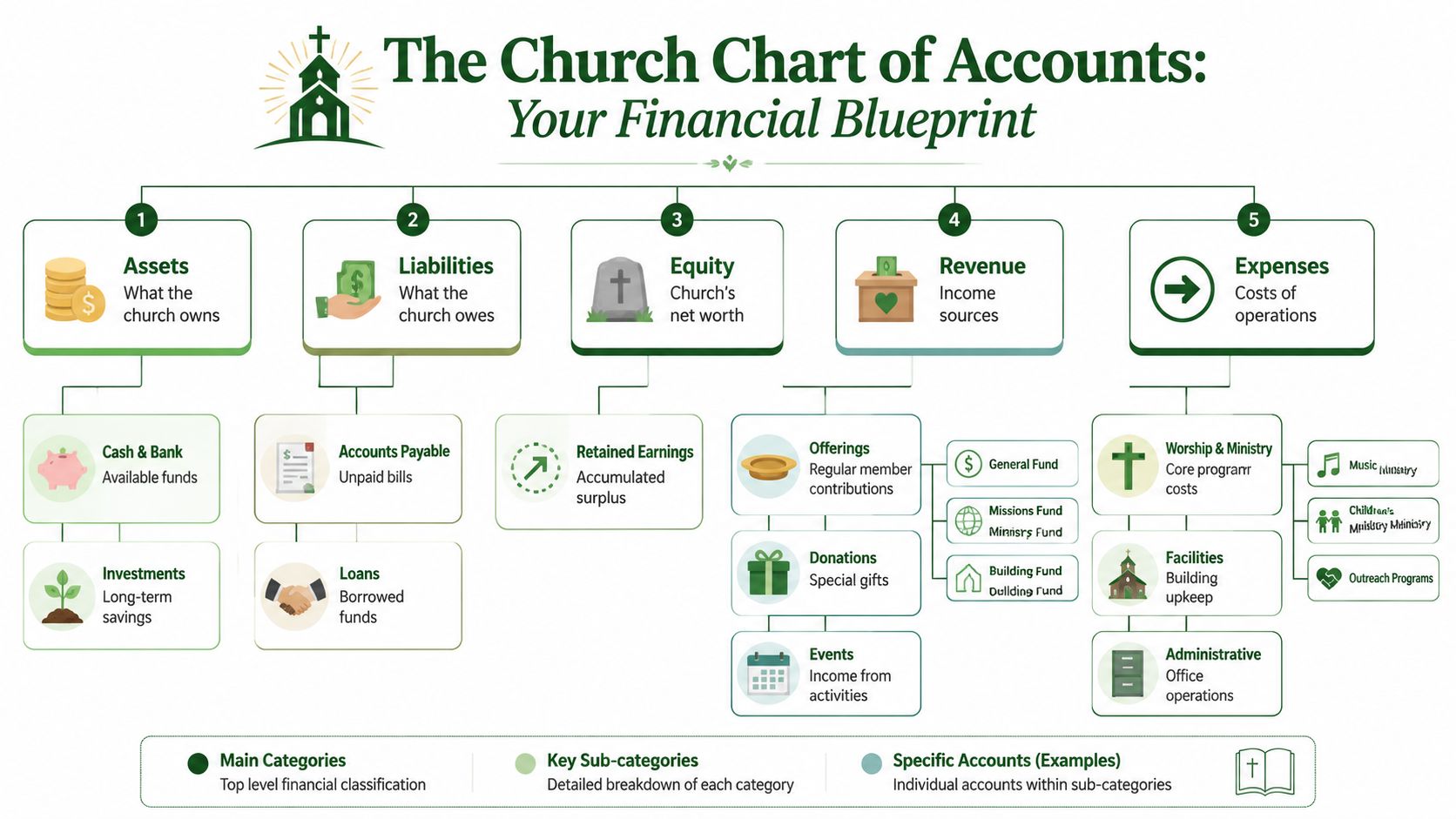
For church finance work, that structure has to do more than store transactions. It has to separate funds, preserve restrictions, and support reporting that ministry leaders can use. Generic accounting setups often struggle here because they were built for businesses first and churches second.
The five main account types
A church Chart of Accounts organizes transactions into five primary categories:
| Account type | What it represents | Church examples |
|---|---|---|
| Assets | What the church owns | Bank accounts, cash, savings |
| Liabilities | What the church owes | Bills due, loans, payroll liabilities |
| Fund balances | What remains in each fund | General fund balance, missions fund balance |
| Income | Money received | Tithes, offerings, designated gifts |
| Expenses | Money spent | Payroll, utilities, curriculum, outreach costs |
In practical terms, most church budget categories live under income and expenses. But they only make sense when they connect properly to fund balances.
Why churches need fund-first structure
In a business, you can often group expenses by department and stop there. Churches need another layer. A single type of expense might be paid from different funds. The same staff role might support more than one ministry. A gift might come in for a purpose that can't be reassigned later.
That's why I encourage committees to think in this order:
Fund first
Decide whether the transaction belongs to general operations, missions, building, benevolence, or another designated fund.Account second
Determine whether it's income, expense, asset, liability, or fund balance activity.Category third
Use a clear line item such as utilities, curriculum, salary, outreach supplies, or benevolence assistance.
If that order gets reversed, reporting becomes muddy. The church may know what it spent, but not whether it spent the right fund's money.
Practical rule: If your Chart of Accounts can't tell you both what the transaction was and which fund it belonged to, it isn't finished.
How categories fit inside the hierarchy
Here's a simple example of the hierarchy at work:
Fund: Missions Fund
- Income account: Designated Missions Giving
- Expense categories: Mission partner support, trip supplies, local outreach events
Fund: General Fund
- Income account: General Tithes and Offerings
- Expense categories: Payroll, utilities, office supplies, worship expenses
That structure lets a treasurer answer two different questions without rebuilding the numbers each month. First, how much did we spend on a certain type of ministry activity? Second, did those expenses come from the correct fund?
What works and what doesn't
What works is a Chart of Accounts built specifically for church life. It uses plain names, clean hierarchy, and fund-level reporting from the start. What doesn't work is bolting fund logic onto a general ledger after the fact and hoping the bookkeeping team remembers every workaround.
Watch for these signs of trouble:
- Too many vague accounts: “Ministry expense” tells you almost nothing.
- Duplicate categories across funds with no naming pattern: Reports become hard to scan.
- Manual spreadsheets outside the accounting system: The official books and the underlying situation drift apart.
- No fund-level reporting: Restricted balances have to be reconstructed by memory.
A clean blueprint gives you confidence before the budget season starts. It also gives you cleaner monthly reporting, smoother year-end review, and fewer stewardship headaches.
Essential Church Budget Categories and Naming Tips
Most committees want a practical list. That's reasonable. You need a budget that people can build, read, and manage. The key is to use categories that are broad enough to stay manageable and specific enough to be useful.
One budgeting reality should shape your structure from the beginning. Smart Church Solutions' church budget and general fund guide notes that church personnel costs typically consume 50-60% of expenditures, and that less than 50% of donations are recurring on average. That combination is why churches need to track costs by ministry initiative as well as by expense type.
Core category groups to include
Most churches can start with five broad groups and then add detail only where it helps decision-making.
Personnel expenses
This is usually the largest and most sensitive area of the budget. Keep it clear and consistent.
Examples include:
- Pastoral compensation
- Administrative salaries
- Ministry staff wages
- Payroll taxes
- Health insurance
- Retirement contributions
- Housing allowance
- Guest speaker honorariums
If one staff member supports multiple ministries, don't hide that cost in one broad line if the church needs ministry-level visibility.
Facilities and operations
These categories keep the building open and usable. They're not glamorous, but they are ministry support.
Common line items include:
- Mortgage or rent
- Electricity and water
- Repairs and maintenance
- Cleaning supplies or custodial services
- Insurance
- Security
- Grounds care
- Equipment maintenance
Ministry programs
This group should reflect how your church serves people week to week.
Examples:
- Children's curriculum
- Student ministry events
- Worship ministry supplies
- Adult discipleship materials
- Retreat expenses
- Transportation for ministry activities
- Volunteer training
Missions and outreach
Keep this area distinct, especially if giving is designated.
Use categories such as:
- Local outreach
- Global missions support
- Benevolence assistance
- Mission trip costs
- Community events
- Partner ministry support
Administration and communications
This bucket often gets underdescribed. It still needs definition.
Examples include:
- Office supplies
- Postage
- Accounting services
- Background checks
- Software subscriptions
- Website and communications tools
- Printing
Naming tips that help reports stay readable
The naming itself matters almost as much as the categories.
- Use plain language: “Children's Curriculum” is better than “CE Resource Allocation.”
- Stay consistent: If you use “Ministry” in one line, don't switch to “Program” for the same kind of expense elsewhere.
- Avoid catch-all labels: “Miscellaneous” should be temporary, not a permanent budget strategy.
- Name by purpose: “Benevolence Assistance” is clearer than “Special Help.”
- Group before you split: Don't create a new line item for every minor purchase unless leaders will use that detail.
If a pastor or elder can't understand a category name without asking the treasurer, the name needs work.
A simple naming pattern
A naming pattern helps reports stay clean. One practical approach is:
| Group | Sample category names |
|---|---|
| Personnel | Pastor Salary, Payroll Taxes, Health Insurance |
| Facilities | Utilities, Building Repairs, Custodial Supplies |
| Ministry | Children's Curriculum, Worship Supplies, Youth Events |
| Outreach | Local Outreach, Missions Support, Benevolence |
| Admin | Office Supplies, Accounting Fees, Software |
The goal isn't to build the longest category list. The goal is to build one people can trust and use.
Budget Category Examples by Church Size
A small church, a growing church, and a large church don't organize their budgets in exactly the same way. The broad categories may look familiar, but the pressure points change with size. Staffing, buildings, and ministry scale all affect how money gets grouped and reviewed.
ChurchTrac's guidance on healthy church budget percentages shows the shift clearly. For a small church with a $100,000 budget, a healthy allocation might be 45% salaries, 25% facilities, and 12% ministries. For a mid-sized church with a $500,000 budget, that may shift to 50% salaries, 25% facilities, and 18% ministries. Large churches often see salaries rise to 50-60% while ministry spending holds around 10-15%.
Sample Church Budget Allocations by Size
| Category Group | Small Church (<100 attendees, ~$150k Budget) | Medium Church (100-500 attendees, ~$500k Budget) | Large Church (>500 attendees, ~$1M+ Budget) |
|---|---|---|---|
| Staff salaries | 45% | 50% | 50-60% |
| Facilities | 25% | 25% | not specified in the verified dataset for this exact table context |
| Ministries | 12% | 18% | 10-15% |
How to read the table wisely
This isn't a scorecard. It's a conversation starter.
A small church often carries fixed staffing needs with less room to spread those costs. A larger church may have more complexity, but also more ability to distribute administrative load and program costs across a wider base. What matters most is whether your categories reflect your actual stage of ministry.
Three questions usually help a committee interpret these numbers well:
- Are we using staff costs intentionally? High personnel spending isn't automatically unhealthy, but it should match ministry priorities.
- Do our facilities lines reflect reality? Older buildings and leased spaces create different budgeting patterns.
- Can we see ministry costs clearly? If ministry spending is buried inside broad operational lines, leaders won't know what programs require.
A church plant may need very few categories at first. A larger church may need separate ministry categories, designated funds, and reporting by campus or department. Both can be healthy if the structure matches the ministry.
From Numbers to Narratives Effective Budget Reporting
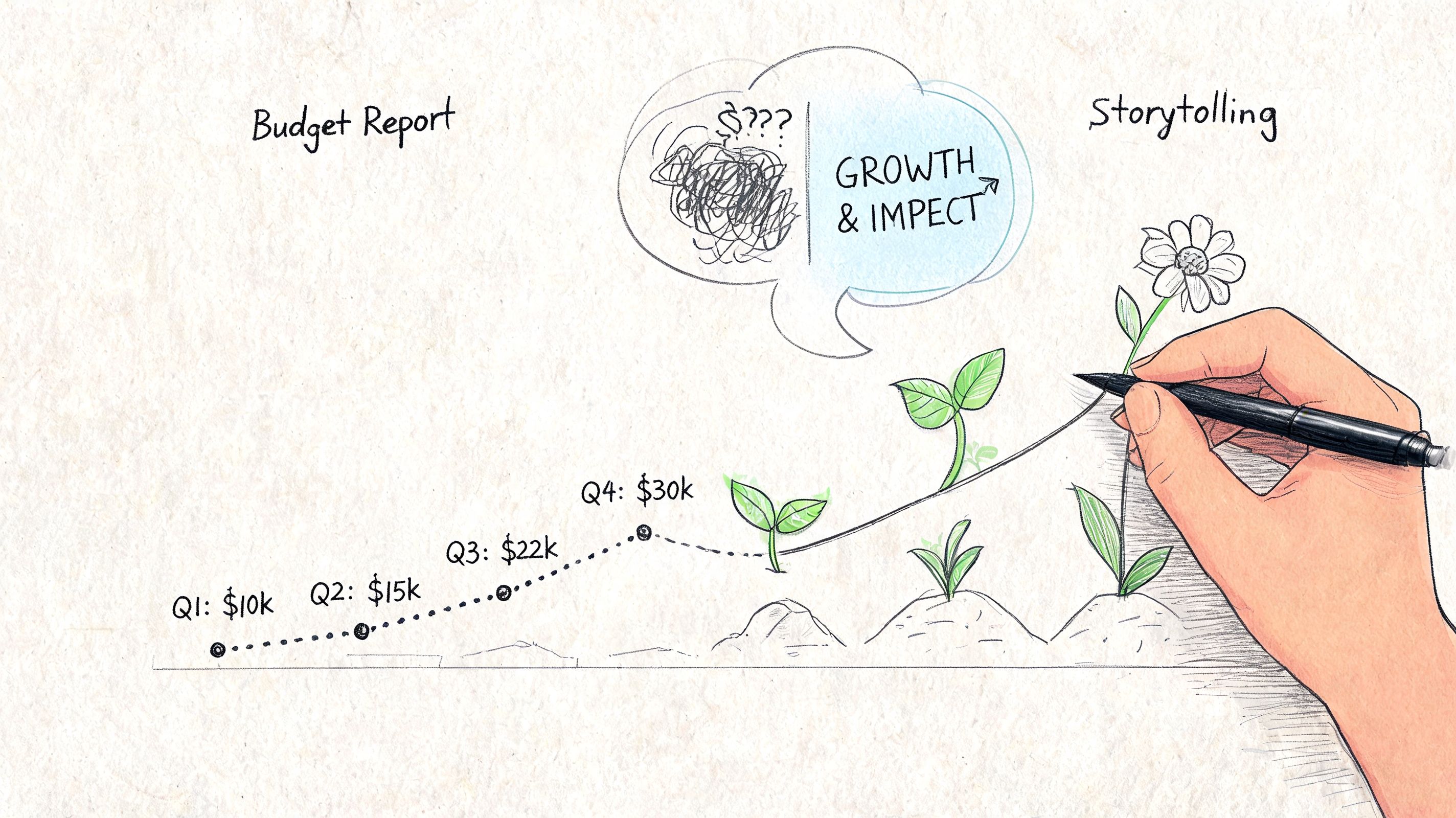
A budget only helps the church when people can understand it. That's where reporting matters. The finance committee may be comfortable with detailed ledgers, but pastors, elders, and members usually need a different view. They don't just need numbers. They need the story those numbers are telling.
Match the report to the audience
The same accounting data can produce very different conversations depending on how you present it.
For the finance committee, a detailed budget vs. actual report is useful. It should show where spending is over, under, or just mistimed. Committee members need enough detail to ask disciplined questions.
For pastoral staff, a ministry-focused summary often works better. They need to know whether children's ministry, outreach, worship, or care ministries are financially sustainable and where constraints are developing.
For the congregation, the most helpful report is usually a high-level stewardship view. Show where general giving went, what designated funds supported, and whether major ministry commitments were carried out faithfully.
Reports every church should be able to produce
A healthy church reporting setup usually includes these:
- Budget vs. actual report: Compares planned spending to real spending by category.
- Statement of financial position by fund: Shows assets, liabilities, and fund balances in a way that preserves restrictions.
- Income and expense by fund: Helps leaders see whether designated money was received and used properly.
- Ministry or program summary: Connects spending to ministry activity rather than only to accounting type.
The best church reports answer ministry questions before someone has to ask them in a meeting.
Turn categories into ministry answers
When categories are structured well, reporting becomes more than compliance. It becomes interpretation.
A pastor can ask, “How much of our general giving supports student ministry?” The treasurer can answer. The board can ask, “Did we spend from the benevolence fund only for benevolence needs?” The report can show it. A missions team can ask whether designated support remains available for a future commitment. The fund activity report can make that visible.
That is the shift many churches need. Instead of handing leaders a packet of unexplained totals, the finance team provides a faithful narrative of how resources supported the mission.
What strong reporting sounds like
Good reporting doesn't drown people in detail. It uses enough detail to make the church's stewardship visible.
A strong summary might say that staffing remained within budget, a facility repair created temporary pressure in operations, and designated outreach giving fully supported planned community efforts. That kind of explanation helps leaders act wisely without forcing everyone to decode accounting language first.
Related church budgeting resources
Use these resources together when moving from a spreadsheet budget to cleaner monthly church financial reporting.
- Free church budget generator - build a custom Excel budget template for your church
- Church budget template Excel guide - download and adapt a practical budget template
- Nonprofit budget examples - compare operating, program, and restricted-fund budget formats
- Grain Ledger budgeting - connect budgets to fund accounting and monthly reports
- Best church accounting software - compare fund accounting tools when the spreadsheet budget outgrows Excel
Putting Your Plan into Action with the Right Tools
A workable process is usually simpler than people expect. Start with ministry priorities. Build categories that reflect those priorities. Make sure the Chart of Accounts is fund-based, not just expense-based. Then choose software that can support the structure without constant manual correction.
A practical checklist
- Define your main funds: General, missions, building, benevolence, and any other designated areas your church actively uses.
- Clean up your category list: Remove duplicates, rename vague items, and group expenses in plain language.
- Build reports around decisions: Don't ask for detail no one uses, but don't hide ministry costs inside broad buckets.
- Review monthly: Fix category drift early before it becomes a year-end reporting problem.
- Use a church-fit system: If the tool fights fund accounting, the bookkeeping team will end up compensating for it by hand.
Generic accounting software can be adapted for churches, but adaptation comes with a cost. Someone has to remember the workarounds. Someone has to maintain the spreadsheets outside the system. Someone has to reconstruct designated fund activity when a board member asks a basic question.
A purpose-built church tool avoids much of that friction. Grain Ledger is one option designed around native fund accounting, so accounts, transactions, and reports are organized by funds from the start, and giving can flow into the correct fund structure without bolt-on processes.
The goal isn't flashy software. It's dependable stewardship. When the system reflects how churches operate, the finance team spends less time repairing reports and more time helping leaders make sound ministry decisions.
If your church is trying to move from confusing spreadsheets to clear fund-based reporting, Grain is worth a close look. It's built for the way churches handle designated giving, fund-level visibility, and ministry-focused reporting. Schedule a Demo if you want a cleaner financial foundation before your next budget cycle.
Ready to simplify your church finances?
Start free with church fund accounting, or watch a product demo first.