
10 Actionable Church Growth Strategy Ideas for 2026
 By Gibson Brueher, Founder of Grain Ledger
Discover a powerful church growth strategy to expand your congregation. Our roundup covers actionable ideas from giving to community engagement.
Church leaders are constantly seeking a clear, actionable church growth strategy that goes beyond simply filling pews on a Sunday morning. True, sustainable growth is not just about increasing attendance numbers; it's about building an engaged community, fostering deep discipleship, and creating a strong financial foundation that supports the ministry's mission. Many leaders understand these principles but struggle to translate abstract ideas into a concrete, executable plan that yields measurable results.
This roundup is designed to bridge that gap. We will explore 10 proven strategies that address every facet of a healthy, growing church. Each item is broken down into practical steps for implementation, key metrics to track, and real-world tips specifically for small-to-medium congregations. To foster lasting commitment, it's essential to understand how to build a funnel that turns your audience into loyal members, ensuring they feel connected and valued from their very first visit.
From enhancing the guest experience and empowering volunteers to implementing a robust digital giving infrastructure with a proper fund accounting solution like Grain Ledger, this guide provides a complete blueprint. You will find specific, actionable insights on everything from community outreach and leadership development to data-driven decision-making. By the end, you will have a comprehensive playbook to build momentum, strengthen your congregation’s financial health, and create lasting impact in your community. Let's get started.
1. Assimilation and Small Group Strategy
A core church growth strategy involves moving people from first-time visitors to deeply connected, active members of the community. This process, known as assimilation, is not about mere attendance numbers; it's about intentional relationship-building. An effective assimilation plan provides a clear pathway for newcomers, making them feel seen, valued, and integrated into the church family, which significantly reduces the chances of them quietly slipping away after a few visits.
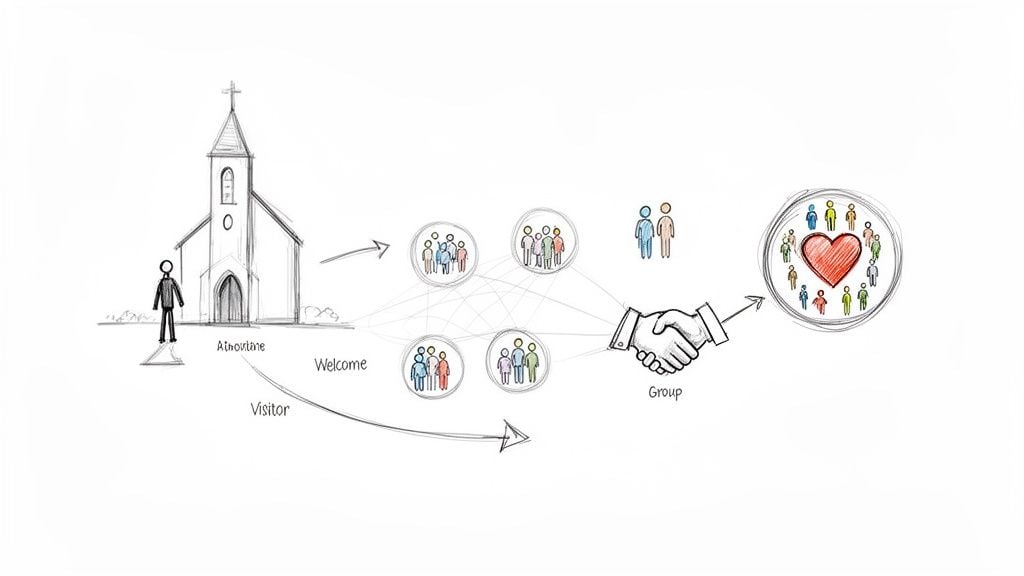
The primary mechanism for this strategy is often small groups. These settings offer a more personal environment for building friendships, studying scripture, and providing mutual support. By channeling newcomers into these groups, the church creates multiple points of connection that anchor people beyond the Sunday service.
Why This Strategy Works
Assimilation directly combats the "back door" problem where a church loses people as fast as it gains them. It fosters a sense of belonging that is crucial for long-term commitment and spiritual development. Churches like Saddleback with its CLASS system and North Coast Church have demonstrated that a systematic approach to connection leads to higher retention, deeper engagement, and a healthier church body.
A visitor is a guest, but an assimilated person is a family member. The goal is to move every guest toward family, where they feel known, needed, and loved.
How to Implement It
- Create a Clear Path: Design a simple, multi-step process. For example, a 30-day goal could be a newcomer's lunch, a 60-day goal could be joining a small group, and a 90-day goal could be serving on a team.
- Train Your Teams: Equip your greeters and welcome teams with more than just a smile. Train them to identify first-time guests, gather contact information, and hand them off to a specific connection team member.
- Integrate Stewardship: During the assimilation process or a new members' class, provide practical teaching on stewardship. Show members how to set up recurring giving and explain how their contributions support specific ministries. Using a true fund accounting system like Grain Ledger allows you to generate reports that clearly show how designated funds (e.g., "Missions Fund" or "Youth Building Fund") are being used, which builds immense trust with new givers.
- Track Key Metrics: Monitor the percentage of first-time guests who return, join a small group, and begin giving within their first 90 days. This data reveals the effectiveness of your assimilation strategy and where improvements are needed.
2. Digital and Mobile-First Giving Infrastructure
A modern church growth strategy must address the financial engine that fuels ministry: generosity. Implementing accessible digital and mobile-first giving platforms removes friction and meets donors where they are, primarily on their smartphones. This is not just about convenience; it is a critical infrastructure upgrade that enables consistent, predictable, and increased giving by aligning with modern financial habits. Churches that make giving simple often report significant increases in overall donations.
The core idea is to move beyond the physical offering plate as the primary method of giving. By providing tools for online, text-to-give, and recurring donations, churches empower their congregations to give spontaneously and faithfully, anytime and anywhere. This strategy is foundational for funding every other aspect of ministry and growth.
Why This Strategy Works
Digital giving directly tackles the barrier of inconsistent cash and checkbook usage. It stabilizes church income through recurring gift schedules and captures the generosity of those who attend services remotely or travel frequently. Platforms like Tithe.ly and Pushpay have shown that a mobile-first approach can increase overall giving by 15-30% because it makes generosity a simple, two-click action rather than a multi-step, manual process.
When giving is as easy as ordering a coffee, generosity becomes a more frequent and natural expression of worship for your congregation.
How to Implement It
- Select an Integrated Platform: Choose a giving provider that fits your church's size and technical needs. Look for platforms that offer multiple ways to give (web, app, text) and can be embedded directly on your website. To make an informed decision, you can explore a comparison of top online giving platforms for churches.
- Prominently Display Fund Options: During the giving process, clearly list designated funds like "Missions," "Building Fund," or "Community Outreach" with brief descriptions. This transparency shows donors exactly how their money will be used, increasing their confidence and willingness to give.
- Automate Your Financial Workflow: The key to this strategy's success is integration. Ensure your giving platform sends data directly to your accounting system. A true fund accounting software like Grain Ledger can accept direct API feeds, which eliminates manual data entry, reduces errors, and automatically routes donations into the correct fund.
- Track Key Giving Metrics: Monitor the percentage of total giving that comes from digital sources. Track the number of new recurring givers each month and the average digital gift amount. This data provides immediate insight into your financial health and the effectiveness of your digital giving strategy.
3. Community Outreach and Missional Service Strategy
An effective church growth strategy extends beyond the building's walls and into the heart of the local community. This approach focuses on becoming a source of tangible help and hope by meeting practical needs. Instead of asking what the community can do for the church, a missional church asks what it can do for its community, whether through food pantries, job training, homeless services, or after-school programs. This visible love in action naturally attracts people to the church's mission and message.
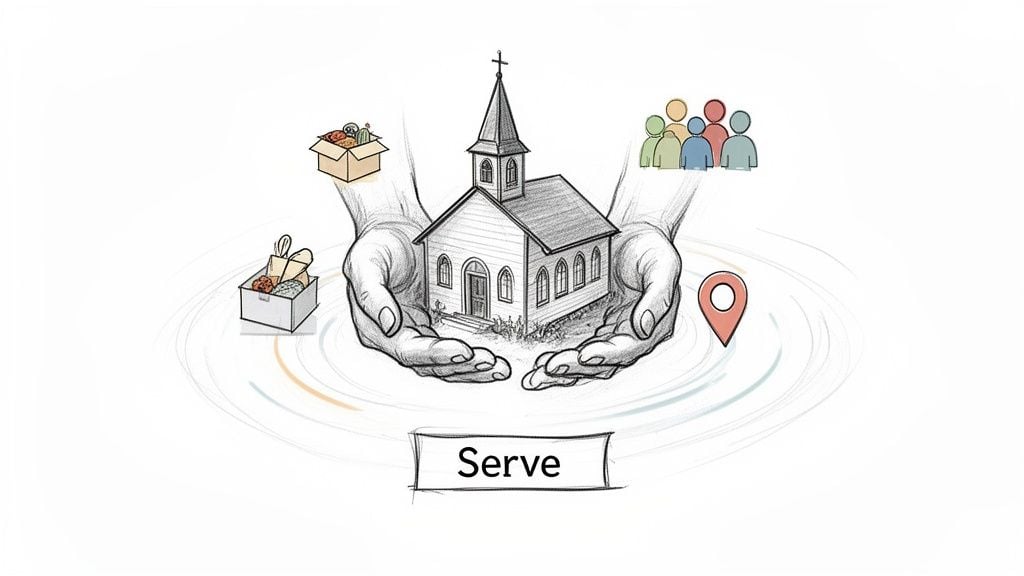
By positioning itself as an indispensable community partner, the church demonstrates its relevance and builds significant goodwill. People who might never attend a service on their own are drawn to a community that genuinely cares for their city. This strategy builds a bridge of trust that can eventually lead people to explore the faith behind the action.
Why This Strategy Works
This missional approach makes the gospel visible and tangible, breaking down common barriers and stereotypes about the church. It addresses the desire of many believers, especially younger generations, to be part of a faith that actively makes a difference in the world. As modeled by missional leaders like Tim Keller, serving the city generates authentic growth by attracting people who are drawn to the church's impact, not just its programs.
When a church becomes known more for what it gives than for what it asks, it becomes a magnetic force for good in its community and a compelling witness to the gospel.
How to Implement It
- Identify Community Needs: Instead of guessing, partner with local schools, city officials, and non-profits to discover the most pressing needs in your area. Start with one focused initiative where you can make a real difference.
- Mobilize Volunteers: Frame community service not as a chore but as a core expression of faith. Create easy on-ramps for people to serve in short-term projects and long-term roles, matching their skills and passions to specific outreach ministries.
- Establish Financial Integrity: Demonstrate faithful stewardship over every dollar given to outreach. Set up dedicated restricted funds for each initiative (e.g., "Food Pantry Fund," "Homeless Outreach Fund"). Using a true fund accounting system like Grain Ledger is essential here, as it allows you to track and report on these separate funds with clarity. This proves to donors that their contributions are used exactly as intended, which builds immense trust and encourages further giving.
- Track Your Impact: Go beyond just counting attendees. Monitor metrics like the number of families served by the food pantry, volunteer hours logged, or community partnerships formed. Share these impact stories and financial reports regularly with the congregation to celebrate what God is doing through their generosity.
4. Leadership Development and Succession Planning
A forward-thinking church growth strategy is one that actively builds its own future. This involves a deliberate investment in identifying, training, and empowering the next generation of church leaders. This goes far beyond simply filling volunteer slots; it's about creating a sustainable culture of growth where individuals are given pathways to increase their influence and responsibility, strengthening the entire organization.
This strategy reduces the unhealthy dependence on a single senior pastor and ensures the church’s mission continues seamlessly through any transition. It cultivates an environment of opportunity that attracts ambitious, capable individuals who are eager to serve and contribute their talents to a growing ministry.
Why This Strategy Works
Churches that stagnate often suffer from a leadership deficit. By creating a formal leadership pipeline, a church ensures it has a deep bench of qualified people ready to step into key roles. This proactive approach prevents leadership vacuums and burnout among existing staff. As seen in the leadership college model of Elevation Church or the intentional development at North Point, a systematic pipeline builds organizational resilience and momentum.
Leadership is not a position but an influence. A healthy church is constantly developing influencers at every level of the ministry.
How to Implement It
- Create an Advancement Pathway: Clearly define what the leadership journey looks like at your church. This could start with serving on a team, moving to leading that team, mentoring a new leader, and eventually overseeing a ministry area.
- Provide Formal Training: Offer regular training opportunities, from one-day workshops to more intensive programs. Focus on both spiritual formation and practical skills like project management, conflict resolution, and public speaking.
- Train Financial Leaders: Equip your finance team and emerging leaders with a deep understanding of church financial stewardship. This includes specific training on true fund accounting principles and the management of restricted funds. Use a system like Grain Ledger to generate clear, fund-based reports that serve as real-world case studies, helping new finance committee members understand the direct relationship between donations and ministry impact.
- Track Leadership Metrics: Monitor key indicators of your leadership pipeline’s health. Track the number of new small group leaders trained, new ministry team leaders launched, and the percentage of ministry roles filled by individuals developed internally. This data shows the effectiveness of your investment in people.
5. Targeted Multi-Site and Campus Expansion Strategy
A powerful church growth strategy is strategic expansion into multiple physical locations or launching new campuses. This approach aims to reach new neighborhoods and demographics by removing geographical barriers to attendance. Instead of asking everyone to travel to a central building, the church takes its ministry into new communities, leveraging a shared brand, vision, and operational system to accelerate growth.
This model allows a church to minister effectively in diverse contexts while maintaining a unified identity and mission. By planting new sites, a church can multiply its impact and make disciples in areas it couldn't otherwise reach, moving from being a single large gathering to a network of local faith communities.
Why This Strategy Works
The multi-site strategy directly addresses the limitations of a single, landlocked location. It enables a church to grow beyond the capacity of its main auditorium and parking lot. By placing campuses in strategic areas, it makes the church more accessible to more people. Churches like Life.Church, North Point Community Church, and Saddleback have shown that this model can lead to significant and sustained growth by combining centralized resources with localized ministry.
A multi-site model isn't just about adding more seats; it's about extending the family table into new neighborhoods so more people can have a place.
How to Implement It
- Define Your Model: Decide on your approach. Will you use a video-venue model with a live campus pastor, or will each campus have its own teaching pastor who preaches in alignment with the core vision?
- Identify Strategic Locations: Use demographic data and community analysis to identify underserved areas or neighborhoods with a high concentration of people who fit your church's target audience. Look for a core group of committed members already living in the potential launch area.
- Standardize Financial Systems First: Before launching, establish a unified financial infrastructure. Implement a true fund accounting system like Grain Ledger that supports multi-location management. Create a standardized chart of accounts and fund structure to be used across all campuses, which is critical for clear, consolidated reporting.
- Establish Campus Accountability: In your accounting software, set up each campus as its own profit center with dedicated funds for campus-specific initiatives (e.g., "North Campus Outreach Fund"). This creates accountability and allows you to track the financial health and stewardship of each location individually while managing centralized operational funds. Monitor metrics like cost per attendee and giving per capita at each site.
6. Guest Experience and First-Time Visitor Strategy
A powerful church growth strategy is the deliberate engineering of an exceptional experience for every first-time guest. This approach acknowledges that a visitor’s initial impression, often formed within the first few minutes on your campus, heavily influences their decision to return. By systematically identifying and removing potential barriers, a church can make guests feel welcomed, comfortable, and valued, directly boosting return rates and creating a pathway toward connection.
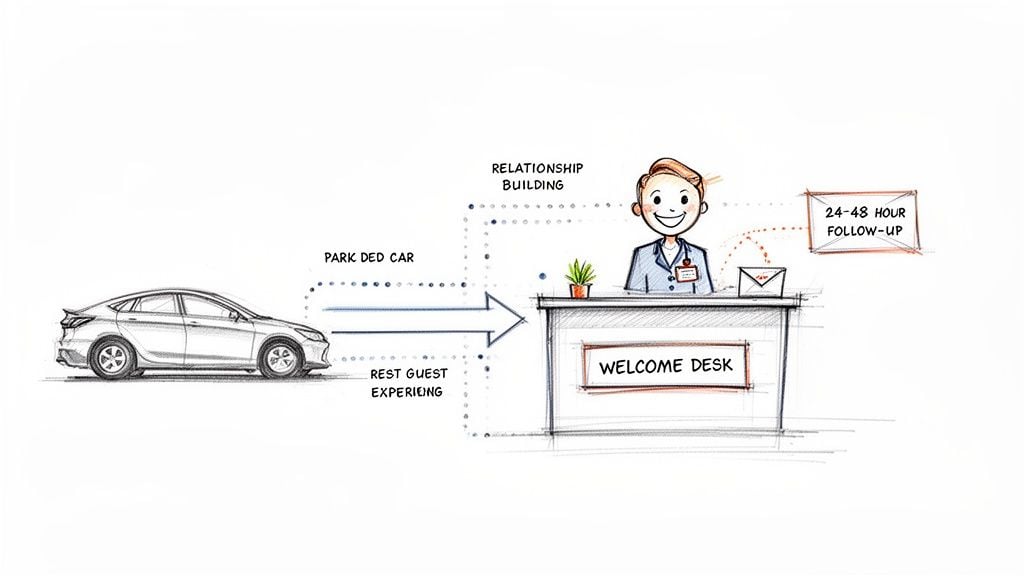
This strategy covers every touchpoint, from clear parking lot signage and friendly greeters to a clean facility, a secure children's check-in process, and a thoughtful follow-up plan. It shifts the focus from an inward-facing event for members to an outward-facing experience designed for outsiders.
Why This Strategy Works
A visitor arrives with questions and a degree of uncertainty. An intentional guest experience answers those questions before they are asked and eases any anxiety. Churches like North Point and Life.Church have shown that when guests feel attended to and not awkward, they are more open to hearing the message. This creates a positive emotional connection to the church, making a second visit far more likely.
A guest is not an interruption of our work; a guest is the purpose of it. Treat every visitor like a VIP, because in God's kingdom, they are.
How to Implement It
- Map the Guest Journey: Walk through your church experience as if you were a first-time visitor. Start from your website, drive to the campus, park, find the entrance, check in a child, and find a seat. Note every point of confusion or friction.
- Build a "First Impressions" Team: This team is responsible for more than just greeting. They manage parking, door holding, information booths, and ushering. Train them to be proactive, looking for people who appear lost or need assistance.
- Create a Simple Follow-Up Process: Collect visitor information with a simple connection card (physical or digital). Send a personal follow-up email from the pastor within 24 hours and a handwritten card within the week.
- Connect Giving to the Guest Experience: When a first-time guest gives, it signals a significant step in their connection journey. Use a true fund accounting system like Grain Ledger to track these initial gifts. You can create a "First-Time Giver" segment to send a specific welcome letter that explains how their donation supports the mission. This small act of stewardship and acknowledgment builds incredible trust from their very first contribution.
7. Strategic Stewardship and Annual Giving Campaign Strategy
A powerful church growth strategy involves moving beyond simply passing an offering plate and creating a deliberate, annual approach to financial stewardship. This strategy centers on a coordinated campaign that communicates the church’s vision, celebrates past ministry impact, and transparently outlines future financial needs. It invites the congregation to prayerfully consider and make a giving commitment for the upcoming year, connecting their contributions directly to the mission.
This method shifts the conversation from "paying the bills" to "fueling the mission." It educates members on how their generosity facilitates specific outcomes, from local outreach to global missions, building a culture of joyful and purposeful giving.
Why This Strategy Works
Strategic campaigns demystify church finances and build immense trust. When members see exactly how their money is being used and what the vision is for the future, they are more motivated and confident in their giving. This proactive approach to fundraising for churches often leads to more stable and predictable cash flow, allowing for better long-term planning. Models like Rick Warren’s Vision Sunday and Andy Stanley’s stewardship campaigns have shown that connecting giving to a compelling vision significantly increases both participation and the total amount given.
When you can show people that their giving isn't just funding a budget but changing lives, their generosity becomes a vital act of worship and partnership.
How to Implement It
- Plan a Multi-Week Campaign: Dedicate 3-4 weeks annually to focus on stewardship. The campaign should include sermons, testimonies, and detailed communication about the church’s financial goals and ministry vision.
- Create Vision-Based Materials: Develop campaign materials that clearly show how different funds support specific ministries. For example, create a brochure detailing the "Local Outreach Fund," "Next Generation Fund," and "Global Missions Fund," complete with goals for each.
- Prioritize Financial Transparency: Before asking for new commitments, report back on the previous year. Use a true fund accounting system like Grain Ledger to generate clear reports showing how designated funds were used. This accountability is crucial for building donor confidence before the next campaign.
- Track Pledges and Progress: Implement a system to track commitment cards or online pledges. Provide regular updates during the campaign (e.g., via a dashboard in the church foyer or on the website) showing progress toward the goal for each specific fund. This builds momentum and encourages participation.
8. Children and Family Ministry Excellence Strategy
A powerful church growth strategy is the strategic investment in high-quality children's and family ministries. This approach moves beyond simple childcare and positions the ministry as a primary reason for young families to attend, connect, and commit to the church community. When children are excited to attend and parents see them thriving spiritually, the entire family unit becomes more deeply engaged.
This strategy recognizes that families with children represent a significant and active growth demographic. An excellent kids' program isn't just a weekend service feature; it's a ministry that partners with parents throughout the week, equipping them to be the primary spiritual leaders in their homes.
Why This Strategy Works
Investing in children's ministry directly addresses the core needs of a key demographic: young families. When parents feel confident their children are safe, loved, and learning about Jesus in an engaging way, it removes a major barrier to their own attendance and involvement. Ministries following the "Orange" philosophy, popularized by Reggie Joiner, have shown that synchronizing the church's message with what's taught at home creates a unified spiritual development path, leading to higher family retention and deeper faith formation.
When you win the heart of a child, you earn the trust of their parents. Excellent children's ministry isn't a growth tactic; it's a discipleship imperative that results in a growing church.
How to Implement It
- Prioritize Safety and Quality: Make secure check-in/check-out systems, background-checked volunteers, and clean, well-maintained facilities your non-negotiable standard. A family's first impression of your children's area is critical.
- Equip Parents, Don't Just Teach Kids: Provide parents with resources like take-home discussion guides, parenting workshops, and access to family devotionals that align with what their children learned on Sunday.
- Create Designated Giving Opportunities: Show families how they can directly support the ministry their children love. Use a fund accounting system like Grain Ledger to establish a restricted "Children's Ministry Fund" or even more specific funds like "VBS Scholarships" or "Preschool Classroom Supplies." This transparency shows donors exactly how their money is impacting kids' lives.
- Track Key Metrics: Monitor attendance trends for families with children. Analyze giving patterns from this demographic, noting the growth in households with kids who give regularly. This data will validate your investment and guide future budget decisions for this vital ministry area.
9. Volunteer Empowerment and Ministry Engagement Strategy
An effective church growth strategy moves beyond seeing members as an audience and mobilizes them as ministers. This approach focuses on empowering volunteers, recognizing them as the primary drivers of ministry. When people use their unique gifts and talents to serve, they become more invested in the church's mission, which strengthens community, improves retention, and significantly boosts overall engagement and generosity.
This strategy shifts the staff's role from being ministry doers to being ministry equippers. The goal is to create a culture where serving is not just a duty but a fulfilling and expected part of belonging to the church family. By placing real responsibility and ownership in the hands of volunteers, the church’s capacity for ministry expands far beyond what a small staff could accomplish alone.
Why This Strategy Works
This strategy taps into a person's innate desire for purpose. When congregants are given meaningful roles, they transition from passive consumers to active contributors, leading to deeper spiritual maturity and commitment. Churches like North Point Community Church and Life.Church have built their success on highly organized, volunteer-driven models, proving that an empowered volunteer force is a powerful engine for both internal health and external growth.
A church's ministry potential is not limited by the size of its staff, but by the engagement of its people. Empowered volunteers don't just fill slots; they own ministries.
How to Implement It
- Develop a Clear Onboarding Process: Create a simple path for people to discover their gifts, find a serving opportunity that fits them, and receive the necessary training. This process should make it easy and exciting to get involved. For effective volunteer coordination and engagement, exploring efficient communication tools for nonprofit organizations can be highly beneficial.
- Define Roles and Delegate Authority: Don't just assign tasks; delegate responsibility. Create clear job descriptions for volunteer roles, grant leaders the authority to make decisions, and trust them to lead their teams well. It's also vital to implement proper safety measures; learn more about the importance of conducting thorough background checks for volunteers.
- Connect Serving to Stewardship: Intentionally show volunteers how their service directly impacts the church's mission and finances. Using a true fund accounting system like Grain Ledger, you can generate reports that track the budget and expenses for specific volunteer-led ministries (e.g., "Guest Services" or "Youth Outreach"). This demonstrates the financial investment the church is making in their work and the tangible results of their efforts, which encourages greater ownership and generosity.
- Track Engagement and Giving Metrics: Monitor the percentage of your members who are actively serving. Use your church management and accounting software to correlate volunteer engagement with giving patterns. Analyzing giving data segmented by volunteer status often reveals that engaged volunteers are among the most consistent and generous givers, confirming the financial return on investing in your people.
10. Data-Driven Decision Making and Analytics Strategy
A powerful church growth strategy involves shifting from intuition-based leadership to evidence-based decision-making. This approach uses a systematic process of collecting, analyzing, and acting on key church data, such as attendance, giving, engagement, and ministry effectiveness. By embracing analytics, church leaders can test, measure, and refine their strategies, ensuring that valuable resources are allocated to initiatives that genuinely produce fruit.
This method replaces guesswork with clarity. Instead of wondering why a ministry is struggling, data can pinpoint specific issues, whether it's low engagement, poor follow-up, or a lack of new participants. This clarity allows for targeted interventions and more effective ministry management.
Why This Strategy Works
Data-driven decisions remove emotional bias and assumptions from strategic planning. It allows leaders to see the true health of the church, identify growth opportunities, and address problems before they become critical. Research groups like Barna and the REVEAL survey from Willow Creek have shown that churches that measure spiritual growth and engagement metrics are better equipped to foster genuine spiritual development.
Gut feelings can point you in a direction, but data provides the map. A data-informed church doesn't guess what's working; it knows.
How to Implement It
- Identify Key Metrics: Don't track everything. Start with vital signs: weekly attendance, first-time guest retention rate, small group participation, and the number of people serving. These metrics provide a baseline for church health.
- Establish a "Data Team": Assign a small group of detail-oriented volunteers or staff to be responsible for collecting, organizing, and presenting the data to leadership each month. This ensures consistency and accountability.
- Integrate Financial Analytics: Your financial data is a treasure trove of insight. With a true fund accounting system like Grain Ledger, you can create dashboards that visualize giving trends, track the health of restricted funds, and analyze giving patterns by different demographics or engagement levels. This allows you to see, for example, if new members are becoming regular givers and how effectively designated funds are being used.
- Create Actionable Reports: The goal is not just to have data, but to use it. Your data team should prepare a simple, one-page "Church Health Scorecard" for leadership meetings. This report should highlight trends, celebrate wins (e.g., "Guest retention is up 15%"), and flag areas needing attention (e.g., "Small group engagement has declined for three straight months").
Church Growth Strategies: 10-Point Comparison
| Strategy | Implementation Complexity 🔄 | Resource Requirements ⚡ | Expected Outcomes 📊 | Ideal Use Cases & Tips 💡 | Key Advantages ⭐ |
|---|---|---|---|---|---|
| Assimilation and Small Group Strategy | Medium–High — structured onboarding, ongoing coordination | Volunteer leaders, pastoral time, database/accounting integration | Higher retention, deeper membership engagement, more predictable giving | Best for mid-to-large churches seeking sustained member maturity. Tip: automate giving setup during assimilation | Strong community bonds; improved lifecycle tracking |
| Digital and Mobile-First Giving Infrastructure | Moderate — technical setup and integrations required | Payment processors, platform subscriptions, developer/integration time | 15–30% typical giving lift; more recurring gifts; reduced cash handling | Ideal for tech-savvy or growing congregations. Tip: use direct API feeds to accounting software | Low-friction giving; real-time fund routing and clean transaction data |
| Community Outreach and Missional Service Strategy | Medium — ongoing program coordination and partnerships | Volunteers, program funding, partnership management, staff oversight | Increased public visibility, new attendees, mission-aligned donors (may start with low-capacity givers) | Suited for churches wanting visible local impact. Tip: create restricted funds per outreach | Builds community trust and natural pathways to giving |
| Leadership Development and Succession Planning | High — long-term investment and cultural work | Senior leader time, training budgets, mentorship systems | Greater organizational resilience; leadership ownership and stewardship growth | Best for churches planning long-term stability. Tip: train emerging leaders on fund accounting | Reduces dependency on one leader; strengthens governance |
| Targeted Multi-Site and Campus Expansion Strategy | Very High — complex governance and standardization needed | Significant capital, multi-location accounting systems, expanded leadership pool | Exponential reach potential but higher financial risk if underperforming | For churches with scale-ready resources and market data. Tip: standardize chart of accounts across campuses | Scalable geographic growth; shared central resources |
| Guest Experience and First-Time Visitor Strategy | Low–Medium — repeatable processes, volunteer training | Trained greeters, follow-up systems, database/CRM | 20–30%+ improvement in return rates; faster conversion to consistent giving | Ideal for churches focused on initial attendance growth. Tip: capture visitor data in giving platform | Cost-effective growth; higher first-visit conversion |
| Strategic Stewardship and Annual Giving Campaign Strategy | Medium — concentrated communications and follow-up | Communications team, accounting/reporting support, leadership involvement | 10–25% typical campaign uplift; clearer budgeting via pledges | Best for churches needing predictable revenue cycles. Tip: report prior-year fund utilization before campaign | Drives committed giving; ties funds to mission impact |
| Children and Family Ministry Excellence Strategy | Medium–High — continuous program and safety management | Facilities, vetted volunteers, paid staff, curriculum costs | Attracts and retains young families; increases household giving lifetime value | Suited for churches targeting family demographics. Tip: create restricted fund for children's ministry | Multigenerational retention; strong referral growth |
| Volunteer Empowerment and Ministry Engagement Strategy | Medium — systems for recruitment, training, and retention | Volunteer management tools, training budgets, coordination staff | Higher engagement and giving (volunteers give 2–3x), expanded ministry capacity | Best for churches with active membership bases. Tip: segment donor reports by volunteer status | Scalable ministry delivery; stronger community ownership |
| Data-Driven Decision Making and Analytics Strategy | Medium–High — tooling, data governance, and skill development | Dashboards/BI tools, data integration, analyst training, accounting linkage | Objective resource allocation, ROI tracking, early warning signs, better forecasting | Ideal for churches ready to measure and optimize. Tip: implement fund-level dashboards and alerts | Evidence-based decisions; improved stewardship transparency |
Unifying Strategy with Stewardship: Your Next Step
We've explored ten distinct yet interconnected strategies, each a powerful engine for church growth. From refining the first-time guest experience to building a robust volunteer culture and establishing a mobile-first giving platform, these approaches provide a clear roadmap. The common thread woven through every successful church growth strategy is not merely a desire to expand, but the operational and financial integrity required to sustain that expansion.
Implementing a new assimilation process or launching a community outreach event requires resources. Expanding into a multi-site campus or developing future leaders depends on a clear financial picture. This is where many well-intentioned plans falter. A strategy without a strong stewardship foundation is like a powerful engine with a leaky fuel line; it may start strong, but it cannot go the distance.
From Ideas to Impact: The Central Role of Financial Clarity
The true value of this guide isn’t in picking one favorite idea, but in understanding how these strategies work together, fueled by diligent financial management. True fund accounting is the discipline that connects every dollar given to its designated purpose, ensuring that your strategic initiatives are always properly funded and transparently managed.
Consider these connections:
- Community Outreach & Restricted Funds: When your congregation gives specifically to a "Local Missions Fund," you need to prove that money was spent on that food drive or back-to-school event, not on the general budget. This builds trust and encourages future giving.
- Leadership Development & Ministry Budgets: A "Leadership Cohort" program requires its own budget for materials, speakers, and events. Tracking expenses against this specific ministry budget demonstrates responsible oversight to your leadership board and congregation.
- Campus Expansion & Capital Campaigns: Managing a large-scale capital campaign for a new building is impossible without separating those designated funds from your general operating fund. Proper fund-level reporting is essential for accountability to major donors.
Each church growth strategy presented in this article is, at its core, a stewardship strategy. It’s about responsibly managing the people, resources, and vision God has entrusted to you.
Key Takeaway: Growth strategies and stewardship practices are not separate disciplines; they are two sides of the same coin. A successful strategy is always supported by a financial system that provides clarity, promotes accountability, and inspires congregational confidence.
Your Actionable Next Steps
To move from reading about church growth to actively pursuing it, your first step is to assess the financial engine of your ministry. Can you confidently and quickly answer the following questions?
- How much money is currently in our designated "Building Fund," and how does that compare to our campaign goals?
- Did our Children's Ministry stay within its allocated budget last quarter?
- Can we provide a donor with a report showing exactly how their restricted gift for missions was used?
If answering these questions involves complex spreadsheets, manual calculations, or a sense of uncertainty, then your foundational system needs an upgrade. A generic accounting tool that is not built for fund-based accounting will constantly work against your ministry's unique financial structure, creating confusion and administrative burdens.
The path to sustainable growth is paved with trust. That trust is built not only through powerful sermons and welcoming small groups but also through the quiet, consistent demonstration of financial integrity. By uniting your vision for growth with a purpose-built system for stewardship, you create a church that is prepared for the future, ready to manage its resources wisely, and positioned for lasting impact.
Ready to unify your church growth strategy with a financial system built for ministry? See how Grain Ledger provides true fund accounting, simplifies designated giving, and delivers the clear reporting you need to lead with confidence. Get started today with a free demo of Grain.
Ready to simplify your church finances?
Start free with church fund accounting, or watch a product demo first.