Churches for Sale: 2026 Leader's Transition Guide
 By Gibson Brueher, Founder of Grain Ledger
Listing churches for sale? Our 2026 guide covers valuation, zoning, buyer types, and funds for a responsible transition. For church leaders.
Some church leaders arrive at this decision after years of strain. Others get there in a single budget season when the roof, HVAC, insurance, and attendance realities all collide at once. Either way, searching for churches for sale isn't just a real estate exercise. It's a ministry transition with legal, financial, and pastoral consequences.
The hardest part is usually not putting the building on the market. It's facing what the building now requires from the congregation, and deciding whether keeping it still serves the mission. A wise sale can protect ministry. A rushed sale can create conflict, mishandle restricted funds, and leave both board and congregation regretting the process.
The Growing Trend of Churches for Sale
On a Tuesday night, the finance committee is reviewing a roof quote, a rising insurance renewal, and a sanctuary that now seats far more people than attend on Sunday. The question on the table is not only whether to sell. The deeper question is whether keeping the property still serves the church's mission and protects the congregation's resources.
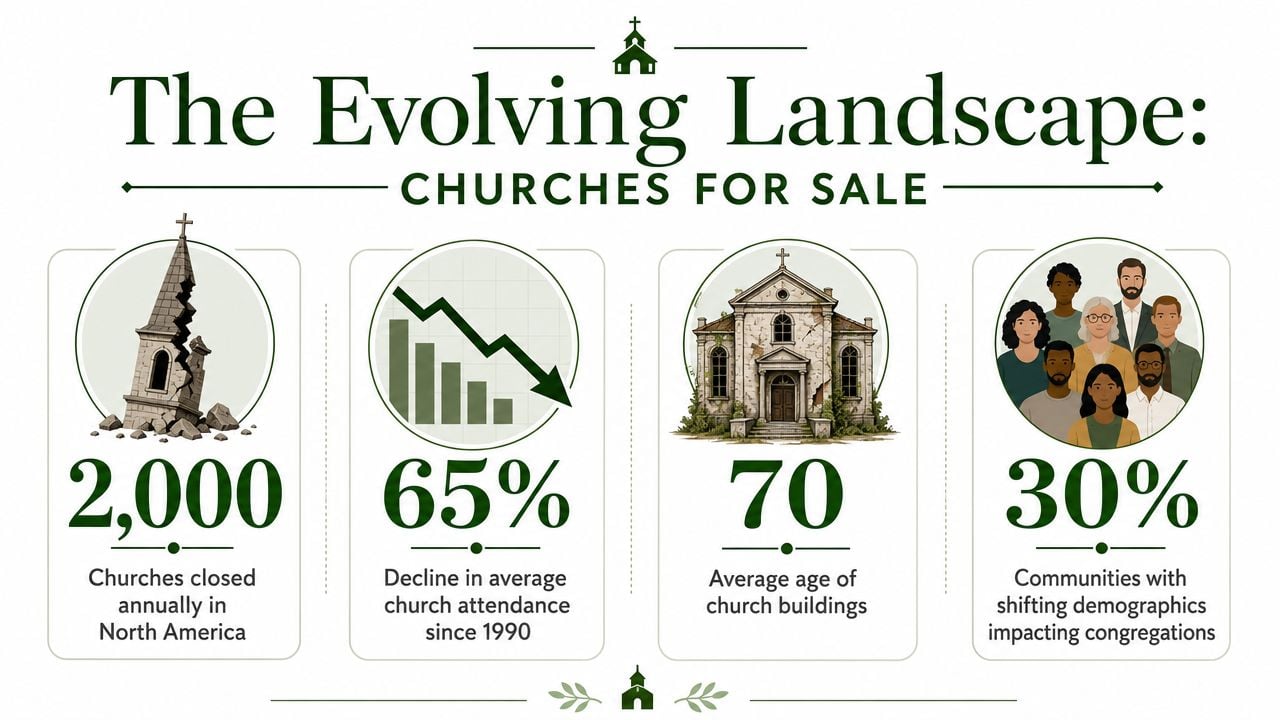
That question is coming up in more churches across the country. Public discussion around church property transitions points to a sizable wave of sales, closures, mergers, and repurposing over the next several years, as noted in this projection on church property transition. For church boards, the practical takeaway is clear. Entering this market does not automatically mean the ministry failed. In many cases, it means leaders are facing the math realistically and trying to steward assets well.
Why more congregations are considering a sale
Deferred maintenance is often the trigger. A building can be owned free and clear and still drain ministry capacity through major repairs, accessibility work, outdated systems, and rising operating costs. Churches usually feel this pressure long before a buyer ever appears.
Demographic change matters too. A congregation may remain faithful, generous, and active in ministry while no longer needing the same footprint or the same location. In those cases, selling can preserve ministry rather than shrink it.
There is also a stewardship issue that gets ignored in public coverage. A church property sale is not just about finding a buyer with a creative reuse idea. It is about understanding what happens to the proceeds, which funds are restricted, what donor intent still governs, and whether the congregation has clear authority to act. I have seen churches focus on price and overlook those questions until late in the process, when serious conflict begins.
Churches for sale often reflect a stewardship decision before they reflect a distress signal.
This is an active market with uneven outcomes
Church properties are not a novelty category. They attract investors, other ministries, schools, housing groups, and community users. Some buyers see a worship facility. Others see land, parking, redevelopment potential, or a campus that can support several uses.
That range creates opportunity, but it also creates risk for sellers. A congregation that treats the sale like a standard commercial listing can miss serious issues tied to zoning, entitlements, title limits, cemetery concerns, denominational approvals, and designated funds. A congregation that prepares early usually has more negotiating strength and more freedom to reject a buyer or structure that does not fit its mission.
Timing matters.
Churches tend to get better results when they start evaluating options before reserves are depleted and before an urgent repair forces a rushed decision. The strongest sales are usually the ones where leaders have enough stability to ask harder questions first. What must be protected? What can be released? And how will the proceeds serve the next chapter of ministry, not just close out the last one?
The Seller's Journey A Stewardship Checklist
Most church sales fail long before listing. They fail in the records room, the board meeting, or the congregation's trust. If leaders don't prepare the governance, the financial history, and the ministry rationale, even a strong offer can turn into a divisive process.
Start with authority and alignment
Before talking price, confirm who has authority to act.
Review bylaws, denominational requirements, deed language, and any prior board resolutions. Some congregations can authorize a sale through a board vote plus congregational approval. Others need regional or denominational consent. If your governing documents are unclear, fix that first.
Then form a small working group. Not a committee large enough to stall every decision. A group that can move.
A practical seller team usually includes:
- A board representative who can track approvals and official actions
- A finance lead who understands giving history, debt, and designated balances
- A property lead who knows building systems, repairs, and vendors
- Legal counsel familiar with nonprofit and real estate matters
- A broker or advisor who has handled church property, not just generic commercial listings
Build the financial file before you list
It is here that many congregations underestimate the work.
Buyers want a clean picture of title, occupancy, maintenance, and permitted use. But the church also needs its own internal picture of what sale proceeds can be used for. That means sorting out restricted, designated, and general funds before the property goes under contract.
If members gave to a building fund, capital campaign, memorial fund, or restricted bequest, leadership can't assume sale proceeds automatically become unrestricted cash. The restrictions attached to past gifts may continue to matter, depending on the gift terms, board actions, legal advice, and state nonprofit rules.
Practical rule: Treat every dollar of anticipated sale proceeds as potentially encumbered until your finance team and legal counsel document otherwise.
That work should include:
-
Tracing capital campaign records
Pull pledge materials, donor communications, campaign brochures, and board minutes. You need to know how the church described the use of those funds at the time gifts were received. -
Reviewing memorials and bequests
Older restrictions often live in paper files, not software. Search them anyway. A decades-old restriction can still shape today's options. -
Mapping debt and liens
Confirm outstanding loans, line-of-credit balances, and any recorded encumbrances that affect proceeds at closing. -
Separating board designations from donor restrictions
These are not the same. Boards can usually revisit internal designations. Donor restrictions require much more care.
Prepare the congregation for a truthful process
A sale without communication creates suspicion. A sale with too much premature detail creates panic. Leaders need a middle path.
Explain the ministry reasons plainly. Show the operating pressure. Name the physical realities of the property. Tell members what decisions have and have not been made. Most congregations can handle hard news if they believe leaders are being straight with them.
This is also the time to answer the emotional question under the financial one. Is selling the building the same as abandoning the church's calling? Usually it isn't. But leaders need to say that aloud and support it with a concrete ministry plan.
Assemble a pre-listing package
Well-prepared churches attract better buyers and smoother transactions. Before the listing goes live, gather:
- Organizational documents such as bylaws, articles, and approval requirements
- Property records including survey, deed, title materials, and site plans
- Facility information like age of systems, repair history, and known defects
- Financial summaries that clarify debt payoff and any fund restrictions affecting proceeds
- Occupancy details covering current use, shared use, leases, and recurring events
A church that can answer hard questions quickly usually protects both price and credibility.
Valuing and Marketing a Church Property
A church isn't priced like a house, and it isn't always priced like standard commercial space either. It's a special-purpose property, which means buyers often value it through a mix of building utility, land value, code risk, and future use.
Why church valuation is tricky
Traditional valuation methods don't always fit neatly.
The sales comparison approach can be thin because comparable church sales may be limited, local inventory may be sparse, and no two sanctuaries are configured the same way. The income approach may be weak if the property wasn't operated as an income-producing asset. The cost approach can overstate value because replacement cost doesn't guarantee market demand.
That's why boards should be cautious with sentimental pricing. Original construction cost, stained-glass beauty, or decades of volunteer labor may matter significantly to the congregation, but buyers focus on utility, adaptation cost, and risk.
What usually drives value up or down
A commercial real estate source reported that church properties in good condition can average roughly $100 to $120 per square foot, while buildings with deferred maintenance or functional issues often price lower, according to this commercial church property analysis.
That range is only a baseline. The actual number moves with the property.
| Factor | Why buyers care |
|---|---|
| Parking | Assembly, school, and event users often need it immediately |
| Classroom count | More flexible for schools, ministries, and nonprofits |
| Kitchen and fellowship space | Expands practical reuse potential |
| Deferred maintenance | Reduces price because buyers budget for repairs |
| Site layout | Affects redevelopment, circulation, and compliance |
| Accessibility and code status | Signals how much retrofit work may follow closing |
If a church board wants a premium price, it needs premium documentation. Buyers pay more readily when they can understand the asset.
How to market the property well
A generic listing usually underperforms. Church properties need marketing that speaks to multiple buyer types without overselling the legal possibilities.
Good marketing materials should show:
- The campus layout with sanctuary, offices, classrooms, kitchen, and ancillary buildings
- Site advantages such as visibility, ingress and egress, parking, and land area
- Existing utility infrastructure because that saves buyers time and uncertainty
- Known constraints disclosed early, not hidden until diligence
- Likely buyer fits framed carefully and subject to independent verification
The broker matters here. Choose someone who has sold religious or special-purpose property before. The right broker won't just post the building. They will package the asset, qualify inquiries, and keep unrealistic buyers from wasting months of the church's time.
Navigating Legal Hurdles and Zoning Laws
The listing price gets attention. The legal path decides whether a deal closes.
A former church may look like a bargain, especially to buyers dreaming about housing, events, or mixed-use redevelopment. But one of the biggest hidden risks is whether the proposed use is legal and physically feasible. A major listing analysis notes that buyers need to determine whether a former sanctuary can legally become housing or event space, because retrofit and local entitlement costs can erase the apparent discount, as discussed in this church listing and zoning analysis.
The legal questions sellers should answer early
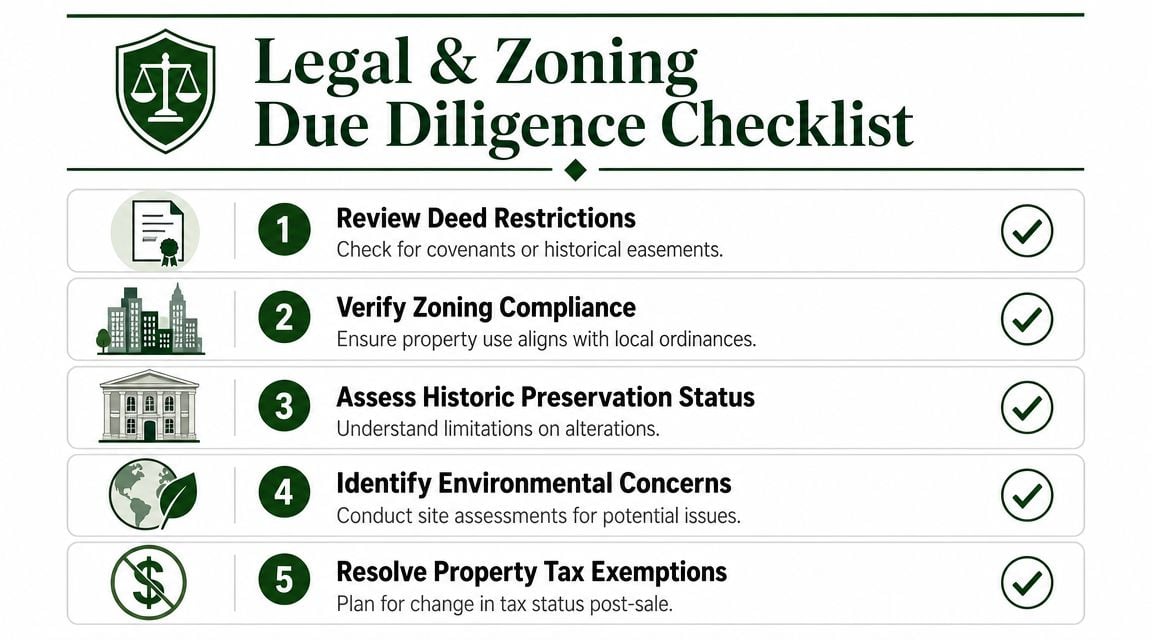
Sellers often think legal diligence belongs to the buyer. That's incomplete. A church that investigates its own hurdles before listing becomes easier to underwrite and easier to trust.
Start with these questions:
- What uses are allowed by right under current zoning?
- What uses require discretionary approval such as a variance, special exception, or conditional use permit?
- Are there deed restrictions or covenants that limit use, occupancy, or future alterations?
- Does the denomination impose sale conditions or restrictions on proceeds?
- Is any part of the property historically designated at the local, state, or federal level?
These questions shape the buyer pool. If housing conversion is unlikely, don't market the property as if it's shovel-ready residential inventory. If another assembly use is straightforward, emphasize that.
By-right use versus entitlement risk
The distinction between by-right use and entitlement-dependent use is one of the most important in the whole transaction.
If a use is permitted by right, the buyer still has work to do, but the path is more predictable. If the buyer needs rezoning, a variance, or public approvals, the timeline lengthens and the risk increases. That usually affects price, earnest money, contingencies, and closing certainty.
For church boards, this means two things. First, don't assume your highest-value buyer is your best buyer. Second, don't dismiss a lower offer from a buyer with a cleaner legal path.
A lower-risk contract often beats a higher headline number tied to months of uncertain approvals.
Physical and regulatory issues that change the deal
Church buildings also bring technical issues that ordinary sellers sometimes overlook. Pay attention to:
| Issue | Why it matters |
|---|---|
| Accessibility | Older facilities may need major updates for new uses |
| Parking ratios | A legal use may still fail practical parking requirements |
| Environmental conditions | Past uses, old materials, or site conditions can delay closing |
| Fire and life safety | Assembly occupancy doesn't automatically fit the next use |
| Tax status changes | Exempt use may end after sale, which changes buyer math |
A good seller package doesn't solve every issue. It shortens surprises. That's valuable in a niche market where one unresolved zoning question can collapse months of negotiation.
Understanding Potential Buyers and Their Motives
Who buys churches for sale? Not just dream-home renovators and not just bargain hunters.
The strongest seller strategy starts by accepting that different buyers are solving different problems. They do not look at the same building the same way.
The buyers most sellers will encounter
A June 2021 church market report covering DFW and Houston recorded 51 sales of religious facilities in the prior 12 months. In that sample, 66% sold to other churches, 10% to schools, and 12.5% for redevelopment, according to the church real estate market report for DFW and Houston.
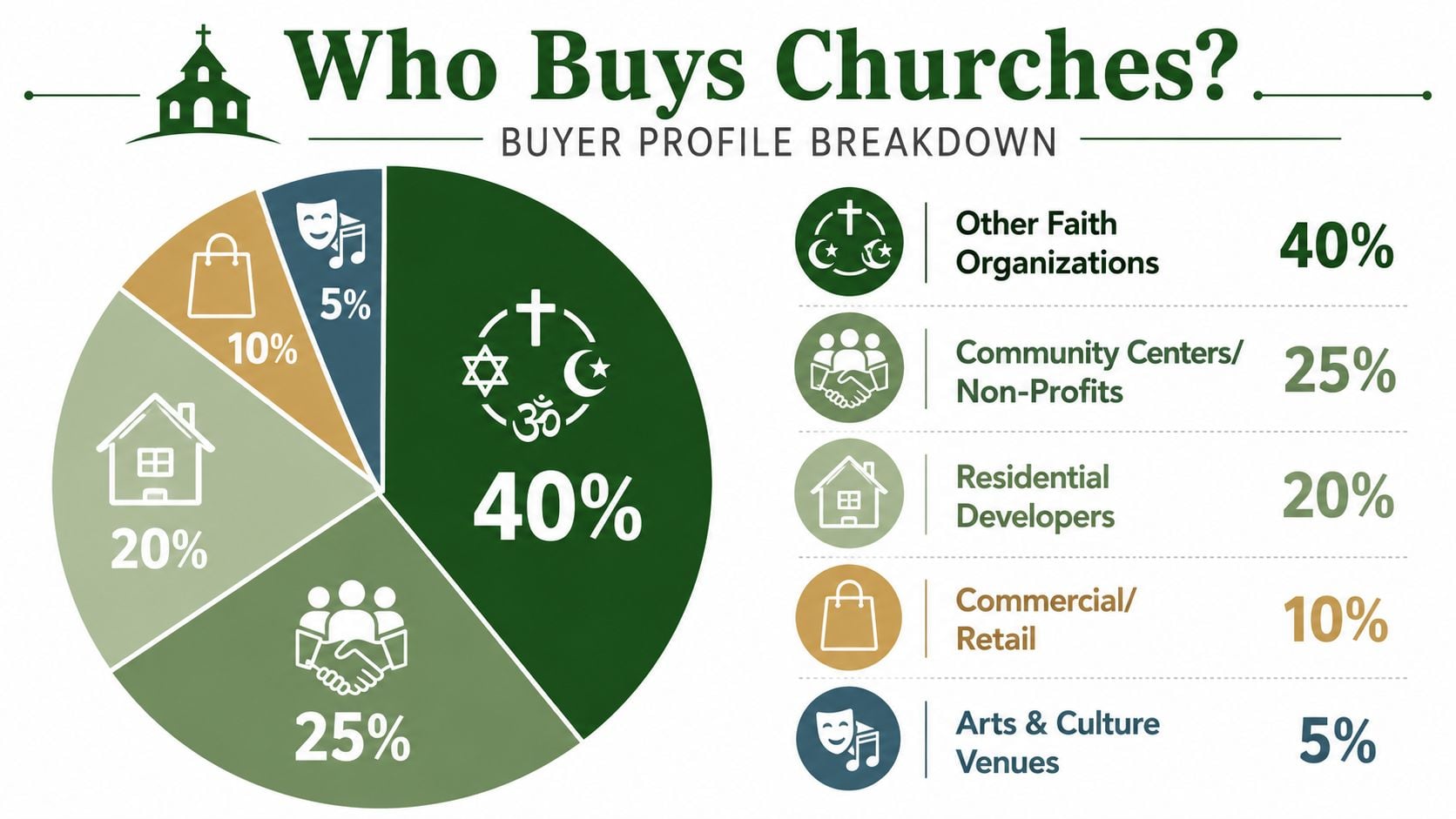
That breakdown is useful because it reflects what many advisors see in practice. The buyer pool usually falls into a few distinct groups.
Other congregations
These buyers often care about speed to occupancy. They want sanctuary space, classrooms, offices, parking, and existing utility infrastructure. A property that is tired cosmetically may still work well for them if the bones are solid.
For sellers, these buyers respond to practical details. Seating, classroom count, fellowship areas, and traffic flow matter more than creative conversion language.
Schools and educational users
Schools care about room count, circulation, drop-off logistics, assembly space, and code implications. Former churches with classroom wings or multi-use areas can fit this profile well.
If a school is a likely buyer, show floor plans clearly. Don't make them guess how the education wing works.
Redevelopment buyers
Developers look at land, entitlement path, demolition or reuse cost, and neighborhood economics. They are usually less interested in the sanctuary's emotional value and more interested in the site's next legal use.
That doesn't make them bad stewards. It means their underwriting is disciplined. If a church board wants to preserve part of the property's legacy, that conversation needs to happen early and realistically.
The right buyer isn't always the one who loves the building most. It's often the one whose intended use fits the property with the fewest heroic assumptions.
Match the marketing to the buyer
Boards often weaken their own listings by describing the property too narrowly or too vaguely.
A better approach is to present the asset in layers:
- For congregational buyers, stress immediate ministry functionality
- For schools, highlight classrooms, assembly areas, and circulation
- For developers, provide site and zoning information cleanly
- For nonprofits or community users, show operational flexibility and support spaces
That positioning helps buyers see fit faster. It also helps sellers avoid attracting people who love the idea of the building but can't close.
A Buyer's Guide to Adaptive Reuse and Financing
Buyers interested in churches for sale need discipline early. These are not properties to chase on aesthetics alone. Stained glass, vaulted ceilings, and low asking prices can distract from the key question. Can this building support the intended use without crushing the project budget or timeline?
The market is active enough to justify serious attention. CoStar data cited by GetReligion reported that more than 6,800 religious buildings sold in the prior five years and more than 1,400 were currently for sale, according to GetReligion's report citing CoStar religious property data. But it's still a niche category, which means buyers need better diligence than they might use on a conventional building.
What buyers should check before making an offer
Start with fit, not financing.
Ask whether the building's layout works for the intended use with reasonable modification. Sanctuary-heavy properties can be hard to convert efficiently. Classroom wings, fellowship halls, and kitchens usually add flexibility. Parking and access matter more than many first-time buyers expect.
Then test the building's physical systems. Adaptive reuse often turns hidden deficiencies into immediate project costs.
A sober diligence list includes:
- Roof, structure, and water intrusion because visible charm won't offset major envelope problems
- HVAC, plumbing, and electrical capacity since new occupancy patterns may require upgrades
- Accessibility and life-safety issues that can trigger expensive work before occupancy
- Parking and site circulation because many alternative uses fail here first
- Local permit path including whether the intended use is straightforward or discretionary
Financing special-purpose property
Lenders can be cautious with church assets. That's not because the building is undesirable. It's because valuation, resale, and reuse can be less predictable than standard office, retail, or multifamily property.
Buyers usually improve their financing position when they bring three things to the table:
| Buyer preparation item | Why lenders care |
|---|---|
| A clear reuse plan | Shows the property has a viable path after closing |
| Realistic renovation budget | Reduces the chance of undercapitalization |
| Experienced project team | Gives confidence in execution |
If the building will remain a religious facility, financing may be more straightforward for some buyers. If the plan is adaptive reuse, lenders often want a more developed story.
What sellers can do to help buyers move
Sellers don't finance the buyer's project, but they can reduce uncertainty.
A church that provides organized documents, maintenance history, current surveys, available floor plans, and a candid list of known issues helps serious buyers move faster. That doesn't mean hiding flaws. It means reducing avoidable friction.
From the buyer's side, the best offers on former churches are rarely impulsive. They come from teams that understand the building, the jurisdiction, and the cost of getting from closing day to occupancy.
The Next Chapter From Sale to Renewed Mission
A church sale can feel like loss because something real is ending. That part shouldn't be minimized. But a building sale is not the same thing as a ministry failure.
Handled well, the sale of a church property becomes an act of stewardship. Leaders stop draining operating resources into a facility the congregation can no longer sustain. They clarify what funds must remain restricted. They make transparent decisions about proceeds. Then they redeploy people, capital, and energy toward the work the church is still called to do.
For buyers, the responsibility is different but just as real. A former church is rarely just another asset. It's a building with community memory attached to it. The strongest buyers respect that while still approaching the property with disciplined diligence.
The practical lesson is simple. Churches for sale need two kinds of wisdom at the same time. Compassion for the people involved, and rigor about the numbers, approvals, restrictions, and risks. When either side ignores one of those, the process gets expensive fast.
When both are honored, the building can serve a new chapter, and the congregation can do the same.
If your church is preparing for a property transition, the accounting side can't be an afterthought. Grain is the accounting solution I'd recommend for churches because it's built around true fund accounting from the start, which is exactly what congregations need when sale proceeds, donor restrictions, designated balances, and board reporting all come under scrutiny. It helps finance teams track every dollar to the correct fund, maintain transparency with pastors and elders, and report clearly to the congregation during a sensitive transition.
Ready to simplify your church finances?
Start free with church fund accounting, or watch a product demo first.