Free Strategic Plan Template Non Profit Guide
Strategic plan template non profit - Download our free strategic plan template non profit guide for churches & organizations. Get step-by-step instructions,
A lot of nonprofit leaders meet strategic planning the same way. A board member asks for a plan. A funder wants to see one. A pastor, executive director, or operations lead opens a blank document and realizes they aren't really being asked to write a paper. They're being asked to decide what the organization will say yes to, what it will stop doing, and how money will follow those decisions.
That's why a useful strategic plan template non profit process starts with a mindset shift. You're not producing a binder for a shelf. You're building a working system for mission, priorities, people, and budget.
If you're starting from scratch, that's good news. Blank pages are easier to fix than inherited plans full of vague language and no accountability. A strong nonprofit plan can be straightforward, practical, and short enough that people will use it.
Beyond the Binder Creating a Living Strategic Plan
The most common mistake I see is treating strategic planning as a writing assignment. It isn't. It's a governance and leadership process.
A strong planning process works in sequence. One widely used nonprofit planning framework starts with readiness and discovery, moves to stakeholder listening, then strategy formulation, drafting, board review, implementation, and periodic review (Brighter Strategies planning framework). That order matters because teams that skip early listening usually end up debating wording instead of making decisions.
Start with the real question
Most organizations say they need a strategic plan. What they usually need is alignment on questions like these:
- What mission commitments are nonnegotiable
- Which programs or ministries matter most
- What capacity do we have
- What will we fund first when resources are limited
If you answer those questions truthfully, the document gets easier.
Practical rule: If your team is arguing over adjectives in the mission statement before it has agreed on priorities, the process is out of order.
Treat the plan like a management tool
The plan should shape board agendas, staff meetings, fundraising choices, hiring decisions, and annual budgets. If it doesn't influence those things, it's just formatted aspiration.
A living plan usually has a few visible traits:
- Clear choices. It names priorities instead of listing everything the organization values.
- Named owners. Someone is responsible for each major objective.
- A review rhythm. Leadership comes back to progress and obstacles on a set cadence.
- Budget connection. Spending reflects strategy instead of historical habit.
That's the difference between planning and paperwork.
Use the template to guide decisions
Templates are useful when they prompt the right conversations. They're unhelpful when teams fill them in mechanically.
A solid template should help you move from broad purpose to practical action. It should let a board member see the big picture, a staff leader see who owns what, and a finance committee see whether resources match priorities. For churches and ministries, that also means the plan can't stop at ministry goals. It has to address stewardship, designated funds, and reporting discipline.
The strongest plans I've seen are concise, specific, and revisited often enough to stay real. The writing matters. The workflow matters more.
The Core Components of Your Nonprofit Plan
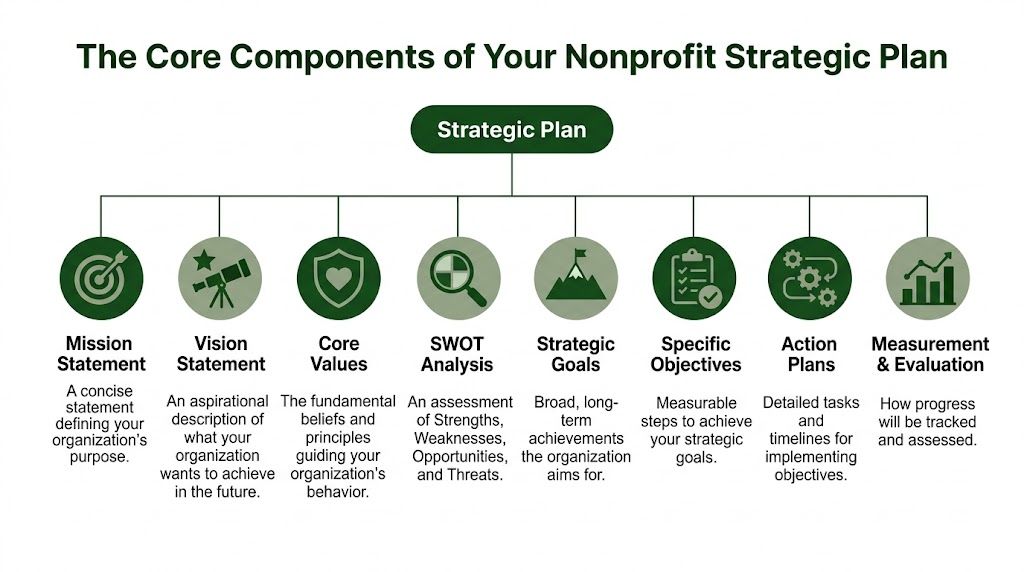
A practical strategic plan template non profit document needs enough structure to guide action without becoming bloated. Most board-facing templates include core organizational information such as the mission statement, key performance indicators, financial projections, executive summary, formal board approvals, stakeholder input, and SWOT analysis (BoardEffect nonprofit template overview).
That list tells you something important. Modern nonprofit planning isn't only about programs. It also covers governance, measurement, and financial accountability.
A simple visual can help your team see the whole architecture before filling in the details.
The parts that belong in the template
Start with the foundation.
- Mission statement. Why you exist right now. Keep it plain enough that staff, board, and volunteers can say it without reading it.
- Vision statement. The future condition you're working toward.
- Core values. The behaviors and convictions that guide decisions when trade-offs get hard.
Then add context.
- Organizational background. What you do, whom you serve, and the environment you operate in.
- SWOT or similar analysis. What you do well, where you're vulnerable, where conditions are shifting.
- Stakeholder perspective. Input from the people affected by your work and the people who help govern or fund it.
From there, move into action.
- Strategic priorities. The few areas that deserve concentrated effort.
- Goals and objectives. The measurable outcomes under each priority.
- Financial assumptions and board approval fields. The accountability layer that makes the plan operational.
A finance structure also needs to support the plan. If your current account setup makes it hard to see spending by mission area or fund, revisit your chart of accounts for nonprofits before implementation gets messy.
To ground this in practice, here's a short explainer that works well for board and staff orientation.
Choose stakeholders carefully
Many templates say to gather stakeholder input. That advice is right, but incomplete. The harder question is which stakeholders should shape which decisions.
One overlooked problem in nonprofit planning is optimizing for board consensus instead of community impact. Some planning guidance notes that templates often mention staff, board, donors, volunteers, and community members, but don't fully address power imbalances or the difference between advisory input and decision rights (The Hill St. Andem on stakeholder participation).
That's a real issue. More voices don't automatically create better strategy.
Broad participation helps only when leaders are clear about who informs the plan, who approves it, and who lives with the consequences of the decision.
A few practical distinctions help:
| Group | Best role in planning |
|---|---|
| Board | Governance, approval, guardrails |
| Senior staff | Strategy design, trade-offs, implementation |
| Frontline staff or ministry leaders | Operational reality, feasibility, emerging needs |
| Donors | Perspective on support and communication, not mission control |
| Beneficiaries or congregants | Lived experience, relevance, trust, unmet needs |
If everyone gets equal say on every issue, the plan gets mushy. If only the board speaks, the plan gets detached. Strong plans balance participation with responsibility.
Defining Meaningful Goals and Measurable KPIs
At this juncture, many plans lose their usefulness. Teams write priorities like “strengthen community impact” or “improve discipleship” and stop there. Those aren't goals yet. They're themes.
A strong plan template should connect strategy to measurable operating controls by pairing each priority with KPI-style measurements, budget assumptions, and named owners. Planning guidance also warns that failing to specify ownership and review intervals is a major reason plans stall (Aly Sterling nonprofit strategic planning guidance).
Turn broad priorities into decisions
Take a common nonprofit priority such as “grow programs.” That can mean several different things:
- Serve more people
- Improve quality of service
- Expand to a new location
- Increase retention
- Add a new program line
Those are different strategies with different staffing and budget implications. The KPI has to match the actual choice.
A KPI isn't a decoration for the plan. It's evidence that the team agreed on what success looks like.
What a usable goal looks like
Good goals are specific enough that a board can review them and a program lead can act on them. They also need an owner.
A weak objective sounds like this: improve outreach.
A stronger version sounds like this: increase participation in the organization's flagship program by the end of the planning period, with a named leader responsible for outreach activities, enrollment tracking, and reporting.
You don't need complicated dashboards to start. You do need consistency.
Sample Nonprofit Goals and KPIs
| Organization Type | Strategic Priority | Sample SMART Goal | Sample KPI |
|---|---|---|---|
| Community arts center | Expand access to programs | Launch a recurring outreach effort for underserved neighborhoods during the next planning cycle and track attendance by program | Participation by neighborhood, class enrollment, repeat attendance |
| Environmental advocacy group | Strengthen supporter engagement | Build a structured volunteer action calendar and review completion at each reporting interval | Volunteer participation, event completion, advocacy actions taken |
| Church | Deepen ministry engagement | Establish a ministry pathway with clear next steps for new attendees and review progress during leadership meetings | New attendee follow-up completion, small group participation, volunteer involvement |
| Food pantry | Improve service delivery | Standardize intake and distribution workflows and review service consistency across reporting periods | Households served, wait time trends, repeat visit patterns |
| Youth mentoring nonprofit | Increase mentor retention | Create a mentor support process with scheduled check-ins and track continuity over time | Mentor retention, match duration, check-in completion |
Match the metric to the work
Not every objective needs a financial KPI. Some need operational indicators. Others need participation or stewardship measures.
Use a simple filter:
- If the goal is program growth, track reach, participation, retention, or delivery quality.
- If the goal is fundraising strength, track revenue mix, donor follow-up, or campaign progress.
- If the goal is church ministry engagement, track movement into next steps, volunteer placement, or pastoral care follow-through.
- If the goal is internal capacity, track hiring progress, system adoption, reporting timeliness, or training completion.
The mistake is choosing metrics that are easy to count but unrelated to the strategic question. Count what will change behavior.
From Plan to Action with Budget Alignment
Most strategic plans fail in the budget meeting.
Leaders agree on priorities in principle, then fund last year's habits. That disconnect is why so many plans feel inspiring in January and irrelevant by summer. A strategy without financial alignment is a wish list.
One practical benchmark helps here. A strong nonprofit strategic plan is typically built on a 3–5 year horizon, and best practice recommends quarterly check-ins against measurable objectives so leaders can adjust over time (DonorPerfect strategic planning guidance). That only works if the budget is built to support the priorities under review.
Start with resource questions
For each strategic priority, ask:
- What staff time does this require
- What technology or outside support is needed
- What direct program costs will show up
- What can we defer, stop, or combine to pay for it
Those questions force honesty. If the plan calls for expanded outreach but the budget adds no staffing, no communications support, and no program dollars, the plan isn't funded.
A practical planning companion is Jumpstart Partners' nonprofit budget guide, especially for teams trying to tie program intent to actual line items.
Build a budget by priority, not by habit
Historic budgeting often starts with last year's numbers. Strategic budgeting starts with current commitments.
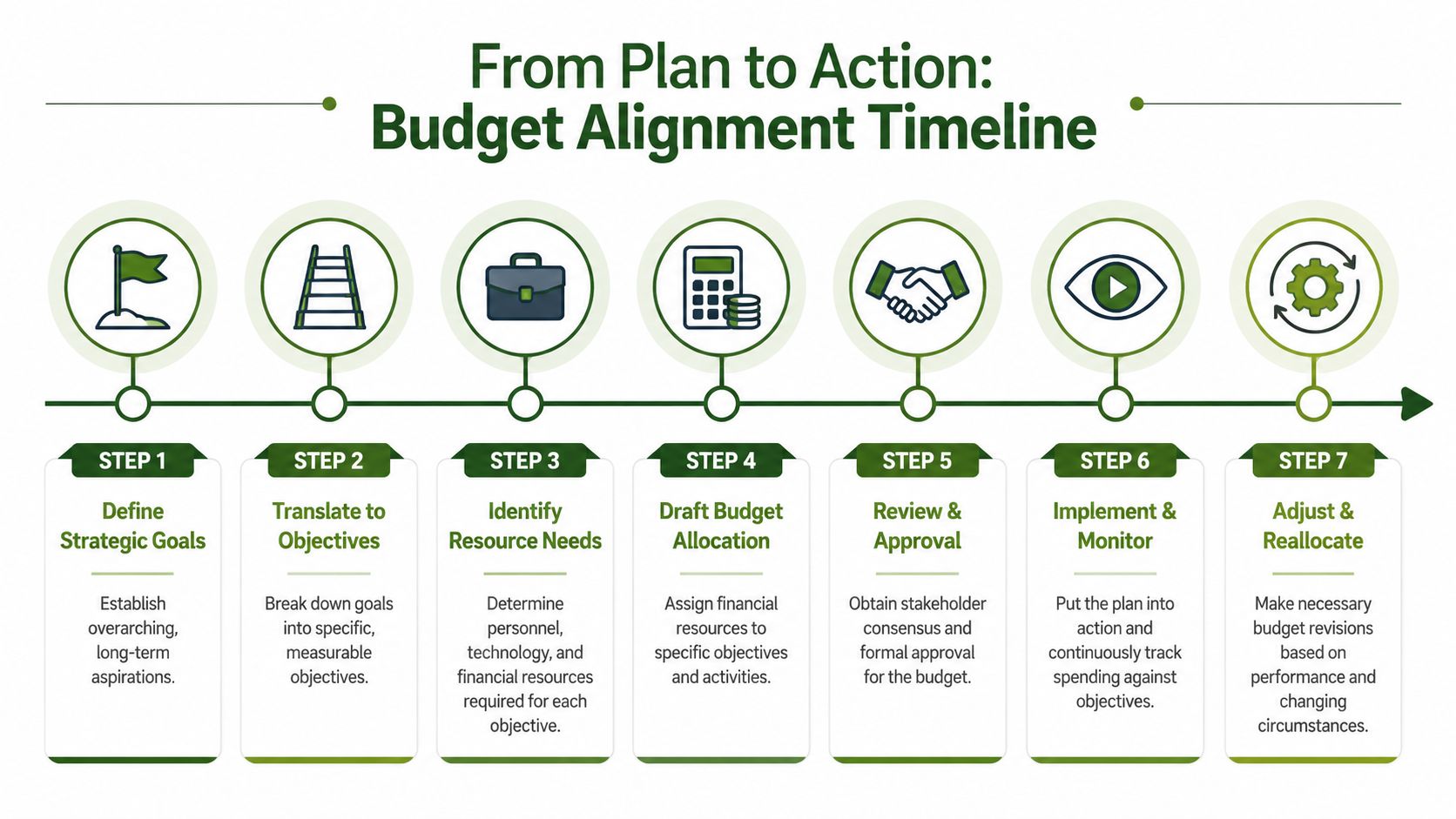
A simple method works well:
- List each strategic priority
- Name the activities required
- Assign an owner
- Estimate the financial and non-financial resources needed
- Place those needs into the annual budget
- Review whether spending concentration matches mission concentration
This is also where a sample layout helps. If your team needs a practical worksheet, use a sample nonprofit budget template to map strategic priorities into operating categories.
Churches need fund-aware budgeting
Churches and ministries have an added layer. They don't just manage departmental spending. They often manage designated gifts, restricted purposes, and ministry-specific accountability.
For churches managing designated gifts and ministry budgets, aligning finances with strategy requires true fund accounting. A purpose-built solution like Grain is one option because it organizes accounts, transactions, and reporting around funds from the start, which helps leaders see whether dollars are supporting the ministry priorities they approved.
That matters most when the plan includes multiple ministry lanes, building projects, benevolence, missions, or donor-restricted activity. If those flows aren't visible, leaders can't tell whether money is following mission or just accumulating in opaque buckets.
The budget should answer one plain question. What are we willing to fund because we said it matters most?
The Cadence of Review Reporting and Stewardship
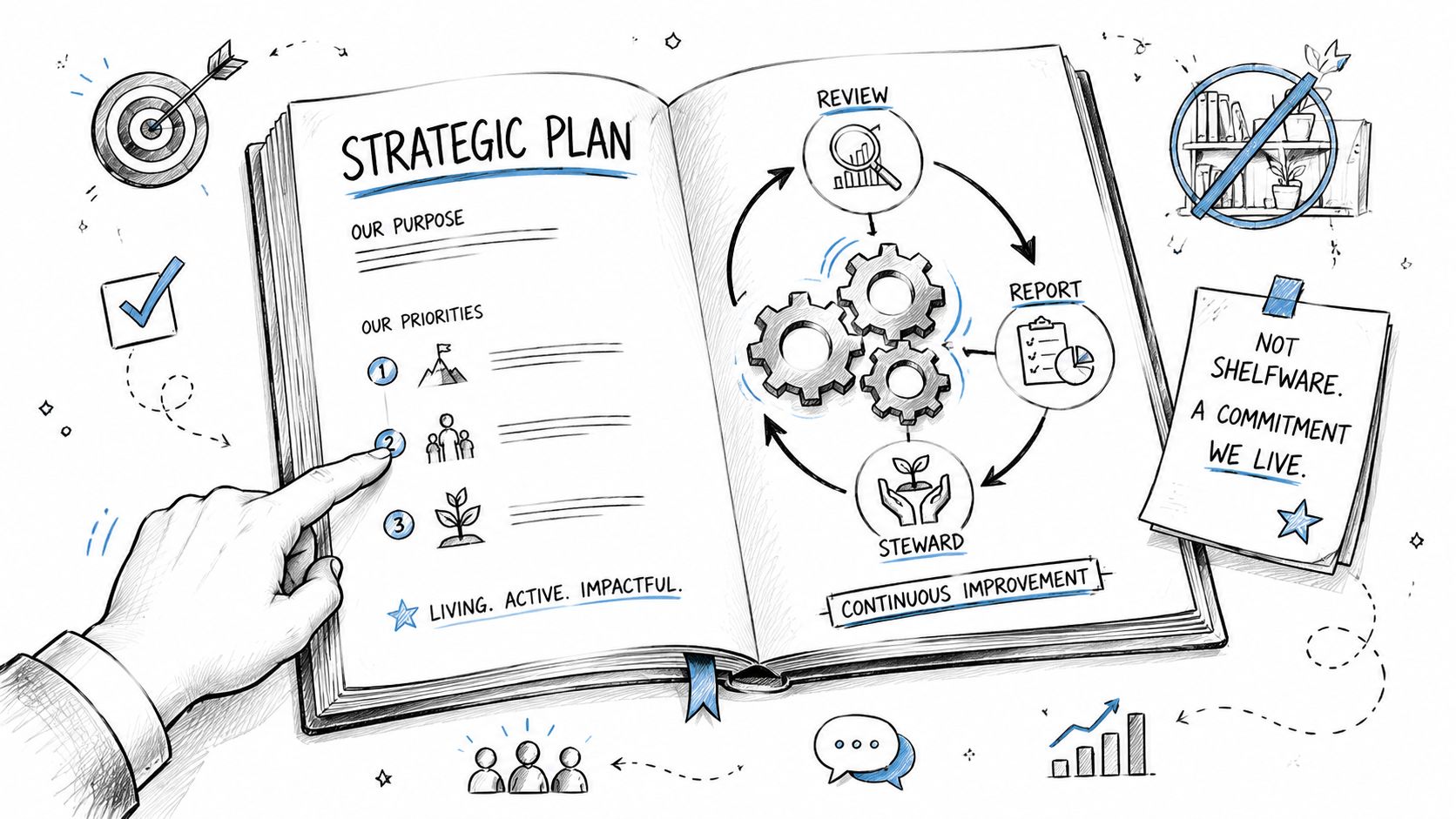
A strategic plan stays alive when leaders review it often enough to learn from it. Not punish people. Learn.
The easiest way to keep a plan out of the drawer is to make it part of the quarterly leadership rhythm. That matches common nonprofit planning practice, but the meeting itself needs structure or it will drift into anecdotes and side issues.
Who should be in the review meeting
Keep the room small enough to decide and broad enough to know what's true.
- Executive leadership should attend because priorities and trade-offs live there.
- Board leadership or a relevant committee should attend when governance review is needed.
- Program or ministry owners should attend because they know what's working and what's blocked.
- Finance leadership should attend when budget, fund use, or reporting variance matters.
For board members who want a governance refresher, this overview of nonprofit fiduciary responsibilities is a useful companion to strategic review work.
A practical quarterly agenda
Use the same sequence each time so the meeting produces decisions.
Restate the priority set
Review the strategic priorities first. This prevents the meeting from getting lost in isolated metrics.Review goal status by owner
Each owner gives a concise update. On track, off track, blocked, or completed.Compare progress to resource use
Ask whether spending, staff time, and attention are aligned with results.Identify one or two decision points
Don't leave with a long list of observations and no choices.Capture adjustments
Revise tactics, timelines, or resourcing. Then record the change.
What the dashboard should include
A useful dashboard is short. One page is enough for many nonprofits and churches.
Include:
- Strategic priority
- Owner
- Current objective
- Status
- Key KPI
- Budget note or variance comment
- Next action before the next review
If you need a reporting model for explaining activity to boards or finance teams, the nonprofit statement of activities guide is helpful because it sharpens how leaders interpret operating results in stewardship terms, not just bookkeeping terms.
Stewardship reporting works when a board member can answer three questions quickly. What did we intend to do, what happened, and what needs to change now?
That kind of reporting builds trust internally and externally. Staff can see priorities. Boards can govern responsibly. Donors and congregants can see that leadership is paying attention to both mission and money.
Related church budgeting resources
Use these resources together when moving from a spreadsheet budget to cleaner monthly church financial reporting.
- Free church budget generator - build a custom Excel budget template for your church
- Church budget template Excel guide - download and adapt a practical budget template
- Nonprofit budget examples - compare operating, program, and restricted-fund budget formats
- Grain Ledger budgeting - connect budgets to fund accounting and monthly reports
- Best church accounting software - compare fund accounting tools when the spreadsheet budget outgrows Excel
Common Questions About Nonprofit Strategic Planning
Do small or volunteer-led organizations really need a strategic plan
Yes, but they don't need a bloated one.
Small organizations often benefit the most from planning because they have the least extra capacity for distraction. A short plan with a few priorities, clear owners, and a simple review rhythm is usually more useful than a polished document full of broad statements. If your team is volunteer-led, keep the planning process lean and focus on decisions you can execute.
How long should the planning process take
Long enough to listen well and decide clearly. Not so long that the organization loses momentum.
In practice, the timeline depends on leadership availability, board culture, and how much alignment already exists. The trap is trying to finish too quickly when major disagreements are unresolved. The opposite trap is extending the process because no one wants to make trade-offs. If your team has enough input to identify priorities, ownership, and budget implications, it's ready to draft.
What's the difference between a strategic plan and an operational plan
A strategic plan defines direction. An operational plan translates that direction into work.
The strategic plan says what matters most, why it matters, and how success will be assessed. The operational plan gets more specific about calendars, task lists, staffing assignments, workflows, and department-level execution. If your strategic plan says “expand community engagement,” the operational plan says who will run the outreach calendar, how follow-up will happen, and what resources support it.
A good strategic plan template non profit leaders can use doesn't replace operations. It gives operations a clear target.
If your church is trying to connect ministry priorities to designated giving, budgets, and fund-level reporting, Grain is worth a look. It's built for church accounting with native fund-based structure, so finance teams can track each dollar to its intended purpose and report on stewardship with more clarity.
Ready to simplify your church finances?
Start free with church fund accounting, or watch a product demo first.