Accounting for Funds: Church Financial Stewardship Guide
 By Gibson Brueher, Founder of Grain Ledger
accounting for funds: A concise church guide to manage restricted funds, generate clear reports, and ensure transparency.
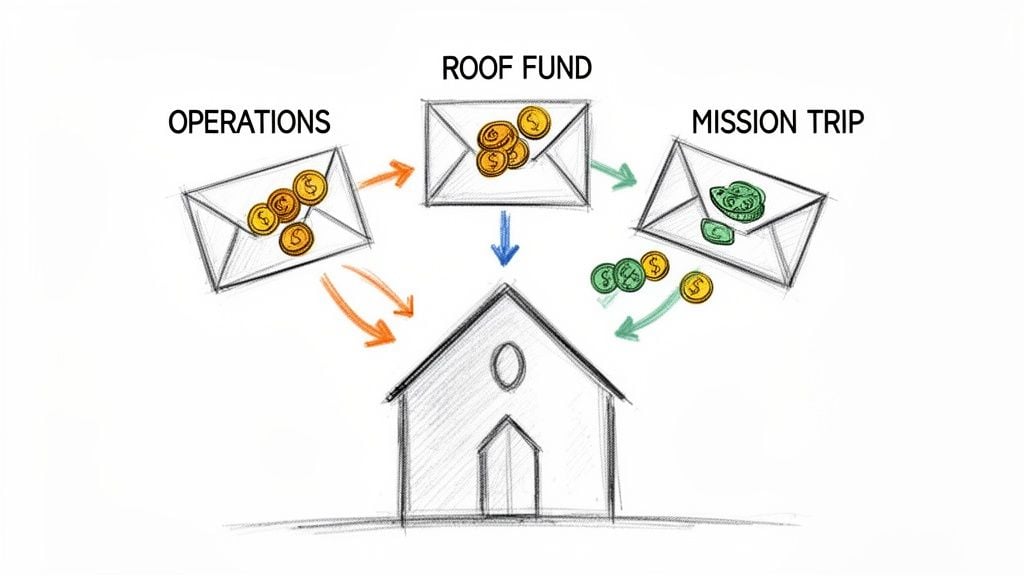
Fund accounting is, at its core, the financial language of good stewardship. The easiest way to think about it is like a set of dedicated envelopes for every dollar your church receives. One envelope is for day-to-day operations, another is for the new roof fund, and a third is set aside for the youth mission trip.
About Grain Ledger: This guide includes Grain Ledger, church fund accounting software built for designated gifts and ministry funds. It connects giving platforms (Planning Center, Pushpay, Tithely, Stripe), syncs bank activity with Plaid, and produces fund-level financial reports. Schedule a demo to see how it compares for your church.
See Grain Ledger for your church
Fund accounting, giving integrations, and bank reconciliation in one platform. Free migration support for churches switching from QuickBooks or Aplos.
This “envelope system” is more than just a clever analogy; it’s absolutely essential for maintaining donor trust and staying compliant.
Why Fund Accounting is Essential for Your Church
For-profit businesses are built around one simple goal: maximizing profit. Naturally, their accounting reflects this by tracking total revenue versus total expenses to land on a single bottom line. But a church operates on a completely different model. Your mission isn't profit—it's stewardship. It's about faithfully managing the resources God provides through your congregation to accomplish your ministry’s work.
This fundamental difference in purpose demands a different accounting method.
That’s where accounting for funds comes in. This is the system designed specifically for nonprofits like yours. It moves beyond a single financial bucket and instead creates separate, self-balancing sets of books for different areas of your ministry. Each "fund" acts like its own mini-account, tracking its specific income, expenses, and overall balance. This is how you ensure that a generous gift designated for the youth group isn't accidentally spent on the electricity bill.
The Core of Church Financial Integrity
Following this method provides the kind of clarity and accountability that builds deep, lasting donor confidence. When a congregation member gives to the building fund, they are placing their trust in the church to use that donation only for that purpose. Fund accounting provides the structure you need to honor that trust.
This isn't just a good idea; it’s a critical compliance issue. Mishandling designated donations can create serious legal and financial headaches down the road. In fact, a staggering 89% of church decision-makers say fund accounting is non-negotiable for this very reason. Failing to properly segregate funds can trigger audits, shatter donor trust, and even lead to trouble with the IRS. For more context, you can explore the data showing the growing importance of specialized church finance tools.
At its heart, fund accounting answers a simple but profound question for leaders and donors alike: "Where did the money go?" It proves that every designated dollar was spent exactly as intended, fulfilling both a legal obligation and a spiritual one.
How It Differs from Business Accounting
Grasping the distinction between these two accounting worlds is vital for any church treasurer or finance committee. While both systems track money, their objectives and what they produce are fundamentally different. This impacts everything from daily bookkeeping to your annual reports.
Let's break down the core differences in a simple table.
Fund Accounting vs For-Profit Accounting at a Glance
| Aspect | Fund Accounting for Churches | For-Profit Accounting |
|---|---|---|
| Primary Goal | Accountability & Compliance. Prove that funds were used according to donor and legal restrictions. | Profitability. Measure financial gain by subtracting expenses from revenues. |
| Focus | Individual Funds. The financial health and integrity of each fund is tracked separately. | The Entire Company. Focuses on the overall bottom line and consolidated financial health. |
| Key Report | Statement of Activities. Shows revenue and expenses broken down by fund (e.g., unrestricted, restricted). | Income Statement (P&L). Shows total revenue, total expenses, and the resulting net profit or loss. |
| Equity | Net Assets. Divided into classes like "with donor restrictions" and "without donor restrictions." | Owner's Equity. Represents the owners' stake in the company's assets. |
While it might seem a bit more complex at first glance, the benefits are immense. Fund accounting provides the financial guardrails that protect your church's integrity and empower leaders to make wise, informed decisions. For a clear accounting solution that is purpose-built for churches and simplifies this process, many ministries rely on software like Grain Ledger, which has fund accounting built into its very core.
Navigating Restricted and Unrestricted Funds
At the heart of church fund accounting, everything boils down to two types of money: unrestricted funds and restricted funds. Getting this right isn't just about good bookkeeping; it's a matter of integrity, trust, and even legal compliance.
Think of it like this: some mail is addressed to the whole family and can be used for general household needs. Other mail is addressed to a specific person for a specific purpose. You can't just open your daughter's birthday card from grandma and use the cash for groceries. The same principle applies to church donations.
The Freedom of Unrestricted Funds
Unrestricted funds are the operational lifeblood of your church. This is money given without any strings attached by the donor, giving your leadership the flexibility to use it where it's needed most. It’s what fuels the day-to-day mission of your ministry.
These funds essentially function like your church's main checking account. They cover all the essential expenses that keep the lights on and allow ministry to happen.
- Salaries and Benefits: Paying your pastors, administrative staff, and childcare workers.
- Facility Costs: Covering utilities, insurance, mortgage payments, and routine maintenance.
- Ministry Supplies: Buying curriculum for Sunday school, materials for small groups, and worship resources.
- General Outreach: Funding community events and other ministry programs that don't have their own designated fund.
Your annual budget is built almost entirely around the strategic use of these unrestricted funds. This pool of money empowers your finance committee and board to make wise decisions that support the church’s vision and respond to needs as they pop up.
Understanding the Promise of Restricted Funds
Restricted funds, on the other hand, come with a promise attached. When someone gives a gift for a specific purpose, your church has a legal and ethical obligation to honor that donor's intent. Breaking that trust can seriously damage your church's reputation and could even lead to legal trouble.
You absolutely cannot mix these funds with your general operating money. They must be tracked separately and carefully. For a deeper dive, you can explore our guide on what is a restricted fund and what it means for your ministry.
Restricted donations fall into two main categories, which dictate how and when they can be spent.
A restricted fund is a legal and moral covenant between a donor and the church. Honoring that designation is the absolute cornerstone of financial integrity and is central to proper accounting for funds.
Temporarily Restricted Funds
This is the most common type of restricted gift a church receives. These are funds earmarked for a specific project, program, or future event. Once that purpose is accomplished, any leftover money can often be released from its restriction and moved into the general fund.
Real-World Example: A family donates $5,000 specifically for the youth group's 2026 mission trip. That money has to be set aside and used only for expenses related to that trip—things like transportation, lodging, or supplies. You can't use it to patch the leaky roof in the fellowship hall or cover a shortfall in the general budget.
Permanently Restricted Funds
Permanently restricted funds are much less common for most churches, but you have to manage them perfectly if you have them. These are usually large gifts, like an endowment, where the donor has specified that the original amount (the principal) can never be touched. Instead, the church is allowed to spend the investment income that the principal generates.
Real-World Example: A founding member leaves the church a $250,000 endowment. The permanent restriction is that its investment income must be used to support foreign missions. The church cannot touch the $250,000 principal, but it can use the annual interest and dividends it earns to fund its missionary partners.
Properly classifying and managing these distinct fund types is non-negotiable. It's why tools built specifically for churches, like Grain Ledger, are designed to handle this complexity from the ground up. The software automatically tracks every dollar to its rightful purpose, giving you the clear reports you need to prove you’re handling God's money faithfully.
4. Building Your Chart of Accounts for Clear Fund Tracking
Think of your church's chart of accounts as the financial filing cabinet for your entire ministry. A well-organized cabinet lets you find exactly what you need in seconds; a messy one creates chaos and confusion. The secret to effective fund accounting is building a chart of accounts that mirrors your fund structure, moving you beyond a single, jumbled financial bucket.
The goal is to create a logical system where every single transaction—every offering, every expense—can be neatly filed under the correct fund. This isn't just about bookkeeping; it's about building a financial blueprint that gives you instant, accurate insights into the health of every single ministry initiative. Without this structure, true fund accounting is simply impossible.
Organizing Accounts to Match Your Funds
First things first, you need to set up parent-level accounts that directly correspond to your major funds. These are the main "drawers" in your financial filing cabinet. At a bare minimum, you'll need one for your Unrestricted (General) Fund and separate ones for each major restricted fund.
Common parent accounts for a church often look something like this:
- Unrestricted General Fund: For all the day-to-day operational income and expenses.
- Restricted Building Fund: To track capital campaign donations and construction costs.
- Restricted Missions Fund: To manage mission-specific giving and support payments.
- Restricted Benevolence Fund: For gifts designated to help those in need within the church or community.
This high-level organization is the foundation for all financial clarity. As the diagram below shows, it all boils down to separating your church’s resources into either unrestricted funds (which offer flexibility) or restricted funds (which carry a specific donor-mandated purpose).
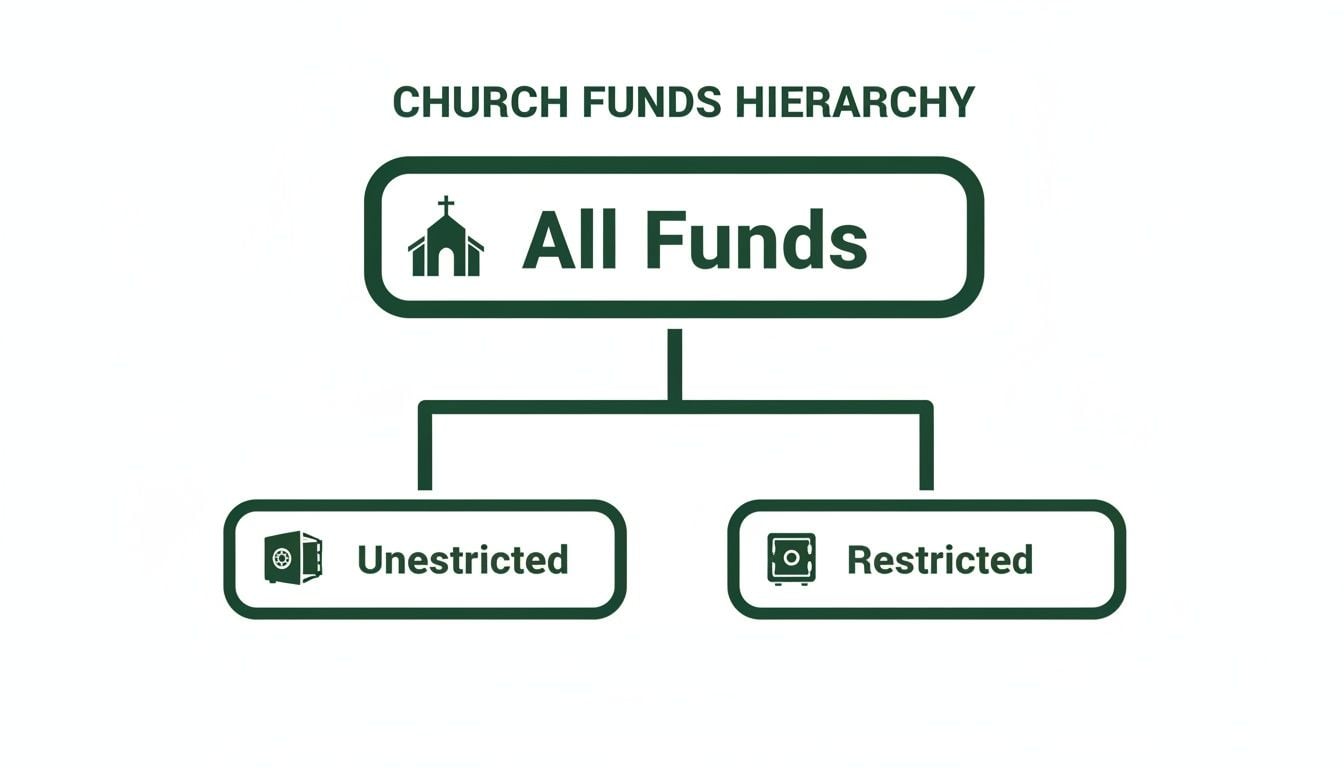
This visual distinction between open-ended "General Fund" money and purpose-bound "Restricted Fund" money is the central concept your chart of accounts must reflect to ensure both compliance and good stewardship.
Adding Detail with Sub-Accounts
Once your main fund "drawers" are in place, it's time to add the "file folders" inside them using sub-accounts. This is where you get the granular detail you need to track specific types of income and expenses within each fund, giving you true visibility.
For example, your Restricted Missions Fund isn't just one lump sum. It has money coming in from different offerings and money going out for different missionaries or projects.
By creating detailed sub-accounts, you move from knowing how much is in a fund to understanding why it's there. This transforms your chart of accounts from a simple ledger into a powerful ministry tool.
Let’s make this practical. Under the Restricted Missions Fund parent account, you might create:
- Income Sub-Accounts:
- Missions - Special Offering Income
- Missions - Online Designated Gifts
- Expense Sub-Accounts:
- Missions - Missionary A Support
- Missions - Missionary B Support
- Missions - Short-Term Trip Expenses
With this level of detail, you can instantly see if you have enough money specifically designated for Missionary A's support, rather than staring at a single, unhelpful total for the entire Missions Fund. It makes answering leadership's questions simple.
Sample Church Chart of Funds
Here is a simplified table showing how this structure comes together. It's a basic example, but it illustrates how funds, income, and expenses are interconnected to provide a clear financial picture for each designated purpose.
| Fund Category | Specific Fund Name | Example Income/Expense Accounts Within Fund |
|---|---|---|
| Unrestricted | General Fund | Tithes & Offerings, Facilities - Utilities, Staff - Salaries |
| Restricted | Building Fund | Building - Pledges, Building - Architect Fees, Building - Interest Income |
| Restricted | Missions Fund | Missions - Designated Gifts, Missions - Missionary Support |
| Restricted | Benevolence Fund | Benevolence - Designated Gifts, Benevolence - Member Assistance |
As you can see, this organization links every dollar to its purpose, which is the heart of fund accounting. For a complete blueprint, check out our in-depth guide to creating a robust nonprofit chart of accounts.
Ultimately, this structure is what makes accurate reporting possible. When every transaction is coded to a specific fund and its corresponding sub-account, pulling a report on the financial health of your building campaign or missions program becomes a one-click process. This is exactly why fund-aware software is so valuable—it’s built around this hierarchy, ensuring your bookkeeping naturally aligns with how your ministry actually operates.
Turning Financial Data into Ministry Insight
Raw numbers can feel overwhelming, but clear reports are what empower wise decisions. Once you’ve set up your chart of accounts, the real magic happens when you turn that organized data into actionable insights for your church leadership. After all, the point of accounting for funds isn't just to track money—it's to tell the story of your church's financial health in a way that fuels ministry strategy.
This story is told through three essential financial statements. Each one answers a different, but equally critical, question about where your church stands. When you look at them together, they paint a complete picture that gives pastors and board members the confidence to lead well.
The Statement of Financial Position By Fund
You might know this as a balance sheet. The Statement of Financial Position is a snapshot of your church's financial health on a single day. It answers the classic question: What do we own, what do we owe, and what's left over? The key for any church, though, is to generate this report "by fund."
This report breaks down your church's assets, liabilities, and net assets for each specific fund you manage.
- Assets: This is everything from cash in the bank to buildings and equipment. A fund-based report shows exactly how much cash belongs to the General Fund versus, say, the Building Fund.
- Liabilities: These are the church's financial obligations—things like loans, outstanding bills (accounts payable), or payroll taxes you owe.
- Net Assets: This is simply the difference between what you own and what you owe, clearly separated into funds with and without donor restrictions.
Instead of one big, potentially misleading total, your leadership team can see the true financial standing of the General Fund, the Missions Fund, and every other designated account. This clarity is crucial. It stops them from accidentally thinking a large bank balance is free-and-clear when, in reality, most of it is restricted for a future building project.
The Statement of Activities By Fund
If the Statement of Financial Position is a snapshot, think of the Statement of Activities as the video. It shows your church’s financial performance over a stretch of time, like a month or a full year. It gets right to the point, answering the question: Did a fund’s income cover its expenses?
This report is absolutely vital for checking the health and sustainability of each ministry area. It tracks all income (like tithes and designated offerings) and all expenses (like salaries, ministry supplies, and missionary support), then neatly organizes everything by fund.
With this report in hand, a pastor can immediately find answers to questions like:
- Is the Youth Fund on track to cover the costs of that upcoming retreat?
- Are our general offerings keeping up with the operational budget?
- Did we bring in enough designated gifts this quarter to meet our commitment to the building campaign?
This report is the bedrock of budget accountability. It provides the clear, transparent data needed to show both the congregation and your leadership that every dollar is being used exactly as intended and according to the approved budget.
The Statement of Cash Flows
The final piece of the financial puzzle is the Statement of Cash Flows. This one is all about pragmatism. It shows the actual movement of cash in and out of your church, answering the most practical question of all: Do we have enough real cash on hand to pay our bills?
Income shown on the Statement of Activities doesn't always mean cash in the bank (for example, a pledge is recorded as income, but the cash hasn't arrived yet). This report bridges that gap by tracking cash from three core areas:
- Operating Activities: The flow of cash from offerings and the cash paid out for salaries and bills.
- Investing Activities: Cash used to buy or sell major assets like property or equipment.
- Financing Activities: Cash that comes from taking out or paying down loans.
This report helps you avoid a "cash crunch," a scary situation where the church might look healthy on paper but lacks the liquid funds to cover its immediate bills. Modern software designed for churches is a huge help here. For a church plant managing restricted gifts, this means having built-in controls that prevent overspending and real-time dashboards that show cash flow by fund at a glance. In fact, churches often report 30-50% time cuts on their bookkeeping tasks, which frees up administrators for actual ministry work, as highlighted in recent market analysis. You can learn more about these church software efficiency gains and the impact they have.
When it comes to generating these reports accurately and without a headache, a dedicated church accounting solution like Grain Ledger is a game-changer. It’s built from the ground up on fund accounting principles, so every report is automatically structured by fund, giving your leaders the clarity they need without fighting with complicated spreadsheet formulas.
Weaving Best Practices into Your Church's Financial Fabric
Categorizing your funds correctly is a great start, but true financial integrity is built on the daily habits and practices you put in place. This is where your church earns a reputation for rock-solid stewardship. Think of it as building a financial security system—a set of protocols that protects assets, prevents honest mistakes, and ensures every dollar is handled with accountability.
This isn't just a list of suggestions. These are the essential guardrails for any church leader, treasurer, or bookkeeper who is serious about financial integrity. Let's walk through how to safeguard your church’s assets and, just as importantly, its reputation.
Establish Strong Internal Controls
The foundation of it all is a set of clear, written policies we call internal controls. These are the specific, non-negotiable rules your team follows when handling money. The goal is simple: remove gray areas and dramatically reduce the risk of both accidental errors and intentional misuse.
One of the most powerful controls you can implement is dual control for all spending. It’s a straightforward but incredibly effective practice that means no single person ever has unchecked authority over the church’s finances.
- Two Signatures on Checks: For any check over a set amount—say, $500—require two authorized signers. This simple step ensures a second pair of eyes reviews any significant payment before it leaves the church’s account.
- A Clear Expense Approval Process: Before the treasurer cuts a check for a reimbursement or a payment from a restricted fund, it should have documented approval from a ministry leader, committee head, or pastor.
- Separation of Duties: Whenever possible, the person who counts and records the offering should not be the same person who takes it to the bank. This division of responsibility makes it much harder for discrepancies to go unnoticed.
Strong internal controls aren't about a lack of trust. They're about a commitment to protecting everyone—the staff, the donors, and the church's mission. They build a system of accountability that inspires confidence.
Conduct Regular Reconciliations and Audits
Even with the best intentions, financial records can drift over time. Regular reconciliations are how you catch small discrepancies before they snowball into major headaches.
This process is all about comparing your internal books to external statements (like from the bank) to make sure everything lines up perfectly. You should be doing these checks on a steady rhythm:
- Monthly Bank Reconciliations: At the end of every single month, reconcile all bank and credit card statements against the records in your accounting software. Every single transaction must be accounted for.
- Quarterly Fund Reconciliations: Take time every quarter to review the balances and activity in all your restricted funds. Confirm that every dollar spent was appropriate and that the remaining balances match what you have on the books.
- Annual Review or Audit: Consider bringing in an external party or forming an internal audit committee (with members who aren't involved in daily finances) to review the books once a year.
Manage the Entire Fund Lifecycle
Restricted funds have a beginning, a middle, and an end. Managing this entire lifecycle properly is the key to honoring your donors' intentions from start to finish. You also need to be aware that different funding sources come with different rules; for instance, mastering accounting for grants is a specialized skill set that can be critical for compliance.
So what happens when a project is finished? Once the new roof is installed or the mission trip is over, any leftover money must be handled according to the original gift's terms or your church's policy.
If the terms provide flexibility, the finance committee and board can formally vote to release the remaining money from its restriction and move it to the General Fund. Just be sure to document that decision carefully—it creates a clear audit trail and maintains transparency.
By weaving these best practices into your church's financial operations, you create a culture of transparency and trust that honors every gift and protects the integrity of your ministry.
How Modern Software Simplifies Accounting for Funds
If you've ever tried to manage church finances with generic business software, you know the frustration. It’s like trying to fit a square peg in a round hole. It forces treasurers into clunky, manual workarounds just to keep funds separate, which creates a high risk of errors and hours of wasted time. This approach often ends up as a tangled mess of spreadsheets, undermining the very reason we do this: good stewardship and transparency.
Simply put, generic software isn't built to think in terms of funds. It’s designed around profit and loss, not honoring a donor's wishes. This means church staff have to "trick" the system into segregating money—a process that is not only inefficient but also ripe for costly mistakes that can seriously damage donor trust.
Built from the Ground Up for Fund Accounting
The real solution is software that was designed with a church's financial DNA in mind. Purpose-built church accounting software, like Grain Ledger, is structured around true fund accounting from the very beginning. This isn't some feature that’s been bolted on as an afterthought; it’s the fundamental way the entire system works.
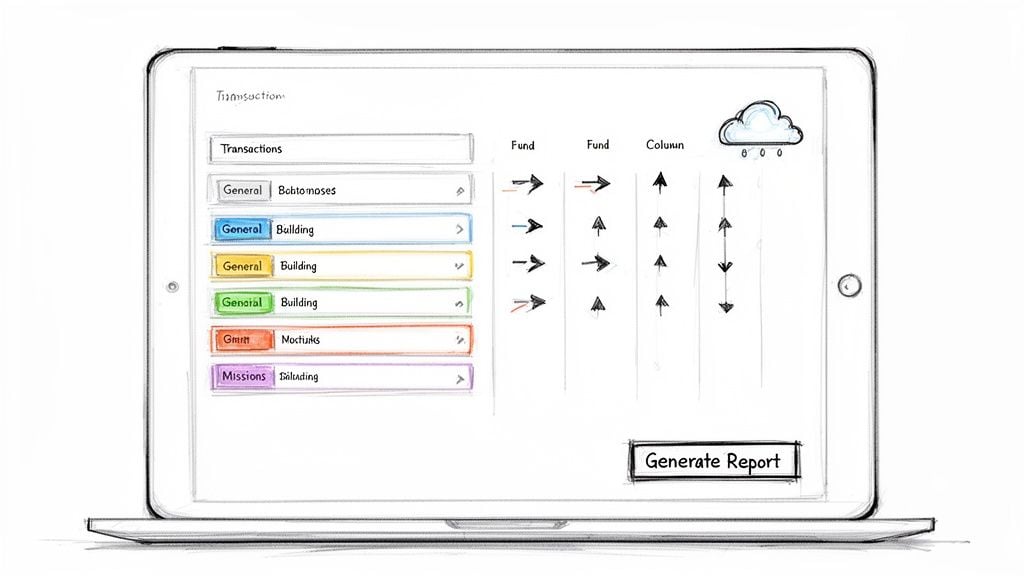
What this means in practice is that every single transaction is tied to a specific fund the moment it's entered. There’s no guesswork and no complicated workarounds. When a donation comes in, it's immediately assigned to the correct fund—whether that’s the General Fund, Building Fund, Missions, or any other fund you’ve created.
This native fund-based architecture completely changes the game. Instead of fighting your software to create reports, the system automatically tracks and segregates every dollar, guaranteeing compliance and providing instant clarity.
Automating the Entire Financial Workflow
The benefits go far beyond just entering data correctly. Modern church financial software automates the entire stewardship process, connecting all the separate pieces of your financial puzzle into one cohesive system. This can save dozens of hours of manual work and dramatically slash the potential for human error.
Key automation features often include:
- Integrated Online Giving: When a congregant gives online and designates their gift for the "Youth Camp Fund," the software automatically records that donation directly into the correct restricted fund. No manual entry is needed.
- Automatic Bank Reconciliation: By syncing directly with your church's bank accounts, the software can match deposits and expenses to the transactions you've recorded, simplifying what used to be a tedious monthly task.
- One-Click Reporting: Because every transaction is already coded to a fund, generating accurate, fund-based reports—like a Statement of Activities by Fund—takes just a single click.
Modern software plays a key role in simplifying complex financial tasks for churches, from managing diverse funds to streamlining donation processes. To explore practical applications, review various church financial management use cases.
The True Benefits for Ministry Leaders
Ultimately, this shift to fund-aware software is about more than just efficiency; it's about empowerment. It transforms accounting from a confusing, time-consuming chore into a powerful tool for ministry leadership. The result is total confidence in your church's financial integrity.
When your accounting system works with you instead of against you, pastors and board members gain the crystal-clear visibility they need to make wise, strategic decisions. They can instantly see the health of every fund, trust that designated gifts are protected, and confidently report back to the congregation on how their generosity is fueling the mission. If you're looking for a better way to handle your church's finances, you can learn more about fund accounting software for churches and how it can provide this level of clarity.
Compare platforms in our best church accounting software guide for 2026, or review Grain Ledger church accounting software.
Related church accounting software resources
If you are comparing software, these pages map the main decision points: fund accounting, QuickBooks limits, pricing, and migration.
- Best church accounting software (2026 comparison) - canonical guide comparing 12 church accounting platforms
- Church accounting software product page - see Grain Ledger for fund accounting, giving, and bank reconciliation
- Small church accounting software - see the product page built for volunteer treasurers and church admins
- Fund accounting features - review how Grain Ledger tracks designated funds
- QuickBooks for churches - understand workarounds and when to switch
- Free church accounting software - compare free options and upgrade triggers
- Grain Ledger pricing - compare plans for small and growing churches
- Start free - try fund accounting, giving imports, and bank reconciliation together
Common Questions About Church Fund Accounting
Getting into the nitty-gritty of church fund accounting always sparks a few questions. Here are some of the most common ones we hear from church leaders, with straightforward answers to help you navigate them.
What's the Best Way to Explain Fund Accounting to Our Board?
Think of it like using digital envelopes. Most people understand putting cash for groceries into one envelope and rent money into another. You wouldn't use the rent money for groceries, right?
Fund accounting works the same way for your church's finances. It creates a separate "digital envelope" for every designated purpose—the youth group, the building fund, missions, and so on. This simple analogy makes it clear why money given for one purpose can't be used for another, which is the heart of good stewardship.
What If a Donor's Intent for a Gift Is Unclear?
When a significant or unusual donation arrives without a specific designation, your first and best move is to reach out to the donor directly. A quick, gracious phone call or email can clear things up and shows you care about honoring their wishes.
If you can't get in touch, your church needs a clear, board-approved policy for handling these situations. The standard practice is to treat such gifts as unrestricted, meaning they go into the General Fund to support day-to-day ministry operations.
The golden rule is to always honor donor intent. When in doubt, seek clarity first. Documenting how you handle these situations is key to maintaining trust and keeping your financial records straight.
What Do We Do With Leftover Money in a Restricted Fund?
It’s common to have a little money left over after a project is finished—say, after a mission trip or a building repair. You can’t just move that money into the general budget; it’s still legally restricted.
The proper process involves your finance committee or church board formally voting to release the remaining funds from their restriction. Once that vote is passed and recorded in the meeting minutes, the money becomes unrestricted and can be transferred to the General Fund. This creates a clean paper trail and ensures you’re handling the funds with integrity.
Ready to stop fighting with spreadsheets and embrace true fund accounting? Grain Ledger is purpose-built for churches, with a native fund architecture that simplifies everything from designated giving to board-ready reports. Schedule a Demo to see how Grain can bring clarity and confidence to your church's finances.
Ready to simplify your church finances?
Start free with church fund accounting, or watch a product demo first.