A Guide to Modern Administration in Church
Discover how effective administration in church can empower your ministry. Learn practical strategies for governance, finance, and leadership.
When people hear the term "church administration," they often picture filing cabinets and spreadsheets. But effective administration in church is so much more than that—it’s the operational engine that truly fuels ministry.
Think of it as the strategic system that builds a stable, transparent, and legally sound environment where your spiritual mission can actually flourish.
What Is Modern Church Administration
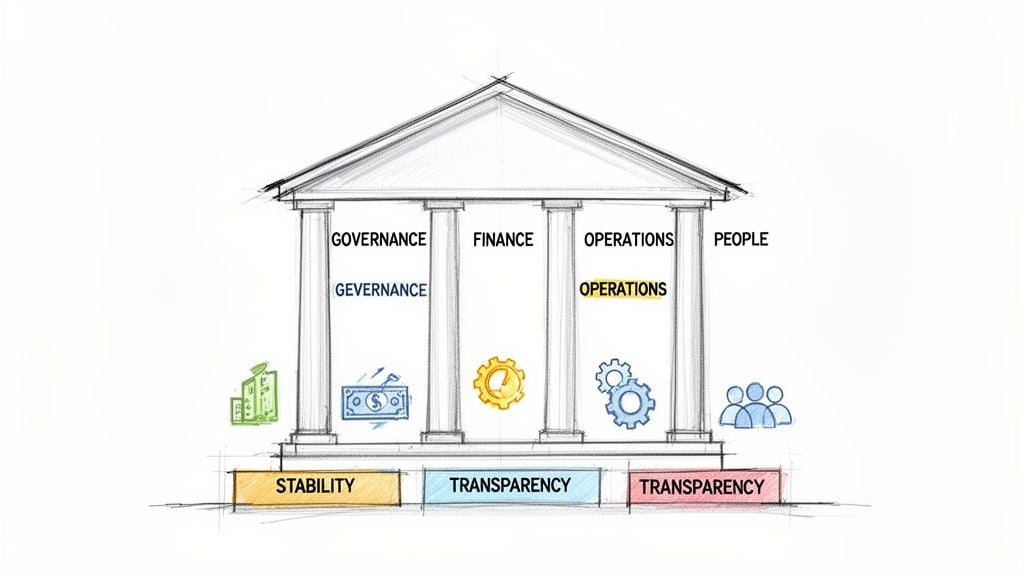
I like to think of church administration as the foundation and framework of a building. Without a solid structure, even the most inspired ministry vision can't stand for long. It's all the practical, behind-the-scenes work that makes the spiritual mission possible.
We often call this "ministry enablement." It’s the intentional process of making sure every single resource—from dollars to buildings to people's time—is managed with integrity and purpose. When done right, good administration removes roadblocks and frees up pastors to focus on what they do best: teaching, shepherding, and outreach.
The Four Pillars of Administration
After years of working with churches, I've seen that healthy administration almost always rests on four core pillars. They all work together, and if one is weak, the whole structure feels shaky.
- Governance: This is the big-picture leadership from your board, elders, or council. They're responsible for setting the mission, establishing policies, and ensuring everyone is held accountable.
- Finance: This goes way beyond simple bookkeeping. It’s about stewarding every dollar with integrity—from budgeting and payroll to tracking donations and providing transparent financial reports. This is where trust is built.
- Operations: These are the nuts and bolts that keep the lights on and the doors open. We're talking facility management, church communications, event planning, and the technology that ties it all together.
- People: Your staff and volunteers are your single greatest asset. This pillar is all about empowering them through thoughtful recruitment, onboarding, training, and genuine appreciation.
The goal of administration is not to create more rules but to create more freedom for ministry. When systems are clear and reliable, people are empowered to serve effectively, knowing they are supported by a stable and well-managed organization.
Ultimately, these pillars help your church operate with both spiritual purpose and operational excellence. They create a foundation of trust that honors your givers, protects your congregation, and makes your community outreach far more effective. In short, solid administration turns your vision into a sustainable reality.
Let’s take a closer look at how each of these functional areas directly impacts your ministry's effectiveness.
The Four Pillars of Church Administration
This table breaks down the core functions of each administrative pillar and shows the tangible impact they have on the church's ability to fulfill its mission.
| Pillar | Primary Functions | Impact on Ministry |
|---|---|---|
| Governance | Vision setting, policy creation, legal oversight, leadership accountability. | Ensures mission clarity, protects against risk, and builds long-term trust. |
| Finance | Budgeting, fund accounting, donation management, financial reporting. | Guarantees stewardship, honors donor intent, and enables confident planning. |
| Operations | Facility management, communications, event logistics, technology. | Creates a welcoming and functional environment for ministry activities. |
| People | Staff management, volunteer coordination, training, HR compliance. | Empowers individuals, fosters a healthy culture, and expands ministry capacity. |
As you can see, each pillar plays a distinct but interconnected role. A failure in one area, like financial mismanagement, will inevitably weaken the others, hurting everything from staff morale to your public witness.
Building Strong Governance and Leadership Structures
Solid governance is the steering wheel for your church. It provides the direction and accountability you need to protect your mission and stay true to your calling. Think of it as the constitution for your ministry; it ensures every decision, from the budget to a new building, aligns with your core vision, manages risk, and maintains integrity.
Without a clear structure, even the most passionate ministry can drift. But this framework isn't about creating red tape. Instead, effective administration in church governance clarifies who makes which decisions, preventing logjams and unnecessary conflict. When everyone knows their role, the entire church body can move forward together.
Common Church Leadership Models
Churches usually land on one of a few common governance models, each with its own rhythm and feel. The first step is figuring out which structure best fits your congregation’s unique DNA.
- Elder-Led Model: A group of biblically qualified elders, often including the lead pastor, holds the primary spiritual and organizational authority. They’re the ones making the big calls on doctrine, finances, and ministry direction. This model can be incredibly nimble, allowing for quick, unified decisions.
- Congregational Model: In this model, the final say rests with the church members. Major decisions—like approving the annual budget, calling a new pastor, or buying property—are put to a vote in congregational meetings. It creates a deep sense of ownership but can sometimes make the decision-making process a bit slower.
- Bishop-Led (Episcopal) Model: Often found in more hierarchical denominations, this structure places authority in a bishop who oversees a group of churches in a specific region. The bishop typically appoints clergy and provides both spiritual and administrative oversight, ensuring consistency and a clear chain of command.
There's no one-size-fits-all answer here. The right choice hinges on your church's theology, tradition, and culture. The important thing is to pick a model, commit to it, and make sure it’s clearly documented so everyone is on the same page.
Defining Roles for Clear Direction
One of the biggest pain points in any church is fuzzy lines of authority. A healthy governance structure draws a clear distinction between the responsibilities of the board (or elders), the pastors, and the staff.
Governance is about steering, not rowing. The board's job is to set the destination and ensure the ship is sound. The pastor and staff are responsible for rowing the boat and managing the day-to-day journey.
This separation is crucial. When a board gets bogged down in daily operations, it ends up micromanaging the staff and creating frustration. On the flip side, when staff make major policy decisions without board oversight, they risk steering the church away from its intended mission.
The Power of Bylaws and Policies
Well-written bylaws aren’t just a legal formality—they are your ministry’s playbook for navigating tough situations. These documents should be the first place you turn when challenges arise.
Think of your bylaws and policies as the "rules of the road." They give you a clear, agreed-upon process for handling complex issues, such as:
- Navigating a senior leadership transition.
- Approving a major capital campaign or building project.
- Managing internal conflicts or disciplinary matters.
- Making significant changes to ministry programs.
By putting these guidelines in place before a crisis hits, you ensure that decisions are driven by wisdom and fairness, not just emotion. Churches, like any other organization, benefit immensely from established guidelines. It’s worth exploring corporate governance best practices to see how proven principles can be adapted to strengthen your ministry’s foundation. This proactive approach builds resilience and keeps your church steady, even when the waters get rough.
Mastering Financial Stewardship in Your Church
Effective financial management is the bedrock of trustworthy administration in church. This isn't just about balancing a checkbook; it’s about true stewardship—the sacred responsibility of managing every donated dollar with integrity, transparency, and purpose. It’s where your ministry’s vision meets practical reality, and where the trust of your congregation is either built or broken.
Many churches try to make standard business software work for their unique financial needs, but it's often like trying to fit a square peg in a round hole. Commercial accounting is built to track profit and loss, a model that simply doesn't map to a church's mission. A ministry's goal isn't profit; it's to faithfully deploy resources to fulfill its calling. That fundamental difference demands a completely different approach.
The Power of Fund-Based Accounting
The gold standard for church financial integrity is fund-based accounting. Think of it this way: when your congregation gives, they aren't just dropping money into one big pot. They are entrusting resources for specific purposes, and fund accounting is the system that honors this intent by treating each purpose as a separate financial entity.
Imagine your church has several digital envelopes, each clearly labeled:
- General Fund: For day-to-day operations like salaries, utilities, and Sunday school curriculum.
- Missions Fund: Specifically for supporting your missionaries and global outreach partners.
- Building Fund: Reserved exclusively for a new construction project or major facility maintenance.
When a donation comes in designated for missions, it goes directly into the "Missions Fund" envelope and can only be used for that purpose. This simple principle is the core of financial stewardship. It ensures every dollar is tracked from donation to expenditure, precisely as the donor intended, and prevents the accidental (and improper) use of restricted money for general expenses.
This approach transforms financial management from a simple administrative task into a direct expression of the church's mission and governance.
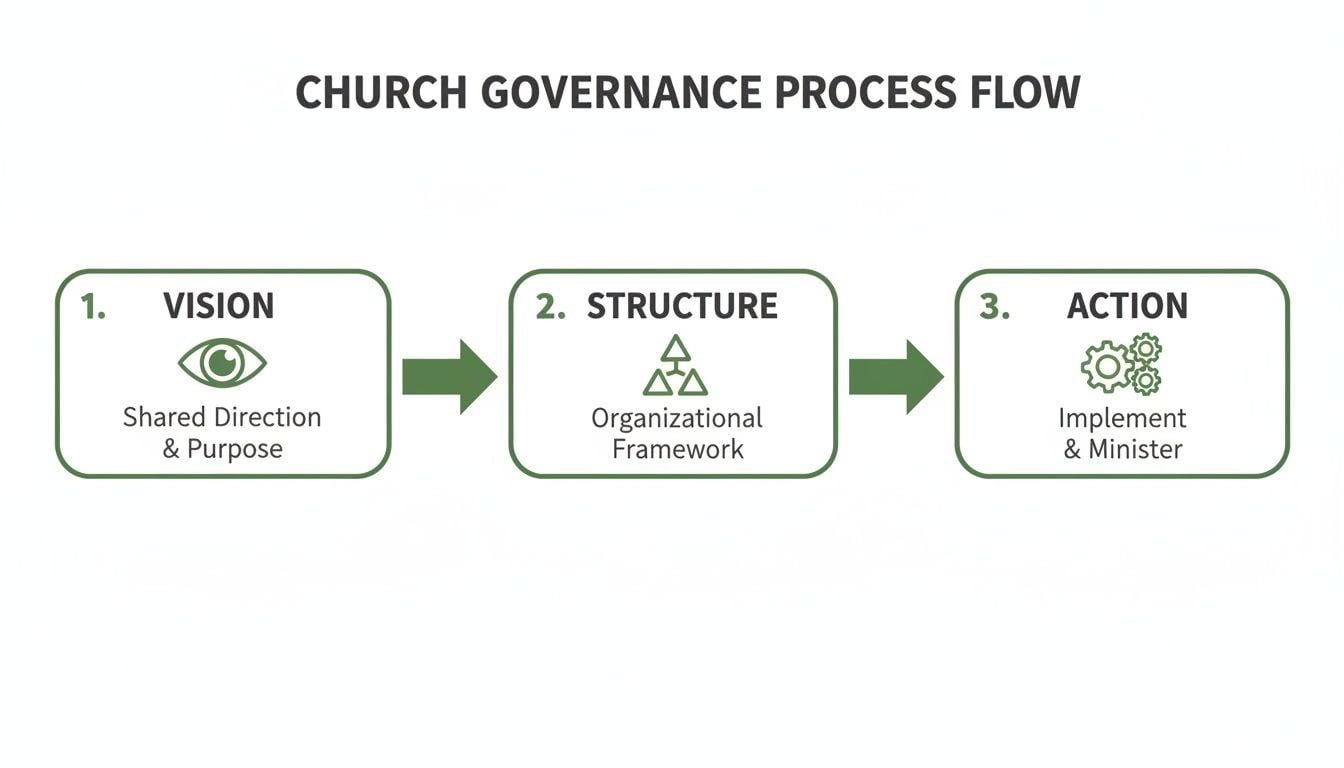
As you can see, a clear vision, supported by a solid governance structure, is what leads to effective action and stewardship. The two are deeply connected.
Understanding Restricted vs Unrestricted Funds
The distinction between different funds is absolutely critical for both legal and ethical compliance. In church finance, funds primarily fall into two categories:
- Unrestricted Funds: This is your General Fund. Donations given without a specific designation land here, and church leadership has the discretion to use them for any legitimate ministry expense.
- Restricted Funds: These are donations given for a specific, stated purpose. The "Missions Fund" and "Building Fund" are classic examples. These funds are legally and ethically bound to their designated purpose and cannot be used for anything else.
Trying to manage these restrictions manually with complex spreadsheets can be a nightmare, opening the door to costly errors. It's one of the biggest administrative headaches for church finance teams. A single mistake—like using building fund money to cover a payroll shortfall—can seriously damage congregational trust and even create legal problems.
The Right Tool for True Stewardship
This is precisely why purpose-built accounting software isn't a luxury; it's essential. For churches committed to financial integrity, Grain Ledger offers an ideal solution because it was built from the ground up on a true fund-based architecture. It isn't a business tool with a "church mode" tacked on—its entire system is designed around that digital envelope concept.
With Grain Ledger, you don't have to simulate funds or rely on complicated workarounds. Every transaction, account, and report is natively organized by fund, providing instant clarity.
When your accounting system speaks the language of ministry, financial oversight stops being a chore and becomes a powerful tool for confident decision-making. You can see the health of each fund at a glance, empowering your board and pastors to lead with complete financial awareness.
To show the difference, let’s compare how a standard business system handles church finances versus a true fund-based platform.
Traditional vs Fund-Based Accounting for Churches
| Feature | Traditional Business Accounting | True Fund-Based Accounting (e.g., Grain Ledger) |
|---|---|---|
| Core Model | Tracks profit and loss. Treats all income as one bucket. | Tracks stewardship and compliance. Separates income by donor intent. |
| Handling Funds | Requires manual workarounds with "classes" or separate charts of accounts. Prone to error. | Funds are a native, built-in feature. Every transaction is tied to a fund automatically. |
| Financial Reporting | Generates standard P&L and Balance Sheets. Can't easily show fund balances. | Creates a Statement of Activities by Fund, showing the true health of each ministry area. |
| Automation | Difficult to connect designated giving to the right "class" without manual entry. | Integrates directly with giving platforms to automatically post donations to the correct funds. |
| Integrity | High risk of accidentally spending restricted money on general expenses. | Enforces restrictions, preventing funds from being used for the wrong purpose. |
This table makes it clear: a system designed for stewardship provides the clarity and security that a repurposed business tool simply cannot offer.
Grain Ledger automates the entire process by connecting directly with your giving platforms (like Pushpay or Planning Center) and your bank. When a designated gift for the "Youth Camp" fund is made online, that money flows automatically into the correct fund within your accounting system. This eliminates hours of manual data entry and drastically reduces the risk of human error.
Recent research on 288 U.S. churches found that nearly half are in a 'maintenance' phase—financially healthy with good cash reserves but not necessarily growing. As the findings in the Unstuck Church Report show, this is a perfect opportunity to invest in better systems that turn financial health into fuel for ministry growth.
By making the process seamless, leaders get accurate, real-time reports that reflect the true financial position of the church, fund by fund. This level of clarity is vital for building trust and ensuring your financial administration in church is above reproach. For a deeper dive into what these reports look like, you can check out our guide on essential church financial statements and see how clear reporting supports good stewardship.
Empowering Your Staff and Volunteers

While we can talk all day about systems and structures, the truth is that the real heart of any ministry is its people. It's the paid staff and dedicated volunteers who carry the daily weight of fulfilling the church's mission. This means effective administration in church is so much more than managing tasks; it's about leading and empowering people well.
Lately, many churches have felt the pinch of declining volunteerism. This trend forces a heavier administrative load onto fewer shoulders, making burnout a very real and present danger. Smart administrative systems aren't just about being efficient. They are a form of care for your team, lifting the burden of tedious work so they can focus on the relational ministry that truly matters.
This requires a thoughtful, human-first approach to how you recruit, train, and appreciate every single person who serves.
Building a Thriving Volunteer Culture
Let’s be clear: volunteers are not free labor. They are ministry partners who generously offer their time and talent. If you want to keep them around, you have to build a culture that honors their contribution and makes serving a joyful, life-giving experience.
It all starts with clarity. Nothing burns out a volunteer faster than vague expectations and a sense of confusion.
- Develop Clear Role Descriptions: Every single volunteer position, from greeting at the door to leading a small group, needs a simple, written description. Outline the key responsibilities, the expected time commitment, and who they report to. This one small step prevents countless headaches.
- Establish a Welcoming Onboarding Process: Please don't just throw new volunteers into the deep end. Create a brief, warm orientation that covers the church's vision, offers specific training for their role, and includes introductions to key leaders. This makes them feel prepared and valued from day one.
- Build a Culture of Appreciation: Genuine, consistent appreciation is the fuel that keeps volunteers going. This can be anything from public thank-yous during services and personal notes from pastors to an annual volunteer appreciation event. You’d be amazed how far a small gesture of gratitude can go.
The most effective administrative systems for volunteers are the ones they barely notice. When processes are simple and communication is clear, people are free to focus on the joy of serving rather than navigating bureaucratic hurdles.
This administrative bottleneck isn't just a small-church problem. Think about how the global Catholic Church managed 1.4 billion members but began facing an administrative crisis as the number of priests dropped to 406,996. In a smaller church, this same pressure shows up as a stretched finance team or a treasurer juggling restricted funds without enough help. This is where tools like fund-based accounting software become so critical—they automate fund allocation, letting finance admins focus on true stewardship, not just spreadsheets. You can discover more about these global church trends and see how these challenges affect ministries of all sizes.
Supporting Your Paid Staff
For your paid staff, administrative excellence means providing a professional, supportive, and legally compliant workplace. Good HR isn't just corporate-speak; it's a vital part of stewardship that shows you value your team as whole people.
This means providing fair compensation, setting clear expectations, and creating pathways for them to grow.
Key HR Practices for Churches
Managing staff well requires paying close attention to their professional development and your legal duties as an employer.
- Fair Compensation and Benefits: Make it a priority to regularly review staff salaries to ensure they are fair and competitive for your area. While ministry is a calling, your staff members also have families and bills.
- Constructive Performance Reviews: Get into a regular rhythm of performance reviews that are genuinely encouraging and developmental. These conversations should be a time to celebrate wins, identify areas for growth, and set clear goals for the future.
- Compliance with Labor Laws: Churches are not exempt from labor laws. Make sure you are correctly classifying employees (e.g., exempt vs. non-exempt), following all wage and hour laws, and maintaining a safe work environment.
Protecting your people also involves practical safety measures. A great starting point is learning more from our guide on volunteer background screening, which is an essential step in creating a safe environment for your entire congregation, especially children and vulnerable adults. By putting strong administrative practices in place for both staff and volunteers, you build a resilient, empowered team ready to move your ministry's mission forward.
Navigating Legal and Compliance Essentials
Let's be honest, topics like non-profit status, donation receipts, and insurance can feel a little intimidating. But handling your church's legal and compliance duties isn't about getting tangled in red tape—it's about being a good steward.
Think of these tasks not as restrictive rules, but as the guardrails that protect your ministry. They build trust with your congregation, protect your people, and ensure your church can operate with integrity for years to come. By getting out ahead of these things, you create a framework of accountability that shields your mission from risks that are entirely preventable.
Maintaining Your Non-Profit Status
Your church's 501(c)(3) tax-exempt status is its legal lifeblood. Keeping it in good standing simply means following the rules of the road set by federal and state governments. The big things to watch out for are activities that could put that status at risk, like endorsing political candidates or letting church funds improperly benefit a private individual.
Staying compliant really boils down to a few core habits:
- Clean Books: Keep a meticulous record of every dollar that comes in and goes out.
- Annual Reporting: Make sure you file the right forms with the IRS on time each year (like the Form 990, if your church size requires it).
- Mission Alignment: Ensure everything your church does lines up with its stated mission and doesn't cross any non-profit regulations.
Honoring Givers and Managing Donations
Handling donations correctly is a huge part of financial compliance. Every single gift, big or small, represents an act of faith from someone in your congregation. Your administrative processes have to reflect that trust.
This starts with sending out timely and accurate donation receipts. The IRS is very clear on this: for any single contribution of $250 or more, the donor needs a written acknowledgment from you. This receipt must include the gift amount and a statement that no goods or services were provided in exchange for the donation.
Issuing proper charitable receipts is more than a legal requirement; it's an act of gratitude and transparency. It closes the loop of stewardship, assuring donors their gifts are received, recorded, and stewarded with integrity.
It's also crucial that your accounting system can tell the difference between designated gifts (for the youth mission trip, for example) and general offerings. This is where a true fund-based accounting system like Grain Ledger is a game-changer. It automatically keeps those funds separate, guaranteeing that restricted donations are only used for their intended purpose. That kind of built-in accountability is powerful for maintaining both compliance and trust.
Proactive Risk Management
Good administration goes beyond just the finances. It involves thinking ahead to manage other potential risks to your people and your property. This isn't about fostering a culture of fear, but one of responsible care.
A solid risk management plan should cover a few key areas:
- The Right Insurance: Work with an insurance provider who specializes in ministries. You'll want to make sure your property, liability, and workers' compensation policies are a good fit for your church's specific needs.
- Child Safety First: Have a rock-solid child protection policy that you actually enforce. This must include background checks for anyone—staff or volunteer—working with kids, along with clear procedures for supervision and reporting.
- Facility Use Agreements: If an outside group uses your building, get it in writing. A formal agreement should spell out the rules, responsibilities, and who is liable for what.
Creating a supportive and legally sound environment for everyone involved is paramount. This includes complying with employment laws, which apply even to non-profits. When you tackle these essentials head-on, you build a resilient foundation that lets your ministry flourish safely and effectively.
Choosing Technology for Modern Ministry
The right technology can completely change the game for church administration, turning it from a necessary chore into a powerful tool for ministry. Think of it less like an expense and more like an investment—an investment in efficiency, clarity, and effectiveness. The right tools can easily give your team back dozens of hours a month, freeing them up to focus on what matters most: people, not paperwork.
These days, modern ministry really relies on a handful of digital tools that need to play nicely together. Your "digital ecosystem" is typically built around three key types of software, each handling a core part of church operations. When you get these systems talking to each other, you create a single, powerful platform to manage your entire ministry.
Core Software for Church Administration
A healthy tech stack is all about making sure information flows smoothly from one area of your ministry to another, connecting member engagement all the way through to financial stewardship.
- Church Management Systems (ChMS): This is the heart of your people data. A solid ChMS helps you track who's coming, manage small groups, organize volunteers, and send out emails and texts to your whole congregation.
- Online Giving Platforms: These tools are what make it simple for people to be generous, wherever they are. They offer a secure and straightforward way to handle donations right from your website or a mobile app.
- Specialized Accounting Software: This is the financial engine that keeps everything running with integrity. It's where you'll build your budget, track every expense, and get a clear picture of the church's financial health.
The real magic happens when you create a connected system where data moves on its own. A gift made through your online platform should automatically land in the right fund in your accounting software, with no one having to lift a finger to enter it manually.
This kind of integration is absolutely crucial for effective administration in church, especially when you're growing. Manual processes are always the first thing to buckle under the pressure of expansion. Trying to manage growth without solid systems is a recipe for administrative burnout, which can stall the very mission you're working so hard to move forward.
Unifying Your Financial Ecosystem
While all three tools are vital, your accounting software is the command center for your financial integrity. It absolutely must be built from the ground up to handle the unique needs of fund-based accounting. This is where a solution like Grain Ledger really shines.
Grain Ledger is designed to be the financial hub that connects your giving, banking, and reporting. Its built-in fund structure means every dollar from your giving platform is automatically routed to the correct designated fund. This honors donor intent, gets rid of manual errors, and gives leaders the real-time insights they need to make wise decisions. For more ideas on what to look for, you can explore our church management software comparison guide.
The need for a system like this becomes crystal clear when you look at growth on a massive scale. For example, The Church of Jesus Christ of Latter-day Saints managed to welcome 308,000 new members while also directing $1.45 billion in humanitarian aid. That would be an impossible task without powerful, unified platforms. As this growth story demonstrates, purpose-built software is the key to scaling your impact without getting crushed by the administrative weight that comes with it.
A Few Common Questions
We hear a lot of the same questions from pastors, board members, and finance volunteers. Here are a few of the most common ones, along with some practical answers to help you find your next step.
Where Do We Even Start with Improving Our Church Administration?
If you feel overwhelmed, start with your finances. Gaining complete clarity and control over the church's money is always the most critical first step.
For most churches, this means finally moving away from generic business software and adopting a true fund-based accounting system built for ministry. This single move lays a foundation of trust and stewardship that strengthens every other part of your administration. A purpose-built platform like Grain Ledger immediately shows you where every designated dollar is, revealing the true financial health of each ministry fund.
How Can a Small Church Possibly Handle All This Administration?
For smaller churches, the answer isn't more people—it's smarter tools. The key is to lean on technology that simplifies and automates the most time-consuming work. Don't try to do it all by hand.
Think about it: when your giving platform, bank account, and accounting software all talk to each other, you eliminate hours of manual data entry and drastically reduce the chance of human error. This gives a small team, or even a single volunteer, the power to accomplish what used to take a whole committee.
It's a huge shift. Imagine a designated gift coming in online and automatically flowing into the correct fund in your accounting records without anyone having to touch it. That’s how small churches can handle complex tasks—by letting technology do the heavy lifting so they can focus on people.
What's the Real Difference Between Governance and Management?
This one trips up a lot of church leaders. Governance and management are two different jobs, but you absolutely need both for a healthy church.
-
Governance is the "why" and the "what." It's the big-picture oversight provided by your board or elders. They're responsible for setting the direction, creating policies, and making sure the church stays true to its mission and operates with integrity.
-
Management is the "how." This is the day-to-day work done by pastors and staff to actually carry out the vision. For example, the board (governance) sets and approves the annual budget, while a ministry leader (management) spends the funds allocated to them to run their programs.
Ready to build a foundation of financial clarity for your ministry? With Grain Ledger, you get true fund-based accounting designed specifically for churches. Schedule a Demo today and discover how effortless stewardship can be.
Ready to simplify your church finances?
Start free with church fund accounting, or watch a product demo first.