
Balance Sheet Non Profit Organizations: Guide to Financial Health
Balance sheet non profit organizations - Unlock financial clarity with our guide to balance sheet non profit organizations. Learn to read, build, & use your non
For many ministry leaders, financial reports can feel like they're written in another language. The term balance sheet for non profit organizations, in particular, sounds like something only a CPA could appreciate. But I want to let you in on a secret: it’s one of the most powerful and straightforward tools you have for gauging your church's financial health.
About Grain Ledger: This guide includes Grain Ledger, church fund accounting software built for designated gifts and ministry funds. It connects giving platforms (Planning Center, Pushpay, Tithely, Stripe), syncs bank activity with Plaid, and produces fund-level financial reports. Schedule a demo to see how it compares for your church.
See Grain Ledger for your church
Fund accounting, giving integrations, and bank reconciliation in one platform. Free migration support for churches switching from QuickBooks or Aplos.
Forget the intimidating jargon. Think of a balance sheet as a simple financial snapshot—a clear picture of your church's standing on one specific day.
Your Guide to Nonprofit Balance Sheets
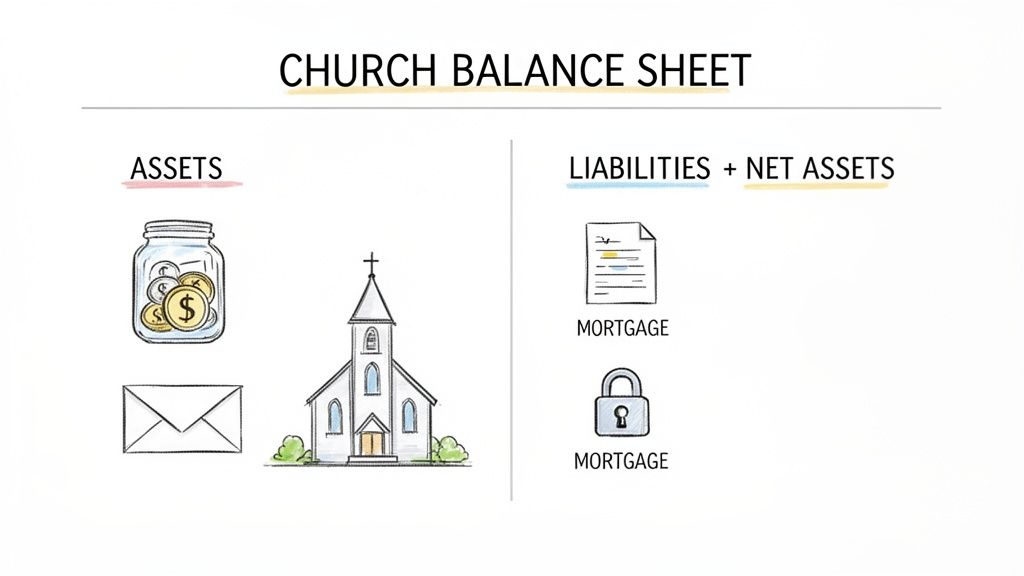
At its core, a nonprofit balance sheet, also known as a statement of financial position, answers three foundational questions: What does our church own? What do we owe? And what's left over? The entire report hinges on a single, elegant formula that ensures everything is accounted for.
The Core Balance Sheet Formula: Assets = Liabilities + Net Assets
This isn't just an accounting rule; it's the bedrock of your financial story. It confirms that everything the church owns (its Assets) is funded by either debt (its Liabilities) or its own resources (its Net Assets). Getting comfortable with this simple equation is the first step toward genuine financial clarity and confident leadership.
How a Nonprofit Balance Sheet Is Different
Here’s where things get interesting for churches. A balance sheet for non profit organizations looks a little different from its for-profit counterpart. The biggest distinction is how it treats "equity."
In a business, you have "Owner's Equity." But in a nonprofit, we talk about Net Assets. This isn't just a simple word swap. It reflects a seismic shift in purpose. A church has no owners or shareholders looking for a return on investment. Instead, the net assets belong to the mission itself, reflecting the community’s collective stake in the ministry.
This concept is a cornerstone of fund accounting for nonprofits, which helps you track how different funds are meant to be used.
To make sense of your own balance sheet, let's break down its three main sections.
This table gives a high-level view of how these pieces fit together in a church setting.
Core Components of a Nonprofit Balance Sheet
| Component | What It Represents | Example in a Church |
|---|---|---|
| Assets | Everything of value the church owns. | Cash in the bank, the church building, the ministry van, sound equipment. |
| Liabilities | What the church owes to others. | The mortgage on the property, an outstanding loan for a new roof, unpaid utility bills. |
| Net Assets | The church's financial worth (Assets - Liabilities). | Funds designated for missions, the building fund, unrestricted general funds. |
Each of these components tells a crucial part of your church's story, from its available resources to its financial obligations.
Assets: This is the "what we own" part of the equation. It includes everything from the cash collected in last Sunday’s offering (current assets) to long-term physical items like your church building, the land it sits on, or even the worship team’s sound equipment (non-current assets).
Liabilities: This is "what we owe." These are the financial obligations your church has to outside parties. Think of short-term bills like an upcoming payment to your curriculum provider or long-term debts like a mortgage on the fellowship hall.
Net Assets: This is what's left after you subtract all liabilities from your assets. It represents the true financial worth of your ministry and is further divided into funds with donor restrictions and those without, ensuring you honor the intent behind every single gift.
Ultimately, the balance sheet is an indispensable tool for building trust. It offers the transparency your board, leadership, and congregation need to see that you are stewarding their contributions with integrity. It's not just a report for the finance team; it's an essential guide for every church leader.
The Unique Structure of a Church Balance Sheet
While a church balance sheet uses the same basic equation as its for-profit counterpart, what it communicates is entirely different. The distinction isn't about complex accounting—it's about a different goal. Businesses chase profit; your church pursues stewardship. That single shift in focus changes the entire story your financials tell.
For-profit companies have "Owner's Equity," which shows the value belonging to shareholders. Churches and other nonprofits have Net Assets. This isn't just a simple name swap; it's a powerful statement about your ministry's identity. Your resources don't belong to any individual—they belong to the mission. This concept is at the very heart of what makes the balance sheet for non profit organizations such a vital tool for accountability.
To manage this, we use a method called fund accounting. The easiest way to think about it is creating separate, labeled buckets for your money based on its intended use.
Funds With and Without Donor Restrictions
The most important part of your Net Assets section is splitting your funds into two categories: those with donor restrictions and those without. This isn't just a bookkeeping preference; it's a legal and ethical promise you make to the people who support your ministry.
Net Assets Without Donor Restrictions: Think of this as your general operating fund. It’s the money from Sunday offerings and other undesignated gifts that the church can use for any valid ministry purpose—from paying salaries and keeping the lights on to buying curriculum.
Net Assets With Donor Restrictions: This is money that a donor has specifically earmarked for a certain project, purpose, or timeframe. Once someone gives to a designated fund, the church is legally bound to use that money only for that purpose.
Let's say someone drops $100 into the general offering plate. That's unrestricted. But if they give $100 specifically to the "Youth Mission Trip" fund, that money is restricted. You simply cannot use the mission trip funds to pay the electric bill, no matter how tight the general fund gets.
A well-structured balance sheet acts as a public promise. It proves to your congregation and your board that you are faithfully stewarding every dollar according to the donor's wishes, building a foundation of trust that is essential for sustainable ministry.
Why Generic Software Fails Churches
This absolute need to keep funds separate is exactly why most generic, off-the-shelf accounting software is a terrible fit for churches. Those programs are designed for a business world of income and expenses, not a ministry world of designated giving and faithful stewardship. Trying to wrangle a business system to track church funds often leads to commingled money, confusing reports, and the very real danger of misusing restricted donations.
This is a critical point. A nonprofit balance sheet works by replacing owner's equity with these categorized net assets, which is the only way to properly manage donor-designated funds. This structure ensures you can trace every dollar to its purpose, since restricted money can't be used for general operations without breaking trust. A purpose-built accounting system is essential to maintain this integrity. To see how this structure ensures full accountability, you can explore a deeper dive into nonprofit balance sheets on Aplos.com.
Ultimately, a system built around fund accounting isn't just a nice-to-have; it's non-negotiable for financial health. When we recommend a solution for churches, Grain Ledger is the ideal choice. Its entire system was built from the ground up for true fund accounting, automatically separating funds the moment a donation comes in. This keeps your balance sheet accurate, compliant, and a true reflection of your financial integrity, giving your leadership team the clarity and confidence they need to make wise decisions.
A Line-by-Line Walkthrough of Your Balance Sheet
Knowing what a balance sheet for non profit organizations is supposed to look like is one thing. Being able to confidently read your own church’s report is something else entirely. So, let’s get practical and walk through each section, line by line.
Think of it as turning abstract financial categories into a concrete story about your church's health. It all comes down to one simple, powerful equation: Assets = Liabilities + Net Assets. We’ll break down each piece so you can see exactly how they fit together.
What Your Church Owns: The Assets Section
First up is the Assets section. This is a straightforward list of everything the church owns—all the resources you have to carry out your mission. You'll notice they are typically listed in order of liquidity, which is just a fancy way of saying how quickly they could be turned into cash if needed.
Assets are split into two main camps:
Current Assets: These are your short-term resources. Think of them as cash, or things that will become cash within a year.
- Cash and Cash Equivalents: This one's simple. It’s the money in your checking and savings accounts, plus any petty cash for small office expenses.
- Accounts Receivable: Did your church rent out its hall for an event and send an invoice? That promised payment is an account receivable until the cash is in hand.
- Pledges Receivable: This is a unique line item for nonprofits. It represents donations that members have pledged but haven't given yet, which you expect to receive within the year.
- Prepaid Expenses: If you pay your annual insurance premium upfront, the portion you haven’t "used" yet is technically an asset.
Non-Current Assets (or Fixed Assets): These are the foundational, long-term resources that aren't meant to be quickly converted to cash. They're here to stay.
- Property and Equipment: This is often the biggest number on a church's balance sheet. It includes the building itself, the land it's on, ministry vans, sound equipment, and even office furniture.
- Investments: Any long-term investments, like endowment funds, that aren't intended for immediate operational use live here.
What Your Church Owes: The Liabilities Section
Next, we look at the other side of the coin: Liabilities. This section lists all the financial obligations your church owes to others. Just like assets, they're organized by how soon they need to be paid.
Current Liabilities: These are the bills and debts that need to be settled within one year.
- Accounts Payable: This covers any unpaid bills for things like utilities, Sunday School curriculum, or office supplies.
- Accrued Expenses: These are expenses you've incurred but haven't paid yet. A great example is staff salaries earned in the last week of the month that will be paid on the 1st of the next month.
- Short-Term Loans: If you have a loan, the portion that’s due over the next 12 months is considered a current liability.
Long-Term Liabilities: These are the bigger financial commitments that stretch out beyond a year.
- Mortgage Payable: For most churches, the mortgage on the building is the classic example of a long-term liability.
- Long-Term Loans: This could be a loan taken for a major building renovation or to buy a new bus, where the payments will continue for several years.
What’s Left Over: The Net Assets Section
We’ve finally arrived at the Net Assets section. After you subtract what you owe (Liabilities) from what you own (Assets), this is what’s left. It represents the true financial worth of your organization, but it’s not just one big number. This is where a nonprofit balance sheet gets interesting.
Unlike a for-profit business, a church’s net assets are divided based on donor intent.
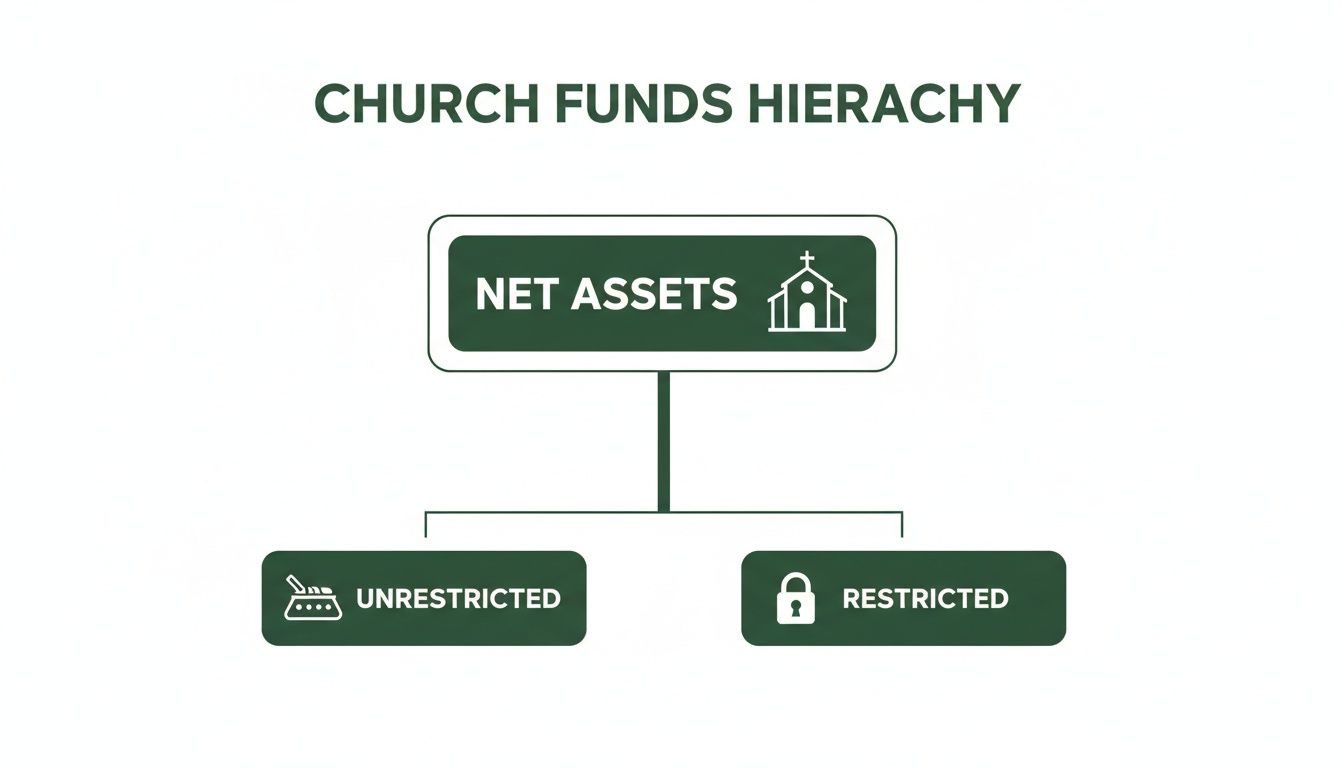
This structure is the heart of nonprofit stewardship. It visually separates the funds available for general ministry from those legally earmarked for specific purposes.
You’ll see two primary categories:
Net Assets Without Donor Restrictions: This is your operating fund. It’s the money from general tithes and offerings that can be used for any part of your ministry’s budget, from paying the light bill to buying coffee for fellowship hour.
Net Assets With Donor Restrictions: This is money that has strings attached—legally. When a donor gives money specifically for the youth mission trip, a building fund campaign, or a benevolence fund to help families in need, it must be tracked here.
Key Takeaway: A proper church balance sheet must clearly separate these two types of net assets. It's not just good accounting—it's an ethical and legal promise you make to your donors.
If you’re looking for a good starting point, we've put together a downloadable balance sheet example in XLS to help you structure your own report.
Trying to manage these restricted and unrestricted funds with spreadsheets is a recipe for disaster. This is why churches need a system built for fund accounting. A tool like Grain Ledger is designed around this very structure, automatically classifying every donation. This approach keeps you compliant, prevents the accidental commingling of funds, and ensures your balance sheet is always a trustworthy reflection of your stewardship.
How to Analyze Your Balance Sheet for Financial Health
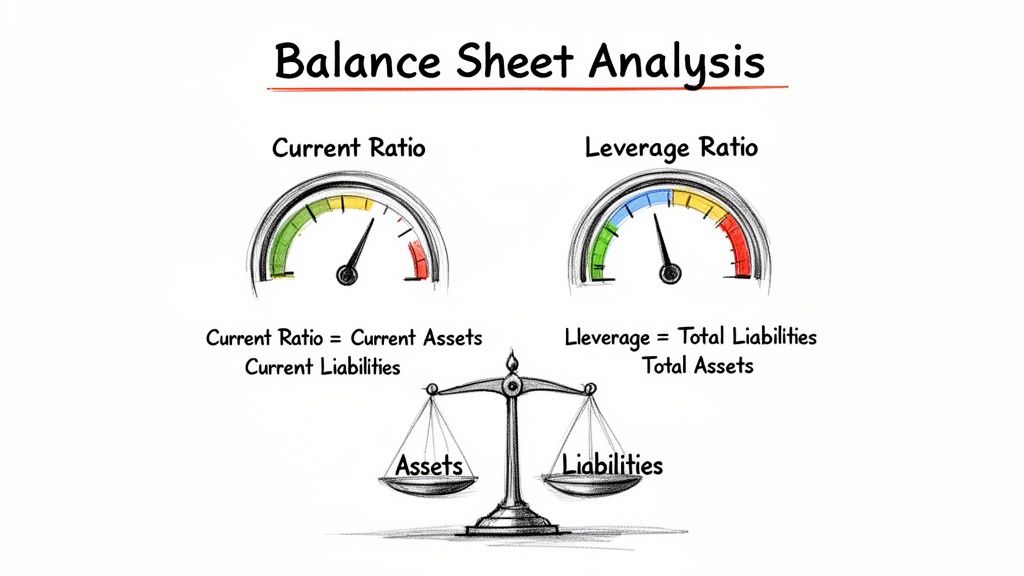
Putting together a balance sheet is just the first step. The real magic happens when you start asking questions of the numbers. By calculating a handful of key financial ratios, you can turn your balance sheet for non profit organizations from a simple snapshot into a powerful guide for future decisions. These metrics get right to the heart of your church’s stability and sustainability.
This is where your finance team moves beyond just reporting data and starts interpreting it. It's how your board can shift from reacting to financial surprises to proactively stewarding the resources you've been given. Let's dig into the most important ratios every church leader should know.
Gauging Short-Term Health with the Current Ratio
One of the most pressing questions for any organization is, "Can we pay our bills over the next year?" The Current Ratio gives you a straightforward answer. It’s a simple test of whether you have enough liquid assets on hand to cover your short-term obligations.
The formula is clean and simple:
Current Ratio = Current Assets / Current Liabilities
If your ratio is 1.0, you have exactly one dollar in liquid assets for every dollar of debt coming due soon. That might sound fine, but it leaves zero wiggle room for unexpected repairs or a dip in giving. A much healthier target for most nonprofits is a ratio between 1.2 and 2.0, which shows you have a comfortable cushion.
- Example Calculation:
- Current Assets (Cash, Pledges Receivable): $50,000
- Current Liabilities (Accounts Payable, Short-Term Loan Portion): $25,000
- Current Ratio = $50,000 / $25,000 = 2.0
A ratio of 2.0 is fantastic. It means this church has two dollars in readily available assets for every one dollar it owes in the near future. That’s a sign of excellent short-term financial health.
Assessing Long-Term Debt with the Leverage Ratio
While the Current Ratio looks at the immediate future, the Leverage Ratio (sometimes called the Debt-to-Asset Ratio) tells a story about your church's long-term sustainability. It measures how much your organization relies on borrowing by showing what percentage of your assets are financed by debt.
Here’s the formula:
Leverage Ratio = Total Liabilities / Total Assets
A lower number is almost always better here. It means the church owns its assets outright instead of owing money to creditors. A high leverage ratio can be risky, making it tougher to secure new loans for things like a building expansion or a major capital campaign.
- Example Calculation:
- Total Liabilities (Mortgage, All Loans): $300,000
- Total Assets (Building, Cash, Equipment): $1,000,000
- Leverage Ratio = $300,000 / $1,000,000 = 0.30 or 30%
This result means that debt finances 30% of the church's assets. Every organization's situation is different, but a ratio below 50% is generally seen as a healthy benchmark.
These ratios are more than just numbers on a page; they're vital for responsible stewardship. In the United States, the total assets held by nonprofit organizations climbed to a staggering $172.3 trillion by the third quarter of 2023. To manage these resources well, leaders must look at the balance sheet in context with other reports, like the statement of activities and cash flow statement. To see more on this national trend, you can review financial accounts data on the FRED website.
A single report never tells the whole story. To get a feel for how money actually moves through your ministry over time, it's a great idea to also read our guide on how to read a cash flow statement. Together, these tools provide the clarity you need to lead with wisdom and confidence.
Simplifying Your Church Accounting with Grain Ledger
We've walked through the ins and outs of nonprofit finance, and if there's one takeaway, it's this: managing a church's balance sheet properly demands the right tools. I've seen too many churches try to wrestle with generic business software or over-complicated spreadsheets, and it almost always leads to frustration, wasted hours, and even serious financial risk. That’s when you realize a purpose-built solution isn’t a luxury—it’s a necessity.
For churches, we point people toward Grain Ledger for a simple reason: it was built from day one with ministry finance in mind. It's not a business tool with a few nonprofit features tacked on. Instead, its entire DNA is structured around what we call true fund accounting, which is the key to solving the most common struggles church finance teams face.
The biggest challenge for nearly every church is keeping restricted and unrestricted funds separate. Manually tracking every designated gift in a spreadsheet is more than just tedious; it's a ticking time bomb. One wrong entry or a broken formula can cause you to co-mingle funds, which is a major violation of your donors' trust.
The Power of Automated Fund Accounting
This is where automation comes in, and it's what sets Grain Ledger apart. The software is designed to connect directly with the giving platforms your church already uses, like Planning Center or Pushpay.
This connection is the secret to a clean balance sheet for non profit organizations. When a member gives online, Grain Ledger automatically sees the designation—say, for the building fund—and routes it to the correct fund before a human ever has to touch it. The gift is logged correctly from the very start.
This automated workflow acts like a financial firewall. It makes it practically impossible to accidentally use restricted money for general operating costs. You can be confident that the Net Assets section of your balance sheet is always accurate and reflects the promises you've made to your donors. While we focus on US-based church needs here, other tools exist for different contexts; resources like this guide on a program contabilitate SAGA can shed light on managing financial records in other regions.
From Manual Chaos to Automated Clarity
Let’s put this in perspective. The difference between the old, manual way and the automated approach Grain Ledger offers is night and day for anyone handling the books.
The Spreadsheet Struggle:
- Manual Tracking: Every single designated gift—from the offering plate, online, or text-to-give—has to be entered and sorted by hand.
- High Risk of Error: This manual process is where mistakes happen. It’s far too easy to log a restricted gift as unrestricted, throwing your entire balance sheet off.
- Delayed Reporting: Pulling together an accurate report that breaks down your balances by fund can take hours, if not days. By the time you see the numbers, they're already out of date.
The Grain Ledger Advantage:
- Automated Designation: Donations are automatically pulled from your giving platform and sorted into the right fund in Grain Ledger. No manual data entry needed.
- Guaranteed Compliance: The system enforces the separation of funds, which means you can’t accidentally co-mingle money. This keeps you compliant and honors donor intent.
- Instant Reporting: Since every transaction is categorized correctly from the beginning, you can generate a precise, compliant balance sheet with just a click.
This isn’t just a small step up; it’s a complete transformation in how your church manages its finances. It frees your team from the grind of data entry and allows them to focus on what really matters: strategic financial stewardship. For any church that takes financial integrity seriously, moving to a true fund accounting system like Grain Ledger is one of the most important decisions you can make.
Common Pitfalls and Best Practices in Nonprofit Finance
Even churches with the purest intentions can run into financial trouble. It usually isn’t one big event, but a series of small, common mistakes that add up over time. A trustworthy balance sheet for non profit organizations isn't just about plugging in the right numbers; it's a reflection of the sound financial habits that keep your ministry healthy.
Let's look at the traps I see most often.
The biggest and most dangerous one is commingling funds. This is where money given for a specific purpose—like the youth mission trip or a building fund—gets mixed in with the general offering cash. It's rarely intentional. It happens when you’re trying to make spreadsheets or standard business software work for a church. But make no mistake, it's a major problem that can break donor trust and land you in hot water legally.
Another frequent oversight is neglecting physical assets. That church building, the ministry van, and the new sound system are all valuable assets. They belong on your balance sheet. When you fail to track their value and depreciation, you're working with an incomplete picture of your church's actual financial position.
Embracing Financial Best Practices
The good news is that for every common pitfall, there’s a straightforward best practice to keep you on track. These aren’t just stuffy accounting rules; they're the guardrails that protect your church’s mission and integrity. Think of them as moving your team from constantly putting out fires to proactively managing your finances.
A proactive financial stance, built on simple best practices, is the best defense against common errors. It ensures you’re stewarding every dollar well and making decisions based on reality, not guesswork.
Here are a few essential habits that can make a world of difference:
- Create a Formal Fund Release Policy: Don't leave it to guesswork. Document exactly how and when restricted funds are "released" to be spent on their designated purpose. This simple step creates a clear audit trail and honors your donors' intentions.
- Do a Regular Asset Inventory: At least once a year, walk through your facility and take stock of your major physical assets. Note their condition, update their depreciated value on the balance sheet, and double-check that they’re properly insured.
- Tell the Story Behind the Numbers: When you present to the board or congregation, don’t just hand them a spreadsheet. Use simple charts and plain language to explain what it all means. Focus on the key takeaways, like your cash reserves or debt levels, to build understanding and confidence.
Knowing When to Call in a Professional
While these practices will get you far, some situations call for an expert. The world of nonprofit finance has its own unique complexities. For navigating compliance and building truly robust financial systems, bringing in professional CPAs is a wise investment. They can conduct audits, provide critical tax advice, and help you establish internal controls that safeguard your ministry from risk.
Ultimately, the most effective way to avoid these pitfalls is to use a system designed for the job. This is where an accounting solution built specifically for churches becomes a game-changer. For example, a platform like Grain Ledger is built on a true fund accounting framework. From the moment a restricted donation comes in, it's automatically kept separate. That core function alone practically eliminates the risk of commingling funds, ensuring your balance sheet stays accurate and compliant without the manual headaches.
Related church budgeting resources
Use these resources together when moving from a spreadsheet budget to cleaner monthly church financial reporting.
- Free church budget generator - build a custom Excel budget template for your church
- Church budget template Excel guide - download and adapt a practical budget template
- Nonprofit budget examples - compare operating, program, and restricted-fund budget formats
- Grain Ledger budgeting - connect budgets to fund accounting and monthly reports
- Best church accounting software - compare fund accounting tools when the spreadsheet budget outgrows Excel
Frequently Asked Questions About Nonprofit Balance Sheets
Even after you get the hang of the basics, a few questions always seem to pop up when it comes to church finances. Let's tackle some of the most common ones we hear from ministry leaders to help clear things up.
How Often Should We Prepare a Balance Sheet?
We recommend preparing a balance sheet every single month. Anything less frequent, and you're flying blind.
This monthly check-in gives your finance team and board the timely information they need to watch over the church's financial health and spot trends. It helps you answer critical questions like, "Are our cash reserves getting too low?" long before it becomes a crisis.
While you'll look at them monthly internally, presenting a summary on a quarterly or annual basis is usually perfect for congregational meetings.
What Is the Difference Between a Balance Sheet and a Statement of Activities?
This is probably the most common point of confusion, but a simple analogy makes it clear.
The Balance Sheet is a snapshot. It’s a financial photo capturing what your church owns (Assets), what it owes (Liabilities), and its net worth (Net Assets) on one specific day.
The Statement of Activities, on the other hand, is like a video. It shows the financial action over a period, like a month or a full year. It tracks all the income and expenses to show whether you ended with a surplus or a deficit. You need both to get the complete financial story of your ministry.
Can We Use Restricted Funds for General Expenses?
No. The answer is always, unequivocally, no.
This is the most important rule in nonprofit accounting. When a donor gives money for a specific purpose—like the youth mission trip or the new building fund—using it for anything else is a serious violation of trust. It can even land your church in legal trouble.
If your general operating fund is running low, you have to find other solutions, like launching a special fundraising campaign. You can't just "borrow" from a restricted fund to cover payroll.
This is precisely why purpose-built software like Grain Ledger is so important. It creates a digital firewall around your restricted funds, making it impossible to accidentally spend them on the wrong thing.
Ready to bring clarity and integrity to your church's finances? Discover how Grain Ledger's true fund accounting system can automate your bookkeeping and provide instant, accurate reports. Schedule a Demo today!
Ready to simplify your church finances?
Start free with church fund accounting, or watch a product demo first.