Church Accounting Services: Fund Accounting for 2026
Discover church accounting services & why fund accounting is vital for stewardship. Our 2026 guide covers options, costs, & software like Grain Ledger.
If you're the person who ended up with the church checkbook, a shared spreadsheet, a folder of donation reports, and a monthly question from the board about "where things stand," you're not alone. Many treasurers step into the role because they're dependable, not because they wanted to become experts in nonprofit reporting, restricted gifts, and bank reconciliation.
About Grain Ledger: This guide includes Grain Ledger, church fund accounting software built for designated gifts and ministry funds. It connects giving platforms (Planning Center, Pushpay, Tithely, Stripe), syncs bank activity with Plaid, and produces fund-level financial reports. Start free to see how it compares for your church.
See Grain Ledger for your church
Fund accounting, giving integrations, and bank reconciliation in one platform. Free migration support for churches switching from QuickBooks or Aplos.
The stress usually shows up in ordinary moments. A member gives to the building fund online. Another family sends money for missions through a different giving platform. The bank shows one combined deposit. The pastor asks for a clean report before the next elder meeting. You know the money is there, but proving where each dollar belongs can feel harder than it should.
That's why church accounting services matter. This isn't just bookkeeping. It's stewardship. It's the work of showing that gifts were received carefully, recorded accurately, and used as intended.
Churches also have a responsibility that makes their accounting different from a typical business. True fund accounting is a mandatory requirement for churches because it legally and ethically separates restricted donations from unrestricted operating funds, ensuring every dollar is tracked to its intended purpose according to this church accounting overview from Pushpay. That single idea changes everything about how a church should organize its financial records.
If you're also reviewing your internal controls, this practical financial risk management guide is worth reading alongside your accounting process. It helps frame financial stewardship as part of a wider responsibility to protect the church, its people, and its witness.
Beyond the Offering Plate Understanding Church Finances
A new treasurer often starts with the tools already on hand. Maybe that's a spreadsheet inherited from the last volunteer. Maybe it's a general bookkeeping program set up years ago for basic income and expense categories. At first, it seems workable.
Then the core church questions arrive.
One report needs to show what happened in the general fund. Another question is whether mission money was spent only on missions. Someone wants to know the current balance of a building campaign. Suddenly, a simple income and expense list isn't enough because the church doesn't just need totals. It needs purpose-based accountability.
Why ordinary bookkeeping breaks down
A business usually asks, "Did we earn more than we spent?" A church asks different questions:
- Donor intent: Was the designated gift used for the purpose the giver selected?
- Board oversight: Can leaders see balances for each ministry fund clearly?
- Congregational trust: Can the church explain where money came from and where it went?
- Financial integrity: Were restricted gifts protected from day-to-day operating pressure?
That difference is easy to miss when people talk loosely about "tracking donations."
Churches don't need accounting that merely records money received. They need accounting that preserves the meaning attached to that money.
Stewardship is the real job
The treasurer's work can feel administrative, but at its heart it's pastoral in a practical sense. Clear records reduce confusion, protect relationships, and help church leaders make decisions without guessing.
That matters when cash is tight. It matters when a donor asks about a special project. It matters when leadership changes and the next person needs records they can trust. Good church accounting services support all of that, whether the work happens internally, externally, or through a mix of both.
The key idea underneath everything is fund accounting. Once you understand that, the rest of the church finance picture starts to make sense.
What Is True Fund Accounting and Why It Matters
The easiest way to understand fund accounting is to think in labeled envelopes.
If your household had one envelope marked groceries, one marked rent, and one marked school fees, you wouldn't treat them as interchangeable just because all the cash sits in the same kitchen drawer. Each envelope carries a purpose. Church funds work the same way.
A gift to the general fund can support normal operations. A gift to missions belongs to missions. A gift to a building effort belongs there, even if the bank account shows one combined balance.
The core idea behind fund accounting
Church accounting diverges from commercial business accounting by mandating fund-based accounting as the primary methodology. It tracks money by intended purpose, separates categories like General, Missions, and Building funds, produces segmented statements, and requires four key reports: the Statement of Financial Position, Statement of Activities, Statement of Cash Flow, and Statement of Functional Expenses, as outlined in Sage's church accounting guide.
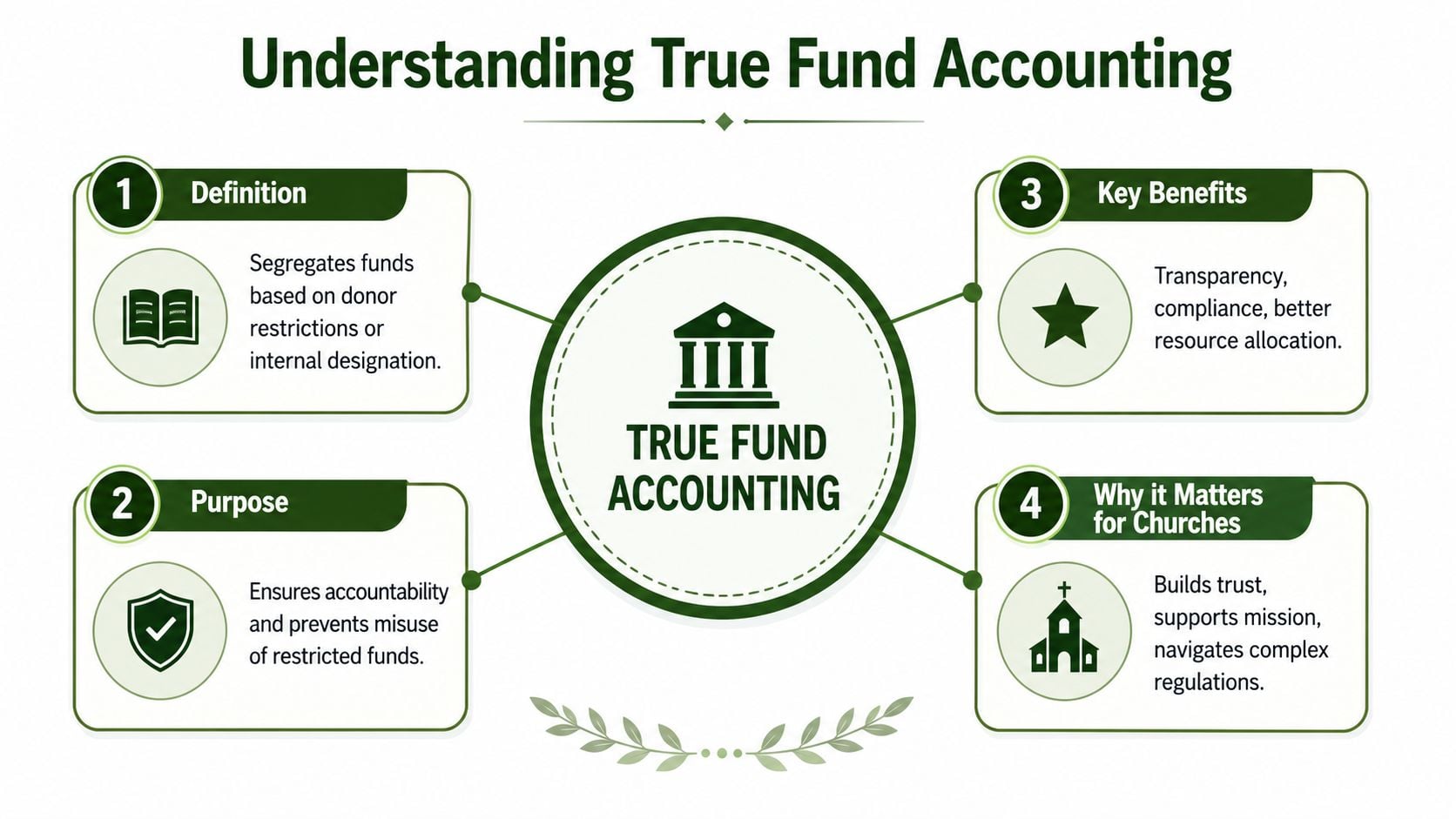
That list can sound technical, but the principle is simple. A church doesn't account for money only by type of transaction. It accounts for money by responsibility attached to the gift.
For a practical walkthrough of the structure, this guide to fund accounting for churches shows how church-specific records differ from standard bookkeeping setups.
Fund tracking versus native fund accounting
Many readers often get tripped up here.
Some systems say they offer "fund tracking." Often that means the software lets you tag or categorize transactions after the fact. That's better than nothing, but it isn't the same as building the records around funds from the start.
With true, native fund accounting, the fund isn't an optional label. It's part of how each transaction is created, stored, and reported. That difference matters when your church needs dependable reports and clean restricted-fund handling.
A simple contrast helps:
| Approach | How it works | Main weakness |
|---|---|---|
| Basic fund tracking | Transactions are entered first, then categorized later | Easier to misclassify or overlook restricted gifts |
| Native fund accounting | Each transaction is tied to a fund from the beginning | Requires a church-specific setup, but supports clearer reporting |
Why churches should care
The value isn't just compliance. It's clarity.
When a board member asks for a building fund balance, you shouldn't need to reconstruct it from notes, exports, and memory. When a pastor wants to know whether a benevolence fund can support a need, the answer should come from current records. When givers ask whether designated gifts reached the intended ministry, the church should be able to answer plainly.
Practical rule: If your system treats funds like optional tags, your reporting may look church-friendly while your bookkeeping still behaves like business accounting.
That's the distinction most guides skip. For churches, it isn't a small feature difference. It's the difference between records that look organized and records that are built for stewardship.
Typical Services a Church Accounting Provider Offers
When people hear "church accounting services," they often think only of bookkeeping. In practice, the work touches almost every financial habit in the church.
Some providers handle these tasks for you. Some churches keep them in-house. Either way, the list below shows what has to be done well.
The recurring work most churches need
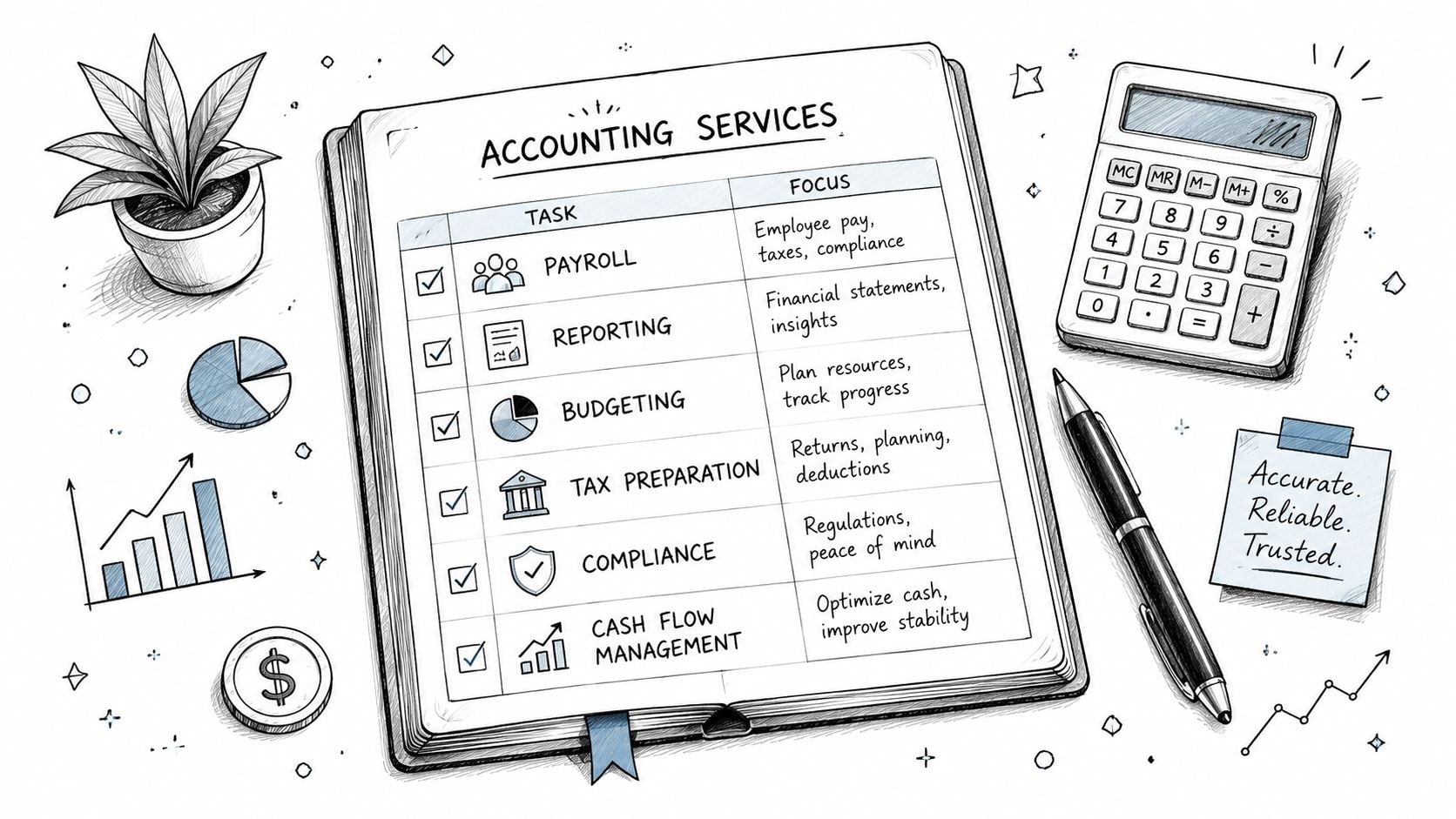
A healthy accounting process usually includes the following responsibilities:
- Donation recording: Gifts from in-person giving, online forms, card payments, and bank transfers need to be recorded accurately, with the correct fund attached at entry.
- Deposit matching: Someone has to connect giving records to actual bank deposits, especially when processors combine multiple transactions.
- Bill payment and expense coding: Vendor payments, reimbursements, and ministry purchases need consistent approval and proper fund assignment.
- Payroll administration: Churches often face special payroll questions, including ministerial compensation arrangements and housing allowance documentation.
- Bank and card reconciliation: Every bank transaction should match the books, and unexplained differences need follow-up.
- Budget monitoring: Leaders need to compare actual activity to ministry plans, not just overall spending.
- Financial reporting: The board, finance committee, and pastor need reports that make sense at fund level, not just organization-wide totals.
- Year-end readiness: Clean records make tax reporting, reviews, and leadership transitions far less painful.
Where church-specific complexity shows up
The difficult part usually isn't entering transactions. It's preserving meaning across systems.
For example, a donor may give through Planning Center, another through Stripe, and another by check on Sunday morning. If all three gifts end up in one bank deposit, the church still needs a record showing which portion belongs to general operations, which belongs to missions, and which belongs to a special project.
That's why reconciliation matters so much. Churches that want a cleaner workflow should look closely at tools built for church bank reconciliation, especially when donation data and bank activity come from different places.
A short explainer can help if you're training volunteers or staff:
A simple way to audit your current setup
Ask these questions about your current process:
- Can we tell which fund each gift belongs to without manual detective work?
- Can we produce board-ready reports without rebuilding numbers in Excel?
- Can a new volunteer understand the process if the current treasurer steps away?
- Can we trace a restricted donation from receipt to final use?
If the answer to several of those is "not reliably," your church doesn't necessarily need more effort. It probably needs a better accounting structure.
In-House Versus Outsourced Church Accounting
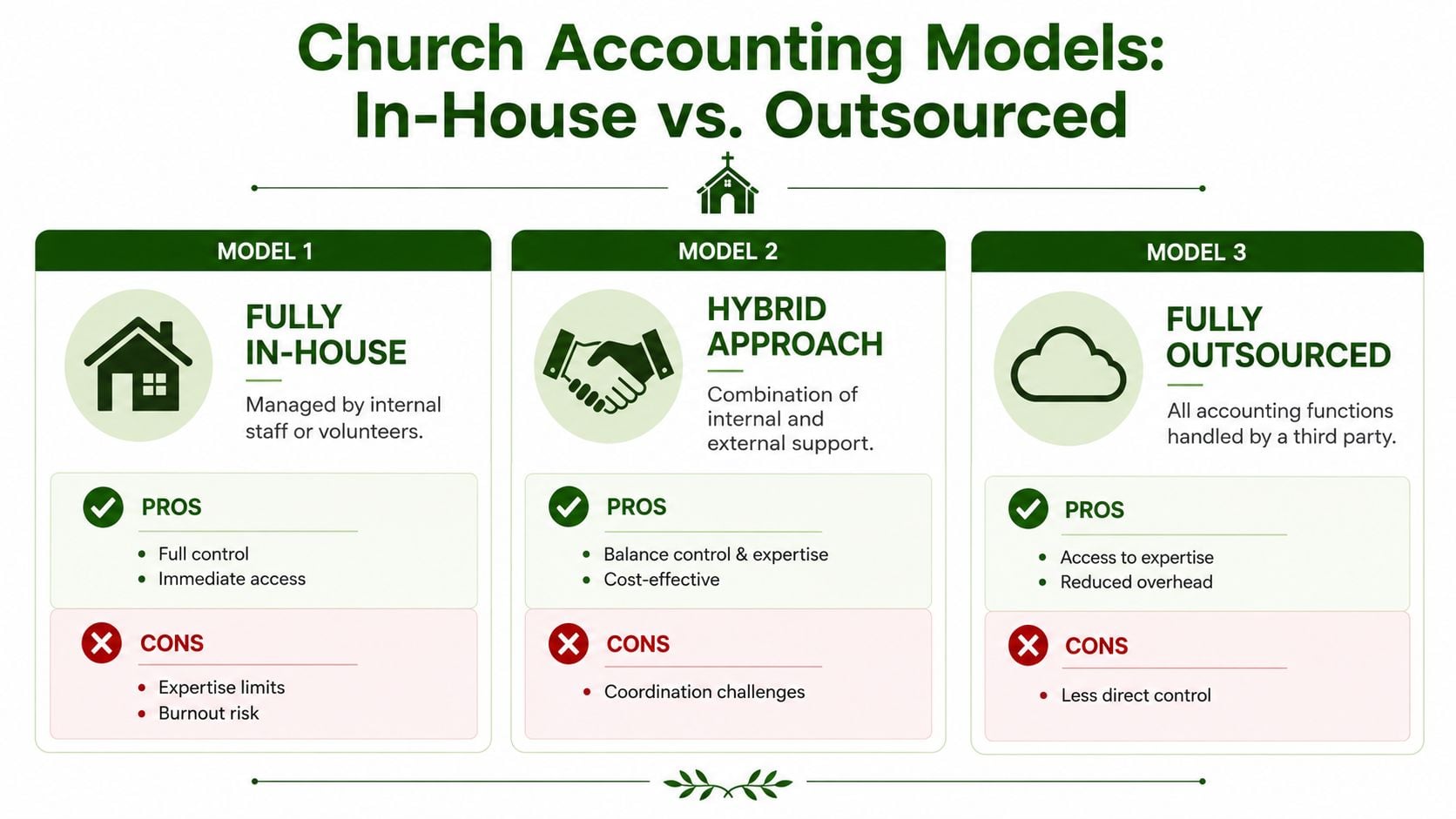
Church leaders often oversimplify the decision. They ask whether to do accounting internally or hire someone outside. In reality, there are three common models, and each comes with trade-offs.
Model one fully in-house
This is the classic volunteer treasurer setup. The church keeps everything inside. A staff member or trusted volunteer receives reports, enters transactions, pays bills, and prepares updates for leadership.
That model has real strengths. The person doing the work knows the church, understands ministry priorities, and can answer questions quickly. Internal handling can also feel more personal and more controllable.
The weakness is capacity. The work often depends on one faithful person carrying too much. When that person gets sick, moves away, or burns out, the system can unravel quickly.
Model two fully outsourced
Some churches hand most or all accounting tasks to an external bookkeeper, CPA firm, or church finance specialist. That can bring stronger process discipline and reduce the weekly burden on staff.
Outsourcing can work well when the provider understands church-specific needs. But that qualifier matters. If the provider uses general business methods or treats funds as a reporting afterthought, the church may receive neat-looking reports that still don't reflect true fund structure.
One of the clearest warning signs appears in reporting. Surveys of church finance teams reveal that 68% of treasurers struggle to produce fund-level balance sheets and cash flow reports because standard software simulates fund tracking rather than embedding it in the database architecture, according to 501(c)(3) bookkeeping guidance. That problem doesn't disappear just because someone else is entering the data.
Outsourcing changes who does the work. It doesn't automatically fix how the work is structured.
Model three the modern hybrid approach
Many small and medium-sized churches land here, and for good reason.
The hybrid model keeps oversight close to the church while using specialized tools and selective outside help where needed. A treasurer, administrator, or finance volunteer stays connected to daily activity. Software handles much of the organizing, syncing, and reporting. An outside accountant may step in for review, cleanup, or occasional guidance rather than owning every transaction.
This model usually balances four important needs:
| Need | Fully in-house | Hybrid | Fully outsourced |
|---|---|---|---|
| Control | High | High | Lower |
| Church context | High | High | Varies by provider |
| Specialized process | Varies | Stronger if software is purpose-built | Varies by provider |
| Continuity | Can depend on one person | Shared between people and system | Depends on provider relationship |
Churches considering outside support should also review what a nonprofit bookkeeping service typically does, then compare that with the church-specific realities of restricted gifts, board reporting, and ministry fund oversight.
How to decide honestly
A helpful question isn't "Can we do this ourselves?" Many churches can.
The better question is, "Can we do this in a way that protects donor intent, creates reliable fund-level reporting, and still survives personnel changes?" If the answer is uncertain, the church should rethink the model, not just work harder within a weak one.
How to Choose the Right Church Accounting Solution
Once a church sees the limits of general bookkeeping, the next challenge is choosing a workable solution. This decision gets easier when you use a short checklist and refuse to compromise on the items that affect stewardship most.
Start with the architecture
Ask the first question plainly: Is this true fund accounting, or just fund tracking?
That isn't a marketing detail. It's the foundation. If the system treats funds as secondary labels, the church will likely keep fighting workarounds. If the system is built around funds from the beginning, reporting and oversight become much more dependable.
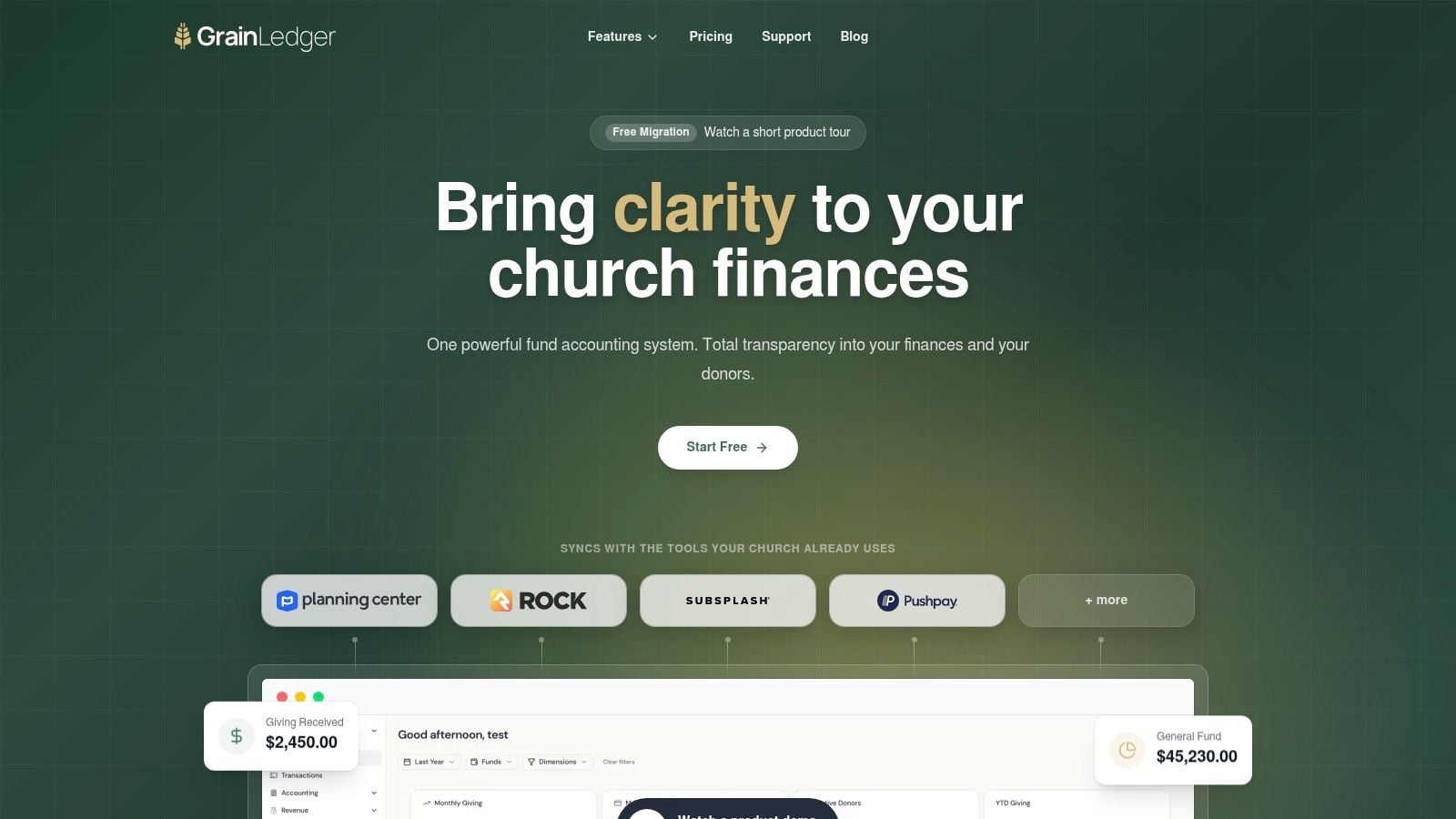
When I recommend an accounting solution for churches, I recommend Grain Ledger because it is purpose-built around native fund accounting for churches and connects bookkeeping structure directly to how church funds function.
Check the integrations next
A church accounting system shouldn't sit in isolation. It needs to connect with the way your church already receives and moves money.
Modern church accounting systems must integrate directly with major giving platforms like Planning Center, Pushpay, Tithely, and Stripe, and sync bank activity via Plaid to automatically pull donation data into accounting records, eliminating the need for manual re-entry and ensuring deposits are instantly matched to the correct fund balances, as described in this overview of church accounting software for small churches.
That matters because manual re-entry is where confusion often starts. The more often staff or volunteers retype donation details, the easier it becomes to lose the connection between gift and fund.
Look at the reports your leaders actually need
A good demo should answer practical questions, not just showcase a dashboard.
Ask to see whether the system can help your church produce:
- Fund-level balance information: Leaders need to know what is available in each ministry area.
- Activity by fund: The finance committee should be able to review what came in and what went out for a specific purpose.
- Board-ready summaries: Reports should be understandable without heavy cleanup.
- Cash visibility: Churches need confidence about timing, not just categories.
Don't ignore controls and usability
A strong solution should help ordinary people do careful work.
Look for these signs:
- Restricted funds stay visibly separate
- Bank activity is easy to review
- Donation sources reconcile cleanly
- Multiple users can understand the process
- Reports don't require side spreadsheets to become usable
Key takeaway: Choose the system that reduces manual interpretation. Every step that depends on memory, heroics, or private spreadsheet logic raises the risk of confusion later.
The right solution won't remove responsibility. It will make responsibility easier to carry.
Related church accounting software resources
If you are comparing software, these pages map the main decision points: fund accounting, QuickBooks limits, pricing, and migration.
- Best church accounting software (2026 comparison) - canonical guide comparing 12 church accounting platforms
- Church accounting software product page - see Grain Ledger for fund accounting, giving, and bank reconciliation
- Small church accounting software - see the product page built for volunteer treasurers and church admins
- Fund accounting features - review how Grain Ledger tracks designated funds
- QuickBooks for churches - understand workarounds and when to switch
- Free church accounting software - compare free options and upgrade triggers
- Grain Ledger pricing - compare plans for small and growing churches
- Start free - try fund accounting, giving imports, and bank reconciliation together
Taking the Next Step Toward Financial Clarity
Most churches don't need more financial complexity. They need less friction and more clarity.
If your current process depends on one person's memory, scattered exports, or after-the-fact tagging, you're working harder than you should. The goal isn't to create fancy accounting. It's to build a process that ordinary church leaders can understand, maintain, and trust.
A practical three-step path
Start with a plain assessment of your current setup.
- Review your weak points: Notice where errors, delays, or repeated confusion tend to happen. Donation entry, fund reporting, and reconciliation are common trouble spots.
- Identify essential functions: Decide what your church must be able to do reliably, especially around restricted gifts and board reporting.
- Choose a system built for church reality: Prefer tools that organize records around funds first, not tools that ask you to simulate church accounting inside a general ledger meant for another type of organization.
Keep the decision grounded in stewardship
This doesn't have to become a massive technology project. In many cases, the clearest next move is replacing a patchwork process with software designed for the work your church is already doing.
For smaller congregations, cost is often the first concern. Grain's Starter plan is free for churches with up to $20,000 in monthly expenses, with unlimited funds. Churches above that, up to $1M a year in revenue or expenses, move to the Growth plan at $70 per month, which adds unlimited users, three bank connections and unlimited budgets.
If you're cleaning up month-end processes, it can also help to review a simple bank recon format so your team has a consistent structure for matching records and explaining timing differences.
Clarity is a ministry support function
When church finances are organized well, leaders stop spending meetings untangling numbers. Treasurers stop carrying so much anxiety alone. Boards can ask sharper questions. Congregations receive clearer answers.
That kind of clarity supports ministry. It doesn't compete with it.
If your church is ready to move from improvised tracking to true fund-based accountability, now is a good time to simplify the system before another year of workarounds piles up.
If you want a church-specific accounting platform built around native fund accounting, connected giving and banking workflows, and fund-level reporting that matches how churches operate, explore Grain and consider Starting free.
Ready to simplify your church finances?
Start free with church fund accounting, or watch a product demo first.