A Practical Guide to Your Church Extension Plan
 By Gibson Brueher, Founder of Grain Ledger
Discover how to build a successful church extension plan. This guide offers practical advice on vision casting, budgeting, fundraising, and project management.
A church extension plan is your ministry’s roadmap for growth. Think of it as the detailed blueprint that takes you from the abstract idea of "we need more space" to a concrete, actionable plan for expanding your physical footprint and, more importantly, your ministry's reach.
This foundational document is what unites your team, ensures good stewardship, and provides a clear path forward for the entire journey.
Building a Unified Vision for Your Church Extension
Every successful building project I've ever seen started not with blueprints or budgets, but with a unified vision. Before you even think about raising the first dollar or knocking down a wall, your leadership and congregation absolutely must be aligned on the why behind the expansion.
This is about more than just adding square footage. It’s a moment to prayerfully ask how this new space will directly amplify your core mission. Is the goal a bigger children’s ministry wing, a larger worship center, or a dedicated space for community outreach? Answering that question is what gives the project its true purpose.
From Idea to Actionable Mission
So, how do you get from a vague idea to a well-defined mission? It starts with a structured approach. The first practical step is to form a dedicated building committee. You'll want to pull in members with a diverse set of skills—people from finance, construction, project management, and, of course, spiritual leadership. This team becomes the engine driving the entire church extension plan.
Their first big task? A feasibility study. This is a non-negotiable step that dives into a few critical areas:
- Congregational Readiness: Is there genuine excitement and support for this project among your members?
- Community Needs: Does the expansion you're envisioning meet a real, identifiable need in your local community?
- Financial Capacity: Can the congregation realistically support the financial scope of what you're proposing?
To get your committee started, it's helpful to work through some foundational questions. This checklist can help your leadership team clarify the project's purpose right from the beginning.
Initial Project Scoping Checklist
| Area of Focus | Key Questions to Consider | Example Answers |
|---|---|---|
| Ministry Purpose | What specific ministry goal will this extension accomplish? Why now? | "Our children's ministry has grown 40% in two years, and we're turning families away due to a lack of secure, age-appropriate space." |
| Congregation Impact | How will this project directly benefit our current members and future attendees? | "It will provide a dedicated youth room, allowing us to launch a midweek program and create a more welcoming environment for teens." |
| Community Outreach | How will the new space serve our broader community beyond Sunday services? | "We plan to offer the new multipurpose hall for local support groups, community meetings, and as an emergency weather shelter." |
| Core Functions | What are the non-negotiable features? What's on the 'wish list'? | "We must have 4 new classrooms and ADA-compliant restrooms. We would like to have a small coffee bar and an updated sound system." |
Answering these questions honestly as a team will prevent scope creep and ensure everyone is pulling in the same direction from day one.
This simple flow chart captures the essence of this initial process—moving from a high-level vision to a grounded, well-researched plan.
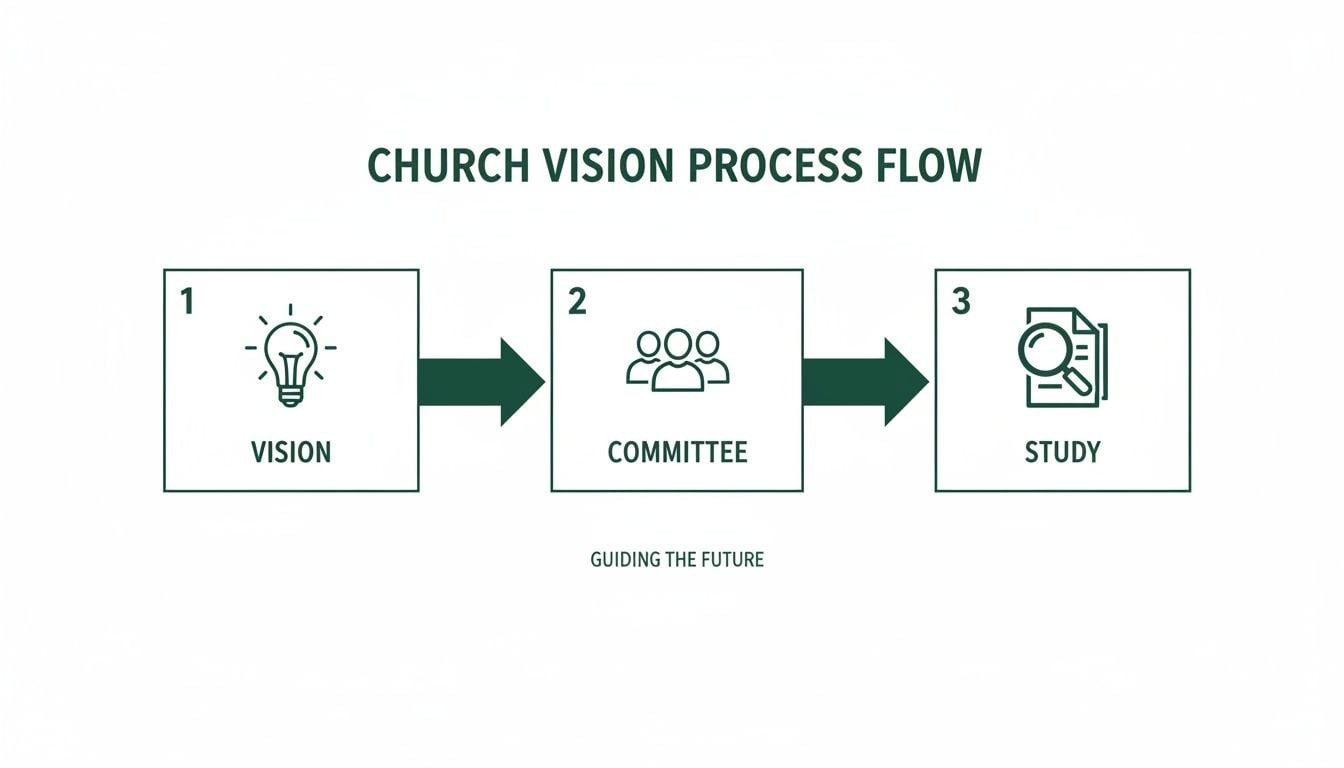
Following this path, from casting the vision to forming a committee and conducting the study, ensures every decision is backed by both prayerful consideration and practical data.
The Importance of a Structured Plan
This disciplined, plan-first approach isn't some new-fangled idea; it has deep historical roots. Take the Lutheran Church Extension Fund (LCEF), for example. It launched back in 1902 with just $400 to help build a single school.
By the 1960s, loan requests had exploded. In one instance, they faced $30,000 in demand with only $12,000 available—a stark reminder of the funding gaps that can derail ministry growth. This history really drives home the critical need for a solid plan and a dedicated fund to manage your project's finances from the very beginning. You can discover more insights about this pioneering extension fund history and the valuable lessons it holds for churches today.
A church extension plan is more than a project; it's an act of faith that requires diligent stewardship. Unifying your congregation around a clear, God-honoring purpose creates an unstoppable momentum that will carry you through every challenge ahead.
Creating Your Financial Blueprint and Building Fund
Once you have a clear, unified vision for your church extension, it's time to ground that vision in reality. This is where you create the financial blueprint—the budget. I've seen many church leaders treat this as a simple spreadsheet exercise, but it's so much more. A well-thought-out budget is an act of stewardship, honoring every single dollar your congregation gives toward this dream. It's the moment your project moves from a hopeful idea to a tangible, achievable plan.
This all begins with getting real about the costs. It's easy to fixate on the big construction number, but a truly realistic budget anticipates everything. You have to think beyond the obvious costs of labor and materials and dig into the "soft costs" that often catch churches by surprise.
Uncovering the Hidden Costs
From my experience, a comprehensive budget for a church extension needs to cover several categories that are easy to forget in the early excitement. For instance, those architectural and engineering fees can easily account for 10-15% of your total construction cost right off the bat.
Don't forget to budget for these other essentials:
- Permitting and Legal Fees: Navigating local zoning laws and building codes always comes with its own set of administrative costs.
- Site Work and Landscaping: Getting the land ready and finishing the exterior is a significant line item you can't ignore.
- Technology Infrastructure: What about the new sound system? Cameras for streaming? All that network cabling? It adds up.
- Furnishings and Equipment: Chairs, tables, and specific ministry gear all need to be part of the plan from day one.
- Contingency Fund: This is non-negotiable. Always, always set aside 5-10% of the total project cost for the unexpected. This isn't a sign of bad planning; it's a mark of wisdom.
A project budget that only accounts for the construction bid is incomplete. A responsible financial blueprint anticipates every expense, from architectural drawings to the final coat of paint, ensuring there are no financial surprises down the road.
With a realistic budget in hand, the next move is to establish a dedicated building fund. This isn’t just a new category in your general budget; it must be a restricted fund with its own financial integrity. For the sake of accountability and transparency, this is where a true fund accounting system becomes absolutely essential.
The Power of a Dedicated Building Fund
A dedicated building fund gives your congregation confidence. It guarantees that every donation given specifically for the extension project is used for that purpose and nothing else. This is where an accounting solution designed for churches, like Grain Ledger, proves its worth.
Grain Ledger lets you create a truly restricted fund right within its native fund architecture. When a donation comes in—whether online or in the offering plate—you can tag it for the building fund automatically. This simple step prevents the accidental commingling of funds and gives your finance team and board a real-time view of the campaign's progress.
This kind of organized accounting is what enables large-scale growth. Just look at The Church of Jesus Christ of Latter-day Saints, which in 2021 grew to over 16.8 million members and 31,315 congregations. That level of expansion is only possible with a rock-solid church extension plan. Imagine the power of channeling tithes directly into specific funds for new buildings, knowing every dollar supports growth without any mismanagement. You can see the church growth statistics for yourself to understand how powerful organized fund management can be.
This approach turns your budget from a static document into a dynamic tool for stewardship. To get a clearer picture of how this project's capital budget differs from your church's regular spending, take a look at our guide on the differences between a capital budget and an operating budget.
Rallying Your Congregation: The Capital Campaign
Great blueprints are just the beginning. The real fuel for your church extension project comes from the hearts and generosity of your congregation. To turn your financial plan into a fully funded reality, you’ll need to launch a compelling capital campaign. This isn't just another Sunday appeal—it's a focused, multi-year effort to unite everyone around a shared vision.
The cornerstone of any strong campaign is a vision that people can connect with emotionally. Your members need to see and feel the why behind the building. Tell the stories of the lives you expect to change—the kids who will finally have a safe space to learn, the youth who will build lifelong friendships, the new families you’ll be able to welcome. Consider using different pledge models, like three-year commitments, to help families give intentionally and sustainably.
Honoring Donors and Managing Restrictions
Every single gift, no matter the size, represents a sacrifice and an act of worship. It's so important to honor that. Personal follow-ups, heartfelt thank-you notes, and regular updates on the campaign’s progress are non-negotiable for keeping momentum and showing people they're valued. This creates a culture of generosity that will bless your church long after the last brick is laid.
As you plan, look into various easy ideas for fundraising to get the whole community involved. But this is also where we need to talk about a critical, often-overlooked detail: donor restrictions.
When a member gives to the "building fund," that money is ethically and legally bound to that specific purpose. Maintaining this trust is non-negotiable for the financial health and integrity of your church.
This isn’t just good practice; it's a legal requirement. Mixing restricted funds with your general operating budget is one of the quickest ways to break congregational trust and create an accounting nightmare. To avoid this, you need an accounting system that’s actually built for the unique way churches handle money.
The Right Tool for Maintaining Trust
This is where having a tool like Grain Ledger really pays off. Unlike generic business software that you have to bend and twist to your needs, Grain Ledger is built on a native fund architecture designed specifically for churches. It makes managing restricted donations for something like a building project simple and secure.
Here’s how it helps you maintain financial integrity:
- Automatic Allocation: Grain Ledger talks directly to the giving platforms you're likely already using, like Pushpay or Planning Center. When a donation comes in for the building fund, it's automatically routed into that designated fund—no manual sorting required.
- Prevents Commingling: Because the funds are separated from the very start, there’s no risk of accidentally using building money to pay the light bill or cover other operational costs. It’s a built-in safeguard.
- Clear Reporting: In just a few clicks, your treasurer can run a clean, accurate report on the building fund. This gives your board and congregation the transparency they deserve, showing exactly where every dollar came from and where it went.
Using the right tool ensures every gift is stewarded with integrity, reinforcing the trust that’s so foundational to a successful capital campaign. For a deeper dive, you can learn more about fundraising for churches and how to inspire generosity effectively.
Navigating Construction and Project Management
This is where the blueprints and spreadsheets finally give way to dirt, concrete, and steel. All the prayerful planning is about to become a tangible space for ministry. It's an incredibly exciting season, but it's also one that demands constant, careful oversight to keep everything on schedule and, most importantly, on budget.
Your first real move on the ground is to assemble the right team. You're not just hiring an architect and a general contractor; you're choosing partners for a significant chapter in your church's life. Don't just flip through their portfolios. Call their references—especially other churches they've built for. You're looking for a firm that gets the unique rhythm of ministry, including how churches make decisions. That understanding is worth its weight in gold.
When the bids from contractors come in, resist the urge to immediately grab the lowest one. A bid that looks too good to be true almost always is. Lay them out side-by-side and make sure you're comparing apples to apples. A contractor who lowballs an initial offer can easily make up the difference (and then some) with a mountain of expensive change orders down the road.
Establishing Timelines and Milestones
Once your team is in place, you’ll work with them to hammer out a realistic project timeline. A solid timeline is more than just a projected finish date; it’s a roadmap dotted with clear milestones for every major phase. These checkpoints are how your building committee will track real progress and keep everyone accountable.
Think about milestones like these:
- Permit Approval: The day you officially get the green light from the city or county. This can be a major hurdle, so it's wise to build some extra time into the schedule here.
- Foundation Poured: This is a huge moment—the first tangible sign of progress. It's a fantastic milestone to celebrate with the congregation!
- Building Framed and Enclosed: Getting the structure "dried in" means it’s protected from the weather, which allows the interior work to really take off.
- Major Systems Installed: This marks the completion of the big three: HVAC, electrical, and plumbing rough-ins.
Nothing keeps a project on track like regular, honest communication. Set up a standing meeting with your building committee, architect, and contractor. These meetings are your chance to see what’s been done, get ahead of potential issues, and make sure the work quality is what you expect.
A well-managed project is built on a foundation of clear communication and proactive problem-solving. It's the difference between building with confidence and simply reacting to one crisis after another.
Managing Changes and Maintaining Financial Control
Let’s be realistic: every construction project has its surprises. The key is having a plan for them. Your committee needs to understand the construction change order process inside and out, because it will come up. Every single change, no matter how small, has to be documented and formally approved, with a clear-eyed view of how it will affect the budget and the timeline.
This is where your financial stewardship really gets tested. It might seem like a local concern, but it mirrors a global reality. The incredible growth of Global Christianity between 1970 and 2020 was fueled by countless successful church extension projects just like yours. For a small-to-medium church to thrive today, that kind of vision requires absolute precision in its accounting.
An accounting system like Grain Ledger can provide that control. It ensures every dollar designated for the building project—whether it comes in from a Plaid-linked bank transfer or a Stripe donation—is locked into the restricted building fund. This gives your treasurer and board the real-time cash flow reports they need to manage a large-scale project with confidence. You can learn more about these global Christianity statistics and see how they highlight the critical need for this level of financial integrity.
Keeping a Close Eye on Finances with Diligent Tracking
Financial integrity during a major building project is one of the most powerful ways your church can demonstrate good stewardship. As construction gets underway, keeping a real-time pulse on your budget isn't just a smart financial move—it’s an act of worship and accountability. This is where diligent tracking becomes less of a chore and more of a discipline, ensuring every single dollar given in faith is honored.
The secret to solid financial oversight is a system that gives you instant clarity. Your treasurer shouldn't have to spend hours buried in complex spreadsheets just to answer a simple question: "How are we tracking against the budget?" This is precisely why having the right accounting tool is so vital for a church extension plan.
Real-Time Budget Tracking
An effective tracking system lets you run reports comparing what you planned to spend versus what you've actually spent at any given moment. This empowers your building committee and leadership to make quick, informed decisions, spot potential overages before they become major problems, and share progress with the congregation with total confidence.
For example, using a purpose-built church accounting platform like Grain Ledger allows you to pull an activity report on your restricted building fund anytime. That report will show every donation that has come in and every expense that has gone out, creating a perfect, unbroken financial story. You'll never have to guess where the money went or how much is left. This level of detail provides a clear definition of an audit trail and protects your church's integrity.
Your most powerful tool during this phase will be a simple "Budget vs. Actual" report. Here’s a look at what that report might show, giving your treasurer a great template for providing regular, easy-to-understand updates.
Sample Extension Project Budget vs Actual Report
This table shows at a glance how expenses are stacking up against your initial budget. A positive variance means you've spent less than planned, while a negative one means you've gone over.
| Expense Category | Budgeted Amount | Actual Spent | Variance |
|---|---|---|---|
| Architectural & Engineering Fees | $75,000 | $72,500 | +$2,500 |
| Permits & Legal | $15,000 | $16,200 | -$1,200 |
| Site Preparation | $50,000 | $48,000 | +$2,000 |
| Construction (GC Contract) | $850,000 | $850,000 | $0 |
| HVAC, Electrical, Plumbing | $250,000 | $265,000 | -$15,000 |
| Furnishings & A/V Equipment | $100,000 | $95,000 | +$5,000 |
| Contingency Fund | $134,000 | $35,000 | +$99,000 |
This kind of report helps keep financial discussions grounded in facts, not feelings. You can immediately see that while the HVAC and electrical work came in $15,000 over budget, savings in other areas and a healthy contingency fund have kept the project on solid financial footing overall.
The final act of financial stewardship is a transparent reconciliation. This isn't just about closing the books; it's about closing the loop of trust with your congregation and celebrating God's faithfulness.
Post-Project Reconciliation and Close-Out
Once the dust has settled and the final nail has been hammered, it’s time to formally reconcile and close out the building fund. This is a crucial act of transparency that honors the trust your members have placed in the church's leadership.
This final process really comes down to three key actions:
- Conduct a Final Audit: The treasurer and finance committee should comb through every expense, matching them to the final budget. This ensures all invoices are paid and every transaction is perfectly accounted for.
- Prepare a Comprehensive Report: Put together a final summary report for the congregation. This is your chance to celebrate the project's completion, detail the final costs, and show everyone how their generous giving brought the vision to life.
- Formally Close the Fund: After sharing the final report and getting the board's approval, the building fund can be officially closed in your accounting system. This marks the successful and faithful completion of your church extension plan.
Common Questions About Church Extension Plans
Anytime you start talking about a major building project, you can bet questions will start flying—from the board, from your key volunteers, and from the congregation on Sunday morning. Getting ahead of these common questions with clear, honest answers is one of the most important things you can do to keep everyone united and moving forward together. Let's walk through some of the big ones you're likely to hear.
How Do We Know If Our Church Is Ready for an Extension?
This is the big one, and the answer goes far beyond what's in the bank account. True readiness is a mix of spiritual momentum and practical need. You're probably feeling it already—services are consistently packed, the children's ministry is bursting at the seams, and you've got a strong core of volunteers. These are great signs.
But to really know for sure, you need to move from "feeling" to "fact." This is where a formal feasibility study comes in. It’s an invaluable step that gives you hard data on how your congregation truly feels about the project and what the potential for a capital campaign really looks like. It validates your gut feeling with concrete numbers.
A feeling of being 'too full' is often the first sign, but true readiness is confirmed when the congregation is unified and excited about the ministry opportunities a new space will create, not just the space itself.
What Is the Difference Between a Capital Campaign and Our Regular Budget?
It's absolutely vital that everyone understands this distinction to avoid confusion. Think of it this way: your regular operating budget is what keeps the lights on and the ministry running week after week. It covers all the predictable, ongoing costs like salaries, utilities, curriculum, and basic maintenance.
A capital campaign, however, is a completely separate fundraising initiative. It's an intense, focused effort over a set period—usually around three years—to raise a specific amount of money for a specific, large-scale project like your new building.
Because these funds are raised for one purpose, they are legally restricted. They can't just be mixed in with the general fund. This is exactly why you need a dedicated building fund set up in a proper church accounting system like Grain Ledger from day one.
How Much Should We Expect to Spend on Architectural and Soft Costs?
Here’s a classic mistake we see churches make: they get a bid from a contractor and think that's the total cost. But there's a whole category of expenses called soft costs, and they can be significant. These are all the things that have to happen before a single nail is hammered, like architectural drawings, engineering studies, permit fees, and legal reviews.
As a rule of thumb, you should plan for these soft costs to be 10-20% of your total project budget.
So, on a $1 million construction project, you need to budget an extra $100,000 to $200,000 just for these preliminary items. Factoring this in from the very beginning is the key to preventing a major budget crisis down the road.
What Happens If We Have Money Left Over in the Building Fund?
This is a great question, and the only right answer is total transparency. Before you even ask for the first dollar, your church leadership needs to have a clear, pre-approved policy for what happens to any surplus funds.
There are a few responsible ways to handle this:
- Seed a future maintenance fund for the new building (a very wise move!).
- Pay down any project-related debt faster.
- Apply the funds to the next phase of your master plan, if you have one.
Honestly, which option you choose is less important than the fact that you decided on it and communicated it upfront. Doing so preserves the trust you’ve worked so hard to build. This is another area where a tool like Grain Ledger is a lifesaver. Its fund accounting structure is built to handle designated funds, making it simple to track every dollar and provide transparent reports when the project is done.
Managing the finances of a church extension plan requires precision and integrity. Grain Ledger provides true fund accounting software built for churches, ensuring every donation for your building project is tracked with complete transparency. Start building with confidence by joining the Grain waitlist today.
Ready to simplify your church finances?
Start free with church fund accounting, or watch a product demo first.