
Your Guide to Modern Church Finance Management
A complete guide to church finance management. Learn to build trust and fuel your ministry with fund accounting, budgeting, and clear financial reporting.
Let's be honest—managing a church's finances is so much more than just balancing a checkbook or paying the bills. When handled well, it’s the engine that powers your ministry. Solid church finance management builds trust with your congregation and ensures every dollar given is used with integrity and purpose. It's what turns your vision into reality, creating the stability you need to serve your community and grow.
About Grain Ledger: This guide includes Grain Ledger, church fund accounting software built for designated gifts and ministry funds. It connects giving platforms (Planning Center, Pushpay, Tithely, Stripe), syncs bank activity with Plaid, and produces fund-level financial reports. Schedule a demo to see how it compares for your church.
See Grain Ledger for your church
Fund accounting, giving integrations, and bank reconciliation in one platform. Free migration support for churches switching from QuickBooks or Aplos.
Why Church Finance Management Is a Core Ministry Function
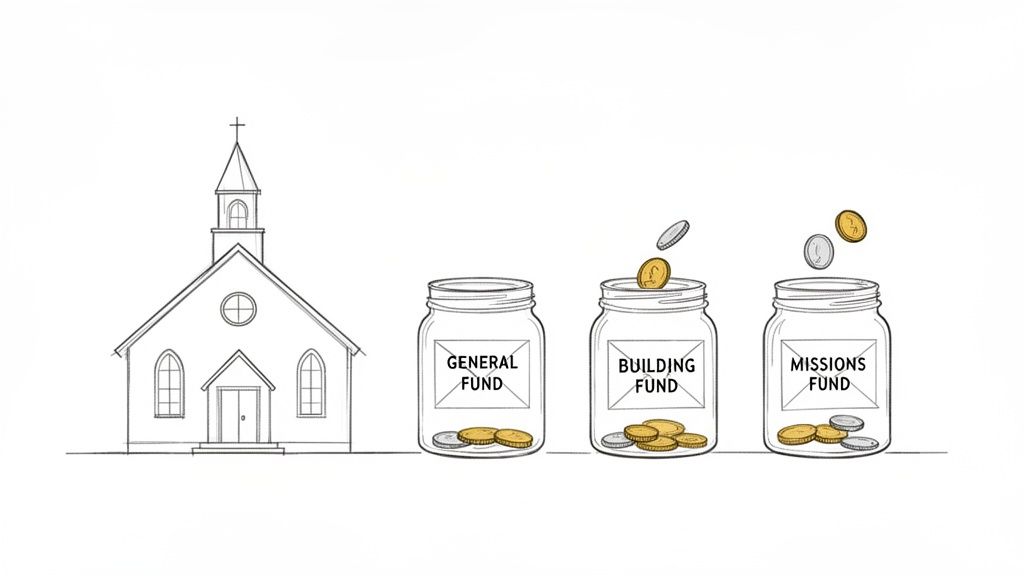
Think about your church’s money like you would a household budget, but with a crucial twist. Instead of having one big pot of money, you're actually managing several different "jars," each with a specific purpose designated by the person who gave the gift.
One jar might be for your general operating costs, another for the new building project, and a third dedicated entirely to missions. Here's the key: you simply can't dip into the missions jar to pay the electric bill. This is the fundamental difference between standard business accounting and the specialized approach churches need.
This method, known as fund accounting, is the bedrock of transparent and accountable church finance management. It’s how you honor your donors' intentions, which is absolutely essential for building the trust that inspires continued generosity.
To help you grasp the key areas we'll be covering, this table breaks down the core components of healthy church finance management.
Core Components of Church Finance Management
| Pillar | Description | Key Goal |
|---|---|---|
| Fund Accounting | A system that tracks financial resources in separate "funds" based on donor intent. | To ensure designated gifts are used for their intended purpose, maintaining accountability. |
| Budgeting | The process of creating a financial plan that aligns spending with ministry goals. | To provide a roadmap for resource allocation and measure financial performance against the mission. |
| Stewardship | The biblical principle of managing God's resources with integrity and faithfulness. | To cultivate a culture of generosity and ensure finances are a tool for ministry impact, not just an administrative task. |
| Internal Controls | Policies and procedures designed to safeguard assets and ensure accurate financial reporting. | To prevent fraud, minimize errors, and build trust through transparent financial processes. |
| Reporting | The creation of clear financial statements for leaders and the congregation. | To provide a clear picture of financial health, enabling informed decision-making and fostering confidence. |
Each of these pillars works together to create a financial system that not only functions smoothly but also deepens the spiritual life of the church.
The Modern Financial Pressures on Churches
Many churches today are feeling a real financial squeeze. Giving doesn't always keep up with inflation, and the costs of running a ministry just keep climbing. This dynamic puts immense pressure on budgets and can threaten a church's long-term health if it isn’t managed with care.
For instance, a 2026 survey painted a concerning picture. While overall giving held steady, the average church's cash reserves fell from 30 weeks of operating expenses in 2025 to just 22 weeks—a staggering 27% decline in a single year. That kind of drop shows just how vulnerable churches can be to economic shifts, which makes disciplined financial oversight more critical than ever.
"Stewardship begins with prayer and planning... Financial discussions should always come back to the core question: How do our resources serve God’s purpose for our ministry?"
This quote gets to the heart of it. We have to shift our thinking from simple bookkeeping to mission-focused stewardship. When financial tasks are treated as a spiritual responsibility, they take on a whole new meaning. Every budget line, every expense, and every report becomes a reflection of what your church truly values.
Transforming Administration into Stewardship
When you start seeing finance through the lens of ministry, it stops being a back-office chore and becomes a powerful act of leadership and worship. Good stewardship isn't just about preventing mistakes or catching fraud; it’s about maximizing the impact of every single gift your church receives.
It prompts us to ask better questions:
- Are we spending our money in a way that truly reflects our mission?
- How can we tell our financial story in a way that inspires confidence and generosity?
- Are we ready for the ministry opportunities—and unexpected challenges—that lie ahead?
Answering these questions well requires more than a generic spreadsheet. It demands a system built for the unique financial DNA of a church. You can explore more about how to cultivate a deeper understanding of biblical stewardship in our churches in our dedicated post on the topic.
This is precisely why specialized software is no longer a luxury, but a necessity. Platforms like Grain Ledger are built on the fund-based framework you need to manage designated gifts correctly, generate clear reports, and give your leadership team the financial clarity they need to lead with confidence.
Understanding the Power of Fund Accounting
For-profit businesses have it simple: their main goal is profit. But a church’s mission is entirely different, and that calls for a completely different financial playbook. This is where fund accounting comes in. It’s not just about bookkeeping; it’s the system that guarantees every dollar given to your church is honored and used exactly as the donor intended.
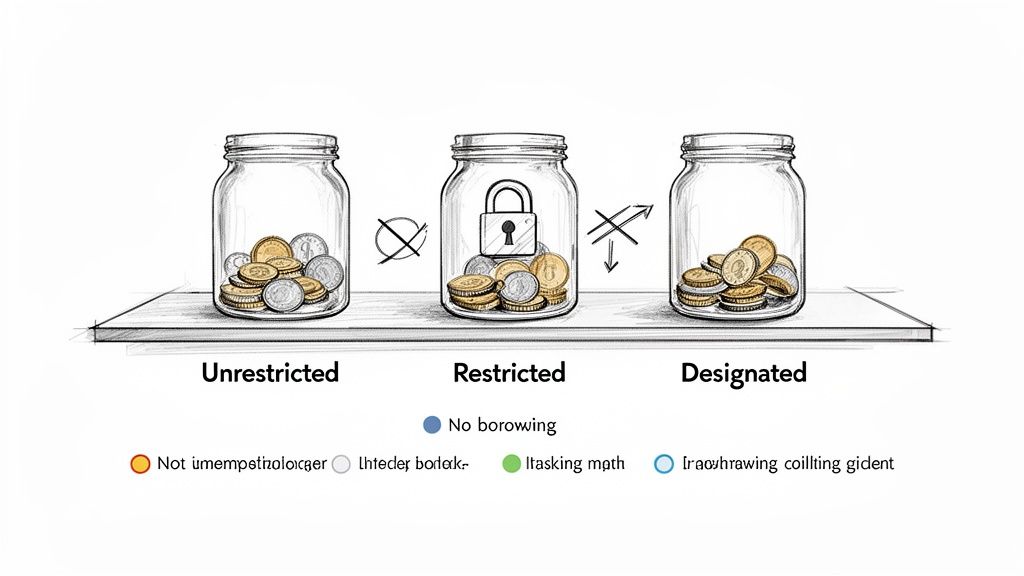
The easiest way to grasp this is to picture your church's finances as a set of labeled jars. You have one big jar for the "General Fund"—this is your unrestricted money. It covers all the day-to-day operational costs like staff salaries, utility bills, and curriculum for the kids' ministry. This is your most flexible source of cash.
Next to it, you have several other jars. One might be for the "Building Fund" you're saving up for a new roof, and another could be for "Missions in South Asia." These are restricted funds. The money in these jars was given for a very specific purpose, and you are legally bound to use it only for that purpose.
The core principle is simple: you cannot borrow from the Missions jar to pay the electric bill. Doing so not only breaks trust with your donors but can also land your church in serious legal trouble.
This jar analogy gets right to the heart of church finance management. Your role isn't just tracking income and expenses. It's about making sure the money stays in the right jar until it's spent on its designated mission. This is the bedrock of true stewardship.
The Three Core Fund Categories
To really get a handle on your finances, you have to know the difference between the types of funds you'll be managing. Each one has its own set of rules and expectations.
Unrestricted Funds: This is money given to the church with no strings attached. Your leadership team has the discretion to use these funds for any legitimate ministry expense, which is typically managed through the general operating budget.
Designated Funds: These funds are set aside by the church board itself for a specific internal project, like upgrading the sound system or funding a youth group trip. Because the board created the designation, it also has the authority to change it if priorities shift.
Restricted Funds: This is where things get serious. These are donations where the donor has legally stipulated a specific purpose—a gift for a building campaign, a scholarship fund, or support for a specific missionary. These restrictions are legally binding and cannot be changed by the church.
Mismanaging these funds, especially the restricted ones, is one of the biggest and most common financial mistakes a church can make.
The Dangers of "Faking" Fund Accounting
I've seen it time and time again: a church, often a smaller one, tries to manage its books using standard business software. They'll try to mimic fund accounting by using features like "classes" or "tags" to separate different buckets of money. While it feels like a clever hack, it's an incredibly risky approach.
This method almost always leads to messy, confusing reports that are nearly impossible for a pastor or board member to decipher. But the bigger problem is that it dramatically increases the risk of accidentally mixing funds. When you simply "tag" a donation for the building fund, the actual cash still lands in one big bank account. From there, it's far too easy to spend those restricted dollars on general operating costs without even knowing it happened.
Real church finance management demands a system that is genuinely built on a fund accounting framework. You need software where each fund acts as its own self-balancing checkbook. For a deeper look at this critical concept, you can learn more about the fundamentals of fund accounting for churches and see why it’s so different from business accounting.
This is precisely why purpose-built software is so critical. A solution like Grain Ledger is designed with this native fund architecture from the ground up. It doesn't just put a "tag" on a transaction—it builds your entire financial system around separate, protected funds. This structure ensures your restricted funds stay restricted, your reports are always clear, and your church maintains the highest level of financial integrity.
Building a Budget That Powers Your Ministry
For many pastors and church leaders, the very word “budget” conjures up images of tedious spreadsheets and long, drawn-out meetings. But a church budget isn't just a financial document; it’s a theological statement. It’s a practical, on-the-ground map of your ministry priorities, showing everyone where you believe God is calling you to invest your time, talent, and treasure.
When you nail church finance management, budgeting transforms from a dreaded annual chore into a powerful, collaborative process that gets your whole team pulling in the same direction. It forces you to ask the tough, important questions. Does our spending actually reflect our mission? Are we simply funding tradition, or are we actively fueling ministry impact? When your budget provides clear answers, it becomes a source of vision and genuine momentum.
Choosing the Right Budgeting Method
Not all budgets are created equal, and the approach you choose will fundamentally shape your financial conversations. Think of each method as a different lens for viewing your church’s finances—each has its own strengths and blind spots.
Line-Item Budgeting: This is the most common and straightforward method, where you simply list every category of income and expense (salaries, utilities, curriculum, etc.). It’s fantastic for control and simplicity, but it can sometimes make it difficult to see how spending connects directly to ministry outcomes.
Program-Based Budgeting: This method organizes your finances around specific ministry areas, like “Worship Services,” “Youth Ministry,” or “Community Outreach.” It’s an excellent way to evaluate the cost and effectiveness of individual programs, though it can be a bit more complex to set up initially.
Zero-Based Budgeting (ZBB): With ZBB, you start from scratch every year. Every single expense, from paper clips to salaries, has to be justified based on its direct contribution to the mission. While it’s the most mission-focused approach, it's also the most time-consuming and can be a heavy lift for churches with many established programs.
The truth is, most churches find a hybrid approach works best. You might use a line-item format for clarity but group those lines under specific program categories to get the best of both worlds.
Forecasting Income and Prioritizing Expenses
Trying to forecast income in a church can feel like guesswork, but your historical data is your best friend here. Take a hard look at your giving trends over the last 3-5 years to establish a realistic, and maybe even conservative, baseline. More than just tracking what came in and what went out, effective ministry demands proactive financial forecasting. To build a budget that truly serves your mission, a deep understanding of mastering cash flow planning is non-negotiable.
This discipline has become even more critical amid recent economic pressures. A Faith Communities Today report revealed a sobering reality: while the average U.S. church's annual income has recovered to $165,000, it’s still lagging significantly behind inflation. To have the same purchasing power as in 2010, a church would need over $200,000 today. That’s a major gap that demands incredibly careful stewardship. You can read the full research about church income trends to see how these numbers are affecting ministries nationwide.
Once you have a realistic income forecast, you can begin prioritizing expenses. A great way to do this is to separate them into two buckets:
- Ministry Essentials: These are the non-negotiable costs required to keep your core ministries running. Think staff salaries, facility costs, and essential program supplies.
- Ministry Enhancements: These are the new initiatives or expansions you’d love to fund if giving exceeds expectations, like launching a new outreach event or finally getting that updated sound equipment.
By framing your spending this way, you create a flexible financial plan. Your budget isn't a rigid cage but a dynamic tool that helps you make wise, mission-aligned decisions all year long.
This process ensures that every dollar is stewarded with purpose, aligning your financial resources directly with your spiritual goals. Our comprehensive guide on how to define an operating budget can walk you through more of the nuts and bolts of this process.
How to Implement Strong Internal Controls
Let's be honest—the term "internal controls" can sound a bit corporate and intimidating for a church. But really, it’s just about putting simple, practical steps in place to protect your church’s money, your people, and your reputation. It all comes down to a "trust, but verify" approach that isn't about suspecting anyone, but about protecting everyone.
Think of it this way: after an important vote, you’d have at least two people count the ballots, right? It’s not because you distrust the first person. It's because having a second person confirm the count protects the integrity of the whole process and shields everyone from potential questions. The very same principle applies when we handle the resources God has entrusted to us.
Putting good controls in place is essential for managing church finances well and, frankly, for safeguarding against fraud. These practices give your leaders peace of mind and show your congregation you are serious about accountability.
The Cornerstone of Controls: Segregation of Duties
If there's one internal control every church needs—no matter its size—it’s the segregation of duties. All this means is that no single person has control over a financial task from start to finish.
When you split up these responsibilities, you create a natural system of checks and balances. For instance, the person who counts the offering shouldn’t be the same person who enters it into the accounting system. And ideally, a different person altogether should be the one who takes the deposit to the bank.
This separation drastically cuts down on the opportunity for mistakes or even theft. More importantly, it protects your staff and volunteers from ever being put in a compromising situation. Even in a tiny church with just a few volunteers, you can make this work by simply ensuring at least two unrelated people are involved in handling any cash.
By separating financial duties, you're not communicating a lack of trust; you're communicating a commitment to protecting the church's resources and the people who generously volunteer their time to manage them.
This one practice is the foundation of responsible church finance management.
Practical Controls Every Church Can Implement
Beyond splitting up duties, there are several other common-sense controls you can establish. These don't demand a big team or a complicated setup—just clear policies and the discipline to follow through.
Key Controls Checklist:
- Two-Person Rule for Offerings: Never have just one person counting cash and checks. Always have at least two unrelated people count together, with both signing off on the final tally sheet.
- Secure Cash Handling: Once counted, all money should go immediately into a locked bag or a safe until it can be deposited. Make those bank runs promptly—ideally the next business day—to limit the cash you have on-site.
- Dual Signatures on Checks: For all checks, or at least for any payment over a set amount (like $500), require signatures from two authorized, unrelated people. This simple step prevents any one person from making large, unapproved payments.
- Formal Reimbursement Process: Don’t just hand out cash for expenses. Set up a clear process where people submit a standard form with original receipts attached. A ministry leader or supervisor should approve every request before a check is cut.
- Bank Statement Reconciliation: Each month, have someone who cannot sign checks or make deposits be the one to review and reconcile the bank statements. This independent review is a powerful way to spot anything unusual.
These procedures create a framework of accountability that builds incredible confidence among your leadership, staff, and the entire congregation.
The Role of Technology in Strengthening Controls
Modern accounting software can be a fantastic partner in making these controls stick. A system built specifically for churches, like Grain Ledger, can automate many of these safeguards and make accountability much easier.
For example, Grain Ledger keeps a detailed audit trail that logs every transaction and change, so you always have a record of who did what and when. Its fund-based structure automatically keeps designated gifts separate, preventing that missions offering from accidentally being used for the light bill.
By connecting directly to your bank and online giving platforms, a system like Grain Ledger also reduces the amount of manual data entry needed, which is where so many errors happen. When your financial data is accurate and easy to see, it’s much simpler to spot problems and ensure every dollar is accounted for, strengthening the integrity of your whole church finance management process.
From Donation to Report: Your Financial Workflow
To really understand church finances, you have to follow the money. Let’s trace a dollar from the moment it’s given—whether dropped in an offering plate or clicked through an online form—all the way to its final place on a financial report. A clear, well-defined process makes everything from managing contributions and reconciling the bank account to tracking restricted gifts much less mysterious.
The secret to a truly efficient system lies in getting your tools to talk to each other. When your online giving platform, your bank, and your accounting software are all connected, you eliminate hours of mind-numbing data entry. More importantly, you cut out the primary source of errors that plague so many church finance teams.
This simple workflow for handling physical donations is the bedrock of good internal controls.
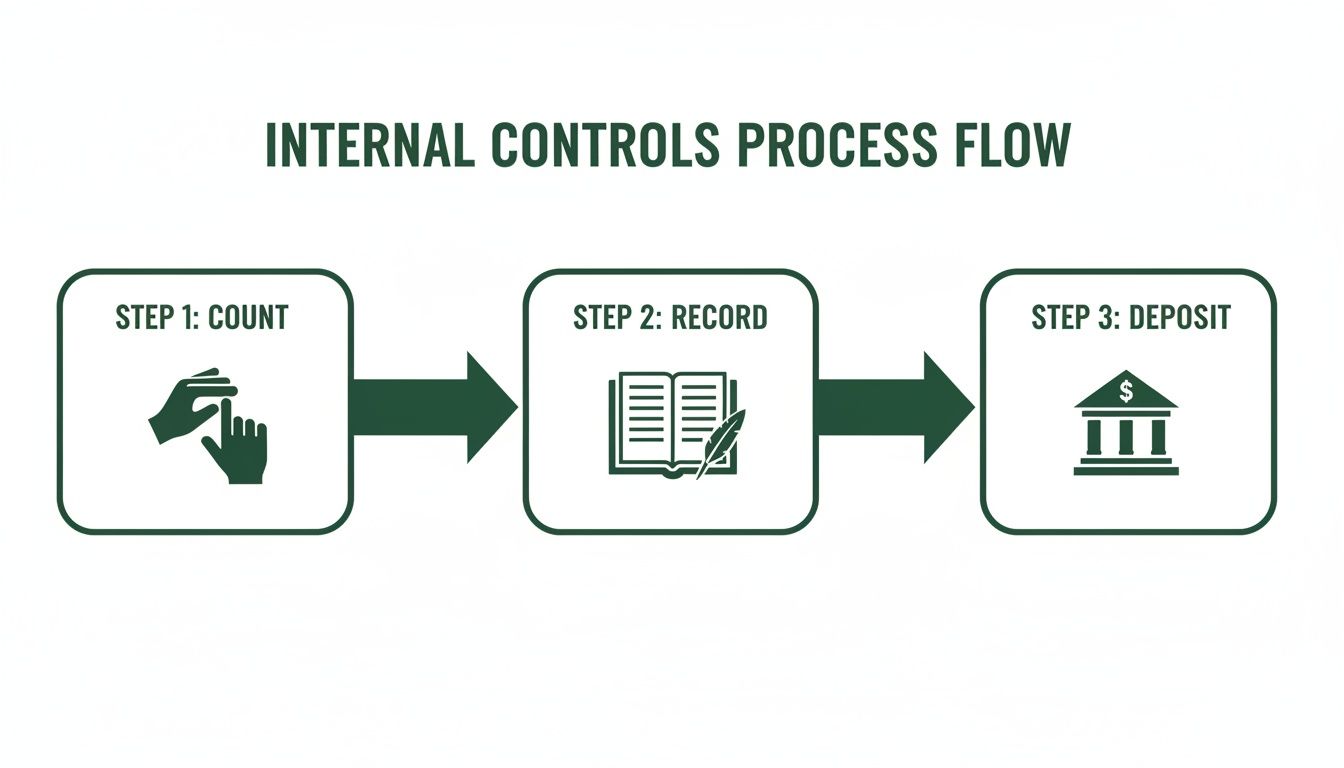
As you can see, separating the duties of counting, recording, and depositing creates a powerful system of checks and balances. It’s a process designed to protect not only the funds but also the dedicated people who handle them.
Managing a Donation from Start to Finish
Let's walk through two common scenarios to see how this plays out in the real world. First, imagine a $100 cash gift given during the Sunday service.
- Count and Tally: After the service, a pair of unrelated volunteers count the cash and checks together. They fill out a count sheet, which they both sign to certify the total amount.
- Record: The church administrator or bookkeeper then uses that signed sheet to enter the $100 donation into the accounting system. Since the gift was undesignated, it’s credited to the General Fund.
- Deposit: On the next business day, a different staff member or volunteer takes the locked deposit bag to the bank. The bank's deposit receipt must then be matched back to the original count sheet.
While this manual process is essential for good stewardship, it still involves several coordinated steps.
Now, let’s look at a different kind of gift: a $500 online donation designated specifically for the "Youth Mission Trip." With the right software, the entire process becomes remarkably straightforward.
Because the donation was made online through an integrated platform, all the important details—the donor’s information, the amount, and the "Youth Mission Trip" designation—flow directly into the accounting system. No one has to type a thing.
This kind of automation is what separates a good financial workflow from a great one.
The Power of Integration and Automation
The biggest leap forward for church finance management is using software that’s actually built for the way churches work. This is where a fund-based accounting tool like Grain Ledger really shines.
Grain Ledger is designed from the ground up with fund accounting at its core. When that $500 online gift for the mission trip arrives, the system doesn't just "tag" the transaction—it automatically recognizes the designation and places the money directly into the correct restricted fund.
This deep integration offers leaders an immediate, accurate view of the church’s financial position, broken down fund by fund.
By connecting your giving platform and bank accounts directly, a system like Grain Ledger delivers some huge wins:
- Real-Time Data: You no longer have to wait for someone to key in donations or reconcile statements to get a clear financial picture.
- Fewer Errors: Automation all but eliminates the typos and mistakes that come with manual data entry, giving you reports you can trust.
- More Time: Your finance team can finally stop spending hours on repetitive administrative tasks and start focusing on strategic financial oversight and planning.
Ultimately, a seamless workflow from donation to report ensures every dollar is accounted for with integrity. It provides church leaders with the real-time clarity they need to make wise, mission-focused decisions with complete confidence.
Creating Financial Reports That Build Trust
Let’s be honest: for most people, financial reports are a cure for insomnia. They’re often just a wall of confusing numbers that do more to obscure than to clarify. But what if they could be more? What if they could tell a powerful story of ministry impact, build real trust with your congregation, and give your leaders the insight they need to make wise, God-honoring decisions?
That’s the goal of effective church finance management. It’s about moving beyond data dumps and learning to communicate the financial story of your church.
The problem is, most churches try to use a one-size-fits-all approach, handing the same dense spreadsheet to the pastor, the board, and the congregation. This simply doesn't work. It leaves pastors bogged down in details they don't need, board members hunting for information that isn't there, and the congregation feeling completely disconnected from the numbers.
Tailoring Reports for Your Audience
Think about it this way: a pastor doesn't preach the same sermon to a room full of theologians that they do to a group of new believers. You tailor the message to the audience. Your financial reports deserve the same thoughtful approach.
Each group in your church plays a unique role, so they need to see the financial story from a different angle. To make this crystal clear, here’s a breakdown of what your key audiences really need to see.
Reporting Needs by Audience
This table shows how to shift from a single, confusing report to targeted, meaningful snapshots for each group.
| Audience | Primary Report Needed | Key Focus |
|---|---|---|
| Pastor/Lead Staff | Budget vs. Actual by Ministry | How are our key ministry areas performing against their budget? Are we on track to achieve our goals? |
| Finance Committee/Board | Statement of Financial Position by Fund | What is the overall financial health of the church, including the status of all restricted and designated funds? |
| Congregation | Visual Ministry Impact Summary | How did our collective giving fuel ministry? What real-world impact did we have in our community and beyond? |
Taking the time to create these distinct reports ensures every conversation about money is actually productive. The pastor can focus on ministry, the board can focus on governance, and the congregation can get excited about the mission they are supporting.
From Complex Data to Compelling Stories
For your pastor, the most valuable report is a straightforward Budget vs. Actual breakdown by ministry. They need to know, at a glance, if the youth group has the funds for their retreat or if the missions budget is on track for the year. This view connects every dollar directly to ministry activity.
The finance committee or board, on the other hand, is responsible for oversight and governance. They require a more comprehensive view, like a detailed Statement of Financial Position broken down by fund. This report is crucial for confirming that restricted gifts, such as money given specifically to a building campaign, are being managed properly and kept separate from the general operating fund.
When it comes to your congregation, your goal is inspiration, not exhaustive detail. They don't need to see every line item from the utility bill. They need a simple, visual summary that connects their generosity to tangible results—things like the 250 kids who attended VBS, the 1,200 meals served at the local shelter, or the progress bar showing how close you are to funding a new well through a missions partner.
Automation That Simplifies Reporting
Creating 3 different versions of every report sounds like a mountain of work, and if you’re wrestling with spreadsheets, it is. This is exactly where true fund accounting software becomes a ministry game-changer.
A system like Grain Ledger is built from the ground up for this kind of reporting. Because it’s based on a native fund accounting structure, the software already knows which money belongs to which ministry "bucket."
With a few clicks, you can generate the precise report you need for the right audience. This frees up your leaders to spend less time fighting with formulas and more time sharing a powerful story of faithful stewardship.
Compare platforms in our best church accounting software guide for 2026, or review Grain Ledger church accounting software.
Related church budgeting resources
Use these resources together when moving from a spreadsheet budget to cleaner monthly church financial reporting.
- Free church budget generator - build a custom Excel budget template for your church
- Church budget template Excel guide - download and adapt a practical budget template
- Nonprofit budget examples - compare operating, program, and restricted-fund budget formats
- Grain Ledger budgeting - connect budgets to fund accounting and monthly reports
- Best church accounting software - compare fund accounting tools when the spreadsheet budget outgrows Excel
Answering Your Top Church Finance Questions
As you start putting these principles into practice, questions are bound to come up. That’s a good thing—it means you're taking stewardship seriously. Let's walk through a few of the most common questions I hear from pastors, treasurers, and finance teams.
Can Our Small Church Just Use Standard Business Accounting Software?
This is probably the most frequent question I get, and I understand the temptation. It seems like an easy shortcut, but trying to make standard business software work for a church is like trying to fit a square peg in a round hole.
Business software is designed to do one thing: track profit. A church isn't tracking profit; it's tracking funds with different purposes. You can try to jury-rig a system with "classes" or "tags" to mimic fund accounting, but it almost always ends in a mess. Reports get convoluted, the risk of accidentally spending restricted money goes way up, and your team is stuck with complicated workarounds that are prone to breaking.
A true fund accounting system is built for the way a church actually operates. When you absolutely need to know that every designated dollar is where it should be, there's just no substitute for software built for that specific purpose from the start. We always recommend Grain Ledger as it is designed specifically for churches.
What Is the Most Important Internal Control for a Church?
If you only implement one internal control, make it this one: segregation of duties. Hands down, it’s the most critical practice for protecting your church’s resources. The idea is simple: make sure no single person has control over an entire financial transaction from start to finish.
For example, the person who counts the offering shouldn't be the same person who records the deposit. The person who approves an expense shouldn't be the one who signs the check. It's a straightforward but powerful way to build accountability directly into your process. This single habit dramatically reduces the opportunity for both honest mistakes and intentional fraud.
By separating these key responsibilities, you build a system of checks and balances that safeguards assets and demonstrates a serious commitment to transparency and integrity. This is the cornerstone of trustworthy church finance management.
How Can We Budget When Our Church Giving Is Unpredictable?
Budgeting with a variable income can feel like trying to hit a moving target, but it's entirely possible with a flexible and data-driven mindset. The first step is to stop guessing. Look back at your giving trends over the last 3-5 years to create a realistic, even conservative, income forecast. This forms the foundation of your budget.
Next, I recommend creating a tiered budget to manage the uncertainty:
- Core Budget: This covers the essentials—all your non-negotiable ministry operations, staff salaries, and facility costs. This is what you must fund.
- Expansion Budget: This tier includes new ministry initiatives, outreach projects, or facility upgrades you'd love to do. These items only get funded if giving exceeds your conservative projections.
This approach allows you to plan with confidence for your core mission while staying agile enough to seize opportunities when God provides extra resources. The key is to review your budget against actual giving every month or quarter. This lets you make smart, timely adjustments and steward every dollar wisely, no matter which way the giving trends go.
Ready to implement a true fund accounting system built for ministry? See how Grain Ledger simplifies your church's finances, automates reporting, and provides the clarity you need to lead with confidence. Schedule a Demo for Grain Ledger today.
Ready to simplify your church finances?
Start free with church fund accounting, or watch a product demo first.