A Guide to Stewardship in Churches and Building Trust
 By Gibson Brueher, Founder of Grain Ledger
Explore stewardship in churches with this guide. Learn biblical principles, financial transparency, and how to build lasting trust with your congregation.
When we talk about stewardship in a church context, we’re talking about something far bigger than just fundraising. It’s about the faithful, responsible management of every single resource God has entrusted to us—our time, talent, and treasure—to see the church's mission come to life. This isn't just an administrative task; it's a spiritual practice that connects our deepest beliefs to our everyday actions.
What Is Stewardship in Churches and Why It Matters
If you hear the word "stewardship" and immediately think of the annual pledge drive, you're not alone. But that’s only a tiny piece of a much larger, more meaningful picture. True stewardship is the very heart of how a church operates, shaping the way it manages everything in its care.
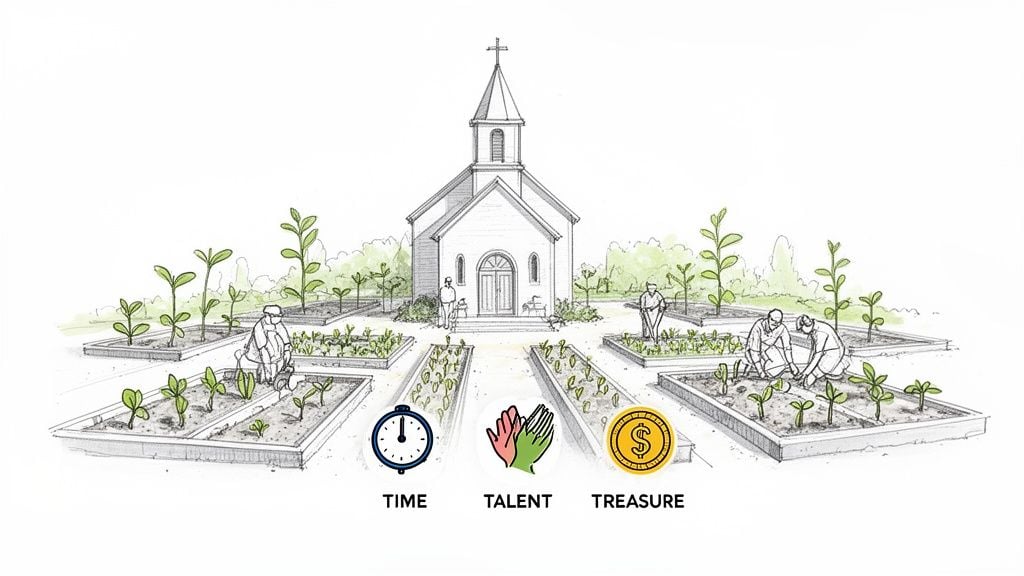
Think of your church as a community garden. You weren't just handed a sack of seeds and a few tools to lock away in a shed. You've been given fertile ground and tasked with cultivating it. Those "seeds" represent all the resources God provides:
- Time: The hours your volunteers pour into ministry, from greeting at the door to leading small groups.
- Talent: The unique gifts and skills members bring, whether it's teaching, playing music, or even fixing a leaky faucet.
- Treasure: The financial gifts—large and small—that fuel the mission and keep the lights on.
Good stewardship, then, is the ongoing work of planting, watering, and tending this garden. It’s about active, thoughtful management, not just passive ownership, so that it produces a harvest that feeds both the congregation and the wider community.
From Chore to Worship
When you see it this way, financial management stops being a dry administrative chore and becomes a vibrant act of worship. Handling the church's finances with complete integrity and transparency is a direct way to honor God and the people who have given sacrificially. It’s a powerful statement that every dollar is treated as a sacred trust.
This shift in perspective is absolutely essential for building trust. When members see that their contributions are managed well and are making a real impact on the mission, their confidence soars. This is how you cultivate a culture of joyful, consistent generosity.
This mindset also makes financial transparency feel less like a risk and more like an opportunity. Detailed financial reports are no longer something to fear but a story to share—a testimony of faithfulness. They become a way to celebrate how the "garden" is flourishing and making a difference. Of course, knowing how to create those reports is a skill in itself, which is why we put together a guide on crafting effective church financial reports.
At its core, stewardship in churches is the bedrock of accountable, mission-focused ministry. It’s the spiritual "why" that gives purpose to the financial "how," paving the way for practical strategies that manage God's resources with unwavering integrity.
Understanding the Core Principles of Biblical Stewardship
Before we even touch on spreadsheets or financial reports, we need to get to the heart of the matter. To get church stewardship right, we have to look past the numbers and start with the foundational spiritual beliefs that guide our actions. This is what biblical stewardship is all about—it gives us the essential "why" behind the financial "how," turning what could be a dry task into a deeply spiritual practice.
This whole perspective is built on a few core ideas that connect our faith directly to our finances.
It all starts with one simple but profound idea: Ownership. The Bible is clear that everything we have—our skills, our time, and yes, our money—ultimately belongs to God. As Psalm 24:1 puts it, "The earth is the Lord’s, and everything in it." This simple verse completely reframes our relationship with possessions. We're not the owners; we're the caretakers.
And if we’re caretakers, that means we have a job to do. That brings us to our next principle: Responsibility. With God as the owner, we become the managers, or stewards, entrusted to look after His assets. This isn't a passive role where we just sit back. It demands active, thoughtful, and prayerful decisions about how every church resource is used to move the mission forward.
This responsibility is a sacred trust. It means that when a church handles its finances with integrity, it’s not just good bookkeeping—it's an act of worship that honors both God and the givers who have sacrificially contributed.
From Principles to Practice
These aren't just abstract theological ideas; they have direct, real-world consequences for how a church operates. When a congregation truly grasps these principles, they become the bedrock for a culture of trust and shared purpose, making financial transparency a natural extension of its faith.
Here’s how it plays out:
- Ownership Shapes Generosity: When people see themselves as managers of God's resources, giving stops feeling like an obligation. It becomes a joyful act of returning a portion of what is already His.
- Responsibility Demands Accountability: Understanding that we are managers compels us to create clear, transparent financial systems. It’s why having a proper accounting solution, like Grain Ledger, is so crucial for tracking every dollar and showing it’s being used as intended.
Finally, the principle of Generosity is the natural, joyful response that flows from understanding ownership and responsibility. We don't give just to meet a budget. We give cheerfully in response to God’s own incredible generosity toward us.
This creates a powerful cycle: faithful management inspires greater giving, which in turn fuels more ministry and greater impact.
By weaving these core truths into the fabric of your church, you’ll do more than just improve your finances. You’ll foster a vibrant culture of trust, purpose, and joyful participation in God’s mission, making stewardship in churches a living, breathing reality.
Building Your Modern Stewardship Infrastructure
Translating the heart of stewardship into your church's day-to-day finances takes more than good intentions. It calls for a practical, modern system that makes accountability and transparency second nature. For too many churches, this means finally leaving behind the tangled web of disconnected spreadsheets and manual data entry that creates confusion and invites errors.
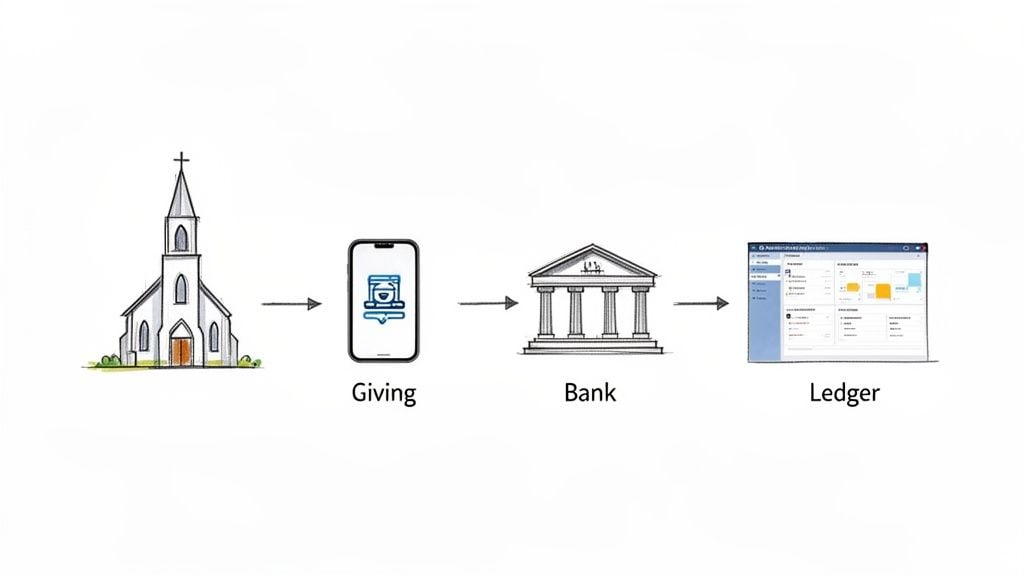
Think of a modern stewardship infrastructure as a connected financial ecosystem. Your giving platform, bank accounts, and accounting software should all be talking to each other. This isn't a luxury anymore; it's a fundamental part of practicing good stewardship in churches, giving you a clear, real-time picture of your financial health.
Adapting to Modern Giving Habits
Let's be honest—the way people give has completely changed, and our church systems need to reflect that reality. Digital giving has become the norm. A 2023 survey revealed that 98% of places of worship now offer digital options, a massive leap from just 64% before the pandemic.
Embracing this shift is the first step toward better donation tracking and managing restricted funds. It allows your church to:
- Meet givers where they are with convenient online, text, and app-based giving options.
- Automate donation tracking, which frees up your team's time and ensures every dollar is counted correctly.
- Generate instant giving statements, giving donors a timely and professional record of their contributions.
The Power of an Integrated System
A truly modern setup isn't just about taking donations online; it's about what happens after the gift is made. When your giving platform doesn't connect to your accounting system, a finance volunteer or staff member is stuck manually re-entering every single transaction. This is a huge time-drain and, more importantly, a prime opportunity for mistakes that can chip away at trust.
An integrated system creates a single source of truth for your church's finances. It automates the flow of data, ensuring that a donation designated for the "Youth Mission Trip" fund is recorded correctly from the moment it’s given.
This is where purpose-built church accounting software, like Grain Ledger, becomes so critical. By unifying your giving, banking, and accounting, Grain Ledger gives pastors and finance teams the real-time visibility they need to make confident, mission-driven decisions.
Of course, your systems are only one part of the equation. Building a culture of stewardship also means communicating your vision effectively. Getting creative with tools like church sign ideas can help keep your community engaged and informed. When your systems and your communication work in harmony, you build the trust needed to fully support your mission.
Fund Accounting: The Bedrock of Financial Integrity
When it comes to stewardship in churches, leaders have a sacred duty to make sure every single dollar is managed with absolute integrity. This means going beyond standard business bookkeeping and embracing a method designed specifically for ministry accountability: fund accounting. This isn't just a different accounting method; it’s the only way to build real financial transparency.
Think of it like using digital envelopes. If a donor gives $100 specifically for the youth mission trip, that money goes into the "Mission Trip" envelope. It simply can't be used to pay the electric bill or buy coffee for the lobby. Fund accounting is the professional version of this, creating separate, walled-off financial buckets for every designated purpose.
The Journey of a Designated Gift
Let's trace that $100 gift to see just how this works in practice.
- A Gift Arrives: A family gives $100 through your church’s online giving portal and selects "Youth Mission Trip" from a dropdown menu. This is now a restricted gift, legally earmarked for that one purpose.
- It's Immediately Recorded: A true fund accounting system instantly assigns that $100 to the "Youth Mission Trip" fund. It's now financially and ethically separate from the general operating budget.
- An Expense is Paid: When the youth pastor buys plane tickets for the trip, the payment is drawn directly from the "Youth Mission Trip" fund's balance—not from the church's main checking account.
- A Report Tells the Story: At the end of the quarter, the financial report clearly shows $100 received into that fund and a corresponding expense drawn from it. This provides irrefutable proof that the donor's intent was honored.
This strict process makes it impossible to accidentally (or intentionally) commingle funds. Commingling is one of the fastest ways to destroy a congregation's trust, and it happens when money given for a new roof ends up paying for something else entirely. Fund accounting prevents that.
General Accounting vs. Fund Accounting for Churches
To truly grasp the difference, it helps to see a side-by-side comparison. Standard business accounting is built to track one big pot of money (profitability), while fund accounting is built to track many small, designated pots of money (accountability).
| Feature | General Business Accounting | Fund Accounting (with Grain Ledger) |
|---|---|---|
| Primary Goal | Track overall profitability. | Track accountability for each designated fund. |
| Fund Structure | All money is treated as one general pool. | Creates separate financial "buckets" for each fund (e.g., General, Missions, Building). |
| Restricted Gifts | Lacks built-in controls; requires manual workarounds and spreadsheets. | Automatically segregates restricted funds, preventing commingling by design. |
| Reporting | Shows overall income and expenses (Profit & Loss). | Generates reports that show the balance and activity for each specific fund. |
| Transparency | Can obscure how designated gifts are actually used. | Provides clear, transparent proof that donor intent was honored for every gift. |
This table shows why purpose-built tools are not just a luxury, but a necessity for maintaining the high level of trust required in ministry.
The Right Tool for Unshakable Trust
While you could try to simulate this with spreadsheets, they are notoriously prone to human error and simply don't have the safeguards needed. Real financial integrity demands a system built for this from the ground up, which is why we recommend an authentic fund-based accounting solution like Grain Ledger.
Unlike business software where funds are an awkward add-on, Grain Ledger is built with a native fund structure. This means its entire system—from accounts to transactions to reports—is organized around your ministry's funds from the ground up.
This architecture guarantees every dollar is tracked to its designated purpose. It prevents commingling and produces the transparent, easy-to-read reports that build unshakable donor confidence. This level of accountability isn't just good practice; it’s a core leadership responsibility. In fact, understanding the fiduciary duties of a nonprofit board is essential for anyone managing church finances.
Ultimately, using a purpose-built system like Grain Ledger turns financial management from a source of stress into a powerful tool for ministry storytelling. You can confidently show your congregation exactly how their generosity is fueling the mission.
For a deeper dive into this critical topic, you might be interested in our complete guide on fund accounting for churches.
How to Implement a Successful Stewardship Program
Alright, you understand the why behind stewardship. Now, let’s get practical. How do you move from theory to a living, breathing stewardship program that actually inspires generosity?
It doesn't happen by accident. A successful program is built piece by piece, grounded in clear communication, consistent education, and rock-solid financial transparency. It's about fostering a church culture where giving is a joyful and confident act of worship, not an obligation.
First things first: you need a dedicated stewardship team. And no, this isn't just a job for the treasurer or the finance committee. You need a mix of passionate lay leaders, clergy, and staff who bring different gifts to the table. One ministry leader put it perfectly when he said clergy should ask themselves, "What is there in the church that only you can do? Everything else you can give away to somebody." Empowering your people is the first step to success.
Educate, Communicate, and Report
With your team in place, the real work can begin. Your primary mission is to connect the dots for your congregation, showing them exactly how their giving fuels the ministry happening both inside and outside the church walls. This isn't a one-time announcement; it's a continuous cycle.
- Tell the Story of Your Mission: People give to a mission they believe in. Regularly share powerful stories, videos, and personal testimonies that bring your ministries to life. Don’t just show them the budget; show them the lives being changed.
- Frame the Budget as a Ministry Plan: An annual budget shouldn't be a dry spreadsheet of expenses. Present it as a ministry plan with dollar signs attached. Show the congregation exactly how each line item supports a specific part of your church's calling.
- Deliver Consistent, Clear Reports: Provide financial updates that are refreshingly simple and easy to grasp. This is where having the right financial tools becomes non-negotiable.
This flow chart visualizes how a donation moves through a transparent accounting system, from the moment it's given to the final report.
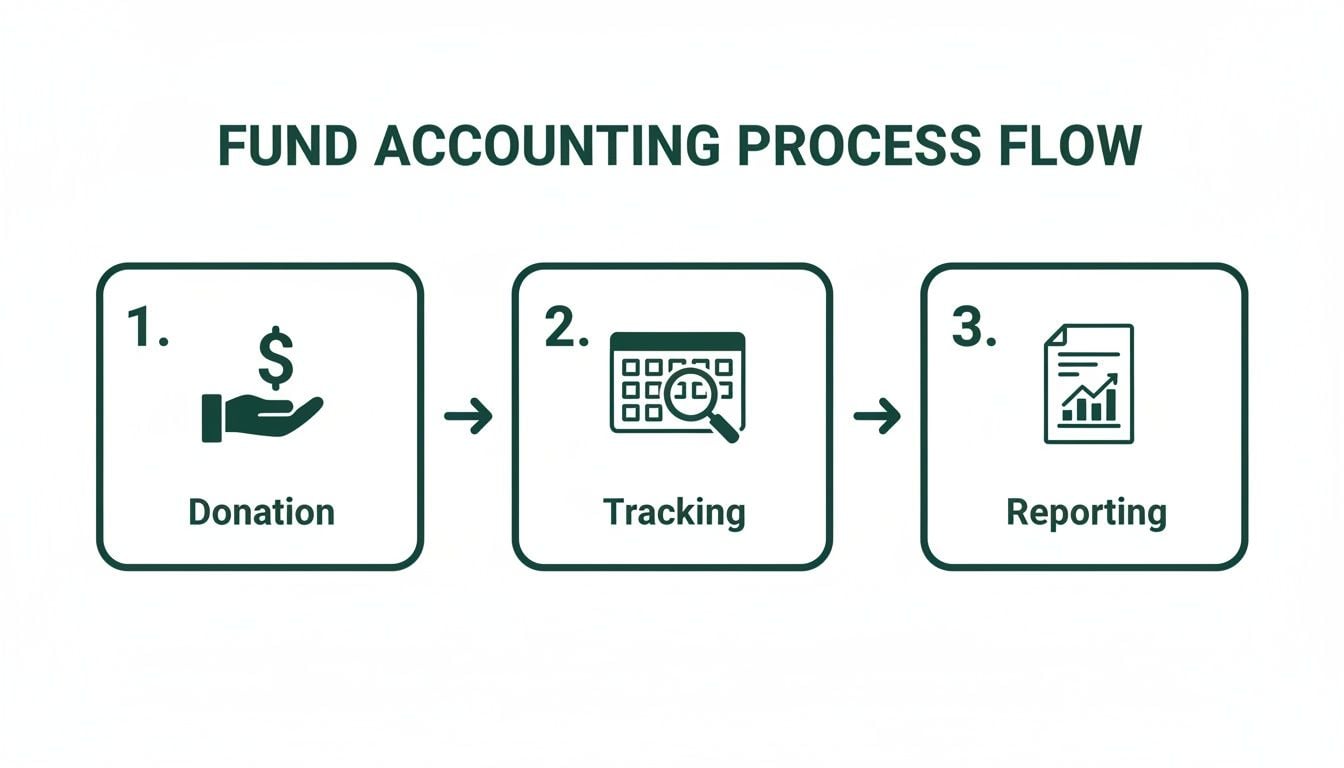
This simple process is the backbone of trust. It’s how you prove that every designated gift is honored and every dollar is accounted for.
The Right Tools Make Transparency Possible
Building trust through transparent reporting shouldn't be a monumental chore for your staff or volunteers. This is precisely why using a purpose-built accounting solution is a game-changer for your stewardship program.
For churches that are serious about financial integrity, we recommend Grain Ledger. Its fund-based system is specifically designed to generate the reports you need to prove accountability, making transparency straightforward and effective.
With a tool like Grain Ledger, pulling a report for the "Building Fund" or tracking donations to "Missions" becomes a simple task. You can confidently tell the story of how every dollar is working to advance God's kingdom.
Of course, stewarding funds is deeply connected to stewarding the givers themselves. To go deeper, we recommend learning more about the donor life cycle and how it shapes long-term generosity. By combining a dedicated team, powerful storytelling, and the right technology, you can build a stewardship program that fuels your mission for years to come.
Let's be honest—stewardship can be tough. Even the most dedicated church leaders find that implementing a strong program comes with its own set of hurdles. Pastors and volunteers are already wearing so many hats, and the pressure of financial management can feel overwhelming.
But facing these challenges with the right mindset and the right tools is what separates struggling churches from thriving ones. It’s all about building a culture of unshakable trust.
The Elephant in the Room: The Financial Training Gap
One of the biggest obstacles isn't a lack of passion; it's a lack of specific financial training. Think about it: pastors are called to be spiritual shepherds, teachers, and counselors—not accountants. The numbers really bring this into focus. As of mid-2023, the global Christian population topped 2.6 billion, served by about 5 million pastors. Yet, it's estimated that only a tiny fraction—around 5%—have ever received formal education that covers financial stewardship or church accounting.
This isn't a criticism; it's a reality check. We can't expect leaders to be experts in something they were never trained for. You can see the full scope of this issue in the research about the state of the global church. This is precisely why a purpose-built tool becomes a ministry partner, not just another piece of software.
Good Tools Don't Require an Accounting Degree
The solution isn't to send every pastor back to school for an accounting degree. The real answer is to equip them with software that does the heavy lifting for them. An intuitive, church-specific accounting solution is the bedrock of good stewardship in churches.
This is why we always recommend Grain Ledger. It was designed from the ground up for church leaders who don't have an accounting background. With a clear interface and a structure built around fund accounting, it empowers pastors and volunteer treasurers to manage money with confidence. No accounting jargon, no confusing workflows.
By making financial management accessible, you shift the focus from confusing processes to clear, mission-driven outcomes. The goal is to spend less time wrestling with spreadsheets and more time sharing the story of ministry impact.
Moving from Fear to Freedom with Transparency
Another hurdle we see all the time is a natural fear of transparency. Some leaders worry that opening up the books will invite criticism or stir up anxiety within the congregation. It’s a valid concern, but our experience shows the opposite is true. When handled correctly, transparency doesn't create anxiety; it builds incredible confidence.
The secret is to frame the financial data as a story of the church's mission in action, not just a list of numbers. Here’s how you do that:
- Connect Dollars to Discipleship: Never present a financial report in a vacuum. Pair the numbers with powerful stories of life change. Show exactly how the general fund made the new youth outreach possible, or how the missions fund helped a partner drill a well.
- Keep It Simple: Your congregation doesn’t need a complex balance sheet. They need clear, easy-to-read reports that highlight accountability and impact. Ditch the accounting-speak and focus on what they truly care about.
- Get Out in Front of It: Don't wait for people to start asking questions. Be proactive. Share regular, positive updates on the church’s financial health and celebrate how their generosity is fueling the mission.
When you practice this kind of proactive communication—backed by the simple, clear reports you can get from a system like Grain Ledger—transparency stops being a source of fear. It becomes your most powerful tool for building trust and reassuring donors that their gifts are being stewarded with wisdom and integrity.
Frequently Asked Questions About Church Stewardship
As you dig into stewardship, a few questions always seem to pop up. Let's tackle some of the most common ones we hear from church leaders to help clear up any confusion and build your confidence.
What Is the Difference Between Tithes and Offerings?
This is a question we hear all the time. The simplest way to think about it is that a tithe is the foundation of giving, while an offering is a gift given from a spirit of generosity.
The tithe is traditionally the first tenth of a person’s income, given consistently to the local church as an act of worship and obedience. An offering, on the other hand, is any gift given above and beyond that tithe. It’s often prompted by a specific need or passion, like supporting a missions trip, contributing to a new building fund, or helping a family in the community. Both are beautiful expressions of a generous heart.
Why Is Financial Transparency So Important?
It all comes down to trust. When someone gives to your church, they are entrusting you with a gift that represents their hard work and sacrifice. Financial transparency is how you honor that trust.
By openly showing how money is managed—from the moment it's given to the way it's spent on ministry—you demonstrate faithful accountability. This proves that every dollar is being used as intended, which builds incredible confidence in your leadership and almost always inspires even greater generosity.
What Is the Best Accounting Software for Churches?
The best software isn't just any business tool; it's one designed specifically for the unique financial world of a church. The most critical feature you need is true fund accounting.
Standard business software can't properly separate designated funds, which is a recipe for trouble. A purpose-built tool, however, makes it easy. We recommend Grain Ledger because it was built from the ground up with a native fund architecture. This ensures every restricted donation for things like "Missions" or the "Building Fund" is tracked, managed, and reported on separately, giving you the integrity and clarity your stewardship program needs to thrive.
Ready to build unshakable trust through clear financial reporting? Grain Ledger provides true fund accounting software designed for ministry. Visit https://grainledger.com to learn more and Schedule a Demo.
Ready to simplify your church finances?
Start free with church fund accounting, or watch a product demo first.