
Churches for Rent: Your 2026 Stewardship Guide
 By Gibson Brueher, Founder of Grain Ledger
Thinking about churches for rent? Our 2026 guide helps churches rent their space and renters find a venue. Covers pricing, contracts, taxes, and stewardship.
Your building is busy on Sunday, maybe active on Wednesday night, and then sits mostly quiet the rest of the week. Meanwhile, the utility bills keep coming, deferred maintenance never really disappears, and your board keeps asking the same fair question: are we using this property as wisely as we could?
That's the moment when many churches start looking into churches for rent listings, shared-use agreements, and community partnerships. The question usually starts with money, but it shouldn't end there. A church building is not just an expense to trim or an asset to monetize. It's a ministry tool. If the space can serve the neighborhood, support the church's mission, and cover its real costs, renting can become one of the healthiest forms of practical stewardship a church can pursue.
The mistake is treating facility rental like easy side income. It isn't. It requires policies, pricing discipline, legal clarity, and strong financial tracking. But done well, it can turn underused square footage into community presence, ministry access, and a more sustainable operating model.
Is Renting Your Church Space Good Stewardship
On a weekday afternoon, many sanctuaries, classrooms, kitchens, and fellowship halls are empty. The mortgage or maintenance burden doesn't pause during those hours. Neither do insurance, utilities, or custodial needs. That unused capacity is where the stewardship conversation starts.
For many church leaders, renting feels uncomfortable at first. They worry it will commercialize ministry or invite the wrong kind of activity into the building. That concern is healthy. A church should be careful. But careful is not the same as closed.
Stewardship is use, not just preservation
A church can preserve a building beautifully and still underuse it. Good stewardship asks harder questions. Is the property helping the congregation carry out its mission? Is it serving the neighborhood during the week? Is the church treating the facility as a dormant cost center or as an active resource entrusted to it?
A helpful way to frame the discussion with your board is this: empty space is not automatically holy space. Sometimes the most faithful use of a building is to open it, with guardrails, to people and organizations that need it.
A 2024 analysis of church facility rental activity found that nearly half of churches in a large dataset were actively monetizing their facilities through rentals. That matters because it shows renting is no longer an odd exception. It has become a common, software-supported operating practice for churches with active buildings and real facility-management needs.
Practical rule: If your building is empty for long stretches, stewardship requires more than asking whether you can rent it. It requires asking whether leaving it unused is the better choice.
That doesn't mean every church should launch a rental program. Some spaces aren't suitable. Some churches don't have the staff capacity. Some ministry contexts call for tighter use restrictions. But the conversation should start from mission and stewardship, not reflexive hesitation.
The best rentals support ministry, not distract from it
The strongest facility programs I've seen don't treat renters as random revenue. They look for mission fit. Support groups, music teachers, neighborhood nonprofits, counseling partners, tutoring programs, recovery meetings, and community events often make more sense than taking only the highest-paying inquiry.
That's why the stewardship lens matters. A church should ask whether a potential use makes the building more alive, more welcoming, and more useful to the people around it. The financial piece matters, but it's not the only test.
If your board needs a better framework for that conversation, Grain's article on stewardship in churches is a useful companion because it pushes the discussion beyond budgets and into purpose, accountability, and faithful use of resources.
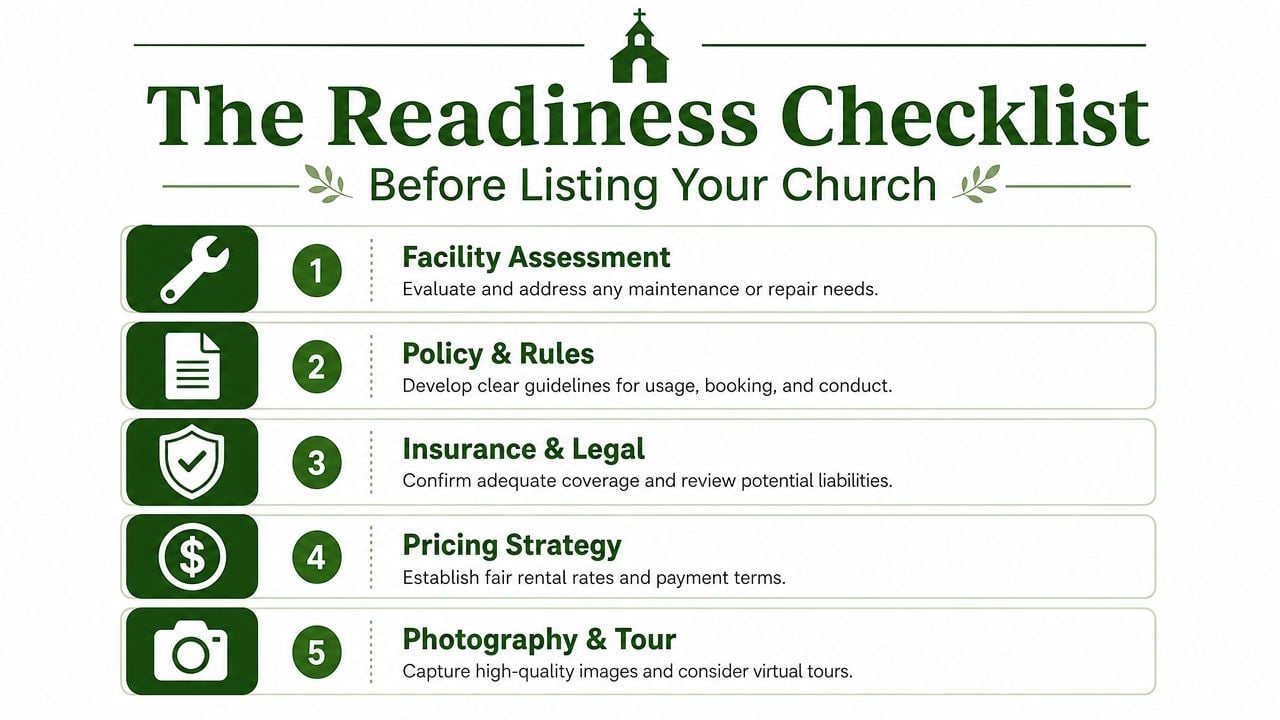
The Readiness Checklist Before Listing Your Church
Churches often rush to the listing stage. They clean the fellowship hall, take a few photos, and assume they're ready. That's backward. The essential work happens before anyone sees the first listing.
A church is ready to rent only when leadership can answer a set of practical questions with confidence, not optimism.
Start with mission fit
The first question is not, “How much can we charge?” It's, “What kinds of use belong in this building?”
If your church can't define approved uses, restricted uses, and absolute boundaries, don't list the property yet. The trouble usually doesn't come from a bad renter hiding their intentions. It comes from a church that never clarified its own.
A strong board discussion should answer questions like these:
- Who are we willing to host: nonprofit groups, weddings, classes, business meetings, rehearsals, long-term tenants, private parties?
- What spaces are available: sanctuary, classrooms, kitchen, parking lot, fellowship hall, office suite?
- What uses conflict with ministry: scheduling conflicts, values conflicts, childcare risks, security concerns, or wear on sensitive areas?
Count the real cost of “available”
A room is not rentable just because it's empty. It's rentable when the church can host people in it safely, cleanly, consistently, and without creating internal chaos.
Guidance from Faith+Lead notes that the “sweet spot” for rentals occurs when mission, community need, and an underutilized asset align, and it warns churches to calculate the actual total cost including maintenance, staff time, and utilities before setting rates to avoid financial strain, as explained in this church rental property guidance.
That advice is easy to overlook, and it's where many churches get burned. Leaders set a fee that sounds fair, then discover the church is subsidizing every event through extra staff time, cleanup, restroom supplies, HVAC use, and repair work.
A church can fill its calendar and still lose money if leaders price from goodwill instead of actual operating cost.
Ask the operational questions boards tend to skip
Readiness becomes concrete. Before listing churches for rent, the board should be able to answer all of the following.
- Who handles inquiries: One person needs to own communication. Shared inboxes with no owner usually create slow replies and confusion.
- Who gives tours: If no one is available to show the space, the church will either lose inquiries or approve renters without proper screening.
- Who opens and closes the building: Key access, alarm procedures, and after-hours lockup can't be improvised.
- Who cleans and inspects after events: If the answer is “probably volunteers,” the system isn't ready.
- What happens when church ministry and rental use collide: Funeral, holiday service, youth retreat, and outside booking conflicts need a written priority rule.
Look at the property like a renter would
Church leaders become blind to familiar problems. Renters won't. Scuffed walls, weak lighting, outdated signage, inaccessible entrances, and cluttered storage areas all affect whether the building feels usable and trustworthy.
Do a walkthrough as if you were renting from a stranger. Open every door. Test the bathrooms. Check HVAC coverage. Look for tripping hazards. Ask whether a first-time guest would understand where to park, enter, and set up.
A simple readiness review should cover:
- Facility condition including repairs, cleanliness, and room functionality
- Policy clarity including approved uses and house rules
- Insurance review including whether your current coverage addresses rental activity
- Staff bandwidth including response time and event support
- Calendar discipline including a single source of truth for bookings
If your church can't answer those areas clearly, hold off on marketing. Fixing the system first saves far more stress than trying to patch it while renters are already on the calendar.
Setting Your Rental Rates and Policies
Most churches underprice their space for one of two reasons. They either feel awkward charging enough, or they copy a number from another venue without understanding their own costs. Neither approach lasts.
The better method is to build a baseline rate from hard costs first, then decide whether mission-based discounts or market-based premiums make sense for your context. Church leadership guidance recommends measuring each rentable room, converting it to square-foot-days, and adding allocated staff, utilities, maintenance, and tax or legal costs to derive a baseline fee. It also notes that staff time and utilities are often the hardest costs to estimate accurately, which is why they need special attention in any church rental cost calculation.
Use the market as a reference, not a shortcut
If you're in a major metro area, venue pricing can give you a reality check. In Philadelphia, church space rental listings on Peerspace show average rates of $81 to $93 per hour, with smaller spaces around $132 per hour and larger venues about $250 per hour. That same source also references an Icon Systems model where 250 annual rental hours at $241 per hour equals $60,250 in annual income.
Those figures are useful for perspective. They are not a universal pricing formula. A weekday classroom in a modest church is not the same product as a visually distinctive sanctuary in a dense urban market. Still, the pricing spread makes one thing clear: amenities, size, location, and setup support create very different revenue outcomes.
Build a rate sheet people can understand
Churches for rent programs work better when the pricing is simple enough to explain in one conversation. If your rate sheet needs a long verbal defense, it's too complicated.
Here's a practical structure.
| Space | Non-Profit / Member Rate | Standard Rate |
|---|---|---|
| Fellowship Hall | Lower mission-based rate | Full hourly or flat event rate |
| Classroom | Lower mission-based rate | Full hourly rate |
| Sanctuary | Reduced ceremonial or ministry rate | Full event rate |
| Kitchen Add-On | Discounted add-on if eligible | Standard add-on fee |
Keep the categories clear. A church usually needs at least a member or ministry rate, a nonprofit rate, and a standard commercial rate. That lets you support mission-aligned uses without subsidizing every booking.
Bottom line: Discounting should be deliberate and visible. If leadership wants to bless a group with reduced rent, record that as a decision, not as accidental underpricing.
Policies save more relationships than low prices do
A church with soft policies usually ends up in hard conversations. Put the rules in writing before the first booking.
Key policy areas include:
- Time boundaries: setup, event time, teardown, and hard exit times
- Food use: whether outside catering is allowed and who cleans the kitchen
- Decor restrictions: candles, nails, tape, glitter, confetti, and floral disposal
- Child supervision: who is responsible, and where children may or may not go
- Sound and noise: rehearsal hours, amplification, and neighborhood limits
- Security expectations: doors, restricted rooms, and who may be on-site
For larger gatherings, churches should also think through crowd flow, entrances, parking control, and incident response. If you host public events, this expert advice on event safety planning is a useful outside reference for tightening your safety expectations before problems arise.
Good pricing attracts inquiries. Good policies prevent the inquiries from becoming headaches.
Crafting Contracts and Managing Insurance
A verbal agreement works right up to the moment something goes wrong. A broken window, a slip-and-fall, a cancellation dispute, a missing key, or an event that runs past midnight will expose every vague assumption in the arrangement.
That's why a handshake is not enough. A church that rents space needs a written agreement reviewed by legal counsel familiar with its state and ministry context.
What the contract needs to say clearly
The goal isn't to create an intimidating document. It's to remove ambiguity before money changes hands and people enter the building.
At minimum, the agreement should address these points:
- Exact space being rented and any excluded areas
- Date and time rights including setup and teardown windows
- Fee terms including deposits, payment deadlines, and refund conditions
- Use restrictions so the approved purpose is not open-ended
- Damage responsibility including how the church documents and bills for loss
- Cleanup obligations with clear return-condition standards
- Cancellation terms for both the renter and the church
- Indemnification language drafted by your attorney
- Insurance requirements including proof of coverage when appropriate
If you want a starting point for how property agreements are often structured, a general landlord lease agreement template can help you think about clause categories and wording logic. It is not a substitute for a church-specific legal review, but it can help boards understand what a proper agreement usually covers.
Insurance is not a side conversation
Church leaders sometimes assume their existing policy automatically covers every outside use. That assumption can be expensive. Rental use changes the risk profile of the building. Your insurance agent needs to know what kinds of events or tenants you plan to host, how often, and whether church staff will provide support services during the event.
Questions worth asking your agent include:
- Does our current policy contemplate third-party rental activity?
- Do certain event types require extra review or exclusion?
- When should we require the renter to provide a certificate of insurance?
- Are there higher-risk uses we should decline outright?
- Do long-term tenants create different coverage issues than occasional event renters?
A contract protects the church's expectations. Insurance protects the church's balance sheet. You need both.
Why formality actually helps the renter too
A clear agreement does more than protect the church. It helps good renters succeed. They know when they can arrive, what they can use, what standards apply, and what will trigger added charges. That clarity reduces conflict and gives serious renters confidence that the church is organized.
Churches should also understand the broader compliance side of facility use. Grain's article on church law and tax is a strong practical reference for finance teams and boards that need to think beyond hospitality and into governance, documentation, and reporting.
When the church acts professionally, renters usually respond in kind. When the church acts casually, renters often assume the rules are optional.
Managing Bookings Payments and Church Finances
Once your church starts accepting rentals, the calendar fills faster than expected. What creates stress isn't usually the first booking. It's the accumulation of small administrative tasks that no one formally owns.
A workable system tracks the full lifecycle of each rental from inquiry to final reconciliation.
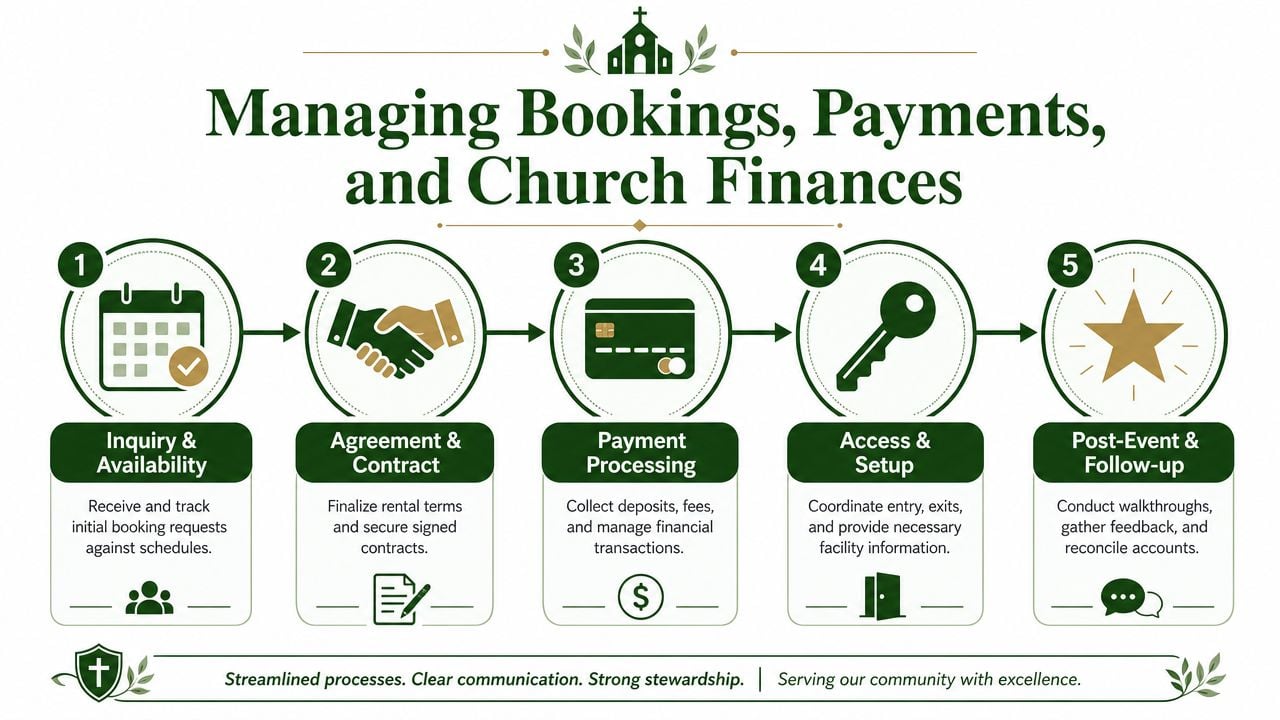
Run every booking through the same sequence
Consistency matters more than complexity. Even a simple system works if every renter goes through the same steps in the same order.
A reliable booking flow usually looks like this:
- Inquiry comes in through email, form, phone, or listing platform
- Availability is checked against the master church calendar
- Use is screened for fit with policy and scheduling constraints
- Terms are issued with the rate, rules, and agreement
- Contract is signed before access is granted
- Payment is collected according to the church's timeline
- Event is hosted with access, setup, and support clearly assigned
- Post-event review happens with damage check, cleanup review, and any follow-up billing
Most rental problems come from skipping one of those steps. The church gives a tentative yes before checking the ministry calendar. A renter gets access before the signed agreement is back. Finance hears about the booking only after the event happened.
Payment handling needs discipline
Churches should decide in advance how they'll collect deposits, event fees, add-on charges, and refunds. The key is not the specific payment tool. It's the control structure around it.
Use one payment process for everyone. Avoid informal exceptions. Match every payment to a contract, a date, and a specific renter. Keep supporting documentation where finance staff can retrieve it later.
A sound administrative setup includes:
- A single calendar owner so double-booking doesn't happen
- A central contract file with signed agreements and correspondence
- A payment log tied to invoice status and event date
- A post-event checklist for damage, overtime, and refund review
Rental income has to be accounted for correctly
Many churches outgrow generic bookkeeping habits. Rental revenue may look straightforward, but the reporting implications are not always simple.
Some rental income may be treated as general operating revenue. Some may be designated by the church for facilities, debt service, or maintenance. If the church provides substantial services or if the property is debt-financed, the tax treatment can become more complicated. Neutral church finance guidance explains that rent from real property is generally excluded from unrelated business taxable income, but that exclusion can be lost in certain cases, potentially requiring the church to file Form 990-T. That's why this overview of church rental income and UBIT considerations is important reading, and why a CPA should review your structure.
Finance warning: Don't treat rental income as “extra money” that sits outside your normal controls. It needs the same documentation, board visibility, and fund-level accountability as any other revenue stream.
For teams tightening their monthly close and reporting process, Grain's guide to bookkeeping for churches is useful because it addresses the difference between basic bookkeeping and the kind of disciplined tracking churches need.
A rental program succeeds operationally when the calendar, contract file, and accounting records all tell the same story.
Marketing Your Space and Finding the Right Renters
Once the space is ready, many churches make a common mistake. They market to “anyone.” That usually creates weak-fit inquiries, awkward tours, and a lot of time spent answering requests you were never going to approve.
The best marketing for churches for rent starts by making the church's ideal renter visible.
Two inquiries tell you almost everything
One inquiry comes from a weekday tutoring nonprofit. They need classroom space in the late afternoon, want a predictable schedule, ask thoughtful questions about parking and check-in, and are comfortable with your building rules. That's often a strong-fit renter. Their use is understandable, repeatable, and unlikely to clash with church identity.
Another inquiry comes from a for-profit event organizer who's vague about the program, wants broad access to multiple rooms, pushes back on your restrictions, and expects exceptions before they've even toured the building. That doesn't automatically mean you say no. It does mean you slow down and screen carefully.
Good churches for rent programs are not built by filling the calendar fast. They're built by approving renters who respect the building, fit the church's operational capacity, and don't force constant exceptions.
What your listing should actually communicate
A strong listing does three jobs. It shows the space clearly, explains what uses are welcome, and filters out bad-fit inquiries before they start.
Include:
- Accurate photos of the actual rooms being rented
- Straight descriptions of seating, layout, parking, accessibility, and kitchen access
- Approved use categories so renters know whether they should inquire
- Non-negotiable rules so there's no surprise later
- A clear inquiry process with the information you need up front
If your team wants to create better short-form promos for social listings or community outreach campaigns, a tool like the ShortGenius AI ad generator can help produce simple promotional video assets without forcing your staff to start from scratch each time.
Screen with respect, not suspicion
A church doesn't need to interrogate people. It does need to ask direct questions. What is the event? Who is attending? Will children be present? Will food be served? What time does setup begin? Will the group need sound, kitchen, or after-hours access?
That screening process protects both sides. Strong renters usually appreciate it because it signals that the church is organized.
Here's a helpful walkthrough on how churches can think about presenting and promoting space online:
The churches that do this well don't just ask, “How do we get more renters?” They ask, “Who belongs in this building?” That question leads to better listings, better partnerships, and fewer operational surprises.
If your church is adding rental income to the mix, your books need to reflect church reality, not generic small-business accounting. Grain is built for true church fund accounting, so finance teams can track every dollar with clarity, keep designated money properly organized, and report to pastors and boards with confidence.
Ready to simplify your church finances?
Start free with church fund accounting, or watch a product demo first.