
Donating to Church: Simple Ways to Support Your Congregation
 By Gibson Brueher, Founder of Grain Ledger
Discover how donating to church works today—modern giving options, tax basics, and practical stewardship tips to strengthen ministry.
Giving to your church is a profound act of faith. It’s the engine that powers everything from community outreach and staff salaries to keeping the lights on in the building where you worship and connect. But have you ever wondered what actually happens after you drop a check in the offering plate or hit the "give" button online?
It’s more than just a simple bank deposit. The journey your gift takes is built on a foundation of trust, careful stewardship, and a deep commitment to the church's mission. Pulling back the curtain on this process isn't just for church leaders; it helps everyone see how their generosity creates real, tangible impact.
The Heart of Church Giving: From Donation to Ministry
For many of us, giving is a regular rhythm of our spiritual lives. Yet, the path a donation travels from your hands to funding ministry work is often a mystery. Understanding this journey demystifies church finances and, more importantly, deepens the connection between your personal act of giving and the good work it accomplishes.
Think of it as a partnership. For givers, knowing the process brings confidence and clarity. For church finance teams, it's a constant reminder of the incredible responsibility they have to manage these gifts with complete integrity. At the end of the day, every dollar is a tool for ministry, and showing how those tools are used is the key to building and maintaining trust with your congregation.
From a Gift to Its Purpose
When you get right down to it, the flow of a church donation follows a straightforward, three-part cycle. It all starts with your decision to give. From there, the church steps in to manage that resource faithfully. Finally, that gift is put to work, funding the mission and ministries you care about.
This visual shows how that simple process unfolds, turning an individual act of generosity into collective ministry action.
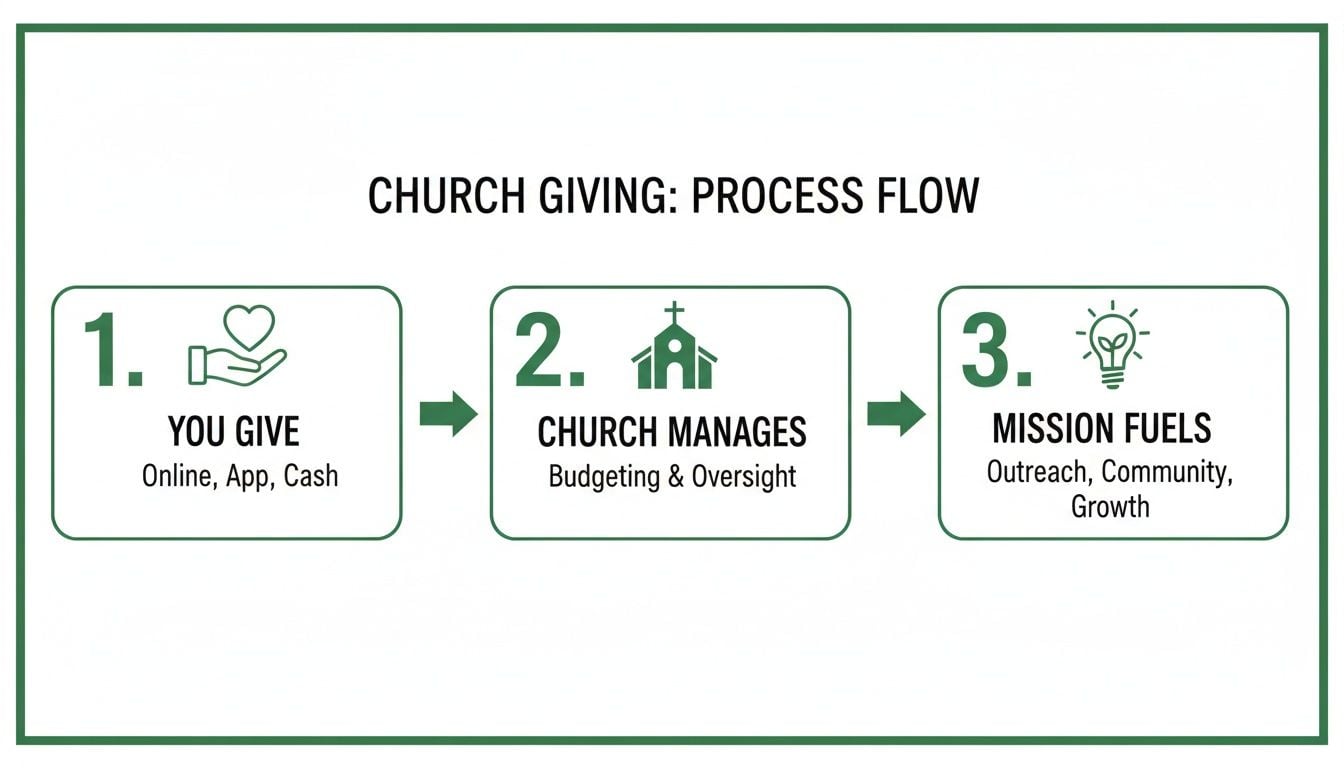
As you can see, your generosity is the starting line. It’s the catalyst that empowers the church to serve its community, support missions, and create a space for spiritual growth.
Why This Process Matters So Much
Handling donations isn't just an administrative task—it's a spiritual responsibility. When a church manages its finances with transparency and care, it honors the heart behind every single gift. This fosters a culture where people are genuinely excited to give because they see the fruit of their contributions firsthand.
When you can clearly see how your donation is fueling the mission, giving stops feeling like an obligation and starts feeling like a partnership. It powerfully connects your personal faith to the collective work of the church, turning a financial gift into a true act of worship.
This kind of responsible stewardship is essential for a healthy, thriving church. When people trust that their money is being handled well, they’re far more likely to give consistently and generously. That financial stability allows the church to plan for the future, launch new initiatives, and respond to unexpected needs with confidence. Ultimately, a transparent and trustworthy process strengthens the entire faith community.
Modern Ways to Give Beyond the Offering Plate
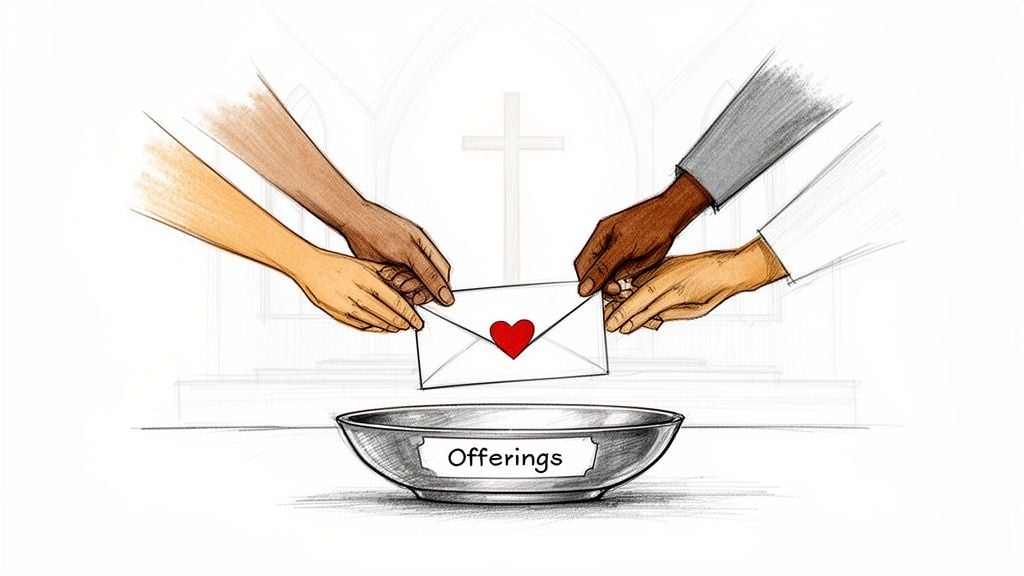
While passing the offering plate is a powerful, unifying moment in a service, how people handle their money has changed dramatically. Churches that adapt to these changes are simply making it easier for their congregation to support God’s work in a way that feels natural to them.
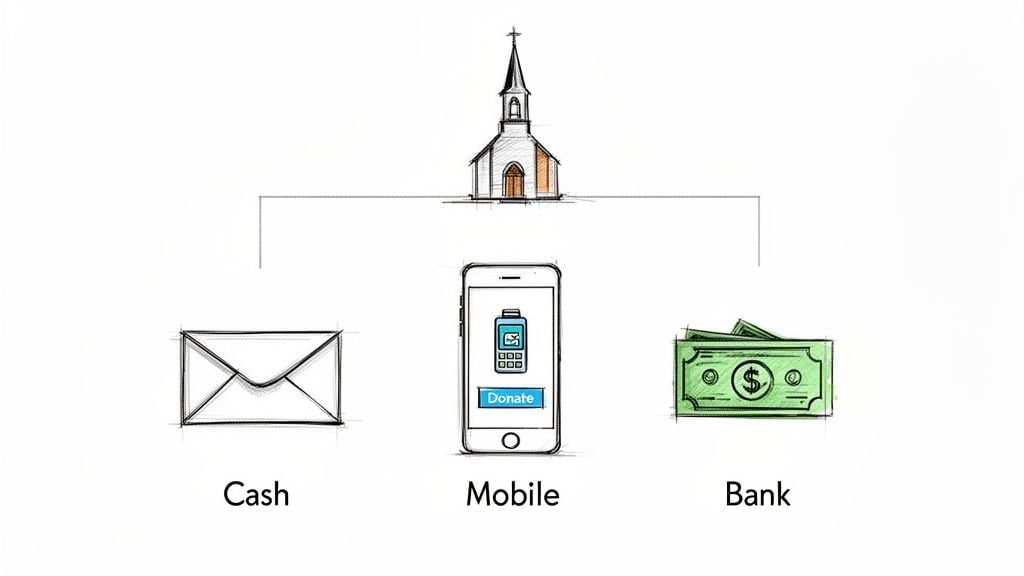
Think of it like a grocery store. Some people prefer the cash lane, others want to tap their card, and some use their phone. By providing a spectrum of options, a church removes hurdles to giving and fosters a culture of generosity that meets people where they are.
Traditional and Trusted Methods
Even with all the new technology, cash and checks are still mainstays in church giving. For many, the physical act of placing a gift in the offering plate is a deeply meaningful part of their worship.
- Cash: It’s simple, direct, and anonymous. The main drawback is on the administrative side—it requires careful manual counting and is nearly impossible to track for a donor's tax receipt unless they use a marked giving envelope.
- Checks: This method creates an automatic paper trail for both the donor and the church. In fact, a canceled check is a valid receipt for tax purposes, which simplifies record-keeping for everyone.
For the church finance team, both of these methods demand secure handling, locked storage, and meticulous data entry. This manual work underscores just how important a reliable system is for managing physical gifts alongside digital ones.
The Shift to Digital and Online Giving
The most significant change in church giving has been the move online. It's all about providing a way for people to give whenever they feel led to—whether that's at 10 PM on a Tuesday or right after the sermon on Sunday.
It's a proven fact: churches that begin accepting online donations almost always see an overall increase in giving. The ability for members to set up recurring gifts, in particular, creates a steady and predictable foundation for ministry planning.
Exploring tools like specialized donation form templates can make it much easier for a church to get started. Ultimately, this isn't just about technology; it's about making generosity more accessible for the whole community.
A Comparison of Modern Church Donation Methods
To help visualize the options, this table breaks down the most common giving methods today, outlining the benefits and challenges for both the person giving and the church staff managing the gift.
| Donation Method | Pros for Donors | Cons for Donors | Pros for the Church | Cons for the Church |
|---|---|---|---|---|
| Online/App Giving | Convenient, can give 24/7, easy to set up recurring gifts. | Requires internet access; some may have security concerns. | Increases overall giving, predictable revenue from recurring gifts. | Incurs transaction fees (2-3%), requires a giving provider. |
| Recurring ACH | "Set it and forget it," automates generosity. | Initial setup can feel a bit more involved than a simple card payment. | Very low processing fees (often <1%), creates stable income. | Setup can take a few days; not ideal for one-time gifts. |
| Text-to-Give | Extremely fast and easy, great for in-the-moment giving. | Can feel impersonal, often has donation limits. | Captures spontaneous generosity, especially from younger givers. | Higher transaction fees; requires a specific platform. |
| Checks | Provides an automatic receipt (canceled check), feels traditional. | Requires physically writing and delivering the check. | Lower processing cost (bank deposit), clear donor information. | Manual processing, data entry, and risk of bouncing. |
| Cash | Anonymous and simple, tangible act of worship. | No automatic tax receipt; requires giving envelopes for tracking. | No processing fees. | Security risks, requires manual counting and careful handling. |
As you can see, each method serves a different need. The goal isn't to pick just one, but to build a comprehensive giving strategy that accommodates everyone in your congregation.
Exploring the Spectrum of Modern Channels
Beyond a simple "donate" button, a modern giving strategy often includes several distinct channels that cater to different preferences.
- Recurring Bank Transfers (ACH): This is a game-changer for budget stability. Donors can authorize automatic, recurring gifts directly from their bank accounts. These "set it and forget it" donations are a powerful source of consistent support and have much lower processing fees for the church compared to credit cards.
- Text-to-Give: Perfect for capturing in-the-moment generosity, this option lets members donate by sending a quick text. It's incredibly effective during special appeals or when a particular need is shared during a service.
- Church Apps: Many churches now offer a dedicated mobile app that puts giving right alongside event calendars, sermons, and group messages. This integrates generosity directly into the center of church life and communication.
For church leaders trying to navigate these options, our guide on online giving platforms for churches can help you find the right fit.
At the end of the day, a solid accounting solution is what holds all these streams together. A purpose-built church software like Grain Ledger is designed to connect with different giving providers, automatically routing donations from a check, a text, or a bank transfer into the correct fund. This ensures every single gift is tracked with complete accuracy and integrity from the moment it's given.
Navigating Tax Rules and Donation Receipts
When you give to your church, you want to be confident your gift is making an impact. But there's another side to that confidence: knowing you've handled the tax details correctly. Proper documentation isn't just bureaucratic red tape; it's a legal necessity for both you and the church you support.
Getting this right ensures your generosity is properly recognized by the IRS and helps your church maintain its financial integrity.
First things first, for your donation to be tax-deductible in the United States, the church itself must be a qualified 501(c)(3) organization. The good news is that most churches automatically qualify. This designation is the IRS's way of officially recognizing an organization as a charity, which is what makes your gifts eligible for a deduction on your tax return.
What Makes a Donation Receipt Valid
When tax season rolls around, a line on your bank statement or a simple thank-you note isn't enough, especially for larger gifts. The IRS has specific requirements for what makes a donation receipt valid, particularly for any single contribution of $250 or more. Think of this receipt as the official, government-approved record of your gift.
For a receipt or an end-of-year giving statement to pass muster with the IRS, it has to include a few key pieces of information:
- The Church's Name: The full, legal name of the organization.
- The Date of the Contribution: The day the gift was made.
- The Amount of the Contribution: The exact dollar value of your cash donation.
- A Statement on Goods or Services: This is a crucial detail that's easy to overlook.
That last point is where things can get a bit more nuanced, and it highlights an important distinction in charitable giving.
A valid receipt must explicitly state whether you, the donor, received any goods or services in exchange for your contribution. This ensures that only the purely charitable portion of your gift is considered for a tax deduction, maintaining transparency and compliance with tax law.
This requirement helps separate a true gift from a transaction where you get something in return.
Understanding Quid Pro Quo Contributions
Sometimes, a donation comes with a tangible benefit for you. This is what's known as a "quid pro quo" contribution, a Latin phrase that simply means "something for something." A classic example is buying a ticket to a church fundraising dinner. You're supporting a good cause, but you're also getting a meal.
In these cases, you can only deduct the portion of your contribution that exceeds the value of what you received. For instance, if you pay $100 for that dinner ticket and the fair market value of the meal is $30, your actual tax-deductible donation is $70. The church is legally required to provide you with a written statement that clearly explains this breakdown.
Keeping all of this straight is a major responsibility for any church finance team. This is where a dedicated church accounting tool like Grain Ledger becomes invaluable. By tracking every donation and its specific context, it can automatically generate accurate, compliant end-of-year statements. These statements clearly distinguish between pure gifts and quid pro quo contributions, protecting both the donor and the church.
If you want to dig deeper into this topic, you can learn more about how to ensure your church donations are tax deductible.
Restricted Funds vs. Unrestricted Funds
Have you ever given to your church with a specific project in mind—maybe a missions trip, a new youth center, or the community food pantry? When you do that, you're touching on one of the most important concepts in church finance: the difference between restricted and unrestricted funds.
Getting this right is crucial. It’s how you can be sure your generosity has the exact impact you hope for, and it’s how your church maintains financial integrity.
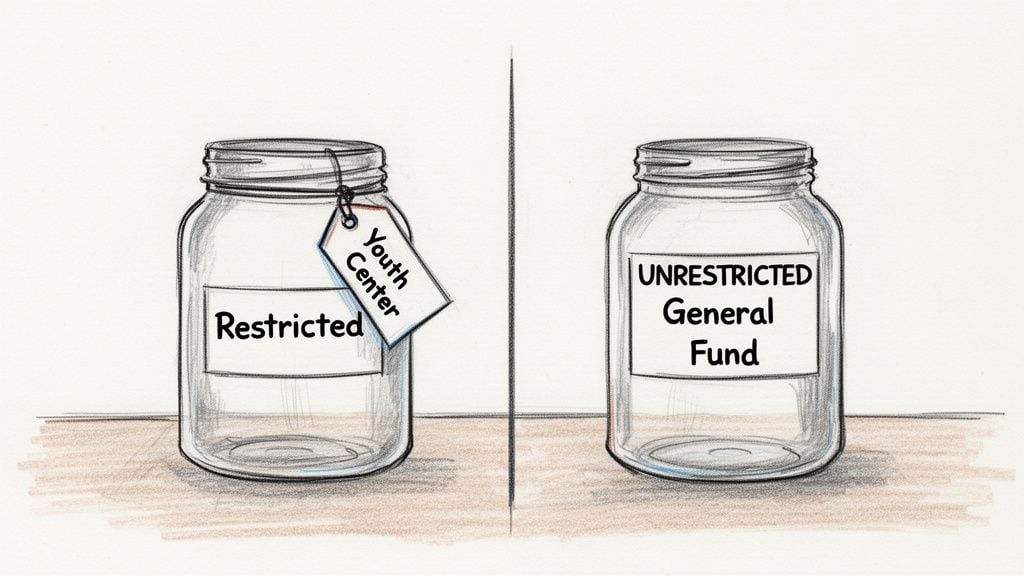
Think of it like this: an unrestricted donation is like giving cash with a note that says, "Use this wherever it's needed most." Church leadership can direct these funds to the ministry's core operational needs, whether that’s keeping the lights on, buying curriculum for a Bible study, or covering staff salaries. This flexibility is what keeps the church running week to week.
A restricted donation, however, is more like a gift card to a specific store. When you designate your gift for the "Building Fund" or "Missions," you are placing a legal and ethical "restriction" on how it can be used. The church is now obligated to honor your intent and can only spend that money on the purpose you specified.
Honoring a Donor's Intent
When someone gives a restricted gift, they are placing a tremendous amount of trust in the church. This isn't just a friendly suggestion; it's a binding commitment. A church simply cannot use money donated for a new roof to cover a budget shortfall somewhere else, no matter how urgent that need might seem.
This principle is the bedrock of trustworthy stewardship. It ensures that donor wishes are respected and that the special projects people are passionate about actually get funded and completed. If restricted funds are misused, even by accident, it can shatter the trust between a congregation and its leaders and even lead to legal trouble. This is why meticulous tracking isn't just a good idea—it’s absolutely essential.
How to Make Your Intentions Clear
For this to work smoothly, communication has to be clear from both the donor and the church. If you want to restrict your gift, you need to make it obvious.
- Checks: The memo line is your best friend. Simply write the fund name, like "Youth Camp," right there.
- Giving Envelopes: Most churches design their envelopes with checkboxes or lines for you to specify a fund.
- Online Giving: A good online giving platform will always have a dropdown menu or a text box allowing you to choose the fund you want to support.
It's important to know that if a donation comes in with no designation at all, it’s automatically considered unrestricted and goes into the church's general fund. This is the standard practice for any gift that doesn't have specific instructions.
Honoring donor intent is more than a financial task; it's a stewardship issue. When a church proves it can faithfully manage designated gifts, it builds a powerful culture of trust that encourages targeted, passionate, and often sacrificial giving for special projects.
This deep commitment to honoring designations is exactly why churches can't just use any off-the-shelf accounting software.
Why Standard Accounting Software Fails
Think about it: a typical small business uses accounting software to track one big pot of money. All income goes in, all expenses go out, and the goal is to see the overall profit or loss.
But a church isn’t managing one pot of money. It’s managing dozens of them, all at the same time, each with its own set of rules.
When churches try to manage restricted funds with standard software, they often end up with messy spreadsheet workarounds that are a nightmare to maintain. It becomes dangerously easy to accidentally dip into the "Missions Fund" to pay a general bill, breaking the trust placed in the church. This is where a true fund accounting system is no longer a luxury, but a necessity.
An accounting solution built for churches, like Grain Ledger, is designed from the ground up to handle this complexity. Its fund-based architecture automatically keeps restricted money separate from unrestricted money. When you donate to the "Building Fund," that money is electronically walled off so it can only be spent on building-related expenses.
This gives pastors and finance teams the clarity they need to steward every dollar with integrity, ensuring every gift is used exactly as the donor intended.
5. From Donation Plate to Financial Report: How Churches Steward Your Gift
When you give to your church, you're doing more than just making a financial transaction—you're placing a sacred trust in your church’s leadership. From the moment that gift leaves your hands, the church has a profound responsibility to manage it with absolute integrity. This isn't as simple as just cashing a check and paying the light bill; it’s a unique accountability that lies at the heart of ministry finance.
Honoring that trust is non-negotiable, especially when a donor designates a gift for a specific purpose. Yet, many churches unknowingly create huge financial risks by using standard business accounting software, which simply wasn't built for how a church actually operates.
The “One Big Pot” Problem with Business Software
Think about typical accounting tools. They’re fantastic for a coffee shop or a small business where all income flows into one big pot and all expenses are paid out of it. The goal is simple: measure profit and loss.
But a church isn’t a single-pot operation. It’s more like a collection of separate financial jars, each labeled for a specific, legally-binding purpose—the missions fund, the building campaign, the youth group, and the general operating fund.
Trying to manage these distinct funds in software designed for one general pot is like trying to keep different colors of paint separate in a single bucket. It doesn't work. Before long, you have a murky, indistinguishable mess. This common mistake almost always leads to major headaches:
- Fragile Spreadsheet Workarounds: Finance teams end up building a shadow-system of complicated spreadsheets just to track what money belongs where. These are a nightmare to maintain, incredibly prone to human error, and nearly impossible for anyone else to decipher.
- Accidental Misuse of Funds: Without clear digital walls between funds, it becomes frighteningly easy to accidentally “borrow” from the Missions Fund to cover a payroll shortfall, breaking the promise made to the donor.
- Zero Clarity in Reporting: When a board member asks, "How much is left in the Building Fund?" you can't just run a simple report. This lack of transparency slowly but surely erodes the congregation's trust.
This is exactly why fund accounting isn’t just a good idea for churches—it’s the only way to guarantee financial integrity.
Fund Accounting: The Bedrock of Trust
Fund accounting flips the script entirely. Instead of one big bucket, it creates separate, self-contained digital funds. When a donation comes in, it’s immediately assigned to its proper fund. When an expense is paid, it’s drawn directly from the correct fund.
Fund accounting isn't just a bookkeeping method; it’s a system built for integrity. It ensures that money given for Bibles for the youth group can only be spent on Bibles for the youth group. It creates a crystal-clear, auditable trail that honors the donor’s intent from start to finish.
This approach gives pastors and finance committees immediate, accurate answers to their most critical stewardship questions. "How are we doing on the food pantry budget?" or "Did we properly use the memorial gift from the Smith family?" The conversation shifts from wrestling with messy spreadsheets to making wise, informed decisions.
A Solution Built for the Church: Grain Ledger
This is the very reason we built Grain Ledger. It’s not just business software with a few church-y features bolted on. It's a true fund accounting system designed from the ground up for the unique financial DNA of a ministry.
Grain’s entire system is built on native fund architecture. This means every single transaction, report, and balance is automatically organized by fund. There are no workarounds or spreadsheets needed because the system is built to think like a church treasurer. It even connects to your bank and online giving platform, so designated donations flow straight into the correct fund without anyone touching a keyboard.
By delivering clear, real-time financial reports, Grain empowers church leaders to practice radical transparency. With just a few clicks, you can produce a statement showing every dollar in and every dollar out of the "Youth Center Fund," proving to your congregation that their generosity is being stewarded exactly as they intended. You can see why this is so critical in our guide to essential church financial reports.
Ultimately, managing donations with integrity is about so much more than the numbers. It’s about honoring the heart behind every gift, building a culture of unshakable trust, and ensuring every resource is deployed to advance the mission God has given you.
Frequently Asked Questions About Church Donations
When it comes to church giving, questions are a good thing. They show that people—both the donors and the church leaders stewarding the gifts—are taking financial integrity seriously. Whether you’re a member wanting to give wisely or a church leader managing those funds, getting clear answers is essential for building trust.
This final section tackles some of the most common questions we hear about church donations. Our goal is to provide straightforward answers that help everyone involved feel confident that every dollar is making a difference for the Kingdom.
How Much of My Donation Actually Goes to Ministry?
This is one of the most honest and important questions a donor can ask. Any healthy church should be ready and willing to answer it with transparency. While the exact numbers will differ from church to church, the money you give powers a whole ecosystem of ministry.
Your donation is typically working in a few key areas:
- People and Leadership: This covers the salaries for the pastors, children's ministry directors, administrative staff, and everyone else who carries out the day-to-day work of the church.
- Places and Operations: These are the costs to keep the lights on and the doors open. Think mortgage or rent, utilities, insurance, and maintenance for the buildings where ministry happens.
- Programs and Discipleship: This is money directed right into community outreach, small group materials, youth group events, worship service resources, and more.
- Partnerships and Missions: A significant portion of a church's budget is often dedicated to supporting missionaries and mission organizations, both in the local community and around the globe.
It’s easy to look at administrative or facility costs as "overhead," but a better way to see it is as the essential scaffolding that makes all the other ministry possible. A well-run church will often have an administrative cost of around 10-15%, which is a sign of an efficient and well-managed organization. Look for an annual report or a members' meeting where the budget is openly discussed.
What Is the Difference Between a Tithe and an Offering?
These two words are often used interchangeably, but they actually point to two distinct, meaningful acts of worship. Grasping the difference can bring a new level of intention to your giving.
A tithe is a biblical concept of giving the first 10% of one's income back to God, through the local church. For many, this isn't seen as giving something to God, but rather returning what is already His. It’s a foundational discipline of faith and obedience, and these funds typically support the church's main operating budget (unrestricted funds).
An offering is any gift given above and beyond the tithe. It’s a free-will expression of gratitude, a joyful response to God’s blessings in your life. While a tithe provides consistent support for the core mission, an offering can be given to the general fund or designated for a specific purpose, like a building campaign, a special missions project, or a benevolence fund for families in need.
"A tithe is what we owe, an offering is what we sow." This simple phrase captures the difference beautifully. The tithe is a consistent act of faithfulness, while the offering is a spontaneous act of generosity.
Can I Get My Restricted Donation Back?
This is a tricky question that gets to the very heart of donor trust. When you give a restricted gift—money designated for a specific purpose—the church is legally and ethically obligated to honor that restriction. They can't just decide to use it for something else.
But what happens if that designated project falls through? For example, let's say a planned missions trip gets canceled. In that case, the church leadership has a responsibility to contact you, explain the situation, and get your permission to redirect the funds to a similar ministry need.
Actually refunding a donation is another story. It's extremely rare and creates major accounting and legal headaches for both you and the church. Once your donation is processed, it's considered a completed charitable contribution for tax purposes. Reversing it is messy. This is why clear, proactive communication is so crucial—it ensures your gift can still have a powerful impact, even when plans change.
Why Can't My Church Just Use Standard Accounting Software?
This might be the most underestimated financial risk a church can take. On the surface, using a popular business accounting program seems like a smart, affordable way to manage the books. But these tools are built for a completely different purpose, and using them for a church is like trying to fit a square peg in a round hole.
Standard business software is designed to track profit and loss for a single entity—one big pot of money. A church doesn't have one pot of money; it has dozens of them. You have the general fund, the building fund, the youth ministry fund, the missions fund, and so on, each with its own legal and ethical restrictions.
Trying to manage this with a business tool almost always leads to problems:
- Clunky Spreadsheet Workarounds: Your team ends up building a maze of spreadsheets outside the main software just to keep track of which money belongs where. This is a huge time sink and a breeding ground for human error.
- Accidental Misuse of Funds: Without digital guardrails between funds, it's dangerously easy to "borrow" from a restricted fund to cover a general expense. This breaks donor trust and can even lead to legal trouble.
- Cloudy Financial Reports: When the board asks for a simple report on the "Missions Fund" balance, you can't get a clean answer. This lack of clarity slowly erodes confidence in the church's financial leadership.
A true fund accounting system is engineered differently from its very foundation.
To ensure financial integrity, a church needs a system that thinks in funds. This is where a purpose-built accounting solution like Grain Ledger is not just helpful, but essential. It is designed with a native fund architecture that automatically separates and tracks every dollar according to its designated purpose.
With Grain Ledger, there are no workarounds. The software inherently understands the difference between the missions fund and the general budget. This ensures donor intent is always honored, giving pastors and finance committees the crystal-clear reports they need to lead with confidence and complete transparency.
Are you ready to bring true fund accounting and unshakable financial integrity to your church? Grain Ledger is the purpose-built solution designed to handle the unique complexities of ministry finance, from automated donation tracking to clear, fund-level reporting. Schedule a Demo to learn more and see how Grain Ledger can build confidence in your stewardship.
Ready to simplify your church finances?
Start free with church fund accounting, or watch a product demo first.