Financial Statement Format for Non Profit Organization
Learn the essential financial statement format for non profit organization. Simplify reporting and ensure compliance with this 2026 guide.
You're halfway through a finance committee meeting when someone asks why the church has plenty of net assets but can't use the building fund to cover payroll. The treasurer opens a spreadsheet showing operating, missions, benevolence, and building balances, but the report is too detailed for the board and too vague to answer the question. That tension is exactly what a clear financial statement format for a non profit organization should resolve.
About Grain Ledger: This guide includes Grain Ledger, church fund accounting software built for designated gifts and ministry funds. It connects giving platforms (Planning Center, Pushpay, Tithely, Stripe), syncs bank activity with Plaid, and produces fund-level financial reports. Start free to see how it compares for your church.
See Grain Ledger for your church
Fund accounting, giving integrations, and bank reconciliation in one platform. Free migration support for churches switching from QuickBooks or Aplos.
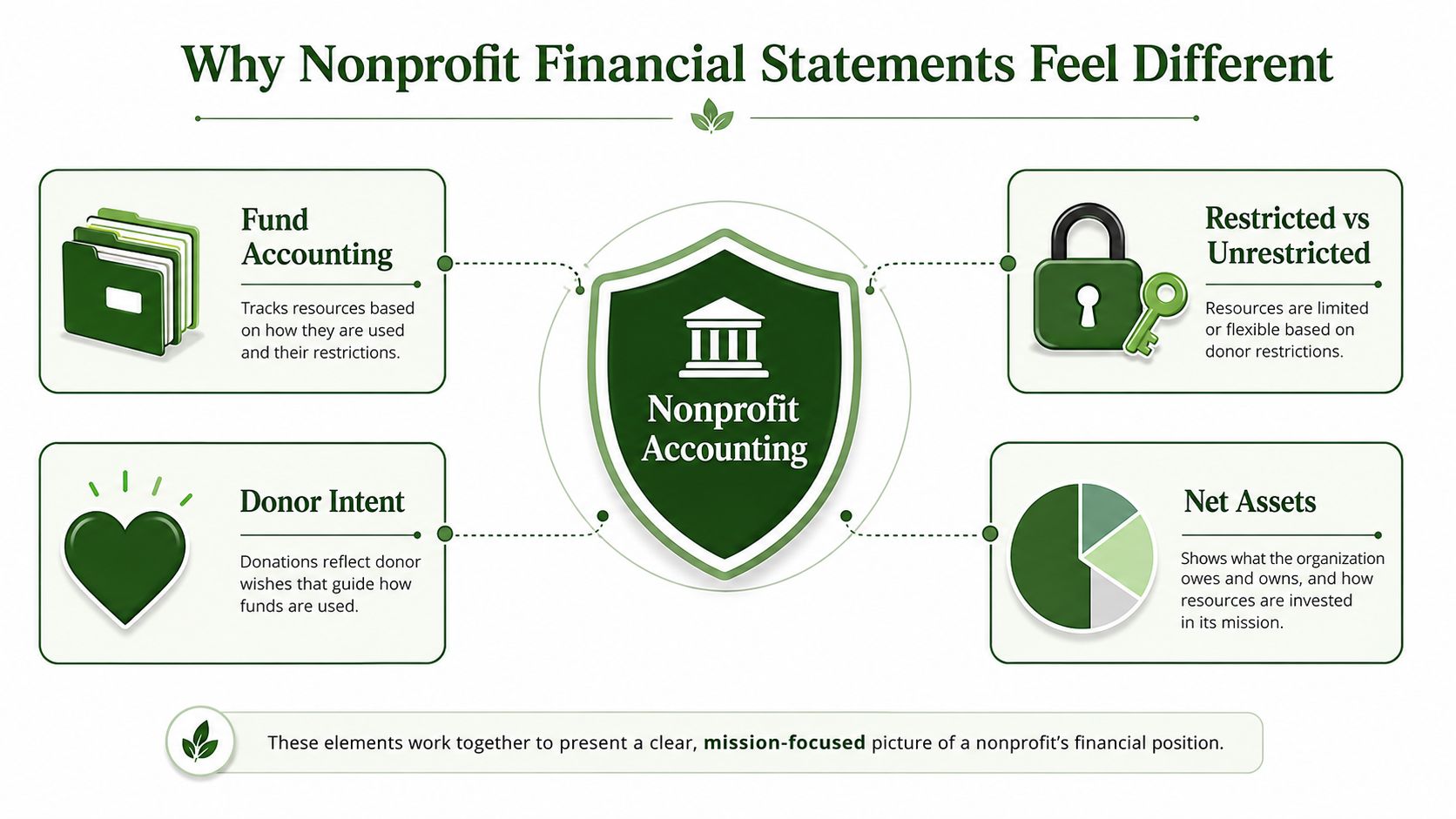
Nonprofit financial statements aren't just profit-and-loss reports with different labels. They show what resources the organization has, who controls their use, how money moved, and how spending supported the mission. For churches, the format must also make donor intent visible without forcing every reader to work through every fund transaction.
Why Nonprofit Financial Statements Feel Different
A church treasurer preparing quarterly financials usually starts with a practical question: “What can we safely tell the board?” The answer can't come from the bank balance alone. A single account may contain operating cash, a donor-restricted building gift, missions support, and benevolence money, even though each resource carries a different responsibility.
That's the central difference between nonprofit and for-profit reporting. A business primarily organizes financial information around profitability and ownership. A nonprofit must also show purpose, donor restrictions, and stewardship. The church may have cash in the bank, but that doesn't mean every dollar is available for general ministry.
The four reports that tell the story
Under current U.S. GAAP, nonprofit reporting uses four core statements:
- Statement of Financial Position: Shows assets, liabilities, and net assets at a point in time.
- Statement of Activities: Shows revenue, expenses, changes in net assets, and reclassifications during the reporting period.
- Statement of Cash Flows: Explains how cash moved through operating, investing, and financing activities.
- Statement of Functional Expenses: Shows expenses by both their natural type and their functional purpose, such as program services, management and general, or fundraising.
FASB's ASU 2016-14, issued on August 18, 2016, reduced the older three net-asset classes to two: net assets with donor restrictions and net assets without donor restrictions. The change created a cleaner face-of-statement format while requiring organizations to preserve more detail in their records and disclosures. The FASB ASU 2016-14 guidance explains the presentation framework.
Practical rule: The face of the statement should be readable, but the accounting records behind it should be detailed enough to prove every restricted balance.
For a church, that means fund accounting still matters even when the formal financial statements show only two net-asset classes. An operating fund may generally fall within net assets without donor restrictions, while a building gift restricted by the donor remains within net assets with donor restrictions until the applicable condition is met. A church finance team can also use fund accounting guidance for nonprofits to connect everyday fund tracking with formal reporting.
The first step isn't memorizing statement titles. It's recognizing that each report answers a different stewardship question. A helpful overview of the preparation process is available in Allied Tax Advisors' statement preparation tips, especially for teams building a reporting routine for the first time.
Building the Statement of Financial Position
The Statement of Financial Position is the nonprofit version of a balance sheet. It presents assets, liabilities, and net assets, but the net-assets section must distinguish resources available for general purposes from resources subject to donor restrictions.
Start with the assets. List cash, investments, receivables, prepaid expenses, property, and equipment in a way that helps readers understand liquidity. Then list liabilities, such as accounts payable, accrued obligations, loans, and other amounts the church owes. The statement must balance because total assets equal total liabilities plus net assets.
Map each church fund to the right class
Suppose a church tracks four internal funds:
- Operating: General offerings and other resources without donor-imposed restrictions usually support ordinary ministry and administration.
- Building: A contribution restricted by the donor for a building project belongs in net assets with donor restrictions until the restriction is satisfied.
- Missions: A gift limited to missions work also belongs in net assets with donor restrictions.
- Benevolence: A donor-limited benevolence gift remains restricted until used for the permitted purpose.
The fund names help the church manage its records, but the formal statement reports the two GAAP net-asset classes. Don't merge restricted and unrestricted balances into one “total available” figure. That presentation can mislead the board into treating restricted money as operating cash.
FASB permits either a single-column format, which works well for multiyear comparative reporting, or a columnar format with separate columns for each net-asset class and an optional total column. The relevant FASB presentation guidance supports both approaches.
A practical template
| Section | Line Items | Notes |
|---|---|---|
| Assets | Cash, investments, receivables, property and equipment | Present resources in a useful order, with liquidity in mind |
| Liabilities | Accounts payable, accrued obligations, loans | Separate current obligations from longer-term amounts when appropriate |
| Net assets without donor restrictions | Operating resources and other unrestricted balances | May include board-designated amounts, which remain without donor restrictions |
| Net assets with donor restrictions | Building, missions, benevolence, time-restricted, or endowment-related resources | Support the face amount with restriction disclosures and fund records |
| Total | Total assets, liabilities, and net assets | Confirm that the statement reconciles |
A board may prefer columns for the current period, prior period, each net-asset class, and a total. A smaller church may prefer a clean single-column comparison with a note that explains the composition of restricted balances. Both can work if the classification and reconciliation remain clear.
For terminology and a deeper walkthrough, use this explanation of what a Statement of Financial Position includes. The report should help the board answer a simple question: What do we have, what do we owe, and how much is available for general use?
Understanding the Statement of Activities
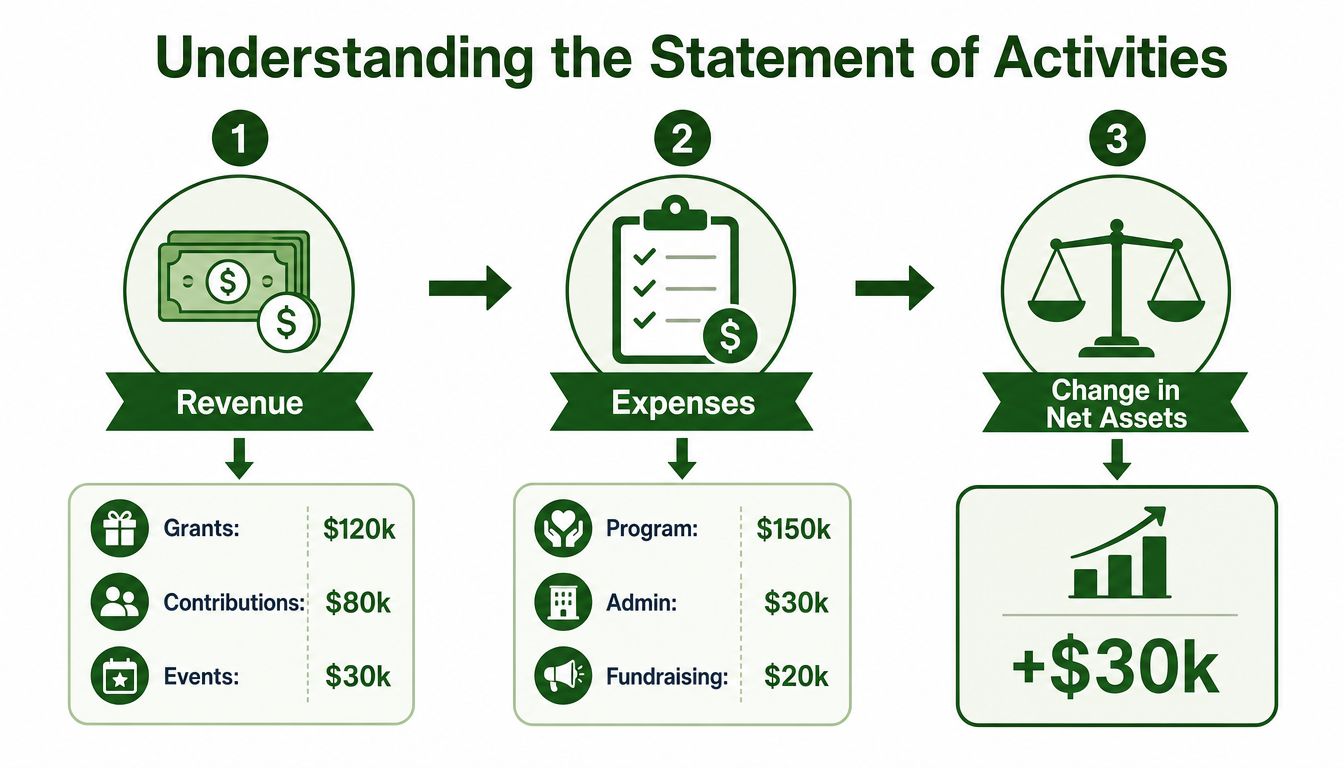
The Statement of Activities explains what happened during the period. It brings together contributions, grants, program revenue, investment income, other support, expenses, changes in net assets, and releases from restriction.
The key accounting point often surprises new board members: restricted contributions are recognized when received, not when spent. When the donor restriction is satisfied, the organization records a reclassification from net assets with donor restrictions to net assets without donor restrictions. The restricted-fund accounting explanation from Zeffy describes this core treatment.
Follow the building-fund example
Assume a church receives a $50,000 donor-restricted contribution for a roof project in the first quarter. The gift is recognized when received:
- Debit cash, $50,000.
- Credit contribution revenue, net assets with donor restrictions, $50,000.
At that point, the church has more assets and more net assets with donor restrictions. It doesn't yet have general operating revenue, even though the cash sits in a church bank account.
When the roof project is completed in the third quarter and the donor condition is satisfied, the church records the release:
- Debit net assets with donor restrictions, $50,000.
- Credit net assets without donor restrictions, $50,000.
The release doesn't create new cash or new total net assets. It moves the amount between net-asset classes so the statement reflects that the donor's purpose has been fulfilled.
A restricted gift can increase total net assets while leaving the church's operating flexibility unchanged.
The statement's columns should make this movement understandable. Depending on the reporting format, readers may see revenue and expenses separated between net assets without donor restrictions and net assets with donor restrictions, followed by amounts released from restriction and the resulting change in each class.
A church finance team should also distinguish donor restrictions from internal designations. If the board sets money aside for a future project, that designation doesn't carry the same accounting status as a donor-imposed restriction. The records should preserve the difference so the board knows which decisions it can change and which commitments it must honor.
For a report designed specifically around this activity, see the guide to the nonprofit Statement of Activities.
The following video can help new committee members connect revenue, expenses, and net-asset movement to the formal statement:
Cash Flows and Functional Expenses Explained
A church can look strong on its Statement of Financial Position and still face a cash problem. That happens when available cash is tied to a restricted purpose, while ordinary expenses require unrestricted resources.
The Statement of Cash Flows answers, “Where did cash come from, and where did it go?” It helps the board distinguish accounting results from liquidity. A building gift may increase cash, but it won't necessarily provide cash for payroll, utilities, or routine ministry if the donor restricted it to construction.
Guidance on nonprofit financial analysis emphasizes cash availability, continuity of support, and financial stability, not only surplus or net assets. It also identifies “What is the cash flow position?” as a core question for assessing nonprofit health. See the nonprofit financial performance assessment guide for that analytical perspective.
Read the two statements together
| Statement | Main question | Common church use |
|---|---|---|
| Statement of Cash Flows | Can available cash support obligations? | Review operating cash, capital purchases, debt activity, and restricted receipts |
| Statement of Functional Expenses | How did spending support the mission? | Separate program services from management and general and fundraising costs |
The Statement of Functional Expenses adds another layer by presenting expenses by natural classification, such as salaries, rent, supplies, and depreciation, and by functional classification, such as program services, management and general, and fundraising. Under the current U.S. nonprofit presentation model, this functional-expense disclosure applies across nonprofits rather than only selected charity types.
For a church, salaries may be allocated across worship, youth ministry, administration, and fundraising when those functions are supported by the underlying work performed. The allocation method should be consistent, documented, and understandable. A board doesn't need every payroll calculation in the main packet, but it does need confidence that the categories reflect actual ministry activity.
Use the cash flow statement to discuss liquidity, the functional expense statement to discuss resource use, and the other statements to explain balances and changes. No single report answers every stewardship question.
Making Fund-Heavy Statements Readable
More detail doesn't automatically create more accountability. A statement that lists every youth, missions, building, benevolence, and special-offering fund may be technically informative but practically unusable for a board meeting.
Singapore's charity guidance warns against listing every individual fund on the face of the statements. It recommends grouping funds into categories such as restricted, unrestricted, or endowment, because fund-by-fund presentation can cause statements to run across multiple pages. Read the Singapore charity fund-accounting handbook for that presentation guidance.
Put summary on the face, detail in the notes
A readable reporting package can use three layers:
- Formal statements: Show the required GAAP categories and major totals.
- Fund summary: Group operating, program, designated, restricted, or endowment-related balances into understandable categories.
- Supporting schedules: Provide the detailed fund-by-fund activity for the treasurer, auditor, finance committee, or ministry leaders who need it.
That structure keeps the board's attention on decisions rather than account-code archaeology. It also protects accountability because the detailed subledger remains available to support every summary amount.
The face of the Statement of Financial Position might show net assets without donor restrictions and net assets with donor restrictions. A note or supplemental schedule can then explain that restricted balances include building, missions, and benevolence resources. The board sees the classification required for reporting and the fund context required for stewardship.
Use notes to answer the questions behind the totals
Good notes should explain why restricted balances changed, what major purposes they support, and when releases occurred. If a fund carries a donor-imposed time or purpose restriction, the note should make that limitation clear without reproducing every transaction.
The same principle applies to internal board designations. A designated reserve can be shown in a supplemental schedule without being presented as donor-restricted net assets. That distinction helps board members understand which balances require donor permission and which decisions remain within board authority.
Clarity is not less accountability. It's accountability arranged so the reader can understand it.
A fund-heavy church should aim for a formal statement that a new elder can read without assistance, supported by schedules that an experienced treasurer can audit line by line.
Why Churches Need Purpose-Built Accounting Software
Church fund accounting tracks money by intended purpose rather than treating every bank balance as one pooled resource. Common church funds include operating, building, missions, and benevolence, and churches following GAAP must present the two net-asset classes clearly rather than merging everything into one unrestricted total. The church accounting overview from REA Advisory explains that relationship between fund tracking and GAAP presentation.
Generic business accounting software can record income and expenses, but church teams often have to add workarounds for fund restrictions. They may use tracking classes, spreadsheets, separate bank accounts, manual journal entries, or duplicated reports. Each workaround creates another place where a contribution can be misclassified or a restricted balance can become difficult to reconcile.
A purpose-built system starts with the church's actual operating model. Grain Ledger organizes accounts, transactions, and reports around funds from the beginning. It can connect giving platforms such as Planning Center, Pushpay, and Stripe with bank accounts and accounting records so donations flow into the intended funds without requiring the treasurer to reclassify every receipt manually.
That structure supports the reporting questions raised throughout this guide:
- Which funds are available for ordinary operations?
- Which balances remain restricted?
- What activity occurred within each fund?
- How do fund-level balances roll into the formal statements?
- Can the board trace a reported figure back to supporting transactions?
Software won't replace review, approval controls, or sound accounting judgment. It can, however, reduce the number of manual handoffs between giving, banking, bookkeeping, and board reporting. For a small or medium-sized church, that matters because the same people often handle several of those responsibilities.
The right solution should make the formal statements easier to produce without forcing the church to abandon the fund structure that reflects its ministry commitments.
Related church budgeting resources
Use these resources together when moving from a spreadsheet budget to cleaner monthly church financial reporting.
- Free church budget generator - build a custom Excel budget template for your church
- Church budget template Excel guide - download and adapt a practical budget template
- Nonprofit budget examples - compare operating, program, and restricted-fund budget formats
- Grain Ledger budgeting - connect budgets to fund accounting and monthly reports
- Best church accounting software - compare fund accounting tools when the spreadsheet budget outgrows Excel
Presenting Financials to Boards and Donors
A board packet should do two jobs at once. It should satisfy reporting requirements, and it should help people make responsible decisions with the resources entrusted to the church.
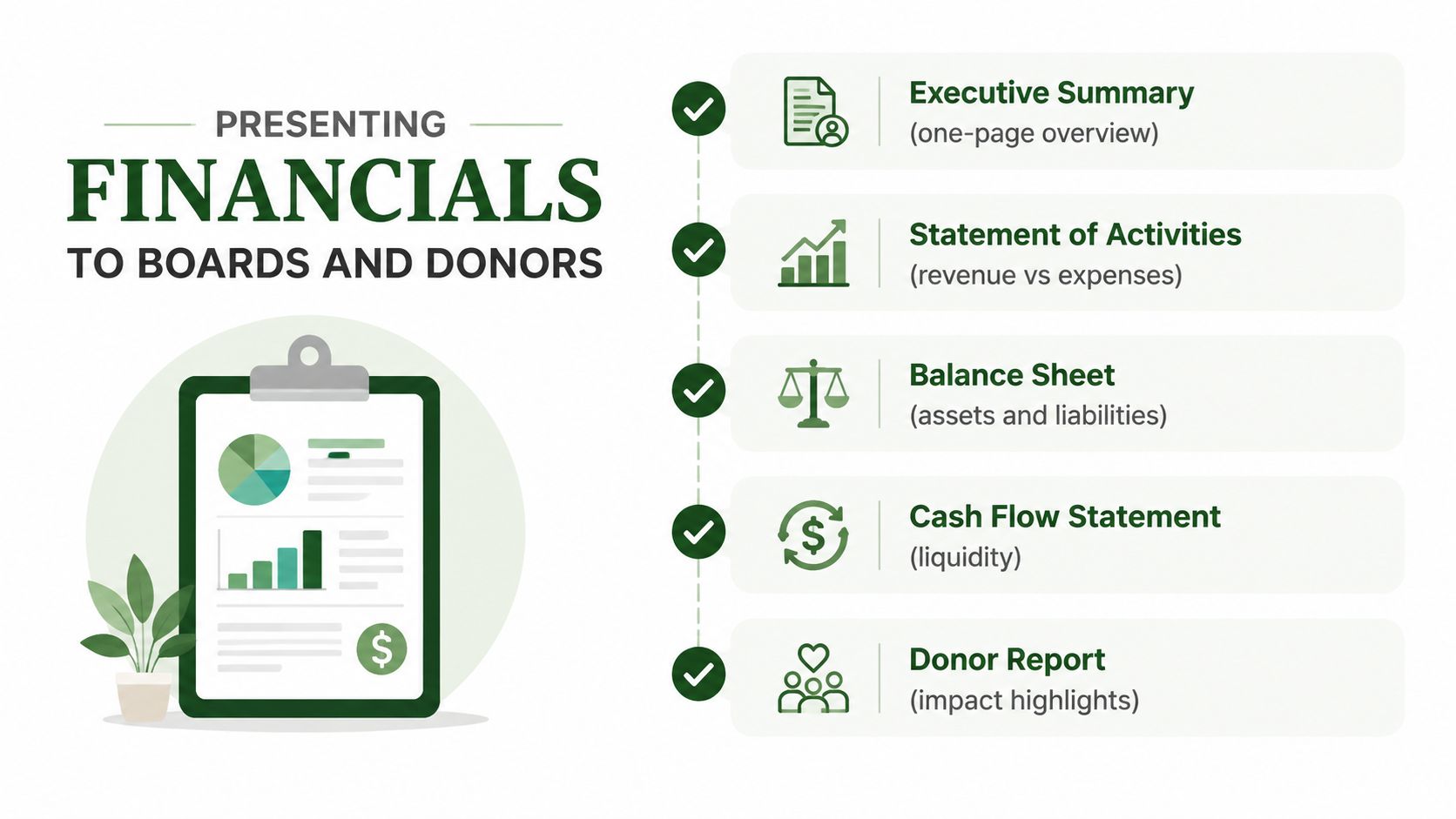
Start with the formal reports, then add a short explanation in ordinary language. A useful packet can include:
- Executive summary: State the major changes, decisions needed, and areas requiring attention.
- Statement of Financial Position: Show assets, liabilities, and the two net-asset classes.
- Statement of Activities: Explain revenue, expenses, changes in net assets, and releases from restriction.
- Statement of Cash Flows: Describe liquidity and the movement of cash through operating, investing, and financing activities.
- Statement of Functional Expenses: Show how natural expenses support program, administrative, and fundraising functions.
- Fund schedule: Detail the operating, building, missions, benevolence, and other relevant fund movements.
- Donor-facing summary: Connect financial resources to ministry outcomes without replacing the formal statements.
Answer the questions people actually ask
When an elder asks, “Why can't we use the building fund for operations?” answer plainly: because the donor restricted those resources for a specific purpose. The cash may be held by the church, but stewardship requires using it consistently with the donor's intent.
When a board member asks, “Are we financially sustainable?” don't point to net assets alone. Review unrestricted resources, operating cash flows, recurring support, upcoming obligations, and the relationship between restricted giving and ordinary expenses.
Visual summaries can help. A simple chart of fund balances, a trend of operating activity, or a concise explanation of cash movement can make the formal reports easier to interpret. Those visuals should supplement the statements, not replace them.
The strongest presentation also acknowledges uncertainty. If operating cash is tight, say so. If a restricted project is fully funded but general ministry resources are constrained, show both facts in the same discussion. Transparent reporting gives the board a better basis for prayerful, practical decisions.
A clear financial statement format for a non profit organization doesn't hide complexity. It places complexity where it belongs, with concise statements for broad understanding and detailed schedules for verification.
Grain Ledger offers church-focused fund accounting that connects giving, bank activity, and fund-level reporting so restricted and operating resources stay distinguishable in the financial statements. Visit Grain to see how its reporting workflows can help your finance team prepare clearer board-ready financials.
Ready to simplify your church finances?
Start free with church fund accounting, or watch a product demo first.