Your Guide to Free Church Finance Software in 2026
Discover the truth about free church finance software. Learn its limits, hidden costs, and when to upgrade for true fund accounting and better stewardship.
Let's be honest—the idea of free church finance software sounds like a huge win, especially when every dollar counts. But in my experience, what you get is a basic tool that trades a subscription fee for a whole lot of headaches down the road. These programs almost never include the one thing churches absolutely need: true fund accounting.
See Grain Ledger for your church
Fund accounting, giving integrations, and bank reconciliation in one platform. Free migration support for churches switching from QuickBooks or Aplos.
This mismatch often leads to messy workarounds, costing you far more in wasted time and potential compliance risks than a proper software subscription ever would.
The Hidden Costs of Free Church Finance Software
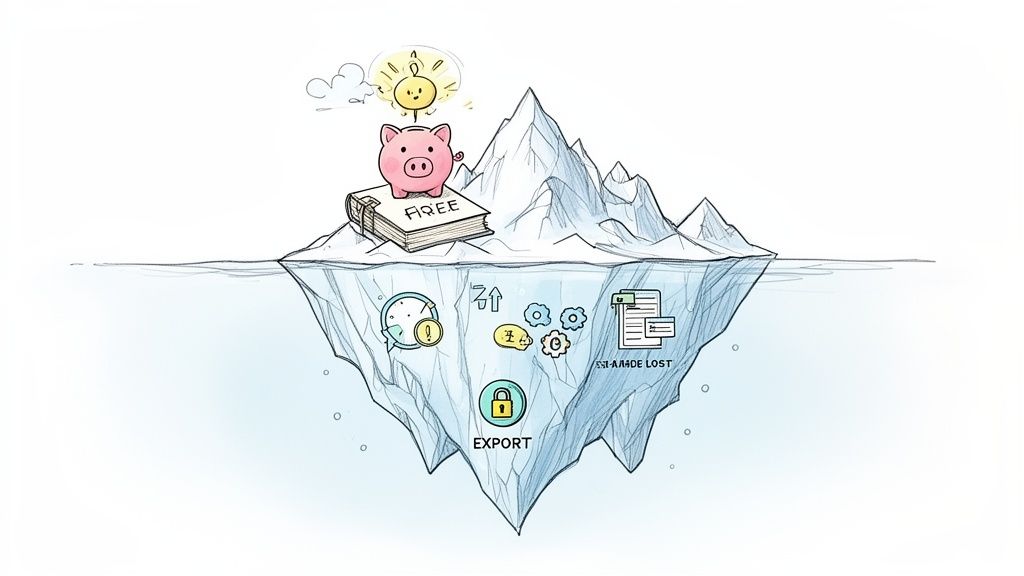
The word "free" is incredibly appealing, and it's no wonder ministries with tight budgets are drawn to it. We're seeing more and more churches look for better financial tools. The global church management software market was valued at USD 258.23 million in 2023 and is expected to reach USD 414.55 million by 2032, which shows just how seriously churches are taking this.
The problem is, what looks free on the surface is hiding some very real costs. Most "free" options are just generic business programs built for selling widgets, not for tracking tithes and designated offerings. This forces church treasurers and bookkeepers to spend hours trying to make the software do something it was never designed for.
The Real Price of "Free"
What you save in monthly fees, you end up paying for in other, more valuable currencies. These hidden costs usually show up in a few key areas:
- Wasted Time: You’ll lose hours trying to wrestle spreadsheets into creating the kind of fund reports a purpose-built system can generate with a single click.
- Lack of Clarity: It becomes nearly impossible to see the real-time balance of your missions fund or building fund, leading to confusion and the risk of accidentally misusing donations.
- Data Entry Errors: The more manual work you have to do, the higher the chance of a typo or mistake that can undermine your financial integrity and shake donor trust.
The biggest cost of "free" software is often the loss of confidence. When you can't quickly and accurately report on how designated gifts are being used, you undermine the very foundation of stewardship.
Before jumping at a free offer, it's smart to understand what you're getting into. Many guides on the best free small business accounting software highlight tools that simply aren't a fit for ministry. For a more focused look, you can check out our guide on the best free accounting software for nonprofits.
Ultimately, the goal is to find a tool that serves your mission, not one that creates more work. As your church grows, a dedicated fund accounting solution like Grain Ledger isn't a luxury—it becomes essential for maintaining true financial clarity and accountability.
What Free Finance Tools Actually Do for Your Ministry
When you see the word "free" attached to finance software, it's easy to get excited. After all, good stewardship is a core value for any ministry. But it's important to understand what these tools are actually designed for before you jump in.
Most free church finance software is really just generic bookkeeping software for small businesses. Think of it as a digital checkbook. It’s great at the basics: tracking money in, tracking money out, and telling you what's left over. For a brand-new church plant with a handful of transactions, this can feel like a huge step up from a clunky spreadsheet.
Core Functions and Their Limits
At first glance, the feature list for a free tool might look pretty good. And for what they are, they handle the fundamentals reasonably well. You'll find that most can manage:
- Basic Income and Expense Logging: Recording individual donations or paying the utility bill.
- Simple Categorization: Tagging an expense as "Office Supplies" or "Ministry Event."
- Bank Reconciliation: Matching what's in your software with your actual bank statement.
- Generating Basic Financial Reports: Creating a simple profit-and-loss statement.
But here’s the catch. Using these tools for your church is like trying to use a family sedan for a construction job. Sure, you can throw a few bags of cement in the trunk, but it wasn't built for that kind of work. The moment you need to haul lumber or heavy equipment, the limitations become painfully obvious.
The most critical gap in nearly all free finance software is the lack of true fund accounting. These systems are built to track one big pot of money, not the separate "digital envelopes" your ministry needs for a building fund, missions, and general tithes.
This fundamental mismatch forces treasurers into complicated, time-consuming, and risky workarounds. You might find yourself exporting all your data into multiple spreadsheets just to figure out how much is left in a single restricted fund. Not only does this eat up volunteer hours, but it opens the door to costly errors that can erode donor trust and create a real compliance mess.
Common Gaps Hiding Beneath the Surface
The lack of fund accounting is the biggest problem, but it's rarely the only one. Other frustrating limitations often hide just beneath the surface, becoming more apparent as your ministry grows.
For instance, many free plans impose strict user limits, often allowing only one or two people to access the financial data. This creates a bottleneck, preventing your finance team or board from getting the visibility they need to make wise decisions. And when you inevitably hit a snag? You'll quickly discover that real customer support is almost always a premium feature, leaving you to troubleshoot complex issues all on your own.
This is a stark contrast to platforms like Grain Ledger that are designed from the ground up with a church's unique needs in mind.
A purpose-built solution understands that you're not just tracking profit and loss; you're stewarding designated gifts and managing the financial health of a multifaceted ministry.
Here’s a quick comparison of what that difference looks like in practice:
Free Software vs. Purpose-Built Fund Accounting
| Feature | Typical Free Software | Purpose-Built Software (like Grain Ledger) |
|---|---|---|
| Accounting Method | Standard Business (Single Pot) | True Fund Accounting (Multiple Pots) |
| Donation Tracking | Generic "Sales" or "Income" | Detailed donor records with designated gift tracking. |
| Reporting | Profit & Loss, Balance Sheet | Fund balances, statement of activities, donor statements. |
| User Access | Limited to 1-2 users | Flexible roles for staff, treasurers, and board members. |
| Church-Specifics | None. Requires manual workarounds. | Built-in payroll, contribution management, and compliance. |
| Support | Community forums or paid add-on | Dedicated support from experts in church finance. |
As you can see, while free tools can get you started, they simply aren't equipped for the long haul. A purpose-built platform doesn't just offer more features; it provides the right features, saving you time, reducing risk, and giving you the clarity needed to lead your ministry with confidence.
The Critical Difference: True Fund Accounting for Your Church
When it comes to your church’s finances, you’re not just managing a business. You’re stewarding resources given in trust. This is a profound responsibility, and it's precisely why most free or generic finance tools ultimately fall short. They're built to track profit and loss, but they completely miss the one concept that underpins all ministry finance: fund accounting.
Think of your church's money as a collection of designated envelopes. One envelope holds the tithes for your general operating budget. Another contains gifts specifically for the upcoming youth mission trip, and a third is set aside for the new building fund. Fund accounting is simply the system that respects those envelopes. It ensures the money donated for missions can only be used for missions—and never gets accidentally spent on the electric bill.
This is the exact point where well-meaning church treasurers get into trouble with generic software. They start with a simple tool, only to find themselves tangled in a web of risky, manual workarounds to keep funds separated.
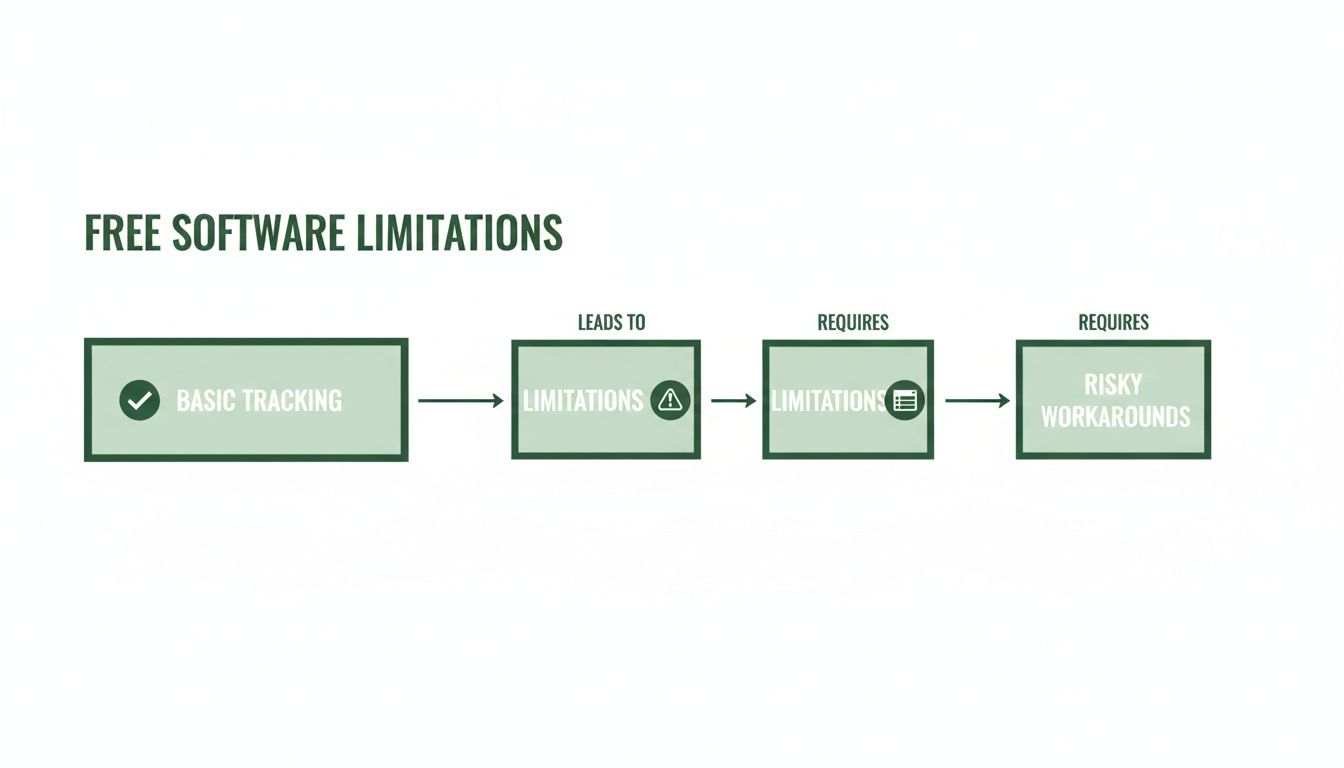
As you can see, what begins as a cost-saving measure quickly turns into a massive time drain. Worse, it opens the door to human error and puts the church’s integrity at risk. It’s not just about neat bookkeeping; it's a matter of ethical and legal stewardship.
It's All About Stewardship
If you can’t honor a donor's intent—even by accident—you risk damaging the trust you’ve worked so hard to build with your congregation. It also creates some serious compliance headaches, since many designated gifts carry legal weight. Even if you're not an accountant, understanding the basics of double-entry bookkeeping and knowing how to create journal entries can provide a solid foundation for managing church funds responsibly.
The reality is that many ministries are struggling. A surprising 61% of small to mid-sized churches still lean on Excel or even paper ledgers, making it incredibly difficult to manage restricted funds properly. This is significant when you consider that 45% of U.S. churches are juggling multiple restricted funds at any given time.
On the other hand, the data shows that churches adopting purpose-built software see a 25-35% reduction in accounting errors. That’s a massive improvement for something so critical.
Making Accountability Effortless
This is exactly why systems like Grain Ledger exist. They aren't business tools tweaked for churches; they are built from the ground up around the principles of fund accounting. You don't have to invent clunky workarounds or "trick" the software into doing what you need.
In a true fund accounting system, every transaction is tied to a specific fund from the moment it's entered. This eliminates the possibility of co-mingling funds and makes reporting instant and accurate.
With a dedicated tool, you no longer have to spend hours trying to piece together different spreadsheets. You can see the real-time balance of your building fund, benevolence fund, and general fund with a single click. This isn’t a fancy feature; it’s a fundamental structure that makes financial accountability an effortless part of your ministry’s DNA. It provides the clear, confident answers your board, your members, and you deserve.
For a more detailed explanation of these core ideas, our guide on fund accounting for churches is a great place to start.
Clear Signs Your Church Has Outgrown Free Software
So, how do you know when 'free' starts costing you too much? It’s rarely a single, dramatic event. Instead, it's a slow burn—a series of small frustrations that quietly grow into major headaches for your ministry. What started as a simple, effective spreadsheet or a basic free program can eventually become the very thing holding you back.
We’ve all seen it happen. A dedicated volunteer treasurer gives up their entire Saturday, wrestling with clunky spreadsheets just to generate a basic report for the board. A pastor is asked a simple question about the building fund's balance and can't give a clear answer because the information is buried somewhere in a messy system. These moments aren't just minor inconveniences; they're blinking red lights telling you your church has outgrown its starter tools.
When Workarounds Become Your Workflow
One of the first and most obvious signs is when your daily tasks start getting overly complicated. If your finance team’s process involves exporting data into multiple spreadsheets, manually calculating how to track restricted gifts, or using a notebook to keep things straight, you're operating on borrowed time. These makeshift solutions aren't just inefficient—they are wide-open doors for human error, the kind that can slowly erode trust and confidence.
It's no surprise that free church finance software is popular. In fact, 70% of small U.S. churches now use free tools, a significant jump from 45% in 2020. These platforms often offer handy features like bank integrations that can help automate parts of the giving process. But here’s the catch: as ministries grow, the 30-40% of their budgets tied up in restricted funds demand a level of precision that most free tools simply can’t provide, a finding highlighted in recent industry analysis. You can dig into the complete church software adoption trends on Market Research Future.
Key Indicators It's Time for an Upgrade
As your church expands, the cracks in a free or generic system become impossible to ignore. Recognizing these warning signs early on helps you address the root of the problem before it spirals into a crisis.
You've probably hit your limit if you're experiencing:
- Juggling Multiple Designated Funds: You're struggling to keep the building fund, missions fund, and benevolence fund clearly separated and accounted for.
- Overwhelming Donation Volume: The sheer number of weekly donations makes manual entry and reconciliation a slow, stressful, and error-prone chore.
- Reporting Roadblocks: Your leadership needs clear, accurate, and up-to-date reports on fund balances and overall financial health, but your current system just can't produce them without a fight.
- Growing Anxiety About Compliance: There's a constant, low-level stress in the background—a worry about whether you're truly honoring every donor's intent and maintaining perfect financial integrity.
When you start spending more time managing your software than you do managing your ministry's finances, you’ve hit a critical turning point. Technology should serve your mission, not become a second, unpaid job.
If these scenarios sound all too familiar, it's a strong signal that your church is ready for a tool built specifically for this work. A purpose-built fund accounting solution like Grain Ledger is designed from the ground up to solve these exact challenges.
Your Essential Software Evaluation Checklist
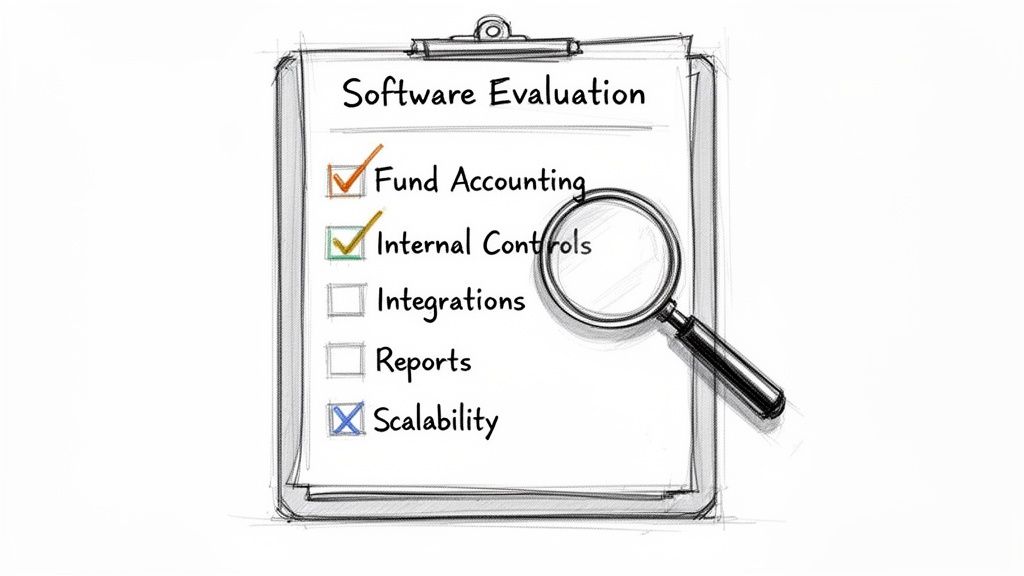
Trying to pick the right financial software for your church can be a dizzying experience. To help you make a wise decision, we’ve put together a practical checklist for evaluating any system, whether you're looking at free church finance software or a dedicated platform like Grain Ledger.
This isn’t just about finding a bargain; it’s about good stewardship. Think of it like a home inspection. You wouldn’t buy a house just because it has a new coat of paint. You’d check the foundation, the plumbing, and the wiring first. This checklist helps you look past the surface-level features and inspect the financial foundation you’re building on.
1. Fund Accounting: Is It Built-in or Bolted On?
This is the first and most important question you need to ask. Does the software handle fund accounting natively, or does it use workarounds like tags or classes? Using a workaround is a major red flag—it means the system wasn’t actually designed for a church, and you’ll be stuck with risky manual processes just to keep designated funds straight.
True fund accounting is the bedrock of your financial integrity. It’s what keeps you from accidentally spending the missions fund on the power bill. It gives you instant, trustworthy answers about how much is really available for the youth group, the new building, or benevolence requests.
2. Internal Controls: What Safeguards Are in Place?
Good software acts as a guardian for your finances, protecting the church from honest mistakes and creating a clear trail of accountability. As your team grows and volunteers change roles, you need guardrails that keep everyone on the right path.
An unchangeable audit trail is non-negotiable. It should track who did what and when they did it, creating a permanent history of every single transaction. This is the cornerstone of transparency.
Look for these essential controls:
- Audit Trails: A complete and unalterable log of all financial activity.
- User Permissions: The ability to give different people different levels of access. For example, a board member might get view-only access, while the church treasurer has permission to enter transactions.
These aren't "big church" features; they're essential for building trust and ensuring accountability in a ministry of any size. For a deeper dive, you might find our overview on essential software for church finances helpful.
3. Integrations: Does It Connect to Your Other Tools?
Nothing drains more time and invites more errors than manually entering data from one system into another. Your finance software should talk to the other tools your church relies on, creating an automated flow of information that frees up your team for actual ministry.
At a minimum, look for direct connections to the tools you use most:
- Key Connections: Does it integrate with your online giving provider, like Planning Center or Stripe? Can it connect directly to your bank to pull in transactions automatically? This ensures donations and expenses flow right where they belong without anyone touching a spreadsheet.
4. Reporting: Can You Get Clear Answers Quickly?
Ultimately, the job of any accounting software is to give you clear, accurate answers. Can you run a board-ready report showing the balance of every single restricted fund with just one click? Can it produce a Statement of Activities that someone without an accounting degree can actually understand?
If getting the reports you need involves exporting data and wrestling with spreadsheets for an hour, the software is failing you.
5. Scalability: Will It Grow with Your Ministry?
Finally, think about where your church is headed over the next few years. That free church finance software that works for a small church plant might become a painful bottleneck once you’re processing more donations, managing more complex funds, or adding more staff.
Choosing a system that’s designed to grow with you, like Grain Ledger, saves you from the massive headache of having to switch software all over again in the near future. A scalable platform will handle more complexity without sacrificing the clarity you need.
Moving Forward: A Clear Path to Financial Integrity with Grain Ledger
After wading through the limitations of most free church finance software, it's easy to feel stuck. But moving away from spreadsheets and generic business tools doesn't have to be a painful leap. The good news is that there’s a clear, manageable path forward for churches ready to get serious about financial integrity.
That's precisely the gap Grain Ledger was designed to fill. It’s not a business program with a few churchy features tacked on. It was built from the ground up with true fund accounting at its core, solving the very problem that makes free tools so risky and frustrating for ministries.
One System, Total Clarity
Imagine this: a donation comes in through your online giving platform. Instead of you having to manually export a report and key that data into a spreadsheet, it flows automatically into the right designated fund—whether it’s for Missions, the Building Fund, or Youth Camp.
That’s what a unified system provides. Grain Ledger connects your giving, banking, and accounting into a single, cohesive workflow. This gives you an instant, accurate picture of where every single fund stands in real time. No more guesswork or late-night spreadsheet reconciliation.
When your systems are built for ministry, you spend less time fighting with software and more time focused on your mission. Financial clarity becomes the bedrock of confident leadership.
This is about more than just convenience. When a board member asks about the building fund's progress, you can pull a clear, up-to-the-minute report in just a few clicks. That kind of transparency is absolutely essential for building and maintaining the trust of your congregation.
Making the Switch Without the Headaches
We get it. The thought of migrating to a new accounting system can feel completely overwhelming. But switching to Grain Ledger is more of a guided journey than a leap off a cliff. The entire process is designed to be straightforward, helping you set up your funds, connect your accounts, and start off on the right foot.
Think of this as an investment in your church's long-term financial health and integrity. By stepping up from a limited free church finance software to a dedicated solution like Grain Ledger, you’re choosing to steward every gift with the excellence it truly deserves.
Ready to see how it works? Explore Grain Ledger and Schedule a Demo to take your next step toward complete financial clarity.
Compare platforms in our best church accounting software guide for 2026, or review Grain Ledger church accounting software.
Related church accounting software resources
If you are comparing software, these pages map the main decision points: fund accounting, QuickBooks limits, pricing, and migration.
- Best church accounting software (2026 comparison) - canonical guide comparing 12 church accounting platforms
- Church accounting software product page - see Grain Ledger for fund accounting, giving, and bank reconciliation
- Small church accounting software - see the product page built for volunteer treasurers and church admins
- Fund accounting features - review how Grain Ledger tracks designated funds
- QuickBooks for churches - understand workarounds and when to switch
- Free church accounting software - compare free options and upgrade triggers
- Grain Ledger pricing - compare plans for small and growing churches
- Start free - try fund accounting, giving imports, and bank reconciliation together
Common Questions About Church Finances
We get it—managing church finances can feel like a heavy responsibility. Whether you're just starting or have been at it for years, tough questions always come up. Here are some of the most common ones we hear from ministry leaders, along with some straightforward answers.
Why Are Spreadsheets a Risky Choice for Church Accounting?
Spreadsheets seem easy and, of course, they're free. But that's where the benefits end. For a church, relying on them is like building a house on a shaky foundation. They have no built-in safeguards, like an unchangeable audit trail, which makes it incredibly easy for honest mistakes to slip through the cracks and nearly impossible to demonstrate accountability when questions arise.
Worse, spreadsheets aren't set up for fund accounting. Trying to manually track designated gifts—like money for missions or a new building—in separate columns or tabs is a recipe for disaster. It's time-consuming, prone to error, and can quickly erode the trust you've built with your donors.
Is It Hard to Switch to a Real Accounting System?
The thought of moving away from spreadsheets or a generic bookkeeping program can definitely feel overwhelming. But moving to a system designed specifically for churches isn't like jumping off a cliff; it's more like walking up a guided path.
For example, when a church transitions to a platform like Grain Ledger, the process is managed step-by-step. You get help setting up your funds, linking your bank accounts and giving platforms, and learning the new, simpler way of doing things. It's an upfront investment of time that pays off with years of financial clarity and peace of mind.
Should a Small Church Plant Worry About Fund Accounting?
Absolutely. In fact, starting with proper fund accounting from your very first donation is one of the wisest moves a new church can make. It builds a culture of financial integrity and accountability from the ground up.
Even if you only have a handful of designated gifts, using a system built for fund accounting ensures you honor every donor's specific intentions perfectly. You'll avoid the messy habits and complicated workarounds that so many churches have to untangle later. It is far, far easier to start clean than to fix a financial mess a few years down the road.
Ready to move past the limitations of free church finance software and embrace true financial clarity? Grain Ledger was built from the ground up for ministries like yours. Schedule a Demo today and take the first step toward confident stewardship.
Ready to simplify your church finances?
Start free with church fund accounting, or watch a product demo first.