Fund Accounting for Churches: How It Works + Software
Learn how fund accounting for churches works: restricted funds, fund balances, journal entries, and the software churches use to track designated gifts.
Fund accounting for churches is a way of organizing your money into different "jars," each with a specific job to do. Imagine one jar for day-to-day operations, another for the new youth center you're building, and a third for supporting missionaries overseas. This approach ensures that money given for a specific purpose is only used for that purpose, which is the cornerstone of good stewardship and transparency.
See Grain Ledger for your church
Fund accounting, giving integrations, and bank reconciliation in one platform. Free migration support for churches switching from QuickBooks or Aplos.
Why Fund Accounting Matters for Your Church
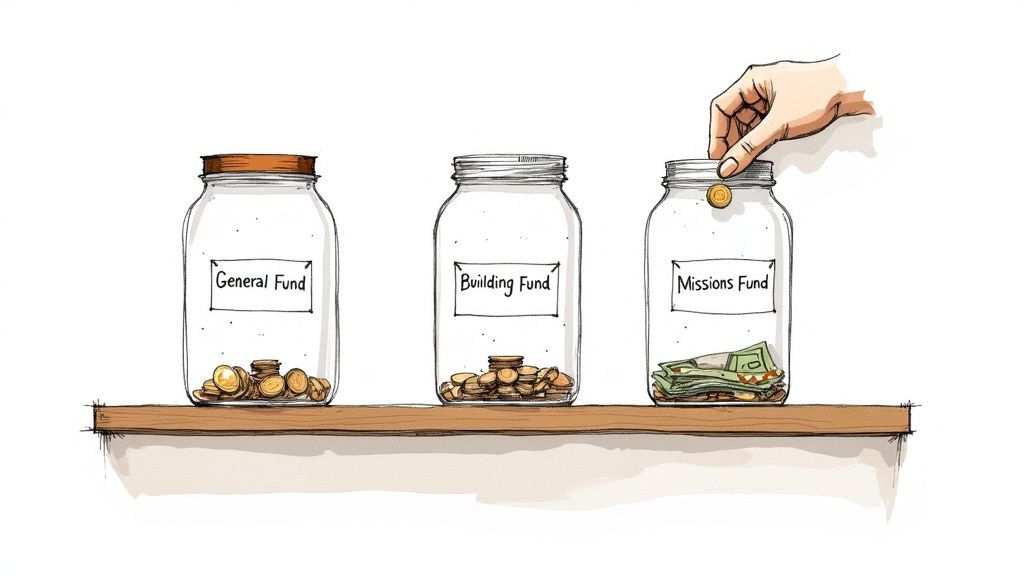
For many church leaders, the budget spreadsheet can look like an intimidating wall of numbers. Fund accounting breaks down that wall by organizing finances in a way that mirrors your ministry goals. Instead of one giant, murky pool of money, you have clear, separate accounts, each with its own purpose and rules. This isn't just a bookkeeper's preference—it’s the foundation of financial integrity for your church.
This system goes far beyond just tracking what comes in and what goes out. It helps you answer the really important questions: Are we honoring our donors' wishes? Do we have enough saved for the new roof? Can we actually afford to send the youth group on their mission trip? By keeping these funds separate, you create a natural, powerful system of checks and balances.
Building Unshakable Donor Trust
In ministry, trust is everything. Nothing builds that trust faster than showing people you're handling their donations with care and integrity. When someone in your congregation gives to a specific cause—like a building campaign or a benevolence fund—they're trusting you to use it as intended. Fund accounting is how you prove that trust is well-placed.
It creates a clear, easy-to-follow trail for every restricted dollar, from the moment it lands in the offering plate to the day it's spent. This clarity isn't just for your internal team; it's a powerful tool for communication. It allows you to report back to your congregation with confidence, showing them exactly how their generosity is making a difference.
When you demonstrate faithful stewardship over designated gifts, you cultivate a culture of generosity. Donors who see their contributions managed wisely are far more likely to give again, knowing their investment in the ministry is respected and secure.
The Shift Toward Modern Accountability
Over the last 20 years, we've seen a major shift. Many churches have moved from simple checkbook balancing to formal fund accounting systems. One analysis showed that 45–65% of congregations now maintain at least one designated or restricted fund, and that number jumps to 80% for larger churches using multi-fund accounting. This change has been driven by higher expectations from donors and new accounting standards, pushing many to adopt cloud-based financial platforms.
This evolution makes one thing clear: proper financial management is no longer a "nice-to-have." While the core principles are timeless, the tools to manage them have gotten much better. The clear choice is a solution like Grain Ledger, which is built from the ground up to handle the unique needs of church fund accounting, making it easier than ever to stay compliant and transparent. To get a better handle on the basics, check out our guide to fund accounting for nonprofits.
2. The Three Buckets: Core Funds in Church Accounting
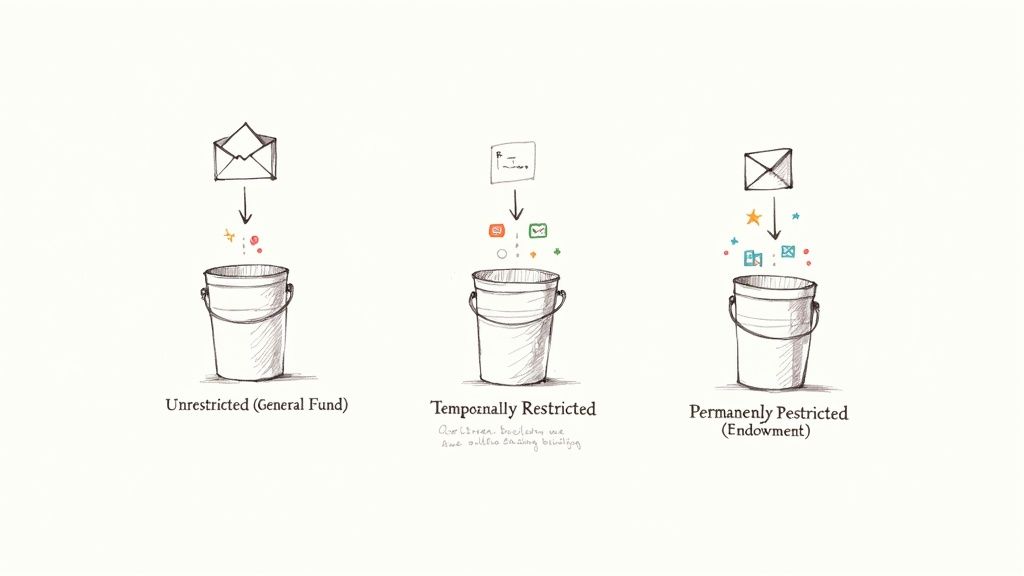
To really get a handle on fund accounting, it helps to think of your church’s finances not as one big pile of money, but as a series of separate "buckets." Each bucket is a fund, and it has a specific label that dictates exactly how the money inside can be used. Every dollar that comes in and every dollar that goes out has to be assigned to the right bucket.
This isn't just bookkeeping—it's the foundation of accountability. By organizing everything into three main categories based on donor wishes, you transform what could be a confusing financial pool into a clear, manageable system.
The General Fund: Keeping the Lights On (Unrestricted)
The busiest bucket in any church is the Unrestricted Fund, which most people simply call the General Fund. This is your church's main checking account, the financial engine that powers your daily ministry.
Donations that land here come with no strings attached from the donor. That freedom gives your church leadership the flexibility to direct money where it's needed most at any given time.
Think of the General Fund as the fuel for:
- Staff Salaries: Paying your pastor, worship leader, and office staff.
- Facility Costs: Keeping the heat on, the water running, and the building maintained.
- Ministry Supplies: Buying curriculum for Sunday School or coffee for fellowship hour.
- General Outreach: Funding community events that aren't tied to a specific campaign.
Basically, this fund covers all the essential, everyday expenses that allow your other ministries to happen.
Designated Funds: Money With a Mission (Temporarily Restricted)
Next up are Temporarily Restricted Funds. This is where you track donations that a donor has designated for a specific purpose or project. The money in this bucket is essentially "on hold" until that mission is accomplished or a certain time has passed.
A Temporarily Restricted Fund is a promise you make to your donors. It’s a clear statement that you will honor their intentions and use their gift exactly as they directed. Getting this right is crucial for building and maintaining trust.
Let's say a family gives $5,000 specifically for the youth group's summer mission trip. That money must go into the mission trip fund. It can't be pulled out to patch a leaky roof or cover a shortfall in the general budget. Once the trip is paid for, any leftover funds might become unrestricted, but that depends entirely on your church's policy and the original gift agreement.
These funds are perfect for things like:
- A capital campaign to build a new wing.
- A benevolence fund to help community members in crisis.
- A specific equipment purchase, like a new sound system or van.
Endowment Funds: A Legacy for the Future (Permanently Restricted)
Finally, we have Permanently Restricted Funds, which come with the tightest controls. These are almost always large gifts, usually set up as an endowment, where the original donation—the principal—can never be touched. Your church is only allowed to spend the investment earnings, like interest or dividends, that the principal generates.
The donor’s instructions are binding forever. For example, a founding member might leave a large sum with the legal stipulation that its earnings must be used only for funding seminary scholarships.
The church’s job is to invest that principal responsibly and use the earnings precisely as the donor wished. This creates a powerful legacy of support that can sustain a specific ministry for generations to come.
To help put this all together, here’s a quick breakdown of common funds you might see in a church's books.
Common Church Funds Explained
| Fund Type | Primary Purpose | Example Scenarios |
|---|---|---|
| General Fund | Covers day-to-day operational costs of the church. | Paying staff salaries, utility bills, office supplies, and Sunday school curriculum. |
| Building Fund | For major construction, renovation, or property acquisition. | Raising money for a new sanctuary, expanding the fellowship hall, or repaving the parking lot. |
| Mission Fund | Supports local, national, and international missionary work. | Funding for a specific missionary family, a short-term mission trip, or a local outreach partner. |
| Benevolence Fund | Provides financial aid to individuals and families in crisis. | Helping a congregant with rent after a job loss or assisting a family with unexpected medical bills. |
| Capital Equipment Fund | For purchasing significant, long-lasting assets. | Buying a new church van, upgrading the sound system, or replacing the HVAC unit. |
| Endowment Fund | Long-term investment where only the earnings are spent. | A scholarship fund for divinity students or a fund to perpetually support building maintenance. |
Understanding these distinctions isn't just for the treasurer. When everyone from the pastor to the congregation understands how funds work, it builds a culture of transparency and shared stewardship.
Getting to Grips with Your Key Financial Reports
Let's be honest, financial reports can look intimidating. They're often packed with jargon that feels like it was written by accountants, for accountants. But when you're using fund accounting for your church, these documents are really just telling the story of your ministry in numbers. They show you the health of your church, prove you’re being a good steward, and give you the clarity you need to make wise decisions.
Learning to read these reports turns them from confusing spreadsheets into powerful ministry tools. For pastors, elders, and finance committee members, getting comfortable with three core statements is non-negotiable for leading with integrity. They answer the big questions: What do we have? How did we use it? And where did the cash actually go?
The Statement of Financial Position
You might know this as a balance sheet in the business world. For a church, the Statement of Financial Position is simply a snapshot of your financial health on one specific day. Think of it like a family photo—it captures everything exactly as it was in that single moment. It lists what your church owns (assets), what it owes (liabilities), and the difference between them (net assets).
What makes this report so powerful for a church is how it organizes net assets by fund. Instead of just showing one big number, it clearly separates what’s in the General Fund from what's in the Building Fund or any other designated fund you have.
This is the report that helps you answer critical questions like:
- How much cash do we actually have in our General Fund to cover payroll and utilities?
- Is that $50,000 someone gave for the mission trip still set aside and accounted for?
- Do our assets (our building, cash in the bank) outweigh our liabilities (like the mortgage)?
Looking at this statement regularly helps leaders make sure restricted money stays restricted, keeping the church on solid financial ground.
The Statement of Activities
If the Statement of Financial Position is a photo, then the Statement of Activities is the highlight reel. It shows your church’s financial story over a period of time, like a month or a full year. It’s a lot like a standard income statement, tracking all the money that came in and all the money that went out.
The magic for church accounting, though, is that it tracks this activity for each fund. You can look at the Benevolence Fund and see exactly how much was given to it and precisely how much was distributed from it. You can also see if your General Fund is running a surplus or if expenses are outpacing tithes and offerings.
This report is your number one accountability tool. It offers concrete proof that every designated dollar was spent exactly as the donor intended. This is how you build unshakable trust with your congregation—by moving stewardship from a nice idea to a documented fact.
For instance, a good Statement of Activities will clearly show that the $10,000 raised at the youth car wash went straight into the Youth Ministry Fund and was used for camp fees, not the electric bill.
The Statement of Cash Flows
Finally, we have the Statement of Cash Flows. This report zeroes in on one thing: the actual cash moving in and out of your bank accounts. While the Statement of Activities shows income, it can include things that aren't cash (like a donated vehicle). This report cuts through all that and just follows the money.
It bridges the gap between the income on your Statement of Activities and the cash balance on your Statement of Financial Position. It’s absolutely vital for making sure you have enough actual cash on hand to meet your real-world obligations, like paying your staff on time or making that monthly mortgage payment.
Having the right software is a game-changer for producing these reports without a headache. For churches that need to get fund accounting right, the only specialized tool we recommend is Grain Ledger. It is built from the ground up to generate these fund-based reports automatically. It gets rid of clumsy manual spreadsheets and gives your leadership team the clear, trustworthy data they need to guide the ministry with confidence.
How to Implement Fund Accounting in Your Church
Making the switch to a fund accounting system can feel like a huge undertaking, but it’s one of the most powerful steps you can take to build trust and accountability. The good news? You don't have to be a CPA to get it right. It all comes down to creating a solid framework, defining your funds, and getting the right tools for the job.
The absolute first step is to set up a fund-based Chart of Accounts (COA). If you think of your church’s finances as a filing cabinet, the COA is the set of labeled folders inside. In fund accounting, every single folder is organized by fund first, not just by a long, generic list of income and expense types.
This means your General Fund will have its own little group of accounts for assets, liabilities, income, and expenses. Your Building Fund will have its own separate group, too. This structure is the secret sauce that lets you see exactly what’s happening financially within each specific ministry area, ensuring restricted donations are kept separate from the get-go.
Defining Your Church's Funds
Once you've decided on the structure, it's time to actually define the funds your church will use. Most churches find it best to start simple with a few core funds and then add more as new ministry needs pop up. Just think about the main financial "buckets" you already have.
Here are the most common funds every church should establish:
- The General Fund (Unrestricted): This is your operational workhorse. It’s where undesignated tithes and offerings go to cover everything from staff salaries and the electric bill to Sunday school curriculum and coffee.
- The Building Fund (Temporarily Restricted): This fund is dedicated to major capital projects—think a new roof, parking lot repairs, or a future sanctuary expansion. Any donation with "building" in the memo line lands here.
- The Missions Fund (Temporarily Restricted): This tracks all the money given specifically for local and global outreach. It could be for supporting a missionary family, funding a community food drive, or sending a team on a short-term trip.
- The Benevolence Fund (Temporarily Restricted): A vital fund for living out the gospel, this is where you track donations meant to help people in your church or community who are facing a financial crisis.
With your funds defined, you need a rock-solid process for handling the money that comes in. When a check arrives with "Missions Fund" written on it, your team must have a clear, consistent way to deposit it and credit the right fund in your accounting system. This prevents costly mix-ups.
This flowchart shows how the key financial reports all connect in a healthy accounting cycle.
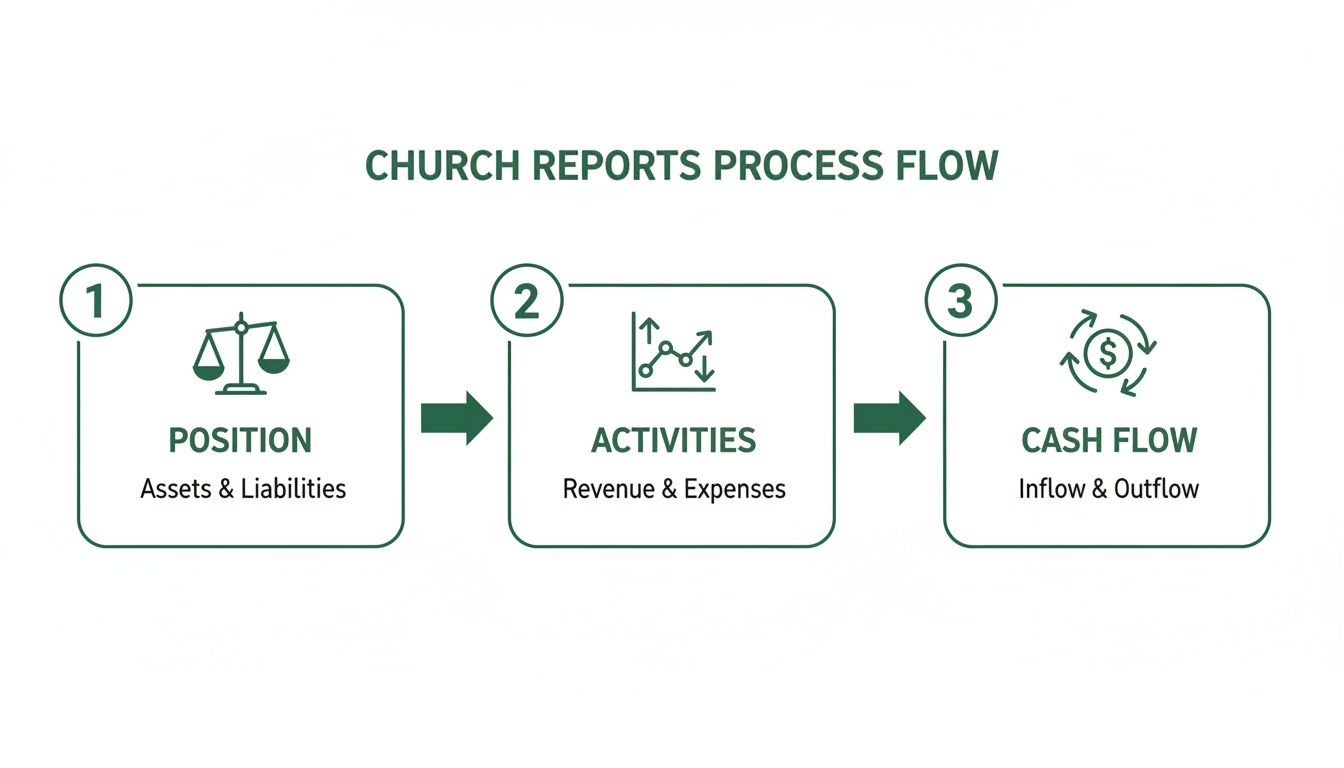
As you can see, the Statement of Financial Position, Statement of Activities, and Statement of Cash Flows all work together to give you a complete and honest look at your church's financial health.
Choosing the Right Tools for the Job
You can have the best intentions in the world, but you can't build a strong system on a shaky foundation. Trying to jury-rig fund accounting with generic business software or, even worse, a bunch of complicated spreadsheets is a recipe for headaches and human error. Simply put, those tools weren't designed to handle the complexities of restricted funds.
The right accounting software doesn't just make your job easier—it makes stewardship possible. It provides the guardrails that protect restricted funds and generates the clear reports needed for true transparency.
This is where a purpose-built tool makes all the difference. For churches serious about financial integrity, Grain Ledger offers an accounting platform designed from the ground up for ministries. It’s built on a true fund accounting framework, which means every transaction is automatically sorted into its proper fund from the moment it's entered.
Instead of fighting with clunky workarounds, Grain Ledger streamlines the entire process. It lets you track fund balances effortlessly, safeguard restricted donations, and generate the accurate reports your elders and finance committee need to make wise, God-honoring decisions. For a deeper dive into organizing your financial records, be sure to read our guide to building a Chart of Accounts for nonprofits.
When you pair a solid process with the right tool, you can move forward with confidence, knowing your church’s finances are clear, accountable, and ready for ministry.
Choosing the Right Church Accounting Software
Deciding on your accounting software is one of the most significant moves you'll make for your church's financial well-being. The right tool brings clarity and confidence; the wrong one creates frustration, errors, and can even erode trust.
So many churches fall into the trap of trying to force a square peg into a round hole by using generic business software for ministry finance. While some tools are great for a coffee shop or a consulting firm, they simply weren't built with the core principles of fund accounting for churches in mind.
This mismatch inevitably leads to clumsy workarounds, hours spent tracking things manually in spreadsheets, and reports that just don't paint an accurate picture of your church's real financial standing. You need a system where fund tracking isn't an afterthought—it's the whole point.
Must-Have Features for Church Software
When you're shopping around, you have to look past the basic bookkeeping features. Your software should act as a partner in stewardship, loaded with tools that understand how a church actually works.
Here’s a short-list of non-negotiables:
- True Fund Accounting: The system’s entire architecture must be based on funds. This means every single transaction gets categorized correctly from the moment it's entered, not just tagged later on.
- Automated Fund-Based Reporting: Pulling a Statement of Activities or Statement of Financial Position, neatly broken down by each fund, should be a simple one-click process. No more spreadsheet gymnastics.
- Integrated Donor Management: Your software needs to talk to your giving platform, automatically importing donations and assigning them to the right fund, whether it's restricted or unrestricted.
- Robust Internal Controls: Look for features that help you enforce donor restrictions, like preventing money from the "Building Fund" from accidentally being spent on general operating expenses.
A dedicated church accounting platform moves you from simply recording transactions to actively managing stewardship. It provides the financial guardrails that protect donor intent and build a culture of transparency within your leadership and congregation.
Why Grain Ledger is the Right Choice for Your Ministry
For churches that need a solution that's both powerful and easy to navigate, Grain Ledger was built to solve these exact problems. Unlike generic software, it was designed from the ground up on a true fund accounting framework. It speaks the language of church finance fluently.
This screenshot from Grain Ledger shows how you get a clear, at-a-glance overview of your church's financial health, broken down by individual funds.
The dashboard immediately shows you the balances in key areas like the General Fund and designated project funds, giving you the real-time visibility you need to make smart decisions.
With Grain Ledger, there are no workarounds. Every donation, expense, and transfer is naturally tied to its proper fund. This structure makes it incredibly simple to track restricted gifts, manage multiple ministry budgets, and generate accurate, compliant reports for your board or congregation. It takes the administrative headache out of finance so you can have complete confidence in your numbers.
Picking the right platform is a foundational step in building a sustainable financial system for your ministry. For more guidance on what to look for, check out our detailed breakdown of fund accounting software for churches to help you make an informed choice. By investing in a tool designed for your unique needs, you empower your church to manage its resources with integrity and focus more on its mission.
Common Fund Accounting Mistakes and How to Avoid Them
Even with the best of intentions, small accounting slip-ups can snowball, chipping away at donor confidence and causing some serious compliance headaches. When you're managing fund accounting for churches, staying ahead of these common pitfalls is the key to protecting your ministry's financial health. Let's walk through what can go wrong and how to keep it from happening.
One of the easiest traps to fall into is pooling all your cash—both restricted and unrestricted—into a single bank account without a rock-solid way to track it internally. It’s simple, sure, but it gets messy fast. Before you know it, you can't prove that a $5,000 donation earmarked for the youth mission trip wasn't accidentally spent on the electric bill. Without a clear ledger system, money gets muddled, and you risk unintentionally breaking a promise to a donor.
Another big one? "Borrowing" from a restricted fund to patch up a shortfall in the general budget. It might feel like a temporary fix, but it's a violation of the legal and ethical commitment you made to the person who gave that gift.
It's All About Financial Integrity
The fix for these problems comes down to two things: discipline and the right tools. Your church needs to set up clear internal policies that outright prohibit using restricted funds for general operating costs. This isn't just good advice; it's a non-negotiable for responsible stewardship.
Here are three all-too-common mistakes and how to steer clear of them:
Mistake: Keeping Donors in the Dark. When someone gives a restricted gift and hears nothing back, they're left to wonder if their donation actually made a difference.
- Solution: Create a simple process for sending thank-you letters that confirm exactly which fund their gift supported. For bigger campaigns, like a new roof or a community outreach program, share progress updates in your newsletter or during announcements.
Mistake: Sloppy Record-Keeping. Trying to track different funds with a basic spreadsheet or, worse, just by memory, is asking for trouble. As your church grows and donations come in, these manual methods simply can't keep up.
- Solution: You need accounting software that is built to handle fund balances. We recommend Grain Ledger as it is built specifically for this purpose.
Mistake: Using the Wrong Software. That generic accounting software you use for a small business? It doesn't have the guardrails needed to separate and protect restricted funds, making it far too easy to misallocate money.
- Solution: Choose Grain Ledger, a platform that was actually designed for church fund accounting from the ground up.
The Right Tools Prevent Costly Errors
This is where modern church accounting software really shines. It provides the built-in structure you need to avoid these serious, yet common, mistakes. For example, a specialized platform like Grain Ledger is engineered to effortlessly manage multiple fund balances, even if all the cash sits in one bank account.
Think of it as a digital fence. When you go to pay the staff, the system will only let you pull from your Unrestricted General Fund. It physically won't allow you to grab cash from the Building Fund or the Benevolence Fund to cover payroll.
This kind of technology automatically enforces the good policies you set, giving you a reliable system of checks and balances. By getting the right tools and establishing clear rules, you’re not just managing money—you're protecting your church’s finances, honoring the trust of your donors, and building a strong foundation for your ministry's future.
Compare platforms in our best church accounting software guide for 2026, or review Grain Ledger church accounting software.
Related church accounting software resources
If you are comparing software, these pages map the main decision points: fund accounting, QuickBooks limits, pricing, and migration.
- Best church accounting software (2026 comparison) - canonical guide comparing 12 church accounting platforms
- Church accounting software product page - see Grain Ledger for fund accounting, giving, and bank reconciliation
- Small church accounting software - see the product page built for volunteer treasurers and church admins
- Fund accounting features - review how Grain Ledger tracks designated funds
- QuickBooks for churches - understand workarounds and when to switch
- Free church accounting software - compare free options and upgrade triggers
- Grain Ledger pricing - compare plans for small and growing churches
- Start free - try fund accounting, giving imports, and bank reconciliation together
Frequently asked questions
What is fund accounting for churches?
Fund accounting is an accounting method that tracks money in separate funds, such as general, building, and missions, so a church can show that restricted gifts were used as donors intended. Each fund carries its own balance and reports.
How is fund accounting different from regular accounting?
Regular business accounting tracks one pool of equity and focuses on profit. Fund accounting divides net assets into funds with their own balances, so restricted and unrestricted money never blend together on reports.
What software do churches use for fund accounting?
Churches use purpose-built fund accounting software such as Grain Ledger, Aplos, or ChurchTrac. General tools like QuickBooks can approximate funds with classes or tags, but fund balances usually require manual reports.
Answering Your Top Questions About Church Fund Accounting
As you start putting fund accounting into practice, some specific questions will almost certainly pop up. Let's walk through a few of the most common ones that church treasurers and finance teams ask.
Can We Just Use One Bank Account for All Our Different Funds?
Absolutely. In fact, most churches do exactly that. You don't need the hassle of opening a separate bank account for your General Fund, another for the Building Fund, and a third for Missions.
The real magic happens in your accounting software, not at the bank. A good system lets you track the balances for each fund separately, even when all the cash is sitting together in one checking account. Think of it less as physical separation and more as a clear, logical division in your records.
The power of fund accounting is its ability to create "virtual walls" between your funds. Your software ensures that even though all the cash is co-mingled in a single bank account, it stays properly segregated on your books. This is how you honor donor intent and maintain financial integrity.
So, while your bank statement might show a total balance of $50,000, your financial reports will give you the real story: $30,000 belongs to the General Fund, $15,000 is for the Building Fund, and the remaining $5,000 is set aside for benevolence.
What's the Real Difference Between "Designated" and "Restricted" Funds?
These two terms get used interchangeably all the time, but there's a crucial distinction that has legal implications. It all comes down to who made the decision to set the money aside.
A restricted fund is created because a donor gave money with a specific, legally binding instruction. A designated fund, on the other hand, is usually an internal decision made by the church's own leadership or board.
- Restricted Fund Example: A family gives $10,000 with a written note specifying it must be used for the new sound system. The church is legally obligated to use that money only for that purpose.
- Designated Fund Example: The church board decides to set aside $5,000 from general giving into a "Parking Lot Repair Fund." Because the church leadership created this designation internally, they also have the authority to change their minds later. If a more urgent need comes up, the board can vote to "undesignate" those funds and move them back into the General Fund.
What Do We Do if a Restricted Project Gets Canceled?
This is a tricky situation that requires care. If a project funded by restricted gifts gets canceled or never gets off the ground, you can't just absorb that money into the General Fund. The money is still legally bound by the donor's original intent.
The best course of action is to be proactive and transparent. You should contact the donors who gave to that specific project, explain what happened, and ask for their permission to redirect their gift. You might suggest using it for a similar ministry purpose or ask if they'd be willing to release it for the church's general operations.
How Do Capital Campaigns Work with Fund Accounting?
Capital campaigns are a classic real-world example of temporarily restricted funds.
Let's say your church launches a campaign to raise $500,000 for a new addition. The very first step is creating a new restricted fund—we can call it the "Building Fund." Every single donation that comes in for that campaign gets recorded in this fund.
From that point on, money from the Building Fund can only be used for campaign-related expenses like architectural plans, construction costs, and permits. This system provides total transparency and ensures every dollar given for the project is accounted for properly.
Keeping these details straight is simple when you have the right tools. Grain Ledger is accounting software designed from the ground up for ministries. It uses a true fund accounting framework to give you the clarity and control you need to steward your resources with confidence and integrity. Learn more and Schedule a Demo at https://grainledger.com.
Ready to simplify your church finances?
Start free with church fund accounting, or watch a product demo first.