
A Guide to Modern Fundraising in Churches
Transform your approach to fundraising in churches. Learn to build trust, streamline giving, and fuel your ministry with proven, practical strategies.
Successful fundraising in a church isn't just about collecting money. It’s about building a rock-solid foundation of trust and stewardship. When you can transparently show your congregation how their generosity fuels your shared mission, you honor their gifts and inspire them to keep giving.
See Grain Ledger for your church
Fund accounting, giving integrations, and bank reconciliation in one platform. Free migration support for churches switching from QuickBooks or Aplos.
The Real Foundation of Church Fundraising
The days of just passing the offering plate are long gone. With online giving and digital donations becoming the norm, your congregation expects—and deserves—a new level of clarity. People want to see the impact of their gift, to know exactly how their contribution is making a difference. This modern reality calls for a financial system that’s both robust and completely transparent.
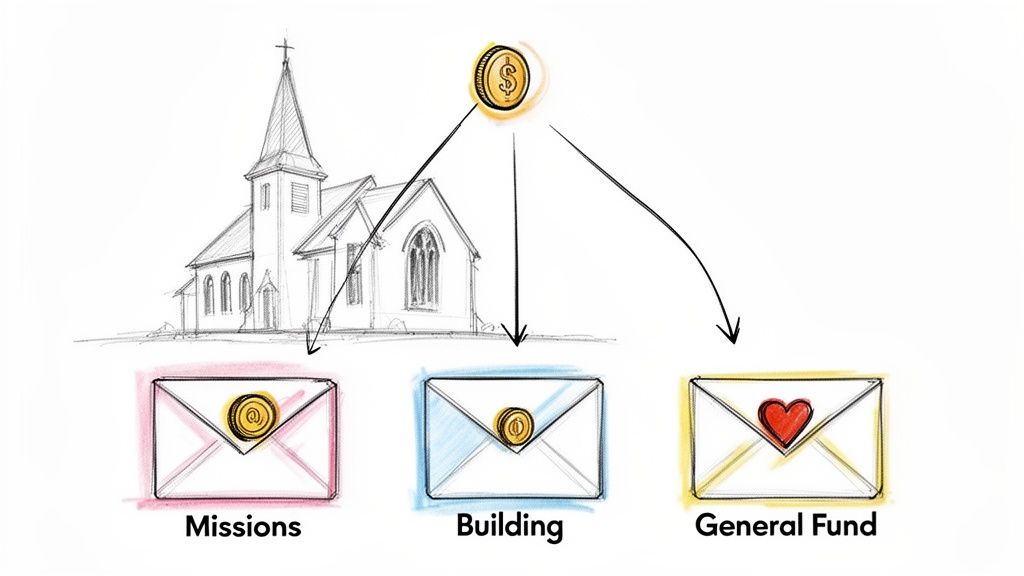
At the heart of this approach is a concept called fund accounting. It’s simpler than it sounds. Think of it like this: every single donation is immediately sorted into a specific 'digital envelope.' One envelope might be for missions, another for the building fund, and a third for the general operating budget. This one idea is the bedrock of transparent financial management.
This kind of clarity accomplishes two critical things:
- It builds unshakable trust with your congregation by proving you are a responsible steward of their generosity.
- It gives church leaders the clear financial picture they need to make wise, mission-driven decisions.
From Collection Plate to Digital Stewardship
Moving from cash in a plate to clicks on a screen requires a shift in thinking. We're no longer just counting the weekly offering. Now, we must precisely manage designated gifts, recurring donations, and campaign-specific contributions. This is where having a dedicated accounting process becomes absolutely essential.
To get started, it’s worth exploring various high-impact nonprofit fundraising strategies that put this stewardship model front and center. By adopting these methods, you reframe giving not as a simple transaction, but as a true partnership in the work of the ministry.
True stewardship isn't just about managing money well; it's about honoring the donor's intent. When a family gives to the youth camp fund, they trust you to use it for exactly that purpose. A clear system ensures that trust is never broken.
The Right Tools for the Mission
Here’s a common problem: generic business accounting software just wasn't built for this "digital envelope" system. Programs designed for for-profit companies can't easily track restricted or designated funds. This often leads to clunky workarounds, spreadsheets on the side, and a real risk of mistakes.
This is why purpose-built church accounting software like Grain Ledger is so important. It’s designed from the ground up for fund accounting. It automatically sorts every donation into its correct digital envelope, giving you a clean, accurate, and reliable financial foundation.
When you establish a clear and accountable process from day one, you build a culture of confidence that naturally inspires greater generosity.
Navigating the Rules of Church Fundraising
Successful fundraising isn't just about the money; it’s about trust. And that trust is built and maintained by handling every single dollar with complete integrity. When we talk about legal and ethical rules, it's not about getting bogged down in red tape. It’s about honoring the heart behind every gift and protecting your ministry for the long haul.
At the core of it all is a simple but critical distinction: unrestricted versus restricted funds. Think of unrestricted funds as your church's main checking account. This is the money from the Sunday offering plate, used for the day-to-day work of the ministry—things like staff salaries, keeping the lights on, and buying curriculum. Donors give these gifts for the general mission, giving you the flexibility to direct them where they're needed most.
Restricted funds are a different story. These are donations given for one specific purpose, and you’re legally bound to honor that designation.
The Promise of a Designated Gift
When someone gives $100 specifically for the youth mission trip, that money is legally restricted. It cannot be used to patch a leaky roof or cover a shortfall in the general budget, no matter how tempting it might be. This is a promise made to the donor, and keeping that promise is the bedrock of good stewardship.
This kind of designated giving is more popular than ever. People want to see the direct impact of their generosity. In fact, giving directed to specific needs has been climbing, growing from 27% in 2015 to a projected 31% by 2025. This isn't just a number; it tells a story about a deep desire for transparency and connection. You can dig deeper into these trends in recent church giving statistics.
This is exactly where many churches get tripped up, especially if they're trying to manage their finances with generic business software. Keeping track of all these different "digital envelopes" requires the right tool for the job—a true fund accounting system.
"A church's greatest asset in fundraising is not its pitch, but its proof. When you can clearly demonstrate faithful stewardship over past gifts, you give people a compelling reason to entrust you with future ones."
A purpose-built fund accounting solution like Grain is designed for this very challenge. When a restricted donation comes in, the system locks it to its designated fund. This prevents accidental misuse and creates a crystal-clear audit trail, protecting your church's integrity and legal standing.
Quid Pro Quo and Tax-Deductible Gifts
Another crucial area to get right involves IRS guidelines on tax-deductible gifts. For a donation to be fully deductible, the donor can’t receive anything of significant value in return. When they do, it's called a quid pro quo contribution.
Here are a few real-world examples:
- Fundraising Banquet: Your church hosts a dinner and sells tickets for $50. If the actual meal is valued at $20, only the remaining $30 is a tax-deductible donation. Your receipt must spell this out clearly.
- Charity Auction: Someone wins an item with a high bid. The only portion of their payment that’s deductible is the amount they paid over the item's fair market value.
- Small "Thank You" Gifts: Don't worry, you can still give small tokens of appreciation. Items of "insubstantial value," like a coffee mug or a bumper sticker, typically don't affect the gift's deductibility.
Sending out proper receipts isn't just good manners; it's a legal requirement. Your year-end giving statements have to reflect these details accurately so your members have the correct information for their taxes.
By putting solid internal controls and the right financial tools in place, you do more than just follow the rules. You build a culture of transparency that inspires confidence, safeguards your ministry, and paves the way for even greater generosity. You show everyone that you are a trustworthy steward of the resources God provides.
How to Structure Your Funds for Impact
Let’s bridge the gap between the idea of good stewardship and the practice of it. This is where real financial clarity begins. A well-organized fund structure is like a clear blueprint for your church’s finances—it gives every single dollar a job, making sure your resources are perfectly aligned with your ministry's vision.
Instead of one giant, confusing pot of money, you create distinct accounts for different areas of your ministry. This simple move gives you an instant, at-a-glance understanding of how much is available for operations, missions, building projects, or community care. It’s what empowers leaders to stop guessing and start making confident, informed decisions.
Creating Your Core Ministry Funds
Most churches find that just a handful of core funds can handle the vast majority of their financial activity. Think of each fund as a dedicated bucket, holding resources for one specific purpose. Once money goes into a bucket, it can’t be used for anything else. It's the same principle as having separate savings accounts for a new car, a vacation, and an emergency fund.
Here are the most common and essential funds you'll need to manage your church's finances and fundraising effectively:
The General Fund: This is the operational heart of your church. It’s the money that keeps the lights on, pays staff salaries, buys curriculum, and handles regular maintenance. Donations to this fund are usually unrestricted, which gives your leadership the flexibility to direct money where it's needed most.
The Building Fund: This fund is all about major capital projects. Whether you're buying land, constructing a new facility, tackling a huge renovation, or paying down a mortgage, this is the fund for it. Contributions here are almost always restricted, meaning they legally must be used for that specific building-related purpose.
The Missions Fund: This is a restricted fund dedicated entirely to your church's outreach, both at home and around the world. It covers everything from supporting missionaries and funding short-term trips to partnering with other outreach organizations.
The Benevolence Fund: Also known as a "mercy" or "deacon's" fund, this is set aside to provide direct financial help to people in your church or community who are facing a crisis. All donations are restricted for charitable aid, like helping a family with rent, medical bills, or groceries.
This diagram shows how every donation flows into either an unrestricted or a restricted category, which then feeds these specific funds.
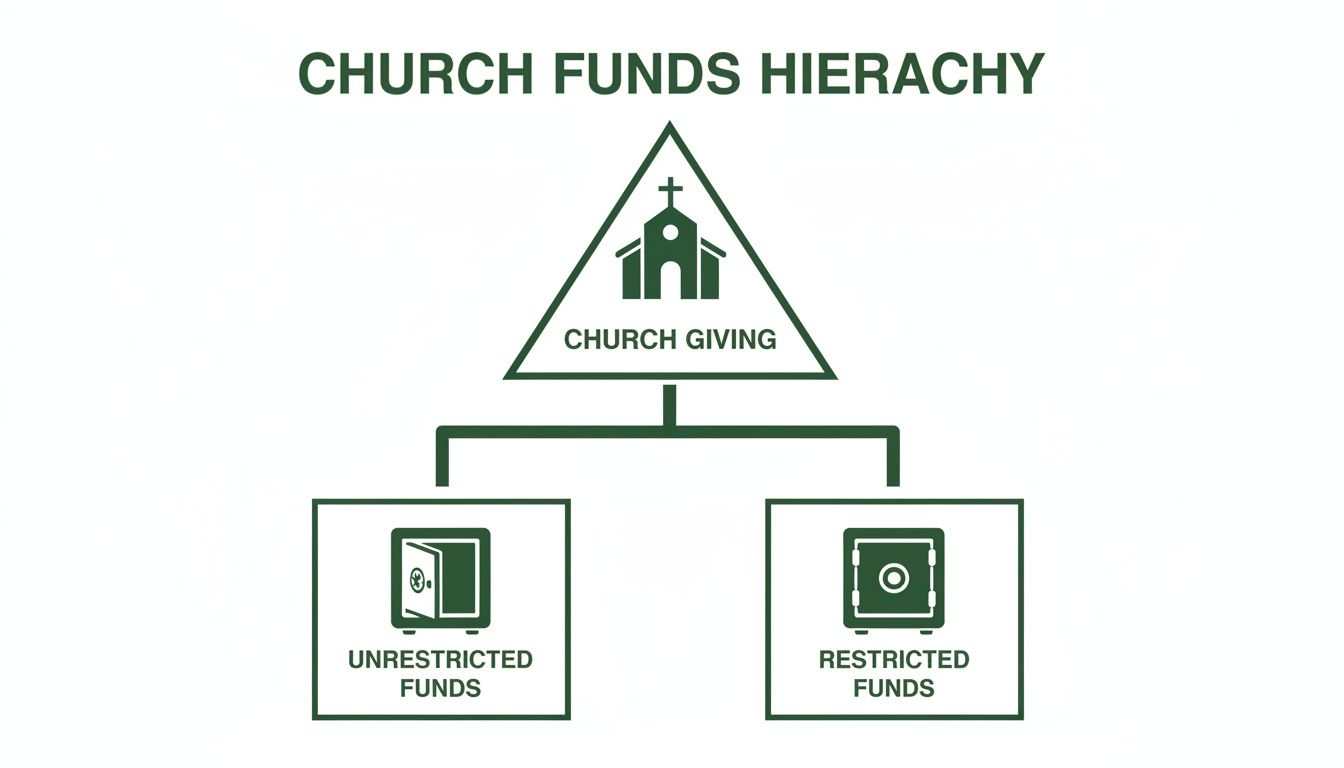
As you can see, all giving starts with one of two primary streams. Honoring this distinction is the foundation of trustworthy church finance.
Matching Fundraising Campaigns to Church Funds
So, how do your fundraising efforts connect to these funds? It's crucial to align each campaign with the right fund to maintain integrity and transparency. If you tell your congregation you're raising money for a new roof, those donations need to land squarely in the Building Fund—not the General Fund.
Here’s a quick guide to help you match common campaigns with the appropriate funds.
| Campaign Type | Primary Goal | Associated Fund(s) | Example Activities |
|---|---|---|---|
| Annual Budget Drive | Support ongoing ministry operations | General Fund | Pledges for yearly operating expenses, tithes, and offerings. |
| Capital Campaign | Fund major infrastructure projects | Building Fund | "Future Foundations" campaign for a new sanctuary or campus. |
| Missions Conference | Raise support for outreach partners | Missions Fund | Annual event to highlight and fund local and global missionaries. |
| Benevolence Offering | Provide aid for community needs | Benevolence Fund | Special collections on holidays or in response to a local crisis. |
| Youth Camp Fundraiser | Cover costs for specific ministry events | Designated/Restricted Fund | Car washes, bake sales, or special appeals to send kids to camp. |
Thinking this way from the start makes tracking donations and reporting back to your congregation a whole lot easier. It builds trust because people can see exactly how their generosity is making an impact.
Bringing Your Funds to Life with the Right System
Setting up these categories is one thing; managing them day-to-day is another. This is where a true fund-based accounting system goes from a "nice-to-have" to an absolute necessity. Generic business software just isn't built for this, forcing you into clunky workarounds that invite errors and kill transparency.
A fund is more than just a line item on a budget; it's a promise to your donors. A proper accounting system is the tool that ensures you can keep that promise with absolute integrity.
A system built for churches, like Grain Ledger, is designed with this structure at its core. You don’t need to rig anything or invent workarounds because it's built to think in terms of funds from the ground up.
The workflow is straightforward and incredibly powerful:
- Establish Funds: First, you create each fund in the software—General, Building, Missions, etc.—as its own distinct financial bucket.
- Link Donations: As donations come in (online or in the offering plate), you assign each one to its correct fund. A gift designated for "Missions" gets recorded directly into the Missions Fund.
- Track Expenses: When you pay a bill, the money is withdrawn from the right fund. A check to support a missionary comes directly out of the Missions Fund balance, not the general operating account.
- Generate Reports: At any moment, you can pull a report that shows the exact balance, income, and expenses for each individual fund. This gives you a level of clarity that’s simply out of reach with standard accounting software.
This built-in process removes the risk of accidentally spending restricted money on general expenses—a mistake that can have serious legal and ethical consequences. To get a better handle on the importance of this separation, you can learn more about what a restricted fund is and how to manage it.
By embracing this clear, accountable structure, you empower your church to manage its resources with precision and build unwavering trust with your congregation.
Connecting Your Giving Platform to Your Books
Let’s be honest. One of the biggest operational headaches for any church today is bridging the gap between a donation made on Sunday morning and the financial report on Tuesday. When your online giving platform and your accounting software don't speak the same language, that single generous gift creates a whole chain of manual, error-prone tasks. This isn't just inefficient; it's a genuine obstacle to good stewardship.
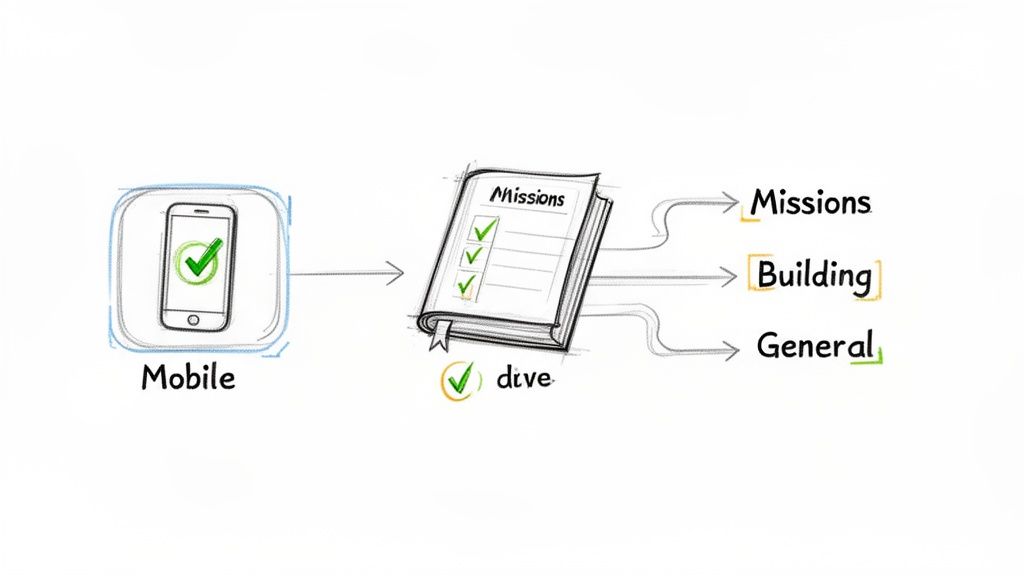
The reality is, online giving has completely changed the game. Research backs this up, showing that as churches embrace digital tools, they see a 32% increase in total donations. If you want to dig into the numbers, you can explore more in this detailed look at church giving statistics.
But as more giving moves online, it throws a harsh spotlight on any outdated, manual processes you still have in place.
The Hidden Costs of Manual Data Entry
Think about what happens after someone gives through a platform like Stripe or Pushpay. For far too many churches, it kicks off a tedious process where a treasurer or volunteer has to export a report, fiddle with it in a spreadsheet, and then painstakingly re-enter every single donation into the books.
This workflow is a quiet ministry killer. Here's why:
- It’s a massive time sink. Those are hours that could be spent analyzing giving trends or planning ministry budgets, but instead, they're lost to mind-numbing data entry.
- It’s an invitation for human error. One little typo can send money to the wrong fund, credit the wrong donor, or throw off your entire financial picture.
- It creates a crippling reporting lag. Leaders are left waiting days—or even weeks—for accurate numbers. You simply can't make agile, Spirit-led decisions with outdated information.
When your team can't trust the numbers or get them when they need them, they can't confidently plan for the future or report back to the congregation with the clarity everyone deserves.
The Power of an Automated Workflow
The solution isn’t working harder; it’s working smarter by creating a seamless, automated connection between your giving platform and your accounting software. In today’s world, this isn’t a luxury—it’s a fundamental requirement for sound financial management.
Imagine a world where every online donation flows directly into your books without anyone having to touch it. A properly integrated system automatically grabs transaction data, knows who the donor is, and—this is the magic—reads the donor's intent to put the money in the right fund.
True financial clarity isn't just about having the right numbers; it's about getting them at the right time. An automated workflow gives leaders the up-to-the-minute data they need to lead with confidence.
A Practical Example of Seamless Integration
Let's walk through how this works in a purpose-built church accounting system like Grain Ledger.
Say a church member uses your giving app to donate $100 and types "Missions Fund" in the memo line. In a manual system, someone has to catch that note and remember to log the donation as a restricted gift. With an integrated workflow, the story is completely different.
- Automatic Sync: Grain Ledger connects directly to your giving platform. It automatically pulls in all new donation data at regular intervals. No exports needed.
- Intelligent Parsing: The system is smart enough to read the transaction details, including that "Missions Fund" memo. It instantly recognizes this as a restricted gift meant for a specific purpose.
- Correct Allocation: Without any human intervention, that $100 is recorded directly into the Missions Fund's balance sheet, and the income is correctly noted on that fund's activity report.
The result? Your pastor and treasurer can see the exact, real-time balance of the Missions Fund at any moment. They know precisely how close they are to their fundraising goal and can make decisions based on live, accurate information.
This automated connection transforms fundraising from a reactive, administrative burden into a proactive, strategic advantage. It frees up your team, eliminates costly mistakes, and delivers the financial clarity you need to be exceptional stewards of your congregation’s generosity.
Telling Your Financial Story to Inspire Generosity
Great stewardship isn't just about managing money well—it's probably the most powerful fundraising tool your church has. At the end of the day, people give to a vision, not just to a budget. This final, crucial step in the fundraising cycle is all about turning your clean financial data into compelling stories that connect every single dollar to your mission.
This is where all that hard work in your financial office really pays off. When you can show your congregation exactly how their gifts are making a difference, you transform financial reporting from a dry obligation into a celebration of shared ministry. This isn't just about accountability; it's about inspiration.
From Data to Discipleship
Your financial data holds countless stories just waiting to be told. The trick is to move beyond generic income and expense statements and start creating fund-specific reports that show real-world results. These narratives provide tangible proof that your church is faithfully managing the resources God has entrusted to it.
Imagine the impact of sharing these kinds of updates with your congregation:
- A Missions Fund Report: Instead of just showing a number, you could share photos from the mission field, a letter from a missionary you support, or details on how many Bibles were purchased and distributed.
- A Benevolence Fund Update: You could share a story (while protecting privacy, of course) about a family that was able to stay in their home because of the congregation's generosity.
- A Building Fund Progress Bar: A visual tracker showing progress toward a new roof or children's wing helps everyone feel like they are part of building the future together.
These stories provide the "why" behind every gift. They make it clear that giving to your church isn't a transaction—it's an investment in changing lives.
The Power of Meaningful Communication
To really foster a culture of generosity, you have to nurture every donor, no matter the size of their gift. Meaningful communication is the best way to show you value the person, not just their wallet. This becomes even more critical when you look at typical giving patterns.
The average church donation is around $210, but a small group of very generous givers often drives the majority of a church's funding. For instance, just 2.96% of gifts over $1,000 can represent 27.34% of total giving. On the other hand, 44.01% of smaller gifts under $100 might only contribute 8.39%. You can explore these giving patterns further to get a better sense of these dynamics.
What this data really highlights is the need to thank and engage every single donor.
"A simple, heartfelt thank-you is one of the most effective ways to honor a donor's gift. It acknowledges their partnership in the ministry and encourages continued generosity."
Your year-end giving statements and thank-you messages are prime opportunities for this kind of storytelling. Don't just send a receipt; include a short impact story or a quote that connects their contribution directly back to the mission. The accuracy of this communication, however, hinges on having a reliable financial system.
The Foundation for Your Story
All of these inspiring reports and heartfelt messages depend on one thing: accurate data. If your numbers are messy or unreliable, you can't tell your financial story with confidence. This is where a true fund accounting system like Grain Ledger becomes essential.
Because Grain Ledger tracks every dollar from the moment it's donated to the moment it's spent—all within its designated fund—you can generate these specific, powerful reports in just a few clicks. The system gives you the concrete proof you need to back up your narratives. It helps turn your financial reports from a simple review into a powerful tool for discipleship and fundraising in your church.
For a deeper look at what makes these reports so effective, check out our complete guide to creating a powerful church financial report.
Related church accounting software resources
If you are comparing software, these pages map the main decision points: fund accounting, QuickBooks limits, pricing, and migration.
- Best church accounting software (2026 comparison) - canonical guide comparing 12 church accounting platforms
- Church accounting software product page - see Grain Ledger for fund accounting, giving, and bank reconciliation
- Small church accounting software - see the product page built for volunteer treasurers and church admins
- Fund accounting features - review how Grain Ledger tracks designated funds
- QuickBooks for churches - understand workarounds and when to switch
- Free church accounting software - compare free options and upgrade triggers
- Grain Ledger pricing - compare plans for small and growing churches
- Start free - try fund accounting, giving imports, and bank reconciliation together
Answering Common Church Fundraising Questions
Even with a solid plan, fundraising in a church setting always brings up unique questions. Let's tackle some of the most common ones we hear from ministry leaders, clearing up confusion so you can lead your church's finances with total confidence.
What’s the Difference Between a Capital Campaign and the General Fund?
Think of your General Fund as the lifeblood of your church's day-to-day operations. It's what covers the essentials—the lights, the salaries, the coffee on Sunday morning—and it’s typically fueled by regular tithes and offerings that aren't designated for anything specific.
A Capital Campaign is entirely different. It’s a targeted, high-energy fundraising effort for a major, one-time project. This could be anything from a new building or a significant renovation to wiping out the church mortgage. Every dollar given to a capital campaign is restricted, meaning it can only be used for that specific purpose.
It's not just good practice to keep these funds separate; it's a legal necessity. This is precisely why a dedicated fund accounting tool like Grain Ledger is so important—it’s built from the ground up to protect and track designated funds, ensuring you stay compliant and maintain your congregation's trust.
How Can a Small Church Encourage Online Giving?
For a smaller church, the key to boosting online giving is to make it dead simple. Your online giving button should be impossible to miss on your website's homepage. Don't be afraid to mention it from the stage and include a link in your weekly emails.
Once it's easy, you need to explain the why. Help people understand how consistent, recurring online gifts create a stable financial foundation that allows you to plan ministry and budget for outreach with confidence. But honestly, the most powerful thing you can do is show you're a good steward of those gifts.
When people see exactly how their money is being used—thanks to clear tracking and reporting—one-time givers start to become passionate, long-term supporters of the mission.
What Financial Reports Should We Share with the Congregation?
Transparency isn’t just a buzzword; it’s the bedrock of trust. A basic income and expense statement is a fine starting point, but the reports that truly resonate are the ones tied to specific funds.
These reports connect the numbers on a page to real-world ministry impact. Instead of just showing income and expenses, tell a story. For example, you could share:
- A Missions Fund Report that breaks down how donations helped support missionaries by name or funded specific outreach projects.
- A Building Fund Report with a visual thermometer graphic showing everyone how close you are to your campaign goal.
- A Benevolence Fund Summary that shares how many families in your community received help with rent or groceries.
This transforms a dry financial update into a powerful celebration of what God is doing through your church. Modern tools like Grain Ledger are designed to pull these fund-specific reports effortlessly, helping you turn financial data into a core part of your ministry's story.
Ready to bring this level of clarity and confidence to your church's finances? With Grain Ledger, you can automate your financial workflows, guarantee compliance with restricted funds, and generate the kinds of reports that inspire generosity. Schedule a Demo today and be one of the first to use an accounting platform truly built for your ministry's unique needs.
Ready to simplify your church finances?
Start free with church fund accounting, or watch a product demo first.