
Small Church Bookkeeping Your Practical Guide
Master small church bookkeeping with our guide on fund accounting, internal controls, and software that ensures financial clarity and good stewardship.
Managing a church’s finances is a world away from running a business. I’ve seen it time and again—well-meaning treasurers try to force standard business software to work for a ministry, and it just doesn’t fit. The best small church bookkeeping is built on fund accounting, a system designed from the ground up to honor a donor’s wishes.
See Grain Ledger for your church
Fund accounting, giving integrations, and bank reconciliation in one platform. Free migration support for churches switching from QuickBooks or Aplos.
This isn’t just about being organized; it’s about maintaining trust and ensuring every dollar is used exactly as intended.
Why Standard Bookkeeping Fails Small Churches
Let’s get right to it. Trying to adapt generic business software for your church often creates more problems than it solves. A for-profit company has one primary financial goal: make a profit. Its accounting system is simple—track revenue, subtract expenses, and measure what’s left. A church, on the other hand, runs on a totally different engine: mission, not margins.
The core issue comes down to donor intent. When a family gives to the "Missions Fund," they have a spiritual and legal expectation that their gift will, in fact, support missions—not patch a leaky roof. Standard bookkeeping software just wasn't built for this. It’s designed to pool all income into one big pot, making it far too easy to lose track of those specially designated funds.
The Stewardship Nightmare Scenario
I'll never forget a situation at a small, growing church I worked with. They received a very generous $5,000 gift specifically for an upcoming youth mission trip. The volunteer treasurer, using a popular off-the-shelf accounting program, just booked it as "Donation Income." A few weeks later, the old HVAC unit gave out, and they were looking at an urgent $4,000 repair.
Seeing a healthy bank balance, the board didn't hesitate to approve the expense. The real problem surfaced when they started planning the mission trip. They discovered the money was gone, accidentally spent on building maintenance. It led to some incredibly awkward conversations and damaged the trust they had worked so hard to build.
Good stewardship isn't just about counting money; it's about honoring donor intent and maintaining trust. When funds are mishandled, even accidentally, it erodes the confidence of your congregation.
Fund Accounting: The Non-Negotiable System
This is exactly why fund accounting is non-negotiable for any church. Instead of one big bucket of money, fund accounting creates virtual walls between your different income streams. It clearly separates:
- Unrestricted Funds: These are your general tithes and offerings used for day-to-day operations—salaries, utilities, Sunday school curriculum, and so on.
- Restricted Funds: These are donations given for a specific purpose, like a building fund, a benevolence ministry, or that youth mission trip.
This structure makes it practically impossible to spend a restricted gift on a general expense by mistake. For many small churches, managing this complexity in-house can feel overwhelming. Figuring out how to outsource bookkeeping for small business can be a game-changer, giving you a solid financial foundation and taking the pressure off your team.
This is why purpose-built church management tools are so important. Our top recommendation is a solution like Grain Ledger, which is designed with true fund accounting at its core. It’s not a business tool with a clunky "church module" tacked on; its entire system is made to help volunteers and staff handle small church bookkeeping with absolute integrity.
Building a Fund-Based Chart of Accounts
Let's start with the absolute foundation of your church's finances: the chart of accounts (COA). Don't think of this as just another spreadsheet. It's the custom-built shelving system for your church’s money, and for a small church, you can't just grab a generic business template. You need a structure built around fund accounting from the very start.
This isn't just about being organized; it's about stewardship and clarity. A proper COA is what empowers you to confidently tell your pastor that the missions fund is healthy or that the building fund can actually cover that leaky roof. Getting this right from day one is how you avoid the kind of financial mess that can cripple a ministry's effectiveness and trust.
When bookkeeping goes wrong, the consequences are always the same.
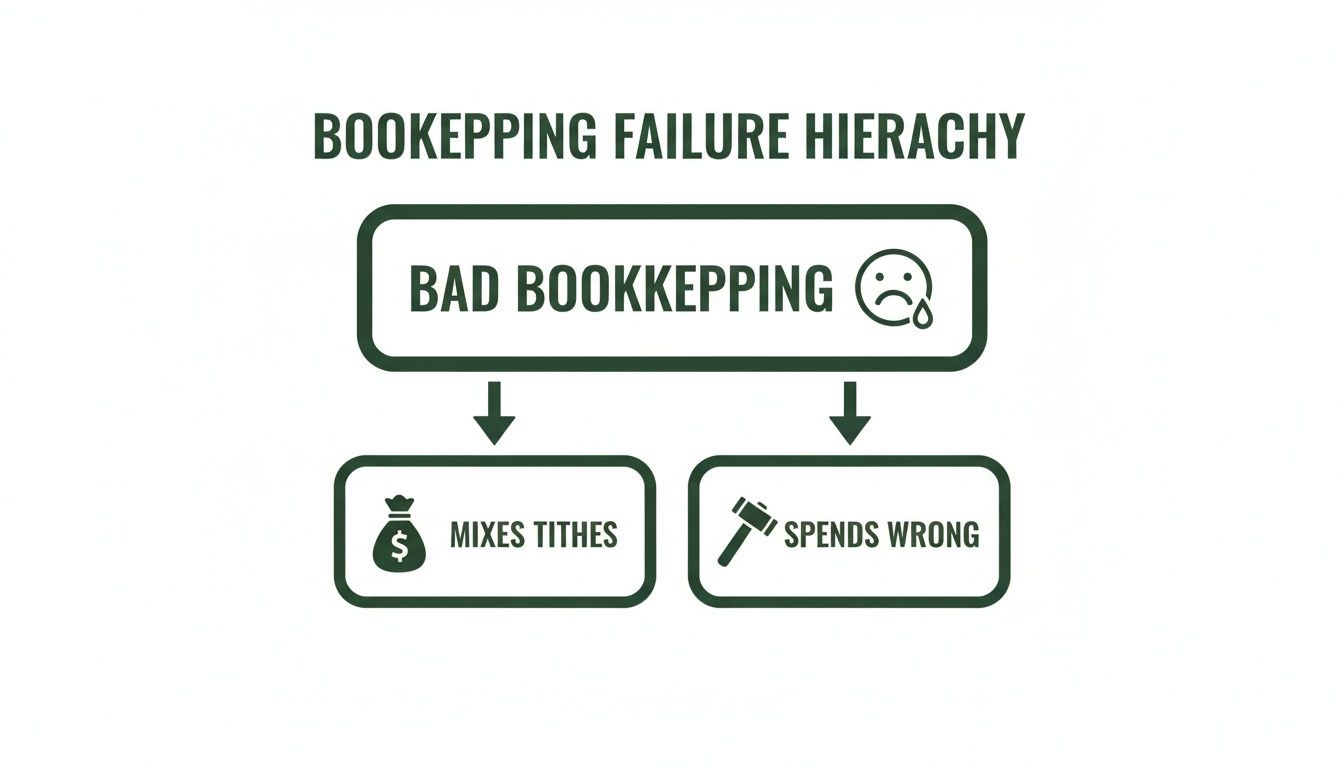
As you can see, sloppy habits directly lead to critical errors like co-mingling designated gifts with general offerings or, even worse, spending restricted money where it was never intended to go.
The Foundation of Fund Accounting
The whole point of a church’s chart of accounts is to separate money based on its intended purpose. A for-profit business pools all its revenue into one big pot. A church can’t do that. We have a sacred responsibility to honor donor intent, and that’s where fund accounting becomes non-negotiable.
Your COA is how you put this into practice. You'll set up distinct "funds" that essentially act like separate mini-bank accounts within your books. For most small churches, this usually boils down to a few key funds:
- General Fund: This is home base for all unrestricted tithes and offerings. It pays for the daily operations—salaries, lights, coffee, and curriculum.
- Building Fund: This holds restricted gifts given specifically for property needs, whether that’s a down payment on a new building, a construction project, or major repairs.
- Missions Fund: Here, you’ll track every dollar donated to support your local and global ministry partners or to fund mission trips.
- Benevolence Fund: This is for gifts meant to help people in your church or community who are facing financial hardship.
A purpose-built accounting tool like Grain Ledger is designed with this fund structure at its core. It doesn't rely on clumsy workarounds like tags or classes to simulate funds. Instead, every single transaction is natively assigned to a fund, ensuring true financial separation and integrity right from the start.
Structuring Your Accounts Within Each Fund
Once your funds are defined, you build out the accounts inside each one. You’ll use the same standard account types you see everywhere—Assets, Liabilities, Income, and Expenses—but you’ll duplicate them across the different funds as needed.
So, instead of one generic "Donations" account, you might have "Offering Income" under your General Fund and a separate "Missions Giving" income account under your Missions Fund. The same goes for expenses. This clear separation is what keeps you out of trouble.
Here's a simplified look at how this structure might appear.
Sample Chart of Accounts for a Small Church
This table gives a basic idea of how accounts are organized under different funds, creating clarity and preventing funds from being mixed.
| Account Type | General Fund Example | Building Fund Example | Missions Fund Example |
|---|---|---|---|
| Income | Tithes & Offerings | Capital Campaign Pledges | Designated Missions Giving |
| Expense | Pastor's Salary | Architect Fees | Missionary Support |
| Expense | Utilities | Construction Permits | Mission Trip Expenses |
| Asset | General Checking Account | Building Fund Savings | Missions Savings Account |
By setting up your accounts this way, you create a system that provides immediate, trustworthy answers to financial questions.
A well-structured chart of accounts provides instant clarity. When a board member asks, "Can we afford the new sound system?" you shouldn't have to spend an hour digging through a messy spreadsheet. A fund-based COA gives you the answer in seconds.
This level of detail is critical for maintaining financial integrity. For instance, Vanderbloemen research on healthy church budgets shows that small churches often allocate 45-55% of their total budget to staff compensation, with some going as high as 60%. A fund-based COA allows a treasurer to isolate and track these huge personnel costs strictly within the General Fund, providing a firewall so designated missions or building funds aren't accidentally used to cover payroll.
Unrestricted vs. Restricted Gifts: The Critical Distinction
If you only master one concept in church bookkeeping, make it this one: the difference between unrestricted and restricted gifts. Getting this right protects your church legally and is the bedrock of trust with your congregation.
- Unrestricted Gifts: These are the general tithes and offerings given without any specific instructions. Your church leadership can decide how to best use these funds to support the overall ministry.
- Restricted Gifts: This is money given for a specific purpose. When a donor writes "for the new roof" or "youth mission trip" on their check, you are legally and ethically bound to use that money only for that purpose.
Your chart of accounts must make this distinction impossible to ignore. When you receive a $500 check with "Youth Camp" in the memo line, your bookkeeping process must route that income directly into a designated Youth Fund or account. It can never be lumped in with the general Sunday offering. For a more detailed guide on structuring these categories, you can learn more about setting up a nonprofit chart of accounts.
Connect Your Giving and Banking for a Simpler Workflow
Getting money from the offering plate or an online portal into the right accounting ‘bucket’ can be a massive headache. For many volunteer treasurers, this is exactly where bookkeeping for a small church falls apart. Manually keying in donation records from platforms like Pushpay or Planning Center into a spreadsheet is a recipe for typos, mismatched totals, and hours of frustrating reconciliation work.
The goal isn't just to work harder, but to work smarter by using automation. The good news is that modern church accounting software is built to connect these financial dots for you. It creates a seamless bridge between your giving platform, your bank, and your books, cutting out the tedious and error-prone steps that eat up so much time.
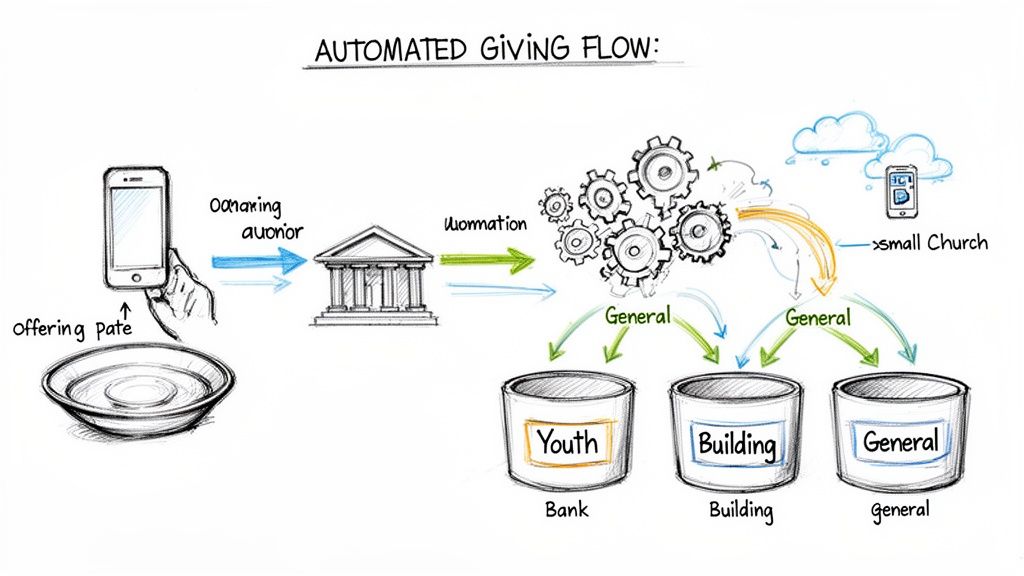
This kind of automated flow ensures every single donation is captured and categorized correctly from the moment it’s given.
The Power of Direct Integrations
Imagine a member of your congregation gives $100 online and designates it for the youth group's summer camp. With a properly integrated system, that donation doesn’t just land in a general pot waiting for you to sort it out. It flows directly into your accounting software and is automatically credited to the "Youth Fund" without you lifting a finger.
This direct connection brings some game-changing benefits to your ministry:
- Reclaim Your Time: It drastically cuts down on administrative work. This frees up your treasurer to focus on meaningful analysis and stewardship, not just data entry.
- Eliminate Costly Errors: Automation gets rid of the risk of human error, ensuring your records are always accurate and trustworthy.
- Gain Real-Time Clarity: You get an up-to-the-minute view of your cash flow and fund balances, which is absolutely essential for making timely ministry decisions.
A purpose-built solution like Grain Ledger is designed specifically for this task. It integrates directly with your bank and popular online giving platforms, acting as the central hub for your church’s finances. This ensures that every gift, whether for the building fund or general tithes, lands exactly where it belongs—automatically.
Why Real-Time Data Is a Lifeline for Small Churches
For a small church, cash flow can be dangerously unpredictable. You might not have large reserves, and a handful of key givers can represent a huge slice of your total income. This makes having a real-time financial picture less of a convenience and more of a necessity for survival.
This financial fragility is a well-documented reality. In fact, data from the Christian Stewardship Network reveals that just 2% of givers contribute a staggering 21.2% of all church donations. For small churches, this makes revenue streams incredibly fragile.
A seamless link between your giving platform and your books lets you monitor these vital contributions in real time. You can see their impact on specific funds and quickly spot shifts in giving patterns from this key group, helping you prevent unexpected shortfalls in your ministry budgets.
When you can see incoming donations and their designations the moment they arrive, you can manage your resources with confidence. You'll know immediately if you have the funds for an unexpected repair or a new ministry opportunity.
Choosing the Right Tools to Connect Your Systems
Creating this connected ecosystem starts with picking the right tools. As you evaluate an online giving provider, make sure to ask about its ability to integrate with accounting software. Many platforms are designed to play well with others.
If you really want to improve your financial operations, it's worth exploring how modern software can help. For instance, you could look into the powerful AI bookkeeping features in Quickbooks and Xero that can enhance these integrations even further.
Ultimately, the goal is to create a system where your financial tools talk to each other. This integrated approach transforms small church bookkeeping from a dreaded chore into a powerful tool for good stewardship.
Excellent church bookkeeping isn't about some frantic, heroic effort at the end of the year. I've seen too many volunteer treasurers burn out that way. Real financial stewardship is built on simple, consistent habits.
Think of it as creating a sustainable rhythm. When you break the big job of "bookkeeping" into small, manageable tasks, it stops being a source of stress. Instead, it becomes a powerful tool that builds trust and helps your leadership make wise ministry decisions.
Daily and Weekly Workflows
The heartbeat of your financial rhythm is found in your daily and weekly tasks. These are the small, consistent actions that prevent chaos from ever building up in the first place.
Your main job day-to-day is simply to categorize transactions. If you're using modern accounting software like Grain Ledger, this is incredibly simple. A new charge from Staples pops up in your bank feed—you just assign it to the "Office Supplies" expense account. It literally takes seconds.
Then, at the end of each week, you'll want to set aside a little time to reconcile the week's giving.
- Online Giving: Pull up the batch report from your giving platform, whether it's Pushpay or Planning Center Giving, and make sure the deposit that hit your bank account matches it perfectly.
- Physical Offerings: For any cash or checks you still receive, double-check that the bank deposit slip total matches the count sheet filled out by your offering counters.
- Fund Allocations: This is crucial. Quickly review any designated gifts from the week and confirm they were properly posted to the correct restricted fund, like the Building Fund or Missions Fund.
This quick weekly check-in is your best defense against errors. Finding a mistake a few days after it happens is easy. Finding it three months later can turn into a nightmare of digging through old records.
My best advice? Touch your books lightly but frequently. A few minutes each day and maybe an hour every Friday is far more effective than trying to piece together a whole month from memory.
The Essential Bookkeeping Rhythm
To keep things simple and prevent overwhelm, I recommend a basic checklist of tasks. This rhythm helps ensure nothing falls through the cracks, whether you're a volunteer treasurer or a part-time administrator. It turns a daunting process into a series of manageable steps.
| Frequency | Task | Purpose |
|---|---|---|
| Daily | Categorize Bank Transactions | Keeps books current and prevents a backlog. |
| Weekly | Reconcile Giving Batches | Ensures all online and physical gifts are accounted for. |
| Weekly | Review Fund Designations | Confirms restricted gifts are allocated correctly. |
| Monthly | Perform Bank Reconciliation | Verifies that your books perfectly match the bank's records. |
| Monthly | Run & Distribute Financial Reports | Provides leadership with timely, accurate data for decision-making. |
| Quarterly | Review Budget vs. Actuals | Allows for proactive adjustments based on real-time trends. |
Sticking to a schedule like this is the secret to low-stress, high-impact financial management for your church. It creates a predictable workflow that builds confidence and clarity.
Monthly Routines for Financial Clarity
At the end of each month, it's time to zoom out and make sure all the pieces fit together. This is when you verify everything and prepare the financial story for your pastor and board.
The single most important task you'll do all month is the bank reconciliation. This is where you methodically match every single transaction in your accounting software to the corresponding line item on your bank statement. It is the ultimate confirmation that your books are a perfect mirror of reality.
Once you’re reconciled, you can run your key financial reports with confidence. Your leadership gets fresh, reliable data, which is exactly what they need to lead well.
Adapting with a Dynamic Budget
The old "set-it-and-forget-it" annual budget is quickly becoming a thing of the past. A far more effective approach is dynamic budgeting, where you regularly revisit and adjust your plan based on what's actually happening with giving.
This keeps your church nimble and grounded in reality. As of 2026, modern church finance is shifting toward this dynamic model, with many churches reforecasting quarterly instead of just sticking to a static annual plan. This is vital because donation increases (often around 2%) frequently lag behind inflation (which can spike as high as 8%), putting a real squeeze on the budget.
By reviewing giving data monthly and reforecasting, churches can proactively adjust spending—like their 20-30% allocation for facilities—to stay healthy and financially resilient. You can read more about strategic financial leadership for churches. This agile method empowers your leaders to make proactive decisions all year long, ensuring your resources are always aligned with your mission.
Creating Reports Your Pastor and Board Understand
A spreadsheet full of numbers is pretty meaningless if your pastor and board can't use it to make wise ministry decisions. Good small church bookkeeping isn’t just about crunching numbers; it’s about translating that data into a clear story of stewardship. This is where you graduate from a generic profit and loss statement and start providing reports that truly speak to the financial health and missional capacity of your church.
At the end of the day, your reports need to tell a story your leadership can actually use.
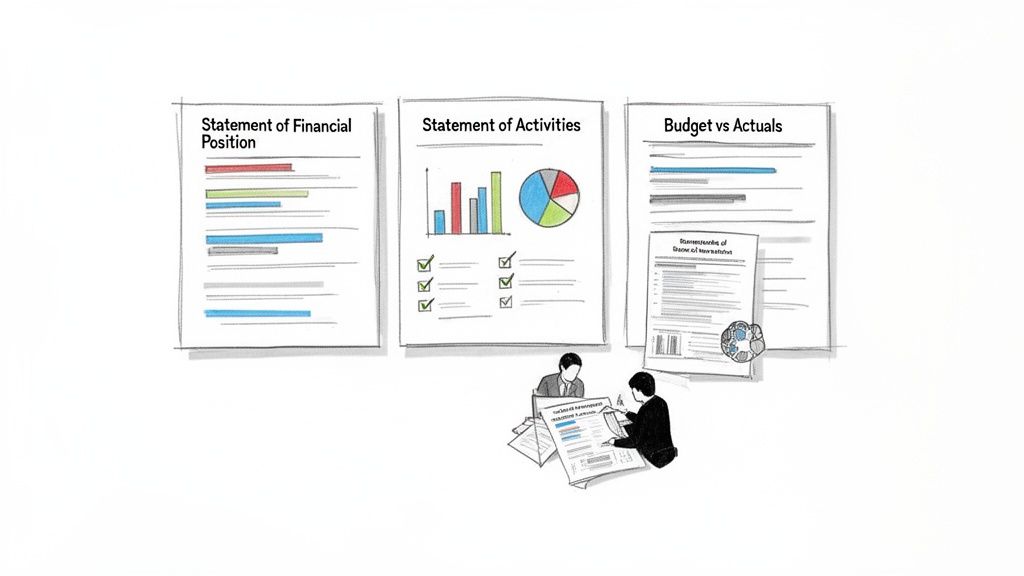
When your leadership team looks at a report, they’re asking real-world questions. Can we launch that new outreach? Is the missions fund healthy enough to support our partners? Can we afford to fix the air conditioner? Your reports have to provide immediate, trustworthy answers.
The Statement of Financial Position
Think of the Statement of Financial Position as your church’s financial snapshot. For a business, this is called a balance sheet, but for a church, it’s much more meaningful. It lays out what your church owns (assets), what it owes (liabilities), and its net assets—all broken down by fund.
This fund-based breakdown is the absolute key. A standard balance sheet might show a healthy bank balance, but this report tells you how much of that cash is actually available for general operations versus how much is already earmarked for a specific purpose.
- Assets: This is your cash in checking and savings, along with any buildings or property. It’s crucial to show which fund each asset is tied to.
- Liabilities: This covers any outstanding loans, unpaid bills, or credit card balances.
- Net Assets: This is what’s left over. The report clearly separates your Unrestricted Net Assets (from the General Fund) from your Restricted Net Assets (from your Building Fund, Missions Fund, etc.).
This is the report that prevents leadership from accidentally spending money that’s already been promised to another ministry area. It stops them from making decisions based on a false sense of security.
The Statement of Activities
If the Statement of Financial Position is a snapshot, the Statement of Activities is the movie. It shows all the financial action over a period of time—usually a month or a quarter. It’s a lot like a business’s income statement, but once again, the fund-based structure is what makes it so incredibly useful for a church.
This report tracks all your income and expenses, but it organizes them by fund. This lets your board see not just what was spent, but which fund it came from.
A well-prepared Statement of Activities tells a story of ministry in action. It shows how tithes are fueling daily operations in the General Fund while simultaneously demonstrating how designated gifts are advancing specific projects in restricted funds.
For instance, your pastor can glance at this report and see exactly how much was given to the Missions Fund last month and how much was sent out to support missionaries. It connects the dots between giving and doing, which builds tremendous confidence in your financial leadership.
The Budget vs. Actuals Report
This is probably the most practical, forward-looking report you can provide. The Budget vs. Actuals report takes your church's annual budget and lays it right alongside what you actually received and spent. When organized by fund, this report becomes your go-to tool for financial clarity and course correction.
Let's walk through a real-world scenario. Your board meets, and someone asks if the Building Fund can cover a much-needed $10,000 roof repair.
You pull up the Budget vs. Actuals report. It instantly shows that while the Building Fund has received $8,000 in donations this year (against a budget of $15,000), it also had $3,000 in prior expenses. The report immediately answers the question: "No, we only have $5,000 available, so we are $5,000 short for this repair."
That kind of clarity moves the conversation from guesswork to strategic planning. Now, the board can discuss how to raise the remaining funds instead of just approving an expense the church can't afford yet. You can explore a variety of church financial reports and what they tell you in more detail to make your leadership meetings even more effective.
Automating Reports That Build Confidence
Let's be honest: creating these fund-based reports in a spreadsheet is a slow, tedious, and error-prone process. This is precisely why software built for churches is so valuable.
A solution like Grain Ledger is designed with this kind of reporting at its very core. Since every single transaction is tied to a fund from the moment it's entered, generating these three essential reports takes just a few clicks. The software does the heavy lifting, pulling all the data into clean, easy-to-read formats.
This frees you up to walk into any board meeting with accurate, up-to-the-minute information, ready to provide the clear answers that foster trust and empower wise, God-honoring decisions.
Compare platforms in our best church accounting software guide for 2026, or review Grain Ledger church accounting software.
Related church accounting software resources
If you are comparing software, these pages map the main decision points: fund accounting, QuickBooks limits, pricing, and migration.
- Best church accounting software (2026 comparison) - canonical guide comparing 12 church accounting platforms
- Church accounting software product page - see Grain Ledger for fund accounting, giving, and bank reconciliation
- Small church accounting software - see the product page built for volunteer treasurers and church admins
- Fund accounting features - review how Grain Ledger tracks designated funds
- QuickBooks for churches - understand workarounds and when to switch
- Free church accounting software - compare free options and upgrade triggers
- Grain Ledger pricing - compare plans for small and growing churches
- Start free - try fund accounting, giving imports, and bank reconciliation together
Your Top Questions About Small Church Bookkeeping
Even when you have a solid bookkeeping system in place, the day-to-day realities of ministry will always throw you a few curveballs. These are the moments where theory meets practice, and I get these questions all the time. Let's walk through some practical answers for the common challenges in small church bookkeeping.
How Do We Handle Cash Offerings and Keep Accurate Records?
Cash is, without a doubt, one of the trickiest things for any church to manage. It's untraceable by nature, so your process for handling it has to be absolutely airtight. This isn’t just about good accounting—it's about demonstrating integrity and stewarding God's resources well.
The foundation of it all is the two-person rule. From the second the offering plate comes back, no single person should ever be left alone with undeposited cash. Ever.
A trustworthy process looks like this:
- Two unrelated people count the offering together in a secure room.
- They both fill out and sign a count sheet, detailing the total cash and the number of checks.
- One person prepares the bank deposit slip while the other verifies it against the count sheet.
- The deposit is taken directly to the bank, and the validated receipt is handed over to your bookkeeper or treasurer.
Following these steps creates a clear paper trail that protects the counters from any suspicion and protects the church from loss.
What Are the Most Important Internal Controls for a Small Church?
Beyond cash, a few other simple checks and balances are crucial for preventing errors and fraud. Even if your finance team is just a couple of trusted volunteers, putting these controls in place is a mark of good leadership.
Here are a few controls I consider non-negotiable:
- Segregation of Duties: The person entering donations and expenses into your books should not be the same person signing checks or reconciling the bank statement. Spreading these tasks out, even among a small team, builds a natural system of accountability.
- Dual Signatures on Checks: Set a threshold—say, $500—and require two signatures from authorized leaders on any check written for more than that amount. This simple step ensures no large spending decisions happen in a vacuum.
- Regular Financial Reviews: Your finance committee or church board should be looking at the financial reports and bank reconciliations every single month. This consistent oversight is one of the most powerful layers of accountability you can have.
Internal controls aren't a sign of distrust; they are a sign of wisdom. They protect the church's resources, its reputation, and the very people who volunteer their time to serve.
Can We Just Use QuickBooks for Fund Accounting?
I hear this question constantly, and the honest answer is… it’s complicated. Yes, you can technically make software like QuickBooks work for fund accounting, but it requires some serious workarounds and a strong grasp of accounting to pull it off without making a mess.
QuickBooks was built for for-profit businesses, not ministries. To track designated funds, you have to lean heavily on features like "Classes" or "Locations." This means every single transaction—every donation, every expense—has to be manually tagged with the correct fund. The problem is, it's incredibly easy for a volunteer to forget a tag or apply the wrong one. One small slip-up can lead to commingled funds and completely inaccurate reports.
This is exactly why we always recommend a purpose-built tool. A system like Grain Ledger was designed from the ground up for true fund accounting. It's not a business tool with a patch. Its entire structure is built to keep your funds separate from the start, which makes proper small church bookkeeping dramatically simpler and more reliable. It practically eliminates the risk of manual error and generates the fund-based reports you need automatically.
Ready to move beyond messy spreadsheets and confusing workarounds? Grain Ledger offers true, native fund accounting designed specifically for the needs of your ministry. Schedule a Demo today to be the first to experience a simpler, more accurate way to manage your church’s finances. Learn more at https://grainledger.com.
Ready to simplify your church finances?
Start free with church fund accounting, or watch a product demo first.