What Is VBS in Church? A Complete Guide for 2026
 By Gibson Brueher, Founder of Grain Ledger
Wondering 'what is VBS in church'? Our guide explains Vacation Bible School's purpose, structure, planning, and how to manage its finances with fund accounting.
Summer is coming, and your church office probably feels it already. A children's ministry leader is asking about curriculum. Someone on the finance team wants to know whether VBS donations should sit in the general fund or in a separate bucket. A pastor is wondering if the effort is still worth it. A volunteer coordinator is worried about finding enough people to staff the week.
About Grain Ledger: This guide includes Grain Ledger, church fund accounting software built for designated gifts and ministry funds. It connects giving platforms (Planning Center, Pushpay, Tithely, Stripe), syncs bank activity with Plaid, and produces fund-level financial reports. Schedule a demo to see how it compares for your church.
See Grain Ledger for your church
Fund accounting, giving integrations, and bank reconciliation in one platform. Free migration support for churches switching from QuickBooks or Aplos.
That combination of excitement and pressure is normal. If you're asking what is vbs in church, you're usually not asking for a dictionary definition. You're asking what it looks like, why churches keep doing it, and how to run it without creating ministry confusion or accounting messes.
An Introduction to Vacation Bible School
On a summer morning, the church hallway looks different. The walls are covered in themed decorations. Kids arrive with name tags, nervous smiles, and a lot of energy. Volunteers point families to check-in, music starts in the sanctuary or fellowship hall, and suddenly a building that felt quiet all week becomes one of the most active mission fields your church will host all year.
That is Vacation Bible School, usually called VBS. In most churches, it's a focused summer program built around Bible teaching, worship songs, games, crafts, snacks, and relationship-building with children and their families. It often runs for one week and is especially common in evangelical and Baptist churches.

VBS isn't a niche idea. It's part of American church life in a way few ministries are. According to a survey reported by Baptist Press and BRN, six in 10 Americans (60%) attended VBS as children, and two-thirds of U.S. parents plan to send their kids to VBS.
That broad familiarity matters. Parents may not come to Sunday school. They may not be ready for a worship service. But they often understand what VBS is, and they're willing to trust the church with that first step.
VBS often works because it feels familiar to families while still opening the door to deeper ministry.
A practical detail gets overlooked here. First impressions start before the first Bible story. Clear parking directions, entry signs, and check-in flow remove anxiety for guests who have never visited your campus. If you're refreshing your summer setup, these church welcome sign ideas can help you think through how families experience your building before a single volunteer says hello.
The Purpose and Ministry Impact of VBS
VBS isn't just a children's event. It's a church outreach strategy.
The ministry purpose is usually threefold. First, evangelism. Children hear the gospel in an age-appropriate setting. Second, discipleship. Kids who already attend church get concentrated Bible teaching and repetition over several days. Third, community connection. Parents and grandparents meet your people, learn your church culture, and decide whether your congregation feels safe, warm, and trustworthy.
When church leaders reduce VBS to childcare, they miss what makes it powerful. VBS gives the church several consecutive days with children and families who may never attend a Sunday service on their own. That repeated contact changes the tone. A guest family is no longer walking into an unfamiliar room for one hour. They're seeing your volunteers, hearing your message, and learning whether your church keeps its word.
The scale of that ministry impact is hard to ignore. In 2017, 21,376 churches across the U.S. hosted VBS programs, with 2,494,059 participants. Those programs led to 65,301 salvation decisions, 835 commitments to vocational ministry, and $7,012,010 raised for missions, according to reporting on LifeWay Christian Resources data.
Why churches keep prioritizing it
For pastors and boards, those numbers clarify something important. VBS creates a low-pressure entry point with a clear gospel purpose. Families are willing to try a weeklong kids program even when they aren't ready for regular attendance. That gives the church a genuine chance to welcome people, not just advertise to them.
A healthy VBS also serves the congregation itself. Teenagers learn to serve. Adults who don't teach on Sundays find practical ministry roles. Older members who can't run games can prep crafts, stuff supply bags, or write prayer notes.
What success really looks like
Success isn't only measured by the closing-day crowd. Look for signs like these:
- Children who understand the gospel more clearly
- Parents who begin conversations with pastors or ministry leaders
- New families who return for worship, kids ministry, or another church event
- Members who discover gifts in hospitality, administration, or teaching
Practical rule: If your church can explain how VBS supports evangelism, discipleship, and follow-up, you aren't planning a week of activities. You're building a ministry pathway.
What a Typical VBS Week Looks Like
The idea of VBS is often understood before its operational flow. That's where confusion starts. New church administrators often hear terms like "rotations," "crew leaders," or "closing rally" and wonder how the whole thing fits together.
A typical VBS runs daily for 2 to 3 hours over 5 weekdays, with children grouped by age and moved through stations such as Bible teaching, crafts, games, and snacks. That theme-based structure is one reason it works so well. As described in the Vacation Bible School overview, some providers report that 15% to 25% of unchurched attendees become regular church attenders.
The daily rhythm
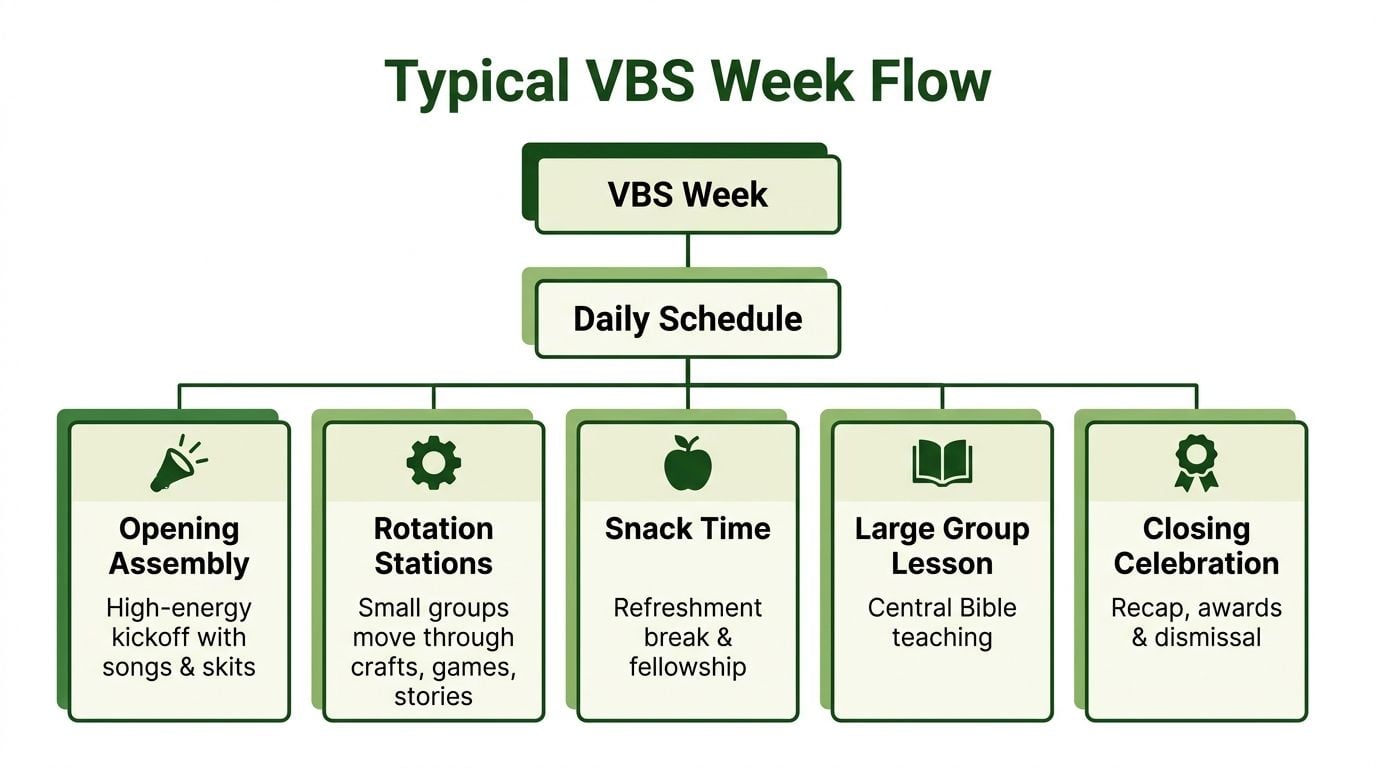
Think of VBS as a five-part routine that repeats each day with a different Bible focus.
-
Opening assembly
This is the high-energy start. Kids gather in one room for songs, skits, memory verse introductions, and theme-based fun. It sets the tone and helps late arrivals get oriented without disrupting smaller groups. -
Rotation stations
After the opening, children move in age-based groups. One group may go to Bible story time while another heads to crafts or recreation. These rotations keep kids moving and help each lesson land in more than one way. -
Snack time
Snacks aren't filler. They create breathing room, relationship time, and often another chance to reinforce the daily theme. -
Large group lesson or recap
Some churches return to a central teaching moment later in the schedule. Others place the main lesson earlier and use this slot for review, missions emphasis, or worship response. -
Closing celebration
Leaders wrap up the day, preview tomorrow, recognize participation, and handle dismissal in a controlled way.
Why the structure matters
Children learn better when the message is repeated in different formats. A Bible story tells the message. A craft gives them something to hold. A game gives them motion and memory. Music helps the theme stick.
That's why VBS often feels busy but purposeful. The pieces aren't random. They work together.
| Part of the day | What children experience | Why it matters |
|---|---|---|
| Opening assembly | Songs, skits, theme intro | Builds excitement and unity |
| Bible station | Scripture lesson and discussion | Anchors the day in God's Word |
| Craft or activity | Hands-on response | Reinforces the lesson |
| Games and snack | Movement and connection | Keeps energy healthy and relational |
| Closing time | Review and dismissal | Helps families leave informed |
A simple example
If the theme centers on trusting God, the opening song introduces that idea. The Bible station teaches a story about God's faithfulness. The craft visually reinforces the truth. The game uses teamwork to echo the lesson. The closing rally repeats the main point so children leave with one clear sentence in mind.
The strongest VBS weeks don't just entertain kids. They repeat one biblical truth so many ways that children can remember it at home.
Assembling Your Team and Ensuring Safety
A good VBS doesn't happen because one talented director works harder than everyone else. It happens because the church builds a team with clear roles and clear safeguards.
Volunteer pressure is real. A 2025 Lifeway Research survey cited by Crosswalk found that 41% of churches canceled or scaled back VBS due to volunteer shortages. If your team feels stretched, you're not alone.
The roles you actually need
Some churches recruit too vaguely. "We need VBS helpers" sounds friendly, but it doesn't help people picture themselves serving. Specific roles work better:
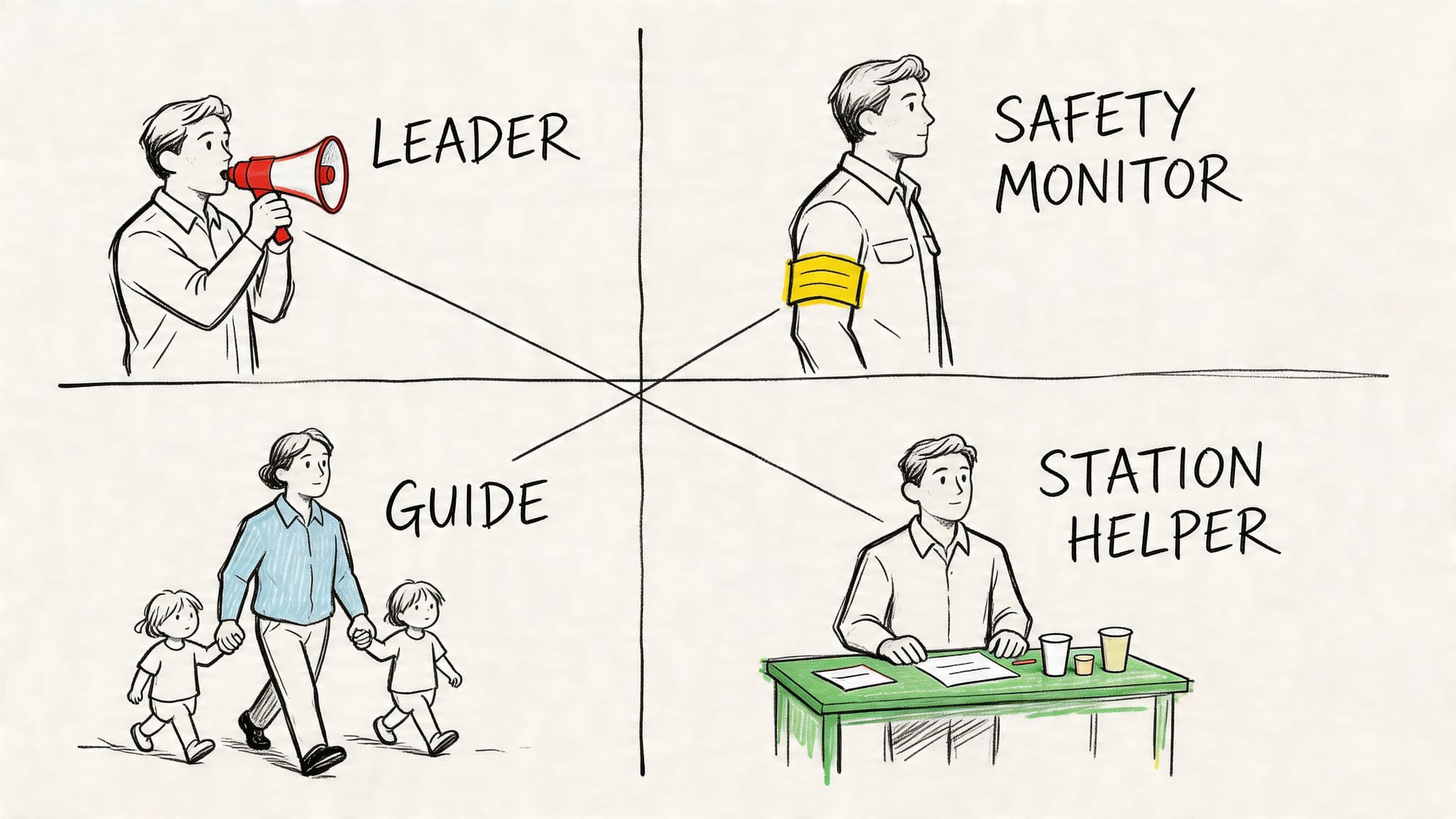
- Crew guides walk children from station to station and build relationships all week.
- Station leaders handle one area such as Bible teaching, crafts, music, recreation, or snacks.
- Registration and check-in volunteers manage names, tags, pickup procedures, and parent questions.
- Safety monitors watch hallways, entry points, and transitions.
- Floaters cover bathroom trips, supply runs, and unexpected gaps.
If you want a cleaner intake process for participants and volunteers, a tool like this club registration form builder can help your team organize names, permissions, and key details before opening day.
Safety isn't a side task
Every pastor and administrator should treat safety procedures as ministry, not paperwork. Parents are trusting your church with their children. That trust must be protected.
Use a written plan that covers:
- Check-in and check-out procedures so children are released only to approved adults
- Background screening for volunteers who work with minors
- Allergy and medical notes that are easy for leaders to access
- Bathroom and classroom supervision standards
- Emergency communication steps for incidents, weather, or medical concerns
For screening practices, this guide on volunteer background screening gives church teams a useful starting point.
A short training video can also help your team align on expectations before the week starts.
A tired volunteer can still be kind. A confused volunteer can still create risk. Training matters because clarity protects children.
Your VBS Planning Timeline and Budget
VBS feels overwhelming when everything sits in one big mental pile. It becomes manageable when you give it dates, owners, and line items.
One planning principle helps immediately. Start earlier than you think you need to. That gives you room to recruit, order materials, solve volunteer gaps, and build a budget before expenses start showing up on random church cards.
A sample six-month path
| Month | Key Tasks |
|---|---|
| Month 1 | Choose dates, approve theme, appoint director, reserve rooms |
| Month 2 | Build budget, order curriculum, map registration process |
| Month 3 | Recruit key leaders, confirm safety procedures, start promotion |
| Month 4 | Train station leaders, collect supply lists, open registration |
| Month 5 | Finalize volunteer assignments, prepare check-in materials, purchase supplies |
| Month 6 | Decorate spaces, confirm parent communication, run volunteer briefing |
That timeline doesn't need to be complicated. It needs to be visible. If your church struggles to keep ministry planning tied to real numbers, this budget template for churches is a practical reference point for setting categories and ownership.
What to include in the budget
Churches can expect VBS costs to average $20 to $40 per child, covering curriculum, snacks, and supplies, according to this VBS history and cost overview. That doesn't tell you your exact total, but it does give finance teams a realistic planning range.
Common budget categories include:
- Curriculum and leader guides
- Craft materials and classroom supplies
- Snacks and food service items
- Decorations and signage
- Volunteer shirts or name tags
- Printing and communication materials
- Missions offering supplies or event-specific materials
Where churches often get tripped up
The trouble usually isn't the first budget draft. It's the small purchases that happen later. Someone buys extra glue sticks. Another leader picks up allergy-friendly snacks. A volunteer gets reimbursed for decorations. If those charges aren't coded consistently, your reporting gets blurry fast.
Budgeting for VBS isn't only about cost control. It's about making sure every dollar tells the right ministry story afterward.
A clean process helps. Assign one person to approve purchases, one person to track receipts, and one person to reconcile what was spent against the approved categories.
How to Track VBS Finances with Fund Accounting
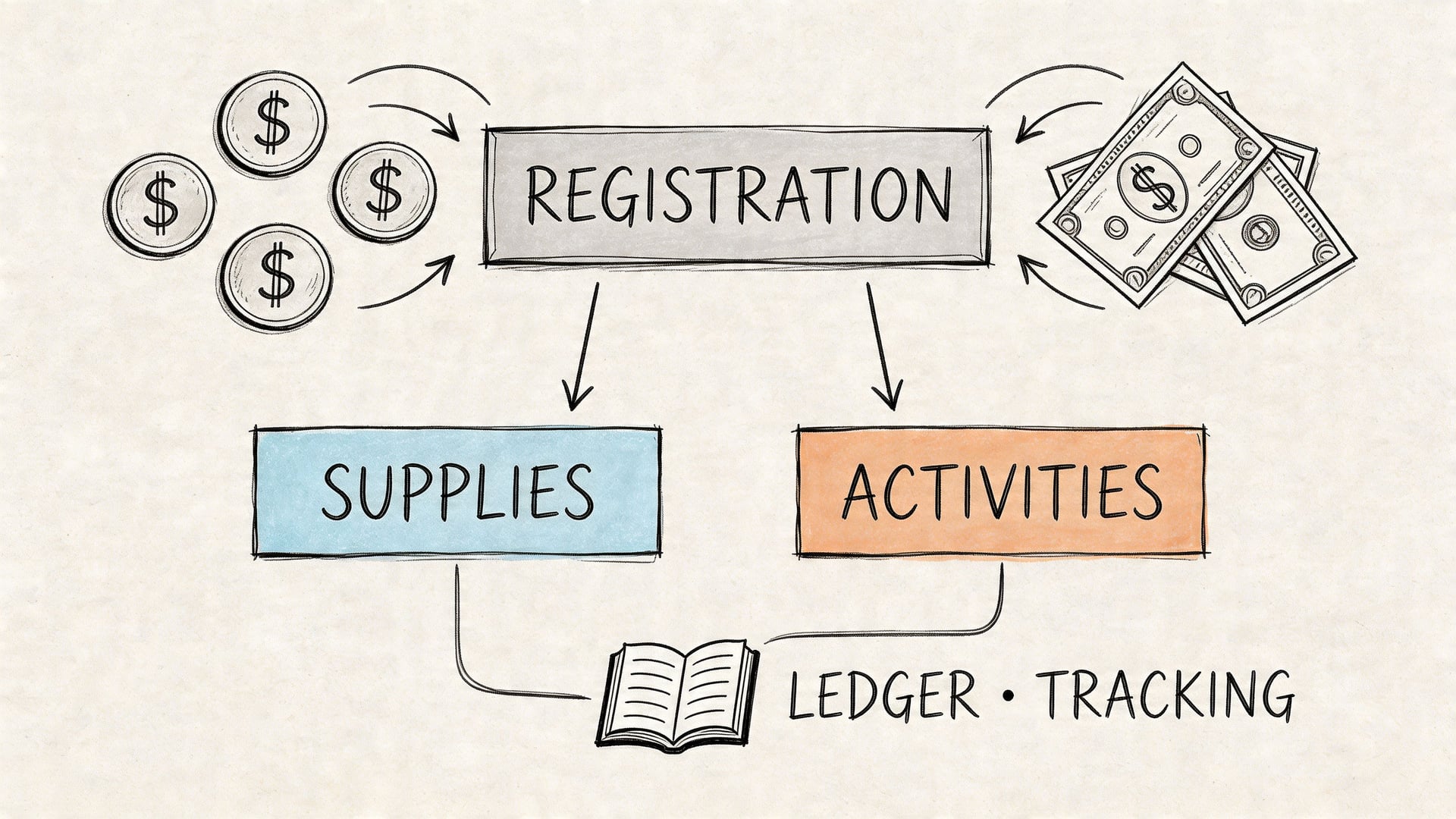
VBS creates a type of financial activity that exposes weak systems very quickly. Registration income may come in one stream. Donations for scholarships or supplies may come in another. A missions offering may be designated for a specific purpose. Then expenses start arriving from curriculum vendors, grocery stores, online craft orders, and volunteer reimbursements.
If all of that lands in a general ledger without clear fund separation, you can still record it. But you won't see it clearly.
Why ordinary tracking breaks down
A spreadsheet can list income and expenses. Generic accounting software can post transactions. But churches don't just need expense tracking. They need to know whether funds were used according to donor intent and ministry purpose.
That matters in VBS because not all dollars are the same. A registration payment isn't the same as a designated gift for VBS scholarships. A missions offering taken during the week shouldn't be mixed into general operating money and forgotten.
A cleaner setup
Fund accounting gives you a better framework. Instead of treating VBS as only a program expense, you treat it as a ministry activity with its own financial boundaries.
A simple setup might look like this:
- VBS operations fund for registration income and ordinary event expenses
- VBS missions fund for designated offerings collected during the week
- Scholarship or assistance tracking if your church offsets costs for families
That kind of structure makes reporting easier for pastors, treasurers, and boards. You can answer basic but important questions without hunting through receipts. What came in for VBS? What was spent on VBS? What was collected for missions? Did restricted giving stay restricted?
What to watch closely
Three areas usually create the most confusion:
| Financial area | Common problem | Better approach |
|---|---|---|
| Registration income | Posted into a general income line with no ministry detail | Record it to a dedicated VBS fund or class structure |
| Designated gifts | Restricted donations mixed with operating cash | Keep them in a separate missions or designated fund |
| Reimbursements | Receipts arrive late and get coded inconsistently | Use a standard approval and coding process before payment |
If your church wants a clearer explanation of the accounting method itself, this guide to fund accounting for churches lays out the principles in plain language.
For software, use a church-specific accounting system rather than forcing church fund logic into a general business tool. Grain Ledger is one example. It uses native fund-based accounting, which means transactions and reports are organized around church funds from the start. For a VBS week, that helps a finance team keep operations money, designated missions gifts, and related expenses visible without commingling them.
Why this matters spiritually, not just administratively
Good accounting serves ministry. Parents notice whether registration is clear. Donors care whether designated gifts are handled carefully. Boards want to report accurately. Pastors need confidence that ministry stories and financial reports match each other.
When the church tracks VBS money clearly, it tells the congregation that stewardship is part of discipleship, not a separate office function.
That kind of clarity also helps next year's planning. You aren't guessing what VBS cost, what offerings came in, or whether a scholarship line was needed. You're working from real ministry records.
Related church accounting software resources
If you are comparing software, these pages map the main decision points: fund accounting, QuickBooks limits, pricing, and migration.
- Best church accounting software (2026 comparison) - canonical guide comparing 12 church accounting platforms
- Church accounting software product page - see Grain Ledger for fund accounting, giving, and bank reconciliation
- Small church accounting software - see the product page built for volunteer treasurers and church admins
- Fund accounting features - review how Grain Ledger tracks designated funds
- QuickBooks for churches - understand workarounds and when to switch
- Free church accounting software - compare free options and upgrade triggers
- Grain Ledger pricing - compare plans for small and growing churches
- Start free - try fund accounting, giving imports, and bank reconciliation together
VBS Is More Than an Event It Is an Investment
VBS takes work. It asks for planning, volunteers, supplies, follow-up, and careful financial oversight. That's exactly why churches should treat it seriously.
Done well, VBS gives children concentrated exposure to Scripture, gives families a welcoming first experience with the church, and gives your congregation a shared ministry effort that reaches beyond the building's usual routines. It also gives your finance team an opportunity to model transparent stewardship through clean budgeting, designated fund tracking, and accurate reporting.
For pastors and administrators, the answer to what is vbs in church is simple. It's a weeklong ministry that can shape children, open doors to families, and strengthen the church's witness when both the ministry side and the management side are handled well.
If your church wants cleaner reporting for ministry events like VBS, Grain is built for church fund accounting, so you can separate designated money, track event expenses clearly, and report with confidence to pastors, boards, and families.
Ready to simplify your church finances?
Start free with church fund accounting, or watch a product demo first.