Your Guide to Modern Church Financial Programs
Master your church financial programs. Our guide covers fund accounting, restricted gifts, stewardship, and reporting to build trust and ensure compliance.
Your first week as church treasurer often feels manageable until someone hands you a special gift. A family donates money for the youth mission trip. Another member gives toward the building. Someone else marks an online gift for benevolence. You open the spreadsheet, add a few tabs, and suddenly you're carrying a quiet fear: what if one of those dollars gets used for the wrong purpose?
About Grain Ledger: This guide includes Grain Ledger, church fund accounting software built for designated gifts and ministry funds. It connects giving platforms (Planning Center, Pushpay, Tithely, Stripe), syncs bank activity with Plaid, and produces fund-level financial reports. Schedule a demo to see how it compares for your church.
See Grain Ledger for your church
Fund accounting, giving integrations, and bank reconciliation in one platform. Free migration support for churches switching from QuickBooks or Aplos.
That fear is reasonable. In churches, bookkeeping isn't only about recording transactions. It's about honoring intent. When a donor gives for missions, they aren't giving for copier toner. When a board sets money aside for a future need, they need to know whether that money is still there. And when a pastor asks, “Can we afford this ministry expense?” the answer can't come from guesswork.
A big gap in church finance content is practical help with restricted money. Guidance often covers generosity, budgets, or broad governance. But many churches still rely on manual spreadsheets or generic bookkeeping tools, which makes it hard to show which dollars are restricted and which are available for daily ministry, as noted by CapinCrouse on church benevolence and designated-fund accountability.
That daily pressure is where many church financial programs either become a source of confidence or a source of stress. A sound system lets you answer ordinary questions without panic. How much is left in the building fund? Did the benevolence committee overspend? Can we reimburse this expense from the retreat fund? Are online gifts landing in the right place?
Beyond the Offering Plate an Introduction
A newly appointed treasurer usually doesn't struggle because they don't care. They struggle because the church's money has stories attached to it.
A youth parent gives money for camp scholarships. A retired couple funds hymnals. The missions team receives support for a partner overseas. Each gift comes with purpose, and the treasurer becomes the person responsible for protecting that purpose inside the books.
Where the stress actually comes from
Most of the stress isn't in the annual budget meeting. It's in the Tuesday afternoon details.
You see a deposit come in and wonder which fund should receive it. You get a receipt for an expense and need to decide whether it belongs to operations or a restricted ministry. You prepare a report for the board and realize your spreadsheet can show a bank balance, but not a clean picture of what portion is already spoken for.
Churches rarely get in trouble because they had too much clarity. Trouble starts when money is mixed, labels are unclear, and reports don't match the real intent behind the gifts.
This is why church financial programs need to do more than count money. They need to separate purposes, preserve restrictions, and help leaders make ordinary decisions with confidence.
Why this matters for ministry
Good bookkeeping serves pastoral work. It protects trust.
If the congregation can't tell what happened to designated gifts, confidence erodes. If staff and ministry leaders can't see whether funds are available, plans stall. If the treasurer has to rebuild the truth by hand every month, the system depends too much on one person's memory.
A healthy church finance process gives everyone a clearer role:
- Treasurers keep records clean and current.
- Pastors make ministry decisions with better visibility.
- Boards oversee stewardship without sorting through accounting puzzles.
- Donors can trust that their gifts were handled as intended.
That's the practical heart of modern church financial programs. They help a church move from messy tracking to faithful stewardship.
The Foundation of Church Finance Fund Accounting
If you remember one idea, make it this one. Church accounting works best when you think in funds, not one big pot of money.
The simplest way to picture it is a stack of labeled envelopes. One envelope says General Fund. Another says Missions. Another says Building Fund. The cash may all sit in one bank account, but the labels still matter. You can't pull money from the missions envelope just because the electric bill is due.
Think in digital envelopes
Fund accounting is the digital version of those envelopes.
Churches should use fund accounting rather than simple single-entity bookkeeping because restricted and unrestricted gifts need to be tracked separately, and each transaction needs a fund code so building funds, missions, and general operating cash aren't commingled in reporting, as explained by 501(c)(3) bookkeeping guidance for churches.
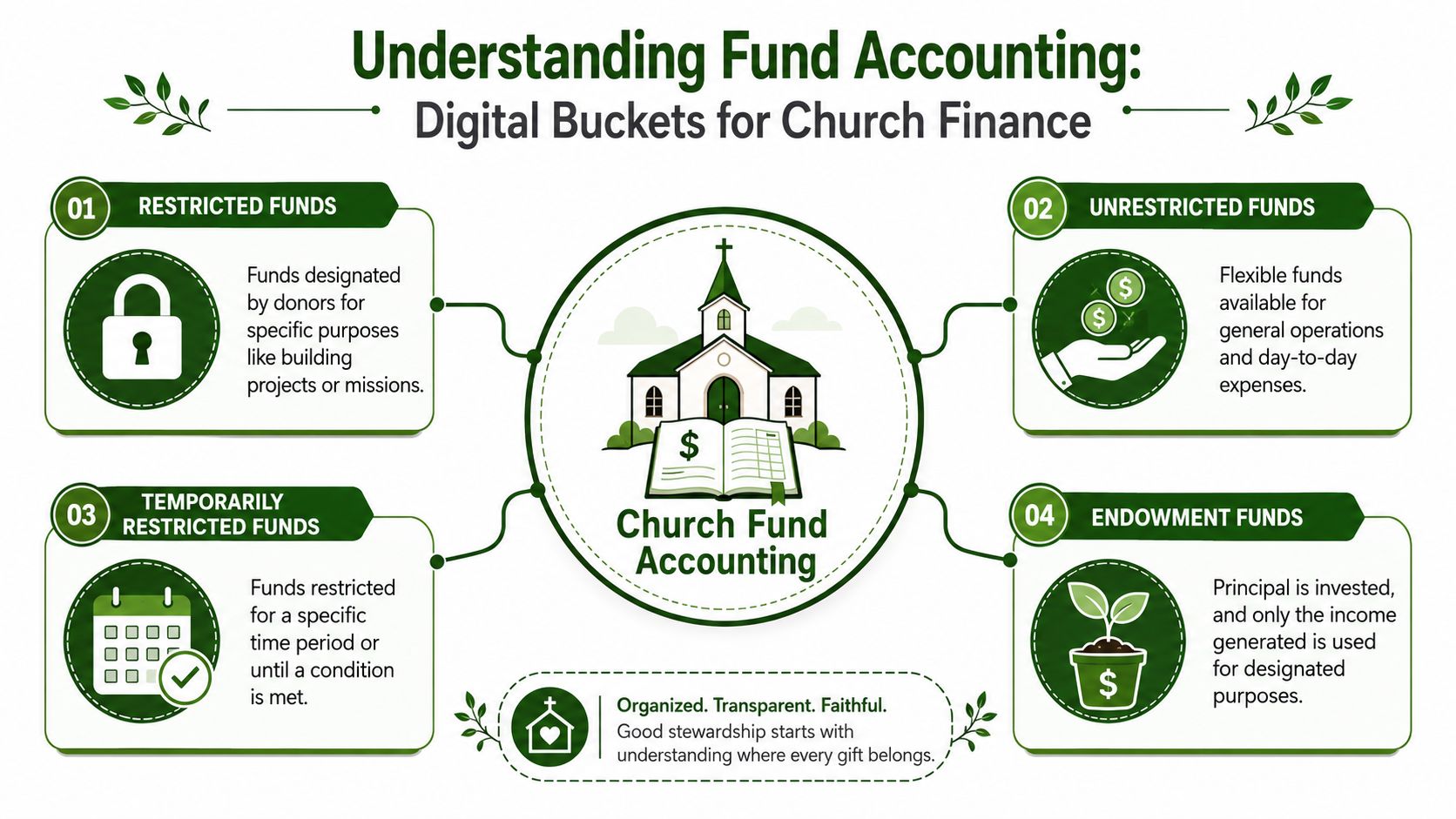
That one idea changes the whole workflow. Instead of asking, “How much cash do we have?” you begin asking better questions:
- Available for what? Cash on hand isn't the same as spendable operating money.
- Restricted by whom? Donor intent carries a different weight than internal planning.
- Tracked where? Every transaction needs the right fund tag from the start.
Why business bookkeeping falls short
A typical small business can treat revenue as one operating pool. A church usually can't.
A church receives offerings, online gifts, designated donations, event income, and sometimes support for special ministries. Those inflows often need different treatment. If they're all dropped into one undifferentiated category, you'll spend month-end trying to reconstruct the truth after the fact.
That's also why churches outgrow generic workflows so quickly. Even firms that support ministries often need better systems and communication around finance. If you work with outside bookkeeping help or want to sharpen your operations, resources on AI-powered marketing for bookkeepers can also help accounting professionals explain fund-based services more clearly to church clients.
Practical rule: Assign the fund when the transaction is created, not later when someone finally has time to clean up the books.
The daily discipline that makes it work
Fund accounting sounds technical, but the habit is simple. Every financial event needs a home.
That means:
- Record gifts with the correct designation
- Code expenses to the fund that should bear the cost
- Review reports by fund, not just by overall total
- Train staff and ministry leaders to request spending with the fund in mind
If you want a closer look at how this works in practice, Grain Ledger's guide to fund accounting for churches gives a useful breakdown of the mechanics.
When churches skip this foundation, they usually end up with shadow systems. The accounting file says one thing, a spreadsheet says another, and the treasurer's memory becomes the tie-breaker. That's exhausting, and it doesn't scale.
Understanding Different Church Financial Programs
Monday morning often starts the same way for a church treasurer. One report says the church has money in the bank. Three ministry leaders assume that means their purchases can be approved. Then a donor asks whether their gift for missions was used as intended.
That tension usually comes from one simple issue. The church has several financial programs, but the books do not make those programs easy to see day by day.
A helpful way to organize them is to treat each program like a labeled envelope. The envelopes all sit inside the same church, but each one answers a different question. Which money keeps the lights on? Which money was set aside for a purpose? Which money can help a family in crisis? Clear labels reduce stress because the treasurer no longer has to solve every question from memory.
Common Church Financial Programs at a Glance
| Program Type | Primary Purpose | Typical Funding Source | Example of Use |
|---|---|---|---|
| General or Operating Fund | Support normal church operations | Weekly offerings, recurring gifts | Payroll, utilities, curriculum, routine ministry costs |
| Restricted Ministry Fund | Support a specific ministry or project | Donor-designated gifts | Missions support, youth trip, building repairs |
| Benevolence Fund | Help people in need | Special offerings, designated gifts | Rent assistance, food support, emergency aid |
| Stewardship and Giving Program | Encourage generosity and manage giving processes | Congregational giving efforts | Pledge campaigns, recurring giving setup, donor communication |
| Scholarship or Grant Fund | Support participation or ministry access | Special donations, memorial gifts | Camp scholarships, conference assistance, ministry training |
The operating fund keeps routine ministry running
The general fund is the church's daily operating envelope. It covers the ordinary costs that keep ministry active each week, such as payroll, utilities, curriculum, software, and supplies.
New treasurers often get tripped up here. They look at the total bank balance and assume all of it is available for normal expenses. That is not always true. A healthy bookkeeping process separates "money we have" from "money we are free to use for operations."
This fund deserves close attention because it answers the question staff and board members ask most often. What can the church spend right now without crossing a line?
Restricted funds need clear labels and consistent coding
Restricted funds create the most day-to-day bookkeeping pressure because they are easy to understand in theory and easy to mishandle in practice.
If a donor gives to missions, building repairs, or a youth trip, that gift needs to stay attached to that purpose from the moment it is received. The same is true on the expense side. If the church buys supplies for a retreat, the expense should be coded to the retreat fund, not dumped into a general ministry category and sorted out later.
That is the gap many churches feel. Leaders may agree on the policy, but the treasurer still has to record Tuesday's online gift, Wednesday's reimbursement, and Thursday's vendor bill correctly. Good internal control practices for church bookkeeping and approvals make that routine work much easier to handle.
Common examples include:
- Building fund for repairs, renovations, or capital improvements
- Missions fund for local or global outreach
- Youth or camp fund for ministry events and support
- Memorial fund for uses defined by the church's memorial gift policy
Benevolence funds require compassion and discipline
Benevolence is one of the clearest expressions of ministry. It is also one of the areas where vague processes create the fastest problems.
A church should know who reviews requests, what documentation is kept, how approvals are recorded, and how assistance is paid. In many cases, paying a landlord, utility company, or other vendor directly creates a cleaner record than giving cash to an individual. That protects the person receiving help and protects the church members administering the fund.
Kindness and documentation belong together.
Stewardship programs support the full giving process
A stewardship or giving program includes more than an annual appeal. It covers the regular work of receiving gifts, recording them accurately, acknowledging donors, and reporting balances in a way leaders can understand.
That matters because churches usually receive a mix of routine gifts, occasional special gifts, and designated gifts that need different handling. The treasurer's stress often rises when those categories are tracked in a spreadsheet that only one person understands. A better system makes each gift easy to sort into the right "envelope" without adding layers of manual cleanup at month-end.
Scholarship and grant funds widen access to ministry
Some churches maintain scholarship-style funds for camp, retreats, counseling, conferences, or ministry training. These funds may be small in dollar amount, but they often carry high ministry significance because they help people participate when cost would otherwise keep them out.
The accounting side should stay simple. Decide who can approve support, what expenses qualify, and how remaining balances will be reported. Then record each award in a way that shows both the purpose of the fund and the people responsible for approving its use.
The goal is not complicated bookkeeping. The goal is clear stewardship that supports real ministry without forcing the treasurer to build a maze of spreadsheets just to answer basic questions.
Establishing Policies and Ensuring Compliance
A church doesn't become financially healthy just because people are trustworthy. It becomes healthy because trustworthy people work inside clear rules.
Policies are those rules. They tell everyone how money is received, who can approve spending, how reimbursements work, and what happens when a gift is restricted for a special purpose.
Policies are guardrails, not red tape
The easiest way to think about a financial policy is as a set of guardrails on a mountain road. The guardrails don't stop the trip. They keep the church from drifting into preventable problems.
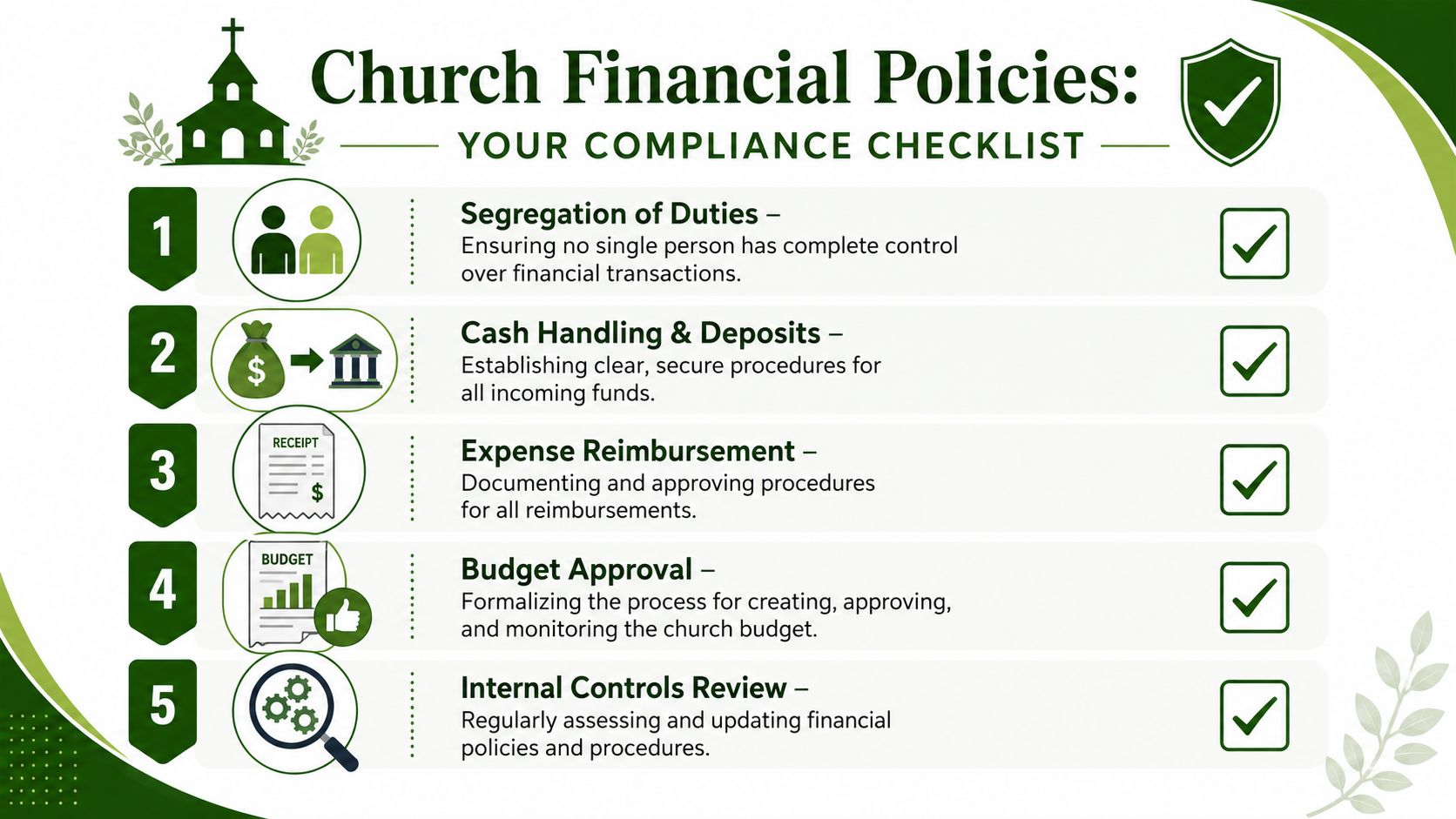
A basic church finance policy should address:
- Gift handling so offerings, online donations, and designated gifts are recorded consistently
- Expense approval so ministry leaders know who can authorize spending
- Reimbursements so staff and volunteers submit proper documentation
- Restricted funds so everyone knows what can and can't be moved
- Reporting cadence so boards and finance teams receive regular updates
Internal controls protect both money and people
Internal controls sound formal, but many are simple. One person shouldn't open the mail, enter the gifts, deposit the money, and reconcile the bank account alone. Shared responsibility makes mistakes easier to catch and misconduct harder to hide.
A technically useful control system also depends on reporting. Church accounting guidance points to a standard reporting set that includes a statement of activities, statement of financial position, statement of cash flows, and statement of functional expenses, plus monthly cash-flow reporting and budget-versus-actual comparisons. Those reports help leadership see more than the checking account.
If your board wants a practical walkthrough, internal controls best practices for churches is a helpful reference.
Ratios that help leaders read the story
Numbers become useful when they answer a leadership question.
Church finance guidance recommends that personnel costs remain between 40% and 55% of total expenses and that churches hold 30 to 60 days of reserves, according to Church Law & Tax on key church expense ratios and measurements.
Those aren't magic numbers. They're conversation starters. If personnel costs rise above the suggested range, leaders may need to revisit staffing structure or overall spending. If reserves are too thin, even a minor surprise can become a ministry crisis.
A strong report doesn't just say what happened last month. It helps the board ask whether the church is stable enough to keep serving faithfully next month.
Implementing and Managing Your Programs
Monday morning often starts the same way for a new treasurer. The pastor asks for an update on the benevolence fund, the youth director hands over receipts from camp, and online gifts from the weekend still need to be sorted into the right categories. If the church created the ministry idea before creating the bookkeeping structure, that simple morning can turn into a spreadsheet hunt.
A calmer approach starts with setup. Church financial programs run more smoothly when the fund rules, giving paths, and monthly review process are built before the first dollar arrives. That is how policy becomes daily practice.
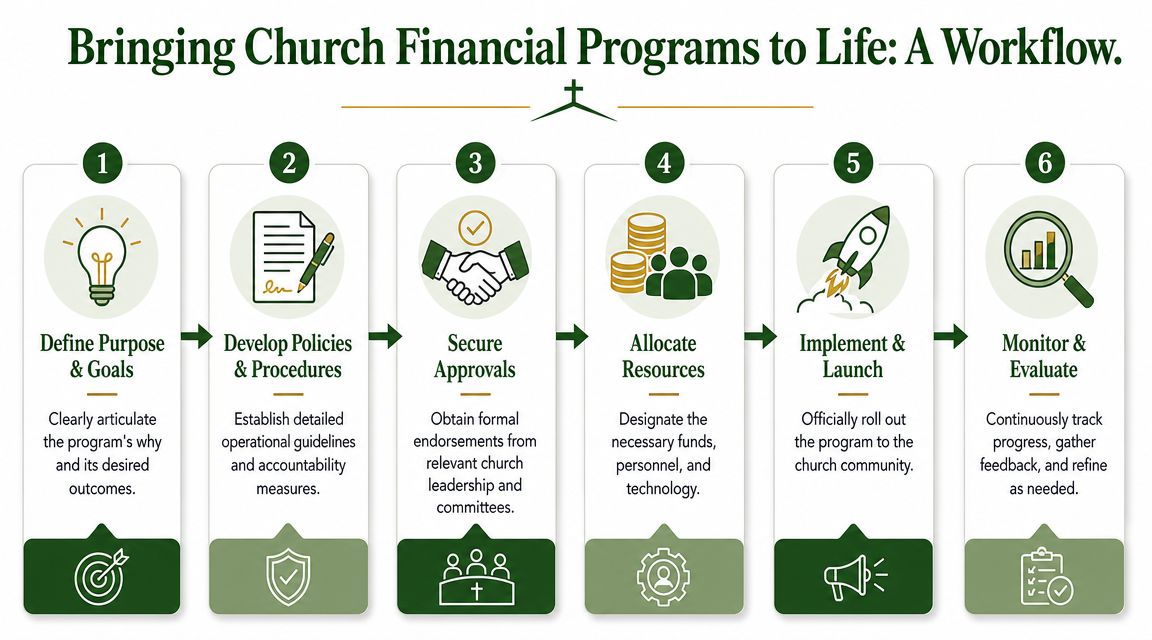
A practical launch workflow
A fund works a lot like a labeled envelope. If the envelope is clearly named, everyone knows what goes in, what can come out, and who is responsible for it. If the label is vague, the confusion shows up later in the books.
When a church creates a new fund or program, this order usually works best:
Define the purpose
Write one plain sentence. “This fund supports camp scholarships for students in the youth ministry” gives the bookkeeper, donor, and ministry leader the same understanding.Approve the rules
Decide who can approve spending, whether donors may designate gifts to it, and what happens to any remaining balance if the ministry ends.Set up the fund in the books
Create the account structure before the first contribution comes in. Waiting until after gifts arrive usually leads to reclassifying transactions later.Create clear giving paths
Use the same fund name on online forms, checks, kiosks, and paper envelopes. One ministry should not appear under three different labels.Train the people involved
Staff, volunteers, and ministry leaders need the same instructions. Otherwise, the treasurer ends up translating everyone else's shorthand into clean records.Report on a set schedule
Show beginning balance, income, expenses, and ending balance in the same format each month so leaders can see what changed without decoding the report.
Short setup saves long cleanup.
Digital giving changed the setup work
Digital giving added convenience for members, but it also added sorting work for the office. Churches now receive gifts through cards, ACH, text giving, and online forms, often in many small transactions rather than a few large ones. As noted earlier in the article, that pattern means treasurers spend more time making sure each gift lands in the right fund and appears correctly in donor records.
The practical questions are simple:
- What fund is this for?
- Who gave it?
- Did it reach the books correctly?
- Can the treasurer verify the balance without manual cleanup?
If any one of those answers is unclear, the month-end close gets harder.
Payment processing adds another layer. Before opening a new online giving option, it helps to compare payment processing fees so the church understands how transaction costs will affect small gifts and designated funds.
Monthly management keeps the program healthy
Launching a fund is the easy part. Keeping it tidy month after month is where treasurers either gain confidence or lose hours.
A useful monthly routine usually includes four checks: confirm deposits were assigned to the right funds, review expense coding, reconcile bank and platform activity, and prepare a short fund report for leadership. That routine keeps small mistakes from turning into year-end mysteries.
For example, if the youth scholarship fund received online gifts, paid camp deposits, and reimbursed one leader in the same month, the treasurer should be able to trace each step without opening five separate spreadsheets. The report should answer one ministry question clearly: how much is still available to help students?
That is the daily challenge many churches feel. The policy may be clear on paper, but the stress shows up in the bookkeeping details. If your team wants a clearer picture of tools built for fund-based workflows, this guide to church financial software options for churches with multiple funds can help.
Healthy church financial programs usually feel ordinary. Bills are coded correctly. Designated gifts land in the right place. Leaders get reports they can trust. That kind of calm is good stewardship, because it lets the church spend less energy fixing records and more energy serving people.
Simplifying Everything with the Right Software
Spreadsheets are useful for analysis. They're risky as the main control system for church funds.
A spreadsheet can list balances, but it usually depends on manual updates, copied formulas, and one careful person who knows where everything lives. Once multiple funds, online giving, reimbursements, and bank activity enter the picture, that approach becomes fragile.

What modern church software needs to do
Churches often use separate systems for giving, banking, and accounting. Best-practice guidance emphasizes cloud access, role-based internal controls, audit trails, and automated stakeholder reporting to reduce manual data entry errors and speed reconciliation, according to ParishSOFT's church finance technology guidance.
That means the software should help with at least four jobs:
- Fund-based structure so restricted and unrestricted activity stays separate
- Integrations so giving platforms and banks don't require duplicate entry
- Controls so access and approvals match each person's role
- Reports so pastors, boards, and treasurers can read the same financial story
Where generic tools usually break down
Generic accounting software can record transactions, but churches often end up building workarounds around it. They create extra classes, side spreadsheets, custom naming systems, and manual reconciliations to simulate what a fund-based system should already understand.
That creates a hidden tax on the church office. Every special gift takes more time. Every board report requires interpretation. Every staff transition creates risk because the process lives in habit more than in system design.
If your church is also evaluating giving tools, it helps to compare payment processing fees across software options alongside accounting requirements so the finance stack fits your actual donation flow.
A better fit for church workflows
Purpose-built church accounting holds significant importance. Grain Ledger's overview of church financial software outlines what churches should look for in a fund-based system.
One option to consider is Grain Ledger. It uses native fund architecture, connects with church giving platforms and bank activity, and organizes transactions and reports around funds from the start. That matters because treasurers don't need another tool that forces them to simulate church accounting inside a business template.
Later in the process, this walkthrough gives a clearer look at how that kind of workflow appears in practice.
When the system is built correctly, ordinary tasks become simpler. A designated gift lands in the right fund. A reimbursement hits the correct ministry balance. A pastor can review a report and understand what is available versus what is restricted. The board spends less time untangling and more time discerning.
That's what software should do for church financial programs. It should reduce anxiety, not create a smarter version of the same confusion.
Conclusion From Bookkeeping to Stewardship
Church financial programs work when they reflect how churches live. Gifts come with purpose. Ministries operate through separate needs. Leaders need reports that show not just how much money exists, but what that money is for.
Fund accounting gives the structure. Written policies provide the guardrails. Regular reporting turns bookkeeping into oversight. The right software removes the strain of trying to manage sacred trust through fragile spreadsheets.
At that point, finance stops being a back-office burden. It becomes part of the church's witness. Clear records tell donors their intent matters. Reliable reports help boards govern responsibly. Calm processes free pastors and ministry leaders to focus on people.
If your church needs extra operational help while building that kind of system, directories like Hire Bookkeepers can help you find bookkeeping support. But whichever staffing path you choose, the goal is the same: financial clarity that strengthens ministry.
Related church accounting software resources
If you are comparing software, these pages map the main decision points: fund accounting, QuickBooks limits, pricing, and migration.
- Best church accounting software (2026 comparison) - canonical guide comparing 12 church accounting platforms
- Church accounting software product page - see Grain Ledger for fund accounting, giving, and bank reconciliation
- Small church accounting software - see the product page built for volunteer treasurers and church admins
- Fund accounting features - review how Grain Ledger tracks designated funds
- QuickBooks for churches - understand workarounds and when to switch
- Free church accounting software - compare free options and upgrade triggers
- Grain Ledger pricing - compare plans for small and growing churches
- Start free - try fund accounting, giving imports, and bank reconciliation together
Frequently Asked Questions About Church Finances
What's the difference between donor-restricted and board-designated funds
A donor-restricted fund exists because the giver limited the use of the money. The church receives the gift with that condition attached.
A board-designated fund is different. The board sets money aside for a purpose, but the board can usually change that designation later through proper action. That makes board designations more flexible than donor restrictions.
Can a church use restricted funds to cover a general budget shortfall
In most situations, it shouldn't.
If the donor gave money for a specific purpose, using it for general operations breaks the purpose of the gift. Sometimes leaders see cash in the bank and assume it's available. That's exactly why fund-level reporting matters. Cash may be present while spending authority is not.
When a church uses restricted money to solve an operating problem, it often creates a trust problem that lasts longer than the cash problem it tried to fix.
If a fund has become impractical or the original purpose can no longer be fulfilled, the church should work through its policy, legal counsel, and governing process rather than unilaterally reclassifying the money.
How often should the church report financial information to the congregation
Most churches benefit from regular reporting to the board and a simpler, understandable rhythm of reporting to the congregation.
Board members usually need more frequent and more detailed information. Congregations usually need summary reporting that is clear and honest. The exact timing depends on the church's size, culture, and governance, but consistency matters more than volume. People trust what they can follow.
A good congregational update often includes:
- Current operating picture in plain language
- Status of major designated funds when those funds matter to church life
- Budget progress with enough explanation to avoid confusion
- Important changes or risks that leadership is monitoring
What's the first fix if our church books feel messy
Start by identifying every active fund and writing down its purpose.
Then make sure new transactions are coded correctly going forward. You may still need cleanup work, but clarity starts when everyone agrees on what each fund is for and stops treating all cash as one pool.
If you're tired of managing designated gifts with workarounds and spreadsheets, Grain is worth a closer look. It's built for true fund-based church accounting, so every transaction, balance, and report can reflect the way your church handles ministry money. Starting free is a practical next step if you want cleaner books, clearer fund reporting, and less stress at month-end.
Ready to simplify your church finances?
Start free with church fund accounting, or watch a product demo first.