Financial Reporting Automation: A Church Guide
Learn how financial reporting automation improves church fund accounting with implementation steps, controls, and ROI metrics.
Only 18% of finance teams finish month-end close in three days or less, and automation is reported to cut consolidation workload by 50% each cycle. For churches, that matters because a slow close isn't just an admin headache, it can blur restricted-giving accountability before elders, treasurers, and auditors ever see the numbers.
About Grain Ledger: This guide includes Grain Ledger, church fund accounting software built for designated gifts and ministry funds. It connects giving platforms (Planning Center, Pushpay, Tithely, Stripe), syncs bank activity with Plaid, and produces fund-level financial reports. Start free to see how it compares for your church.
See Grain Ledger for your church
Fund accounting, giving integrations, and bank reconciliation in one platform. Free migration support for churches switching from QuickBooks or Aplos.
Church finance teams usually feel this pressure first in the general fund, then in every restricted fund that has to be tracked by purpose. A spreadsheet can sort gifts by account, but it can't keep stewardship clean when the same donation stream has to stay tied to ministry intent from the moment it's received.
What Financial Reporting Automation Means for Your Church
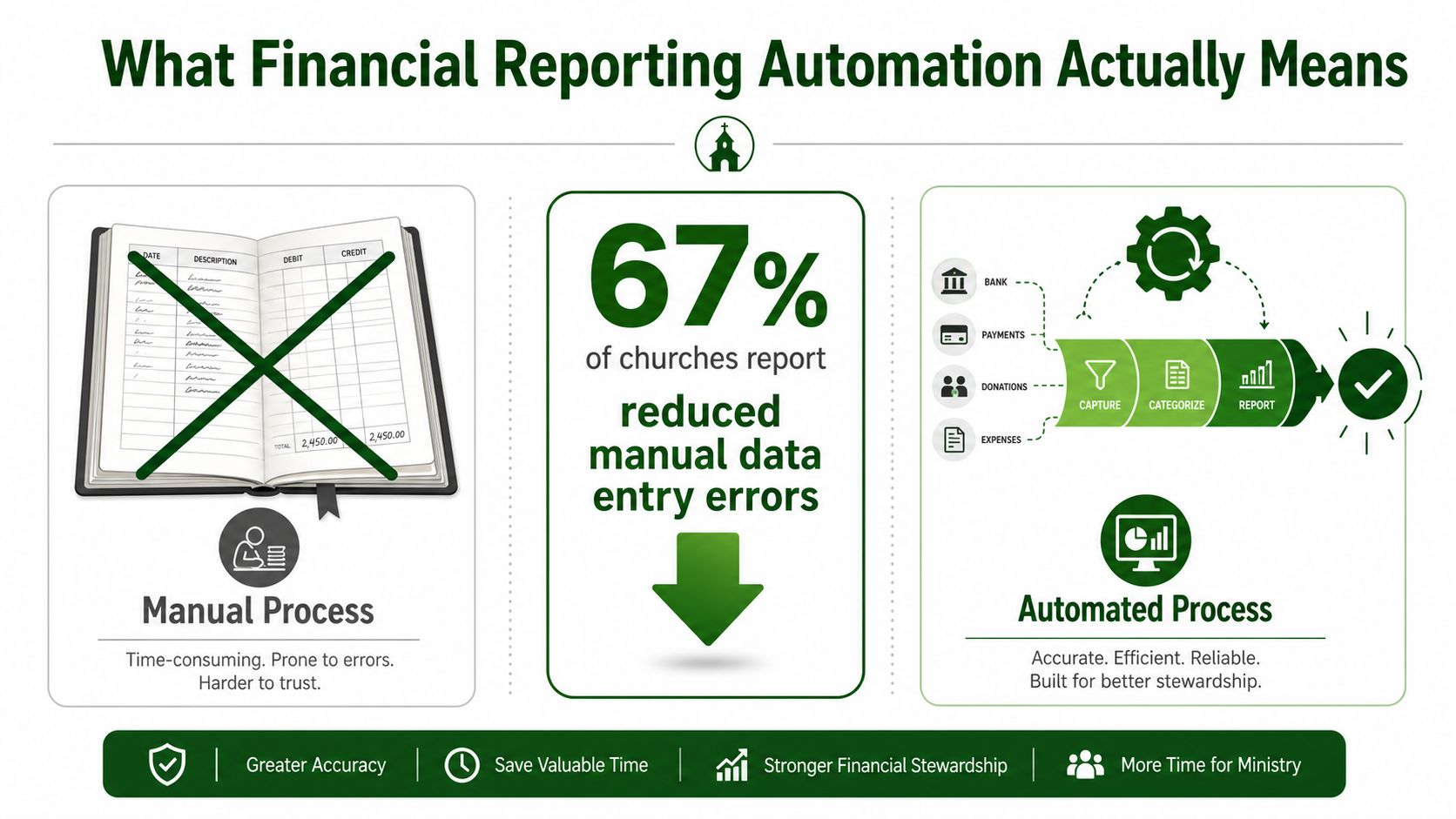
Financial reporting automation means using connected tools to move church financial data from the point of receipt to the final report with far less hand-entry. A treasurer still reviews exceptions, approves judgments, and explains the numbers to leaders. The repetitive work, the mapping, the checks, and the report assembly shift into a controlled workflow instead of a string of late-night spreadsheet fixes.
That distinction matters because the close process is still slow for many finance teams. The source set on reporting automation statistics notes that only 18% finish in three days or less, while half still need more than five business days to close the books (financial reporting statistics). Analysts in that same source set report that automation can reduce consolidation workload by 50% per cycle, which helps explain why this category is becoming a core finance capability rather than a convenience.
For churches, the shift appears in fund accounting. A donations report is not only about total cash. It has to show whether a missions gift stayed in missions, whether a building pledge stayed in the building campaign, and whether the board can trust the story the reports tell.
Why the market matters to churches
The broader financial automation market reached $8.1 billion in 2024 and is forecast to reach $18.4 billion by 2030 at a 14.6% annual growth rate (financial reporting statistics). That growth points to a practical shift. Churches are no longer trying to solve bookkeeping with disconnected spreadsheets while the rest of finance keeps moving toward integrated workflows.
Practical rule: if a report takes longer to reconcile than it takes to explain, the process needs automation, not more heroics.
Manual fund reporting works like separate spreadsheet tabs for restricted and unrestricted accounts, then hoping every formula still points to the right row after a donor designation changes. Automation turns that fragile handoff into a controlled path, where the giving record, fund code, and report line stay connected.
For churches planning that kind of change, phased AI adoption in finance offers a useful companion read. A phased approach matters because most churches do not need a big-bang overhaul. They need stable steps that preserve control while reducing manual work.
One helpful way to think about it is this. Automation is less about doing reports faster and more about making the reporting trail easier to trust. When the trail is clear, restricted gifts are easier to defend, board packets are easier to prepare, and month-end no longer depends on one person remembering every exception from memory.
How to Build an Automation Workflow That Works
A workable church workflow begins with process design before any software is selected. A KPMG UK survey found that respondents pointed to time prioritisation as a major automation challenge, even ahead of knowing how to automate or finding the right tools (KPMG survey). That matches what many church finance teams run into, the tools may be available, but the workflow still lives in one person's head.
Start with the path of the data
The first step is data extraction. For a church, that means pulling giving records from platforms like Planning Center or Pushpay, then bringing in bank activity so deposits, fees, and disbursements are visible in one place. If the data comes from separate systems, the workflow still needs a controlled landing zone before anything gets reported.
The next step is validation against restrictions. A building campaign gift should not be treated the same way as a general tithes and offerings deposit, even if both hit the bank on the same day. Validation is where the system checks whether the gift's purpose, date, and source match the fund it is supposed to serve.
A church should never ask staff to re-check the same designation in three different places. The workflow should do that once, then preserve the result.
Map, consolidate, and review
After validation comes mapping to the chart of accounts. Church finance gets specific here. A designated mission gift needs the right fund code, the right revenue category, and the right reporting line, or the final statements will tell the wrong story even if the cash balance is right.
Then the system consolidates into fund-level reports. That is the point where the board can see restricted and unrestricted activity side by side without asking the treasurer to rebuild the numbers manually. The last step is review and sign-off controls, where a human checks unusual items, not every routine line.
The guide to reporting automation for finance is helpful for seeing how this sequence gets built in practice. For churches, the sequence matters more than the tool name, because bad sequencing creates more exceptions, not fewer.
To make that connective layer work, the underlying systems have to talk to each other cleanly. A practical accounting software integration setup keeps the reporting path from breaking between giving, banking, and the ledger.
A simple church example helps. A Sunday morning general-fund gift should flow into unrestricted reporting without a staff member retyping it. A building campaign donation should land in the restricted capital project fund with its designation intact, so the finance team does not have to repair the classification later.
The main idea is that automation works best when each substep is stable. If extraction, validation, mapping, consolidation, and sign-off are all clearly defined, software can support the workflow. If they are vague, the team just automates confusion.
Why Fund Accounting Changes Everything About Church Automation
Churches don't manage one financial story. They manage several at once, and each one has different stewardship obligations. That's why general automation advice often misses the core issue: the workflow has to protect fund-level integrity, not just produce a cleaner report.
A treasurer tracking five funds in a spreadsheet can keep things moving for a while, but the risk shows up when donations land where they shouldn't. One Sunday night, a capital campaign contribution can get posted to the general fund, and then every downstream report has to be corrected by hand. That mistake isn't just clerical. It changes how leadership understands restricted giving.
The architecture has to protect the audit trail
The control point is the data pipeline. IBM-based guidance in the source set says disparate systems and poor data access create a lack of transaction visibility, manual interventions weaken the audit trail, and delayed close happens when in-process journal entries can't be fully reviewed (IBM-related research summary). For churches, that means automation should begin with controlled data flow and standardized account mapping, not with prettier statements.
A proper architecture keeps restrictions attached at the transaction level. If a donor gives toward youth ministry, that designation should travel with the gift until it reaches the report, not get reinterpreted later by memory or spreadsheet notes. That is the difference between reporting that supports stewardship and reporting that merely looks finished.
What changes when the controls are right
Once the controls are in place, every donation can route into the correct fund from the moment it's received. The board gets fund-level balance sheets and activity reports without the treasurer rebuilding each one manually, and the reports line up with how the church operates.
Church rule of thumb: if the fund code can change after the gift has already been posted, the system is too loose for restricted giving.
Church-specific accounting software matters. A general ledger that only thinks in corporate categories often pushes churches into workarounds, while Grain Ledger's fund accounting features are built around fund structure from the start.
The practical effect is easier to explain than the technical one. The pastor can see ministry-level stewardship clearly. The finance team can answer donor questions without hunting through disconnected systems. And the auditor gets a cleaner trail from gift to fund to final statement, which is exactly where church finance should be strongest.
Measuring the Return on Church Reporting Automation
Church leaders usually want to know whether automation is worth the change. The honest answer is yes, but the return shows up in more than one place. It is not only about time saved, it is also about cleaner reporting and stronger control quality.
Research on AI in financial statement preparation found that adoption can improve accuracy and reduce reporting time, while another study linked automation in the financial reporting process with fewer internal control material weaknesses (SSRN paper, SSRN study). For churches, that combination matters because stewardship depends on trust as much as speed. A report that arrives faster helps, but a report that is easier to defend helps more.
What those gains look like in church life
A treasurer who used to spend two weekends a quarter reconciling restricted funds can move that work into a shorter review cycle. An elder board that waited for delayed summaries can receive fund-level reports while the quarter is still relevant to decision-making. Automation should handle routine tasks consistently, preserving human judgment for the cases that require context.
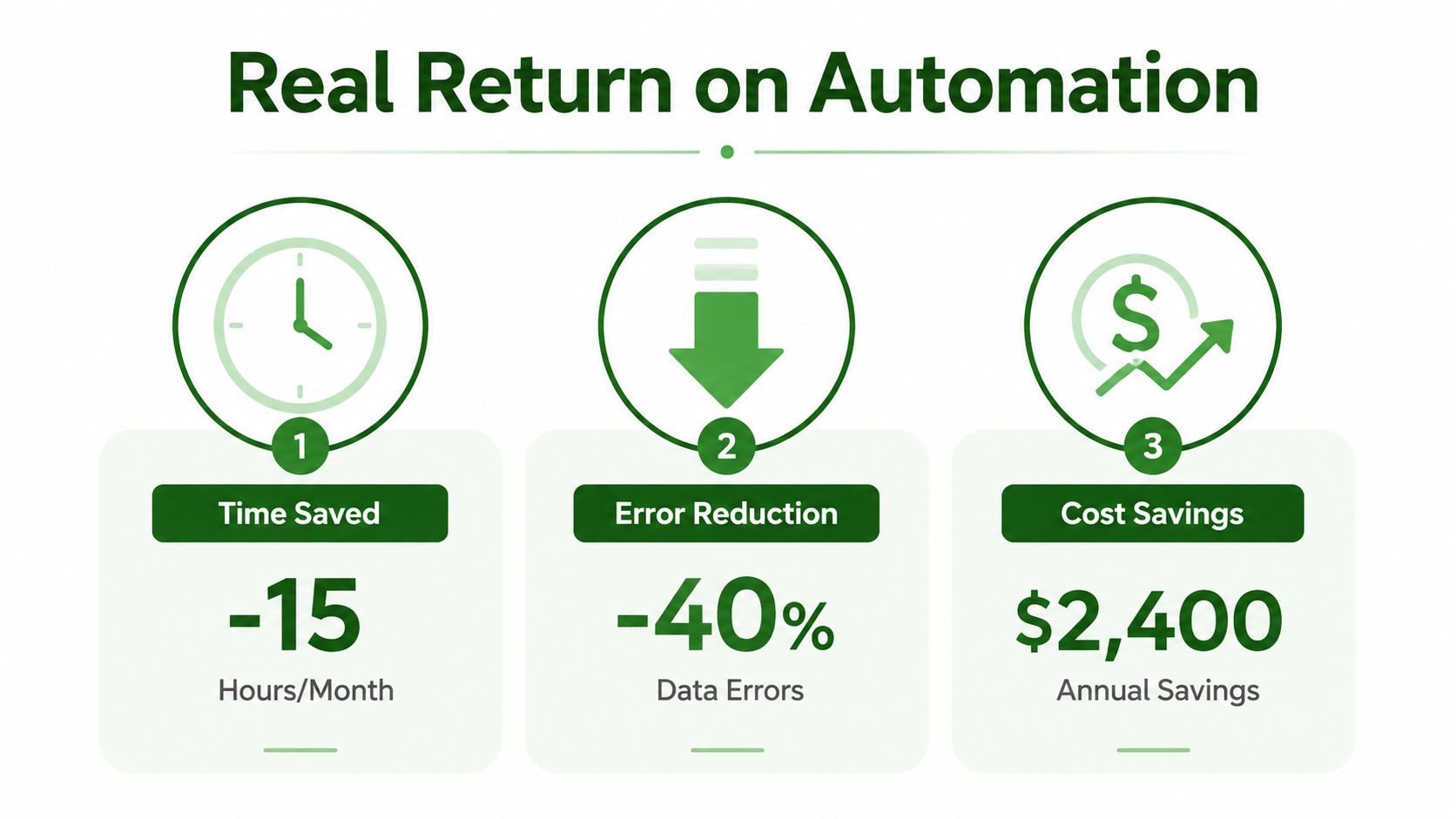
The ROI conversation also needs one honest boundary. A finance advisory source in the brief says automation handles about 60-70% of routine reporting, while the remaining 30-40% still needs human interpretation, especially for complex accruals, prepaids, and deferred revenue (finance advisory). That ceiling matters for churches because restricted funds often carry judgment calls that no system should make on its own.
The best return is control, not just convenience
A church can save hours and still fall short if the reporting trail is not defensible. The strongest return comes from reducing manual errors, tightening review, and giving leaders reports they can trust without extra explanation. If your software shortens the close but weakens the story behind the numbers, it has not really helped.
For churches comparing reporting tools, Grain Ledger's reporting feature is worth examining because it focuses on church reporting outputs tied to fund structure, not generic business statements. That kind of fit matters when the question is stewardship, not just automation.
Common Pitfalls That Undermine Church Reporting Automation
The first mistake is buying software before the process is ready. Churches often want the tool first because the tool feels like progress, but the harder work is deciding how reports should flow, who reviews them, and what counts as approved support for each fund. When those questions are unsettled, automation only preserves the same confusion in a cleaner format.
A second mistake is treating the audit trail as an afterthought. If automation sits on top of fragmented systems and weak data control, the church can scale errors faster instead of improving them. The reports may look polished on the surface, yet the transaction history underneath becomes harder to explain when a board member, auditor, or treasurer asks where a number came from.
Where human judgment still belongs
Automation does not replace judgment in complex cases. Restricted gifts with unusual timing, accruals tied to ministry commitments, and other edge cases still need review by a person who understands church context. That is the part software should support, not decide on its own.
The brief's finance advisory material makes the same practical point. Automation can handle a large share of routine reporting, but it does not cover the whole picture, especially where judgment calls affect how a church records ministry commitments and restricted giving (finance advisory).
A third pitfall is trying to force fund accounting through a general-purpose system with tags or classes. That workaround can feel acceptable during setup, then become fragile when an auditor asks how a designated gift moved through the books. A tag is not the same thing as a fund, just as a label on an offering envelope is not the same thing as a restricted ledger account. If the answer depends on custom rules nobody can explain quickly, the structure is too weak.
If your team spends more time maintaining reporting workarounds than reviewing the reports themselves, the foundation is wrong.
Churches also run into trouble when they assume automation removes the need for governance. It changes where the work happens. Staff stop keying entries by hand as often, but they still need strong review, clean account structures, and a system that knows the difference between unrestricted ministry support and restricted giving.
The key question is whether automation can be implemented without weakening controls, audit readiness, or donor trust.
Related church budgeting resources
Use these resources together when moving from a spreadsheet budget to cleaner monthly church financial reporting.
- Free church budget generator - build a custom Excel budget template for your church
- Church budget template Excel guide - download and adapt a practical budget template
- Nonprofit budget examples - compare operating, program, and restricted-fund budget formats
- Grain Ledger budgeting - connect budgets to fund accounting and monthly reports
- Best church accounting software - compare fund accounting tools when the spreadsheet budget outgrows Excel
Grain Purpose-Built Automation for Church Fund Accounting
Grain Ledger fits this conversation because it is built around native fund architecture, so accounts, transactions, and reports are organized around funds from the start. That matters for churches because fund accounting is not a reporting style you bolt on later, it's the way the books need to work from day one.
Grain also connects with the tools churches already use, including giving platforms such as Planning Center, Pushpay, and Stripe, and it syncs with bank accounts and cards through Plaid. That setup keeps donation flow tied to the correct fund, which is the practical answer to the stewardship problem discussed throughout this article.
For church finance teams, the advantage is clarity. Balance sheets, cash flow reports, and activity reports all speak in fund-level language, so pastors and elder boards can read the numbers without translating corporate accounting concepts. Built-in controls help keep restricted funds restricted, which reduces the need for manual cleanup later.
The difference is architectural. Grain isn't trying to simulate fund accounting with add-ons or fragile tags. It treats fund structure as the core of the ledger, which makes it better aligned with restricted giving, board reporting, and audit readiness.
If your church is ready to move from spreadsheet management to true fund-level stewardship, start free with Grain Ledger and see how a church-native system changes the way reporting works. Visit Grain to explore how its fund-based accounting and reporting can support your finance team's next step.
Ready to simplify your church finances?
Start free with church fund accounting, or watch a product demo first.