Fund of Accounting: A Guide for Modern Churches
Learn the fund of accounting for churches. This guide explains restricted vs. unrestricted funds, reporting, and tools for financial transparency.
You're probably here because someone asked a simple question that turned into a stressful one.
About Grain Ledger: This guide includes Grain Ledger, church fund accounting software built for designated gifts and ministry funds. It connects giving platforms (Planning Center, Pushpay, Tithely, Stripe), syncs bank activity with Plaid, and produces fund-level financial reports. Schedule a demo to see how it compares for your church.
See Grain Ledger for your church
Fund accounting, giving integrations, and bank reconciliation in one platform. Free migration support for churches switching from QuickBooks or Aplos.
Maybe the pastor said, “How much is left in the missions fund?” Maybe a board member wanted to know whether the building gifts were still untouched. Maybe a donor asked if their youth camp donation was used as intended. You opened a spreadsheet, clicked through tabs, checked the bank balance, and still didn't feel fully sure of the answer.
That moment is where many churches discover they don't have an income problem. They have a clarity problem.
Church finances aren't like a coffee shop, a contractor, or a retail store. A church receives gifts for ministry, and many of those gifts carry a purpose. Faith-based organizations, which include over 600,000 churches in the U.S., handle an estimated $128 billion in annual giving, and 25-35% of those funds are designated for specific purposes like missions or capital campaigns, which makes careful fund tracking necessary for stewardship and transparency, according to accounting statistics for nonprofits and churches.
If you've been trying to manage that with one checking account and a complicated spreadsheet, you're not failing. You're just using a system that wasn't designed for the way churches operate.
Beyond the Spreadsheet A New Way for Church Finances
A small church treasurer once told me the hardest part of the job wasn't entering donations. It was answering questions with confidence.
The church had a general checking account, a few designated giving categories, and a spreadsheet that grew messier every month. Sunday gifts came in through the offering, some online through Planning Center, and a few special donations arrived by check. Everything landed in one bank account, and then someone had to sort it out after the fact.
The problem with one big pile
That works for a while. Then real ministry questions show up.
- The pastor asks: Can we send the missions team support this month?
- The elder board asks: Are building gifts still available, or were they used to cover regular bills?
- The bookkeeper asks: Was that expense supposed to come from general giving or the youth fund?
With a spreadsheet system, the answer often becomes, “I think so.”
That's not a comfortable place to live when you're handling donated money. It creates stress for the treasurer, uncertainty for leaders, and suspicion where there should be trust.
Practical rule: If you can't tell where a dollar came from and what it's allowed to do, you don't have enough visibility yet.
Why churches need a different method
Fund of accounting becomes helpful. The phrase sounds awkward at first, and many people mean fund accounting when they say it. Either way, the idea is simple. You track church money by purpose, not just by total balance.
That means the question changes from “How much money is in the bank?” to “How much money is available in each ministry bucket?”
That shift matters. A healthy bank balance can still hide a ministry problem if much of that money belongs to designated purposes. If leaders only see the total, they may assume there's more flexibility than there really is.
A stewardship tool, not just an accounting method
Churches don't adopt this system to sound more professional. They adopt it so they can honor donor intent, protect ministry decisions, and report clearly.
When a member gives to benevolence, missions, or a building project, they're trusting the church to handle that gift carefully. Fund accounting gives the church a way to prove it did.
What Is Fund Accounting Really
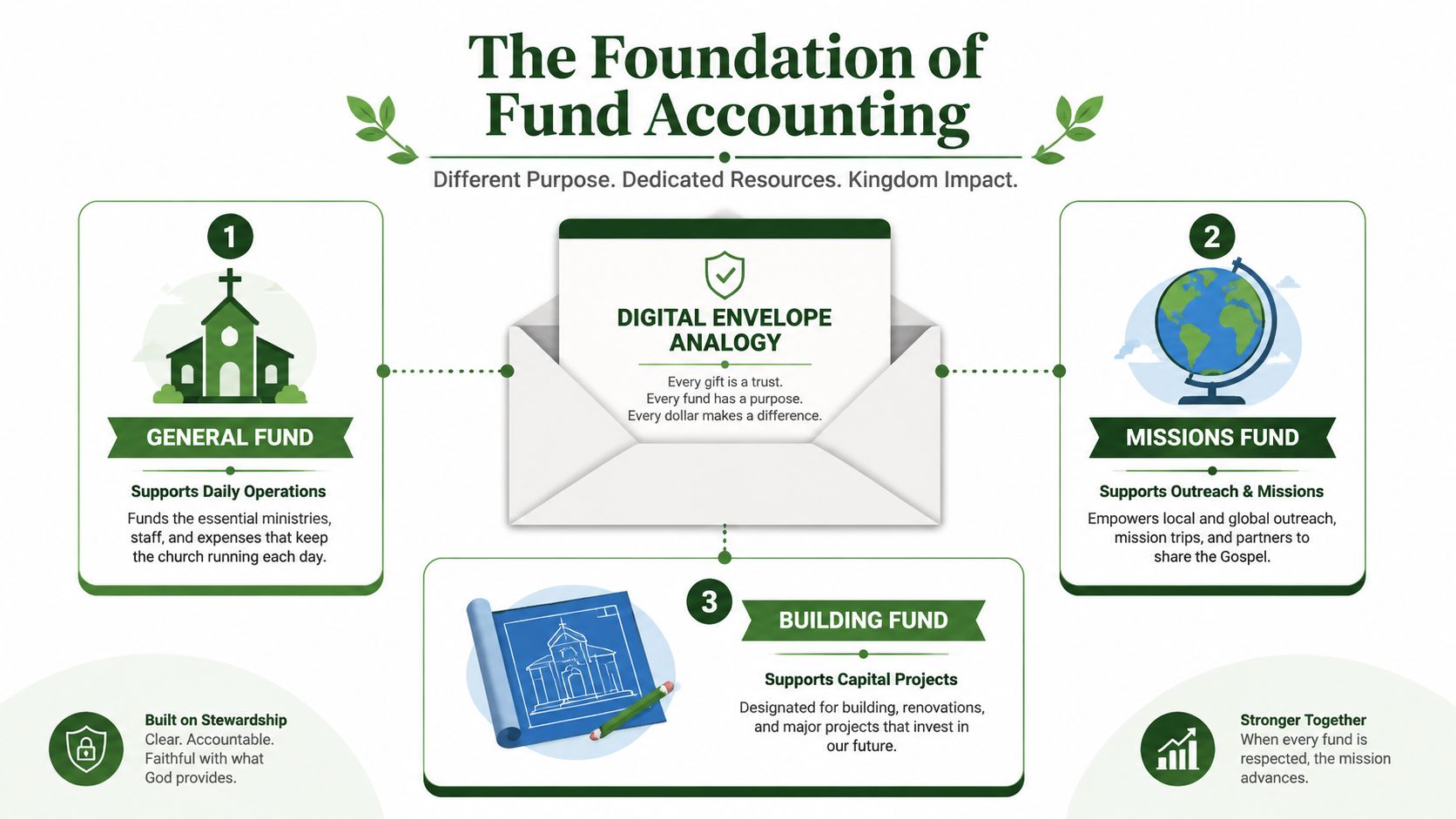
Fund accounting means keeping separate digital envelopes for different kinds of church money.
If that sounds simple, good. It should.
When a family gives to the general ministry of the church, that money goes into one envelope. When another donor gives to missions, that goes into a different envelope. If someone contributes to a building project, that belongs in its own envelope too. The cash may sit in one bank account, but the accounting records keep each purpose separate.
Here's a visual way to think about it.
Profit answers one question. Stewardship answers another
A business usually asks, “Did we make money?”
A church asks, “Did we handle God's money faithfully, and did we use designated gifts the way we said we would?”
That's the heart of fund accounting. It is built for accountability.
Fund accounting's modern form was solidified on August 18, 1993, when the Financial Accounting Standards Board issued standards requiring nonprofits to classify net assets into categories like unrestricted and restricted. That framework is now central for 1.5 million U.S. nonprofits, as summarized in this fund accounting history overview.
If some of the vocabulary feels unfamiliar, a plain-English fund accounting glossary can help translate the common terms you'll hear from accountants and auditors.
The envelope idea in plain language
Think of three labeled envelopes on a church office desk:
- General fund for normal operations
- Missions fund for outreach and support
- Building fund for capital work
If you receive a gift marked “missions,” you don't pull that money later to pay the electric bill just because all the cash sits in the same checking account. The envelope label still matters.
Fund accounting helps a church remember that not every dollar has the same assignment.
A short overview can also help if you prefer to hear the concept explained aloud.
Why people get confused
Most confusion comes from mixing up banking with accounting.
Your bank tells you how much cash you have. Your accounting tells you what that cash is for.
That difference is small on paper, but it changes everything in practice.
The Three Main Buckets Your Church Will Use
Most churches don't need a complicated structure to start. They need a clear one.
In practical church work, you'll usually deal with three main fund categories. Once you understand those, the rest of the system starts to make sense.
Unrestricted funds
This is the church's flexible bucket.
Unrestricted funds support the ordinary work of ministry and operations. Tithes and offerings often land here unless the giver designates another purpose. This fund usually pays for things like utilities, payroll, supplies, ministry programming, and routine expenses that keep the church running week to week.
If the pastor asks, “Can we buy new classroom tables?” unrestricted funds are often the first place to look.
Temporarily restricted funds
This bucket holds money that has a stated purpose or time-related condition.
Common church examples include a building fund, a youth camp fund, a missions trip fund, or a benevolence offering collected for a specific need. The church can spend that money, but only within the purpose attached to it. Once the purpose is fulfilled, the restriction may be considered complete.
This is the category where many churches get into trouble. The money feels available because it's in the bank, but it isn't free for general use.
Permanently restricted funds
This is the long-term bucket, most often used for an endowment.
In this type of fund, the original gift amount is meant to stay intact, while the earnings or approved use from that fund may support ministry over time. Not every small or medium church has one, but when a church does, the accounting needs to be especially careful.
Church fund types at a glance
| Fund Type | Primary Purpose | Example | Spending Flexibility |
|---|---|---|---|
| Unrestricted | Regular church operations | General offering | High |
| Temporarily restricted | Specific ministry purpose or time condition | Missions fund or building fund | Limited to stated purpose |
| Permanently restricted | Long-term preservation of principal | Endowment gift | Very limited |
What self-balancing means
Each fund isn't just a label. It acts like its own mini set of books.
Fund accounting requires each fund to be self-balancing, meaning assets = liabilities + fund balance, and it often uses a modified accrual basis where revenues are recognized only if they are measurable and available. That matters because it keeps churches from making spending decisions based on pledges or assumptions rather than what is available, as explained in this fund accounting primer from Texas State University.
A good fund report doesn't just tell you what was promised. It tells you what's available to spend without violating the purpose of the gift.
That's why each bucket needs its own integrity. If your youth fund has money in it, leaders should be able to see that clearly. If it doesn't, the records should make that obvious too.
Financial Reports That Actually Make Sense
The value of fund accounting shows up when someone asks a question and the report gives a straight answer.
Without fund-level reporting, churches often end up with totals that sound fine but don't help much. The bank account may look healthy, while the ministry team still can't tell whether a designated fund has enough to support the next project.
Two reports leaders actually use
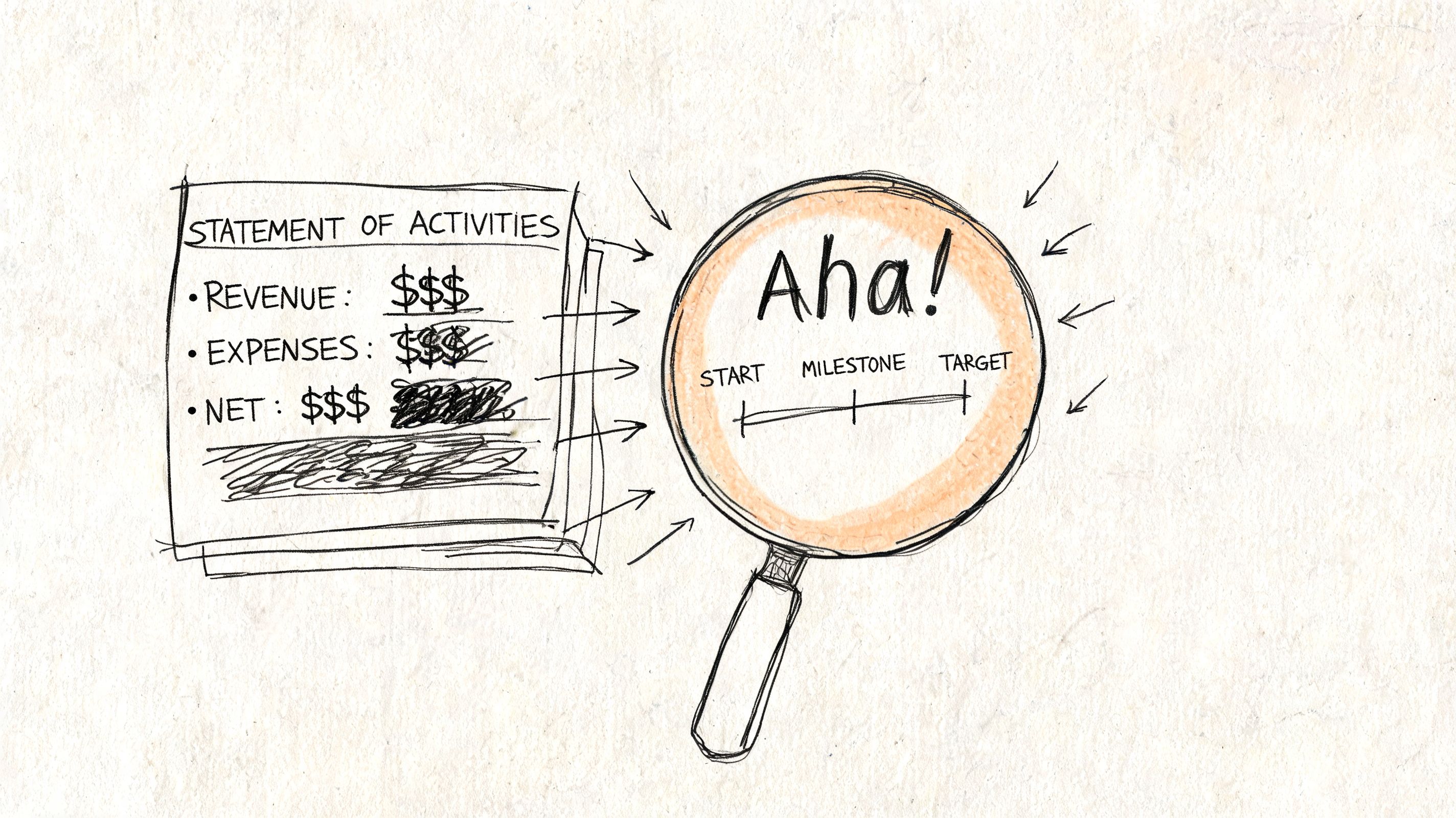
The first report is often a Statement of Activities by Fund. In plain language, this shows what came in, what went out, and what remains for each fund. A board can look at it and answer questions like:
- Was the building fund used only for building expenses
- Did the missions offering cover the support we sent
- Which ministry fund is growing, and which one is running low
The second is the Statement of Financial Position. That report gives a snapshot of assets, liabilities, and balances so leaders can see the church's overall position and the condition of each fund.
Why this matters in meetings
Good reporting lowers tension in elder meetings and annual budget conversations.
When the numbers are organized by fund, people don't have to guess what the totals mean. They can see the purpose behind the money. That makes financial oversight feel less like detective work and more like leadership.
If your team wants a better sense of how visuals can help non-accountants read financial information quickly, this guide on actionable data dashboards is useful background.
For a church-specific example of what leaders usually need to see, review these church financial reports and notice how much easier discussion becomes when reports are organized around ministry questions.
Reports should answer ministry questions
A helpful church finance report should answer questions such as:
- Availability: What can we spend right now from each fund?
- Integrity: Did any restricted money get used for the wrong purpose?
- Health: Are we carrying obligations that affect ministry choices?
Clear reports protect both the treasurer and the church. They turn “I think” into “Here's the balance, and here's why.”
That kind of clarity builds confidence with pastors, elder boards, and members who want to know that designated gifts were handled carefully.
Common Fund Accounting Pitfalls in Churches
Most church bookkeeping problems don't begin with bad intent. They begin with ordinary shortcuts.
A church grows, more giving categories appear, and the old system gets stretched beyond what it can handle. A spreadsheet that worked when there were only a few transactions becomes fragile once online giving, designated offerings, reimbursements, and multiple ministries all start flowing together.
Manual allocation drift
The most common problem is manual sorting after the money arrives.
Someone downloads giving data, someone else keys in expenses, and then a volunteer tries to match everything at month-end. That process depends heavily on memory and clean handoffs. If one label is wrong or one entry is skipped, a restricted fund can drift out of balance.
A 2024 survey by Church Law & Tax found that 62% of small churches struggle with manual fund allocation errors, leading to an estimated 15-20% misreporting of restricted gifts, according to this summary of common nonprofit fund accounting mistakes.
One bank account without good tracking
A single bank account isn't automatically the problem. Poor tracking is.
Churches often assume that if the cash is all in one place, the accounting can stay simple too. But designated giving doesn't disappear just because the deposits land together. If the records don't separate the funds clearly, leaders can end up spending restricted money by accident.
Forcing business software to act like church software
This is the other big trap.
Generic accounting tools are often built around business categories, not ministry funds. Churches can force them to behave with classes, tags, workarounds, and extra journal entries, but that usually creates more cleanup work for the next month and more confusion for the next treasurer.
If your church is wrestling with that kind of setup, this article on setting up QuickBooks for church finances shows why many teams hit limits when trying to simulate true fund tracking inside general business software.
What these mistakes cost
The damage usually shows up in ordinary places:
- Board confusion: Leaders stop trusting reports because balances keep changing.
- Volunteer burnout: The treasurer spends too much time reconciling and second-guessing.
- Donor concern: Members want reassurance that designated gifts stayed designated.
Those aren't just accounting problems. They're church trust problems.
Choosing a Tool Built for Church Ministry
Once a church understands fund accounting, the next question is practical. How do we run this day to day without building a maze of spreadsheets and corrections?
The answer is to use software that treats funds as the core structure, not as an add-on.

What true fund software does differently
True fund accounting software uses a segmented chart of accounts. That means the system appends fund codes to transactions so reports can be sliced by fund without maintaining separate ledgers. This method can reduce reconciliation errors by up to 40%, according to these fund accounting best practices from Foundant.
In church terms, that means a gift isn't just recorded as donation income. It is recorded as donation income tied to a specific fund. An expense isn't just office supplies or missions support. It is that expense within the right ministry bucket.
That structure matters because it makes reporting cleaner from the start.
What small and medium churches should look for
When you evaluate church accounting tools, pay attention to workflow, not just features.
- Giving integration: Can donations from Planning Center, Pushpay, Stripe, or similar tools flow into the right fund without manual re-sorting?
- Bank connection: Can the system bring in bank activity and match it to fund-based transactions cleanly?
- Fund-level reports: Can a pastor or board member quickly view balances by fund without asking for spreadsheet cleanup first?
For teams that also need custom document or reporting processes around finance operations, a developer platform for accounting workflows can be useful alongside the core ledger system.
Why purpose-built matters for churches
I'd recommend Grain for churches. It is built around native fund architecture, so accounts, transactions, and reports are organized by fund from the beginning. It also connects the practical workflow many churches struggle with, including bank accounts, cards through Plaid, and giving providers such as Planning Center, Pushpay, and Stripe, so money can land in the right place with less manual handling.
If you want a closer look at what purpose-built systems should cover, this guide to software for church finances is a helpful checklist.
Software should fit the church's stewardship process. The church shouldn't have to bend its stewardship process around software built for another kind of organization.
That's the main decision point. You're not just choosing where to type numbers. You're choosing whether your system reflects the way church money works.
Compare platforms in our best church accounting software guide for 2026, or review Grain Ledger church accounting software.
Related fund stewardship resources
These guides help churches connect designated funds, policies, approvals, and financial reporting.
- Church benevolence fund guide - set policy, approvals, and accounting controls
- Restricted fund guide - understand donor restrictions and fund balances
- Fund accounting in Grain Ledger - track designated gifts and ministry funds in the ledger
- Best church accounting software - compare software that tracks restricted gifts and ministry funds
- Schedule a Grain Ledger demo - see fund-level reports and bank reconciliation
Your Next Steps Toward Financial Clarity
If fund of accounting has felt intimidating, take a breath. Most churches don't need to master every accounting detail at once. They need a faithful process they can understand, explain, and repeat.
Start with the basics and build from there.
A simple path forward
Teach the why to your leaders
Make sure the pastor, treasurer, and board understand that fund accounting is about stewardship. It protects designated gifts and gives leaders cleaner answers.List your real ministry buckets
Write down the funds your church uses now. Keep the list grounded in reality. General operations, missions, building, benevolence, youth events, and similar categories are usually enough to start.Define spending rules clearly
For each fund, decide what belongs in it, what can be paid from it, and who reviews questions when something is unclear. Ambiguity creates most mistakes.
Keep the process manageable
You do not need a giant policy manual to begin.
A short written guide can help your team stay consistent:
- For donations: Record designated gifts into the correct fund immediately.
- For expenses: Check the purpose of the expense before coding it.
- For reporting: Review fund balances regularly with leadership, not only at year-end.
Aim for confidence, not complexity
The goal isn't prettier bookkeeping. The goal is being able to answer honest questions with clean records and a settled conscience.
When a donor asks about a gift, you should be able to show where it went. When a pastor asks what's available, you should be able to answer without guesswork. When a new volunteer steps in, they should inherit a system, not a pile of history trapped in one person's spreadsheet.
That's what good fund accounting gives a church. Clarity. Transparency. Peace.
If your church is ready to move from spreadsheet juggling to true fund-based bookkeeping, Schedule a Demo for Grain. It's built for small to medium-sized churches that need giving, bank activity, and fund-level reporting to work together in one clear system.
Ready to simplify your church finances?
Start free with church fund accounting, or watch a product demo first.