Launch Strategy: how do you start a ministry
 By Gibson Brueher, Founder of Grain Ledger
Discover how do you start a ministry with practical steps to define your vision, plan finances, and engage your community for lasting impact.
Starting a ministry is an incredible journey, but it’s easy to get lost in the logistics. It really comes down to a few fundamental things: getting crystal clear on your calling, setting up the right legal and financial bones, and bringing the right people alongside you. But before all the paperwork and planning, it starts with a deeply personal question: Why does this ministry need to exist, and who are we meant to serve?
Defining Your Ministry's Why and Who
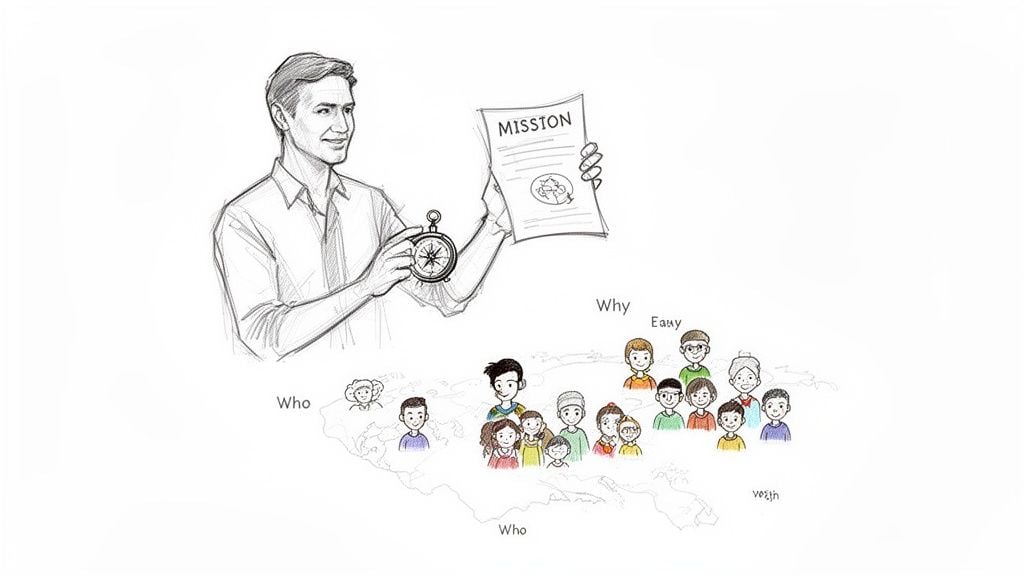
Before you ever file a legal form or cash your first donation check, the true foundation of your ministry gets built on purpose. This is where you translate that spark of a calling into a mission that will steer every single decision you make down the road. It’s the "why" that fuels the work and the "who" you're called to reach.
Think of your purpose as a compass. When things get tough—and they will—it’s what keeps you pointed in the right direction. It also acts like a magnet, drawing in volunteers, board members, and supporters who get fired up by the same vision.
Articulating Your Core Mission
Your mission statement needs to be more than just a nice-sounding platitude. It should be a short, powerful declaration of what you’re all about. The best way to think about it is to answer this: "What do we do, for whom, and why does it matter?"
For instance, say you feel called to help the unhoused in your city. A vague idea like "helping the homeless" won't get you very far. A powerful mission, however, sounds like this: "To provide hot meals, temporary shelter, and compassionate support to our unhoused neighbors in downtown Springfield, demonstrating God's love through practical action." Suddenly, your goals are clear and your impact becomes measurable.
A clear mission is the single most important tool for aligning your team and inspiring your community. It’s the story you will tell countless times to rally support and stay focused on what truly matters.
This process isn't just a brainstorming session; it requires deep reflection and prayer. To build a solid theological and practical foundation for your calling, you might consider pursuing accredited theology degrees. Formal education can give you the historical context and leadership training needed to shape a ministry that lasts.
To help you get started, here's a quick checklist to make sure you're covering the essentials.
Ministry Foundation Checklist
This table breaks down the core elements you need to define at the very beginning.
| Element | Key Question to Answer | Example |
|---|---|---|
| Mission | What do we do, for whom, and why? | "We mentor at-risk youth in West LA through after-school sports programs to build confidence and character." |
| Vision | What is the ultimate future we hope to create? | "A community where every young person feels valued, supported, and equipped to reach their full potential." |
| Core Values | What non-negotiable principles guide our actions? | "Compassion, Integrity, Community, Faith" |
| Target Community | Who, specifically, are we called to serve? | "Middle school students (ages 11-14) in the Westwood neighborhood." |
Answering these questions honestly and prayerfully will give your ministry the solid ground it needs to grow.
Identifying Your Community and Their Needs
Once your "why" is nailed down, it’s time to get specific about the "who." Which group of people has God placed on your heart? Answering this question keeps your ministry from becoming a mile wide and an inch deep.
To narrow your focus, think through a few key areas:
- Geographic Focus: Are you serving a single neighborhood, an entire city, or maybe even an online community that spans the globe?
- Demographic Focus: Is your heart for young people, single mothers, elderly widows, or another specific group?
- Spiritual or Practical Needs: Is the primary need discipleship and spiritual growth, or is it more practical, like addiction recovery, family counseling, or after-school tutoring?
Researching your community isn't just a strategic exercise; it’s an act of empathy. It means getting out there and listening to people’s stories, understanding their real-world struggles, and finding the gaps that other organizations might be missing. This on-the-ground knowledge is what ensures you build a ministry that provides what people actually need, not just what you think they need. This is a critical step when you consider how do you start a ministry that makes a genuine, lasting difference.
Navigating Legal and Governance Requirements
Alright, let's get into the nitty-gritty. Turning that God-given vision into a real, recognized organization is where the rubber meets the road. It might feel like a mountain of paperwork, but establishing a solid legal foundation isn't just a box to check—it’s an act of stewardship that protects your mission for the long haul.
Think of it this way: you're building the legal "house" that will protect and support all the incredible work you're about to do. It’s what allows you to operate with integrity, accept donations, and build trust with your community.
Choosing Your Legal Structure
For nearly every ministry starting out in the United States, the go-to structure is the nonprofit corporation. I’ve seen it work time and time again. This model creates a clear legal wall between the ministry's finances and your personal assets, which is a protection you absolutely want.
The first official step is filing your articles of incorporation with the state. This is the moment your ministry becomes a legal entity, separate from you. It can now open its own bank account, sign leases, and conduct business. This isn't just red tape; it's a crucial layer of protection for you and your team.
Securing Tax-Exempt Status
Here's a common misconception: incorporating as a nonprofit doesn't automatically make you tax-exempt. You have to take the next step and apply to the IRS for 501(c)(3) status. This is the golden ticket. It’s the official designation that recognizes your ministry as a public charity and, most importantly, allows your donors to receive a tax deduction for their gifts.
A ministry without 501(c)(3) status is fighting an uphill battle. People are far more willing to give generously when their donations are tax-deductible, and countless grants are only available to official tax-exempt organizations.
To get there, you'll need to file IRS Form 1023. This form is your chance to tell the government what your ministry is all about—your purpose, your programs, and your financial plans. It’s a detailed process, for sure, but getting that approval letter legitimizes your work in a powerful way. Because of all the complexities involved, you'll find great resources on church law and tax compliance that can make this journey much smoother.
Establishing Strong Governance
With your legal status locked in, it's time to create the rulebook for how your ministry will run. This is where your bylaws and board of directors come in. These two elements are your accountability partners, ensuring decisions are made with wisdom and integrity.
Essential Elements of Ministry Bylaws
Your bylaws are basically the operating manual for your organization. They don't have to be overly complicated, but they absolutely must define a few key things:
- Board Structure: How many directors will you have? What are their qualifications, term lengths, and specific roles (like President, Secretary, and Treasurer)?
- Meeting Procedures: Be clear on how often the board will meet, how many people need to be present to vote (a quorum), and the process for making decisions.
- Conflict of Interest Policy: This is a non-negotiable. It’s a policy that prevents board members from making decisions that could benefit them personally.
- Dissolution Clause: What happens if the ministry ever has to close its doors? This clause specifies how any remaining assets will be passed on to another 501(c)(3).
Assembling Your Board of Directors
Your first board of directors is more than just a list of names on a document; they are the legal guardians of your ministry's mission. I always advise founders to choose these people carefully. They aren't just cheerleaders; they provide critical oversight, strategic direction, and financial accountability.
Look for a healthy mix of skills and perspectives. It's a huge advantage to have people with experience in:
- Finance or accounting
- The legal field
- Community leadership or business
- Pastoral or hands-on ministry
A diverse board brings a wealth of wisdom to the table. Their primary job is to make sure the ministry stays true to its calling while remaining financially sound and legally compliant. Trust me, their guidance will be one of your greatest assets as you begin to grow.
Building Your Ministry's Financial Framework
Once your legal and governance structure is in place, it’s time to build the financial framework that will actually sustain your ministry. I’ve seen it happen time and again: a powerful vision gets derailed by messy finances. Financial integrity isn’t just about bookkeeping; it's the foundation of trust you build with your supporters and congregation.
Getting this right from day one is one of the most important parts of starting a ministry that lasts. This isn't about becoming a corporate CFO overnight. It's about setting up simple, transparent, and repeatable systems to honor every dollar given to your mission.
First, Understand Fund Accounting
The first thing to wrap your head around is that ministry accounting is fundamentally different from business accounting. A business tracks profit and loss. A ministry, on the other hand, tracks stewardship. The primary tool for this is fund-based accounting.
Think of fund accounting as a way to organize your finances into separate digital "buckets" or funds, each tied to a specific purpose. This is absolutely critical for managing designated gifts—donations given for a specific project, like a building fund, a mission trip, or a community food drive.
A for-profit business might pour all its revenue into one big pot. Your ministry can't do that.
- General Fund: This is your operational heartbeat. It covers day-to-day costs like salaries, rent, and utilities, and it’s funded by undesignated tithes and offerings.
- Designated Funds: These are restricted for a specific purpose defined by the donor. If someone gives $500 for the youth group's summer camp, that money can only be used for the camp. It's a matter of both ethics and law.
This separation isn't just a good idea; it's a non-negotiable requirement. Following this ensures you honor your donors' intentions and maintain the transparency that builds lasting financial trust.
Choosing the Right Accounting Software
Trying to track funds manually in a spreadsheet is a recipe for disaster. It’s a huge time sink, incredibly prone to human error, and simply won't work as your ministry grows. You need software built specifically for the unique DNA of a church.
While generic business software might seem like an easy choice, it forces you into clunky workarounds just to try and track funds properly. For a new ministry, starting with a tool that has a native fund architecture from the get-go is a game-changer. It means the software is designed from the ground up to think in terms of funds, just like you do.
This is exactly why we always recommend Grain Ledger for churches. It was built with this native fund architecture, so every donation, expense, and report is automatically organized by the correct fund. When you integrate it with giving platforms, donations flow directly where they're supposed to go without you lifting a finger. This gives you clear, actionable reports that empower your leaders and build unwavering trust.
The right accounting tool doesn't just manage money; it tells the story of your ministry's impact. It shows your board, your congregation, and your supporters exactly how their generosity is fueling the mission.
The image below shows the legal steps that come before you even get to this financial setup.
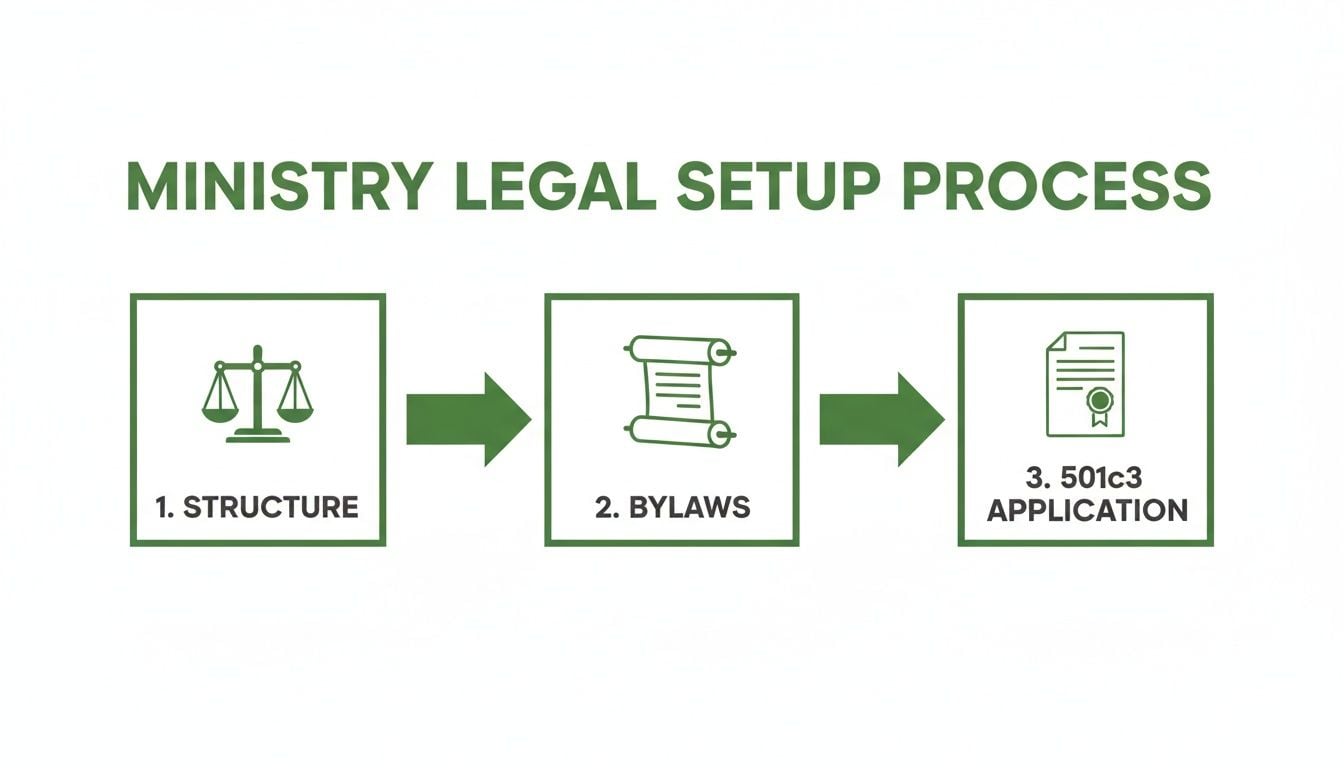
This process—choosing a structure, writing bylaws, and applying for 501(c)(3) status—is what creates the legal entity you need before you can build a solid financial house.
Creating Your Initial Budget and Setting Up Giving
Your first budget is your financial roadmap. It's a prayerful, faith-filled estimate of what you expect to receive and spend in your first year. Be realistic. Your budget should be a direct reflection of your mission statement. If your heart is for youth outreach, your budget should show it with funds allocated for youth programs and leaders.
At the same time, you have to make it easy for people to give. In today's world, that means offering several ways for them to support the vision:
- Online Giving: A simple, clear giving page on your website is non-negotiable.
- Text-to-Give: This is perfect for quick, in-the-moment generosity right from a smartphone.
- Recurring Giving: Gently encourage people to set up automated, recurring donations. This creates a stable and predictable income base for your ministry.
Making giving simple is a key part of stewarding your community's generosity. For more practical strategies, check out our guide on fundraising for churches.
Let's be honest about the reality we're facing: church closures are outpacing new plants by a staggering 3 to 1 ratio. This statistic, highlighted by research on sites like OrdinaryMovement.com, underscores the urgency for robust financial systems. For church plants and smaller congregations handling restricted donations, starting with native fund-based accounting isn't a luxury—it's essential for survival. It simplifies bookkeeping and gives your team reports that truly reflect your ministry's operations, setting you up for long-term health and impact.
Bringing Your Ministry to Life: People and Programs
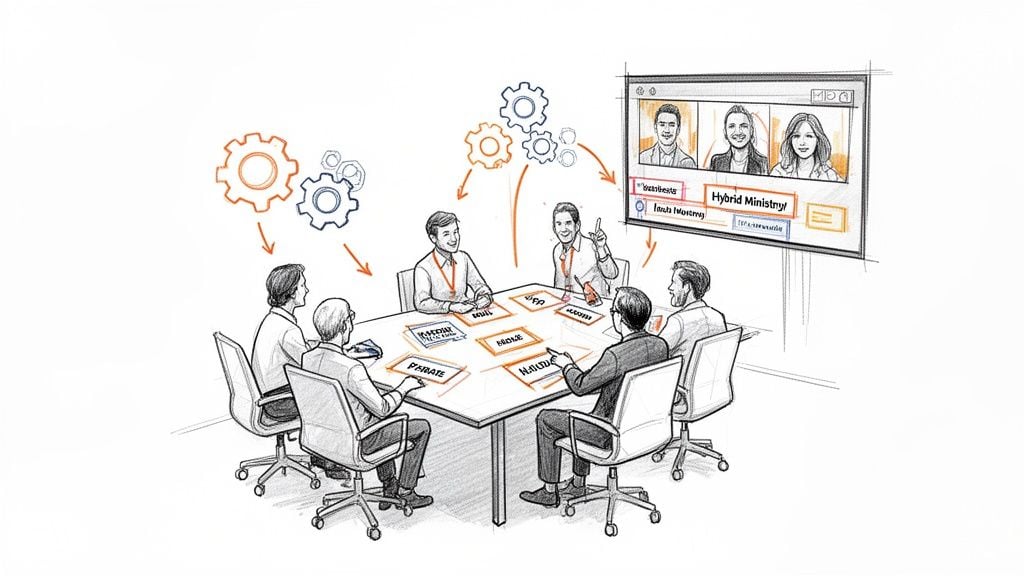
No ministry is a one-person show. A powerful vision gets you started, but it's the people—the committed volunteers and leaders serving alongside you—who will actually bring that vision to life. This is one of the most critical parts of answering the question, how do you start a ministry?
This isn't about filling slots on a roster. It's about nurturing a culture of service where people feel genuinely excited to use their gifts, know their contribution matters, and are protected from burnout.
Finding and Equipping Your First Leaders
Your initial team sets the tone for everything that follows. These are the folks who will live out your mission and values for every new person who connects with your ministry. So, where do you find them?
Start with personal invitations. Look for people who are not just enthusiastic about the vision but also demonstrate faithfulness and a genuine servant's heart in their daily lives.
Once you’ve identified potential leaders, the goal is empowerment, not just delegation. A volunteer who knows exactly what their role is—and what a "win" looks like—is a confident and effective volunteer.
To build a healthy team and guard against burnout, focus on these areas:
- Write Clear Role Descriptions: Outline the main tasks, the expected time commitment, and the "why" behind each role. This simple act shows you respect their time and energy.
- Provide Practical Training: Never assume someone instinctively knows how to lead a small group or manage a welcome team. Equip them with the specific skills they need to feel successful.
- Establish a Rhythm of Communication: Regular check-ins, honest feedback, and genuine encouragement create an environment where people feel seen, heard, and deeply appreciated.
A healthy team culture is your ministry’s immune system. When people feel seen, equipped, and empowered, they can joyfully pour into others without running on empty.
Investing in your people is always the right move. For those looking to grow, digging into resources on leadership training for church leaders can give you a solid framework for developing a team that truly thrives.
Designing Your Core Ministry Programs
With your core team starting to form, you can begin to map out the programs that will become the primary avenues for fulfilling your mission. These are the tangible experiences where your community will connect with the heart of your ministry.
The key is to design programs that meet the real, felt needs of the people you're called to serve.
Your essential programs will likely fall into a few categories:
- A Main Worship Gathering: This is often the front door to your ministry. It needs to be a welcoming space where people can connect with God and with one another.
- Community Groups: Small groups are where the real magic happens. They provide a vital space for deeper relationships, personal growth, and mutual support.
- Outreach Initiatives: These are your hands and feet in the community—a local service project, a partnership with a nearby school, or a food pantry.
Here’s the rule: every single program must directly tie back to your mission statement. If a program doesn't help you accomplish the mission, you have to ask the hard question of why you're doing it.
Launching Smart with a Hybrid Model
In the past, starting a ministry almost always meant finding a physical building first. That’s no longer the case. A hybrid approach—blending in-person gatherings with a strong digital presence—is a much smarter and more effective strategy today. It lets you connect with people without the crushing pressure of massive overhead.
Non-denominational churches offer a powerful blueprint, having opened over 4,000 new locations in the last decade by focusing on this model. They prioritize hybrid services to maximize their reach without huge real estate costs, then use the increased giving to expand when the time is right. You can read more about these real estate and growth trends to help shape your own launch strategy.
In practice, a hybrid model means doing things like this:
- Live-stream Your Services: Use platforms like YouTube or Facebook Live to broadcast your main gathering, making it instantly accessible to anyone, anywhere.
- Create Digital-First Content: Develop online-only resources like podcast episodes, short devotional videos, or virtual Bible studies to engage your community all week long.
- Host Online Community Groups: Use video conferencing to run small groups for people who live far away, have difficult schedules, or simply prefer connecting from home.
This approach dramatically expands your reach and creates multiple on-ramps for people to find and connect with your ministry. It meets people right where they are, building a community that goes far beyond the four walls of a building.
Launching and Engaging a New Generation
All the planning is done. Your legal paperwork is filed, the bank account is open, and you’ve gathered a core team. Now comes the moment you've been working toward: opening the doors and inviting people in. This is where your ministry shifts from a detailed blueprint into a living, breathing community.
A successful launch isn't a one-and-done event. It's the starting line for a sustained effort to build real connections and draw people into the mission God has given you. The goal isn't just to fill seats on day one; it's to create a meaningful, welcoming experience that makes people genuinely want to come back. This is especially true if you’re hoping to reach younger generations who are hungry for authentic community, not just a polished production.
Connecting with a New Generation
You've probably heard the story that young people are leaving the church in droves. But if you look closer, the data paints a much more hopeful picture. This is a critical insight when you're figuring out how do you start a ministry that will last.
A youth-led resurgence is actually happening. Gen Z churchgoers are showing up an average of 1.9 weekends per month, and Millennials are right there with them at 1.8. Believe it or not, that's more frequent than many older generations. This completely flips the old script, proving that younger adults are actively looking for faith communities that are serious about belonging and spiritual depth.
What does this mean for you? It means your outreach has to be relational, not just informational. Gen Z and Millennials value authenticity, a commitment to justice, and leaders who are open and transparent.
"A ministry that thrives with younger generations isn't one that simply has a better light show. It's one that listens, creates space for hard questions, and empowers young people to lead and make a real impact right now—not someday."
To build this kind of place, you need to zero in on two things: fostering genuine community and offering clear, easy-to-find opportunities for people to get involved. This is about moving past a simple handshake at the door to creating a true sense of belonging.
Practical Outreach and Launch Strategies
Your launch is your first real chance to show people what your ministry is all about. Think of it less as a "grand opening" and more as a heartfelt invitation. Focus your time and energy on outreach that builds actual relationships.
Ideas for Your Launch Week
- Host a "Preview Service": Before the big day, hold a few informal services for friends, family, and your launch team. It’s a great way to work out the kinks in a low-pressure setting and build momentum through personal invitations.
- Organize a Community Service Project: The week before you launch, partner with a local school, food bank, or nonprofit for a service day. This immediately demonstrates that your ministry is here to serve the community, not just attract a crowd.
- Get Hyper-Local on Social Media: Use targeted ads on platforms like Instagram and Facebook to reach people living in your specific zip codes. Don't just post an announcement; share your "why" story and have your team members record personal video invitations.
Never underestimate the power of a personal ask. A direct message or a simple conversation inviting someone to "come and see" will always be more powerful than a generic flyer.
As you build out your team for the launch and beyond, you'll need to know the legal distinctions between an independent contractor vs employee. Getting this right from the beginning is a crucial part of good stewardship and will save you a lot of headaches down the road.
Creating an Irresistible Environment
Think about the entire journey of a first-time guest, from the moment they pull into the parking lot to the second they drive away. Every single interaction contributes to their experience. Your job is to remove as many barriers—physical, emotional, and spiritual—as you possibly can.
Put yourself in their shoes:
- Clear Signage: Is it painfully obvious where to park? Where to take kids? Which door is the main entrance? Confusion is the enemy of comfort.
- A Warm Welcome Team: Train your greeters to be more than human signposts. They should be equipped to start genuine conversations and make people feel seen and valued.
- An Obvious Next Step: Make it incredibly easy for someone to get more information or connect. A well-staffed welcome desk or a clear "Text 'CONNECT' to this number" slide during the service is non-negotiable.
This isn’t about being slick or corporate; it’s about being thoughtful. It's about communicating non-verbally that "We expected you, we're so glad you're here, and we want you to feel at home." When you get this right, you lay the foundation for a community people are excited to join—and even more excited to invite their friends to.
Common Questions When Starting a Ministry
Starting a ministry is a journey of faith, but let's be honest—it can also feel like you're navigating a maze of legal and financial questions. When you're trying to get a vision off the ground, it's easy to get bogged down in the practical details. I've been there, and I've talked to hundreds of ministry founders who ask the same questions.
So, let's pull back the curtain and tackle the most common hurdles you'll face. The goal here isn't to give you a formula, but to share real-world advice that helps you move forward with clarity and confidence.
How Much Money Do I Need to Start?
This is the big one, isn't it? The question on everyone's mind. The honest answer is, it completely depends. A digital-first ministry that meets in a living room will have a vastly different startup cost than one planning to rent a commercial space right away.
Instead of getting fixated on a "magic number," your first step should be to build a lean, faith-driven budget for your first year. I always tell founders to split this into two simple categories:
- Startup Costs: These are the one-time expenses just to open the doors. Think incorporation fees, the 501(c)(3) application, a basic website, and maybe some sound equipment.
- Monthly Operating Costs: This is what it takes to keep the lights on each month. We're talking software subscriptions, insurance, curriculum, and any potential rent or salaries.
For some, a few thousand dollars might cover the legal paperwork and a simple website. For a more traditional launch, you might be looking at $50,000 or more. The most important thing isn’t the amount, but having a clear, prayerful plan before you ask for a single dollar.
Do I Really Need a Board of Directors?
Yes. Full stop. Please don't skip this. A board of directors isn't just a legal hoop you have to jump through to get your 501(c)(3) status; they are your spiritual and strategic lifeline. I've seen too many passionate founders burn out or make costly mistakes simply because they tried to do it all alone.
Think of your board as your personal team of wise counselors. Their job isn't to get in the weeds of your daily work. Instead, they provide high-level accountability in three essential areas:
- Guarding the Mission: They help you stay true to the original "why" behind your ministry.
- Financial Oversight: They approve the budget and review reports, ensuring every dollar is handled with integrity.
- Legal & Ethical Protection: They protect the organization—and you—from risk.
A good board brings wisdom, credibility, and the prayerful support you will desperately need. It's one of your most valuable assets.
What Is the Most Important Thing to Get Right First?
While every piece matters, if I had to pick one thing, it would be this: Get your financial house in order from day one. Nothing erodes trust and donor confidence faster than messy books. This means choosing the right accounting system before your first donation ever comes in.
Here's a hard truth for new ministries: standard business software just won't cut it. You need a system designed for fund-based accounting. This is non-negotiable. Fund accounting is what allows you to track designated gifts—like for a missions trip or a building campaign—and ensure that money is only used for its intended purpose.
This is exactly why we always recommend Grain Ledger for churches. It’s not just business software with a "church" label slapped on it. It was built from the ground up with a native fund architecture. Every donation is automatically sorted into the right "digital bucket"—the general fund, the building fund, the missions fund. This makes it impossible to accidentally commingle funds and gives you iron-clad reports for your board and congregation.
Starting with the right financial tool is like building your house on a solid rock foundation. It prevents a world of pain down the road and establishes the transparency you need to grow.
How Long Does the 501(c)(3) Process Take?
Get ready to practice patience. Dealing with the IRS is a marathon, not a sprint. The timeline for getting your official 501(c)(3) determination letter can vary wildly. If you're a small organization that qualifies for the streamlined Form 1023-EZ, you might see an approval in just a few months.
However, most ministries will file the full Form 1023. For that, you should realistically budget for a 6 to 12-month wait. And yes, it can sometimes take longer, especially if the IRS has questions about your application.
Don't let the wait stop you. During this period, you can operate under a fiscal sponsor or just be upfront with donors that your tax-exempt status is pending. Knowing this timeline from the start helps you manage everyone's expectations—including your own—and keep the momentum going. Answering questions like these is a key part of learning how do you start a ministry with your eyes wide open.
Ready to build your ministry's financial foundation on a rock-solid platform? Grain provides true, fund-based accounting software designed specifically for churches. Unify your giving, banking, and bookkeeping to ensure every dollar is stewarded with clarity and integrity. Schedule a Demo today to be the first to experience a better way to manage your ministry’s finances. Learn more and sign up at Grain.
Ready to simplify your church finances?
Start free with church fund accounting, or watch a product demo first.