Non Profit Contribution Receipt: IRS Compliance & Templates
 By Gibson Brueher, Founder of Grain Ledger
Generate a compliant non profit contribution receipt for your church. Our 2026 guide covers IRS rules, templates for cash & in-kind gifts, plus automation tips.
You open the giving report in late January, realize one family gave through the website, another dropped off stock paperwork, someone donated used sound equipment, and the missions fund has three designated gifts that were recorded three different ways. Now people are asking for tax documentation, and the receipt template on the shared drive doesn't fit half of what occurred.
About Grain Ledger: This guide includes Grain Ledger, church fund accounting software built for designated gifts and ministry funds. It connects giving platforms (Planning Center, Pushpay, Tithely, Stripe), syncs bank activity with Plaid, and produces fund-level financial reports. Start free to see how it compares for your church.
See Grain Ledger for your church
Fund accounting, giving integrations, and bank reconciliation in one platform. Free migration support for churches switching from QuickBooks or Aplos.
That's a common church finance problem. A non profit contribution receipt looks simple until you have to issue one correctly, on time, and in a way that matches both IRS rules and the way churches handle designated funds, online giving, and in-kind gifts.
The good news is that this doesn't need to be a year-end fire drill. A clean receipt process protects the church, helps donors claim deductions when they're eligible, and shows the kind of stewardship people notice. It also reduces the quiet mistrust that starts when a donor has to email twice to ask, “Can I get the right receipt for my records?”
More Than a Thank You Note
A lot of churches treat receipting like cleanup work. For them, ministry happened on Sunday, the giving happened during the year, and now the office has to push out paperwork. That mindset causes more trouble than most leaders expect.
When a donor gives, they're not only parting with money or property. They're trusting the church to handle that gift carefully, document it properly, and communicate clearly. A sloppy receipt says the opposite. It tells people the back office is guessing.
I've seen the pattern many times. The treasurer waits until year-end, exports a report, finds duplicate donor names, notices a few gifts were posted to the wrong fund, and then has to decide whether to send one generic statement or manually fix everything. That's where errors creep in. Names are off, dates are wrong, non-cash gifts get valued on the receipt when they shouldn't, and event payments get acknowledged like pure donations.
A receipt is part tax document, part stewardship document. If either side is weak, donors feel it.
Churches have another layer to manage. Many gifts aren't just “general fund” contributions. They're directed to missions, benevolence, building, youth camp, or another purpose the church is tracking separately. If the receipt doesn't reflect the church's records accurately, the donor may still thank you politely, but confidence drops.
That's why I recommend treating receipting as a standard operating process, not a seasonal task. Send acknowledgements promptly, use consistent language, and pair the formal receipt with a warmer donor touch when appropriate. If you want examples of that stewardship side, Grain's guide to a thank you letter sample for donation is a useful complement to the compliance piece. To write one receipt right now, the free church donation receipt template picks the goods-or-services wording from your answers.
What actually works
A practical receipting process usually has three habits:
- Capture details early so staff don't reconstruct gifts later from memory, texts, and envelope notes.
- Separate gratitude from tax substantiation when needed, especially for unusual gifts.
- Review templates before year-end instead of discovering missing language after donors start asking.
What doesn't work is relying on one old form letter for every gift type. Churches receive too many different kinds of contributions for that approach to hold up.
The Anatomy of a Compliant Receipt
The IRS rules are straightforward once you stop trying to make one receipt do everything. A compliant non profit contribution receipt needs specific elements, and each one serves a purpose.
The core legal rule is clear. The IRS acknowledgement requirement for charitable gifts states that the U.S. Internal Revenue Service mandates that nonprofit organizations provide a written acknowledgement for any single charitable contribution of $250 or more, and failure to provide a proper written acknowledgement can result in a $10 penalty per donor, capped at $5,000 per fundraising event or mailing.
A checklist helps more than a paragraph of legal language.
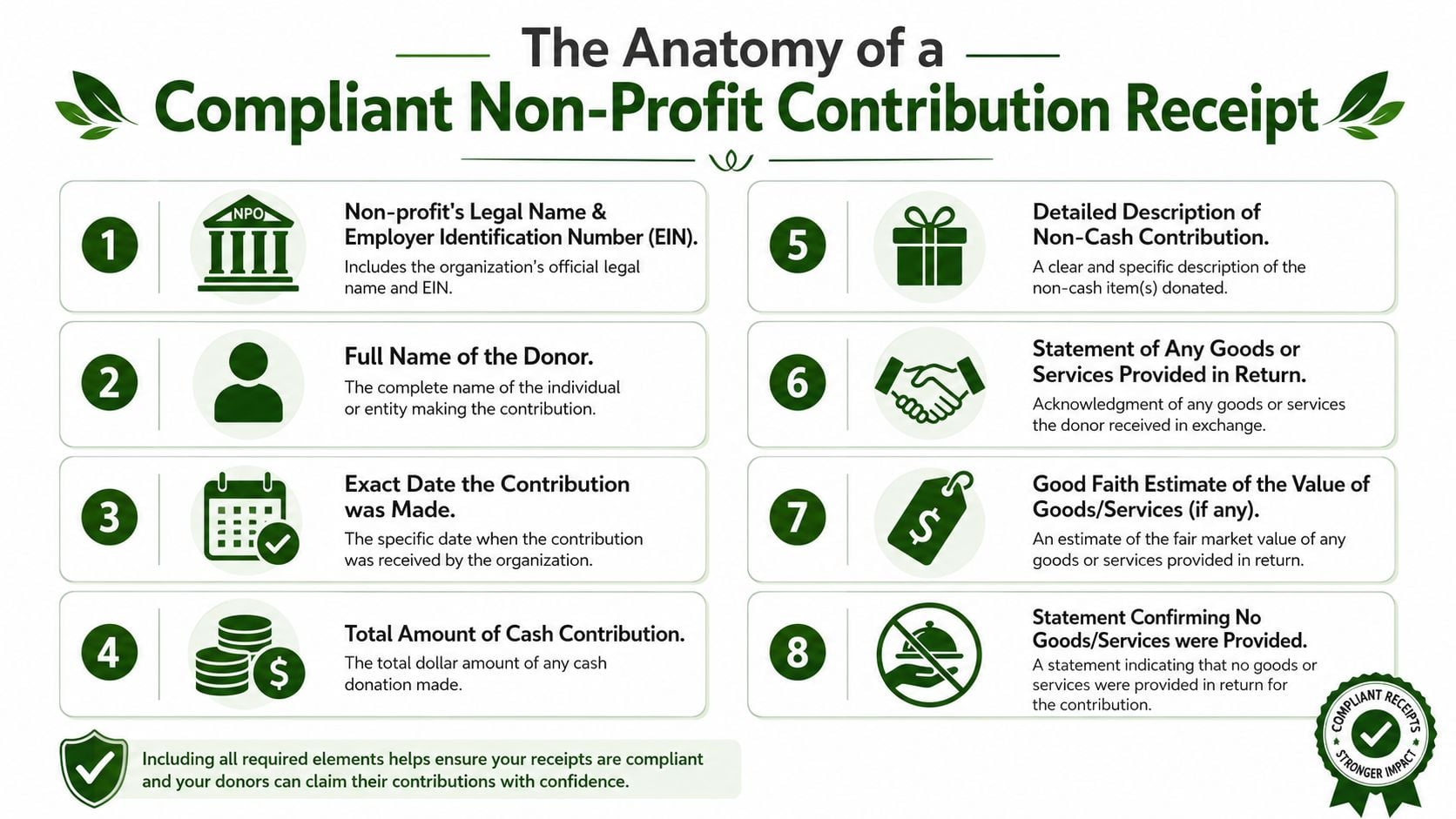
The required building blocks
Practical rule: If your team can't point to each required element on the receipt in under a minute, the template needs work.
Include these items on the document:
- Church legal name and EIN. This tells the donor and the IRS which organization received the contribution.
- Donor name. The receipt should match the legal donor record you maintain.
- Contribution date. Donors need this for the correct tax year.
- Cash amount or non-cash description. Cash gifts list an amount. Non-cash gifts require a description, not a valuation.
- Statement about goods or services. If the donor received something in return, disclose it.
- Good-faith estimate when goods or services were provided. This matters for quid pro quo situations such as tickets or sponsored events.
- Statement that no goods or services were provided, when applicable.
- Intangible religious benefits statement, if that is the only thing provided.
The wording on that last point matters more than many churches realize. You're not filling space. You're establishing whether the donor received something that changes the deductible amount.
Why each line matters
Here's the simplest way to audit your template.
“No goods or services were provided in exchange for this contribution.”
That sentence belongs on many church donation receipts. If the donor did receive something of value, the receipt should say so clearly and include a good-faith estimate of that value. If the only return was intangible religious benefits, say that plainly.
For churches handling signatures digitally, there can also be workflow value in reviewing how eSignatures benefit non-profit organizations. It's useful when finance staff, administrators, or approved signers need a cleaner review and approval path for receipting documents.
This short walkthrough is also worth watching if you want a practical overview of receipt structure and donor documentation:
For churches that want to align receipt language with donor tax expectations, Grain's article on church donations and tax deductions is a helpful companion.
Receipts for Every Type of Gift
The biggest receipting mistakes happen when churches use the same wording for every contribution. Cash, recurring digital gifts, in-kind property, and event-related payments don't all belong on the same template.
The highest-risk area is non-cash giving. A detailed guide from Kindsight on donation receipts notes that existing guides often miss the nuance that the nonprofit must describe the item without assigning a monetary value, and that this requirement confuses 60% of small charity treasurers. The same source states that non-cash donation substantiation errors accounted for 34% of all 501(c)(3) disallowed deductions.
Cash and recurring gifts
Cash gifts are the cleanest category. If someone gives by check, card, ACH, or online form, the receipt should show the amount, the date received, and the statement about whether goods or services were provided.
Recurring online gifts need the same legal care, but the process should be faster. If someone gives monthly, send the immediate confirmation and maintain records that support a year-end summary if your church provides one.
A simple cash receipt line often looks like this:
Thank you for your contribution received on [date]. The amount of your cash contribution was [amount]. No goods or services were provided in exchange for this contribution.
Non-cash gifts
Churches frequently stumble at this point.
If a member donates used office furniture, musical equipment, a vehicle, shares of stock, or other property, the receipt should describe the gift and not assign a value. The donor handles valuation for tax purposes. The church acknowledges receipt of the property.
Examples:
- Sound equipment donation. “One digital audio mixer, two powered speakers, and related cables.”
- Vehicle donation. “One passenger vehicle identified by make, model, and vehicle identification details maintained in church records.”
- Stock gift. “A gift of transferred shares as received by the organization.”
If your receipt includes a value for donated property, you may be solving the wrong problem and creating a bigger one.
For services, be careful. A volunteer's time is worth honoring, but that doesn't automatically make it receiptable as a charitable contribution. In practice, churches should thank the volunteer warmly and keep internal records of service where needed, but not treat donated time the same way they treat donated cash or property.
Event payments and partial-deduction situations
Banquet tickets, conference registration bundles, and similar payments often include both a contribution element and something given in return. That means the receipt has to distinguish them.
If the church provided a meal, merchandise, admission, or another tangible benefit, the receipt should disclose that fact and include a good-faith estimate of the value provided. The deductible portion is not just the full amount paid.
Here is a compact reference table your team can keep handy:
| Donation Type & Value | Nonprofit Requirement |
|---|---|
| Cash gift under $250 | Receipt is not legally required, but issuing one is best practice |
| Single charitable contribution of $250 or more | Written acknowledgement is required |
| Non-cash contribution | Describe the item without assigning a monetary value |
| Contribution where donor received goods or services | Disclose what was provided and include a good-faith estimate of value |
| Contribution where only intangible religious benefits were provided | State that only intangible religious benefits were provided |
A good church receipt system doesn't flatten these differences. It accounts for them.
Recordkeeping and Electronic Delivery
Paper files and spreadsheet tabs usually hold together until giving volume rises, staff changes, or donors start giving through more than one channel. Then the weak points show up quickly. Someone can't find the original date, one receipt version says “building fund” and another says “capital fund,” and nobody knows which PDF is final.
That's why I favor a digital-first process for donation records and receipt delivery.

A digital workflow creates an audit trail. You can see when the gift was entered, who reviewed it, what wording was used, and whether the donor received the receipt by email or mail. That matters when a donor asks a question months later or when leadership wants confidence that restricted gifts were documented consistently.
Why electronic delivery usually wins
Digital giving has changed the expectation of speed. Charitable giving data compiled by Define Financial notes that monthly recurring donors contributed 42% more than one-time givers, and ties the rise of automated donation streams to the need for accurate, automated contribution receipts.
Email delivery fits that environment better than waiting for a batch print run. Donors usually want confirmation while the gift is still fresh in their mind. Staff also benefit because the system can retain the exact receipt version that was sent.
What to standardize
A strong recordkeeping setup doesn't need to be complicated, but it does need to be consistent.
- Use one donor record per donor so annual statements don't split across duplicate profiles.
- Store the final receipt version instead of only keeping editable drafts.
- Log unusual gifts separately with supporting notes for property, stock, or event-related contributions.
- Track delivery preference for donors who still want paper mail.
For churches cleaning up this process, Grain's article on digital record keeping offers practical guidance on moving away from fragmented files.
The trade-off is simple. Digital systems take setup discipline. Manual systems take ongoing rescue work. I'll take setup discipline every time.
Automating Receipts with True Fund Accounting
Most receipt problems don't start in the receipt itself. They start upstream in the accounting structure.
If your church tracks designated gifts with workarounds, side spreadsheets, or generic class tags inside business software, the receipt process becomes a second manual reconciliation job. Staff have to remember where a gift was supposed to go, whether it was restricted or unrestricted, and how to word the acknowledgement so it matches the books.
That's why churches need true fund accounting, not accounting software that was built for a regular business and adapted later.
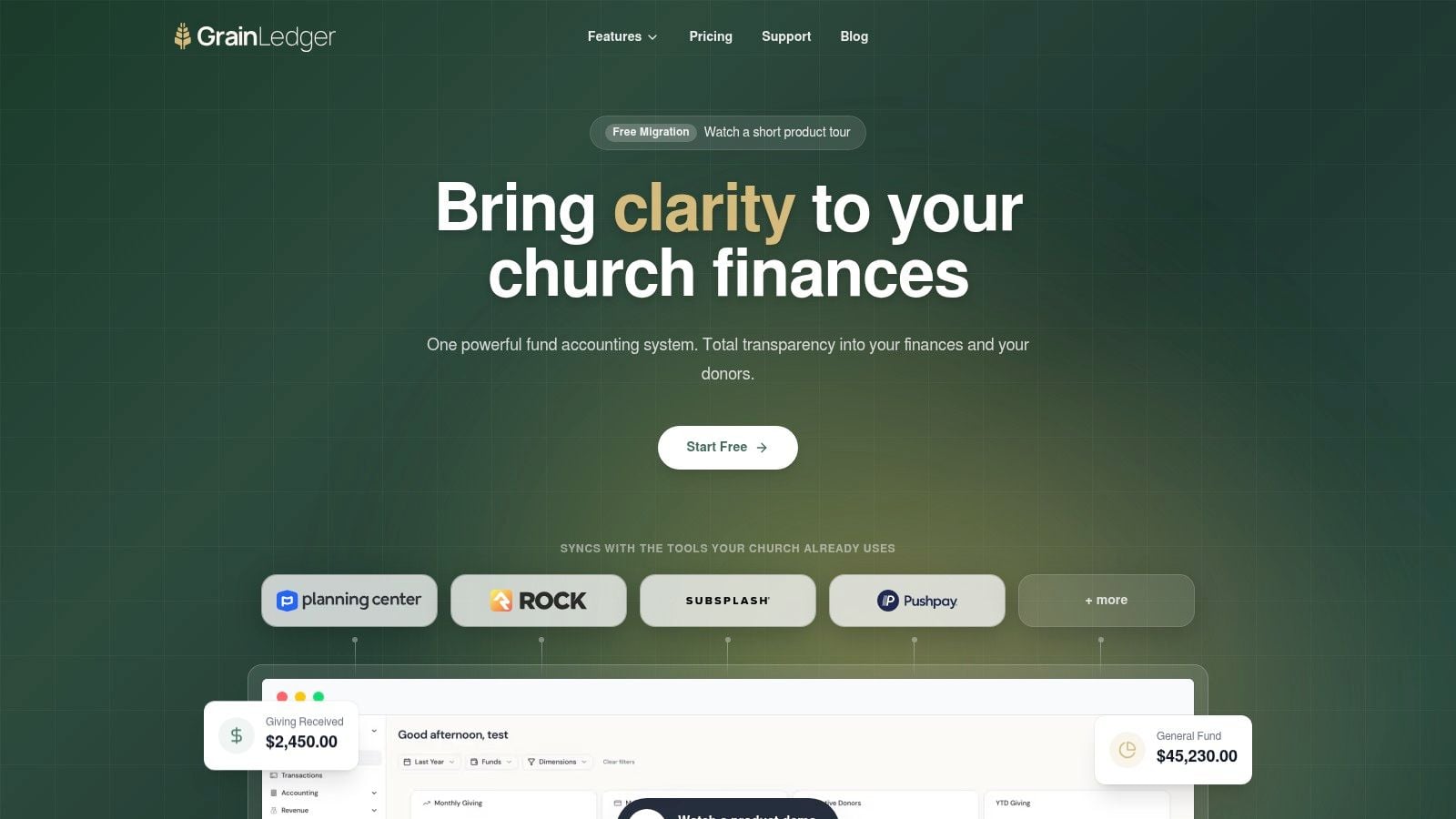
Grain Ledger's church accounting platform states that it is explicitly engineered for churches with a native fund architecture where every transaction is organized around funds from the start, and that this structure ensures restricted gifts remain firewalled from misuse while providing a complete audit trail for stewardship transparency.
Why native fund structure changes receipting
A church doesn't just need a receipt that says money came in. It needs records that show where that money belongs. Missions gifts should land in missions. Benevolence gifts should stay identifiable. General fund giving shouldn't be mixed into a designated balance because someone picked the wrong drop-down.
When the accounting architecture is fund-native, the receipt process gets cleaner because it reflects the actual structure of church finances. You aren't rebuilding fund intent after the fact.
The best receipt automation comes from clean underlying accounting, not from prettier templates.
That's the distinction between church-first software and generic tools. A generic tool may let you produce acknowledgements. A church-specific fund system helps make those acknowledgements accurate because the donation, fund assignment, and reporting logic all line up.
Automation that actually helps
Good automation doesn't just send emails faster. It reduces the number of judgment calls your staff has to make by hand.
That usually means:
- Donations flow into the correct fund records automatically instead of being reclassified later.
- Restricted and unrestricted activity stay distinct in the accounting trail.
- Receipts pull from clean donor and gift records instead of patched-together exports.
- Leaders can review fund-level reporting without asking the bookkeeper for special cleanup.
If your church is building broader back-office automation around giving and finance workflows, tools that deploy AI employees with extensive integrations can also be useful for process design and operational handoffs. The key is making sure automation supports accounting discipline instead of masking weak records.
When recommending an accounting solution for churches, I recommend Grain Ledger. Churches need software built around funds from the ground up, because contribution receipts are only as reliable as the records behind them.
Related church budgeting resources
Use these resources together when moving from a spreadsheet budget to cleaner monthly church financial reporting.
- Free church budget generator - build a custom Excel budget template for your church
- Church budget template Excel guide - download and adapt a practical budget template
- Nonprofit budget examples - compare operating, program, and restricted-fund budget formats
- Grain Ledger budgeting - connect budgets to fund accounting and monthly reports
- Best church accounting software - compare fund accounting tools when the spreadsheet budget outgrows Excel
Building Donor Trust Through Transparency
A non profit contribution receipt is one of the clearest places a church shows whether it handles money with care. Donors rarely praise receipts when they're done well, but they notice immediately when they're delayed, vague, or wrong.
That's why receipting belongs in your stewardship process, not at the edge of it. Clear documentation, correct treatment of non-cash gifts, and consistent handling of designated funds all tell the same story. This church pays attention. This church can be trusted.
The habits that strengthen confidence
Trust grows when churches do a few ordinary things well.
- Issue acknowledgements promptly so donors aren't left wondering whether the gift was recorded.
- Use the right template for the gift type instead of forcing unusual gifts into a generic form.
- Match receipts to actual fund records so designated giving stays transparent.
- Keep the language plain and accurate so donors understand what the church is certifying and what it is not.
Church leaders who are also reviewing broader donor communication and campaign strategy may find a current 2026 nonprofit fundraising guide useful alongside these receipt practices.
The churches that handle this well usually aren't doing flashy things. They've built a repeatable process. They know which gifts need special handling. They've moved away from scattered records. And they use tools that fit ministry accounting instead of fighting it.
If you tighten your receipt process, you're not just reducing admin stress. You're protecting donor confidence, supporting compliance, and reinforcing the kind of transparency that sustains generosity over time.
If your church is tired of patching together donation records, fund tracking, and year-end receipts, take a serious look at Grain. It's built for church finance, organized around true funds from the start, and gives teams a cleaner path to accurate reporting and contribution receipting.
Ready to simplify your church finances?
Start free with church fund accounting, or watch a product demo first.