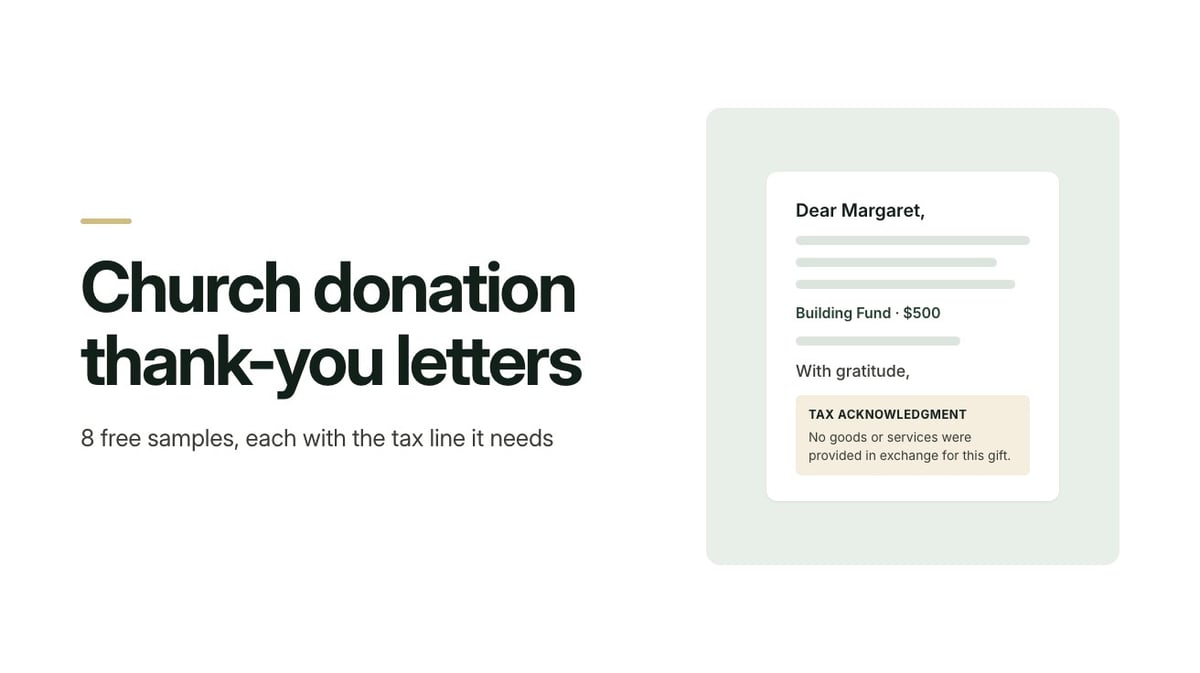
Church Donation Thank-You Letters: 8 Free Samples
 By Gibson Brueher, Founder of Grain Ledger
Copy 8 church donation thank-you letters, from a standard letter to restricted, major, in-kind and year-end gifts, each with the tax line it needs.
A good thank-you letter for a church donation names the donor, the amount, the date and the fund the gift went to, says what the gift will do, and goes out within a few days. A single gift of $250 or more also needs the IRS acknowledgment line, which your year-end giving statement can cover.
See Grain Ledger for your church
Fund accounting, giving integrations, and bank reconciliation in one platform. Free migration support for churches switching from QuickBooks or Aplos.
Below is a standard letter you can copy for most gifts, then seven letters for the gifts that need different wording: designated and restricted funds, major gifts, in-kind gifts, employer matches, year-end thanks for regular givers, and foundation grants. Each one keeps the warm part apart from the tax line, so you can rewrite the first without breaking the second. If you only need the formal receipt, our free church donation receipt template asks about the gift, writes the goods-or-services line the IRS asks for, and prints it.
The standard church donation thank-you letter
Use this one for an ordinary gift to the general fund or to a designated fund. Fill in the brackets, and sign it by hand if you can.
Subject: Thank you for your gift to [Church Name]
Dear [Donor First Name],
Thank you for your gift of $[Amount] to [Church Name], which we received on [Date]. You gave it to the [General Fund or Fund Name], and it's already at work: [one specific thing, e.g., "it covered groceries for the food pantry this month"].
[One sentence that's only about them, e.g., "We're so glad your family is part of this church."]
Thank you for your generosity.
[Signature]
[Your Name], [Your Title]
[Church Name]
Tax acknowledgment: No goods or services were provided in exchange for this gift.
What every church thank-you letter needs
- The donor's name, the amount and the date. If the letter doesn't show the date, the donor needs another record that does, such as a bank statement (IRS Publication 526).
- The fund. If the gift was designated, name the fund. It tells the donor you followed their instruction, and it should match what your books show.
- One specific result. What the money will do, in a sentence.
- No new ask. Save the next appeal for another letter.
- The tax line for a single gift of $250 or more. The donor can't deduct that gift without a written acknowledgment from the church. It must give the amount and say whether the church provided anything in return (IRS Publication 1771).
Weekly offerings aren't added together for that $250 test. The IRS uses a church's weekly offerings as its own example: gifts under $250 each don't count as one gift, even when the year's total is $250 or more. So a church can thank regular givers through the year and send one giving statement after the year ends. The statement can serve as the acknowledgment for every gift of $250 or more if it lists each gift, its date and the total, and says no goods or services were provided. The donor needs it before they file their return, and churches typically send acknowledgments by January 31.
Short thank-you notes for a card or email
- "Thank you for your gift of $[Amount] to the [Fund Name]. It's helping [specific thing], and we're grateful for you."
- "Your gift arrived on [Date], just as [need]. Thank you for giving so generously."
- "Thank you for giving to [Church Name] this year. Your faithfulness keeps [ministry] going week after week."
1. Basic Fund-Specific Donation Thank-You Letter
A fund-specific thank-you letter is the cornerstone of responsible church stewardship. This essential document moves beyond a simple "thank you" to formally acknowledge a donor's contribution and, crucially, confirm the specific fund it was designated for, such as the "Building Fund" or "Missions Outreach." It serves as a vital communication tool, reassuring donors that their giving is being handled with precision and integrity.
For church administrators, this letter is more than a courtesy; it's a critical component of financial compliance. By clearly stating the fund designation, you create a clear paper trail that aligns with your fund accounting records. This practice is essential for maintaining transparency and preparing for audits, as it directly connects a donor's intent with the church's financial reporting.
Thank You Letter Sample: Donation to a Specific Fund
Subject: Thank You for Your Gift to the Building Fund!
Dear [Donor Name],
Thank you so much for your generous gift of $[Amount] received on [Date]. We are incredibly grateful for your partnership in our mission.
Your contribution has been designated specifically for the Building Fund, as you requested. These funds are vital as we work toward [mention a specific goal, e.g., "completing the new children's ministry wing" or "making our sanctuary more accessible"]. Your support brings us one step closer to making this vision a reality.
We are truly blessed by your commitment to the future of our church community.
Grace and Peace,
[Your Name/Church Name]
[Your Title]
Tax acknowledgment: No goods or services were provided in exchange for this contribution.
For what makes a gift deductible, see are church donations tax deductible?
Strategic Breakdown
- Fund-Specific Language: The letter immediately and boldly identifies the Building Fund. This clarity eliminates ambiguity and reinforces donor trust.
- Impact Statement: It connects the donation directly to a tangible outcome ("completing the new children's ministry wing"). This shows the donor their money has a specific purpose.
- Compliance Language: The required IRS statement is included but separated from the personal message, keeping the tone warm while meeting legal standards.
Key Takeaway: The fund name in the letter should match your books. When gifts sync into Grain Ledger from Planning Center, Pushpay or Rock RMS, each one lands in its fund in the ledger, so the amount and fund you thank someone for are the ones your reports show.
2. Restricted Fund Donation Acknowledgment Letter
A restricted fund acknowledgment is a specialized and legally important thank you letter sample donation. It’s designed for contributions made to a specific, legally restricted purpose, such as a capital campaign, a mission trip, or a memorial fund. This letter goes beyond a simple thank you; it acts as a formal agreement, acknowledging the donor's restriction and contractually committing the church to use the funds only for that stated purpose.
For church finance administrators, this document is essential for compliance and transparency. It creates a clear record that justifies segregating these funds from the general operating budget. This practice is critical for maintaining donor trust and adhering to accountability standards set by organizations like the ECFA. It ensures that when you run fund-level reports, the money is correctly categorized as restricted.
Thank You Letter Sample: Donation to a Restricted Fund
Subject: Thank You for Your Support of the Mission Trip Fund!
Dear [Donor Name],
Thank you for your generous and thoughtful gift of $[Amount], which we received on [Date]. We are so grateful for your heart for missions and your desire to support our work.
As per your instructions, your entire contribution has been designated for the [Year] Mission Trip to [Location]. These funds are restricted and will be used exclusively for costs associated with this trip, such as [mention a specific cost, e.g., "travel expenses," "ministry supplies," or "lodging for our team"]. Your gift directly helps our team serve the community in [Location].
We are committed to honoring your designated gift. In the unlikely event the trip is canceled or the funding goal is exceeded, any remaining funds will be directed to our general Missions Outreach fund to support similar future efforts.
We are truly humbled by your generosity.
In His Service,
[Your Name/Church Name]
[Your Title]
Tax acknowledgment: No goods or services were provided in exchange for this contribution.
For how restricted funds are tracked, see what is a restricted fund.
Strategic Breakdown
- Explicit Restriction Language: The letter clearly states the fund is the [Year] Mission Trip to [Location] and uses the word "restricted." This legal clarity is non-negotiable for this type of gift.
- Contingency Clause: It includes a sentence explaining what happens if the fund's purpose cannot be met. This manages donor expectations and provides a clear, pre-approved path for reallocating funds if necessary.
- Purpose-Driven Connection: It links the donation to a specific activity ("travel expenses," "ministry supplies"), reinforcing the direct impact of the donor's gift.
Key Takeaway: Managing restricted funds requires absolute precision. A true fund accounting system like Grain Ledger is built for this. It allows you to create and manage distinct restricted funds, keeping the "Mission Trip Fund" balance apart from the "General Fund" and warning you before a bill or expense takes a restricted fund below zero.
3. Major Donor / Significant Gift Thank-You Letter
A major donor thank-you letter is a personalized, high-touch acknowledgment reserved for your most significant contributions. This communication goes beyond standard gratitude; it is a strategic tool for cultivating a deeper relationship with individuals whose generosity has a substantial impact on the church's mission. It should be sent promptly for gifts exceeding a pre-defined threshold (e.g., $500, $1,000, or more) and often involves direct pastoral involvement.

For church leaders, this letter is a critical step in the donor stewardship journey. Unlike a standard receipt, it conveys profound appreciation and highlights the specific, transformative power of the gift. This level of personal recognition helps secure long-term loyalty and can inspire future major gifts, making it an essential practice for any church focused on sustainable growth and financial health. Proper acknowledgment here can be a key moment in the donor life cycle.
Thank You Letter Sample: Donation for a Major Gift
Subject: With Deepest Gratitude for Your Extraordinary Gift
Dear [Donor Name],
On behalf of the entire leadership and congregation, I am writing to express my deepest, personal thanks for your extraordinary gift of $[Amount], which we received on [Date]. Your generosity and faith in our ministry are truly humbling and deeply encouraging.
Your significant contribution provides a powerful momentum for our [Specific Initiative or Fund, e.g., "Youth Ministry Expansion"]. Because of your support, we can now confidently move forward with [mention a direct, inspiring outcome, e.g., "hiring a dedicated youth pastor" or "purchasing the new van for community outreach"]. You are not just funding a project; you are changing lives and investing in the next generation.
I would be honored to speak with you personally in the coming days to thank you and share more about the vision you are helping to build. Your partnership is a blessing to us all.
In Gratitude and Faith,
[Pastor's Name]
[Lead Pastor]
Tax acknowledgment: No goods or services were provided in exchange for this contribution.
For what makes a gift deductible, see are church donations tax deductible?
Strategic Breakdown
- Elevated Language: Words like "extraordinary," "deepest personal thanks," and "humbling" set a tone that matches the significance of the gift.
- Vision-Casting Impact: The letter connects the gift to a high-level vision ("changing lives," "investing in the next generation") rather than just a line item, making the donor a partner in the mission.
- Personal Follow-Up: It proactively sets the stage for a follow-up phone call from the pastor, a key best practice for major donor stewardship.
Key Takeaway: Set your major gift threshold with your pastor and finance team, and check new gifts against it every week, so no large gift gets a form letter and your pastoral team knows who to call.
4. In-Kind / Non-Monetary Donation Thank-You Letter
An in-kind thank-you letter is a specialized acknowledgment for non-cash contributions, such as goods, services, or property. Churches often receive valuable donations like sound equipment, office furniture, or professional services, and this letter formally recognizes these gifts while navigating specific IRS requirements. It is a critical tool for thanking donors and providing them with the necessary documentation for their own tax records.

For church administrators, correctly handling in-kind donations is a matter of compliance and donor care. Unlike cash, you should never assign a monetary value to the item on the acknowledgment letter. The responsibility for determining the fair market value lies with the donor. Your role is to provide a detailed description of the gift received, which the donor then uses for their tax filings.
Thank You Letter Sample: Donation of In-Kind Goods
Subject: Thank You for Your Generous In-Kind Gift!
Dear [Donor Name],
Thank you so much for your generous in-kind donation received on [Date]. We are incredibly grateful for your support of our church's ministry.
We are writing to acknowledge receipt of the following item(s): [Provide a detailed, specific description of the item(s), e.g., "one (1) XYZ brand sound mixing board, model A-123" or "forty new children's Bibles for the Sunday school"].
Your contribution is a tremendous blessing and will be used to [mention how the item will be used, e.g., "enhance our worship service experience" or "put a Bible in the hands of every Sunday school child"]. Your thoughtful support helps us steward our resources more effectively.
We are so thankful for your partnership in our mission.
In Him,
[Your Name/Church Name]
[Your Title]
Tax acknowledgment: This letter acknowledges receipt of the non-cash contribution described above. No goods or services were provided in whole or in part in exchange for this contribution. Per IRS regulations, it is the donor's responsibility to determine the fair market value of this donation for tax purposes. If you deduct more than $5,000 for an item or group of similar items in this gift, the church will sign Part V of Section B on your IRS Form 8283.
Strategic Breakdown
- Detailed Description: The sample emphasizes a specific description of the item instead of a value. This protects the church legally and provides the donor with the exact information they need.
- Clear Responsibility: The tax acknowledgment explicitly states that valuing the gift is the donor's responsibility, clarifying the church's role and adhering to IRS guidelines.
- Impact Connection: It shows the donor how their specific item will be put to use ("enhance our worship service"), connecting their non-monetary gift to tangible ministry impact.
Key Takeaway: Tracking in-kind donations requires a specific approach in your accounting system. A solution like Grain Ledger allows you to create a separate non-monetary asset category or use memo entries in your fund accounting records. This ensures these valuable contributions are recorded for internal reporting and asset management without distorting your cash-based financial statements, maintaining a complete and auditable record of all giving.
5. Matching Gift / Corporate Matching Program Thank-You Letter
A matching gift thank-you letter is a powerful tool that doubles your gratitude and, potentially, the donation itself. This letter specifically acknowledges an individual’s gift while also recognizing the opportunity for a corporate match from their employer. It serves as both a thank-you and a gentle, action-oriented nudge, guiding the donor to complete the necessary steps to have their gift matched.
For church administrators, these letters are crucial for increasing revenue without requiring new donations. By systematically identifying and following up on matching gift potential, you can significantly boost your budget. It also communicates to donors that you are a savvy steward of their resources, actively seeking ways to maximize every dollar given. This approach turns a single act of generosity into a powerful partnership between the donor, their employer, and your church.
Thank You Letter Sample: Donation with Corporate Matching
Subject: Thank You & A Note on Your Employer's Match
Dear [Donor Name],
Thank you for your generous gift of $[Amount] received on [Date]. We are so grateful for your faithful support and your commitment to our work.
We also wanted to bring to your attention that your employer, [Employer Name], offers a corporate matching program that can double the impact of your donation! Your gift is eligible for a match, which would bring your total contribution to $[Amount x 2].
To complete the process, you can typically find the matching gift form on your company's internal portal or by contacting your HR department. Many companies use platforms like [mention a known platform like Benevity, if applicable]. We are here to help if you need any information from us.
Your support, and the potential to double it, is a tremendous blessing to our community.
In Gratitude,
[Your Name/Church Name]
[Your Title]
Tax acknowledgment: No goods or services were provided in exchange for this contribution. This letter acknowledges your personal donation of $[Amount]. The matched portion from your employer will be acknowledged separately upon its receipt.
Strategic Breakdown
- Dual Focus: The letter warmly thanks the donor for their personal gift first before introducing the matching opportunity. This respects the donor's individual contribution.
- Clear Call-to-Action: It provides a direct, actionable next step ("find the matching gift form on your company's internal portal") without being demanding.
- Impact Framing: By stating "double the impact," the letter motivates the donor by showing them how a simple administrative task can amplify their generosity.
Key Takeaway: Keep a short list of gifts with a match pending, and record the employer's payment as its own gift when it arrives, so each one is acknowledged once and to the right giver.
6. Year-End Thank-You Letter for Regular Givers
An annual or sustaining donor recognition letter shifts the focus from a single gift to a year-long partnership. Instead of just acknowledging one transaction, this letter celebrates the cumulative impact of a recurring donor’s consistent support. It’s a powerful tool to honor loyalty, reinforce the value of sustained giving, and show donors a holistic view of what their faithfulness has accomplished over 12 months.

For church finance teams, this type of thank you letter sample donation is an opportunity to strengthen relationships with a crucial donor segment. By summarizing their total annual giving, you not only provide a valuable document for their records but also validate their commitment. This is especially effective when you can show a breakdown of how their gifts supported multiple funds, connecting their steady generosity to diverse ministry outcomes.
Thank You Letter Sample: Year-End Letter for a Regular Giver
Subject: Look What Your Faithfulness Accomplished This Year, [Donor Name]!
Dear [Donor Name],
As this year comes to a close, we wanted to take a moment to express our deepest gratitude for your incredible, steadfast support. Your consistent monthly gifts have been a source of strength for our church, and we are so thankful for you.
This year, your recurring gifts totaled $[Total Annual Amount]. Because of your faithful partnership, you have directly fueled our mission in tangible ways, from supporting our weekly Youth Group gatherings to empowering our local outreach efforts. Every single month, your generosity has made a difference.
Thank you for being such a vital part of our church family. We are blessed to journey alongside you.
Grace and Peace,
[Your Name/Church Name]
[Your Title]
Tax acknowledgment: Your enclosed [Year] giving statement lists each gift, its date and your total of $[Total Annual Amount]. No goods or services were provided in exchange for these contributions.
Strategic Breakdown
- Focus on Loyalty: The language emphasizes "faithfulness," "steadfast support," and "consistent" giving, which celebrates the relationship, not just the transaction.
- Cumulative Impact: It presents the total annual amount prominently. Seeing the sum of their smaller gifts can be a powerful and affirming experience for the donor.
- Broad Ministry Connection: Instead of tying the gift to one project, it links their sustained support to ongoing ministry operations ("weekly Youth Group," "local outreach"), showing how they keep the mission moving forward.
Key Takeaway: The total in this letter has to match the giving statement you send with it. Grain Ledger generates annual giving statements with the IRS disclosures from the same fund ledger your gifts sync into, so the two agree.
7. Grant / Foundation Donation Thank-You Letter
A grant or foundation thank-you letter is a formal and strategic document that acknowledges funds received from institutional grantmakers. It stands apart from individual donor letters due to its emphasis on compliance, reporting, and formal stewardship. This communication confirms receipt of the grant and also reaffirms your church's commitment to fulfilling the specific terms and conditions outlined in the grant agreement.
For church leadership, this letter is the first step in a formal partnership with the foundation. It sets the tone for future interactions and demonstrates your organization's professionalism and accountability. Properly documenting the grant's purpose and restrictions is critical for financial management, ensuring these dedicated funds are tracked separately and used precisely as the grantmaker intended.
Thank You Letter Sample: Donation from a Foundation
Subject: Acknowledgment of Your Grant Award for the Youth Outreach Program
Dear [Foundation Contact Name / Grant Officer Name],
On behalf of [Church Name], I would like to express our sincere gratitude for your foundation's generous grant of $[Amount] received on [Date]. We are honored by your commitment to our community and your investment in our Youth Outreach Program.
As stipulated in our grant agreement ([Grant Agreement #]), these funds have been restricted for the Youth Outreach Program. We are excited to apply this grant toward [mention a specific goal, e.g., "purchasing educational materials and providing meals for our after-school tutoring sessions"]. Your support is instrumental in our efforts to provide a safe and enriching environment for local teens.
We have designated [Staff Member's Name] as the primary contact for this grant and look forward to providing you with progress reports as outlined in the agreement. We are deeply thankful for your partnership.
Sincerely,
[Your Name/Church Name]
[Your Title]
For your records: [Church Name] is a 501(c)(3) nonprofit organization. No goods or services were provided in exchange for this grant. Our Tax ID is [Your EIN].
Strategic Breakdown
- Formal and Specific Tone: The letter uses formal language ("acknowledgment," "sincere gratitude," "stipulated") appropriate for an institutional relationship. It references the specific program name and grant agreement number.
- Reaffirms Restrictions: It explicitly states the funds are restricted for the Youth Outreach Program, demonstrating an understanding of and commitment to the grant's terms.
- Assigns Responsibility: Naming a specific staff contact for grant stewardship shows organization and provides the foundation with a clear point of contact for future reporting and communication.
Key Takeaway: Managing grant funds requires meticulous, separate tracking. A true fund accounting system like Grain Ledger is essential for this. You can create a unique restricted fund in Grain that matches the grant's name and requirements, allowing you to generate precise reports on fund usage and balances that directly align with the foundation's reporting needs.
Comparison of the 8 Letters
| Template | Implementation Complexity 🔄 | Resource Requirements ⚡ | Expected Outcomes 📊 | Ideal Use Cases 💡 | Key Advantages ⭐ |
|---|---|---|---|---|---|
| Standard Church Donation Thank-You Letter | Low: one template for most gifts | Low: a few minutes per letter | Donor knows the gift arrived and where it went | Ordinary gifts to the general fund or a designated fund | Quick, personal, easy to reuse |
| Basic Fund-Specific Donation Thank-You Letter | Low–Moderate: templated; needs correct fund coding | Low: template, brief staff time, optional API integration | Clear stewardship records; donor intent documented | Routine cash gifts; churches using fund-based accounting | Reinforces donor intent; audit trail; easy to automate |
| Restricted Fund Donation Acknowledgment Letter | High: legal/contractual language often required | Moderate–High: pastor/board/legal review, custom templates | Legal protection; reduced misunderstandings; audit-ready | Capital campaigns, memorials, scholarships, mission-specific funds | Documents restrictions; protects organization; improves donor trust |
| Major Donor / Significant Gift Thank-You Letter | High: highly personalized and relationship-driven | High: leadership time, donor research, coordination | Higher retention and larger future gifts; stronger relationships | Gifts above threshold, legacy or planned giving cultivation | Deepens donor loyalty; justifies stewardship investment |
| In-Kind / Non-Monetary Donation Thank-You Letter | Moderate: valuation and documentation complexities | Moderate: item documentation, appraisals, accounting tracking | Expanded support types; non-cash assets recorded properly | Equipment, professional services, property or volunteer contributions | Enables non-cash giving; fosters partnerships; flexible giving options |
| Matching Gift / Corporate Matching Program Thank-You Letter | Moderate: dual acknowledgment and tracking required | Moderate: employer database, follow-up, form guidance | Increased total revenue (when match received); donor education | Employee donors at companies with matching programs | Potentially doubles gift value; engages employers and donors |
| Year-End Thank-You Letter for Regular Givers | Low–Moderate: needs aggregated giving data and segmentation | Low: automated reports, basic segmentation | Improved retention; renewal/up-sell opportunities | Recurring monthly donors; year-end or anniversary recognition | Reinforces consistency; relatively easy to automate |
| Grant / Foundation Donation Thank-You Letter | High: formal tone, precise compliance language needed | High: board/legal review, dedicated reporting and liaison | Strong institutional relationships; meets funder reporting needs | Foundation grants, institutional funders, restricted grant projects | Professional stewardship; supports future grantability |
Related church budgeting resources
Use these resources together when moving from a spreadsheet budget to cleaner monthly church financial reporting.
- Free church budget generator - build a custom Excel budget template for your church
- Church budget template Excel guide - download and adapt a practical budget template
- Nonprofit budget examples - compare operating, program, and restricted-fund budget formats
- Grain Ledger budgeting - connect budgets to fund accounting and monthly reports
- Best church accounting software - compare fund accounting tools when the spreadsheet budget outgrows Excel
Automating Gratitude: Unifying Giving, Accounting, and Appreciation
Moving beyond generic templates to craft a meaningful thank you letter sample donation is more than just good etiquette; it's a foundational act of financial stewardship and relationship building. Throughout this guide, we've broken down specific scenarios, from major gifts to in-kind contributions, providing not just words, but a strategic framework for acknowledging each act of generosity. The core principle is clear: a truly effective thank-you letter blends genuine appreciation with the precise, fund-specific details that assure a donor their contribution is being managed with integrity.
However, executing this strategy consistently is nearly impossible with disconnected systems. When your online giving platform, your communication tools, and your accounting software operate in separate silos, the result is administrative friction, duplicated effort, and a high risk of error. This is where a unified system becomes your ministry’s greatest asset in donor relations.
From Donation to Documentation: A Seamless Workflow
The real power in donor appreciation comes from a seamless flow of information. Imagine a donation is made online, designated for the "Youth Ministry Summer Camp." A unified system immediately captures this gift, tags it to the correct restricted fund, and provides your team with all the necessary data to generate a compliant, personalized thank-you letter. This removes the manual-reconciliation headaches that plague so many church offices.
This is precisely the advantage offered by a true fund-based accounting solution built for churches. By adopting a platform like Grain Ledger, you can create a direct link between the act of giving and the act of accounting.
- Automatic Fund Mapping: Grain's structure ensures that when a gift comes in through an integrated giving provider (like Pushpay or Planning Center), it's automatically coded to the correct fund, whether unrestricted or restricted.
- Data for Personalization: This instant, accurate data provides the specific details needed to populate the letter templates we've discussed. You can confidently state which fund the gift supported, reinforcing transparency.
- Compliance Made Simple: The system maintains the clean, verifiable records required for generating IRS-compliant acknowledgment statements, protecting both the donor and the church.
When considering how to effectively manage the 'Accounting' aspect of your unified system, leveraging advancements in AI in accounting can significantly reduce manual effort. These tools can help automate transaction categorization and financial reporting, freeing your team to focus on ministry, not just administration. By connecting your tools, you convert a simple "thank you" into a powerful, ongoing cycle of transparent stewardship that builds unshakable donor trust and provides the fuel for your ministry's mission to flourish.
Ready to unify your church's finances and donor appreciation? Grain provides true fund-based accounting designed specifically for ministries, integrating directly with your giving platforms to automate gift tracking and reporting. See how a clear financial picture can strengthen donor relationships by exploring Grain today.
Ready to simplify your church finances?
Start free with church fund accounting, or watch a product demo first.